


 Скачать презентацию The Protestant Reformation WHII 3 Gather Evidence
6e3f091335fd0ea3a684fd74244d34bf.ppt
- Количество слайдов: 38
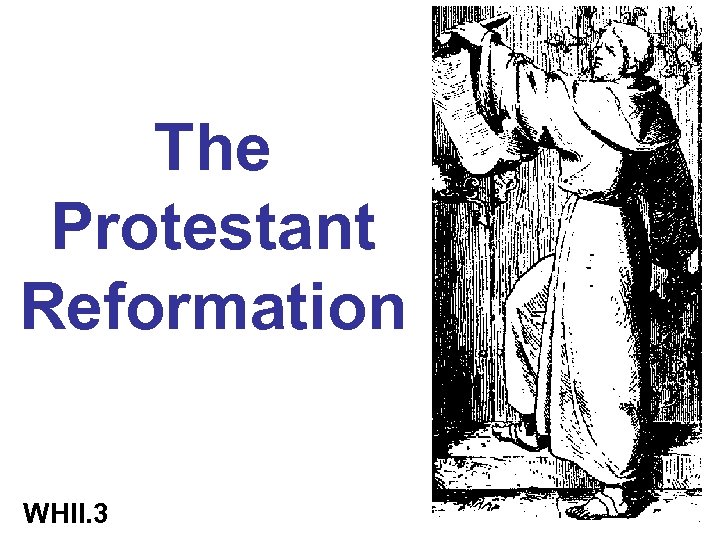 The Protestant Reformation WHII. 3
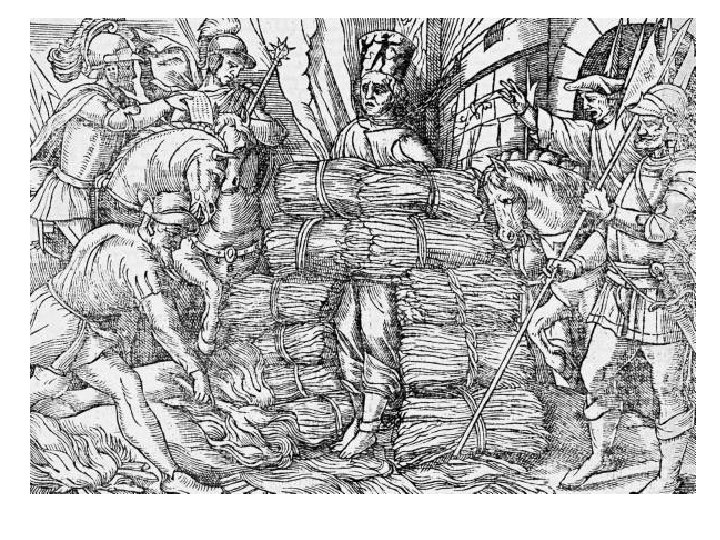
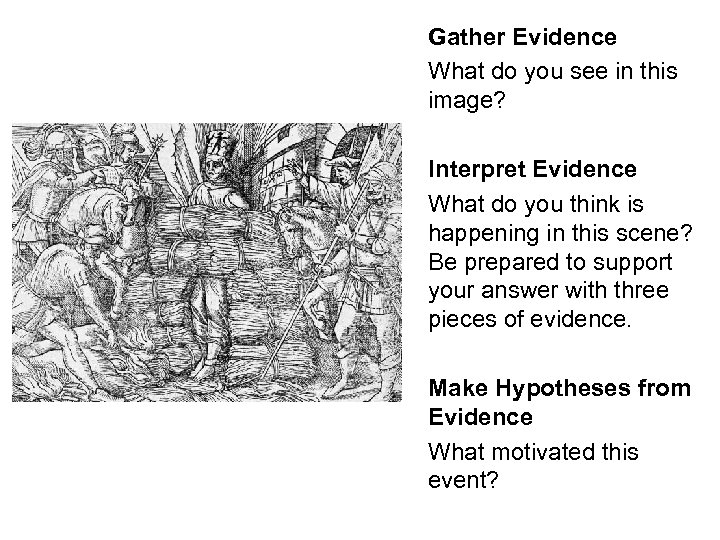 Gather Evidence What do you see in this image? Interpret Evidence What do you think is happening in this scene? Be prepared to support your answer with three pieces of evidence. Make Hypotheses from Evidence What motivated this event?
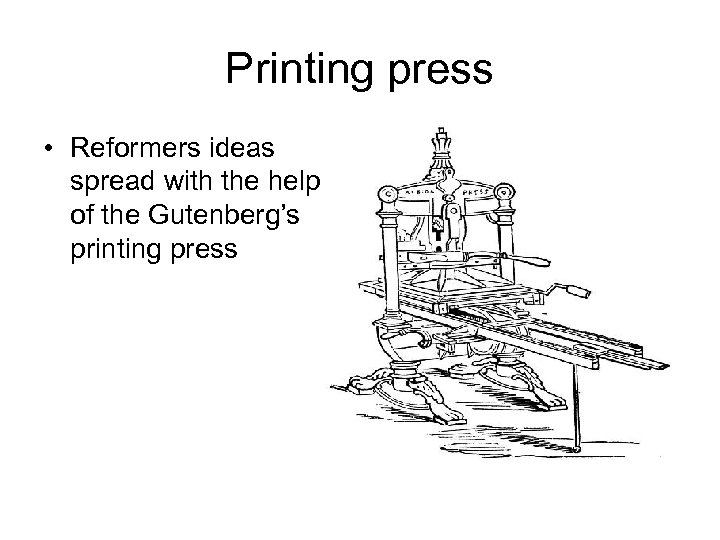 Printing press • Reformers ideas spread with the help of the Gutenberg’s printing press
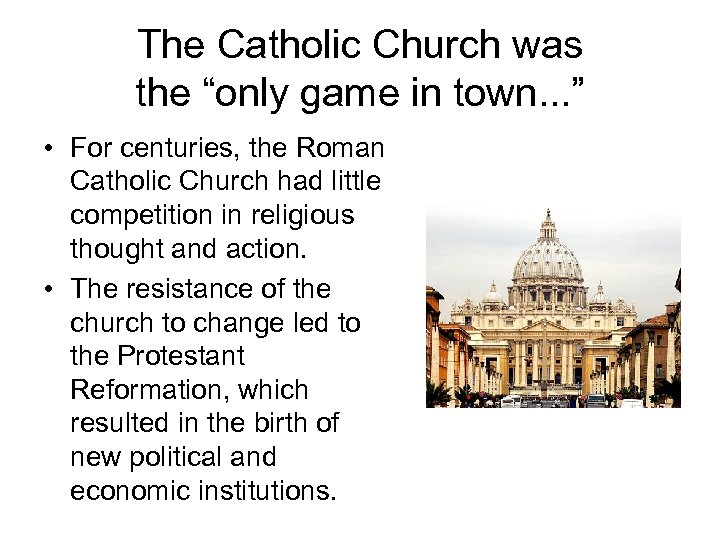 The Catholic Church was the “only game in town. . . ” • For centuries, the Roman Catholic Church had little competition in religious thought and action. • The resistance of the church to change led to the Protestant Reformation, which resulted in the birth of new political and economic institutions.
 Problems and issues provoked religious reforms: • Merchant wealth challenged the Church’s view of usury. • German and English nobility disliked Italian domination of the Church. • The Church’s great political power and wealth caused conflict. • Church corruption and the sale of indulgences were widespread and caused conflict.
 Merchant wealth challenged the Church’s view of usury • Usury = the lending of money with an interest charge for its use New Auto Loans Used Auto Loans • Get pre-approved for auto financing • Auto loan response in minutes • Free 45 -day rate lock • Lock in a low APR before you buy • Fast, free online auto loan application • Find car dealers near you. New auto loan rates as low as 4. 79% APR* Used auto loan rates as low as 5. 59% APR*
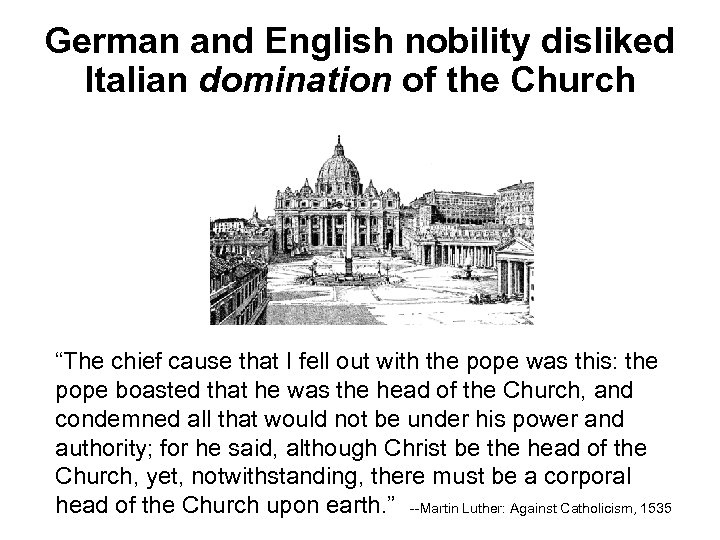 German and English nobility disliked Italian domination of the Church “The chief cause that I fell out with the pope was this: the pope boasted that he was the head of the Church, and condemned all that would not be under his power and authority; for he said, although Christ be the head of the Church, yet, notwithstanding, there must be a corporal head of the Church upon earth. ” --Martin Luther: Against Catholicism, 1535
 The Church’s great political power and wealth caused conflict. "As the Church gradually acquired a disproportionate share of the wealth of Europe, not only in lands but in money, it became more oftener a lender of money than a borrower and it had little difficulty in evading the prohibition of usury in the profitable employment of its capital. It would make loans to a needy noble on the security of his lands, taking a so-called census or ground-rent of one mark for every ten or twelve or fourteen paid down, the borrower being at any time entitled to pay off the debt, while the lender renounced the right to call it in. ” (H. C. Lea, Ecclesiastical Treatment of Usury).
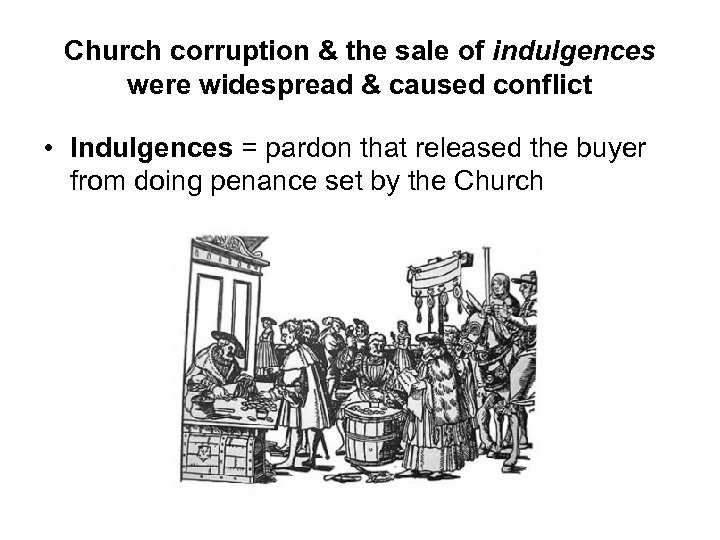 Church corruption & the sale of indulgences were widespread & caused conflict • Indulgences = pardon that released the buyer from doing penance set by the Church

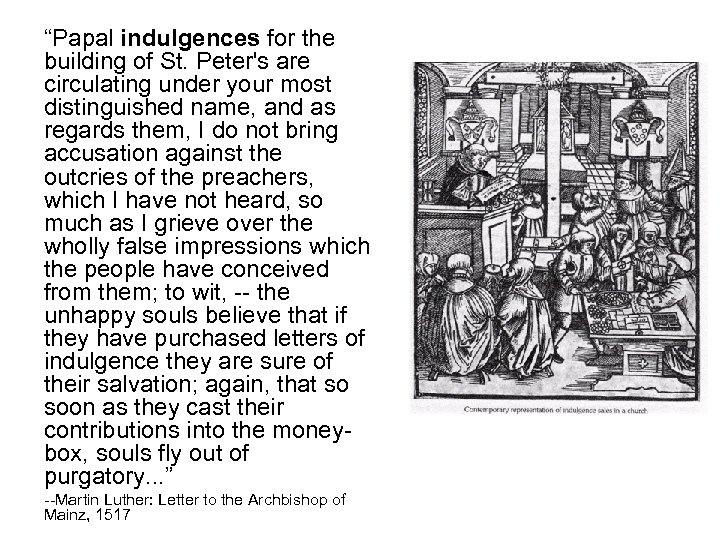 “Papal indulgences for the building of St. Peter's are circulating under your most distinguished name, and as regards them, I do not bring accusation against the outcries of the preachers, which I have not heard, so much as I grieve over the wholly false impressions which the people have conceived from them; to wit, -- the unhappy souls believe that if they have purchased letters of indulgence they are sure of their salvation; again, that so soon as they cast their contributions into the moneybox, souls fly out of purgatory. . . ” --Martin Luther: Letter to the Archbishop of Mainz, 1517
 Conflicts that challenged the authority of the Church in Rome QUICK DRAWS - create symbols to represent each of the conflicts – Usury; – Domination of the Church; – Church’s great political power and wealth; – Indulgences.
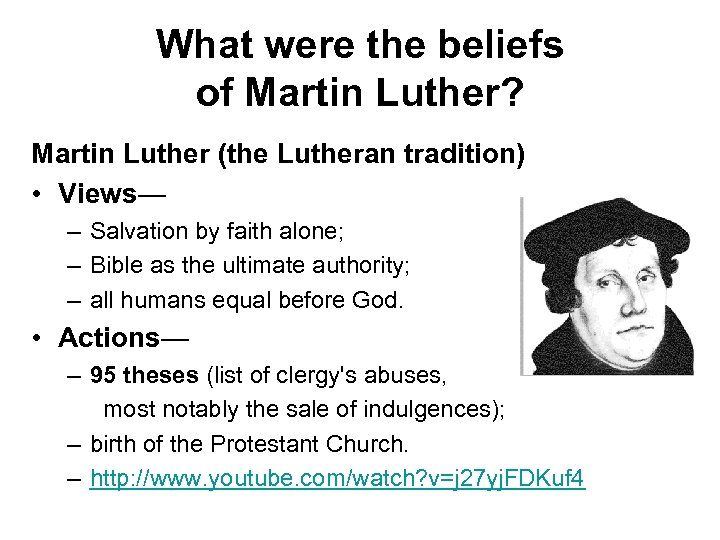 What were the beliefs of Martin Luther? Martin Luther (the Lutheran tradition) • Views— – Salvation by faith alone; – Bible as the ultimate authority; – all humans equal before God. • Actions— – 95 theses (list of clergy's abuses, most notably the sale of indulgences); – birth of the Protestant Church. – http: //www. youtube. com/watch? v=j 27 yj. FDKuf 4

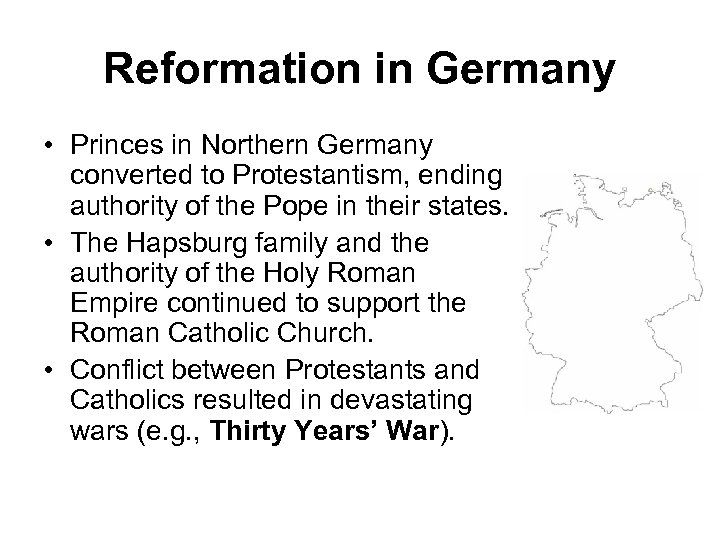 Reformation in Germany • Princes in Northern Germany converted to Protestantism, ending authority of the Pope in their states. • The Hapsburg family and the authority of the Holy Roman Empire continued to support the Roman Catholic Church. • Conflict between Protestants and Catholics resulted in devastating wars (e. g. , Thirty Years’ War).
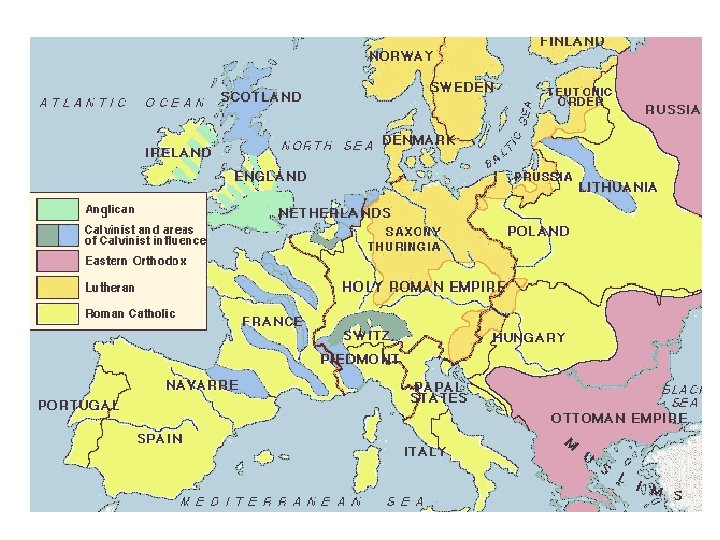
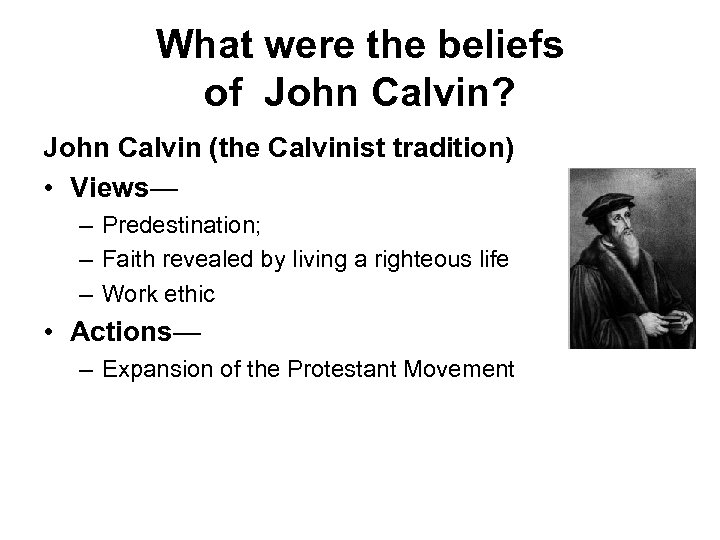 What were the beliefs of John Calvin? John Calvin (the Calvinist tradition) • Views— – Predestination; – Faith revealed by living a righteous life – Work ethic • Actions— – Expansion of the Protestant Movement

 Predestination “We call God’s eternal decree, by which He determined what He willed to become of each man. For all are not created in equal condition; rather eternal life is ordained for some, eternal damnation for others. --John Calvin’s Institutes
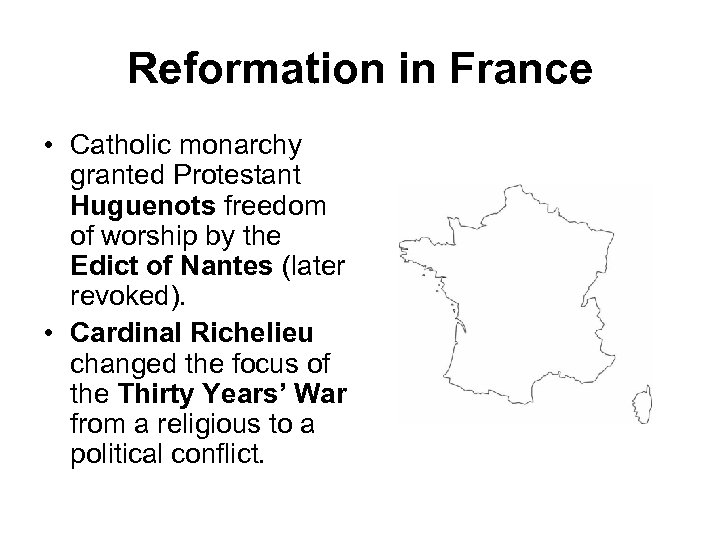 Reformation in France • Catholic monarchy granted Protestant Huguenots freedom of worship by the Edict of Nantes (later revoked). • Cardinal Richelieu changed the focus of the Thirty Years’ War from a religious to a political conflict.
 Religious Toleration in France Edict of Nantes: “. . . we have permitted and do permit to those of the Reformed Religion, to live and dwell in all the Cities and places of this our Kingdom and Countreys under our obedience, without being inquired after, vexed, molested, or compelled to do any thing in Religion, contrary to their Conscience, nor by reason of the same be searched after in houses or places where they live, they comporting themselves in other things as is contained in this our present Edict or Statute. ”
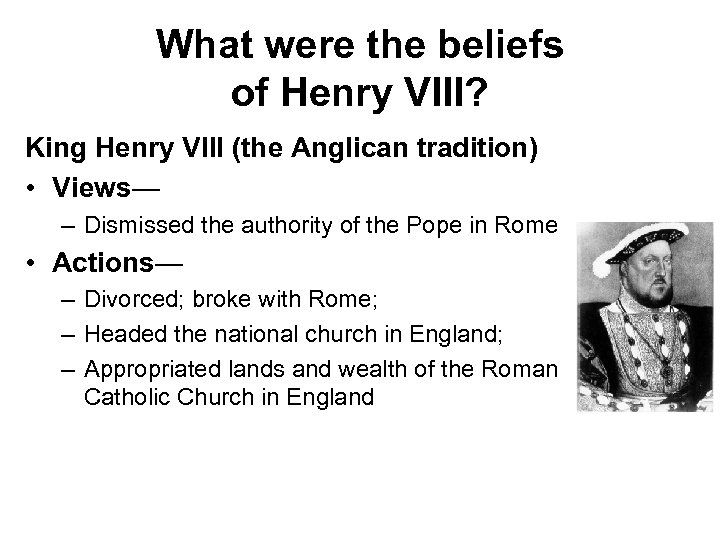 What were the beliefs of Henry VIII? King Henry VIII (the Anglican tradition) • Views— – Dismissed the authority of the Pope in Rome • Actions— – Divorced; broke with Rome; – Headed the national church in England; – Appropriated lands and wealth of the Roman Catholic Church in England

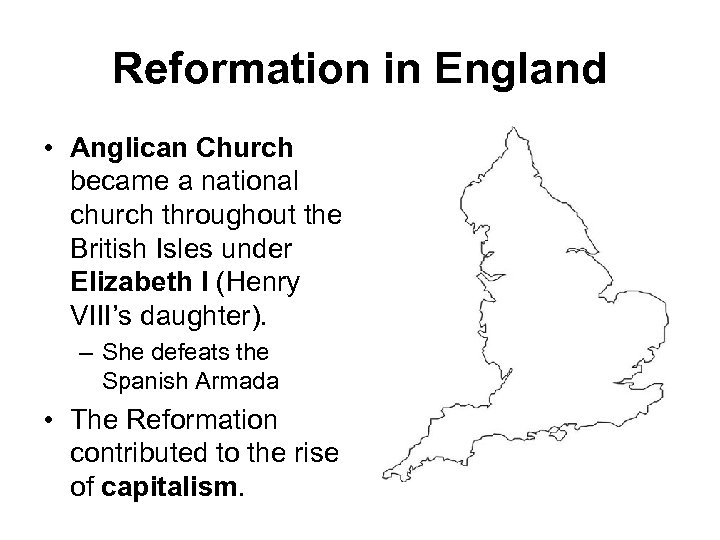 Reformation in England • Anglican Church became a national church throughout the British Isles under Elizabeth I (Henry VIII’s daughter). – She defeats the Spanish Armada • The Reformation contributed to the rise of capitalism.
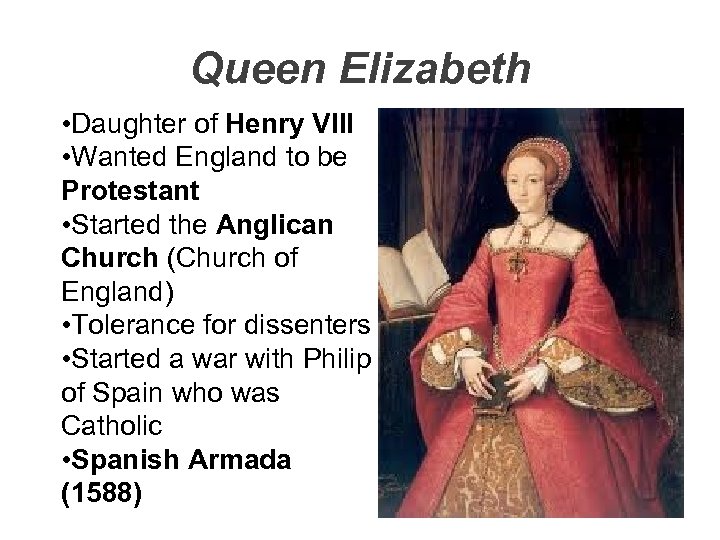 Queen Elizabeth • Daughter of Henry VIII • Wanted England to be Protestant • Started the Anglican Church (Church of England) • Tolerance for dissenters • Started a war with Philip of Spain who was Catholic • Spanish Armada (1588)
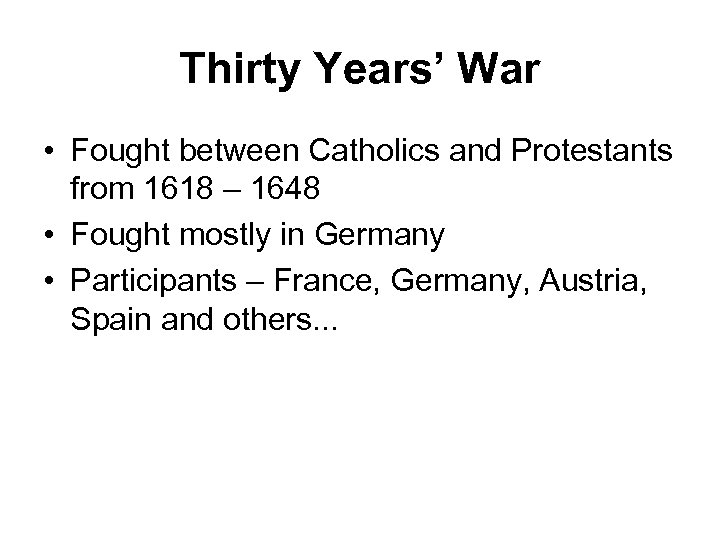 Thirty Years’ War • Fought between Catholics and Protestants from 1618 – 1648 • Fought mostly in Germany • Participants – France, Germany, Austria, Spain and others. . .
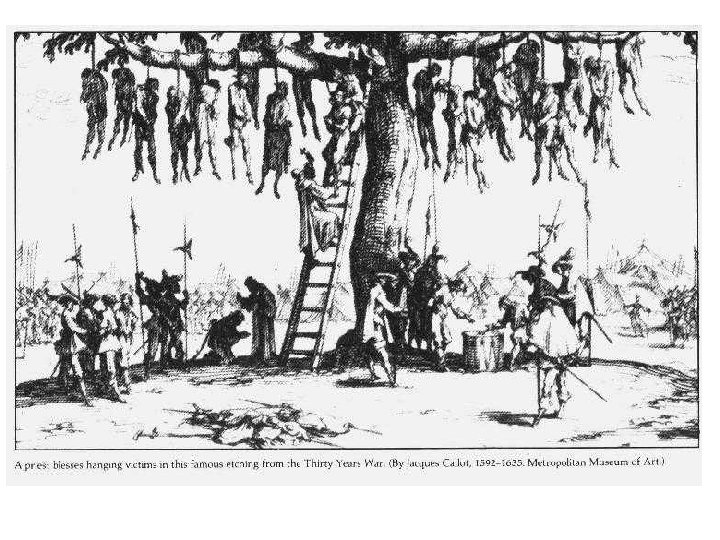
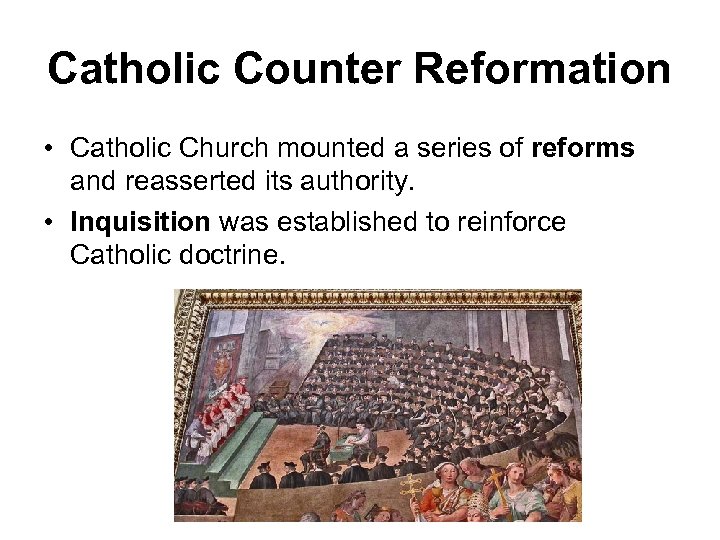 Catholic Counter Reformation • Catholic Church mounted a series of reforms and reasserted its authority. • Inquisition was established to reinforce Catholic doctrine.

 Some Catholic Reforms. . . Decree Concerning Indulgences “And being desirous that the abuses which have crept therein, and by occasion of which this honourable name of Indulgences is blasphemed by heretics, be amended and corrected, It ordains generally by this decree, that all evil gains for the obtaining thereof, --whence a most prolific cause of abuses amongst the Christian people has been derived, --be wholly abolished. ” DECREE ON REFORMATION -- CHAPTER I Cardinals and all Prelates of the churches shall be content with modest furniture and a frugal table: they shall not enrich their relatives or domestics out of the property of the Church.
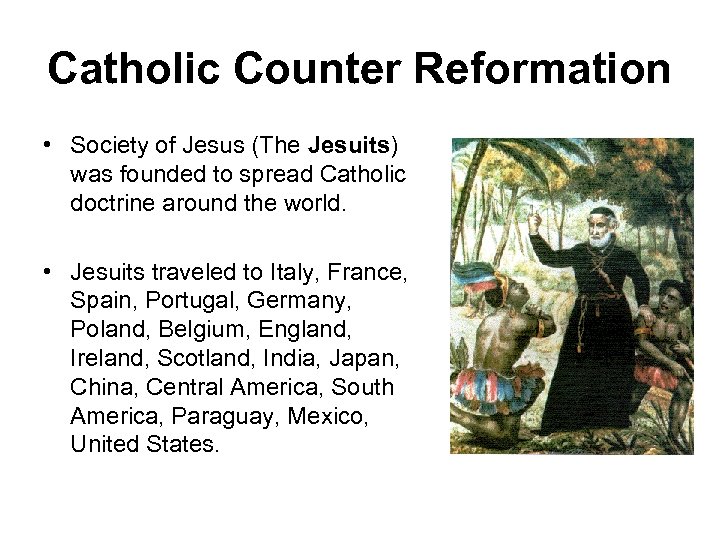 Catholic Counter Reformation • Society of Jesus (The Jesuits) was founded to spread Catholic doctrine around the world. • Jesuits traveled to Italy, France, Spain, Portugal, Germany, Poland, Belgium, England, Ireland, Scotland, India, Japan, China, Central America, South America, Paraguay, Mexico, United States.
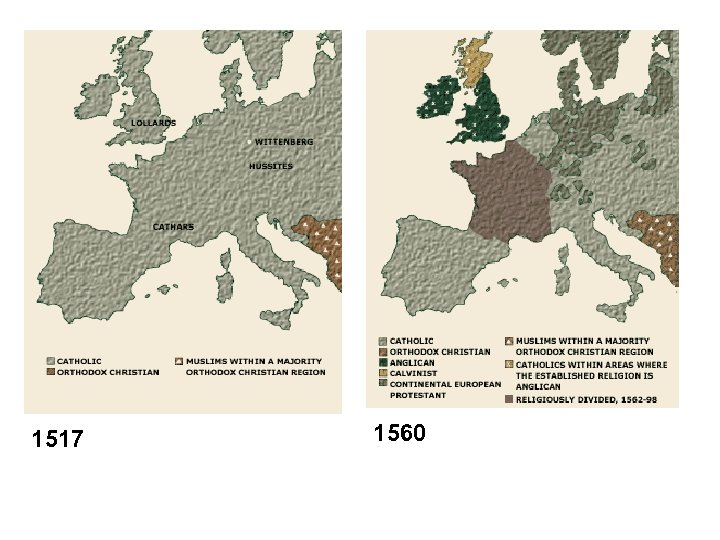 1517 1560
 Impacts of the Reformation • At first the Reformation divided the countries of Europe on religious principles, leading to religious intolerance. • Power in most European states was concentrated in the monarch. • Gradually religious toleration emerged, along with democratic thought.
 Changing cultural values, traditions, and philosophies • Growth of secularism - worldly ideas or ideas that are not regarded as religious • Growth of individualism – the idea that the interests of the individual should take precedence over religious interests (for example, the painting of portraits) • Growth of religious tolerance – a fair attitude towards those of different religion, race, nationality, etc. (for example, the Edict of Nantes)
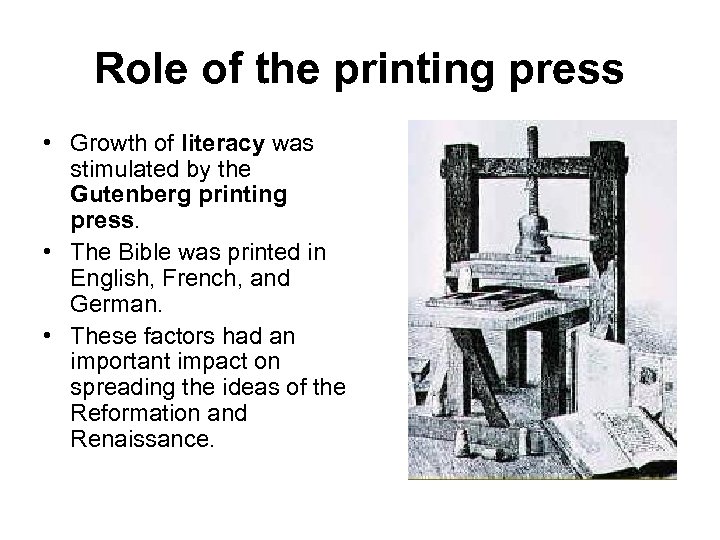 Role of the printing press • Growth of literacy was stimulated by the Gutenberg printing press. • The Bible was printed in English, French, and German. • These factors had an important impact on spreading the ideas of the Reformation and Renaissance.

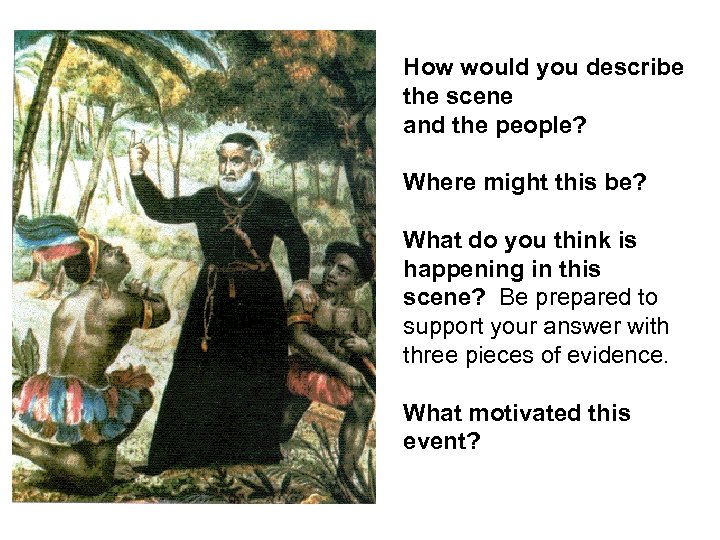 How would you describe the scene and the people? Where might this be? What do you think is happening in this scene? Be prepared to support your answer with three pieces of evidence. What motivated this event?