 Скачать презентацию The Pros and Cons of President Bush s 2
d17a2d5557667f7cc8d9607555bbb7a0.ppt
- Количество слайдов: 29



The Pros and Cons of President Bush's 2 nd Term: Prescribing Private Solutions for the Nation's Healthcare Problems Healthcare Visions, Inc. Creating the Possible… Ronald E. Bachman FSA. MAAA President & CEO Healthcare Visions, Inc. 404 -697 -7376 ronbachman@healthcarevisions. net www. healthcarevisions. net Sr. Fellow - Center for Health Transformation Sr. Fellow - Georgia Public Policy Foundation Fellow - Wye River Group on Health
The Ownership Society 2 nd Term Agenda Theme – The Ownership Society n. Home Ownership n. Business Ownership n. Pension Ownership n. Social Security Ownership n. Healthcare Ownership 1
The President’s Stated Agenda Healthcare – a Part of the Ownership Society A market-based consumer-driven plan to address the problems of rising health care costs and the uninsured, which: n Makes health care coverage more affordable for Americans at all income levels; n Provides new coverage options, targeted to those who need it most -low-income children and families, employees of small businesses, and the self-employed; and n Provides real help to small businesses that are struggling with the high cost of health insurance. 2
Affordable Health Care for all Americans n Medical Liability Reform n Health Information Technology n Cross-state selling of Health Insurance Policies (Shadegg Bill) n Establish a health center in every poor county in America. 3
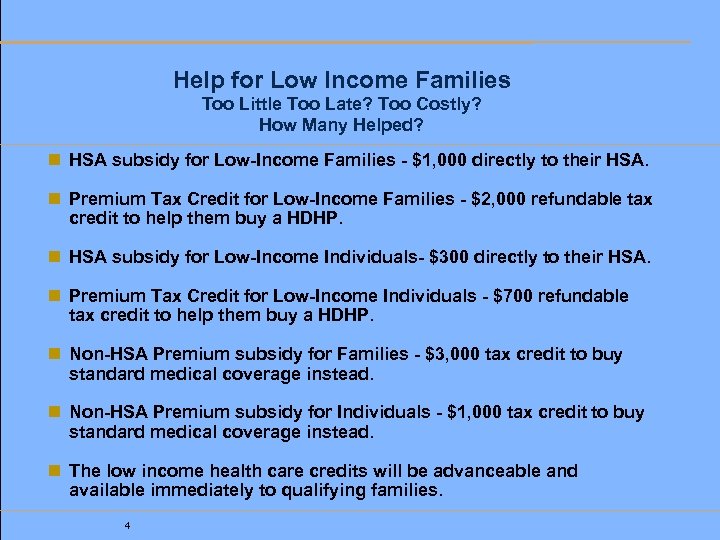
Help for Low Income Families Too Little Too Late? Too Costly? How Many Helped? n HSA subsidy for Low-Income Families - $1, 000 directly to their HSA. n Premium Tax Credit for Low-Income Families - $2, 000 refundable tax credit to help them buy a HDHP. n HSA subsidy for Low-Income Individuals- $300 directly to their HSA. n Premium Tax Credit for Low-Income Individuals - $700 refundable tax credit to help them buy a HDHP. n Non-HSA Premium subsidy for Families - $3, 000 tax credit to buy standard medical coverage instead. n Non-HSA Premium subsidy for Individuals - $1, 000 tax credit to buy standard medical coverage instead. n The low income health care credits will be advanceable and available immediately to qualifying families. 4
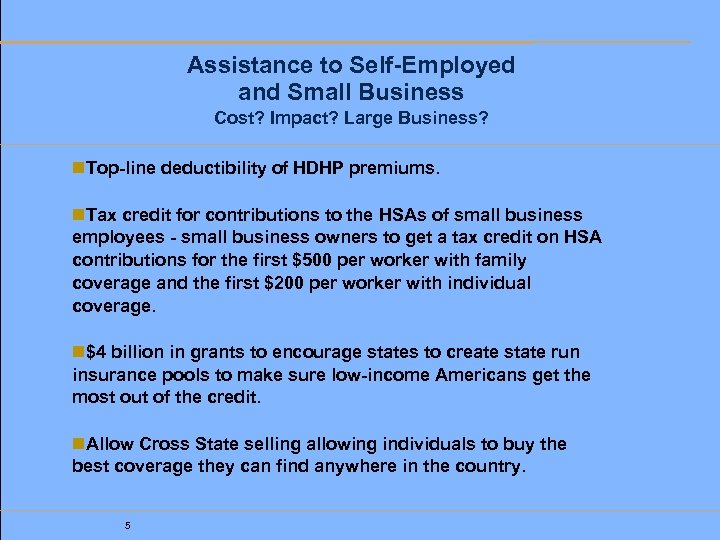
Assistance to Self-Employed and Small Business Cost? Impact? Large Business? n. Top-line deductibility of HDHP premiums. n. Tax credit for contributions to the HSAs of small business employees - small business owners to get a tax credit on HSA contributions for the first $500 per worker with family coverage and the first $200 per worker with individual coverage. n$4 billion in grants to encourage states to create state run insurance pools to make sure low-income Americans get the most out of the credit. n. Allow Cross State selling allowing individuals to buy the best coverage they can find anywhere in the country. 5
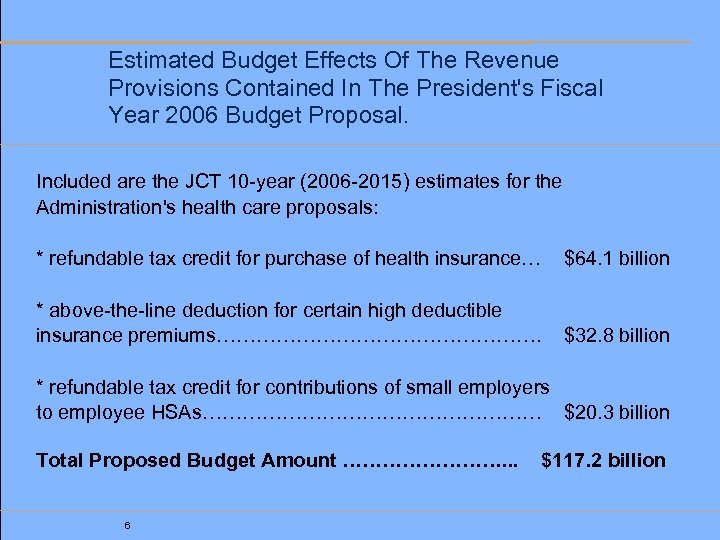
Estimated Budget Effects Of The Revenue Provisions Contained In The President's Fiscal Year 2006 Budget Proposal. Included are the JCT 10 -year (2006 -2015) estimates for the Administration's health care proposals: * refundable tax credit for purchase of health insurance… $64. 1 billion * above-the-line deduction for certain high deductible insurance premiums……………………. $32. 8 billion * refundable tax credit for contributions of small employers to employee HSAs……………………… $20. 3 billion Total Proposed Budget Amount …………. . . $117. 2 billion 6
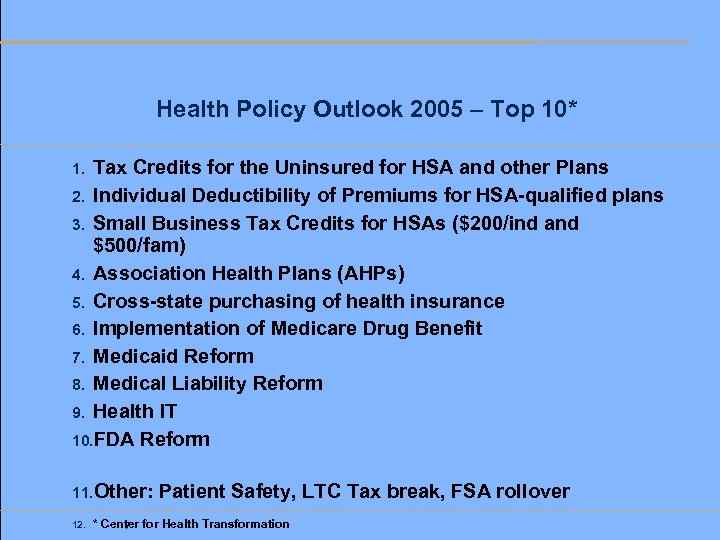
Health Policy Outlook 2005 – Top 10* Tax Credits for the Uninsured for HSA and other Plans 2. Individual Deductibility of Premiums for HSA-qualified plans 3. Small Business Tax Credits for HSAs ($200/ind and $500/fam) 4. Association Health Plans (AHPs) 5. Cross-state purchasing of health insurance 6. Implementation of Medicare Drug Benefit 7. Medicaid Reform 8. Medical Liability Reform 9. Health IT 10. FDA Reform 1. 11. Other: Patient Safety, LTC Tax break, FSA rollover 12. * Center for Health Transformation 7
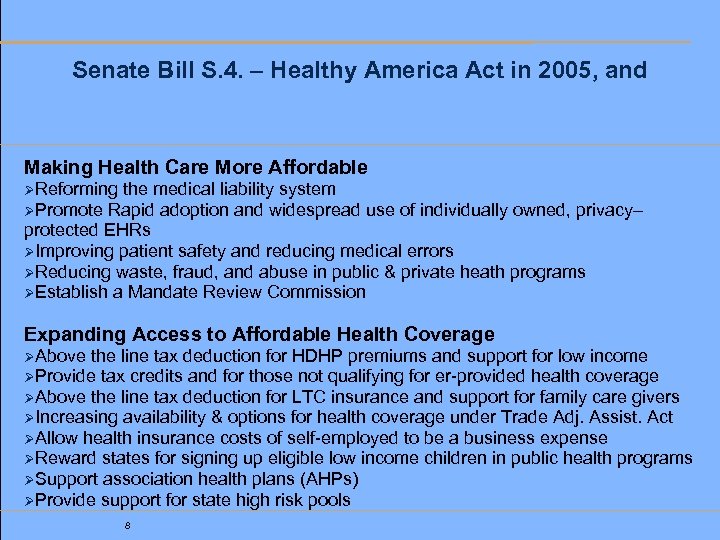
Senate Bill S. 4. – Healthy America Act in 2005, and Making Health Care More Affordable ØReforming the medical liability system ØPromote Rapid adoption and widespread use of individually owned, privacy– protected EHRs ØImproving patient safety and reducing medical errors ØReducing waste, fraud, and abuse in public & private heath programs ØEstablish a Mandate Review Commission Expanding Access to Affordable Health Coverage ØAbove the line tax deduction for HDHP premiums and support for low income ØProvide tax credits and for those not qualifying for er-provided health coverage ØAbove the line tax deduction for LTC insurance and support for family care givers ØIncreasing availability & options for health coverage under Trade Adj. Assist. Act ØAllow health insurance costs of self-employed to be a business expense ØReward states for signing up eligible low income children in public health programs ØSupport association health plans (AHPs) ØProvide support for state high risk pools 8
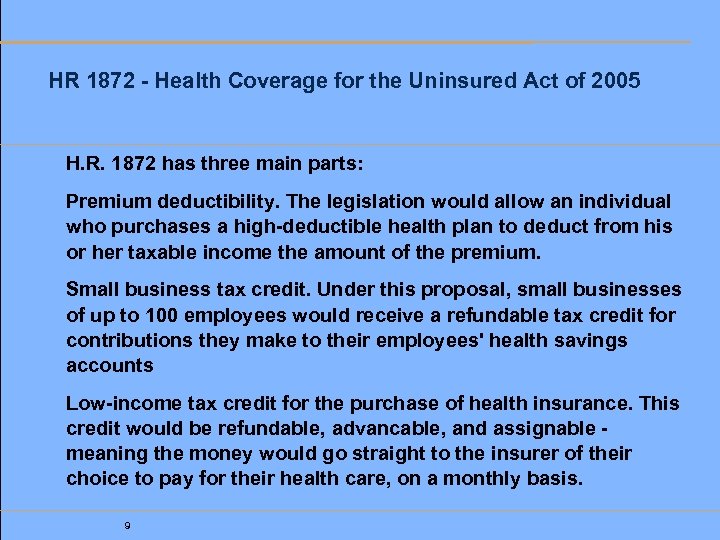
HR 1872 - Health Coverage for the Uninsured Act of 2005 H. R. 1872 has three main parts: Premium deductibility. The legislation would allow an individual who purchases a high-deductible health plan to deduct from his or her taxable income the amount of the premium. Small business tax credit. Under this proposal, small businesses of up to 100 employees would receive a refundable tax credit for contributions they make to their employees' health savings accounts Low-income tax credit for the purchase of health insurance. This credit would be refundable, advancable, and assignable - meaning the money would go straight to the insurer of their choice to pay for their health care, on a monthly basis. 9
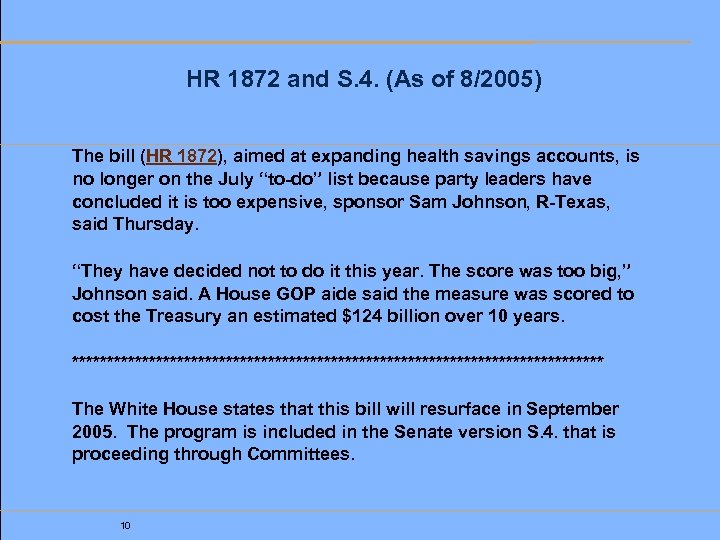
HR 1872 and S. 4. (As of 8/2005) The bill (HR 1872), aimed at expanding health savings accounts, is no longer on the July “to-do” list because party leaders have concluded it is too expensive, sponsor Sam Johnson, R-Texas, said Thursday. “They have decided not to do it this year. The score was too big, ” Johnson said. A House GOP aide said the measure was scored to cost the Treasury an estimated $124 billion over 10 years. ************************************** The White House states that this bill will resurface in September 2005. The program is included in the Senate version S. 4. that is proceeding through Committees. 10
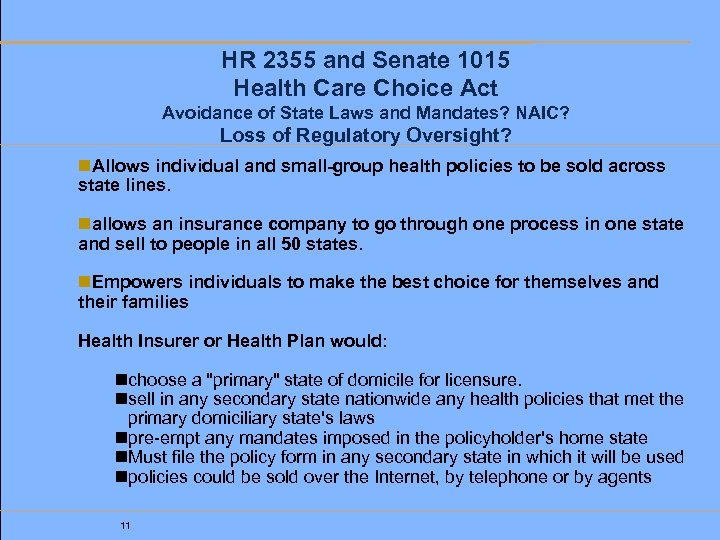
HR 2355 and Senate 1015 Health Care Choice Act Avoidance of State Laws and Mandates? NAIC? Loss of Regulatory Oversight? n. Allows individual and small-group health policies to be sold across state lines. nallows an insurance company to go through one process in one state and sell to people in all 50 states. n. Empowers individuals to make the best choice for themselves and their families Health Insurer or Health Plan would: nchoose a "primary" state of domicile for licensure. nsell in any secondary state nationwide any health policies that met the primary domiciliary state's laws npre-empt any mandates imposed in the policyholder's home state n. Must file the policy form in any secondary state in which it will be used npolicies could be sold over the Internet, by telephone or by agents 11
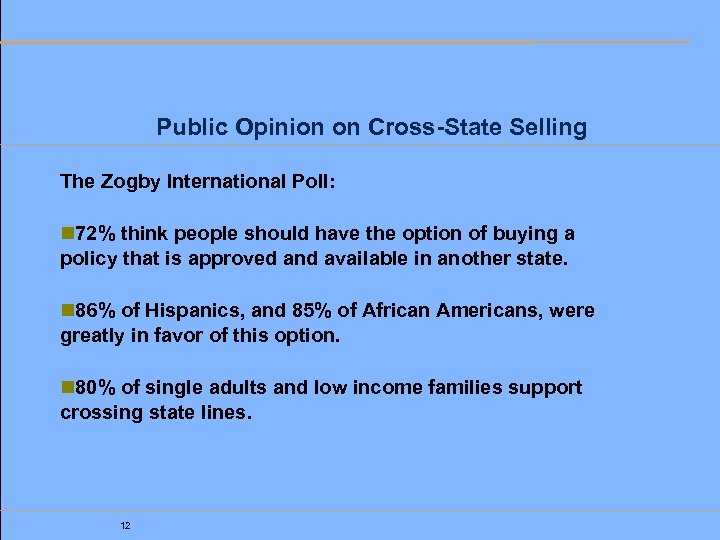
Public Opinion on Cross-State Selling The Zogby International Poll: n 72% think people should have the option of buying a policy that is approved and available in another state. n 86% of Hispanics, and 85% of African Americans, were greatly in favor of this option. n 80% of single adults and low income families support crossing state lines. 12
Basic Principles 1. Personal Responsibility 2. Self-Help, Self-Care 3. Individual Ownership 4. Portability 5. Transparency (the Right to Know) 6. Consumerism (Empowerment) 13
Healthcare Consumerism is about transforming a health benefit plan into one that puts economic purchasing power—and decision-making—in the hands of participants. It’s about supplying the information and decision support tools they need, along with financial incentives, rewards, and other benefits that encourage personal involvement in altering health and healthcare purchasing behaviors. 14
What Is a 21 st Century Intelligent Health System? In a 21 st Century Intelligent Health System, the individual has: n n Accurate, timely knowledge of personal health needs, Access to the best information about how to maintain personal health, Knowledge of whom to see and where to go for health services, And confidence that health providers are practicing medicine using best practices based on the most up-to-date understanding of outcomes-based medicine. In a 21 st Century Intelligent Health System, the individual has the right to know the price and quality information about health services in the most accurate, least expensive, and most convenient manner possible. In a 21 st Century Intelligent Health System, the individual is the center of knowledge and decision-making and has responsibility for his or her own health. 15
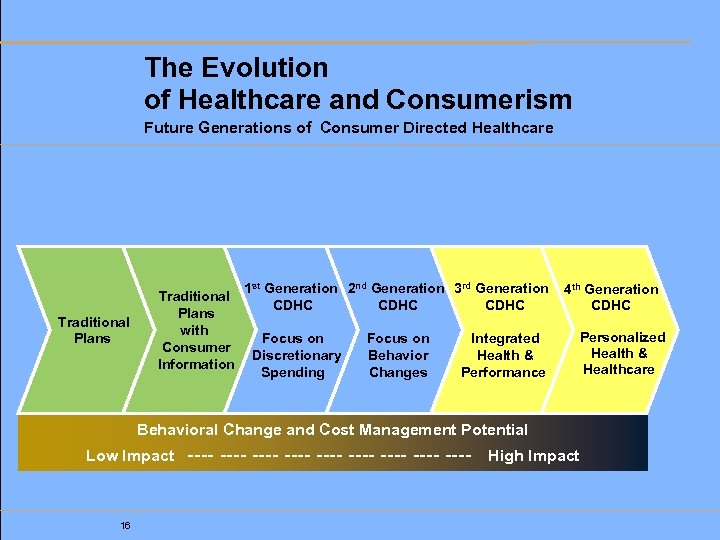
The Evolution of Healthcare and Consumerism Future Generations of Consumer Directed Healthcare Traditional Plans 1 st Generation 2 nd Generation 3 rd Generation Traditional CDHC Plans with Integrated Focus on Consumer Health & Discretionary Behavior Information Performance Spending Changes 4 th Generation CDHC Personalized Health & Healthcare Behavioral Change and Cost Management Potential Low Impact ---- ---- ---- High Impact 16
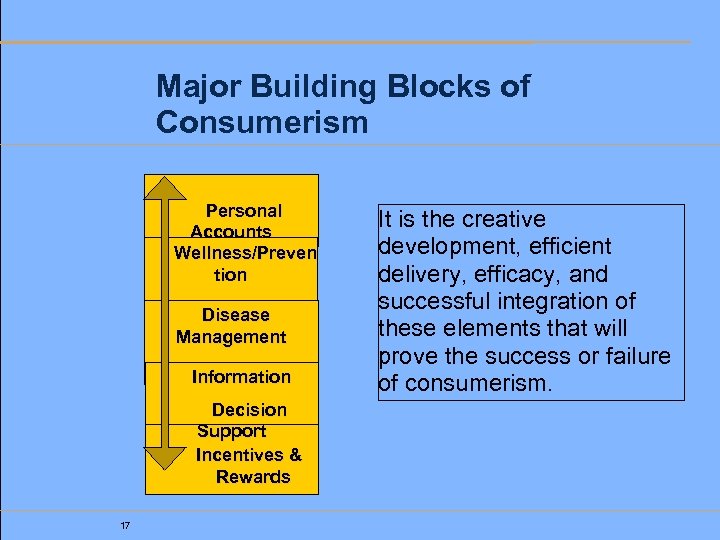
Major Building Blocks of Consumerism Personal Accounts Wellness/Preven tion Early Disease Intervention Management Information Decision Support Incentives & Rewards 17 It is the creative development, efficient delivery, efficacy, and successful integration of these elements that will prove the success or failure of consumerism.
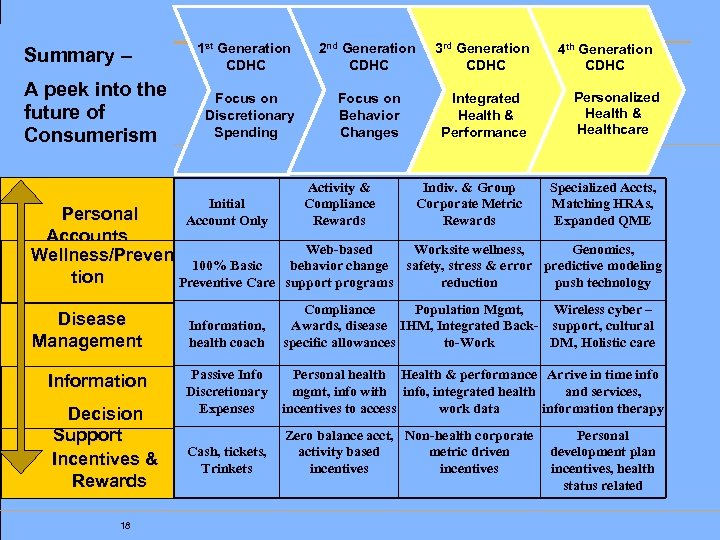
Summary – 1 st Generation CDHC 2 nd Generation CDHC 3 rd Generation CDHC 4 th Generation CDHC A peek into the future of Consumerism Focus on Discretionary Spending Focus on Behavior Changes Integrated Health & Performance Personalized Health & Healthcare Initial Personal Account Only Accounts Wellness/Preven 100% Basic tion Preventive Care Early Disease Intervention Management Information Decision Support Incentives & Rewards 18 Activity & Compliance Rewards Indiv. & Group Corporate Metric Rewards Specialized Accts, Matching HRAs, Expanded QME Web-based Worksite wellness, Genomics, behavior change safety, stress & error predictive modeling support programs reduction push technology Information, health coach Compliance Population Mgmt, Wireless cyber – Awards, disease IHM, Integrated Back- support, cultural specific allowances to-Work DM, Holistic care Passive Info Discretionary Expenses Personal health Health & performance Arrive in time info mgmt, info with info, integrated health and services, incentives to access work data information therapy Cash, tickets, Trinkets Zero balance acct, Non-health corporate activity based metric driven incentives Personal development plan incentives, health status related
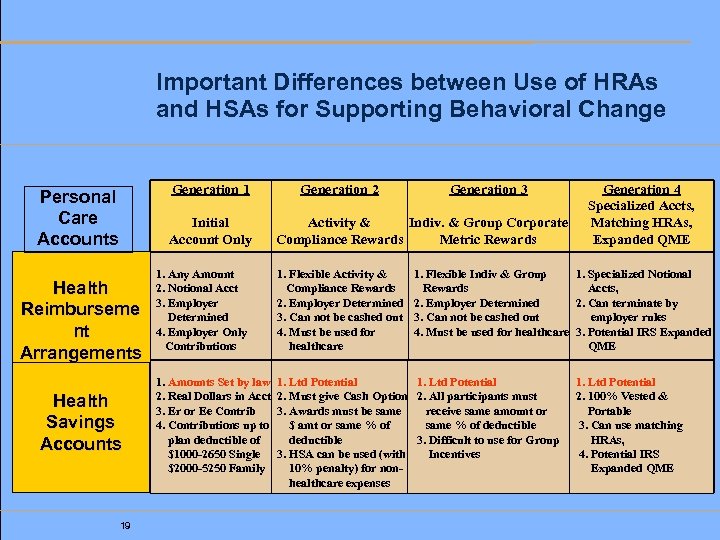
Important Differences between Use of HRAs and HSAs for Supporting Behavioral Change Personal Care Accounts Health Reimburseme nt Arrangements Health Savings Accounts 19 Generation 1 Initial Account Only Generation 2 Generation 3 Activity & Indiv. & Group Corporate Compliance Rewards Metric Rewards 1. Any Amount 2. Notional Acct 3. Employer Determined 4. Employer Only Contributions 1. Flexible Activity & Compliance Rewards 2. Employer Determined 3. Can not be cashed out 4. Must be used for healthcare 1. Amounts Set by law 2. Real Dollars in Acct 3. Er or Ee Contrib 4. Contributions up to plan deductible of $1000 -2650 Single $2000 -5250 Family 1. Ltd Potential 2. Must give Cash Option 2. All participants must 3. Awards must be same receive same amount or $ amt or same % of deductible 3. Difficult to use for Group 3. HSA can be used (with Incentives 10% penalty) for nonhealthcare expenses Generation 4 Specialized Accts, Matching HRAs, Expanded QME 1. Flexible Indiv & Group 1. Specialized Notional Rewards Accts, 2. Employer Determined 2. Can terminate by 3. Can not be cashed out employer rules 4. Must be used for healthcare 3. Potential IRS Expanded QME 1. Ltd Potential 2. 100% Vested & Portable 3. Can use matching HRAs, 4. Potential IRS Expanded QME
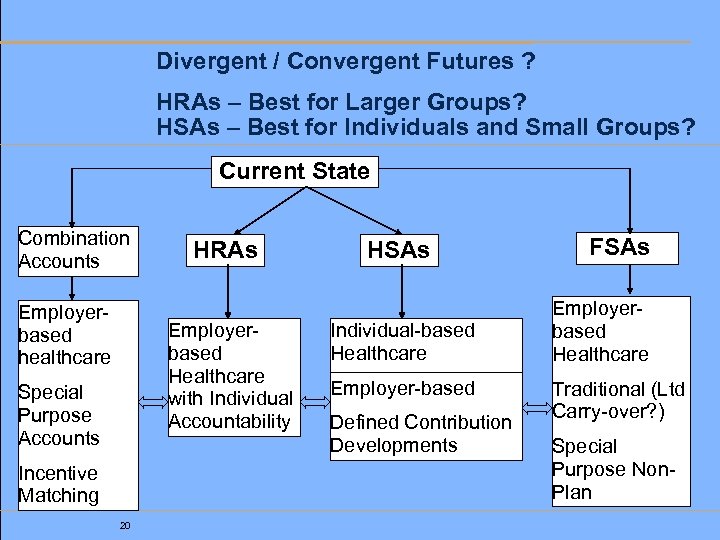
Divergent / Convergent Futures ? HRAs – Best for Larger Groups? HSAs – Best for Individuals and Small Groups? Current State Combination Accounts Employerbased healthcare HRAs Employerbased Healthcare with Individual Accountability Special Purpose Accounts Incentive Matching 20 HSAs Individual-based Healthcare Employer-based Defined Contribution Developments FSAs Employerbased Healthcare Traditional (Ltd Carry-over? ) Special Purpose Non. Plan
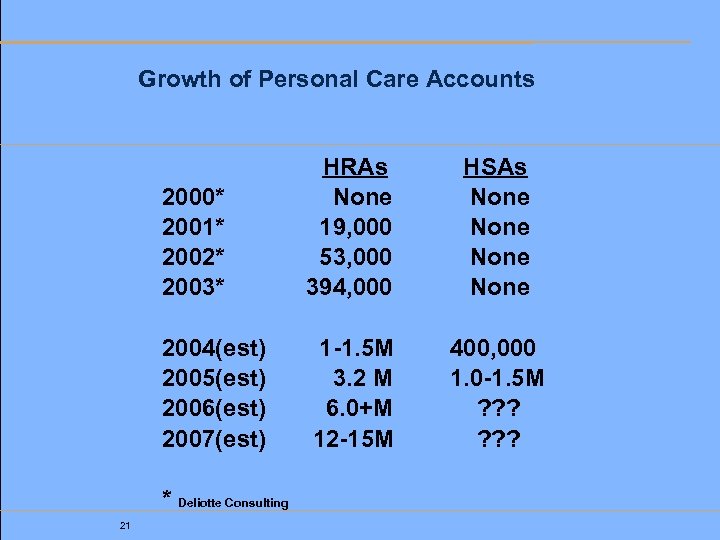
Growth of Personal Care Accounts HRAs 2000* 2001* 2002* 2003* None 19, 000 53, 000 394, 000 2004(est) 1 -1. 5 M 2005(est) 3. 2 M 2006(est) 6. 0+M 2007(est) 12 -15 M * Deliotte Consulting 21 HSAs None 400, 000 1. 0 -1. 5 M ? ? ?
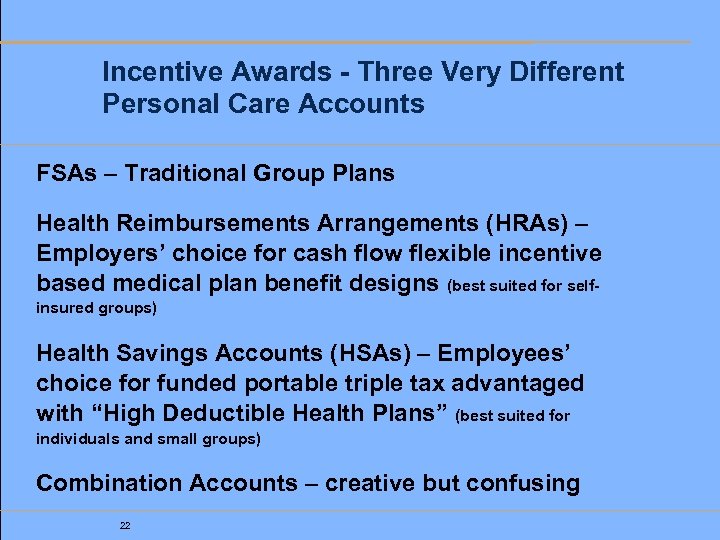
Incentive Awards - Three Very Different Personal Care Accounts FSAs – Traditional Group Plans Health Reimbursements Arrangements (HRAs) – Employers’ choice for cash flow flexible incentive based medical plan benefit designs (best suited for selfinsured groups) Health Savings Accounts (HSAs) – Employees’ choice for funded portable triple tax advantaged with “High Deductible Health Plans” (best suited for individuals and small groups) Combination Accounts – creative but confusing 22
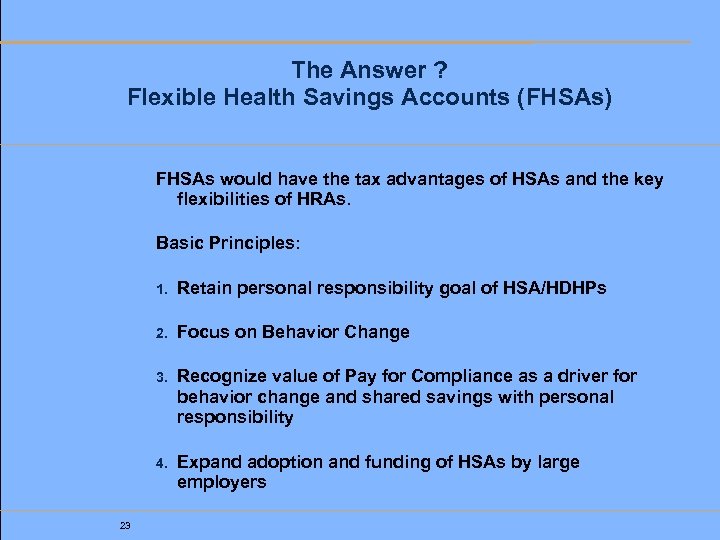
The Answer ? Flexible Health Savings Accounts (FHSAs) FHSAs would have the tax advantages of HSAs and the key flexibilities of HRAs. Basic Principles: 1. 2. Focus on Behavior Change 3. Recognize value of Pay for Compliance as a driver for behavior change and shared savings with personal responsibility 4. 23 Retain personal responsibility goal of HSA/HDHPs Expand adoption and funding of HSAs by large employers
Flexible Health Savings Accounts (FHSAs) The Next Generation Four needs that would allow FHSAs the flexibility to: 1. Provide financial Rewards and Incentives for Behavioral Change. 2. Encourage Employer/Carrier FHSA contributions towards healthcare 3. Be provided with plan designs other than HDHPs 4. Address FHSA/HSA Technical Issues 24

FHSA Flexibilty to Provide Financial Rewards and Incentives for Behavioral Change 1. Allow for compliance incentives under disease management programs (e. g. diabetes, asthma, CHF) and wellness initiatives (e. g. wellness assessments, smoking cessation, etc. ). 2. Change Comparability Rule to mean all members under a given program of care or treatment, such as, a disease management or wellness program. 3. Rewards and/or incentives should not be limited by the deductible limit, but should be consistent with expected savings from programs for which participation is being rewarded. 25
FHSA Flexibility to Encourage Employer Contributions to Healthcare 1. Allow employers/carriers to voluntarily contract with employees to require employer/carrier funded FHSAs to be used only for healthcare expenses while employed and covered under the plan. 2. Remove cap on employer/carrier funded FHSA contributions or expand to at least the plan’s Maximum Out-Of-Pocket total exposure in a given calendar year. 26
FHSAs Flexibility to be Provided with Plan Designs Other than HDHPs 1. Preventive drugs include maintenance drugs. Drugs now defined as preventive by the Treasury Dept. can be covered below the deductible, while the cost of maintenance drugs is now included in the deductible. 2. Allow Rx to exist as carve out benefits at least for prescription drugs associated with chronic and persistent disease states 3. Allow “incentive only based” FHSAs for employer/carrier only funding under non-HDHPs (i. e. no initial FHSA funding or employee funding) 4. Allow some mental health and substance abuse benefits (besides EAPs) to be included under preventive care. 27
FHSA Flexibility - Technical Issues 1. Allow FHSA/HSAs to go into effect on the first day of coverage is effective. 2. Allow FHSA/HSA contributions for a full calendar year regardless of when a plan is effective. 3. Allow FHSA/HSAs to be used to pay for health coverage premiums (other than current limited use for (1) Premiums for coverage under the Consolidated Omnibus Budget Reconciliation Act (COBRA), and (2) premiums for HDHP coverage for those who receive federal or state unemployment compensation). 4. Allow Flexibility to "post-date" the FHSA/HSA effective date so that FHSA/HSA dollars can cover expenses incurred before the account was established. Allow the account to be opened under a "provisional status" until the necessary paperwork is filed, at which time the account becomes active. 28
Скачать презентацию The Pros and Cons of President Bush s 2
d17a2d5557667f7cc8d9607555bbb7a0.ppt