 Скачать презентацию The Project for Shilla Duty-free 일본 관광객 증가에
0b8c921ab52256480606293b75689eb1.ppt
- Количество слайдов: 34



The Project for Shilla Duty-free 일본 관광객 증가에 따른 면세점 시장 내 경쟁우위 확보를 위한 신라면세점 마케팅 커뮤니케이션 전략 작품 번호 : PT 01 -0011 1
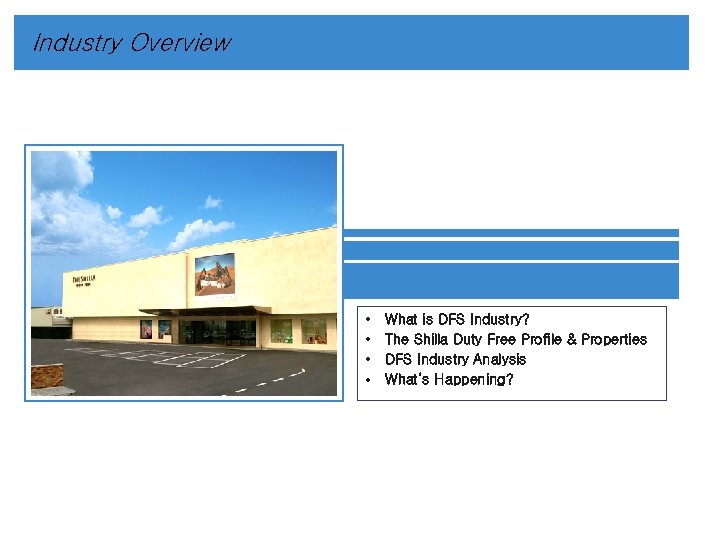
Industry Overview • • What is DFS Industry? The Shilla Duty Free Profile & Properties DFS Industry Analysis What’s Happening?
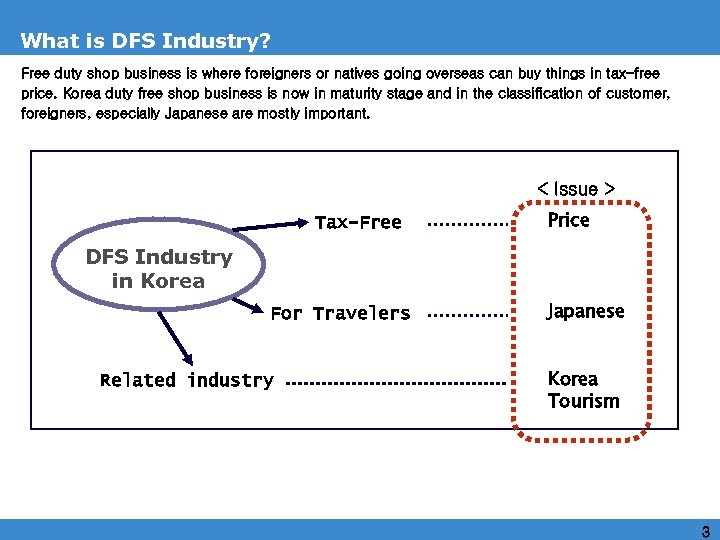
What is DFS Industry? Free duty shop business is where foreigners or natives going overseas can buy things in tax-free price. Korea duty free shop business is now in maturity stage and in the classification of customer, foreigners, especially Japanese are mostly important. < Issue > Tax-Free Price DFS Industry in Korea For Travelers Related industry Japanese Korea Tourism 3
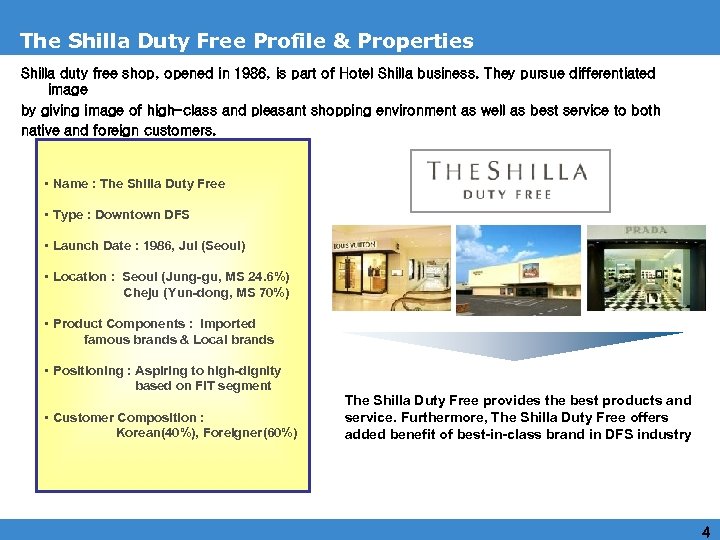
The Shilla Duty Free Profile & Properties Shilla duty free shop, opened in 1986, is part of Hotel Shilla business. They pursue differentiated image by giving image of high-class and pleasant shopping environment as well as best service to both native and foreign customers. • Name : The Shilla Duty Free • Type : Downtown DFS • Launch Date : 1986, Jul (Seoul) • Location : Seoul (Jung-gu, MS 24. 6%) Cheju (Yun-dong, MS 70%) • Product Components : Imported famous brands & Local brands • Positioning : Aspiring to high-dignity based on FIT segment • Customer Composition : Korean(40%), Foreigner(60%) The Shilla Duty Free provides the best products and service. Furthermore, The Shilla Duty Free offers added benefit of best-in-class brand in DFS industry 4
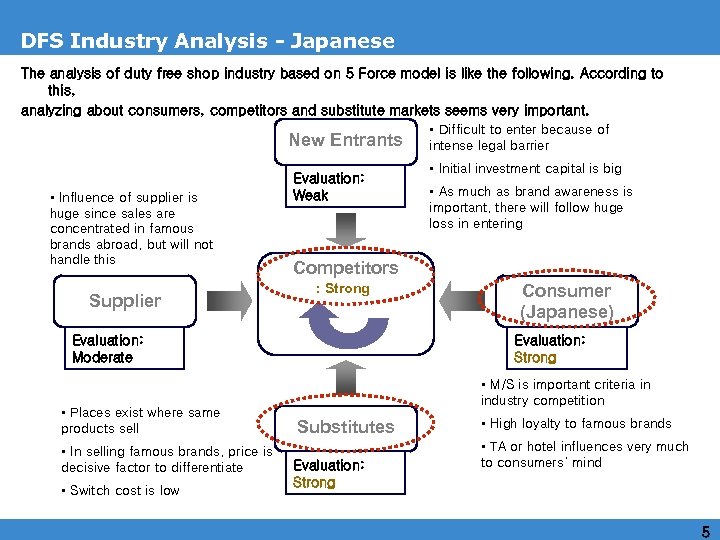
DFS Industry Analysis - Japanese The analysis of duty free shop industry based on 5 Force model is like the following. According to this, analyzing about consumers, competitors and substitute markets seems very important. • Difficult to enter because of New Entrants • Influence of supplier is huge since sales are concentrated in famous brands abroad, but will not handle this Supplier Evaluation: Weak • In selling famous brands, price is decisive factor to differentiate • Switch cost is low • Initial investment capital is big • As much as brand awareness is important, there will follow huge loss in entering Competitors : Strong Evaluation: Moderate • Places exist where same products sell intense legal barrier Consumer (Japanese) Evaluation: Strong • M/S is important criteria in industry competition Substitutes Evaluation: Strong • High loyalty to famous brands • TA or hotel influences very much to consumers’ mind 5
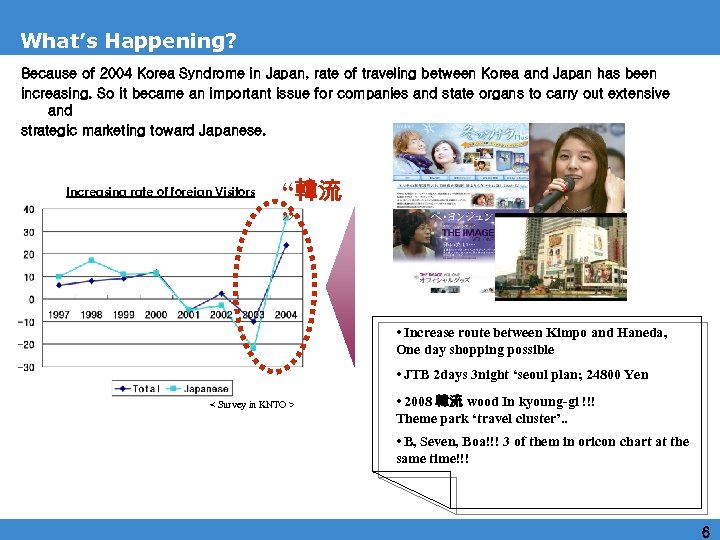
What’s Happening? Because of 2004 Korea Syndrome in Japan, rate of traveling between Korea and Japan has been increasing. So it became an important issue for companies and state organs to carry out extensive and strategic marketing toward Japanese. Increasing rate of foreign Visitors “韓流 ” • Increase route between Kimpo and Haneda, One day shopping possible • JTB 2 days 3 night ‘seoul plan; 24800 Yen < Survey in KNTO > • 2008 韓流 wood In kyoung-gi !!! Theme park ‘travel cluster’. . • B, Seven, Boa!!! 3 of them in oricon chart at the same time!!! 6
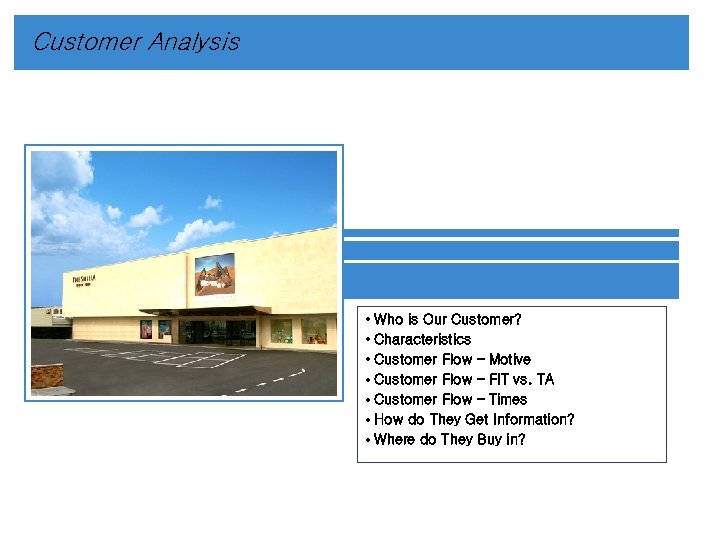
Customer Analysis • • Who is Our Customer? Characteristics Customer Flow – Motive Customer Flow – FIT vs. TA Customer Flow – Times How do They Get Information? Where do They Buy in?
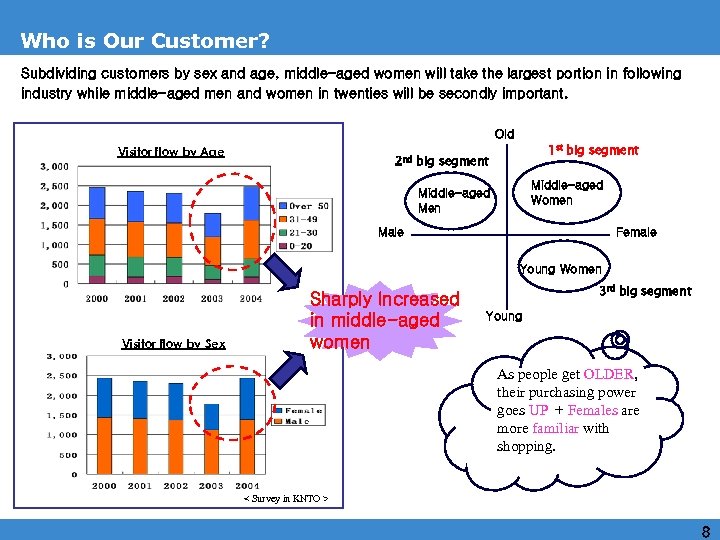
Who is Our Customer? Subdividing customers by sex and age, middle-aged women will take the largest portion in following industry while middle-aged men and women in twenties will be secondly important. Old Visitor flow by Age 2 nd 1 st big segment Middle-aged Women Middle-aged Men Male Female Young Women Visitor flow by Sex Sharply Increased in middle-aged women 3 rd big segment Young As people get OLDER, their purchasing power goes UP + Females are more familiar with shopping. < Survey in KNTO > 8
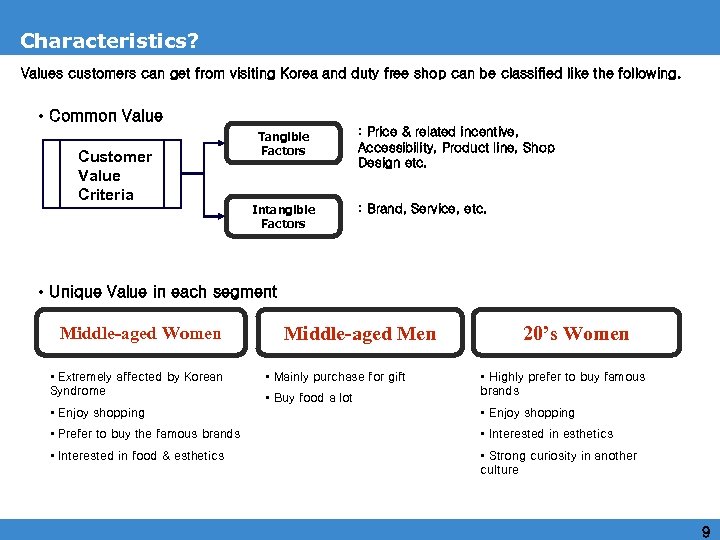
Characteristics? Values customers can get from visiting Korea and duty free shop can be classified like the following. • Common Value Customer Value Criteria Tangible Factors Intangible Factors : Price & related incentive, Accessibility, Product line, Shop Design etc. : Brand, Service, etc. • Unique Value in each segment Middle-aged Women • Extremely affected by Korean Syndrome Middle-aged Men • Mainly purchase for gift • Buy food a lot 20’s Women • Highly prefer to buy famous brands • Enjoy shopping • Prefer to buy the famous brands • Interested in esthetics • Interested in food & esthetics • Strong curiosity in another culture 9
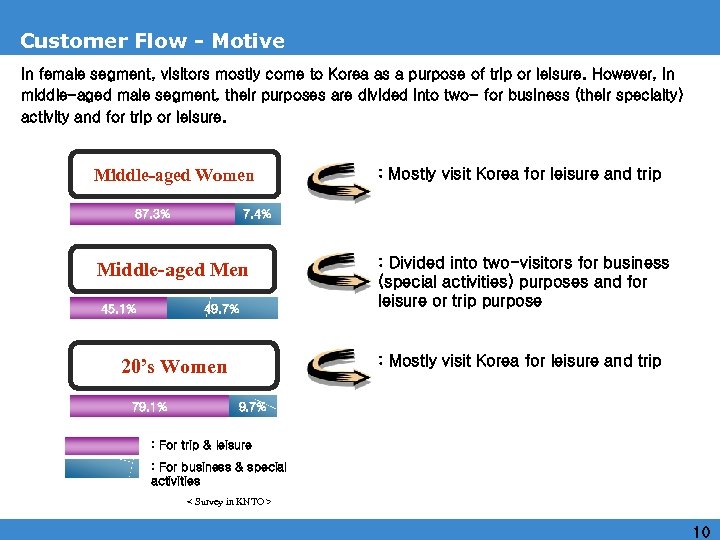
Customer Flow - Motive In female segment, visitors mostly come to Korea as a purpose of trip or leisure. However, in middle-aged male segment, their purposes are divided into two- for business (their specialty) activity and for trip or leisure. Middle-aged Women 87. 3% 7. 4% Middle-aged Men 45. 1% 49. 7% : Divided into two-visitors for business (special activities) purposes and for leisure or trip purpose : Mostly visit Korea for leisure and trip 20’s Women 79. 1% : Mostly visit Korea for leisure and trip 9. 7% : For trip & leisure : For business & special activities < Survey in KNTO > 10
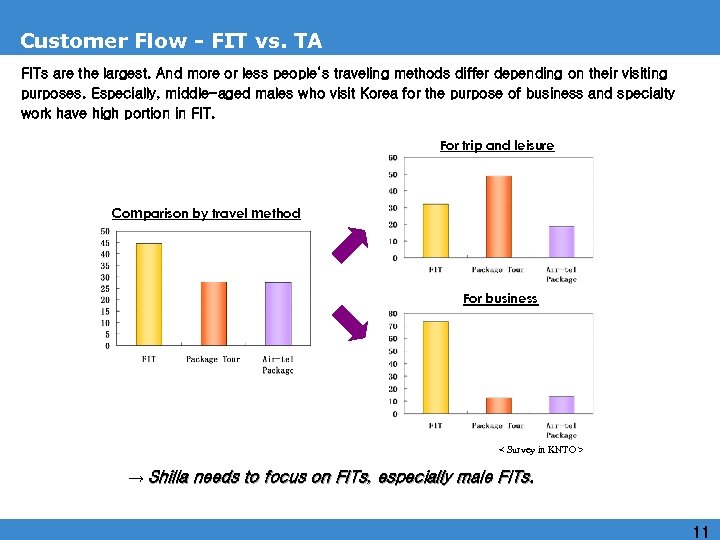
Customer Flow - FIT vs. TA FITs are the largest. And more or less people’s traveling methods differ depending on their visiting purposes. Especially, middle-aged males who visit Korea for the purpose of business and specialty work have high portion in FIT. For trip and leisure Comparison by travel method For business < Survey in KNTO > → Shilla needs to focus on FITs, especially male FITs. 11
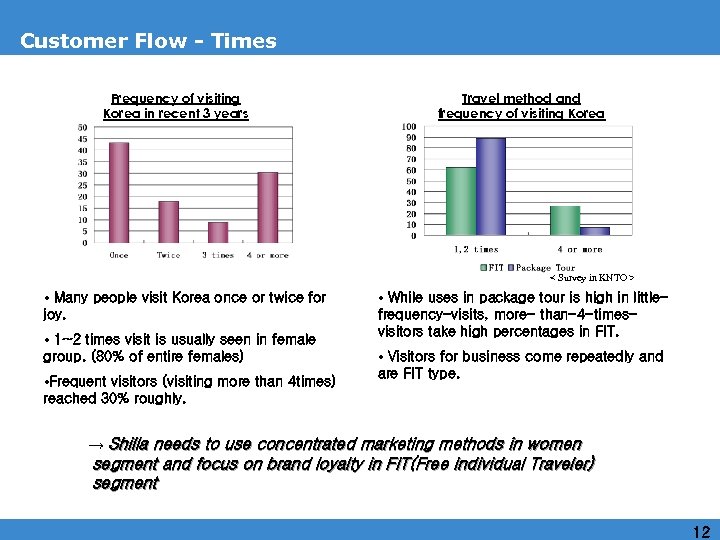
Customer Flow - Times Frequency of visiting Korea in recent 3 years Travel method and frequency of visiting Korea < Survey in KNTO > • Many people visit Korea once or twice for joy. • 1~2 times visit is usually seen in female group. (80% of entire females) • Frequent visitors (visiting more than 4 times) reached 30% roughly. • While uses in package tour is high in littlefrequency-visits, more- than-4 -timesvisitors take high percentages in FIT. • Visitors for business come repeatedly and are FIT type. → Shilla needs to use concentrated marketing methods in women segment and focus on brand loyalty in FIT(Free Individual Traveler) segment 12
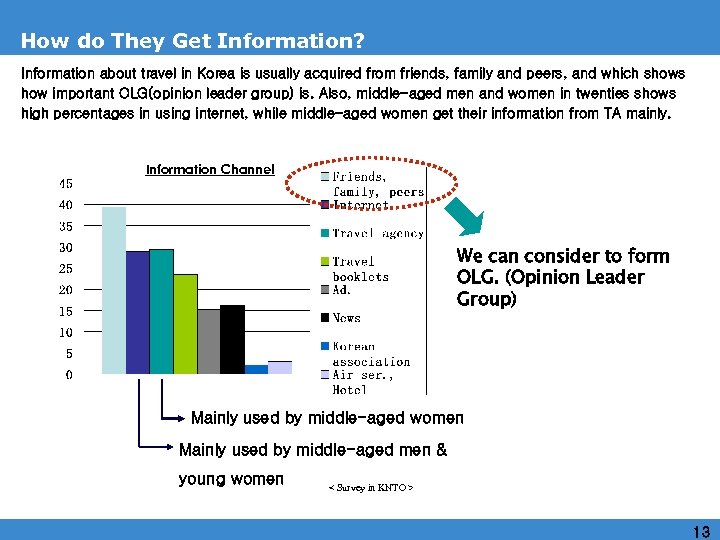
How do They Get Information? Information about travel in Korea is usually acquired from friends, family and peers, and which shows how important OLG(opinion leader group) is. Also, middle-aged men and women in twenties shows high percentages in using internet, while middle-aged women get their information from TA mainly. Information Channel We can consider to form OLG. (Opinion Leader Group) Mainly used by middle-aged women Mainly used by middle-aged men & young women < Survey in KNTO > 13
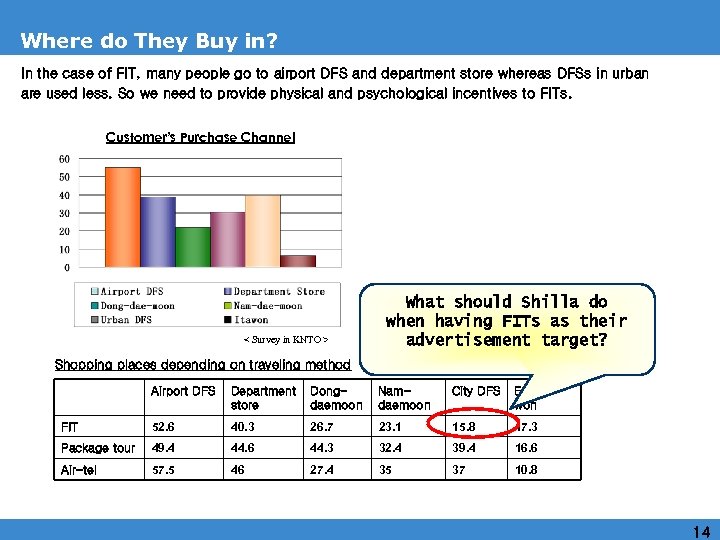
Where do They Buy in? In the case of FIT, many people go to airport DFS and department store whereas DFSs in urban are used less. So we need to provide physical and psychological incentives to FITs. Customer’s Purchase Channel < Survey in KNTO > What should Shilla do when having FITs as their advertisement target? Shopping places depending on traveling method Airport DFS Department store Dongdaemoon Namdaemoon City DFS E-taewon FIT 52. 6 40. 3 26. 7 23. 1 15. 8 17. 3 Package tour 49. 4 44. 6 44. 3 32. 4 39. 4 16. 6 Air-tel 57. 5 46 27. 4 35 37 10. 8 14
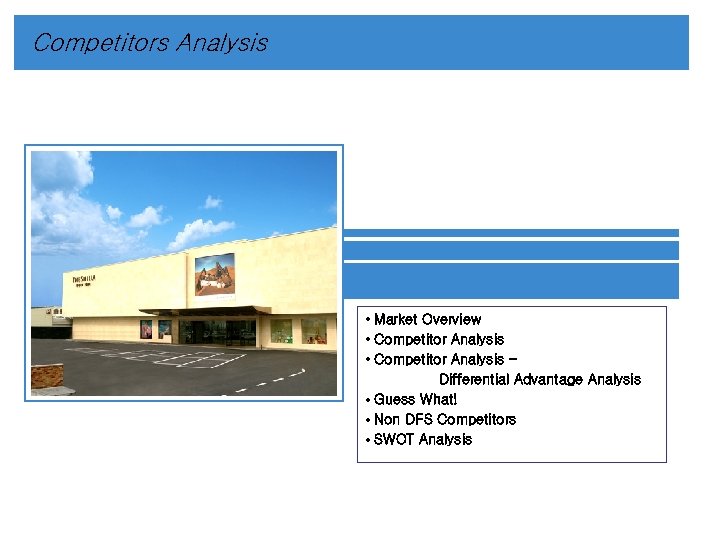
Competitors Analysis • Market Overview • Competitor Analysis – Differential Advantage Analysis • Guess What! • Non DFS Competitors • SWOT Analysis
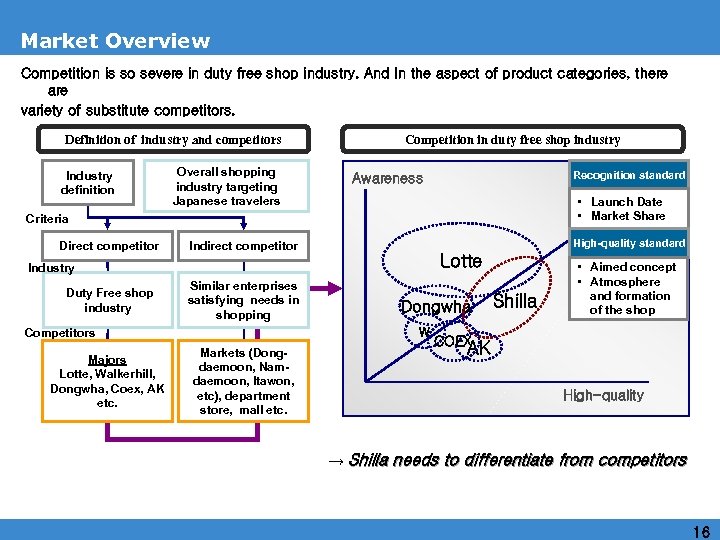
Market Overview Competition is so severe in duty free shop industry. And In the aspect of product categories, there are variety of substitute competitors. Definition of industry and competitors Industry definition Overall shopping industry targeting Japanese travelers Competition in duty free shop industry Recognition standard Awareness • Launch Date • Market Share Criteria Direct competitor High-quality standard Indirect competitor Lotte Industry Duty Free shop industry Similar enterprises satisfying needs in shopping W Competitors Majors Lotte, Walkerhill, Dongwha, Coex, AK etc. Dongwha Markets (Dongdaemoon, Namdaemoon, Itawon, etc), department store, mall etc. Shilla • Aimed concept • Atmosphere and formation of the shop COEX AK High-quality → Shilla needs to differentiate from competitors 16
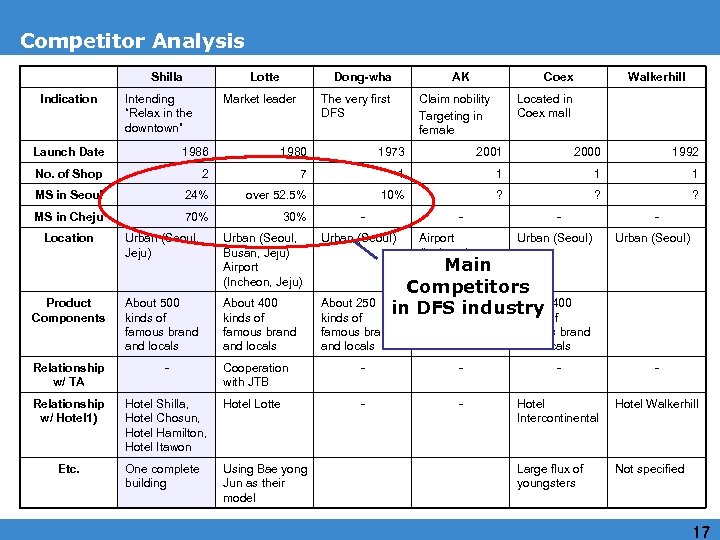
Competitor Analysis Shilla Indication Lotte Intending “Relax in the downtown” Dong-wha Market leader AK The very first DFS Coex Claim nobility Targeting in female Walkerhill Located in Coex mall Launch Date 1986 1980 1973 2001 2000 1992 No. of Shop 2 7 1 1 MS in Seoul 24% over 52. 5% 10% ? ? ? MS in Cheju 70% 30% Location Product Components - Urban (Seoul, Jeju) Urban (Seoul, Busan, Jeju) Airport (Incheon, Jeju) Urban (Seoul) About 500 kinds of famous brand locals About 400 kinds of famous brand locals About 250 kinds of famous brand locals Relationship w/ TA - Relationship w/ Hotel 1) Etc. - Airport (Incheon) Urban (Seoul) Main Competitors About 400 in DFS industry of kinds famous brand locals Cooperation with JTB - - Hotel Shilla, Hotel Chosun, Hotel Hamilton, Hotel Itawon Hotel Lotte - - Hotel Intercontinental Hotel Walkerhill One complete building Using Bae yong Jun as their model Large flux of youngsters Not specified 17
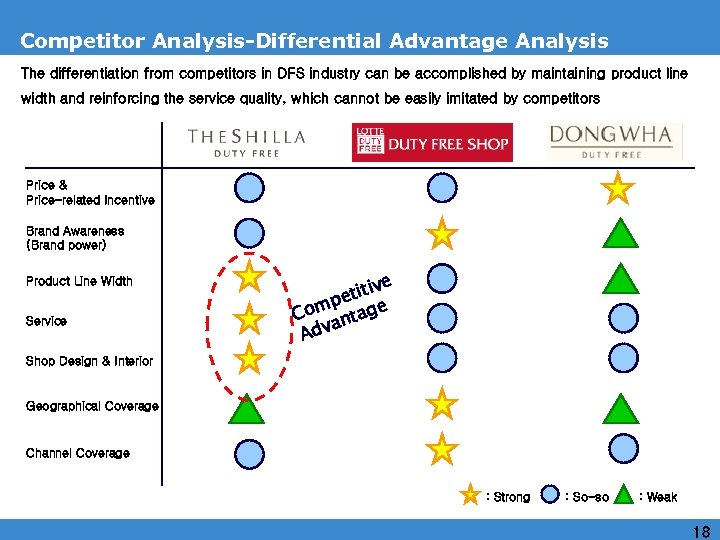
Competitor Analysis-Differential Advantage Analysis The differentiation from competitors in DFS industry can be accomplished by maintaining product line width and reinforcing the service quality, which cannot be easily imitated by competitors Price & Price-related Incentive Brand Awareness (Brand power) Product Line Width Service ive etit p om tage C n dva A Shop Design & Interior Geographical Coverage Channel Coverage : Strong : So-so : Weak 18
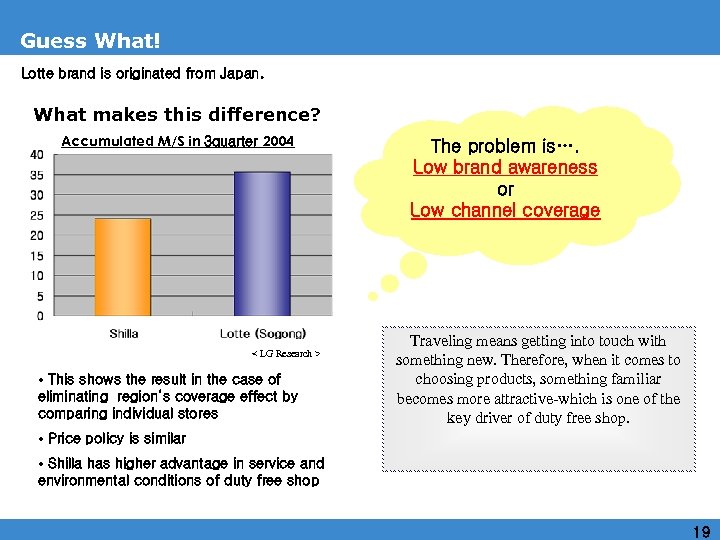
Guess What! Lotte brand is originated from Japan. What makes this difference? Accumulated M/S in 3 quarter 2004 < LG Research > • This shows the result in the case of eliminating region’s coverage effect by comparing individual stores The problem is…. Low brand awareness or Low channel coverage Traveling means getting into touch with something new. Therefore, when it comes to choosing products, something familiar becomes more attractive-which is one of the key driver of duty free shop. • Price policy is similar • Shilla has higher advantage in service and environmental conditions of duty free shop 19
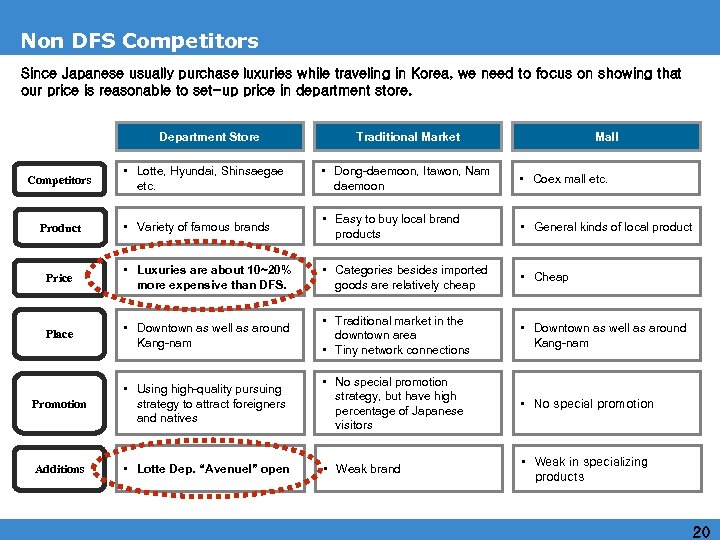
Non DFS Competitors Since Japanese usually purchase luxuries while traveling in Korea, we need to focus on showing that our price is reasonable to set-up price in department store. Department Store Traditional Market Mall • Lotte, Hyundai, Shinsaegae etc. • Dong-daemoon, Itawon, Nam daemoon • Coex mall etc. • Variety of famous brands • Easy to buy local brand products • General kinds of local product Price • Luxuries are about 10~20% more expensive than DFS. • Categories besides imported goods are relatively cheap • Cheap Place • Downtown as well as around Kang-nam • Traditional market in the downtown area • Tiny network connections • Downtown as well as around Kang-nam Promotion • Using high-quality pursuing strategy to attract foreigners and natives • No special promotion strategy, but have high percentage of Japanese visitors • No special promotion Additions • Lotte Dep. “Avenuel” open • Weak brand • Weak in specializing products Competitors Product 20
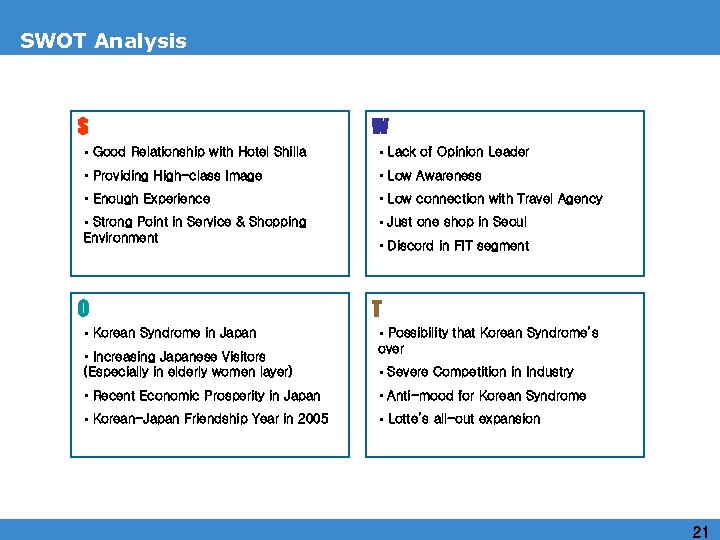
SWOT Analysis S W • Good Relationship with Hotel Shilla • Lack of Opinion Leader • Providing High-class Image • Low Awareness • Enough Experience • Low connection with Travel Agency • Strong Point in Service & Shopping Environment • Just one shop in Seoul O • Korean Syndrome in Japan • Increasing Japanese Visitors (Especially in elderly women layer) • Discord in FIT segment T • Possibility that Korean Syndrome’s over • Severe Competition in Industry • Recent Economic Prosperity in Japan • Anti-mood for Korean Syndrome • Korean-Japan Friendship Year in 2005 • Lotte’s all-out expansion 21
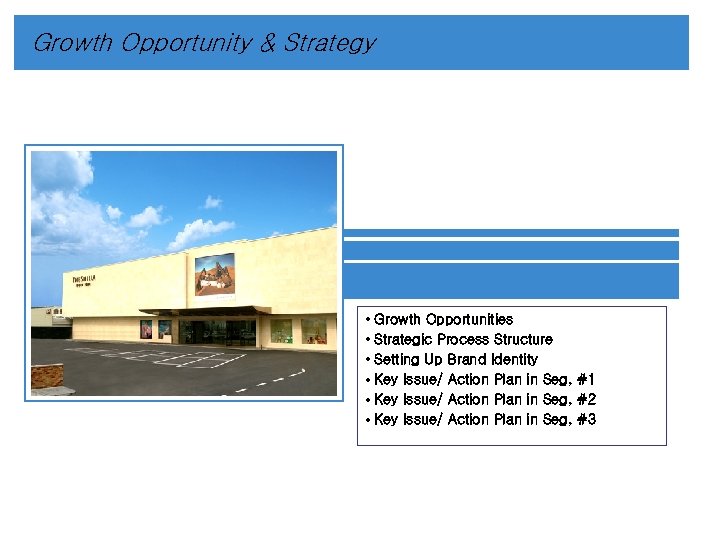
Growth Opportunity & Strategy • • • Growth Opportunities Strategic Process Structure Setting Up Brand Identity Key Issue/ Action Plan in Seg, #1 Key Issue/ Action Plan in Seg, #2 Key Issue/ Action Plan in Seg, #3
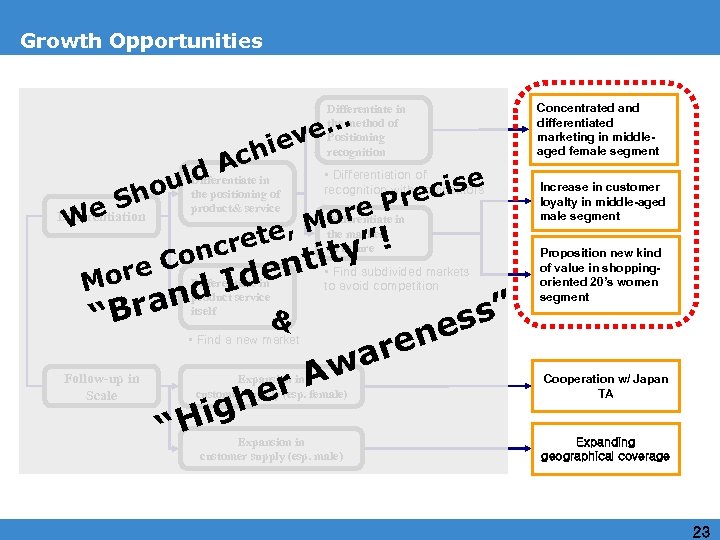
Growth Opportunities Concentrated and differentiated marketing in middleaged female segment Differentiate in the method of Positioning recognition ve… ie e. S W Ach d ul. Differentiate inof ho the positioning e s reci P • Differentiation of recognition with competitors ore te, M ”! ncre ti • tysubdivided markets Co ore Differentiate in n to. Find competition avoid M Ide product service d ranitself & “B ss” e Differentiation product& service Differentiate in the market structure • Find a new market Follow-up in Scale Aw her ig “H Expansion in customer supply (esp. female) Expansion in customer supply (esp. male) ren a Increase in customer loyalty in middle-aged male segment Proposition new kind of value in shoppingoriented 20’s women segment Cooperation w/ Japan TA Expanding geographical coverage 23
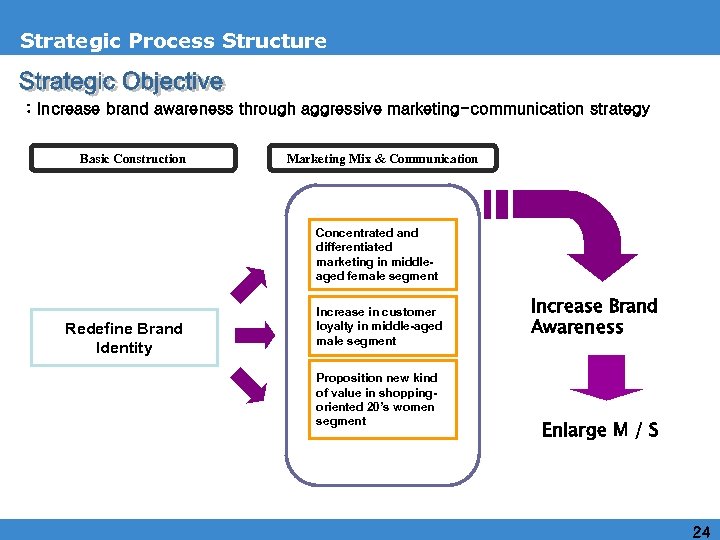
Strategic Process Structure : Increase brand awareness through aggressive marketing-communication strategy Basic Construction Marketing Mix & Communication Concentrated and differentiated marketing in middleaged female segment Redefine Brand Identity Increase in customer loyalty in middle-aged male segment Proposition new kind of value in shoppingoriented 20’s women segment Increase Brand Awareness Enlarge M / S 24
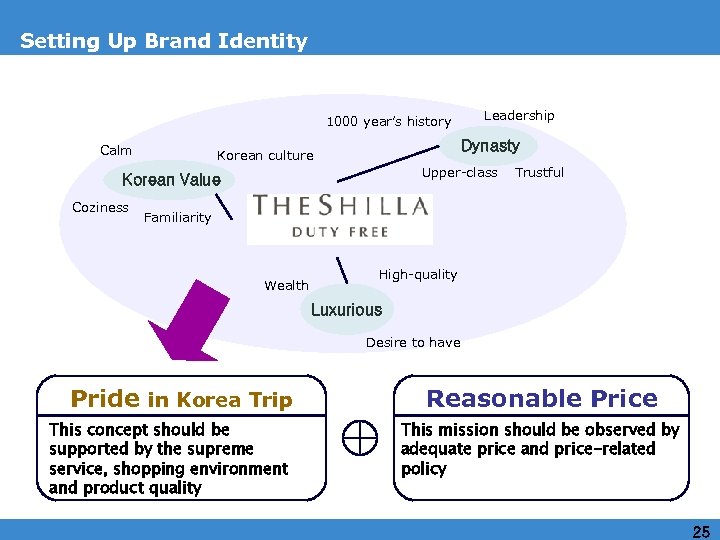
Setting Up Brand Identity 1000 year’s history Calm Dynasty Korean culture Upper-class Korean Value Coziness Leadership Trustful Familiarity Wealth High-quality Luxurious Desire to have Pride in Korea Trip This concept should be supported by the supreme service, shopping environment and product quality Reasonable Price This mission should be observed by adequate price and price-related policy 25
Possess Genuine Korea… Possess Genuine Korea… …in Shilla Duty Free 26
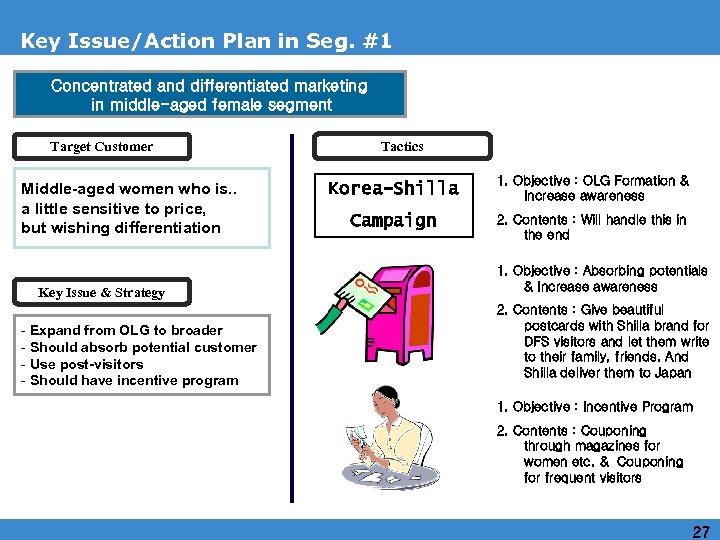
Key Issue/Action Plan in Seg. #1 Concentrated and differentiated marketing in middle-aged female segment Target Customer Middle-aged women who is. . a little sensitive to price, but wishing differentiation Key Issue & Strategy - Expand from OLG to broader - Should absorb potential customer - Use post-visitors - Should have incentive program Tactics Korea-Shilla 1. Objective : OLG Formation & Increase awareness Campaign 2. Contents : Will handle this in the end 1. Objective : Absorbing potentials & Increase awareness 2. Contents : Give beautiful postcards with Shilla brand for DFS visitors and let them write to their family, friends. And Shilla deliver them to Japan 1. Objective : Incentive Program 2. Contents : Couponing through magazines for women etc. & Couponing for frequent visitors 27
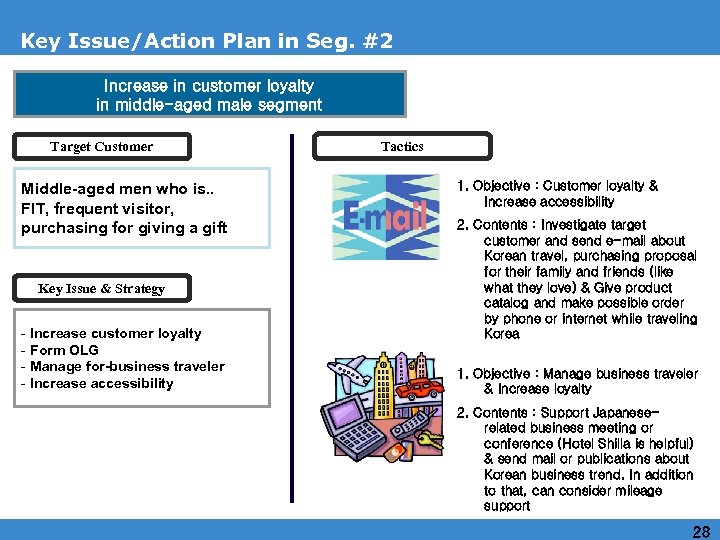
Key Issue/Action Plan in Seg. #2 Increase in customer loyalty in middle-aged male segment Target Customer Middle-aged men who is. . FIT, frequent visitor, purchasing for giving a gift Key Issue & Strategy - Increase customer loyalty - Form OLG - Manage for-business traveler - Increase accessibility Tactics 1. Objective : Customer loyalty & Increase accessibility 2. Contents : Investigate target customer and send e-mail about Korean travel, purchasing proposal for their family and friends (like what they love) & Give product catalog and make possible order by phone or internet while traveling Korea 1. Objective : Manage business traveler & Increase loyalty 2. Contents : Support Japaneserelated business meeting or conference (Hotel Shilla is helpful) & send mail or publications about Korean business trend. In addition to that, can consider mileage support 28
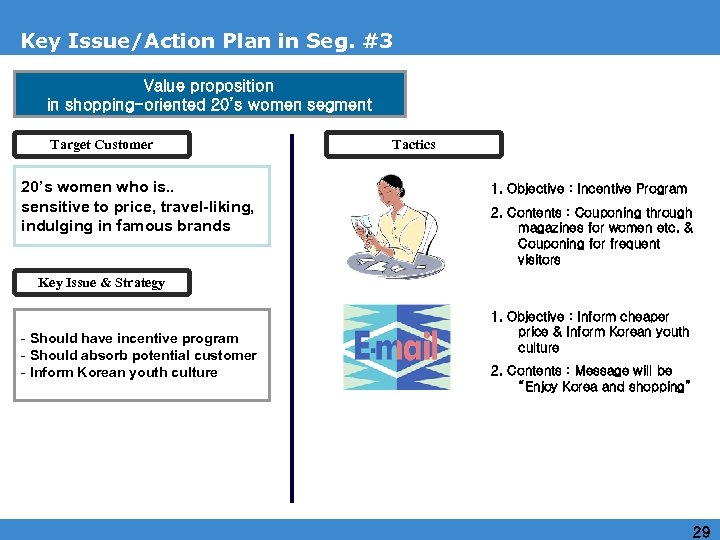
Key Issue/Action Plan in Seg. #3 Value proposition in shopping-oriented 20’s women segment Target Customer 20’s women who is. . sensitive to price, travel-liking, indulging in famous brands Tactics 1. Objective : Incentive Program 2. Contents : Couponing through magazines for women etc. & Couponing for frequent visitors Key Issue & Strategy - Should have incentive program - Should absorb potential customer - Inform Korean youth culture 1. Objective : Inform cheaper price & Inform Korean youth culture 2. Contents : Message will be “Enjoy Korea and shopping” 29
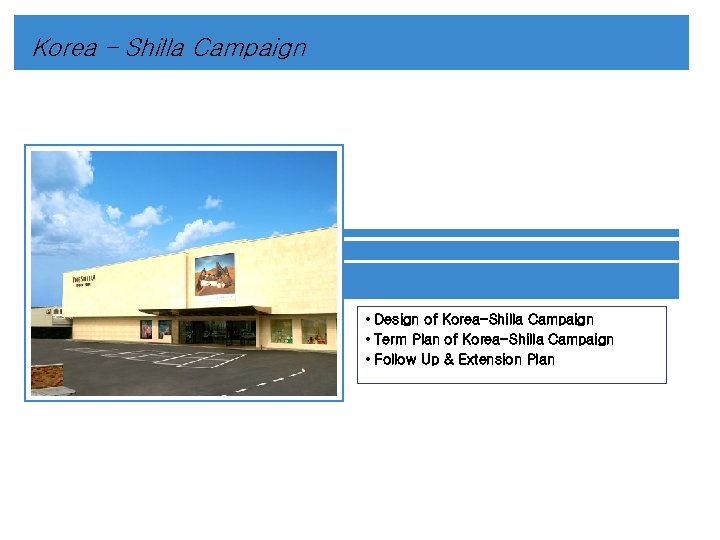
Korea – Shilla Campaign • Design of Korea-Shilla Campaign • Term Plan of Korea-Shilla Campaign • Follow Up & Extension Plan
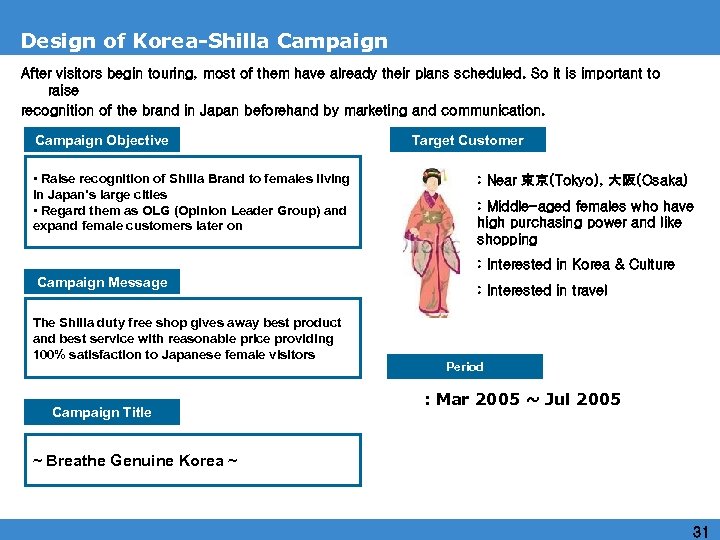
Design of Korea-Shilla Campaign After visitors begin touring, most of them have already their plans scheduled. So it is important to raise recognition of the brand in Japan beforehand by marketing and communication. Campaign Objective • Raise recognition of Shilla Brand to females living in Japan’s large cities • Regard them as OLG (Opinion Leader Group) and expand female customers later on Target Customer : Near 東京(Tokyo), 大阪(Osaka) : Middle-aged females who have high purchasing power and like shopping : Interested in Korea & Culture Campaign Message The Shilla duty free shop gives away best product and best service with reasonable price providing 100% satisfaction to Japanese female visitors Campaign Title : Interested in travel Period : Mar 2005 ~ Jul 2005 ~ Breathe Genuine Korea ~ 31
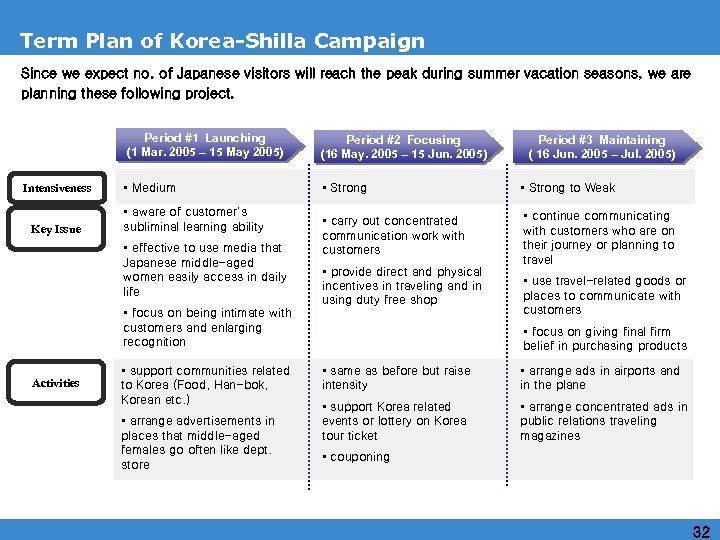
Term Plan of Korea-Shilla Campaign Since we expect no. of Japanese visitors will reach the peak during summer vacation seasons, we are planning these following project. Period #1 Launching (1 Mar. 2005 – 15 May 2005) Intensiveness Key Issue • Medium • aware of customer’s subliminal learning ability • effective to use media that Japanese middle-aged women easily access in daily life Period #2 Focusing (16 May. 2005 – 15 Jun. 2005) • Strong to Weak • carry out concentrated communication work with customers • continue communicating with customers who are on their journey or planning to travel • provide direct and physical incentives in traveling and in using duty free shop • focus on being intimate with customers and enlarging recognition Activities • support communities related to Korea (Food, Han-bok, Korean etc. ) • arrange advertisements in places that middle-aged females go often like dept. store Period #3 Maintaining ( 16 Jun. 2005 – Jul. 2005) • use travel-related goods or places to communicate with customers • focus on giving final firm belief in purchasing products • same as before but raise intensity • arrange ads in airports and in the plane • support Korea related events or lottery on Korea tour ticket • arrange concentrated ads in public relations traveling magazines • couponing 32
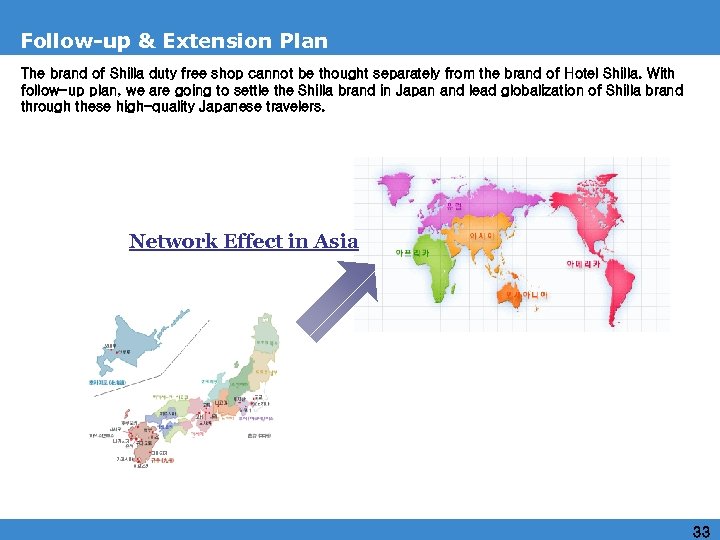
Follow-up & Extension Plan The brand of Shilla duty free shop cannot be thought separately from the brand of Hotel Shilla. With follow-up plan, we are going to settle the Shilla brand in Japan and lead globalization of Shilla brand through these high-quality Japanese travelers. Network Effect in Asia 33
Thank you for listening! Q&A 34
Скачать презентацию The Project for Shilla Duty-free 일본 관광객 증가에
0b8c921ab52256480606293b75689eb1.ppt