


 Скачать презентацию The Project and the Sources Clive D Field
7c4842da0f0f66be29861abac1c291c0.ppt
- Количество слайдов: 25
 The Project and the Sources Clive D. Field School of History and Cultures, University of Birmingham Institute for Social Change, University of Manchester
 Overview Includes • Project. . . slides 3 -10 • Official Sources. . . . slides 11 -13 • Unofficial Sources. . . . slides 14 -19 • Archival Examples. . . . slides 20 -23 • Contacts. . . slide 24 Out of scope • Actual facts and figures about religious change • Consideration of how far religion can be quantified 2
 Project I. Funding • Part of AHRC/ESRC Religion and Society Programme, directed by Professor Linda Woodhead http: //www. religionandsociety. org. uk/ • £ 12 million awarded to 75 original research projects over 2007 -2012 • BRIN awarded £ 267, 000 to develop online centre for British data on religion over 2008 -2010 • BRIN builds on earlier ESRC-funded work: - Churches and Churchgoers (1977) - Reviews of UK Statistical Sources: Religion (1987) • BRIN complements adherents. com, ARDA, ARK and other non-British websites 3
 Project II. Team • Based at Institute for Social Change, Faculty of Humanities, University of Manchester • Co-directors David Voas (demographer/social scientist), and Clive Field (historian). Both with established research reputations in quantification of religion • Siobhan Mc. Andrew, research associate • Sam Smith, technical adviser • University of Manchester committed to maintain and continue to develop BRIN post-project 4
 Project III. Statistics in Scope • Historical (from 17 th century) and contemporary • National (excluding Northern Ireland) with selection of local • Published (print and online) and unpublished • Serial (recurrent) and non-recurrent • Collected by state, faith communities and other agencies • Organizational and measures of personal beliefs, practices and attitudes • Full spectrum of religions (including non. Christian and alternative) and irreligion 5
 Project IV: Goals • Promised project deliverables (all online): - Fully searchable guide to statistical sources - Key time series data (subject to copyright) - Interpretation and visual presentation of data • To meet needs of: - Academics - Media - General public - Policy-makers - Faith communities 6
 Project V. Innovation • Broad temporal, geographical and thematic coverage • Integrates historical and contemporary data • Offers interpretation as well as raw data • Bridges academic and non-academic worlds • Online resource with interactive features • Facility for (moderated) external expert input • Entirely free at point of end-use • Will be continuously updated post-project 7
 Project VI. Website • brin. ac. uk to be formally launched 29 -30 March at Conference for Innovative Methods in the Study of Religion, Royal Mint, London • Website features include (at varying stages of development): - Database of sources - Commentaries - Links - Site search - Maps, charts and tables - News - FAQs - But no datasets 8
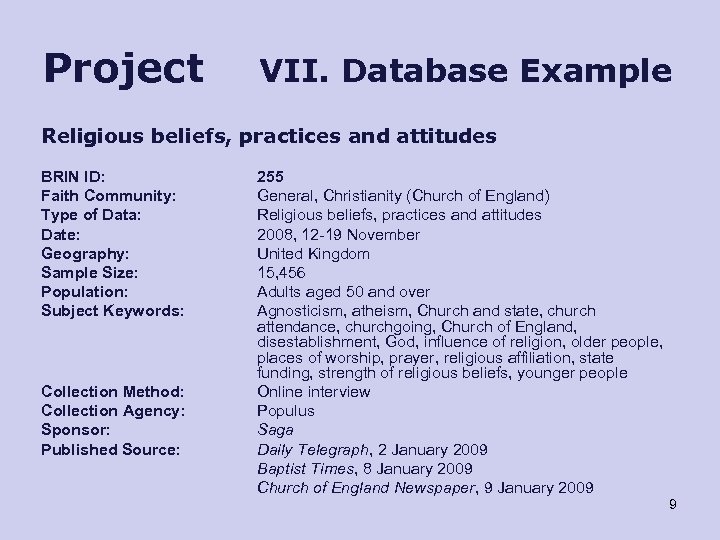 Project VII. Database Example Religious beliefs, practices and attitudes BRIN ID: Faith Community: Type of Data: Date: Geography: Sample Size: Population: Subject Keywords: Collection Method: Collection Agency: Sponsor: Published Source: 255 General, Christianity (Church of England) Religious beliefs, practices and attitudes 2008, 12 -19 November United Kingdom 15, 456 Adults aged 50 and over Agnosticism, atheism, Church and state, church attendance, churchgoing, Church of England, disestablishment, God, influence of religion, older people, places of worship, prayer, religious affiliation, state funding, strength of religious beliefs, younger people Online interview Populus Saga Daily Telegraph, 2 January 2009 Baptist Times, 8 January 2009 Church of England Newspaper, 9 January 2009 9
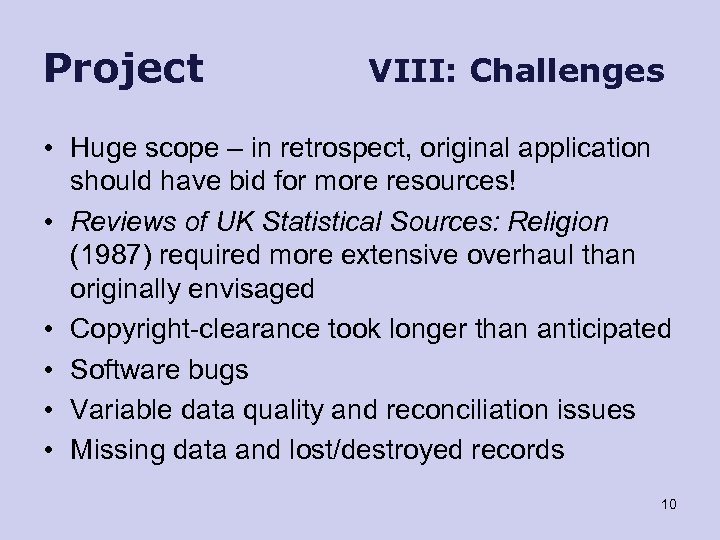 Project VIII: Challenges • Huge scope – in retrospect, original application should have bid for more resources! • Reviews of UK Statistical Sources: Religion (1987) required more extensive overhaul than originally envisaged • Copyright-clearance took longer than anticipated • Software bugs • Variable data quality and reconciliation issues • Missing data and lost/destroyed records 10
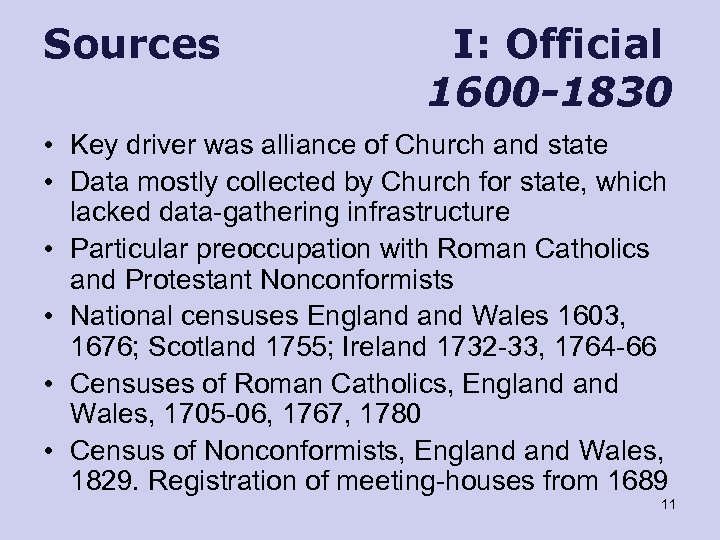 Sources I: Official 1600 -1830 • Key driver was alliance of Church and state • Data mostly collected by Church for state, which lacked data-gathering infrastructure • Particular preoccupation with Roman Catholics and Protestant Nonconformists • National censuses England Wales 1603, 1676; Scotland 1755; Ireland 1732 -33, 1764 -66 • Censuses of Roman Catholics, England Wales, 1705 -06, 1767, 1780 • Census of Nonconformists, England Wales, 1829. Registration of meeting-houses from 1689 11
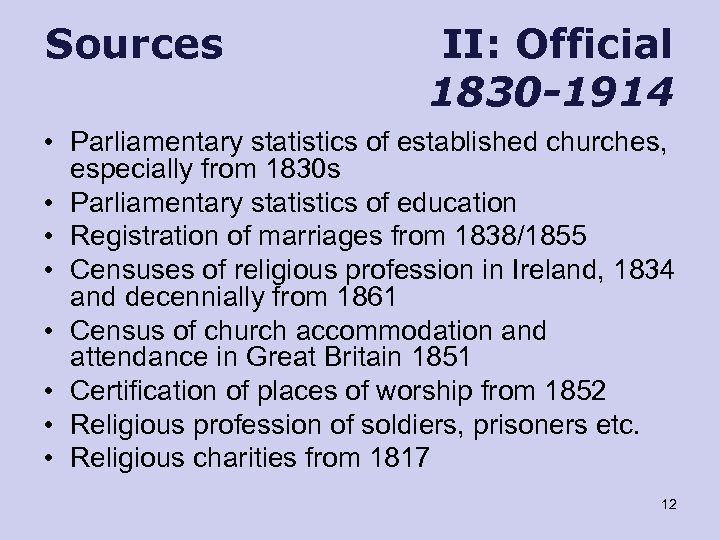 Sources II: Official 1830 -1914 • Parliamentary statistics of established churches, especially from 1830 s • Parliamentary statistics of education • Registration of marriages from 1838/1855 • Censuses of religious profession in Ireland, 1834 and decennially from 1861 • Census of church accommodation and attendance in Great Britain 1851 • Certification of places of worship from 1852 • Religious profession of soldiers, prisoners etc. • Religious charities from 1817 12
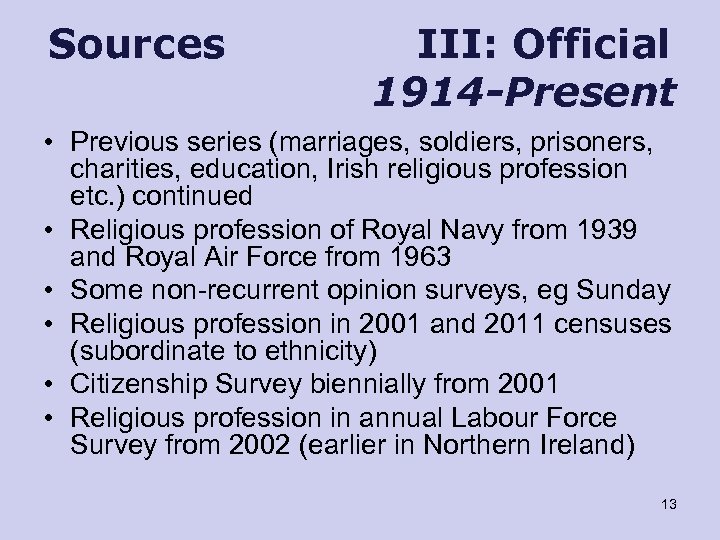 Sources III: Official 1914 -Present • Previous series (marriages, soldiers, prisoners, charities, education, Irish religious profession etc. ) continued • Religious profession of Royal Navy from 1939 and Royal Air Force from 1963 • Some non-recurrent opinion surveys, eg Sunday • Religious profession in 2001 and 2011 censuses (subordinate to ethnicity) • Citizenship Survey biennially from 2001 • Religious profession in annual Labour Force Survey from 2002 (earlier in Northern Ireland) 13
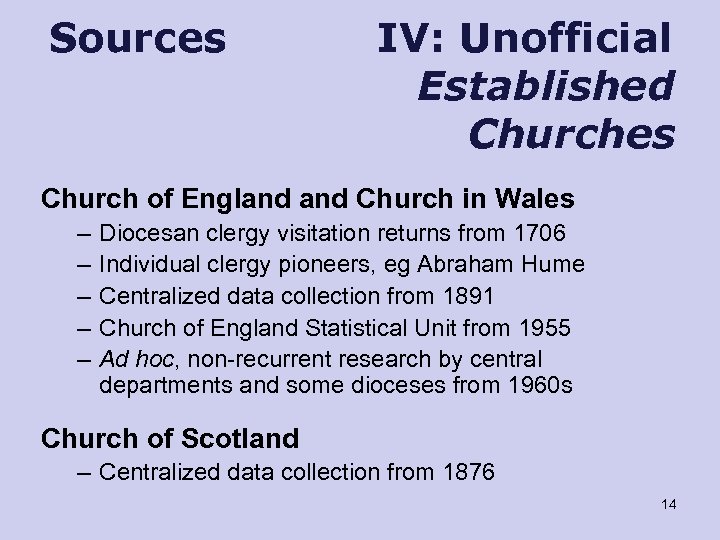 Sources IV: Unofficial Established Churches Church of England Church in Wales – – – Diocesan clergy visitation returns from 1706 Individual clergy pioneers, eg Abraham Hume Centralized data collection from 1891 Church of England Statistical Unit from 1955 Ad hoc, non-recurrent research by central departments and some dioceses from 1960 s Church of Scotland – Centralized data collection from 1876 14
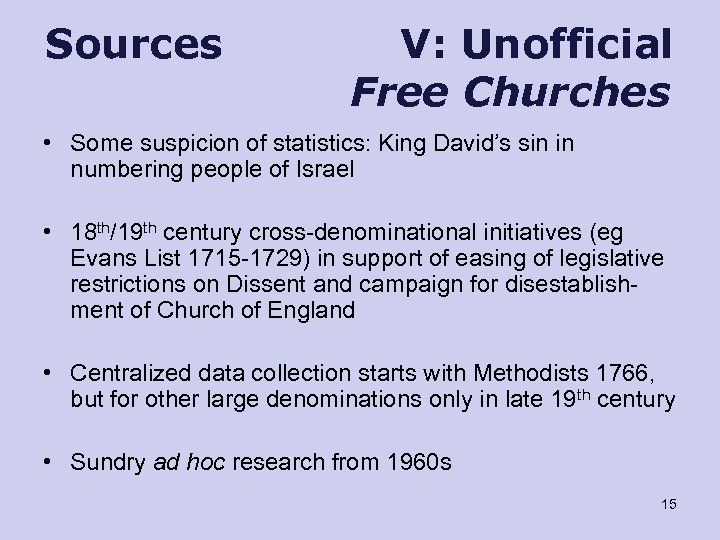 Sources V: Unofficial Free Churches • Some suspicion of statistics: King David’s sin in numbering people of Israel • 18 th/19 th century cross-denominational initiatives (eg Evans List 1715 -1729) in support of easing of legislative restrictions on Dissent and campaign for disestablishment of Church of England • Centralized data collection starts with Methodists 1766, but for other large denominations only in late 19 th century • Sundry ad hoc research from 1960 s 15
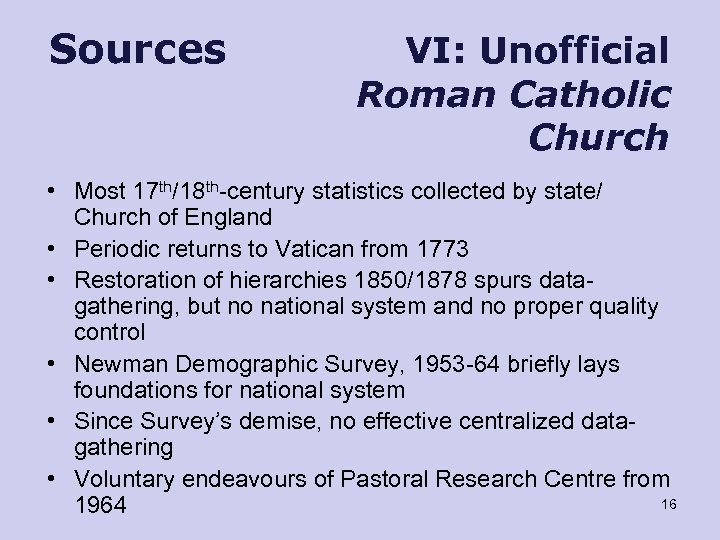 Sources VI: Unofficial Roman Catholic Church • Most 17 th/18 th-century statistics collected by state/ Church of England • Periodic returns to Vatican from 1773 • Restoration of hierarchies 1850/1878 spurs datagathering, but no national system and no proper quality control • Newman Demographic Survey, 1953 -64 briefly lays foundations for national system • Since Survey’s demise, no effective centralized datagathering • Voluntary endeavours of Pastoral Research Centre from 16 1964
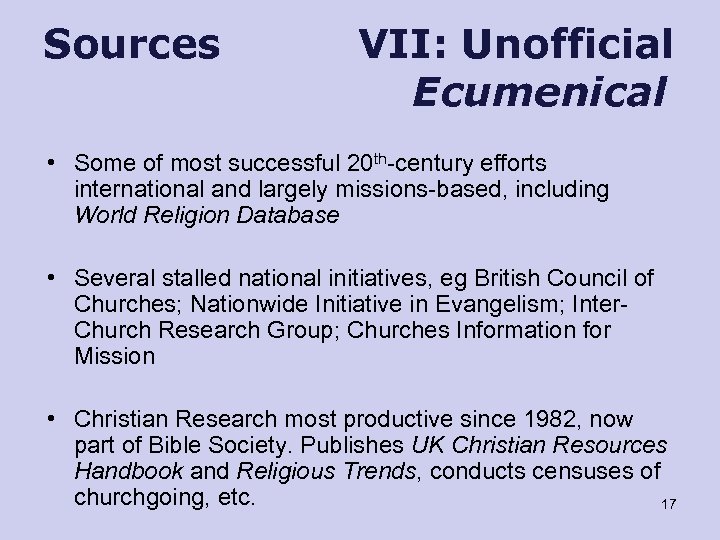 Sources VII: Unofficial Ecumenical • Some of most successful 20 th-century efforts international and largely missions-based, including World Religion Database • Several stalled national initiatives, eg British Council of Churches; Nationwide Initiative in Evangelism; Inter. Church Research Group; Churches Information for Mission • Christian Research most productive since 1982, now part of Bible Society. Publishes UK Christian Resources Handbook and Religious Trends, conducts censuses of churchgoing, etc. 17
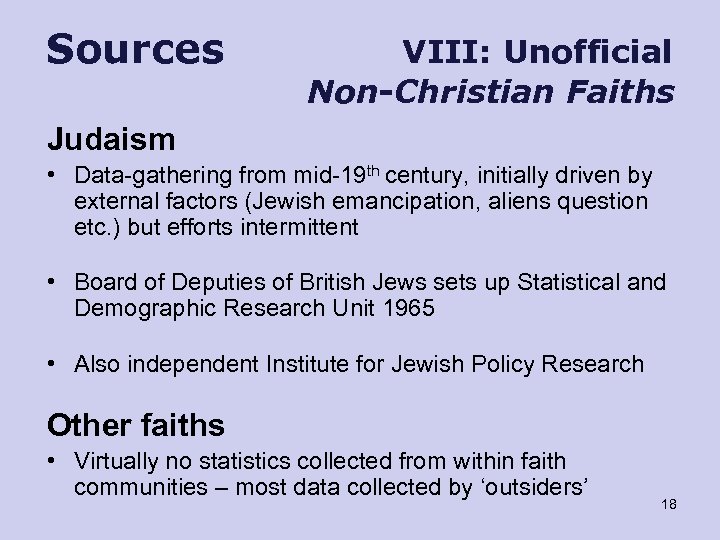 Sources VIII: Unofficial Non-Christian Faiths Judaism • Data-gathering from mid-19 th century, initially driven by external factors (Jewish emancipation, aliens question etc. ) but efforts intermittent • Board of Deputies of British Jews sets up Statistical and Demographic Research Unit 1965 • Also independent Institute for Jewish Policy Research Other faiths • Virtually no statistics collected from within faith communities – most data collected by ‘outsiders’ 18
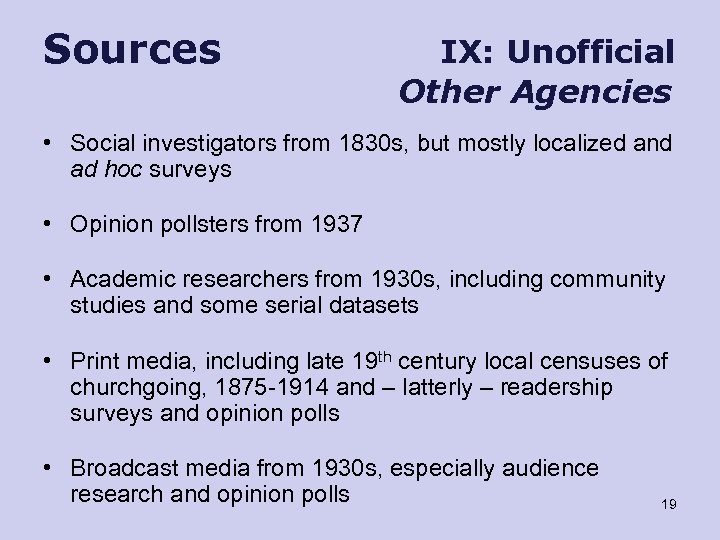 Sources IX: Unofficial Other Agencies • Social investigators from 1830 s, but mostly localized and ad hoc surveys • Opinion pollsters from 1937 • Academic researchers from 1930 s, including community studies and some serial datasets • Print media, including late 19 th century local censuses of churchgoing, 1875 -1914 and – latterly – readership surveys and opinion polls • Broadcast media from 1930 s, especially audience research and opinion polls 19
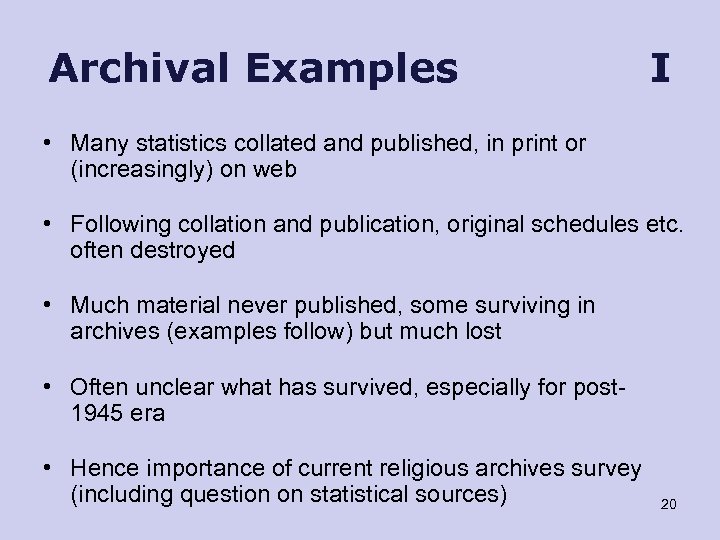 Archival Examples I • Many statistics collated and published, in print or (increasingly) on web • Following collation and publication, original schedules etc. often destroyed • Much material never published, some surviving in archives (examples follow) but much lost • Often unclear what has survived, especially for post 1945 era • Hence importance of current religious archives survey (including question on statistical sources) 20
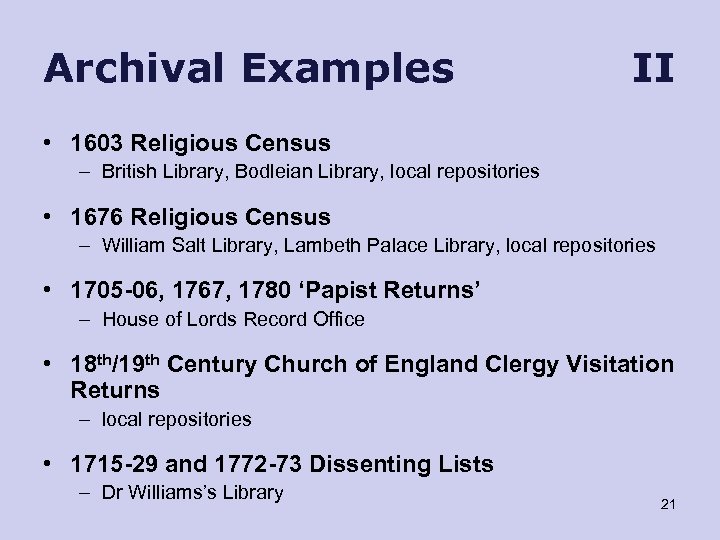 Archival Examples II • 1603 Religious Census – British Library, Bodleian Library, local repositories • 1676 Religious Census – William Salt Library, Lambeth Palace Library, local repositories • 1705 -06, 1767, 1780 ‘Papist Returns’ – House of Lords Record Office • 18 th/19 th Century Church of England Clergy Visitation Returns – local repositories • 1715 -29 and 1772 -73 Dissenting Lists – Dr Williams’s Library 21
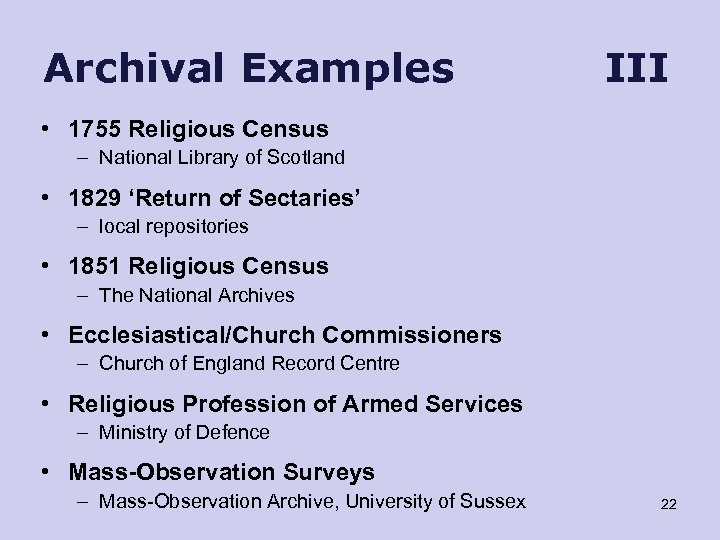 Archival Examples III • 1755 Religious Census – National Library of Scotland • 1829 ‘Return of Sectaries’ – local repositories • 1851 Religious Census – The National Archives • Ecclesiastical/Church Commissioners – Church of England Record Centre • Religious Profession of Armed Services – Ministry of Defence • Mass-Observation Surveys – Mass-Observation Archive, University of Sussex 22
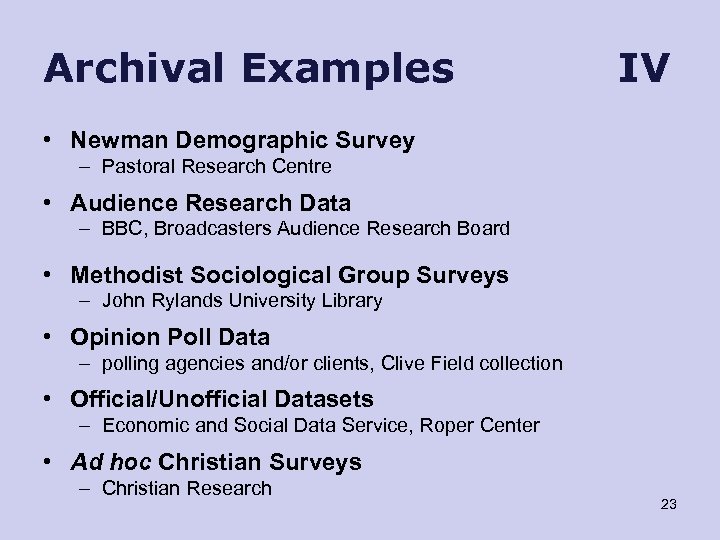 Archival Examples IV • Newman Demographic Survey – Pastoral Research Centre • Audience Research Data – BBC, Broadcasters Audience Research Board • Methodist Sociological Group Surveys – John Rylands University Library • Opinion Poll Data – polling agencies and/or clients, Clive Field collection • Official/Unofficial Datasets – Economic and Social Data Service, Roper Center • Ad hoc Christian Surveys – Christian Research 23
 Contacts e-mail • c. d. field@bham. ac. uk • siobhan. mcandrew@manchester. ac. uk website • http: //www. brin. ac. uk 24
 Thank you Any questions? 25