


 Скачать презентацию The Progressive Era Section 1 The Origins of
c488a832a0745ac824bf8d9b83705ac5.ppt
- Количество слайдов: 57
 The Progressive Era Section 1 The Origins of Progressivism GET YOUR CLICKERS!!
 Four Goals of Progressivism • Progressives aimed to return control of the government to the people, restore economic opportunities and correct injustices in American life • To do this, they had 4 goals
 Four Goals of Progressivism • Protecting Social Welfare – Social Gospel, settlement houses inspire other reform groups – Florence Kelley, political activist, advocate for women, children – helps pass law prohibiting child labor, limiting women’s hours with Illinois Factory Act
 Four Goals of Progressivism • Promoting Moral Improvement – Some feel poor should uplift selves by improving own behavior – Prohibition—banning of alcoholic drinks – Woman’s Christian Temperance Union spearheads prohibition crusade – Carry Nation destroyed kegs of whiskey
 Four Goals of Progressivism • Creating Economic Reform – 1893 panic prompts doubts about capitalism; many become socialists – Muckrakers —journalists who expose corruption in politics, business – Ida Tarbell exposed the Standard Oil Co’s cutthroat strategies to eliminate competition
 Four Goals of Progressivism • Fostering Efficiency – Many use experts, science to make society, workplace more efficient – Louis D. Brandeis uses social scientists’ data in trial – Brandeis Briefs – Scientific management —time and motion studies applied to workplace – Assembly lines speed up production, make people work like machines • cause high worker turnover
 Four Goals of Progressivism • Fostering Efficiency – Frederick W. Taylor used a stopwatch to time motions of employees to shorten wasted time – Henry Ford increased efficiency by paying his employees more - $5 per day
 Who exposed the unethical activities of Standard Oil? • • • A B C D E – John Rockefeller – Frederick Taylor – Louis Brandeis - Ida Tarbell – Cary Nation
 Who became an efficiency expert, timing worker’s movements? • • • A B C D E – John Rockefeller – Frederick Taylor – Louis Brandeis - Ida Tarbell – Cary Nation
 Who was a prohibitionist who destroyed liquor bottles and beer? • • • A B C D E – John Rockefeller – Frederick Taylor – Louis Brandeis - Ida Tarbell – Cary Nation
 Who used scientific data in his legal cases against industries? • • • A B C D E – Henry Ford – Frederick Taylor – Louis Brandeis - Ida Tarbell – Cary Nation
 Reforming Local Governments • Natural disasters played an important role in reforming local governments • Hurricanes and floods tested local authority and put trained people in city positions • Progressive mayors implemented change on the local level
 Reforming child labor laws • “Fighting Bob” La. Follette, WI, served 3 terms as governor – Caused the demise of political machines – Took political control away from businesses • James Hogg, TX, took on railroad rates in his state • (He named his daughters Ima and Ura)
 Reforming work hours • Muller v. Oregon, 1908 – Louis Brandeis looked at scientific data and argued (and won) that women should limit women to a 10 hr day • Bunting v. Oregon, 1917 – ordered a 10 hr workday for men • Progressives also received compensation for workers killed or injured on the job
 Reforming elections • Initiative – method where voters could compel legislature to consider a bill • Referendum – method that allowed citizens to vote on proposed laws • Recall – enabled voters to remove politician from office
 Reforming elections • Direct election of senators – up to this time, the people elected House of Representatives members • The House members then chose the senators for each state • The 17 th Amendment allows for direct election of senators

 The Progressive Era Section 2 Women in Public Life
 Women in the workforce • Women on the farm saw their lives change little in 100 years • They continued to do all the housework and childrearing, and often, farm labor as well
 Women in the workforce • Women in the cities took jobs as pay increased • Most were secretarial, teaching, nursing or telephone operators • They paid about half as much as men and could not join a union
 Women in the workforce • Women without skills took jobs as domestics – maids, cooks, laundry workers • Most of this work was done by immigrants and black women
 Women reformers • Many of the women who sought more rights for women were college educated • Vassar, Smith and Wellesley were the first to accept women
 Women reformers • African American women founded the NACW (National Assoc. for Colored Women) and promoted education • Susan B. Anthony and Elizabeth Cady Stanton joined with Lucy Stone and Julia Ward Howe for women’s suffrage
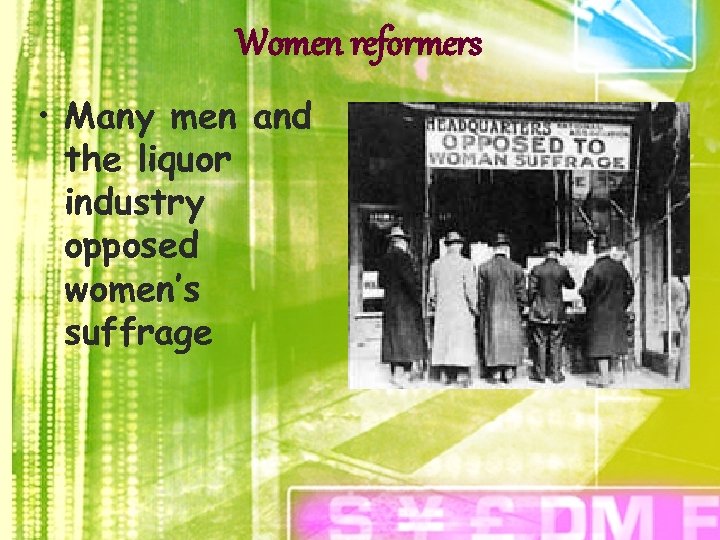 Women reformers • Many men and the liquor industry opposed women’s suffrage
 The Progressive Era Section 3 Teddy Roosevelt’s Square Deal
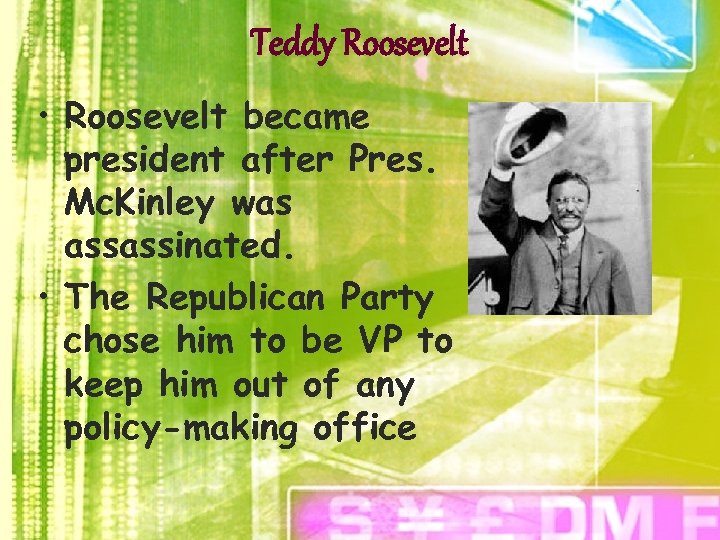 Teddy Roosevelt • Roosevelt became president after Pres. Mc. Kinley was assassinated. • The Republican Party chose him to be VP to keep him out of any policy-making office
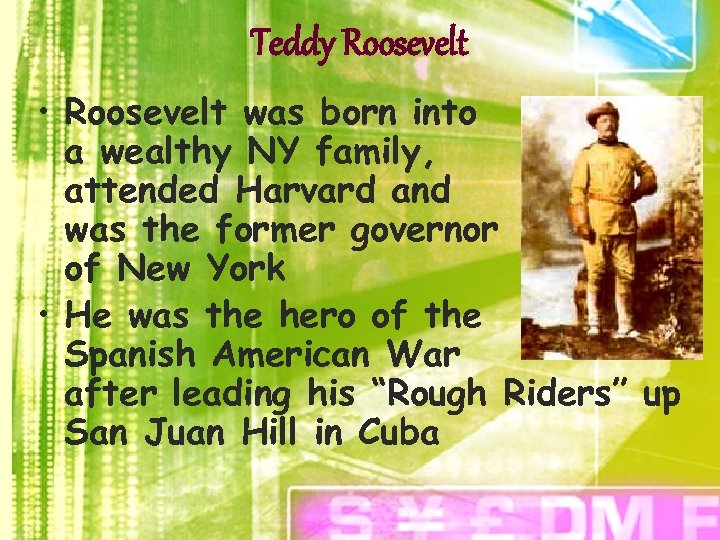 Teddy Roosevelt • Roosevelt was born into a wealthy NY family, attended Harvard and was the former governor of New York • He was the hero of the Spanish American War after leading his “Rough Riders” up San Juan Hill in Cuba
 Teddy Roosevelt • TR used the presidency to influence – his ‘bully pulpit’ • After settling a coal strike through arbitration, he stated that we wanted a “square deal” for all Americans • One of the first targets of his reform was the trusts
 Teddy Roosevelt • Using the weak Sherman Antitrust Act, TR took on the railroads with a suit against the Northern Securities Company • The USSC dissolved the trust • TR filed 44 more suits
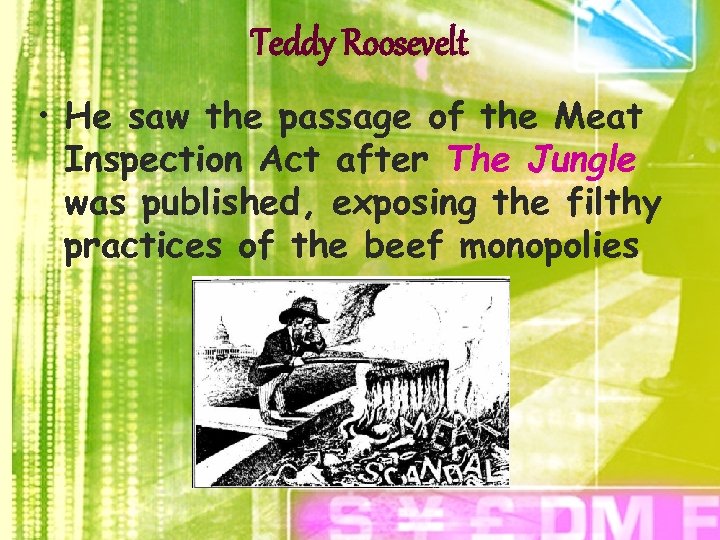 Teddy Roosevelt • He saw the passage of the Meat Inspection Act after The Jungle was published, exposing the filthy practices of the beef monopolies
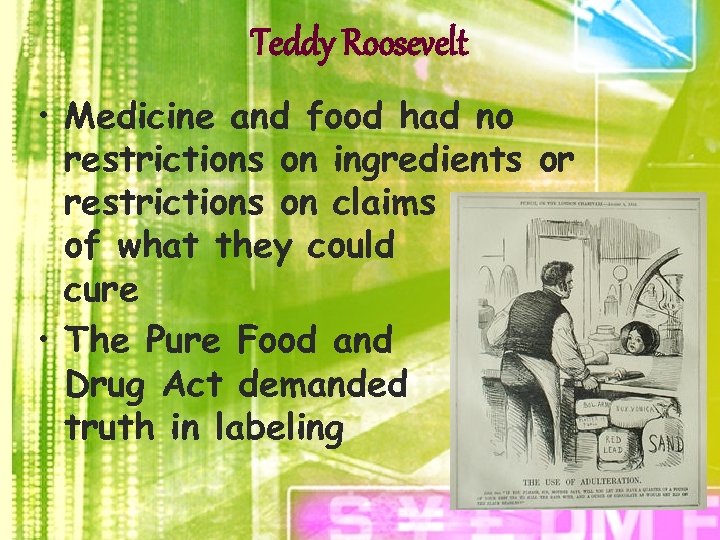 Teddy Roosevelt • Medicine and food had no restrictions on ingredients or restrictions on claims of what they could cure • The Pure Food and Drug Act demanded truth in labeling
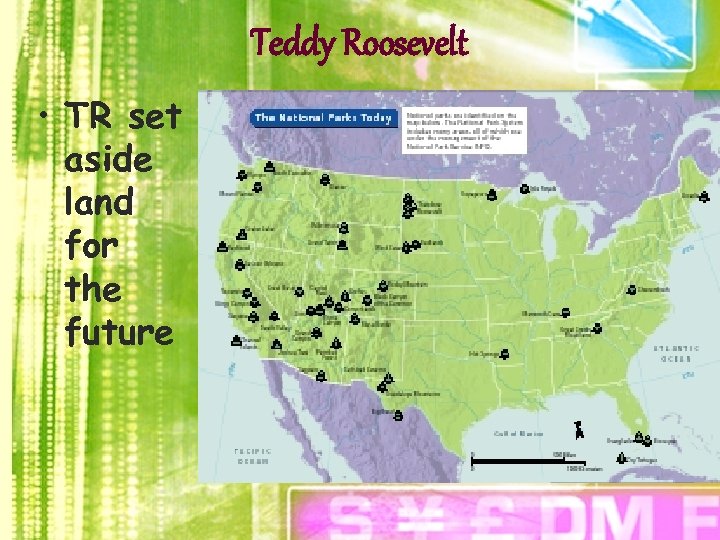 Teddy Roosevelt • TR set aside land for the future
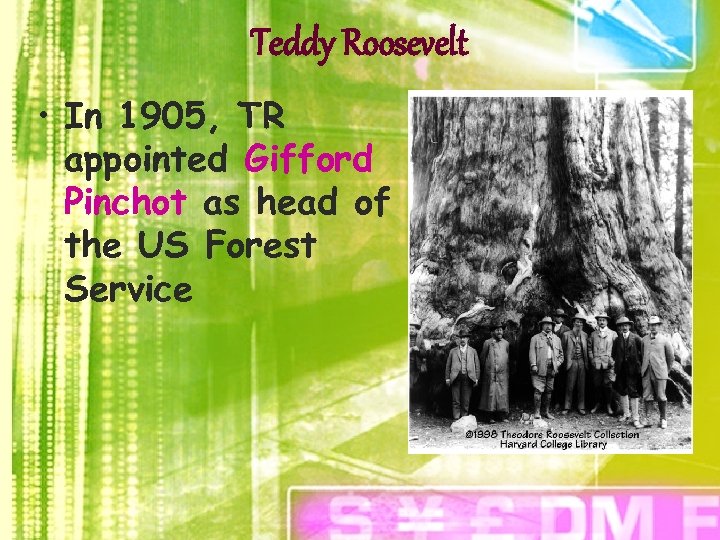 Teddy Roosevelt • In 1905, TR appointed Gifford Pinchot as head of the US Forest Service
 Teddy Roosevelt • TR made little headway in recognizing civil rights for African Americans • Appointing some to federal positions, he backed down at almost every opportunity to offer equality to all
 Teddy Roosevelt • W. E. B. Du. Bois met in Niagara to form the Niagara Movement, demanding equality • The group became the NAACP, the National Assoc. for the Advancement of Colored People
 Teddy Roosevelt • TR is known for his saying, “speak softly and carry a big stick. ” • He ordered the new navy, the Great White Fleet, on a round the world mission to show our new ‘muscle’ • He was also responsible for the construction of the Panama Canal
 Who were the muckrakers? • Ida Tarbel – “The History of Standard Oil” (railroad corruption) • Lincoln Steffens – “The Same of the Cities” and “Tweed Days in St. Louis” (government corruption) • Upton Sinclair – “The Jungle” (meatpacking industry)
 The Progressive Era Section 4 Progressivism Under Taft
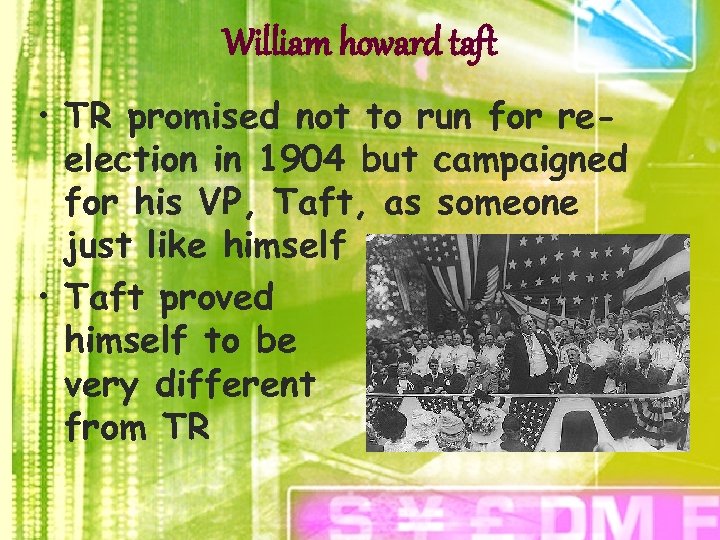 William howard taft • TR promised not to run for reelection in 1904 but campaigned for his VP, Taft, as someone just like himself • Taft proved himself to be very different from TR
 William howard taft • Taft ran on the platform of lowering tariffs • Instead, he signed the Payne. Aldrich Tariff and then bragged about it
 William howard taft • Next he appointed Richard Ballinger as Sec. of the Interior who disapproved of land conservation • Pinchot accused Ballinger of caving into special interests for profits • Taft sided with Ballinger
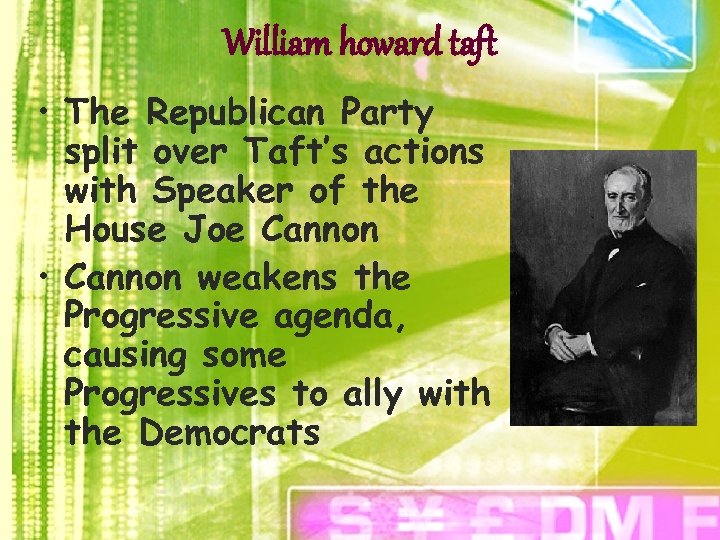 William howard taft • The Republican Party split over Taft’s actions with Speaker of the House Joe Cannon • Cannon weakens the Progressive agenda, causing some Progressives to ally with the Democrats
 William howard taft • In the mid-term elections of 1910, Democrats took many Republican seats • The Republicans still renominated Taft in 1912
 William howard taft • TR fought, and lost, for the Republican nomination • He formed his own splinter party, the Bull Moose Party. • By splitting the Republican voting bloc, Democrats smelled victory • They nominate Woodrow Wilson
 Election of 1912 • The Republicans ran an ugly campaign filled with name-calling • “fathead” “dangerous egotist” • “brain of a guinea pig” • Wilson let them do his dirty work
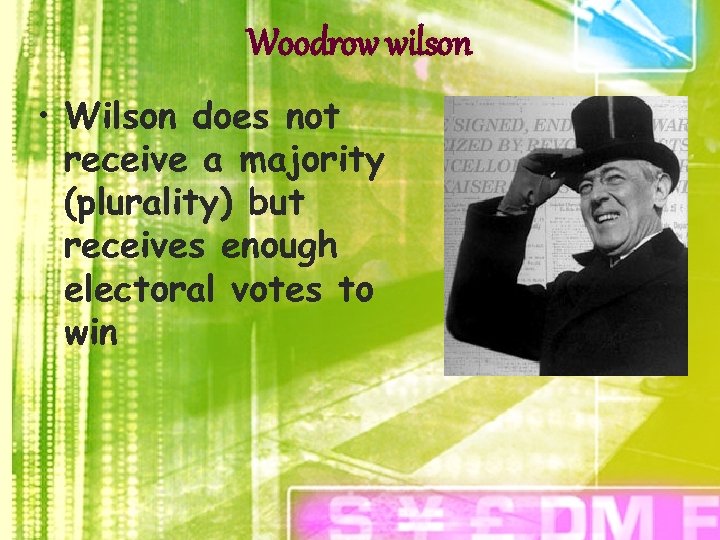 Woodrow wilson • Wilson does not receive a majority (plurality) but receives enough electoral votes to win
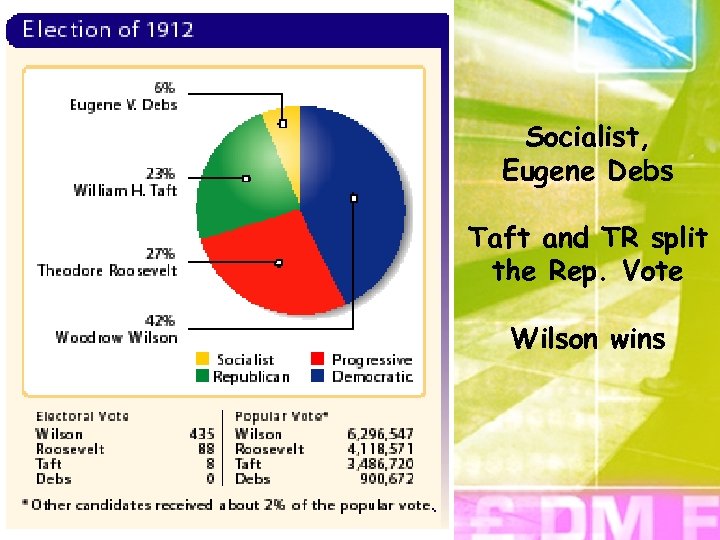 Socialist, Eugene Debs Taft and TR split the Rep. Vote Wilson wins
 The Progressive Era Section 5 Wilson’s New Freedom
 Woodrow wilson – new freedom • Wilson too was a progressive president but having different ideas how to give people more power • Wilson was deeply religious, a lawyer and former president of Princeton University • As the governor of NJ, he supported many progressive ideas
 Woodrow wilson – new freedom • To strengthen the Sherman Antitrust Act, Wilson pushed for the Clayton Antitrust Act which prohibited a merger if it developed into a monopoly • This did not apply to farmers or unions
 Woodrow wilson – new freedom • Wilson established the Federal Trade Commission to investigate industry for unlawful activity • He reduced tariffs under the Underwood Act, 1913 • To replace the revenue, he earners
 Woodrow wilson – new freedom • The average family made about $1500 year • The minimum income to warrant a tax was $4000 – and people bragged about having to pay it • By 1917 the revenue from income surpassed that of the tariffs
 Woodrow wilson – new freedom • Federal Reserve System – to regulate America’s banking system and, hopefully, to avoid depressions like the one in 1893, Wilson established the FED • It required bank inspections and regulates the amount of money in our economy
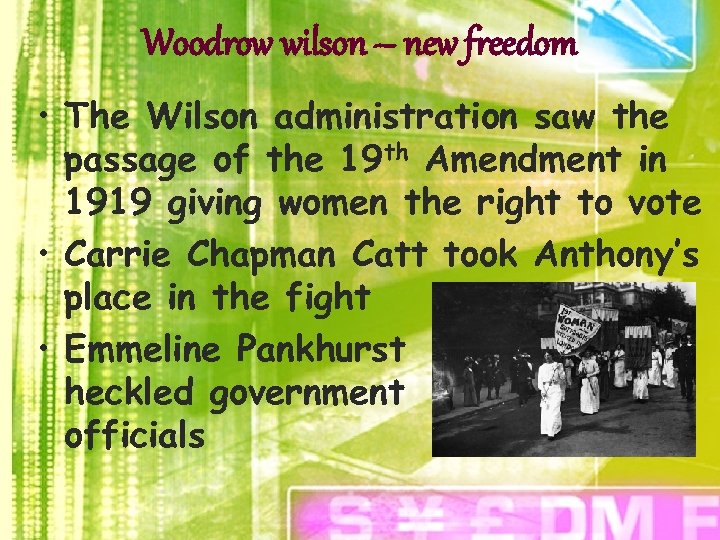 Woodrow wilson – new freedom • The Wilson administration saw the passage of the 19 th Amendment in 1919 giving women the right to vote • Carrie Chapman Catt took Anthony’s place in the fight • Emmeline Pankhurst heckled government officials
 Woodrow wilson – new freedom • Wilson returned to his southern roots with his attitude towards African Americans • He fired all blacks in the White House and enforced segregation in all federal jobs
 Woodrow wilson – new freedom • Wilson ran for re-election in 1916 with the slogan, “He kept us out of the war. ” • America did not want to become involved in Europe’s war and he was re-elected
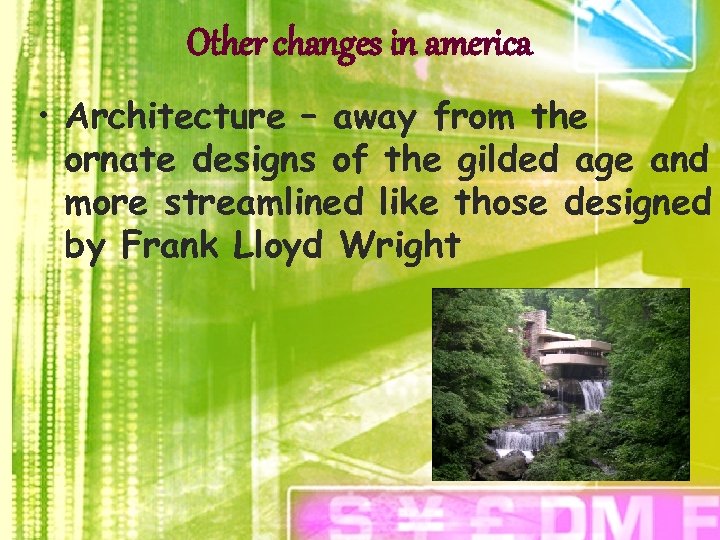 Other changes in america • Architecture – away from the ornate designs of the gilded age and more streamlined like those designed by Frank Lloyd Wright