


 Скачать презентацию THE PROGRESSIVE ERA 1900 -1917 CH 24 PART
e4b050e82be67e88fefabfa25984a873.ppt
- Количество слайдов: 39
 THE PROGRESSIVE ERA 1900 -1917 CH. 24 PART I, II
 SOCIETAL TRANSFORMATION u BETWEEN CLOSE OF RECONSTRUCTION, END OF WWI • “SOCIETY WITHOUT A CORE” CLOSE OF FRONTIER (1890) u SHIFT FROM FARM TO CITY u DECLINE OF SMALL BUSINESS u DEEP-FLOWING CURRENT FLOWING THROUGH PERIOD: REFORM MOVEMENTS u
 AMERICAN SHIFT u FUNDMENTAL SHIFT IN AMERICAN VALUES FROM THOSE OF SMALLTOWN 1880 s TO NEW BUREAUCRATIC-MINDED (GOVERNMENT) MIDDLE CLASS BY 1920
 HEART OF MOVEMENT ENSURE PROGRESS OF AMERICAN SOCIETY u “the real heart of the movement (was) to use government as an agency of human welfare” u
 MUCKRAKERS WRITERS WHO EXPOSED SOCIAL ILLS u Henry Demarest Lloyd Wealth Against Commonwealth (1894) u Jacob Riis How the Other Half Lives (1890) u Lincoln Steffens The Shame of the Cities (1904) u Ida M. Tarbell History of the Standard Oil Company (1904) u
 5 Elements of Progressivism 1. Democracy • Initiative (put measure on ballot) & Referendum (vote measure up or down) -procedures that allow voters to enact laws directly • Direct primary, recall (people to influence directly laws and politics) • Popular Election Senators -17 th Amendment (ratified in 1913)
 5 Elements of Progressivism 2. Efficiency – Reduce waste through careful management/analysis of labor process *In workplace and government Taylorism or Scientific Management (Frederick Winslow Taylor) *Use of specialists (experts from academia)
 5 Elements of Progressivism u 3. Regulation • Giant Corporations • Trust-Busting • Problem of regulating the regulators
 5 Elements of Progressivism 4. Social Justice *Government welfare *Social evils demanded government action *Labor legislation: banned child labor, addressed women in workplace (hrs. , working conditions)
 Supreme Court Inconsistencies Lochner v. New York (1905) – Court voided 10 hr. workday: violated workers’ “liberty of contract” u Muller v. Oregon (1908) – Court upheld 10 hr. workday for women for their health and morals (based on sociological study) u Bunting v. Oregon (1917)- Court accepted 10 -hr day men & women; no min. wage law for 20 years… u
 5 Elements of Progressivism u 5. Prohibition • Prohibit alcohol by merging religious piety with social ethics • Think saloons…. • Women’s Christian Temperance Union sought to make booze illegal since 1874 • Anti-Saloon League (1893)- single-issue pressure group • Alcohol Illegal: 18 th Amendment (1919) u Repealed by 21 st Amendment in 1933 (only amendment ever repealed)
 20 TH CENTURY LIBERALISM u Key Ideology Behind Progressivism • GOVERNMENT MORE ACTIVE • SOCIAL PROBLEMS SUSCEPTIBLE TO GOV’T ACTION AND LEGISLATION • THROW $ AT PROBLEM
 4 TYPES OF PROGRESIVE REFORM MATCHED WITH KEY WORD = REFORM Economic--"Monopoly" u Structural and Political--"Efficiency" u Social--"Democracy" u Moral--"Purity" u
 BASIC GOALS OF PROGRESSIVES They were moralists u Government, once purified, must act u Believed in protecting the weakest members of society u Usually didn’t challenge capitalism's basic tenets u Paternalistic, moderate, soft-minded u
 SIX ORIGINS OF PROGRESSIVE THOUGHT….
 1. “DISCOVERY OF POVERTY” u Poverty had always existed in American society, but a number of urban reformers began to call for new legislation to help the poor in the late 1870 s and early 1880 s.
 2. CHARITY MOVEMENT u Prior to the late 1870 s, there was no systematic method for social welfare, just individual charity groups funded by private donors. In 1877, however, reformers in Buffalo, New York, organized a citywide effort to coordinate local charities. This type of system eventually spread to other United States cities.
 3. EMANCIPATION OF WOMEN u The 1880 s saw the first generation of women--mostly white and middle- or upper-class--to graduate from college in large numbers. These women left college full of enthusiasm, but, for the most part, were shut of professions in medicine, law, science, and business. So, they often used their energies to battle social injustices.
 4. THE “SOCIAL GOSPEL” MOVEMENT u Up until the 1880 s, most Protestant ministers had not concerned themselves with the problems of industrial society. Rapid urbanization and industrialization, however, convinced many of them to fight for social justice. The goal of the Social Gospel movement was to make Christian churches more responsive to social problems like poverty and prostitution. Some ministers became known nationally as spokesmen for the Social Gospel, including Washington Gladden and Walter Rauschenbusch.
 5. SOCIAL SETTLEMENT MOVEMENT u The social settlement movement was formed as a ministry to immigrants and the urban poor. University-educated men and women (such as Jane Addams) settled in working-class neighborhoods to try and help the poor and learn about the real world. Most settlement houses started with clubs and classes, then campaigned for housing and labor reform. As they aided people, settlement houses also tried to instill middle-class values and often had a paternalistic attitude toward the poor.
 6. GOOD GOVERNMENT MOVEMENT u In the 1880 s, reformers organized clubs in several American cities in an effort to streamline government, to clean up corruption, and to turn municipalities into model corporations. The National Conference for Good City Government took place in Philadelphia in 1894. This was the starting point for many reformers who identified themselves with the Progressive movement. The keynote speaker was future President Theodore Roosevelt, who was the Chief of Police for New York City at the time. In his speech, Roosevelt preached morality and efficiency in city government. The founding of the National Municipal League was one crucial outcome of the National Conference for Good City Government. The League was a training ground for Progressives. It became an exchange network for various reform movements and still exists today.
 KEY PROGRESSIVE FIGURES u u u THEODORE ROOSEVELT “The conditions are now wholly different and wholly different action is called for” (social/economic conditions have changed since drafting of Constitution) WOODROW WILSON FRANKLIN D. ROOSEVELT LYNDON B. JOHNSON BARACK OBAMA
 WOODROW WILSON “Administrator” WILSON’S FAVORITE BOOK: PHILIP DRU: ADMINISTRATOR by Edward Mandell House (printed anonymously) u Wilson was fascinated by this book u Main character becomes a sinister dictator of America u Book advances the role of collectivism in U. S. policies u Edward House advisor to Wilson, room in White House u
 “SMARTER” GOVERNMENT u u u WAR HERO, GREAT GUY, EVERYONE LOVES HIM (PHILIP DRU), MASTERMIND BENEVOLENT DICTATOR (ADMINISTRATOR); CAN MAKE DECISIONS QUICKER BY CONSOLIDATING POWER: A SMARTER GOVERNMENT, MORE EFFICIENT RESULT: CHANGE CONSTITUTION, IN BOOK EVENTUALLY GO AROUND AND FORECEFULLY CHANGE ALL STATE CONSTITUTIONS
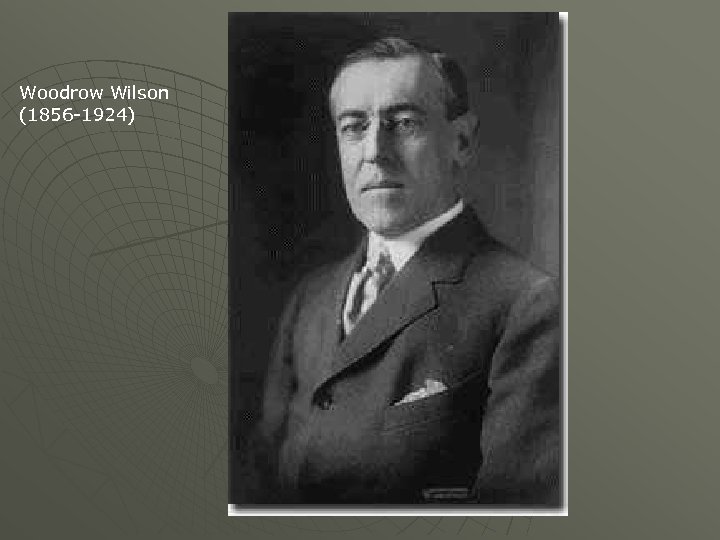 Woodrow Wilson (1856 -1924)
 PROGRESSIVISM & THE U. S. CONSTITUTION IS THE CONSTITUTION A LIVING, BREATHING DOCUMENT? u PROGRESSIVES: YES; CHANGING INTERPRETATIONS, CHANGING TIMES: CAN VIEW IN MORE ENLIGHTENED FORM AS SOCIETY PROGRESSES u CONSTRUCTIONISTS/ORIGINALISTS: NO; VIEW SOCIETY AS ORIGINALLY INTENDED/CONSTRUCTED BY FOUNDERS u
 HOW WOULD CONSTRUCTIONIST /ORIGINALIST INTERPRETATION BE POSSIBLE? u SUPREME COURT USES FEDERALIST PAPERS, WRITINGS OF FOUNDERS TO INTERPRET CONSTITUTION
 PROGRESSIVE ERA u THE INTERPRETATION OF THE CONSTITUTION GRADUALLY BEGINS TO CHANGE…. . ULTIMATELY PROGRESSIVES EMPOWER THE FEDERAL GOVERNMENT VIA THE JUDICIAL SYSTEM, BY THE CENTRALIZATION OF POWER AND THE RISE OF THE ADMINSTRATIVE STATE
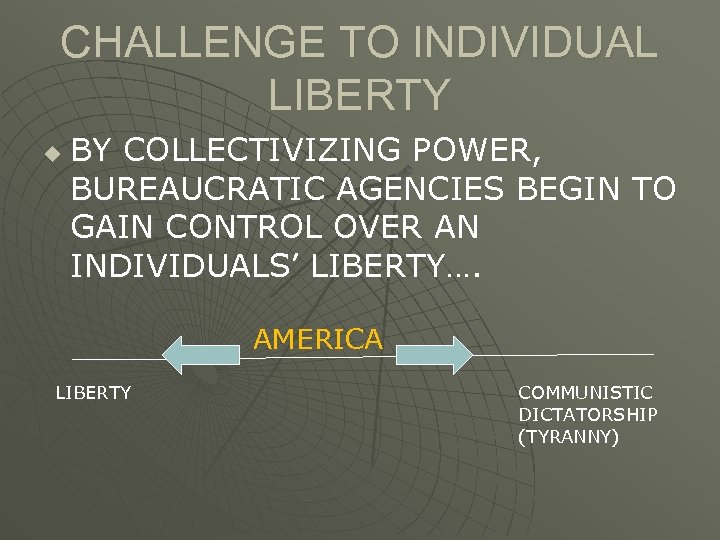 CHALLENGE TO INDIVIDUAL LIBERTY u BY COLLECTIVIZING POWER, BUREAUCRATIC AGENCIES BEGIN TO GAIN CONTROL OVER AN INDIVIDUALS’ LIBERTY…. AMERICA LIBERTY COMMUNISTIC DICTATORSHIP (TYRANNY)
 THEODORE ROOSEVELT u GREATLY EXPANDED: • ROLE, POWER, VISIBILITY OF OFFICE OF PRESIDENT • AUTHORITY, SCOPE OF FEDERAL GOVT. u ROOSEVELT’S SON: “Father always wanted to be the bride at every wedding and the corpse at every funeral. ”
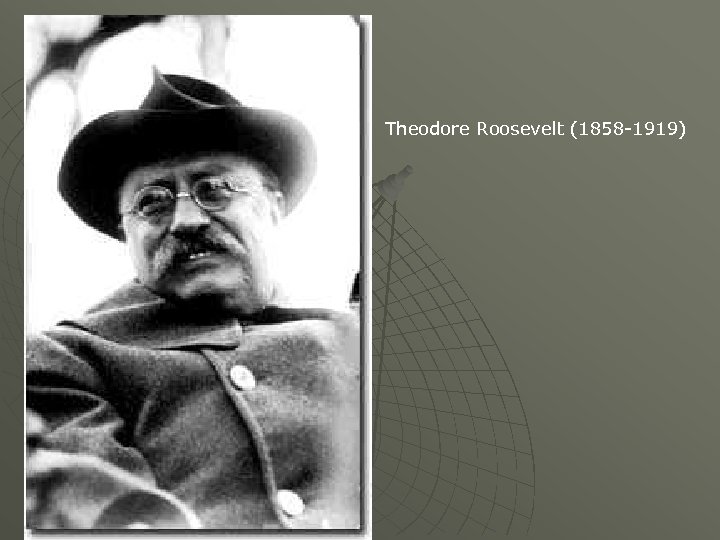 Theodore Roosevelt (1858 -1919)
 WILLIAM MCKINLEY Assassinated in 1901 by anarchist Leon Czolgosz @ Pan-American Exposition in Buffalo, NY (had just visited Niagara Falls) u Died of infection (gangrene) after a surgery by gynecologist (only doctor available) u
 Enter Teddy Roosevelt Sept. 14, 1901: Roosevelt Sworn In u Month later Czolgosz died in electric chair u Born into wealth in New York u Visited Europe as child; spoke German fluently u Harvard grad w/ honors 1880 u Sickly, scrawny boy w/ asthma, poor eyesight, became strong via physical activity u
 Roosevelt (cont. ) Boxer, wrestler, mountain climber, hunter, outdoorsman, intellectual curiosity u Author of 38 books u Fiercely competitive, boundless energy u Enter politics after graduating from Harvard u
 Disaster & Heartbreak u Valentines Day 1884 • Mother & wife died on same day • Wife died after complications (kidney failure) after giving birth to daughter Alice • Double funeral: Even the minister cried throughout the whole service u After the “strange and terrible fate, ” Roosevelt sought solace in the American West
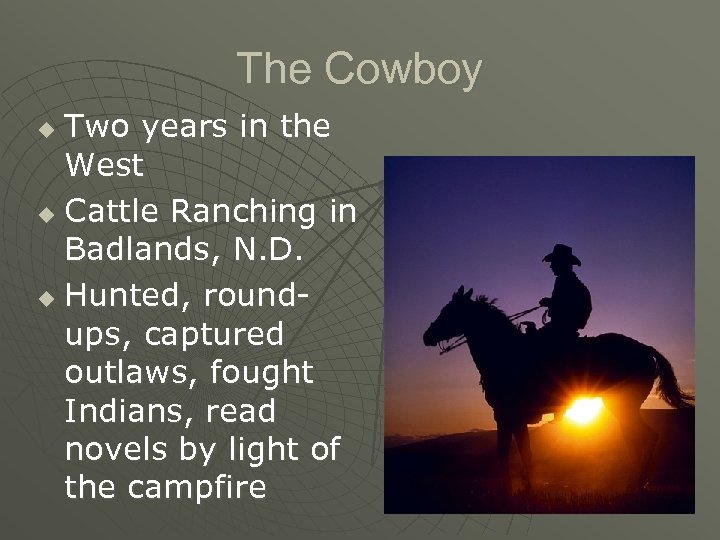 The Cowboy Two years in the West u Cattle Ranching in Badlands, N. D. u Hunted, roundups, captured outlaws, fought Indians, read novels by light of the campfire u
 Back in the Saddle Back in the Political Saddle, Roosevelt soon rises to the Presidency…. u Big Stick Diplomacy: Roosevelt Corollary – U. S. Action in Latin America justified to prevent action(s) by outsiders u • Supplemented Monroe Doctrine: European Powers stay out of Western Hemisphere
 Open Door Policy Supported Independence and Integrity of China u Equal Opportunity for Commerce and Industry in China u Anti-Asian sentiment in U. S. : Distrust of the “yellow peril” (coined by Kaiser Wilhelm II of Germany) u Gentlemen’s Agreement (1907) – halted Japanese immigrants into America u
 The Panama Canal French disaster…. u U. S. in position to take over project u Roosevelt: “I took the Canal Zone and let Congress debate; and while the debate goes on the Canal does also. ” u Canal construction: 1904 -1914, opened two weeks after WWI outbreak, August 15, 1914 u