


 Скачать презентацию The Progressive Era 1890 1920 The nation faces
7045e1a57a73512234c03e06ed81e575.ppt
- Количество слайдов: 49
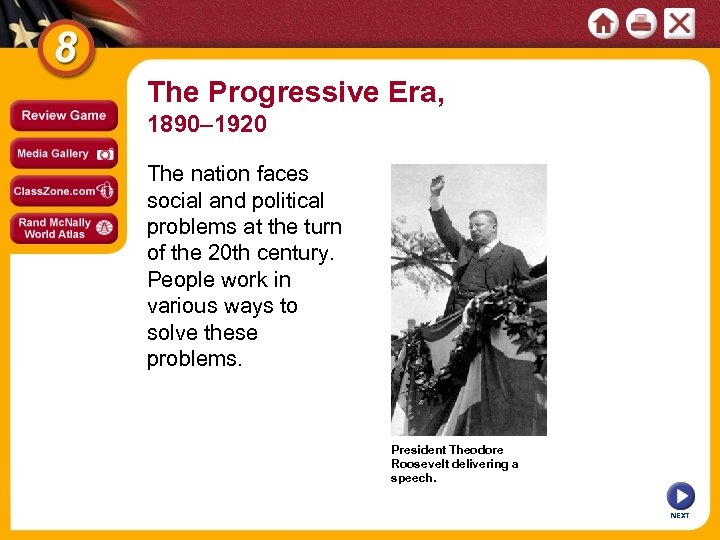 The Progressive Era, 1890– 1920 The nation faces social and political problems at the turn of the 20 th century. People work in various ways to solve these problems. President Theodore Roosevelt delivering a speech. NEXT
 The Progressive Era, 1890– 1920 SECTION 1 Roosevelt and Progressivism SECTION 2 Taft and Wilson as Progressives Quiz Women Win New Rights SECTION 3 Review Test NEXT
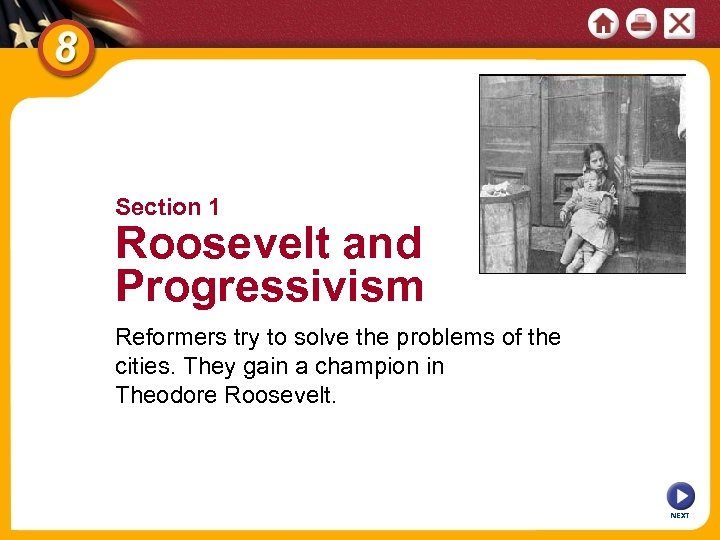 Section 1 Roosevelt and Progressivism Reformers try to solve the problems of the cities. They gain a champion in Theodore Roosevelt. NEXT
 SECTION 1 Roosevelt and Progressivism The Rise of Progressivism • Rapid growth of U. S. cities brings many problems, including: - poverty - spread of slums - poor conditions in factories • Reform movements organize, believe in goodness of people, democracy • Reform movements come to be grouped under the label progressivism. Movements to improve society Continued. . . NEXT
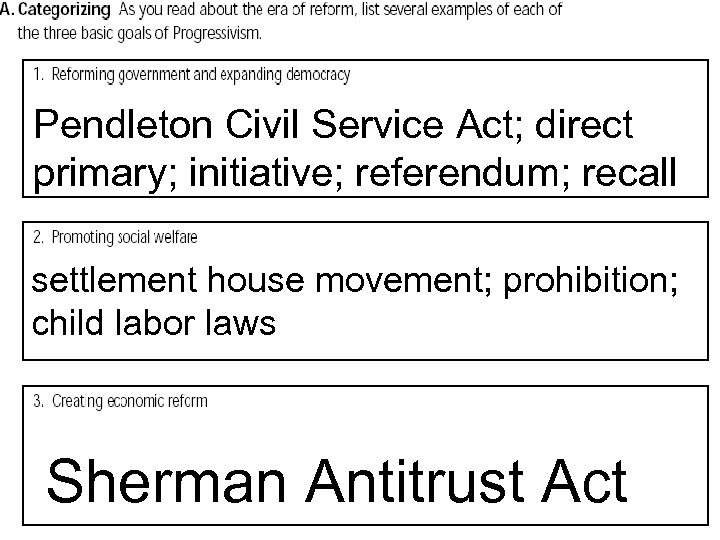
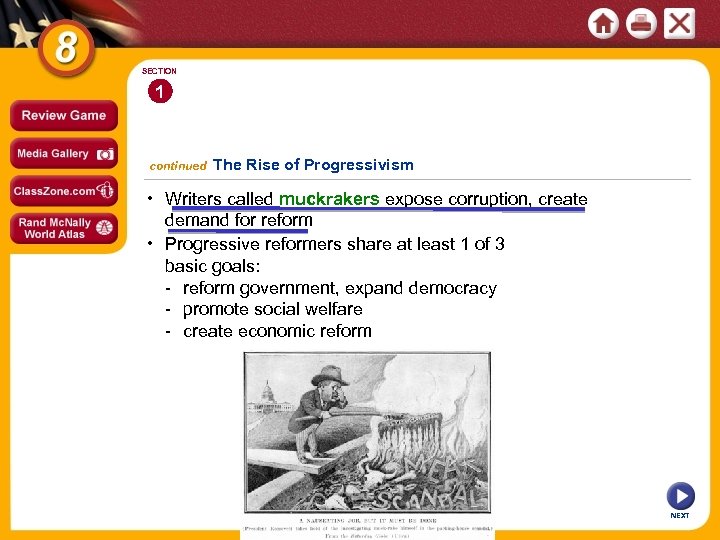 SECTION 1 continued The Rise of Progressivism • Writers called muckrakers expose corruption, create demand for reform • Progressive reformers share at least 1 of 3 basic goals: - reform government, expand democracy - promote social welfare - create economic reform NEXT
 SECTION 1 Reforming Government and Expanding Democracy • Patronage—elected officials give jobs, contracts for political support • Pendleton Civil Service Act (1883): - requires people to take civil service exam for certain government jobs - stops officials from firing civil service workers for political reasons Continued. . . NEXT
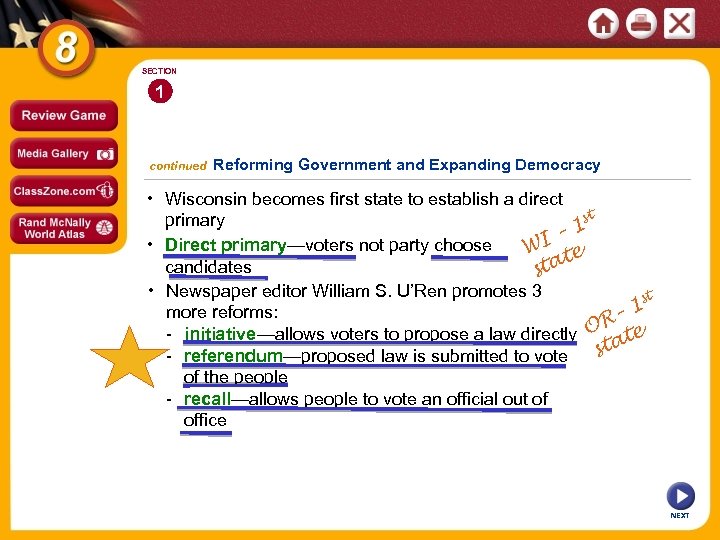 SECTION 1 continued Reforming Government and Expanding Democracy • Wisconsin becomes first state to establish a direct st primary 1 – • Direct primary—voters not party choose WI te candidates sta • Newspaper editor William S. U’Ren promotes 3 st 1 more reforms: – OR te - initiative—allows voters to propose a law directly sta - referendum—proposed law is submitted to vote of the people - recall—allows people to vote an official out of office NEXT
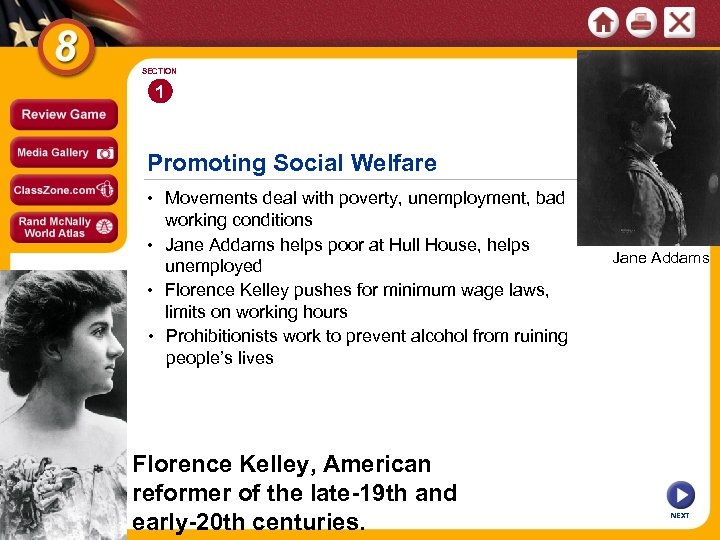 SECTION 1 Promoting Social Welfare • Movements deal with poverty, unemployment, bad working conditions • Jane Addams helps poor at Hull House, helps unemployed • Florence Kelley pushes for minimum wage laws, limits on working hours • Prohibitionists work to prevent alcohol from ruining people’s lives Florence Kelley, American reformer of the late-19 th and early-20 th centuries. Jane Addams NEXT
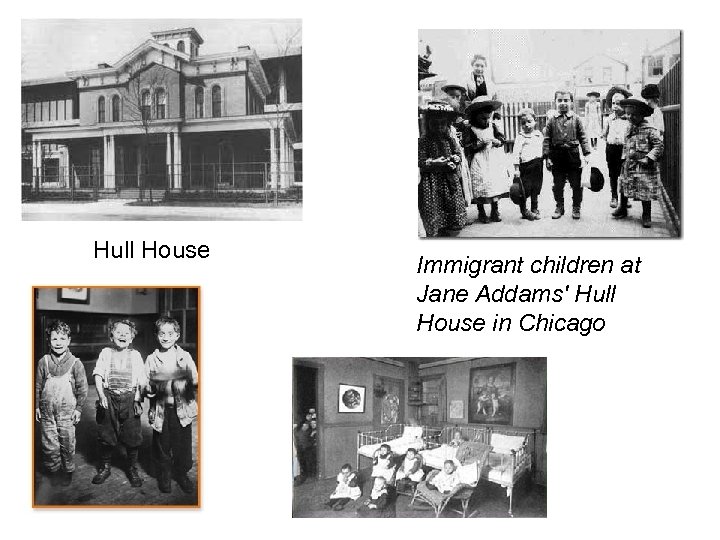 Hull House Immigrant children at Jane Addams' Hull House in Chicago
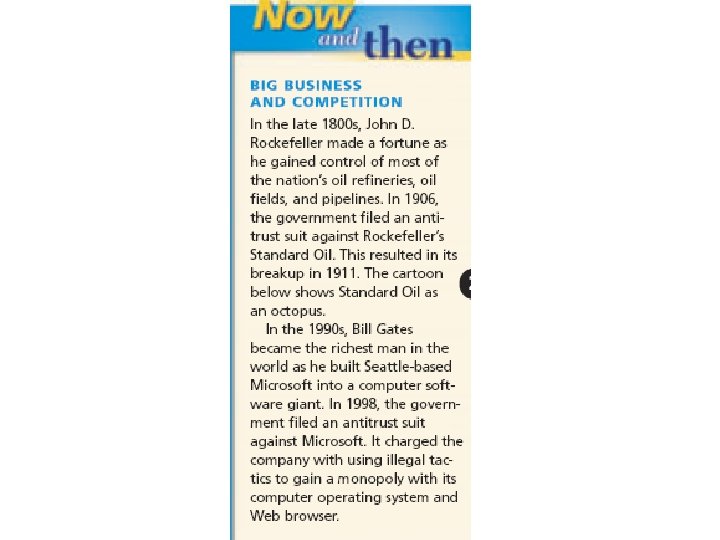
 SECTION 1 Creating Economic Reform t • Economic reform limits, regulates big business mi i ol T • Sherman Antitrust Act of 1890: f e - illegal for corporations to use trusts to gain th er o w control of industries po s - government does not enforce law at first big ines s bu • Enforcement requires a strong president NEXT
 Pendleton Civil Service Act; direct primary; initiative; referendum; recall settlement house movement; prohibition; child labor laws Sherman Antitrust Act
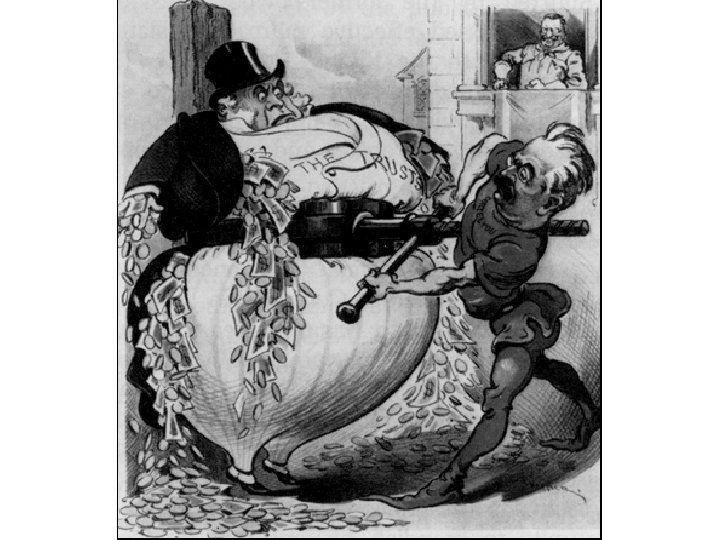
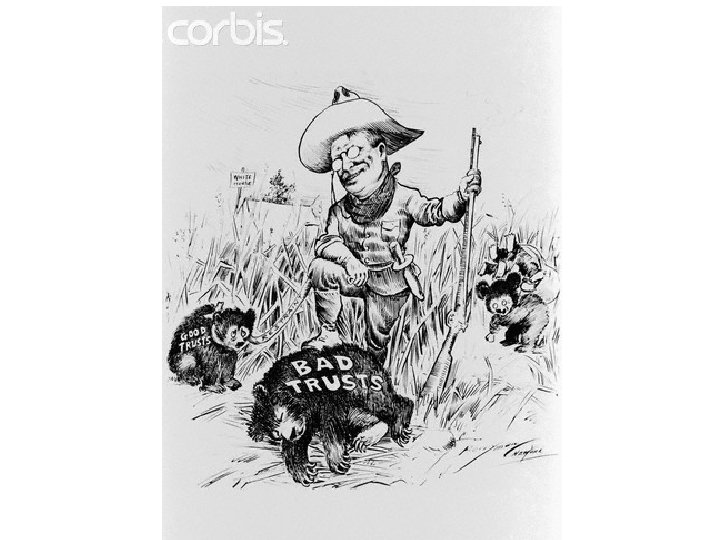
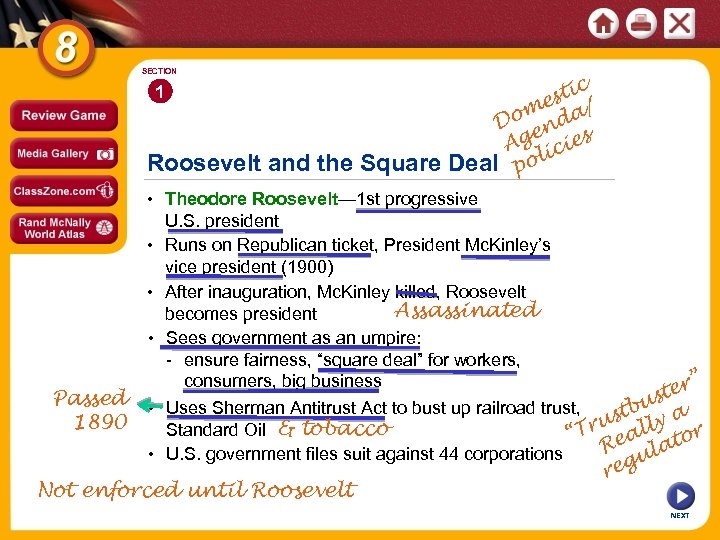 SECTION 1 Roosevelt and the Square Passed 1890 c sti e om da/ D en Ag icies Deal pol • Theodore Roosevelt— 1 st progressive U. S. president • Runs on Republican ticket, President Mc. Kinley’s vice president (1900) • After inauguration, Mc. Kinley killed, Roosevelt Assassinated becomes president • Sees government as an umpire: - ensure fairness, “square deal” for workers, ” consumers, big business ter s • Uses Sherman Antitrust Act to bust up railroad trust, bu a ust lly Standard Oil & tobacco “Tr ea tor R • U. S. government files suit against 44 corporations ula Not enforced until Roosevelt reg NEXT
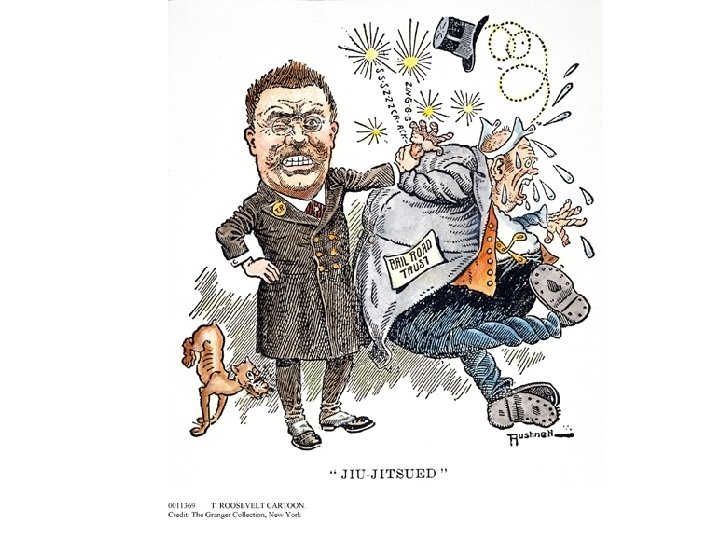
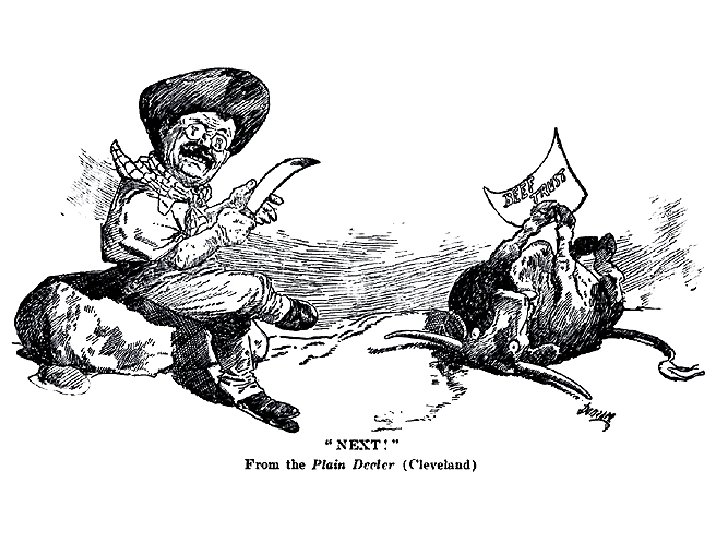
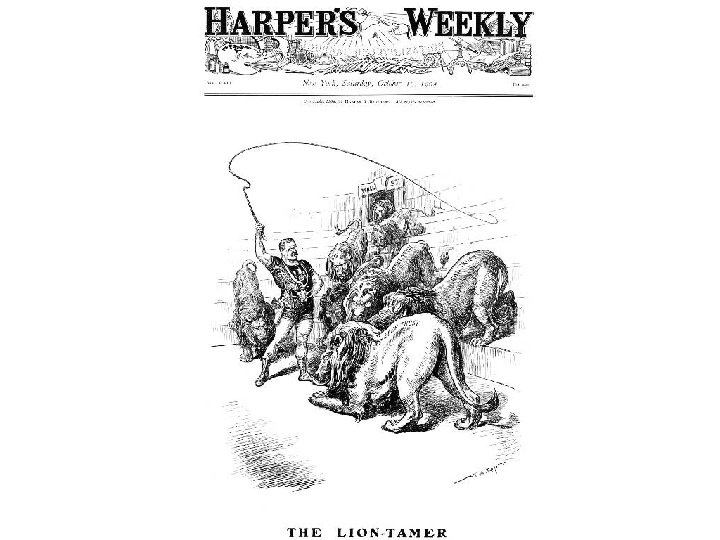
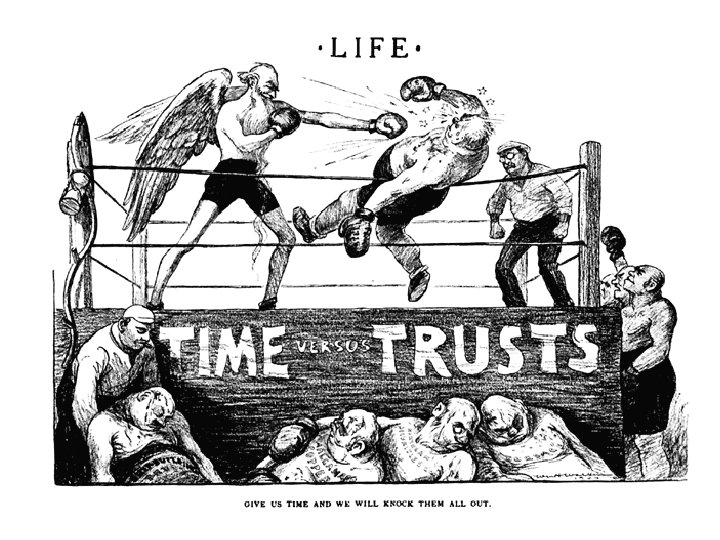
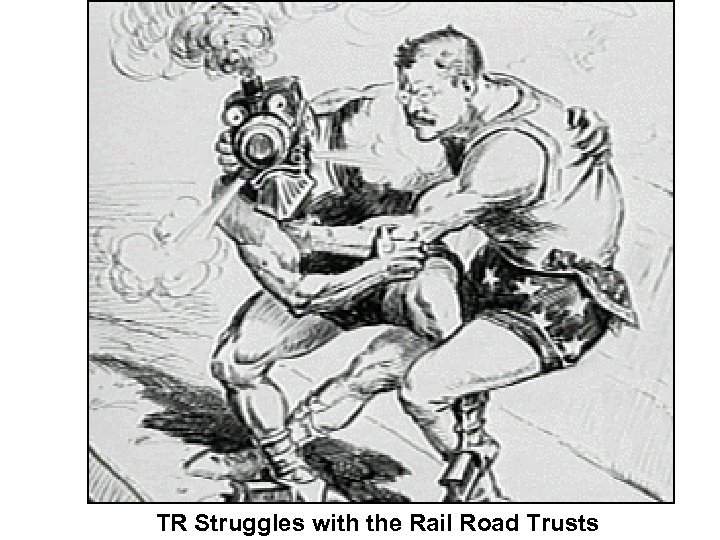 TR Struggles with the Rail Road Trusts
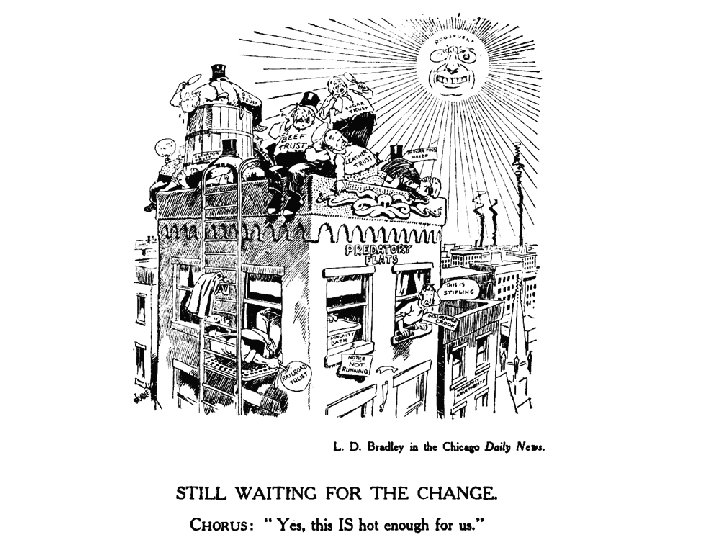
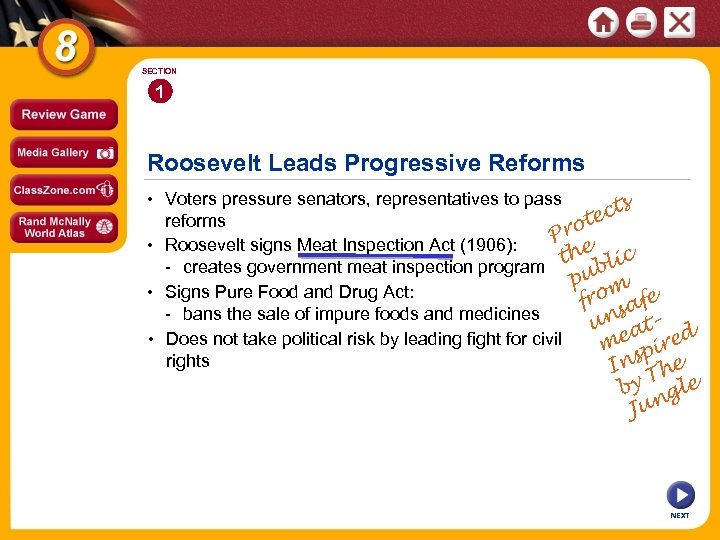 SECTION 1 Roosevelt Leads Progressive Reforms • Voters pressure senators, representatives to pass s ect reforms rot P • Roosevelt signs Meat Inspection Act (1906): the lic - creates government meat inspection program b pu m • Signs Pure Food and Drug Act: fro safe - bans the sale of impure foods and medicines un at– d • Does not take political risk by leading fight for civil me pire s rights e In h y T gle b n Ju NEXT
 “I aimed at the public’s heart, and by accident I hit it in the stomach, ”
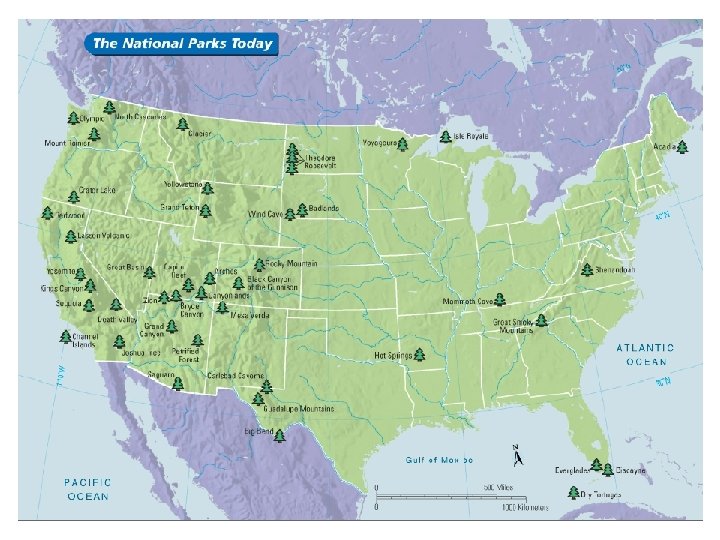
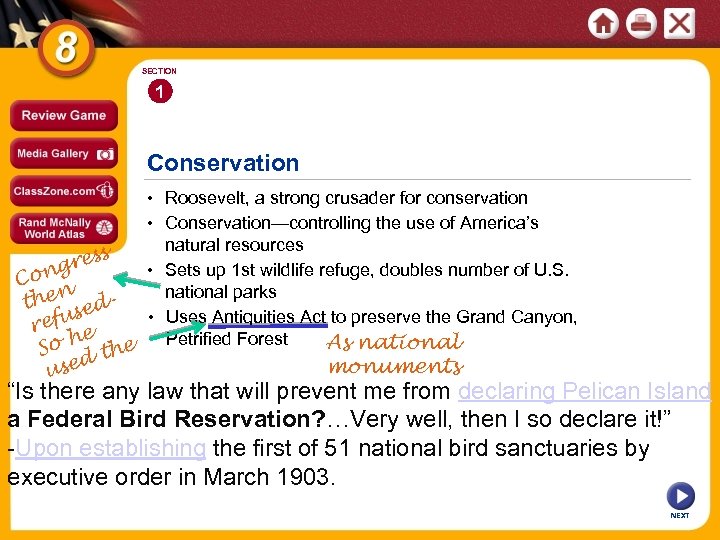 SECTION 1 Conservation • Roosevelt, a strong crusader for conservation • Conservation—controlling the use of America’s natural resources ss e • Sets up 1 st wildlife refuge, doubles number of U. S. ngr Co national parks n the sed • Uses Antiquities Act to preserve the Grand Canyon, refu e Petrified Forest As national So h the d monuments use “Is there any law that will prevent me from declaring Pelican Island a Federal Bird Reservation? …Very well, then I so declare it!” -Upon establishing the first of 51 national bird sanctuaries by executive order in March 1903. NEXT
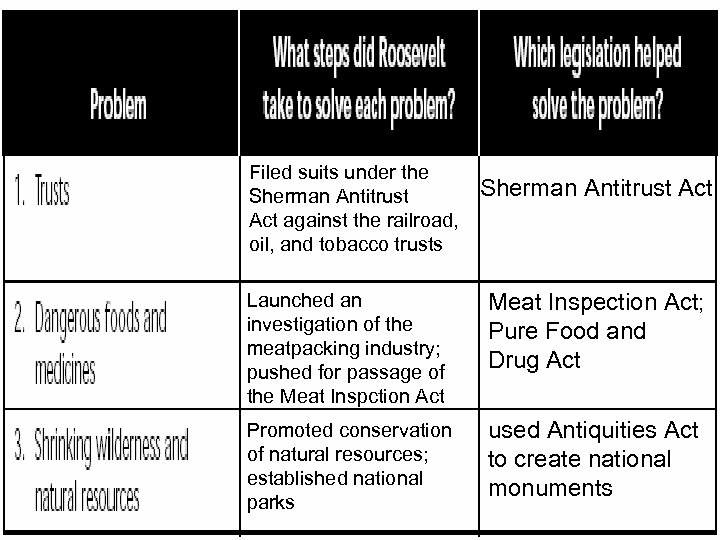 Filed suits under the Sherman Antitrust Act against the railroad, oil, and tobacco trusts Sherman Antitrust Act Launched an investigation of the meatpacking industry; pushed for passage of the Meat Inspction Act Meat Inspection Act; Pure Food and Drug Act Promoted conservation of natural resources; established national parks used Antiquities Act to create national monuments
 Section 2 Taft and Wilson as Progressive reforms continue under William Howard Taft and Woodrow Wilson. NEXT
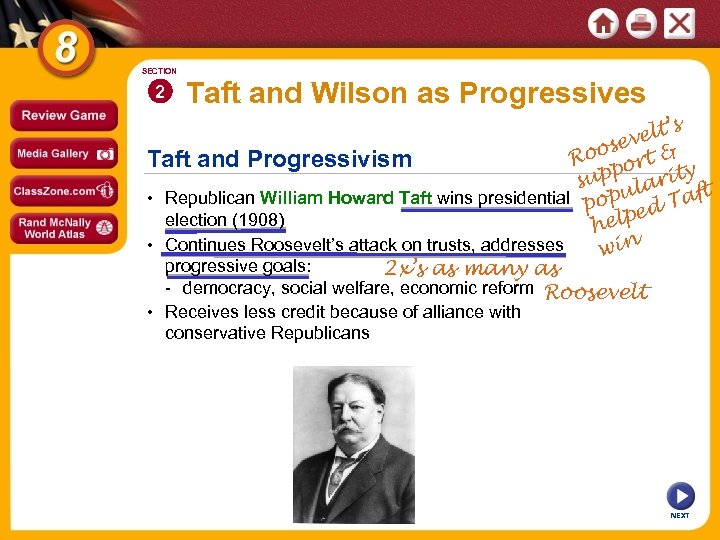 SECTION 2 Taft and Wilson as Progressives ’s velt e oos rt & R Taft and Progressivism o upp larity s t • Republican William Howard Taft wins presidential popu Taf lped election (1908) he • Continues Roosevelt’s attack on trusts, addresses win progressive goals: 2 x’s as many as - democracy, social welfare, economic reform Roosevelt • Receives less credit because of alliance with conservative Republicans NEXT
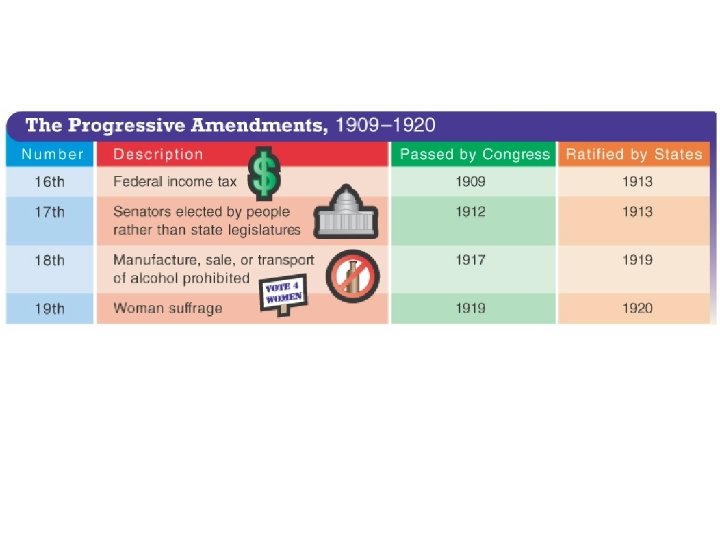
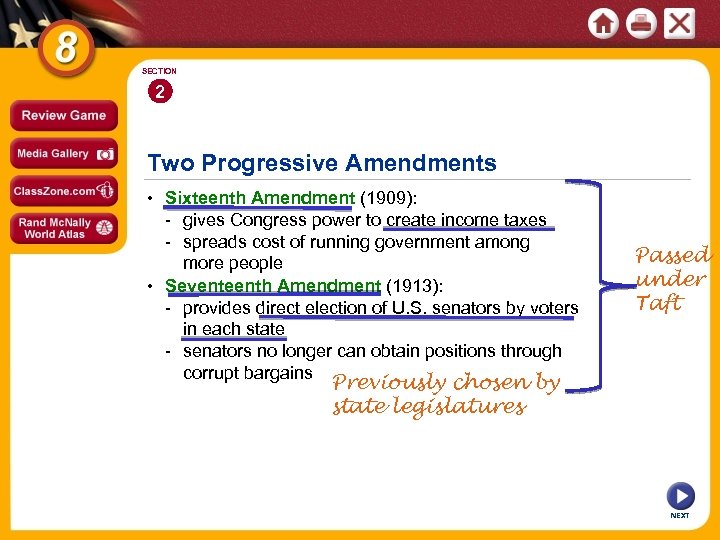 SECTION 2 Two Progressive Amendments • Sixteenth Amendment (1909): - gives Congress power to create income taxes - spreads cost of running government among more people • Seventeenth Amendment (1913): - provides direct election of U. S. senators by voters in each state - senators no longer can obtain positions through corrupt bargains Passed under Taft Previously chosen by state legislatures NEXT
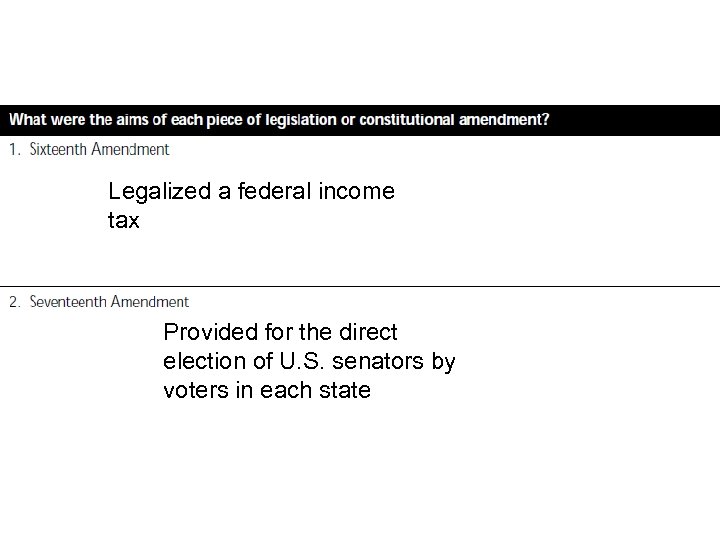 Legalized a federal income tax Provided for the direct election of U. S. senators by voters in each state
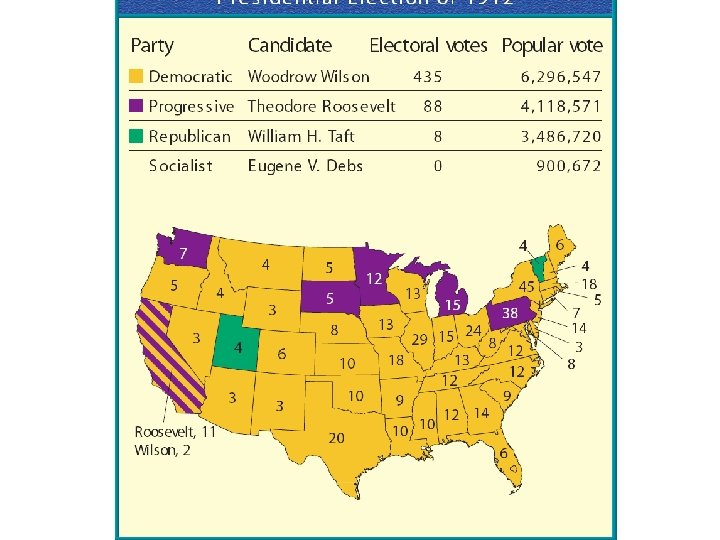
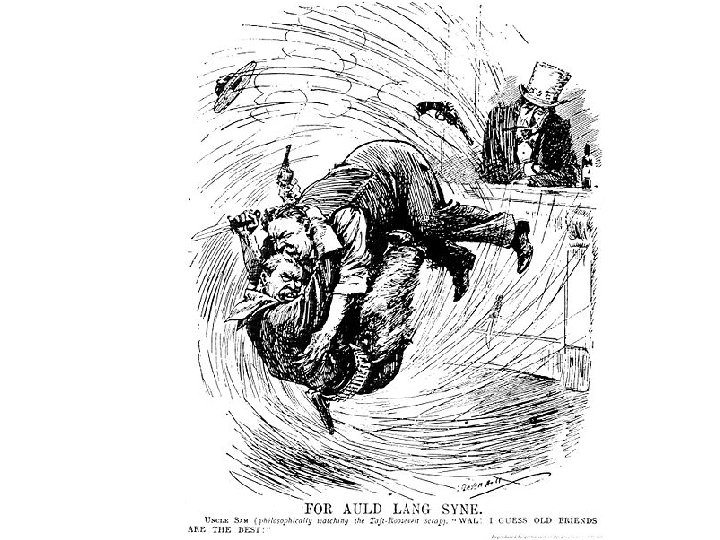
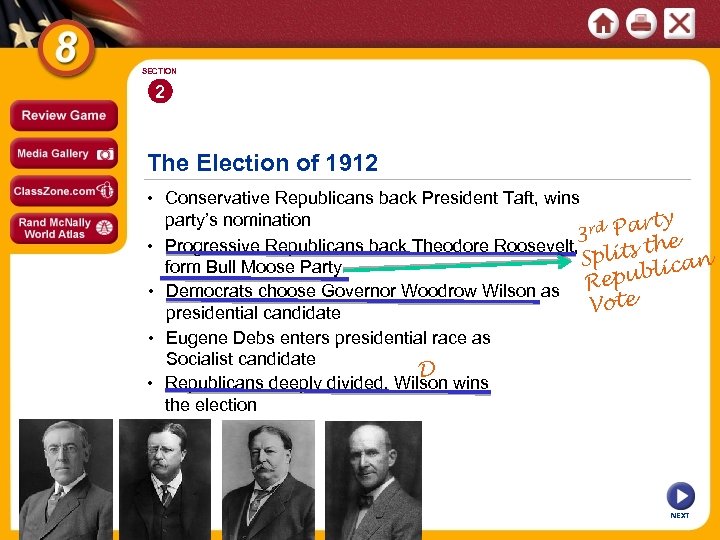 SECTION 2 The Election of 1912 • Conservative Republicans back President Taft, wins party’s nomination y rd Part 3 e • Progressive Republicans back Theodore Roosevelt, lits th an Sp form Bull Moose Party lic epub • Democrats choose Governor Woodrow Wilson as R Vote presidential candidate • Eugene Debs enters presidential race as Socialist candidate D • Republicans deeply divided, Wilson wins the election NEXT
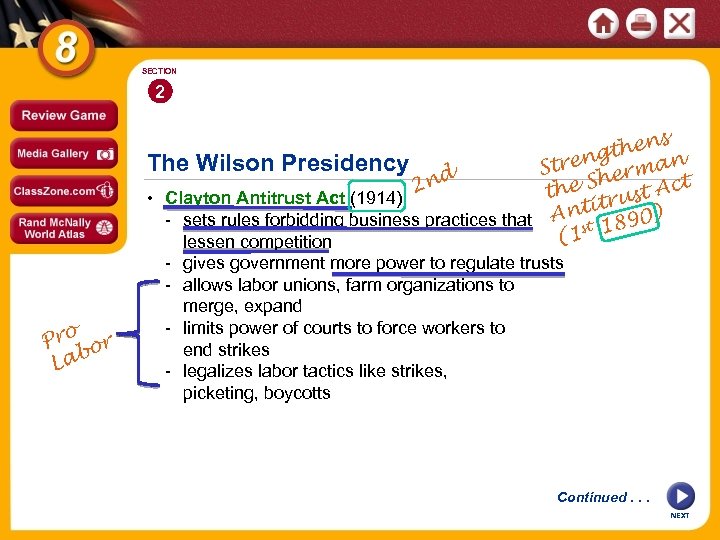 SECTION 2 s then n ng The Wilson Presidency d a Stre erm ct Sh 2 n the rust A • Clayton Antitrust Act (1914): t Antti 890) - sets rules forbidding business practices that s 1 (1 lessen competition Pro or b La - gives government more power to regulate trusts - allows labor unions, farm organizations to merge, expand - limits power of courts to force workers to end strikes - legalizes labor tactics like strikes, picketing, boycotts Continued. . . NEXT
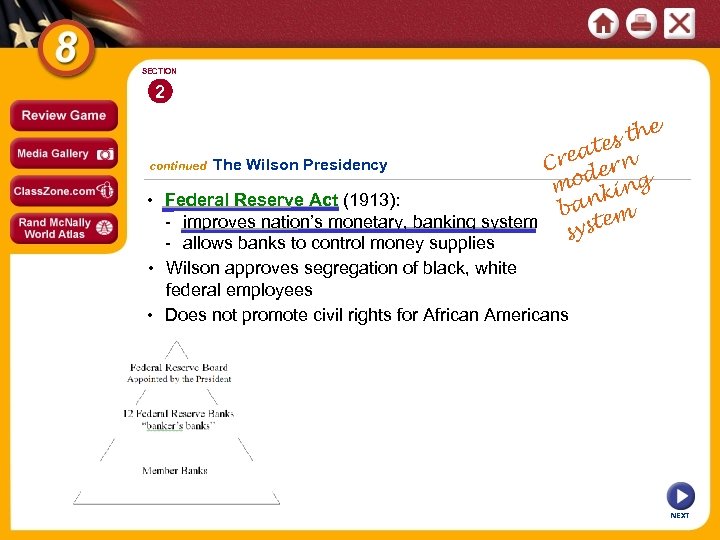 SECTION 2 e s th e eat n continued The Wilson Presidency Cr r ode ng m • Federal Reserve Act (1913): nki ba m e - improves nation’s monetary, banking system syst - allows banks to control money supplies • Wilson approves segregation of black, white federal employees • Does not promote civil rights for African Americans NEXT
 SECTION 2 The Eighteenth Amendment • Supporters of prohibition gain strength during Wilson’s presidency • Congress passes 18 th Amendment (1917): - prohibits manufacture, sale of n alcoholic beverages ibitio proh NEXT
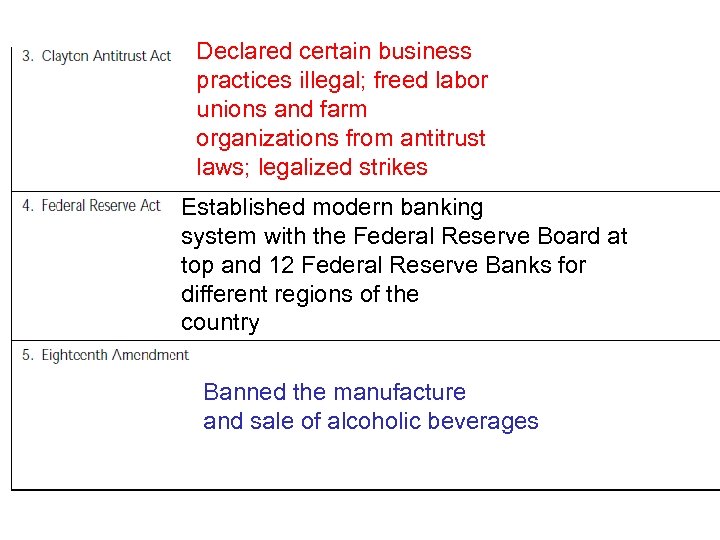 Declared certain business practices illegal; freed labor unions and farm organizations from antitrust laws; legalized strikes Established modern banking system with the Federal Reserve Board at top and 12 Federal Reserve Banks for different regions of the country Banned the manufacture and sale of alcoholic beverages
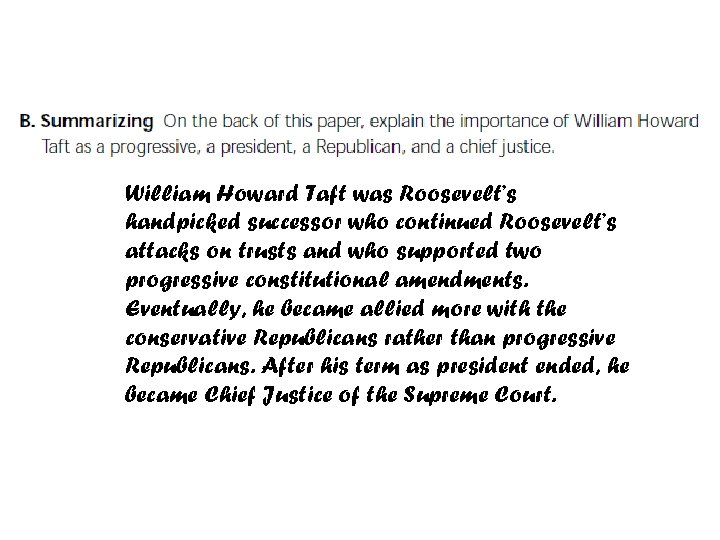 William Howard Taft was Roosevelt’s handpicked successor who continued Roosevelt’s attacks on trusts and who supported two progressive constitutional amendments. Eventually, he became allied more with the conservative Republicans rather than progressive Republicans. After his term as president ended, he became Chief Justice of the Supreme Court.
 Section 3 Women Win New Rights Women become leaders in social reform movements and win the right to vote during the Progressive Era. NEXT
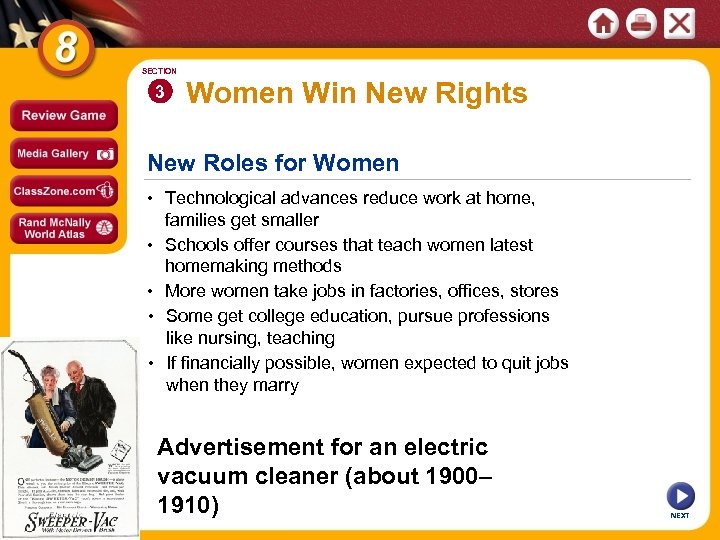 SECTION 3 Women Win New Rights New Roles for Women • Technological advances reduce work at home, families get smaller • Schools offer courses that teach women latest homemaking methods • More women take jobs in factories, offices, stores • Some get college education, pursue professions like nursing, teaching • If financially possible, women expected to quit jobs when they marry Advertisement for an electric vacuum cleaner (about 1900– 1910) NEXT
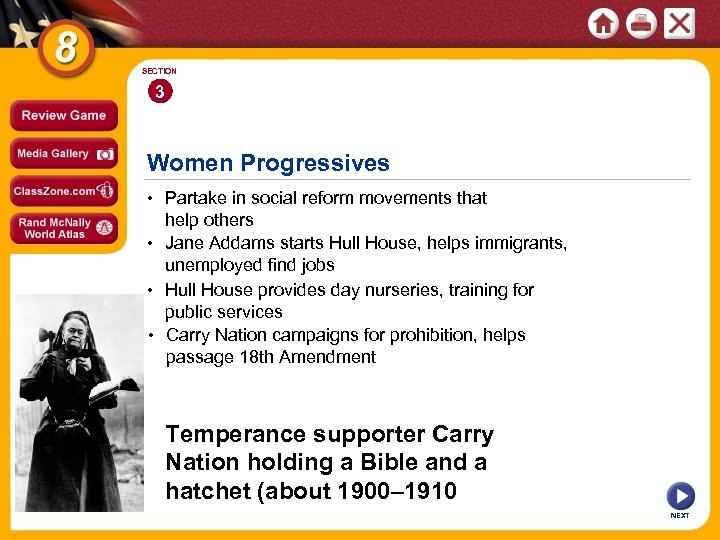 SECTION 3 Women Progressives • Partake in social reform movements that help others • Jane Addams starts Hull House, helps immigrants, unemployed find jobs • Hull House provides day nurseries, training for public services • Carry Nation campaigns for prohibition, helps passage 18 th Amendment Temperance supporter Carry Nation holding a Bible and a hatchet (about 1900– 1910 NEXT
 SECTION 3 Suffrage for Women • 2 woman suffrage groups merge • Form National American Woman Suffrage Association (NAWSA) • Elizabeth Cady Stanton is 1 st president • Susan B. Anthony becomes group’s president (1892) • NAWSA focuses on state campaigns to win right to vote • By 1914, 11 Western states approved suffrage NEXT
 SECTION 3 The Nineteenth Amendment • Tide turns in favor of woman suffrage, U. S. enters WW I (1917) • Carrie Chapman Catt president of NAWSA • Catt argues U. S. cannot deny vote to women who support war effort • President Wilson urges Senate to pass woman suffrage amendment • U. S. states ratify Nineteenth Amendment (1920): - gives women full voting rights NEXT
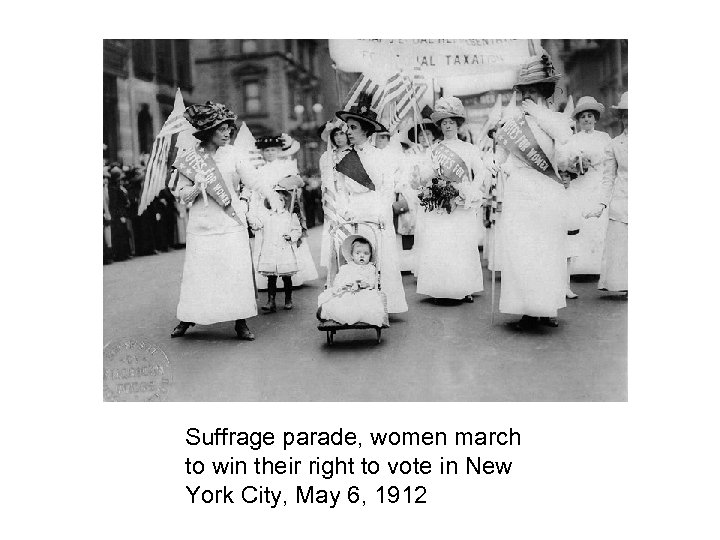 Suffrage parade, women march to win their right to vote in New York City, May 6, 1912
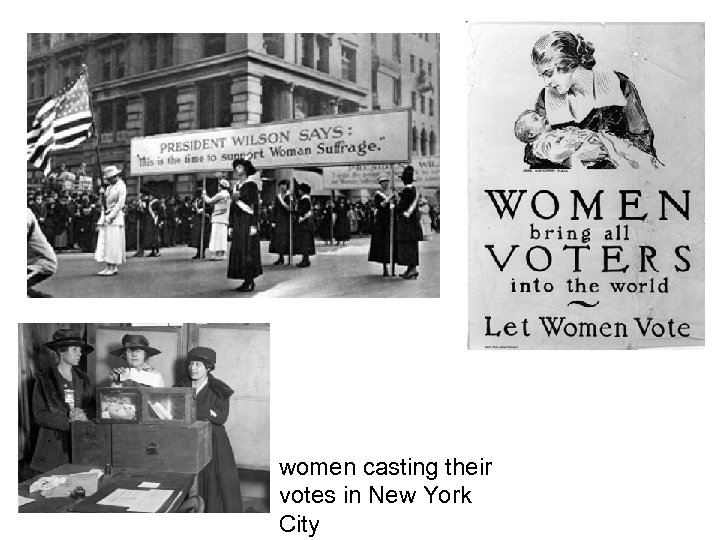 women casting their votes in New York City
 This is the end of the chapter presentation of lecture notes. Click the HOME or EXIT button. NEXT
 Print Slide Show 1. On the File menu, select Print 2. In the pop-up menu, select Microsoft Power. Point If the dialog box does not include this pop-up, continue to step 4 3. In the Print what box, choose the presentation format you want to print: slides, notes, handouts, or outline 4. Click the Print button to print the Power. Point presentation Print Text Version 1. Click the Print Text button below; a text file will open in Adobe Acrobat 2. On the File menu, select Print 3. Click the Print button to print the entire document, or select the pages you want to print Print Text BACK