


 Скачать презентацию The Product Design Process n Concept Development n
49294b35f3e2974da5fabed6d9881d56.ppt
- Количество слайдов: 32
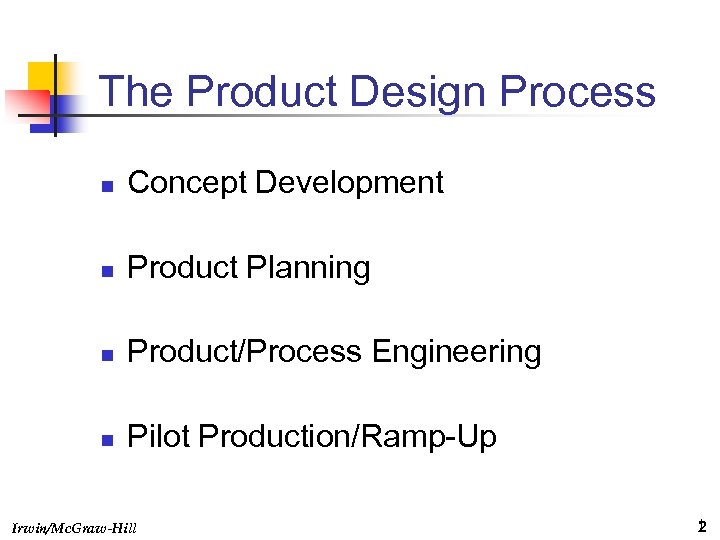 The Product Design Process n Concept Development n Product Planning n Product/Process Engineering n Pilot Production/Ramp-Up Irwin/Mc. Graw-Hill 1 2
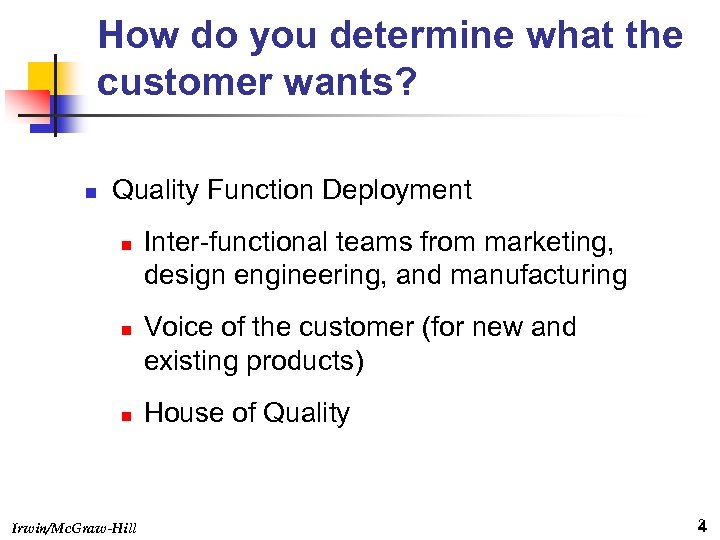 How do you determine what the customer wants? n Quality Function Deployment n n n Irwin/Mc. Graw-Hill Inter-functional teams from marketing, design engineering, and manufacturing Voice of the customer (for new and existing products) House of Quality 2 4
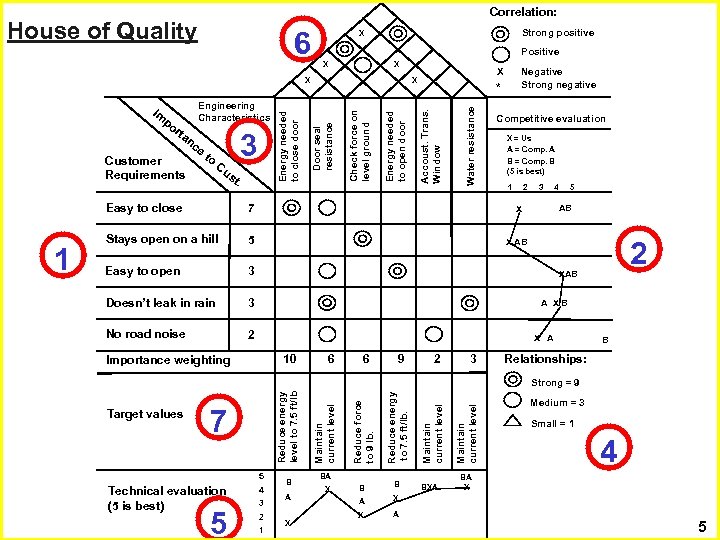 Correlation: 6 Strong positive X Positive X X st. * Water resistance 3 Cu Energy needed to open door to Check force on level ground Customer Requirements nc e Door seal resistance po rta Engineering Characteristics Energy needed to close door Im Negative Strong negative X X X Accoust. Trans. Window House of Quality Competitive evaluation X = Us A = Comp. A B = Comp. B (5 is best) 1 2 Easy to close X Stays open on a hill 5 Easy to open 3 Doesn’t leak in rain 3 No road noise 2 4 5 X AB AB 2 XAB A XB X A 10 Importance weighting 6 6 9 2 3 B Relationships: 5 Technical evaluation (5 is best) 5 4 3 2 1 B A X B B A A BXA Maintain current level Medium = 3 Small = 1 4 BA X X X Maintain current level Reduce energy to 7. 5 ft/lb. 7 Reduce force to 9 lb. Target values Maintain current level Strong = 9 Reduce energy level to 7. 5 ft/lb 1 7 3 5
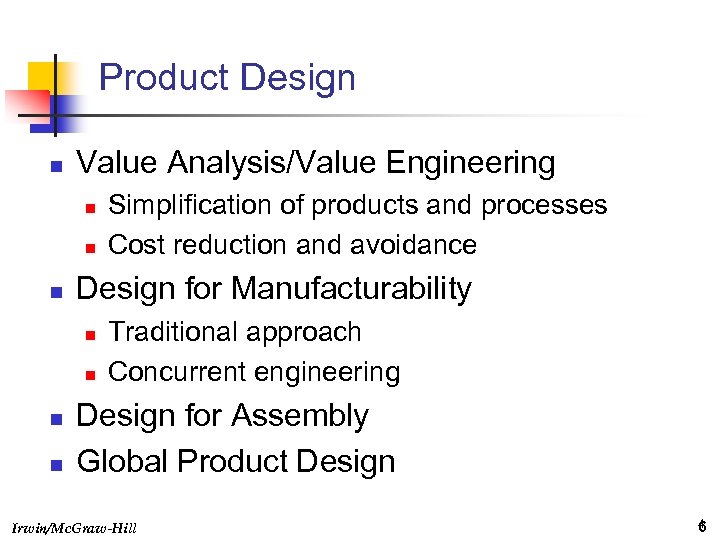 Product Design n Value Analysis/Value Engineering n n n Design for Manufacturability n n Simplification of products and processes Cost reduction and avoidance Traditional approach Concurrent engineering Design for Assembly Global Product Design Irwin/Mc. Graw-Hill 4 6
 Concurrent Engineering n Concurrent engineering can be defined as the simultaneous development of design functions, with open and interactive communication existing among all team members for the purpose of: n reducing time to market n decreasing cost n improving quality and reliability Irwin/Mc. Graw-Hill 5 3
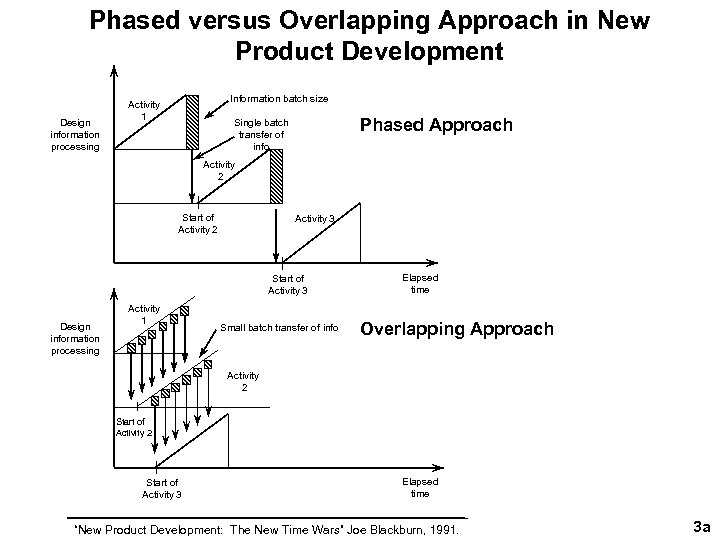 Phased versus Overlapping Approach in New Product Development Design information processing Information batch size Activity 1 Phased Approach Single batch transfer of info Activity 2 Start of Activity 2 Activity 3 Start of Activity 3 Design information processing Activity 1 Small batch transfer of info Elapsed time Overlapping Approach Activity 2 Start of Activity 3 Elapsed time ______________________________ “New Product Development: The New Time Wars” Joe Blackburn, 1991. 3 a
 Types of Processes n Conversion - e. g. , creating steel from iron ore n Fabrication - e. g. , forming steel into cans n n Assembly - e. g. , put cans, lids and ingredients together Testing - e. g. , testing for sealed weight Irwin/Mc. Graw-Hill 7 7
 Process Flow Structures n Job shop n Batch n Assembly Line n Continuous Flow Irwin/Mc. Graw-Hill 8 8
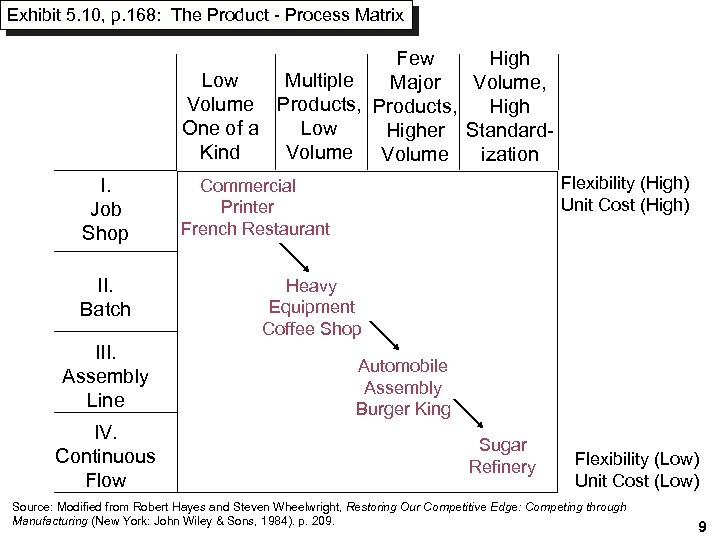 Exhibit 5. 10, p. 168: The Product - Process Matrix Few High Low Multiple Major Volume, Volume Products, High One of a Low Higher Standard. Kind Volume ization I. Job Shop II. Batch III. Assembly Line IV. Continuous Flow Flexibility (High) Unit Cost (High) Commercial Printer French Restaurant Heavy Equipment Coffee Shop Automobile Assembly Burger King Sugar Refinery Flexibility (Low) Unit Cost (Low) Source: Modified from Robert Hayes and Steven Wheelwright, Restoring Our Competitive Edge: Competing through Manufacturing (New York: John Wiley & Sons, 1984). p. 209. 9
 Virtual Factory Shift from centralized production to. . . . an integrated network of capabilities Irwin/Mc. Graw-Hill 10 10
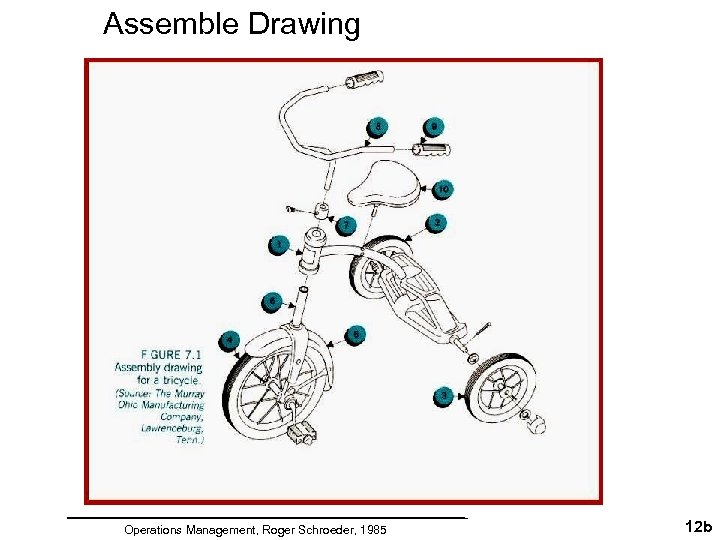
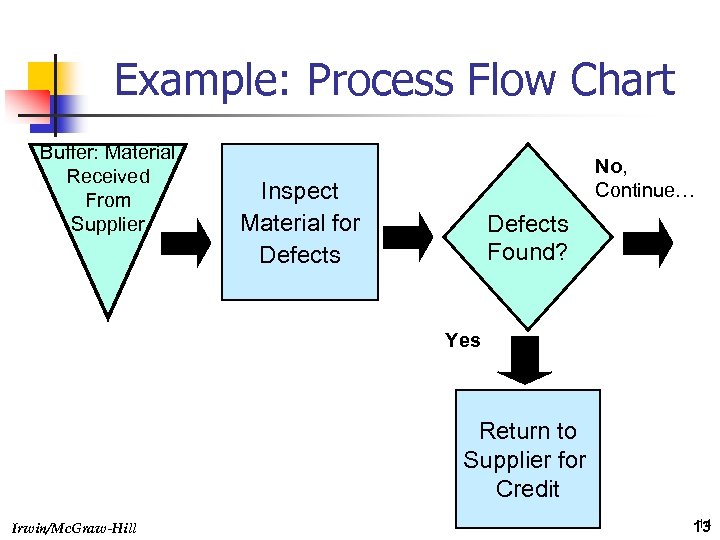
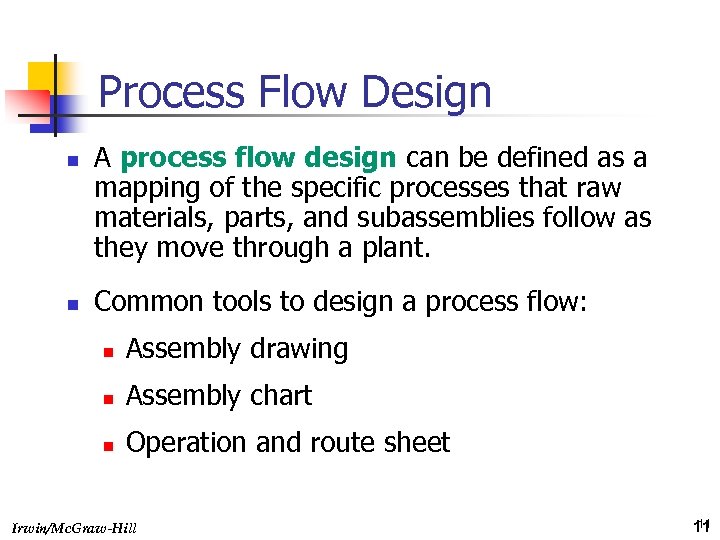 Process Flow Design n n A process flow design can be defined as a mapping of the specific processes that raw materials, parts, and subassemblies follow as they move through a plant. Common tools to design a process flow: n Assembly drawing n Assembly chart n Operation and route sheet Irwin/Mc. Graw-Hill 11 11
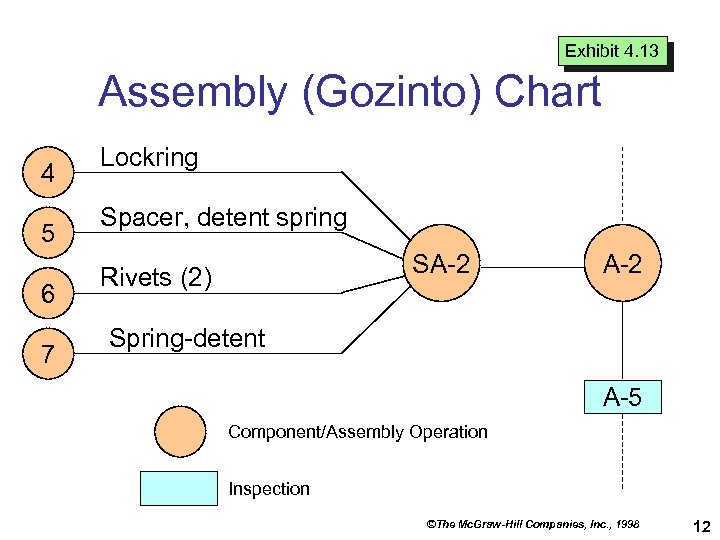 Exhibit 4. 13 Assembly (Gozinto) Chart 4 5 6 7 Lockring Spacer, detent spring SA-2 Rivets (2) A-2 Spring-detent A-5 Component/Assembly Operation Inspection ©The Mc. Graw-Hill Companies, Inc. , 1998 12
 Assemble Drawing ______________________________ Operations Management, Roger Schroeder, 1985 12 b
 Example: Process Flow Chart Buffer: Material Received From Supplier No, Continue… Inspect Material for Defects Found? Yes Return to Supplier for Credit Irwin/Mc. Graw-Hill 14 13
 Goods versus Services goods Pencil Manufacturer • tangible • storable • easy quality assessment • centralized production • long lead times • capital intensive • low customer contact • production separate from consumption Irwin/Mc. Graw-Hill Mc. Donald’s services Psychologist • intangible • perishable • difficult quality assessment • dispersed production • short lead times • labor intensity • high customer contact • production concurrent with consumption 15 47
 Some Service Generalizations (1 of 2) 1. Everyone is an expert on services. 2. Services are idiosyncratic. 3. Quality of work is not quality of service. 4. Most services contain a mix of tangible and intangible attributes (service package). Irwin/Mc. Graw-Hill 16 48
 Some Service Generalizations (2 of 2) 5. High-contact services (described later) are experienced, whereas goods are consumed. 6. Effective management of services requires an understanding of marketing and personnel, as well as operations. 7. Services often take the form of cycles of encounters involving face-to-face, phone, electromechanical, and/or mail interactions. Irwin/Mc. Graw-Hill 17 49
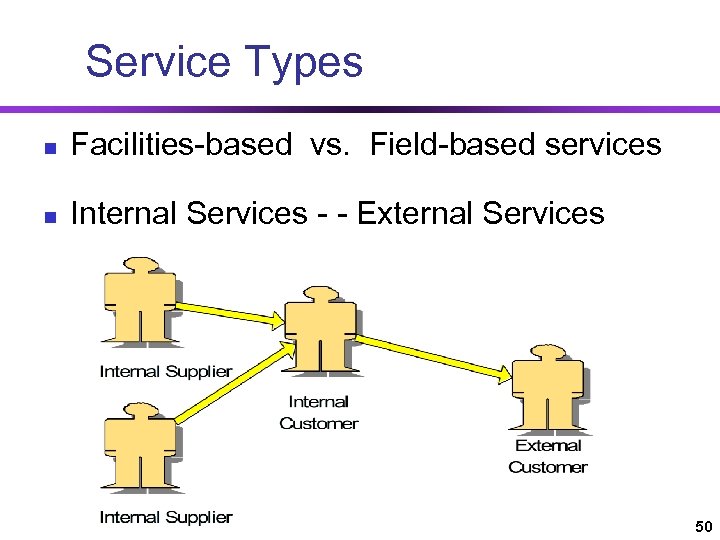 Service Types n Facilities-based vs. Field-based services n Internal Services - - External Services 50
 Service Strategy: Focus and Advantage Performance Priorities n Treatment of the customer n Speed and convenience of service delivery n Price n Variety n Unique skills that constitute the service offering Irwin/Mc. Graw-Hill 19 51
 Classifications of Services n Amount of customer contact Low versus High n Standard or Custom Service n The mix of tangible and intangible goods Irwin/Mc. Graw-Hill 20 52
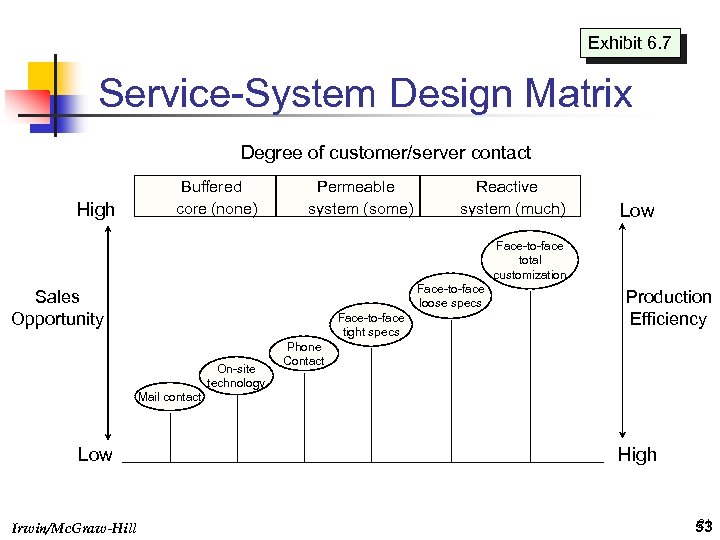 Exhibit 6. 7 Service-System Design Matrix Degree of customer/server contact High Buffered core (none) Permeable system (some) Reactive system (much) Low Face-to-face total customization Face-to-face loose specs Sales Opportunity Face-to-face tight specs On-site technology Production Efficiency Phone Contact Mail contact Low Irwin/Mc. Graw-Hill High 21 53
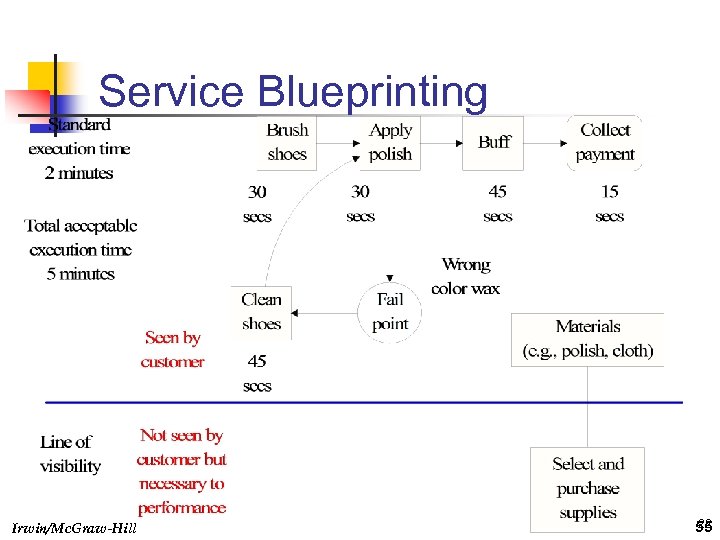 Service Blueprinting Irwin/Mc. Graw-Hill 22 55
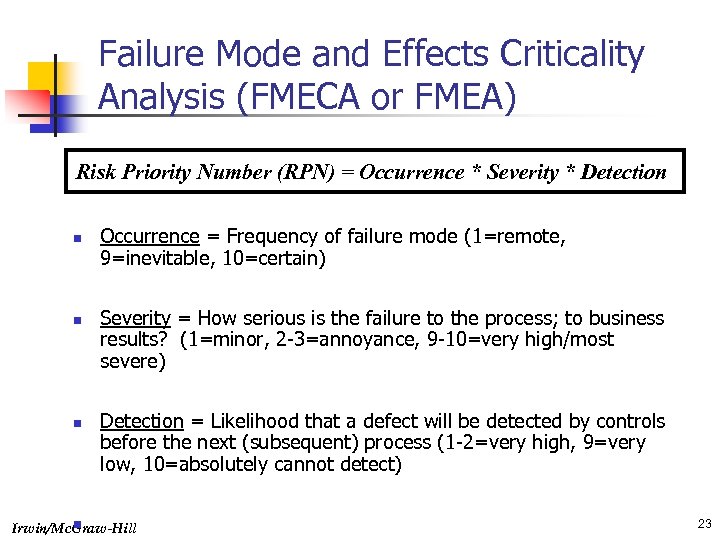 Failure Mode and Effects Criticality Analysis (FMECA or FMEA) Risk Priority Number (RPN) = Occurrence * Severity * Detection n Occurrence = Frequency of failure mode (1=remote, 9=inevitable, 10=certain) Severity = How serious is the failure to the process; to business results? (1=minor, 2 -3=annoyance, 9 -10=very high/most severe) Detection = Likelihood that a defect will be detected by controls before the next (subsequent) process (1 -2=very high, 9=very low, 10=absolutely cannot detect) n Irwin/Mc. Graw-Hill 23
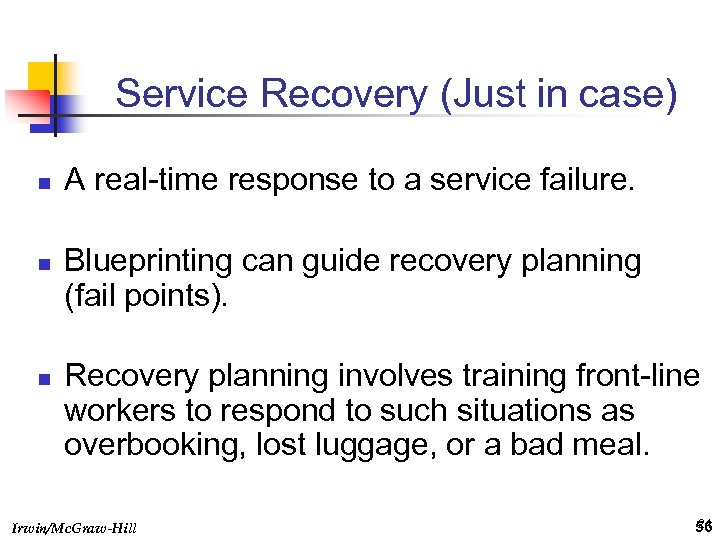 Service Recovery (Just in case) n n n A real-time response to a service failure. Blueprinting can guide recovery planning (fail points). Recovery planning involves training front-line workers to respond to such situations as overbooking, lost luggage, or a bad meal. Irwin/Mc. Graw-Hill 24 56
 Service Recovery (Just in case) “Empowerment can only take place when every associate can personally assure customer satisfaction every time!” Gary Johnson Irwin/Mc. Graw-Hill 25
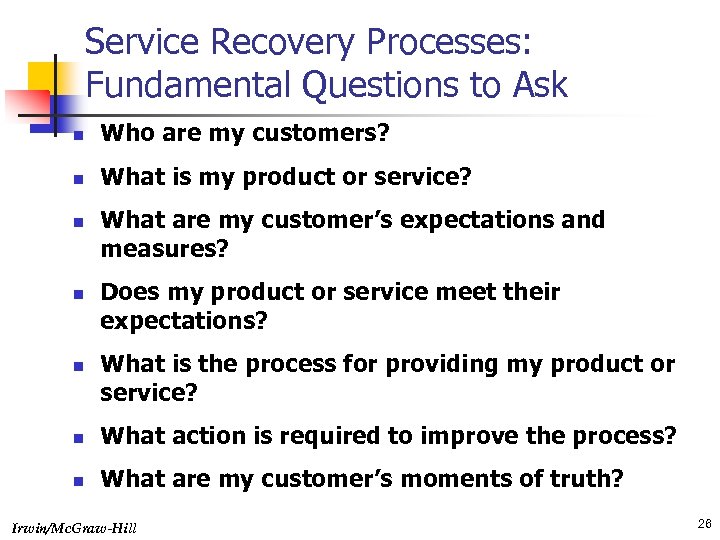 Service Recovery Processes: Fundamental Questions to Ask n Who are my customers? n What is my product or service? n n n What are my customer’s expectations and measures? Does my product or service meet their expectations? What is the process for providing my product or service? n What action is required to improve the process? n What are my customer’s moments of truth? Irwin/Mc. Graw-Hill 26
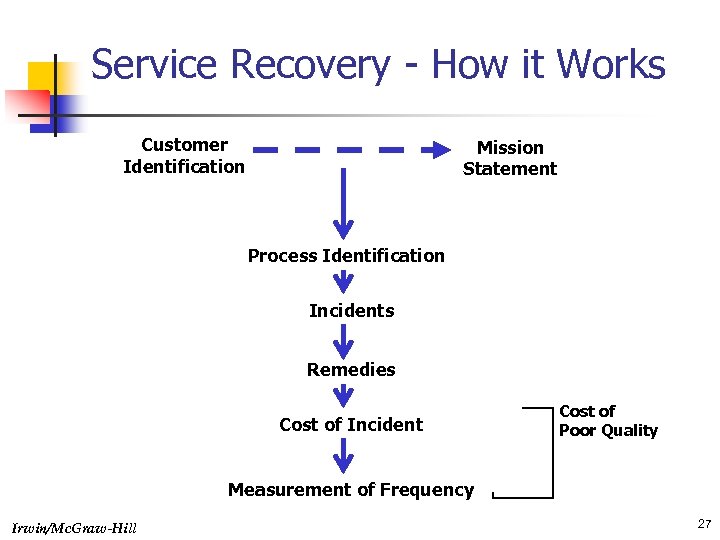 Service Recovery - How it Works Customer Identification Mission Statement Process Identification Incidents Remedies Cost of Incident Cost of Poor Quality Measurement of Frequency Irwin/Mc. Graw-Hill 27
 Service Failsafing: Poka-Yokes n Keeping a mistake from becoming a service defect. n Irwin/Mc. Graw-Hill A proactive approach 28 57
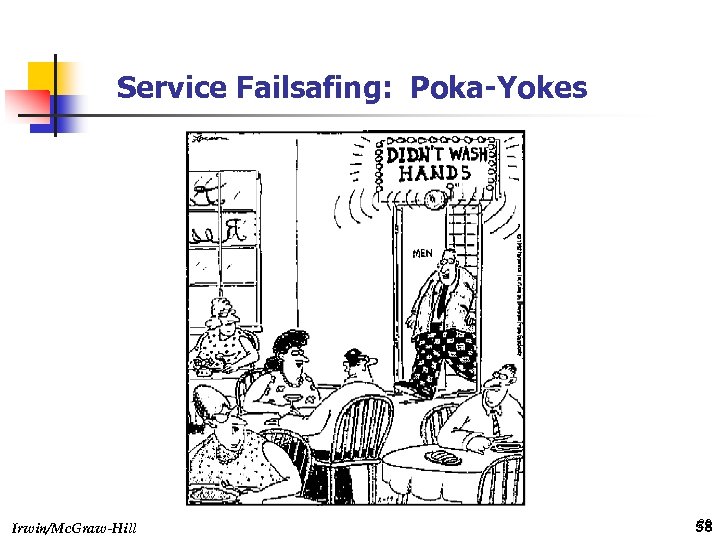 Service Failsafing: Poka-Yokes Irwin/Mc. Graw-Hill 29 58
 Three Contrasting Service Designs n The production line approach n The self-service approach n The personal attention approach Irwin/Mc. Graw-Hill 30 59
 Designing the Service System n Major Design Issues n n n Product & Process are designed simultaneously Scheduling of Capacity n due to uncertainty in demand n inability to store inventory Dealing will uncertainty in demand n preemptive tactics n flexibility n forecasting n use of waiting lines Irwin/Mc. Graw-Hill 31 60
 Characteristics of a Well-Designed Service System 1. Each element of the service system is consistent with the operating focus of the firm. 2. It is structured so that consistent performance by its people and systems is easily maintained. 3. It provides effective links between the back & front office so that nothing falls between the cracks. 4. It manages the evidence of service quality in such a way that customers see the value of the service. 5. The service system is: n cost-effective n user-friendly n robust Irwin/Mc. Graw-Hill 32 61