


 Скачать презентацию The Prison-Industrial Complex Social Policy and Correctional Health
3af5873ff1dcd3eeb00779af5e59b642.ppt
- Количество слайдов: 55
 The Prison-Industrial Complex Social Policy and Correctional Health Care Martin Donohoe
 • “The mood and temper of the public in regard to the treatment of crime and criminals is one of the most unfailing tests of any country. A calm, dispassionate recognition of the rights of the accused and even of the convicted criminal, . . . [and] the treatment of crime and the criminal mark and measure the stored-up strength of a nation, and are the sign and proof of the living virtue within it. ” Winston Churchill
 Lockdown: US Incarceration Rates • World prison population 8. 75 million • US: 6. 5 million under correctional supervision (behind bars, on parole, or on probation) - 1/31 adults (vs. 1/77 in 1982) – 2 million behind bars (jail + prison) • 1. 25 million in jail; 0. 75 million in prison • Includes 180, 000 women
 Lockdown: US Incarceration Rates • 6 -fold increase in # of people behind bars from 1972 -2000 – And rising • # of women behind bars up 750% from 1980 • 3100 local jails, 1200 state and federal prisons in U. S.
 Lockdown: US Incarceration Rates • 10 million Americans put behind bars each year • 3 -fold increase in # of people behind bars from 1987 -2007 – Crime rate down 25% compared with 1988 • # of women behind bars up 750% from 1980
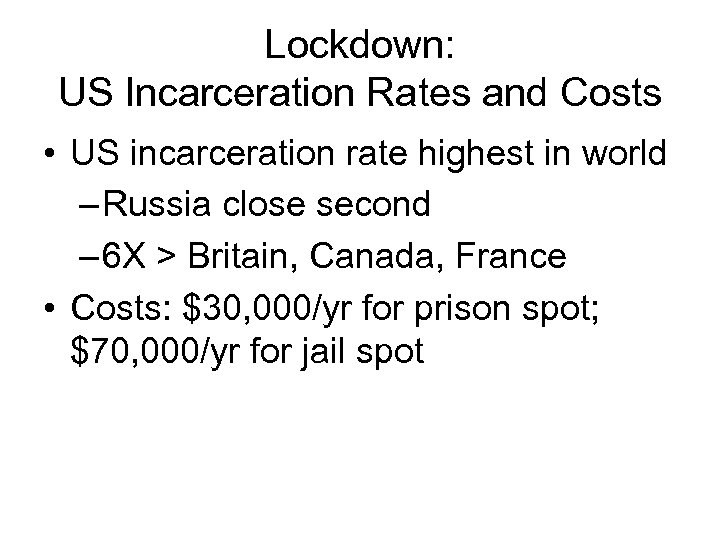 Lockdown: US Incarceration Rates and Costs • US incarceration rate highest in world – Russia close second – 6 X > Britain, Canada, France • Costs: $30, 000/yr for prison spot; $70, 000/yr for jail spot
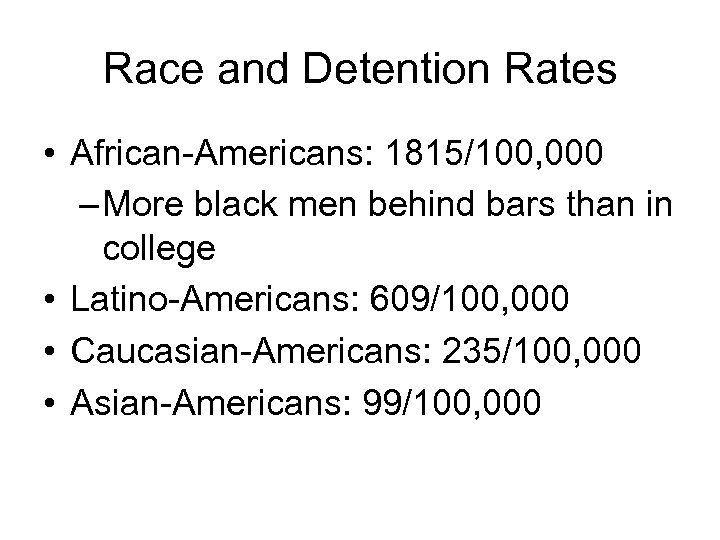 Race and Detention Rates • African-Americans: 1815/100, 000 – More black men behind bars than in college • Latino-Americans: 609/100, 000 • Caucasian-Americans: 235/100, 000 • Asian-Americans: 99/100, 000
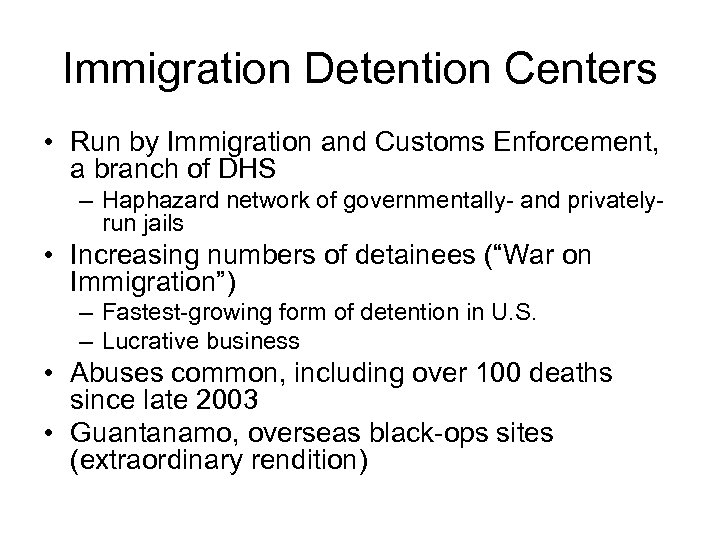 Immigration Detention Centers • Run by Immigration and Customs Enforcement, a branch of DHS – Haphazard network of governmentally- and privatelyrun jails • Increasing numbers of detainees (“War on Immigration”) – Fastest-growing form of detention in U. S. – Lucrative business • Abuses common, including over 100 deaths since late 2003 • Guantanamo, overseas black-ops sites (extraordinary rendition)
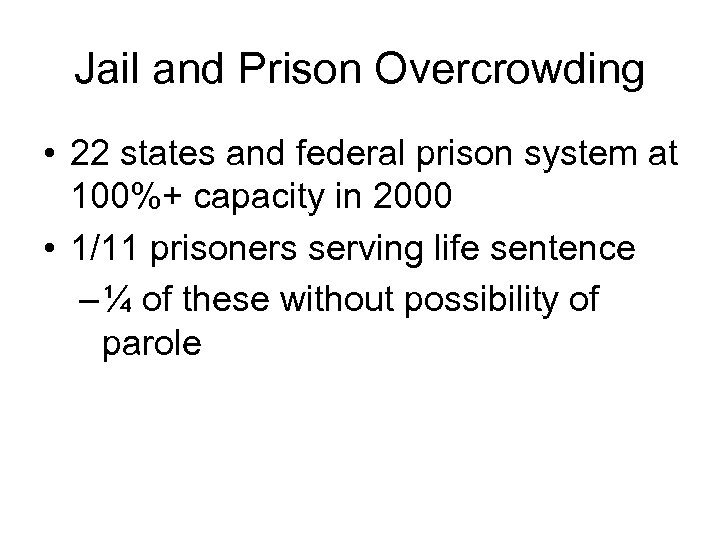 Jail and Prison Overcrowding • 22 states and federal prison system at 100%+ capacity in 2000 • 1/11 prisoners serving life sentence – ¼ of these without possibility of parole
 Reasons for Overcrowding • “War on Drugs” • Mandatory Minimums • Repeat Offender laws – 13 states have “three strikes laws” • Truth in Sentencing regulations • Decreased judicial independence
 Corporate Crime: Silent but Deadly • $200 billion/yr. (vs. $4 billion for burglary and robbery) • Fines for corporate environmental and social abuses minimal/cost of doing business • Some corporations linked to human rights abuses in US and abroad • Most lobby Congress to weaken environmental and occupational health and safety laws
![Corporate Crime • “The [only] social responsibility of business is to increase its profits.](https://present5.com/presentation/3af5873ff1dcd3eeb00779af5e59b642/image-16.jpg "Corporate Crime • “The [only] social responsibility of business is to increase its profits.") Corporate Crime • “The [only] social responsibility of business is to increase its profits. ” Milton Friedman • “Corporations [have] no moral conscience. [They] are designed by law, to be concerned only for their stockholders, and not, say, what are sometimes called their stakeholders, like the community or the work force…” Noam Chomsky
Corporate Crime • “The [only] social responsibility of business is to increase its profits. ” Milton Friedman • “Corporations [have] no moral conscience. [They] are designed by law, to be concerned only for their stockholders, and not, say, what are sometimes called their stakeholders, like the community or the work force…” Noam Chomsky
 Corporate Crime • “Corporation: An ingenious device for obtaining individual profit without individual responsibility. ” Ambrose Bierce • “A criminal is a person with predatory instincts who has not sufficient capital to form a corporation. ” Howard Scott
 The Prison-Industrial Complex • Private prisons currently hold just under 10% of US prisoners – Only UK has higher proportion of private prisoners than US • 18 corporations guard 10, 000 prisoners in 27 states
 Private prison boom over past 15 years • Reasons: – Prevailing political philosophy which disparages the effectiveness of (and even need for) government social programs – Often-illusory promises of free-market effectiveness – Despite evidence to contrary (e. g. , Medicare/Medicaid, water privatization, etc. ) – Increasing demand from ICE and USMS
 The Prison-Industrial Complex • Leading trade group: – American Correctional Association • For-profit companies involved: – Corrections Corporation of America • Controls 2/3 of private U. S. prisons – GEO Group (formerly Wackenhut) • Together these two companies control 75% of market
 The Prison-Industrial Complex • For-profit companies involved: – Correctional Medical Services – Others (Westinghouse, AT&T, Sprint, MCI, Smith Barney, American Express, Merrill Lynch, Shearson-Lehman, Allstate, GE, Wells Fargo [7% owned by Warren Buffet’s Berkshire Hathaway])
 The Prison-Industrial Complex • Aggressive marketing to state and local governments – Promise jobs, new income • Rural areas targeted – Face declines in farming, manufacturing, logging, and mining • Companies offered tax breaks, subsidies, and infrastructure assistance
 The Prison-Industrial Complex: 2001 Bureau of Justice Study • Average savings to community 1% • Does not take into account: – Hidden monetary subsidies – Private prisons selecting least costly inmates • c. f. , “cherry picking” by health insurers – Private prisons attract large national chain stores like Wal-Mart, which: • leads to demise of local businesses • Shifts locally-generated tax revenues to distant corporate coffers
 The Prison-Industrial Complex: Politically Well-Connected • Private prison industry donated $1. 2 million to 830 candidates in 2000 elections – $100, 000 from CCA to indicted former House Speaker Tom Delay’s (R-TX) Foundation for Kids • Delay’s brother Randy lobbied TX Bureau of Prisons on behalf of GEO
 The Prison-Industrial Complex: Politically Well-Connected • $3. 3 million donated in 44 states between 200 and 2004 – 2/3 to candidates, 1/3 to parties (2/3 of this to Republicans – More given to states with tougher sentencing laws
 The Prison-Industrial Complex: Abuses • Some paid for non-existent prisoners, due to inmate census guarantees • 2009: Two judges in PA convicted of jailing 2000 children in exchange for bribes from private prison companies
 Jails for Jesus: Faith-Based Initiatives • • Increasing presence Politically powerful Most evangelical Christian Supported financially by George W Bush’s Faith-Based Initiatives Program – e. g. , Prison Fellowship Ministries – founded by Watergate felon Charles Colson in 1976
 Jails for Jesus: Faith-Based Initiatives • Offer perks in exchange for participation in prayer groups and courses – Perks: better cell location, job training and post-release job placement – Courses: Creationism, “Intelligent Design”, “Conversion Therapy” for homosexuals
 Jails for Jesus: Faith-Based Initiatives • Some programs “cure” sex offenders through prayer and Bible study – Rather than evidence-based programs employing aversion therapy and normative counseling • Highly recidivist and dangerous criminals may be released back into society armed with little more than polemics about sin
 Health Issues of Prisoners • At least 1/3 of state and ¼ of federal inmates have a physical impairment or mental condition – Mental illness – Dental caries and periodontal disease – Infectious diseases: HIV, Hep B and C, STDs (including HPV→cervical CA) – Usual chronic illnesses seen in aging population
 Crime and Substance Abuse • 52% of state and 34% of federal inmates under influence of alcohol or other drugs at time of offenses • Rates of alcohol and opiate dependency among arrestees at least 12% and 4%, respectively – 28% of jails detoxify arrestees
 Inmate Deaths • 12, 129 inmates died in custody between 2001 and 2004 – 89% - medical conditions – 8% - suicide or homicide – 3% - alcohol/drug intoxication or accidental injury
 Prison Health Care • Estelle v. Gamble (US Supreme Court, 1976): affirms inmates constitutional right to medical care (based on 8 th Amendment prohibiting cruel and unusual punishment) • Amnesty International and AMA have commented upon poor overall quality of care
 Prison Health Care • 60% provided by government entities • 40% (in 34 states) provided by private corporations • Private care often substandard
 Prison Health Care • Some doctors unable to practice elsewhere have limited licenses to work in prisons • Some government and private institutions require co-pays – Discourages needed care; increases costs
 Examples of Substandard Prison Health Care • Correctional Medical Systems (largest/cheapest) – Numerous lawsuits/investigations for poor care, negligence, patient dumping; opaque accounting of taxpayer dollars • Prison Health Services – Cited by NY state for negligence/deaths; subject of >1000 lawsuits; under investigation in VT
 Examples of Substandard Prison Health Care • California’s state prison health care system placed into receivership – 1 unnecessary death/day –$5 co-pays limit access
 Rehabilitation and Release • 600, 000 prisoners released each year – 4 -fold increase over 1980 – 97% of all prisoners eventually return to the community – 1990 s: funding for rehab dramatically cut
 Rehabilitation and Release • Newly released and paroled convicts face restricted access to federally-subsidized housing, welfare, and health care • ½ of state correctional facilities provide only a 1 -2 week supply of medication • Wait times for Medicare, Medicaid, and Social Security benefits up to 3 months
 Rehabilitation and Release • Drug felons in 18 states permanently banned from receiving welfare • High risk of death in first few weeks after release, mostly due to homicide, suicide, and drug overdose
 Ex-offenders have poor job prospects • Little education and job skills training occur behind bars – GED programs reduce recidivism, decrease costs • Most prisoners released with $50 to $100 “gate money” and a bus ticket • Limited resumés, background checks • 60% of employers would not knowingly hire an ex-offender • High rates of criminal recidivism
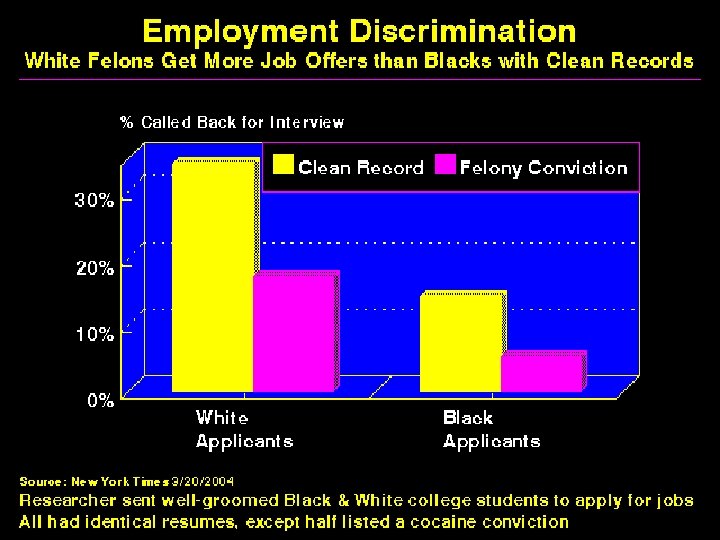
 Summary • US world’s wealthiest nation • Incarcerates greater percentage of its citizens than any other country • Criminal justice system marred by racism • Prisoner health care substandard • Until recently, US executed juveniles and mentally handicapped
 Summary • US continues to execute adults • Drug users confined with more hardened criminals in overcrowded institutions – Creates ideal conditions for nurturing and mentoring of more dangerous criminals • Punishment prioritized over rehabilitation
 Summary • Convicts released without necessary skills to maintain abstinence and with few job skills • Poor financial and employment prospects of released criminals make return to crime an attractive or desperate survival option
 Summary • US criminal justice system marked by injustices, fails to lower crime and increase public safety • Significant portions of system turned over to enterprises that value profit over human dignity, development and community improvement
 Role of Health Professionals in Creating a Fair Criminal Justice System • Address social ills that foster substance abuse and other crimes – Especially rising gap between rich and poor, haves and have nots • Increase focus on magnitude and consequences of corporate crime
 Role of Health Professionals in Creating a Fair Criminal Justice System • Speak out against injustice, racism, death penalty • Improve provider education re criminal justice system • Run for office
 Health Professionals and Criminality • 2002: AAMC standard application includes questions about felony convictions • 2008: Questions about military discharge history and misdemeanor convictions added
 Health Professionals and Criminality • Medical schools make final judgments – Previous offences one of the most robust predictors of future offenses • Including cheating – 2009: BU med student accused of stalking/murder
 Conclusion • Hold government accountable for creating fair system that combines reasonable punishment with restitution and smooth re-entry of rehabilitated criminals into society
 Prison Health Care • “A society should be judged not by how it treats its outstanding citizens but by how it treats its criminals. ” Fyodor Dostoevsky
 Reference • Donohoe MT. Incarceration Nation: Health and Welfare in the Prison System in the United States. Medscape Ob/Gyn and Women’s Health 2006; 11(1): posted 1/20/06. Available at http: //www. medscape. com/viewarticle/520 251
 Contact Information Public Health and Social Justice Website http: //www. phsj. org martindonohoe@phsj. org