


 Скачать презентацию The PRISM Project with some focus on the
9de7c2df803f00d1114888bdffae78ed.ppt
- Количество слайдов: 18
 The PRISM Project, with some focus on the coupler Jean-Claude ANDRE CERFACS, 31 057 Toulouse cedex, France Thanks to Sophie VALCKE and Guy BRASSEUR 4 th International Workshop, NCAR, March 12 -14, 2002 1
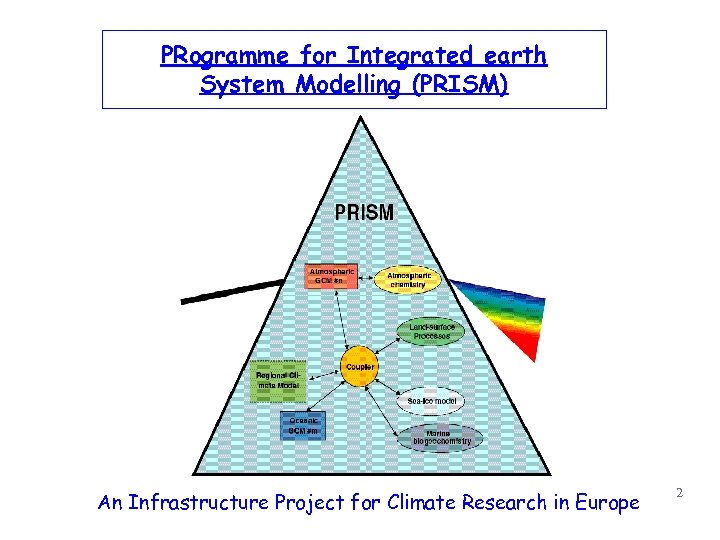 PRogramme for Integrated earth System Modelling (PRISM) An Infrastructure Project for Climate Research in Europe 2
 PRISM Participants -MPG-IMET, Germany (Dr. Guy Brasseur, coordinator) -NERSC, Norway -KNMI, The Netherlands -ING, Italy -MPI-MAD, Germany -Met-Office, United Kingdom -UREADMY, United Kingdom -IPSL, France -Météo-France, France -CERFACS, France -DMI, Denmark -SHMI, Sweden -ETH Zurich, Switzerland -MPI-BGC, Germany -PIK, Germany -ECMWF, Europe -UCL-ASTR, Belgium -NEC Deutschland -FECIT/Fujitsu -SGI Deutschland -SUN, Germany 4 th International Workshop, NCAR, March 12 -14, 2002 3
 Overall PRISM Objectives - Undertake a pilot infrastructure toward the establishment of a distributed European network for Earth system modelling -> Co-ordinate European Climate Modelling efforts: Create a European service and management infrastructure for developing, coordinating and executing a long-term programme of European-wide, multi-institutional climate and Earth System simulations -> Develop a European Climate Modelling System: A portable, efficient and user-friendly Global Climate System based on actual models, and associated diagnostic/visualisation softwares 4 th International Workshop, NCAR, March 12 -14, 2002 4
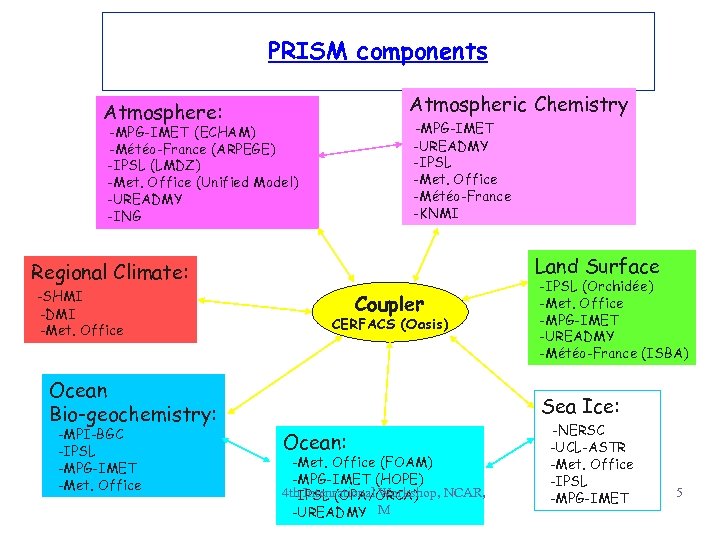 PRISM components Atmospheric Chemistry Atmosphere: -MPG-IMET -UREADMY -IPSL -Met. Office -Météo-France -KNMI -MPG-IMET (ECHAM) -Météo-France (ARPEGE) -IPSL (LMDZ) -Met. Office (Unified Model) -UREADMY -ING Land Surface Regional Climate: -SHMI -DMI -Met. Office Ocean Bio-geochemistry: -MPI-BGC -IPSL -MPG-IMET -Met. Office Coupler CERFACS (Oasis) -IPSL (Orchidée) -Met. Office -MPG-IMET -UREADMY -Météo-France (ISBA) Sea Ice: Ocean: -Met. Office (FOAM) -MPG-IMET (HOPE) 4 th Intenrational Workshop, NCAR, -IPSL (OPA/ORCA) -UREADMY M -NERSC -UCL-ASTR -Met. Office -IPSL -MPG-IMET 5
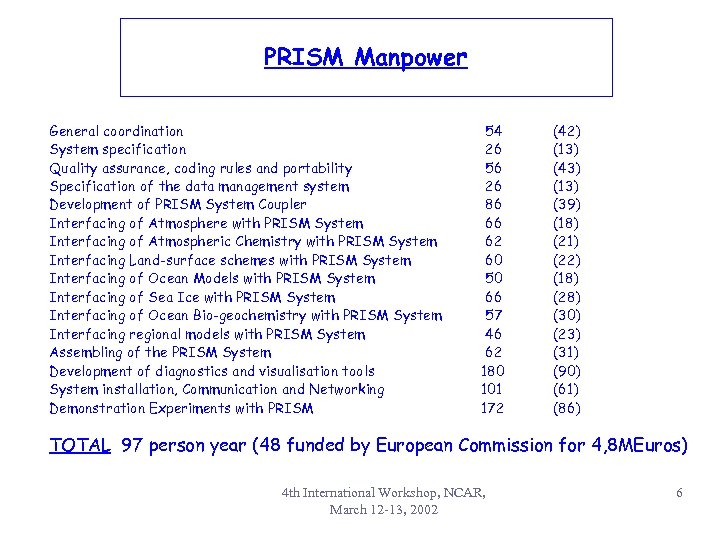 PRISM Manpower General coordination System specification Quality assurance, coding rules and portability Specification of the data management system Development of PRISM System Coupler Interfacing of Atmosphere with PRISM System Interfacing of Atmospheric Chemistry with PRISM System Interfacing Land-surface schemes with PRISM System Interfacing of Ocean Models with PRISM System Interfacing of Sea Ice with PRISM System Interfacing of Ocean Bio-geochemistry with PRISM System Interfacing regional models with PRISM System Assembling of the PRISM System Development of diagnostics and visualisation tools System installation, Communication and Networking Demonstration Experiments with PRISM 54 26 56 26 86 66 62 60 50 66 57 46 62 180 101 172 (42) (13) (43) (13) (39) (18) (21) (22) (18) (28) (30) (23) (31) (90) (61) (86) TOTAL 97 person year (48 funded by European Commission for 4, 8 MEuros) 4 th International Workshop, NCAR, March 12 -13, 2002 6
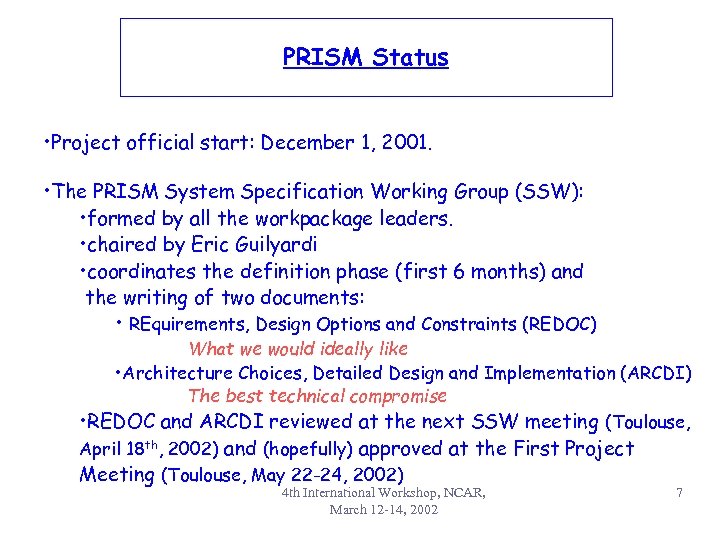 PRISM Status • Project official start: December 1, 2001. • The PRISM System Specification Working Group (SSW): • formed by all the workpackage leaders. • chaired by Eric Guilyardi • coordinates the definition phase (first 6 months) and the writing of two documents: • REquirements, Design Options and Constraints (REDOC) What we would ideally like • Architecture Choices, Detailed Design and Implementation (ARCDI) The best technical compromise • REDOC and ARCDI reviewed at the next SSW meeting (Toulouse, April 18 th, 2002) and (hopefully) approved at the First Project Meeting (Toulouse, May 22 -24, 2002) 4 th International Workshop, NCAR, March 12 -14, 2002 7
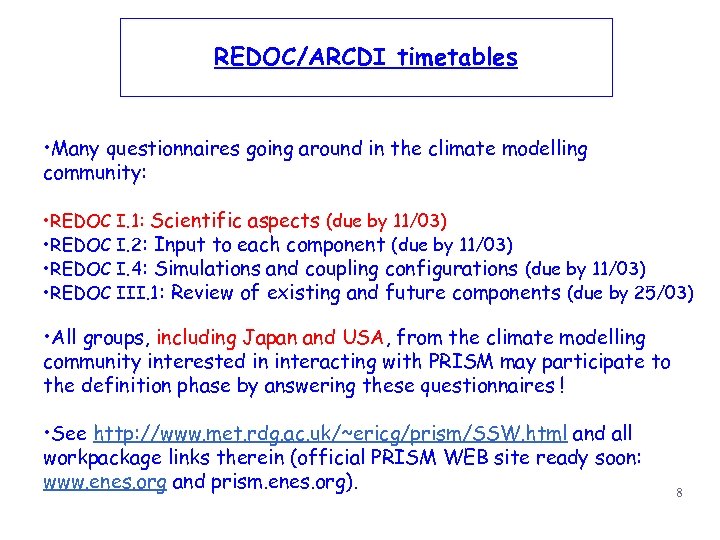 REDOC/ARCDI timetables • Many questionnaires going around in the climate modelling community: • REDOC I. 1: Scientific aspects (due by 11/03) • REDOC I. 2: Input to each component (due by 11/03) • REDOC I. 4: Simulations and coupling configurations (due by 11/03) • REDOC III. 1: Review of existing and future components (due by 25/03) • All groups, including Japan and USA, from the climate modelling community interested in interacting with PRISM may participate to the definition phase by answering these questionnaires ! • See http: //www. met. rdg. ac. uk/~ericg/prism/SSW. html and all workpackage links therein (official PRISM WEB site ready soon: www. enes. org and prism. enes. org). 8
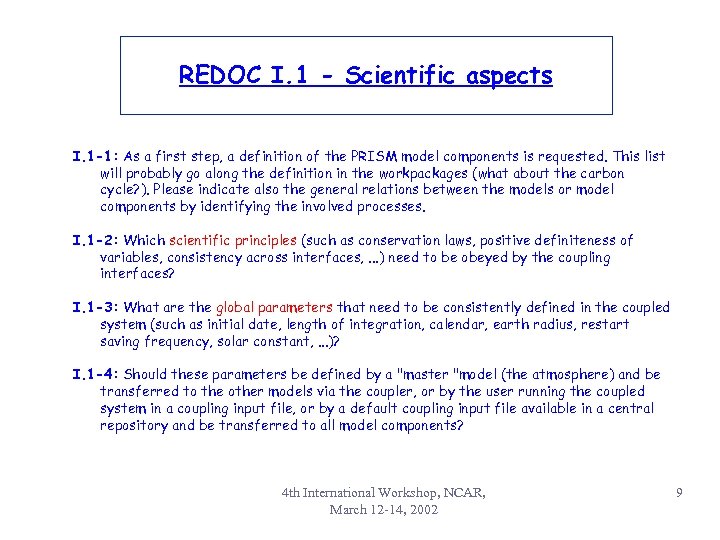 REDOC I. 1 - Scientific aspects I. 1 -1: As a first step, a definition of the PRISM model components is requested. This list will probably go along the definition in the workpackages (what about the carbon cycle? ). Please indicate also the general relations between the models or model components by identifying the involved processes. I. 1 -2: Which scientific principles (such as conservation laws, positive definiteness of variables, consistency across interfaces, . . . ) need to be obeyed by the coupling interfaces? I. 1 -3: What are the global parameters that need to be consistently defined in the coupled system (such as initial date, length of integration, calendar, earth radius, restart saving frequency, solar constant, . . . )? I. 1 -4: Should these parameters be defined by a "master "model (the atmosphere) and be transferred to the other models via the coupler, or by the user running the coupled system in a coupling input file, or by a default coupling input file available in a central repository and be transferred to all model components? 4 th International Workshop, NCAR, March 12 -14, 2002 9
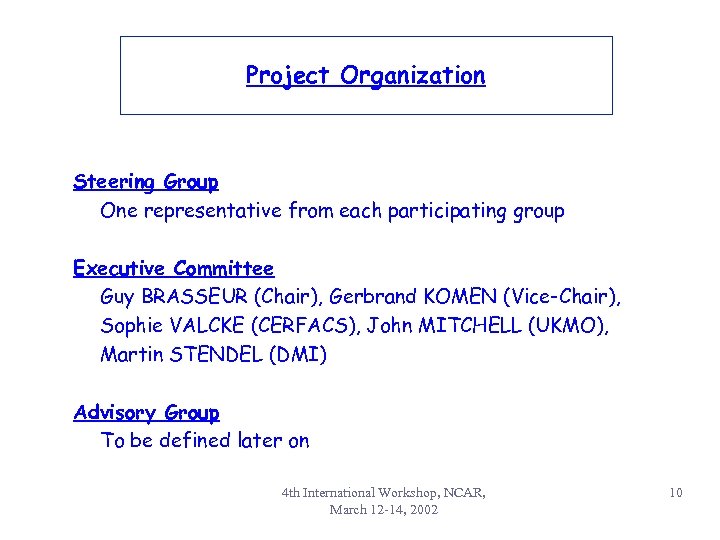 Project Organization Steering Group One representative from each participating group Executive Committee Guy BRASSEUR (Chair), Gerbrand KOMEN (Vice-Chair), Sophie VALCKE (CERFACS), John MITCHELL (UKMO), Martin STENDEL (DMI) Advisory Group To be defined later on 4 th International Workshop, NCAR, March 12 -14, 2002 10
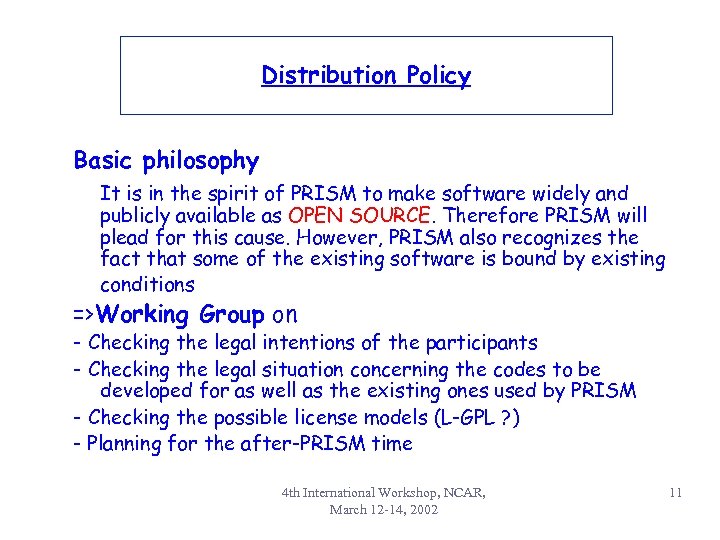 Distribution Policy Basic philosophy It is in the spirit of PRISM to make software widely and publicly available as OPEN SOURCE. Therefore PRISM will plead for this cause. However, PRISM also recognizes the fact that some of the existing software is bound by existing conditions =>Working Group on - Checking the legal intentions of the participants - Checking the legal situation concerning the codes to be developed for as well as the existing ones used by PRISM - Checking the possible license models (L-GPL ? ) - Planning for the after-PRISM time 4 th International Workshop, NCAR, March 12 -14, 2002 11
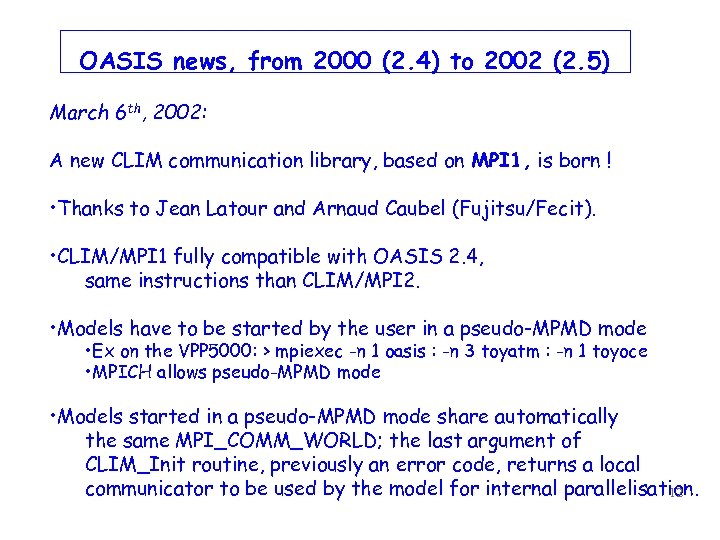 OASIS news, from 2000 (2. 4) to 2002 (2. 5) March 6 th, 2002: A new CLIM communication library, based on MPI 1, is born ! • Thanks to Jean Latour and Arnaud Caubel (Fujitsu/Fecit). • CLIM/MPI 1 fully compatible with OASIS 2. 4, same instructions than CLIM/MPI 2. • Models have to be started by the user in a pseudo-MPMD mode • Ex on the VPP 5000: > mpiexec -n 1 oasis : -n 3 toyatm : -n 1 toyoce • MPICH allows pseudo-MPMD mode • Models started in a pseudo-MPMD mode share automatically the same MPI_COMM_WORLD; the last argument of CLIM_Init routine, previously an error code, returns a local communicator to be used by the model for internal parallelisation. 12
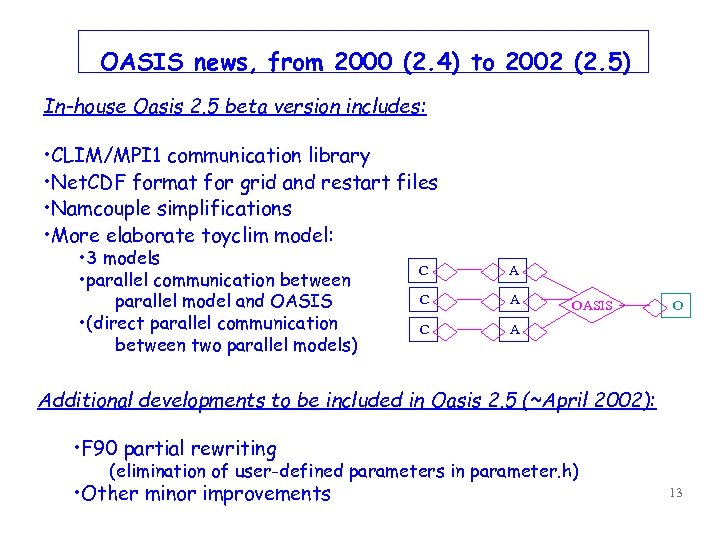 OASIS news, from 2000 (2. 4) to 2002 (2. 5) In-house Oasis 2. 5 beta version includes: • CLIM/MPI 1 communication library • Net. CDF format for grid and restart files • Namcouple simplifications • More elaborate toyclim model: • 3 models • parallel communication between parallel model and OASIS • (direct parallel communication between two parallel models) C A C A OASIS O Additional developments to be included in Oasis 2. 5 (~April 2002): • F 90 partial rewriting (elimination of user-defined parameters in parameter. h) • Other minor improvements 13
 OASIS news, from 2000 (2. 4) to 2002 (2. 5) Planned for Oasis 3. 0 = PRISM wp 3 a 1 st deliverable (12/2002): • Model Technical Coupling Interface (MTCI): reduce the number of OASIS routines, for easier use set of high level routines, that encapsulate OASIS low-level routines, to be implemented in the models to deal with the export and import of coupling fields. • Interfacing with the SCRIP interpolation library: • Bilinear and bicubic interpolations for logically-rectangular grids • 1 st and 2 nd order conservative remapping for all grids • Pseudo parallelisation of OASIS on a field-per-field basis 4 th International Workshop, NCAR, March 12 -14, 2002 14
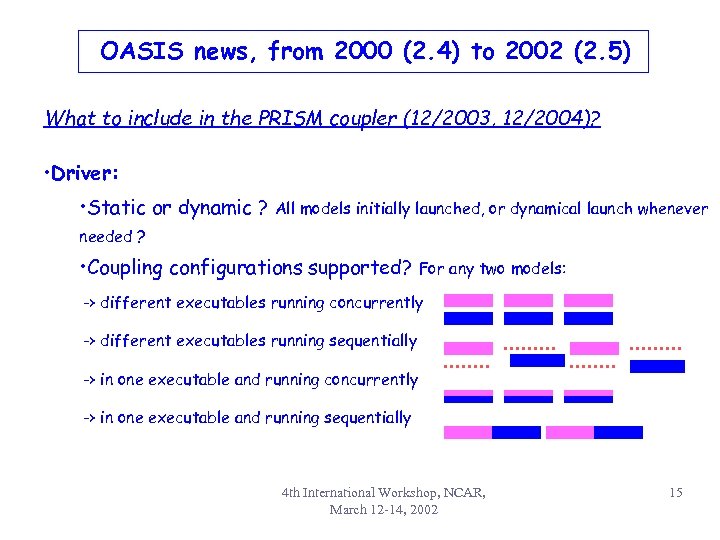 OASIS news, from 2000 (2. 4) to 2002 (2. 5) What to include in the PRISM coupler (12/2003, 12/2004)? • Driver: • Static or dynamic ? All models initially launched, or dynamical launch whenever needed ? • Coupling configurations supported? For any two models: -> different executables running concurrently -> different executables running sequentially -> in one executable and running concurrently -> in one executable and running sequentially 4 th International Workshop, NCAR, March 12 -14, 2002 15
 OASIS news, from 2000 (2. 4) to 2002 (2. 5) What to include in the PRISM coupler (12/2003, 12/2004): • Transformation library: • Full parallelisation • Localisation: • in Model Technical Coupling Interface library (model processes), or in additional coupling processes? • Which type of transformation is performed where? local (ex: time integration) in MTCI; non-local in additional coupling processes? • Type of operation: • Time operations: integration, interpolation, … • 2 D spatial interpolation: nneighbour, bilinear, bicubic, conservative remapping • 3 D spatial interpolation (? ) • Others: energy conservation, combination, algebraic operations, … • Type of grids: lat-lon, logically-rectangular, atmospheric reduced, unstructured (? ) 16
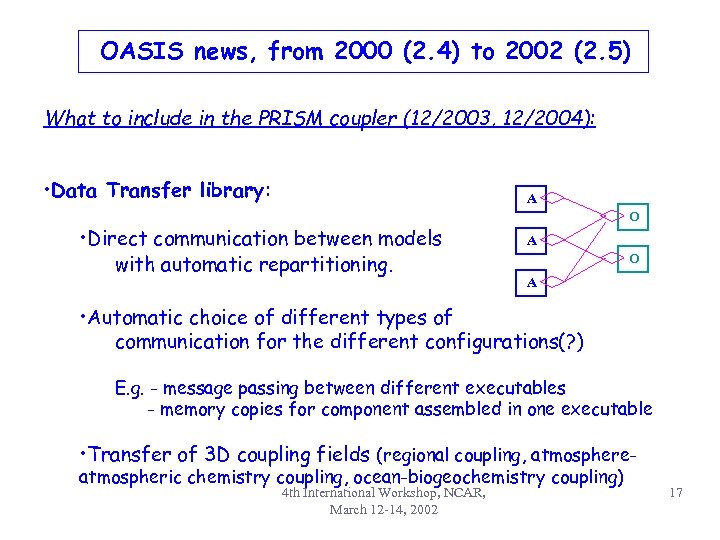 OASIS news, from 2000 (2. 4) to 2002 (2. 5) What to include in the PRISM coupler (12/2003, 12/2004): • Data Transfer library: A • Direct communication between models with automatic repartitioning. O A • Automatic choice of different types of communication for the different configurations(? ) E. g. - message passing between different executables - memory copies for component assembled in one executable • Transfer of 3 D coupling fields (regional coupling, atmosphereatmospheric chemistry coupling, ocean-biogeochemistry coupling) 4 th International Workshop, NCAR, March 12 -14, 2002 17
 ENES: European Network for Earth System modelling • Formed by university departments, research centres, meteorological services, computer centres and industrial partners who signed the ENES Memorandum of Understanding: • Purposes: 1. help in the development and evaluation of state-of-the-art climate and Earth system models 2. facilitate focused model intercomparisons in order to assess and improve these models 3. encourage exchanges of software and model results 4. help in the development of high performance computing facilities dedicated to long high-resolution multi-model ensemble integrations • Possibly proposed as a Network of Excellence for the European FP-6? Under discussions (contact: G. Brasseur brasseur@dkrz. de 18 )