


 Скачать презентацию The Prevention of Child Maltreatment Two Strategies in
d60d24992542e7adefd9d37cbf4b874f.ppt
- Количество слайдов: 41
 The Prevention of Child Maltreatment: Two Strategies in the Child Healthcare System Haruv Institute Conference Jerusalem May 2010 Howard Dubowitz, MD, MS University of Maryland School of Medicine
 The Field of Child Healthcare “As physicians who assume a responsibility for children’s physical, mental & emotional progress, pediatricians must be concerned with social and environmental influences which have a major impact on the health & well-being of children & their families”
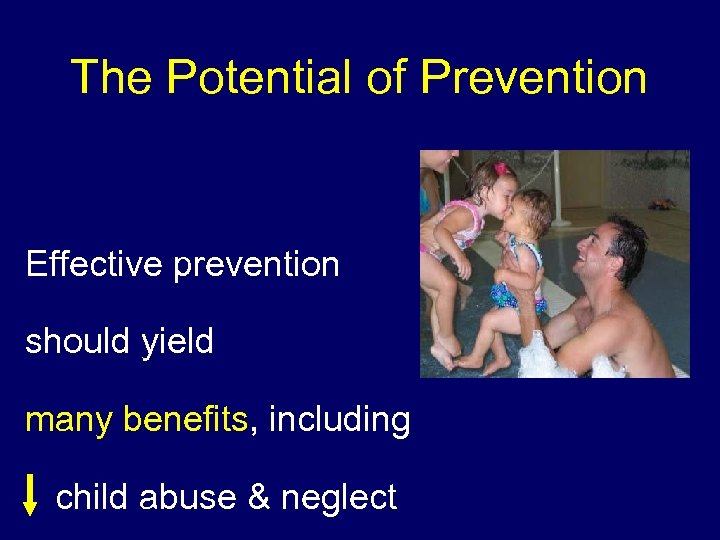 The Potential of Prevention Effective prevention should yield many benefits, including child abuse & neglect
 Prevention of child maltreatment Promotion of children’s health, development and safety
 SEEK a Safe Environment for Every Kid Pediatric Primary Care Dubowitz et al, Pediatrics, 2009; 123: 858
 Pediatric Primary Care • Routine checkups • Periodic intervals – 1 wk, 1, 2, 4, 6, 9, 12, 15 and 18 months – 2, 3, 4, 5 years ……………. • Aims at prevention, early detection of problems
 Pediatric Primary Care: An Opportunity for Preventing Child Abuse & Neglect • Well accepted, institutionalized • Goal of prevention • Concern with child, family • Special relationship with family • No stigma • Multiple visits (1 st few yrs. ) • An opportunity, responsibility
 The SEEK Model • Specially trained health professionals (HPs) • Parent Screening Questionnaire (PSQ) • Brief assessment of identified problems • Initial management • HP/social worker team • SEEK resources – Parent Handouts • Collaboration with community agencies
 Training Primary Care Professionals • Why problem is important – prevalence, impact • How to briefly assess – risk & protective factors • What to do – initial management, referrals
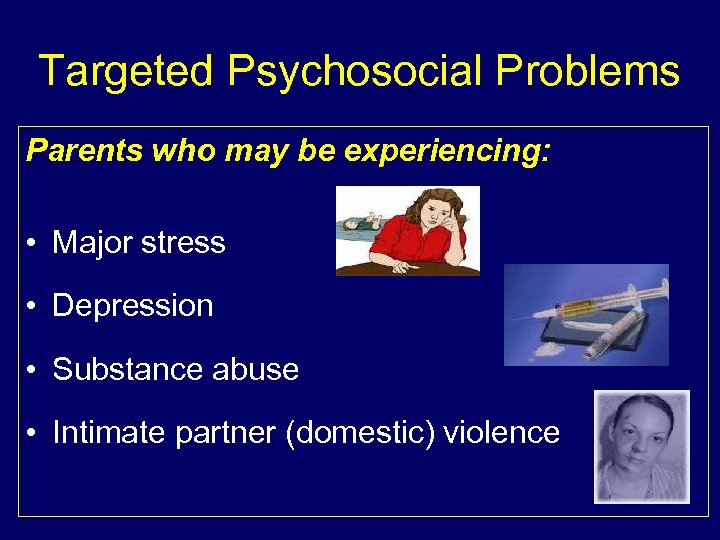 Targeted Psychosocial Problems Parents who may be experiencing: • Major stress • Depression • Substance abuse • Intimate partner (domestic) violence
 Parent Screening Questionnaire (PSQ) • brief • easy to read • answer yes/no • convenient, time to complete • voluntary
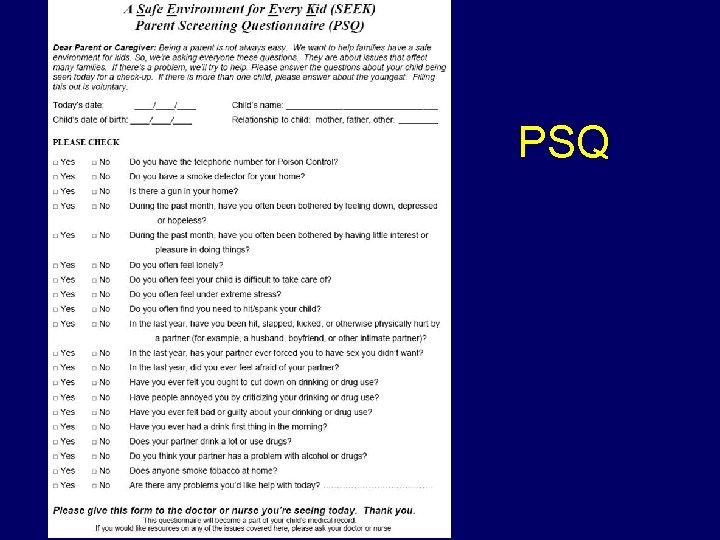 PSQ
PSQ
 PSQ Intro • Empathic: “Being a parent is not always easy” • Universal: “We’re asking everyone …” • Provide context: “We want to help families have a safe environment for kids. ” • Builds on what’s accepted: injury prevention
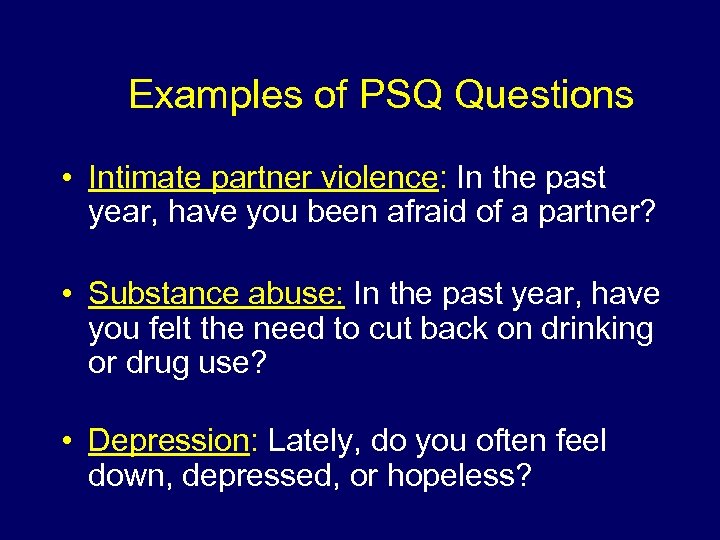 Examples of PSQ Questions • Intimate partner violence: In the past year, have you been afraid of a partner? • Substance abuse: In the past year, have you felt the need to cut back on drinking or drug use? • Depression: Lately, do you often feel down, depressed, or hopeless?
 When to screen? • Regular checkups • Not “sick visits”
 Study Hypothesis The SEEK model of primary care will reduce child maltreatment rate, measured by: • Parent self-report • Medical chart data • Child protective services (CPS) reports
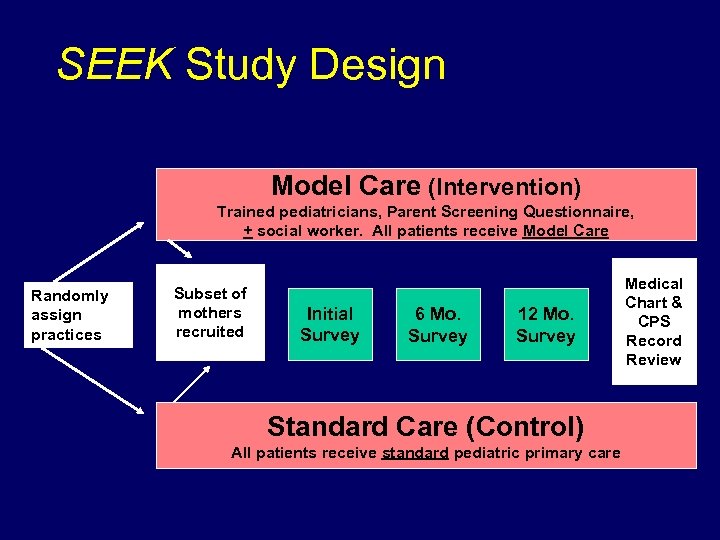 SEEK Study Design Model Care (Intervention) Trained pediatricians, Parent Screening Questionnaire, + social worker. All patients receive Model Care Randomly assign practices Subset of mothers recruited Initial Survey 6 Mo. Survey 12 Mo. Survey Standard Care (Control) All patients receive standard pediatric primary care Medical Chart & CPS Record Review
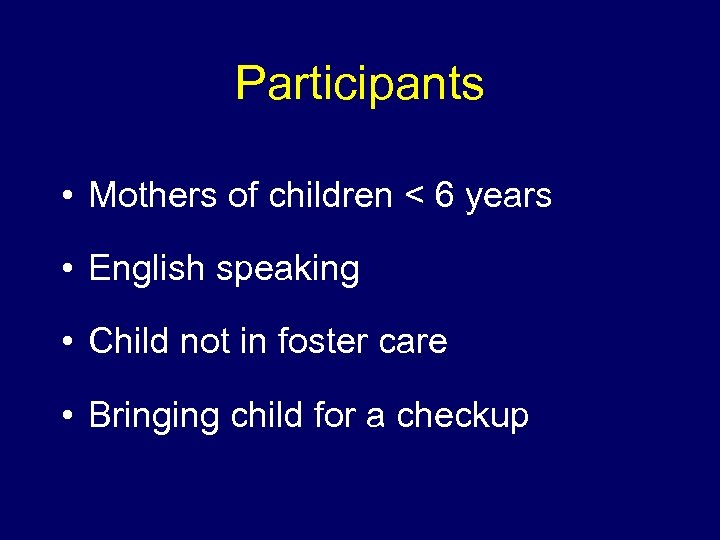 Participants • Mothers of children < 6 years • English speaking • Child not in foster care • Bringing child for a checkup
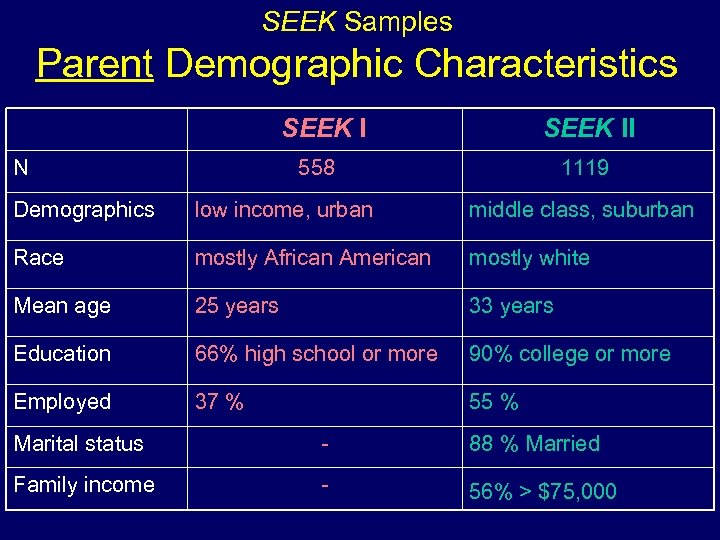 SEEK Samples Parent Demographic Characteristics SEEK I N SEEK II 558 1119 Demographics low income, urban middle class, suburban Race mostly African American mostly white Mean age 25 years 33 years Education 66% high school or more 90% college or more Employed 37 % 55 % Marital status - 88 % Married Family income - 56% > $75, 000
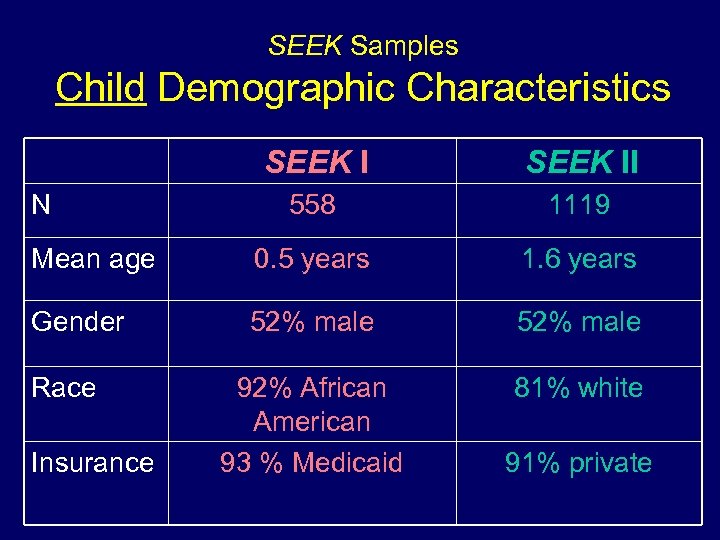 SEEK Samples Child Demographic Characteristics SEEK II 558 1119 Mean age 0. 5 years 1. 6 years Gender 52% male 92% African American 93 % Medicaid 81% white N Race Insurance 91% private
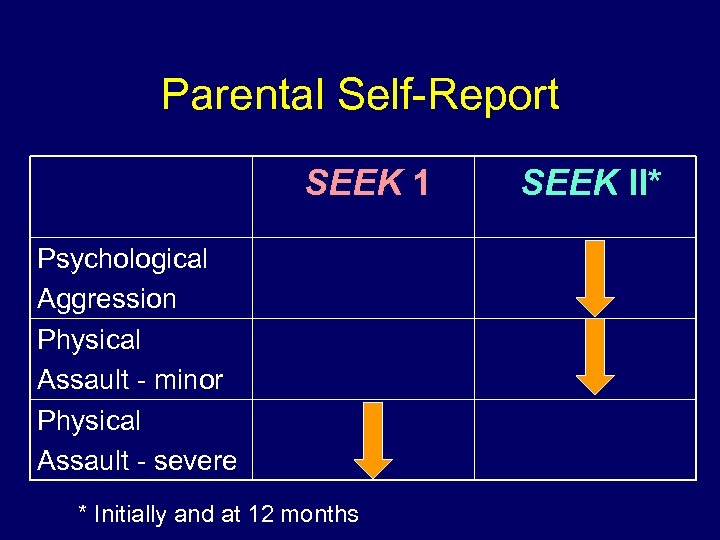 Parental Self-Report SEEK 1 Psychological Aggression Physical Assault - minor Physical Assault - severe * Initially and at 12 months SEEK II*
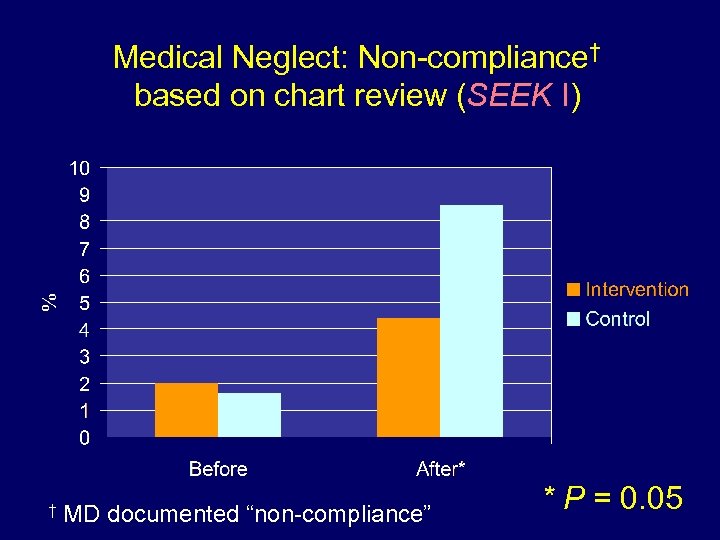 Medical Neglect: Non-compliance† based on chart review (SEEK I) † MD documented “non-compliance” * P = 0. 05
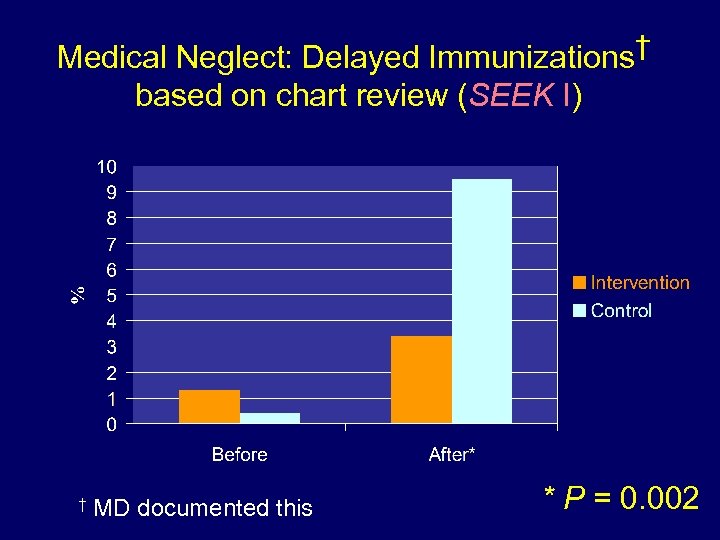 Medical Neglect: Delayed Immunizations† based on chart review (SEEK I) † MD documented this * P = 0. 002
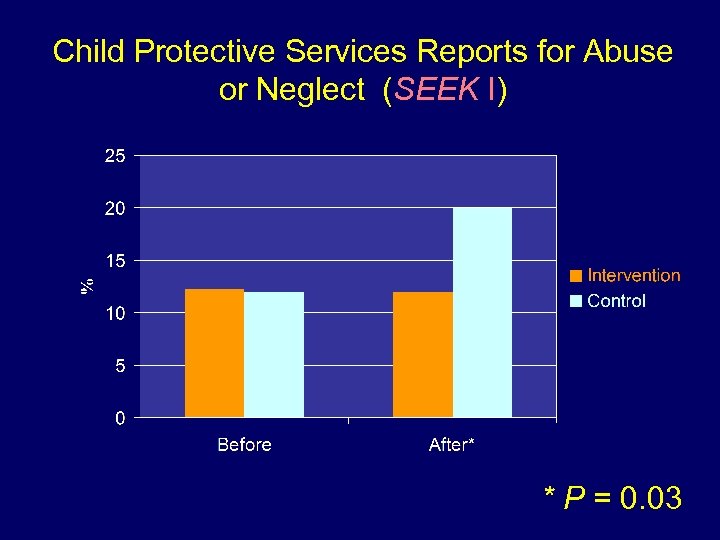 Child Protective Services Reports for Abuse or Neglect (SEEK I) * P = 0. 03
 SEEK - Strengths • Positive findings in 2 RCTs • Moderate size samples – High and low risk • Fits well with an existing system of pediatric primary care • Little additional time required
 SEEK - Limitations • Low prevalence of risk factors in low risk sample • Cost of social worker
 In Sum • Pediatric primary care offers a good opportunity to address major psychosocial issues facing many children & families • SEEK offers a practical model for improving pediatric primary care – Sustained improvement in health professional practice – PSQ a useful screening tool • Evidence that SEEK can prevent maltreatment Dubowitz et al, Pediatrics, 2009; 123: 858
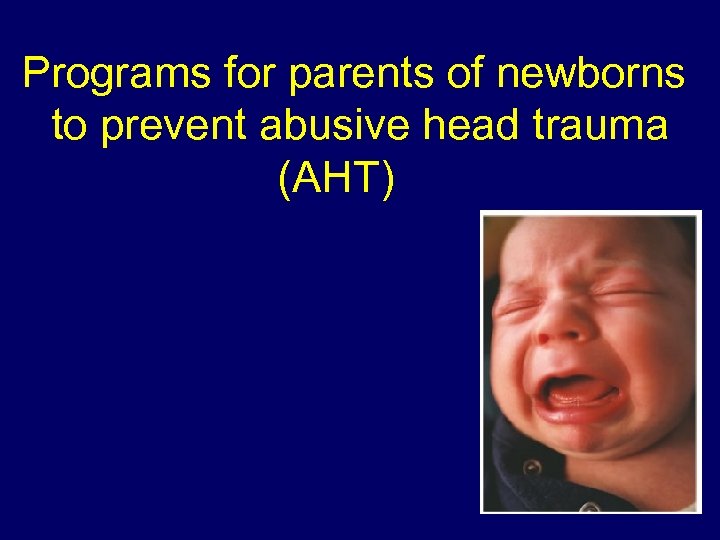 Programs for parents of newborns to prevent abusive head trauma (AHT)
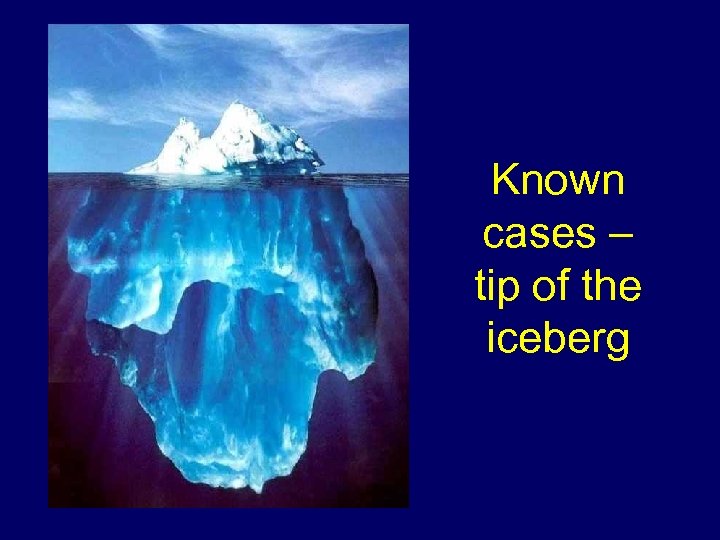 Known cases – tip of the iceberg
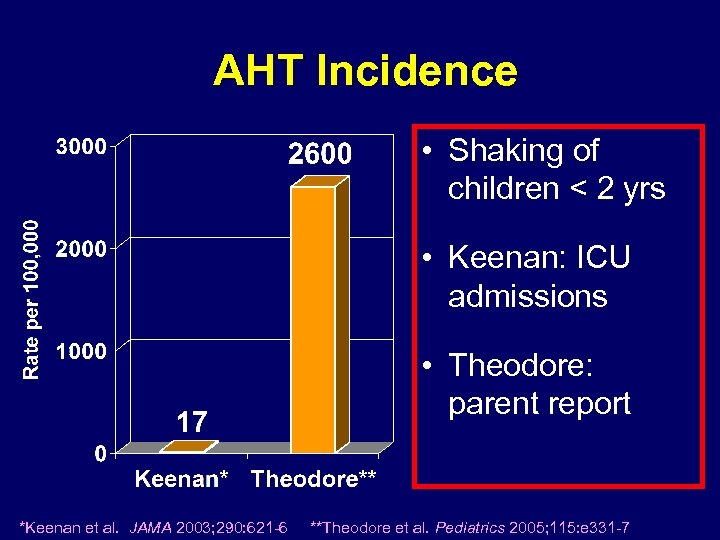 AHT Incidence • Shaking of children < 2 yrs • Keenan: ICU admissions • Theodore: parent report *Keenan et al. JAMA 2003; 290: 621 -6 **Theodore et al. Pediatrics 2005; 115: e 331 -7
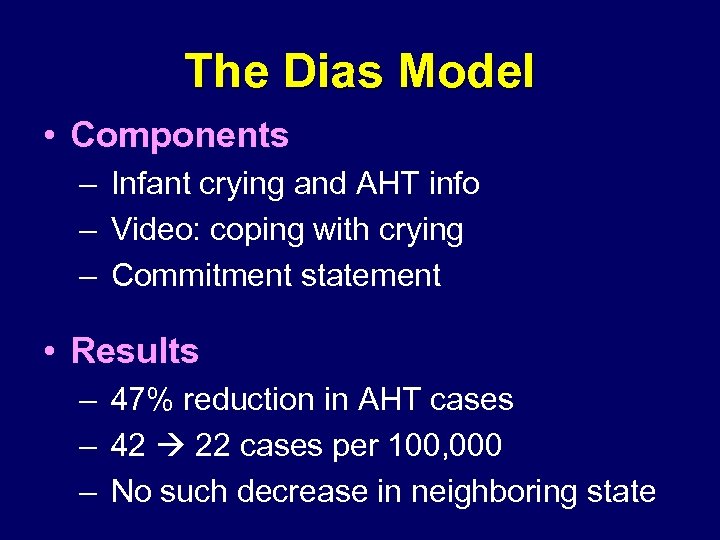 The Dias Model • Components – Infant crying and AHT info – Video: coping with crying – Commitment statement • Results – 47% reduction in AHT cases – 42 22 cases per 100, 000 – No such decrease in neighboring state
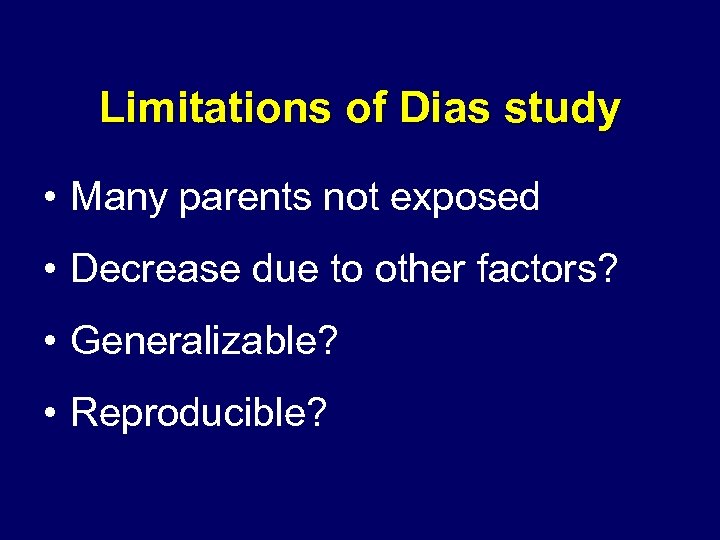 Limitations of Dias study • Many parents not exposed • Decrease due to other factors? • Generalizable? • Reproducible?
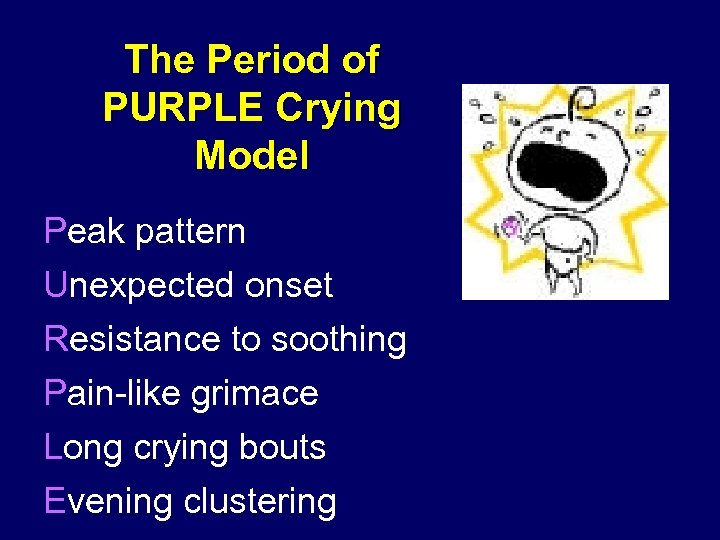 The Period of PURPLE Crying Model Peak pattern Unexpected onset Resistance to soothing Pain-like grimace Long crying bouts Evening clustering

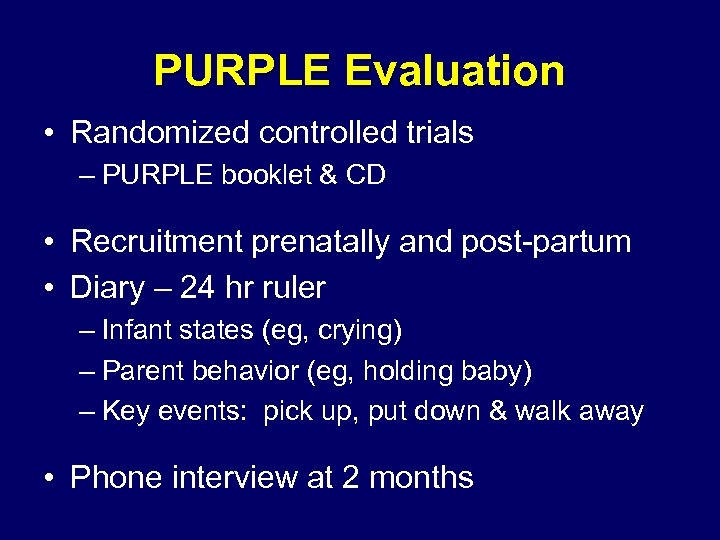 PURPLE Evaluation • Randomized controlled trials – PURPLE booklet & CD • Recruitment prenatally and post-partum • Diary – 24 hr ruler – Infant states (eg, crying) – Parent behavior (eg, holding baby) – Key events: pick up, put down & walk away • Phone interview at 2 months
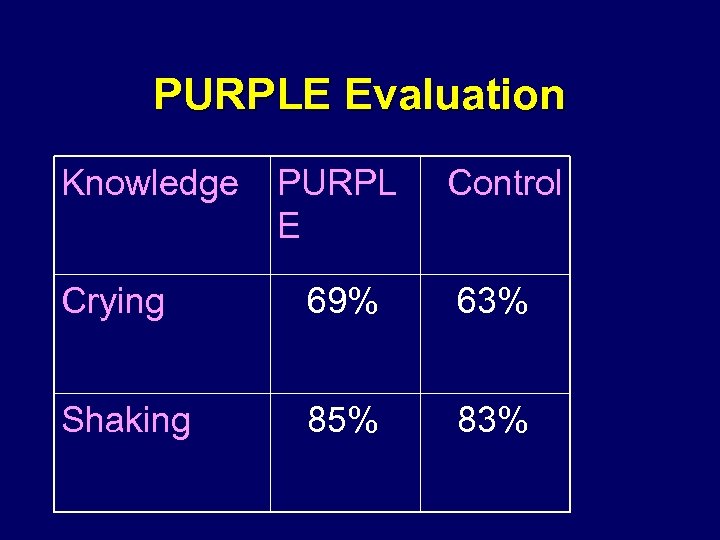 PURPLE Evaluation Knowledge PURPL E Control Crying 69% 63% Shaking 85% 83%
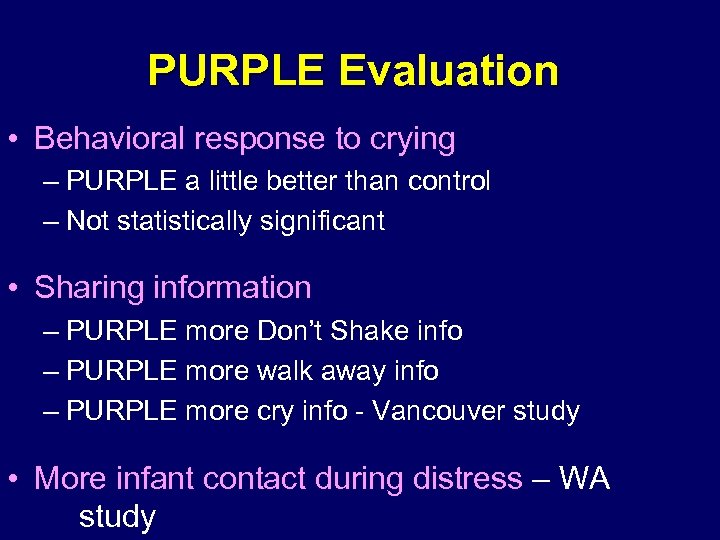 PURPLE Evaluation • Behavioral response to crying – PURPLE a little better than control – Not statistically significant • Sharing information – PURPLE more Don’t Shake info – PURPLE more walk away info – PURPLE more cry info - Vancouver study • More infant contact during distress – WA study
 PURPLE Strengths • Large evaluations • Randomized trials • Fidelity to model
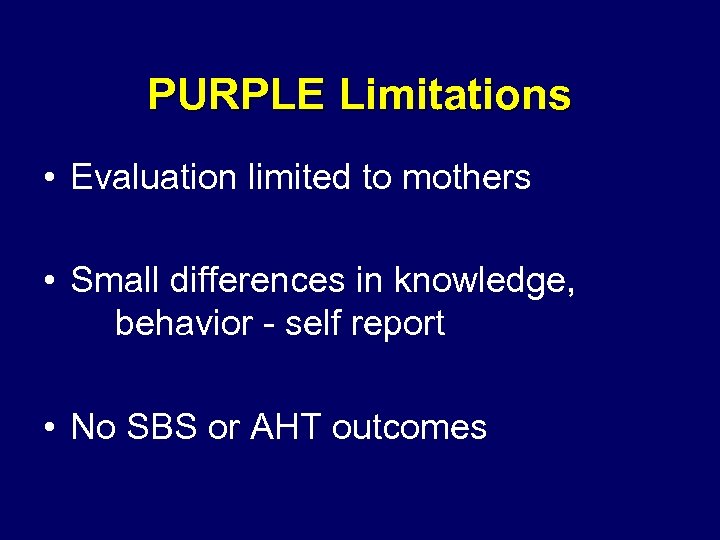 PURPLE Limitations • Evaluation limited to mothers • Small differences in knowledge, behavior - self report • No SBS or AHT outcomes
 Can/should these programs be applied in Israel?
 Toda Raba hdubowitz@peds. umaryland. edu