 Скачать презентацию The Prevention and Identification of Math Disability Using
2699ee2de0412f2e48a8702d05c57ea2.ppt
- Количество слайдов: 57



The Prevention and Identification of Math Disability Using RTI Lynn Fuchs Vanderbilt University September 18, 2008 1
This Presentation Part 1: Brief Review of RTI Framework Part 2: Screening and Progress Monitoring within RTI Part 3: Example of Secondary Tutoring at First Grade Part 4: Example of Secondary Tutoring at Third Grade 2
Responsiveness-To-Intervention (RTI) l RTI integrates assessment and intervention within a multi-level prevention system to identify and reduce risk for academic failure. 3
Typical RTI Procedure • Primary Prevention • All children receive the universal, core instructional program. • All children are tested once in the fall to identify students as potentially at-risk for academic failure. • The progress of potentially at-risk students is monitored for 6 -8 weeks to (dis)confirm risk and identify students for secondary prevention. 4
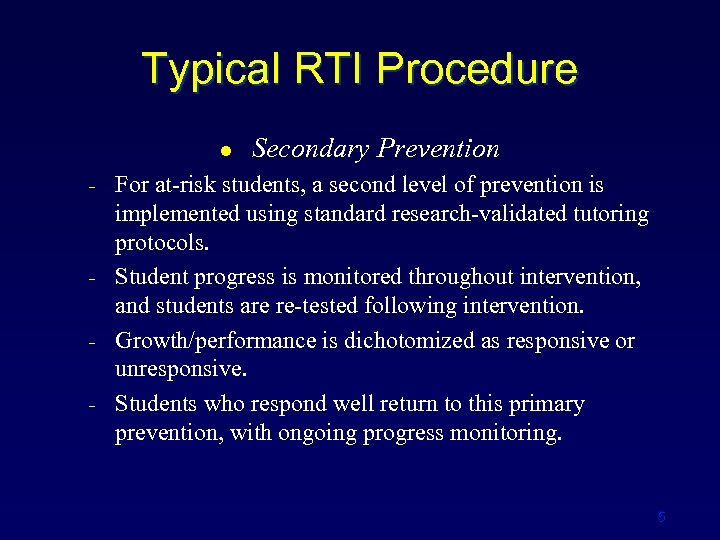
Typical RTI Procedure l − − Secondary Prevention For at-risk students, a second level of prevention is implemented using standard research-validated tutoring protocols. Student progress is monitored throughout intervention, and students are re-tested following intervention. Growth/performance is dichotomized as responsive or unresponsive. Students who respond well return to this primary prevention, with ongoing progress monitoring. 5
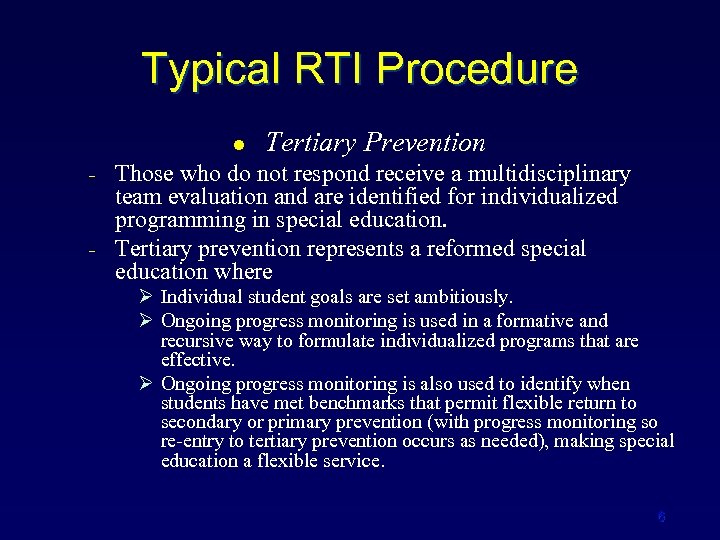
Typical RTI Procedure l − − Tertiary Prevention Those who do not respond receive a multidisciplinary team evaluation and are identified for individualized programming in special education. Tertiary prevention represents a reformed special education where Ø Individual student goals are set ambitiously. Ø Ongoing progress monitoring is used in a formative and recursive way to formulate individualized programs that are effective. Ø Ongoing progress monitoring is also used to identify when students have met benchmarks that permit flexible return to secondary or primary prevention (with progress monitoring so re-entry to tertiary prevention occurs as needed), making special education a flexible service. 6
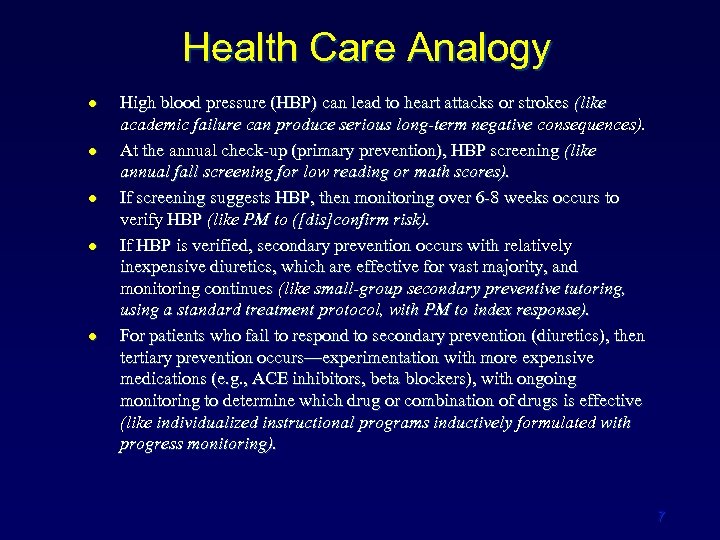
Health Care Analogy l l l High blood pressure (HBP) can lead to heart attacks or strokes (like academic failure can produce serious long-term negative consequences). At the annual check-up (primary prevention), HBP screening (like annual fall screening for low reading or math scores). If screening suggests HBP, then monitoring over 6 -8 weeks occurs to verify HBP (like PM to ([dis]confirm risk). If HBP is verified, secondary prevention occurs with relatively inexpensive diuretics, which are effective for vast majority, and monitoring continues (like small-group secondary preventive tutoring, using a standard treatment protocol, with PM to index response). For patients who fail to respond to secondary prevention (diuretics), then tertiary prevention occurs—experimentation with more expensive medications (e. g. , ACE inhibitors, beta blockers), with ongoing monitoring to determine which drug or combination of drugs is effective (like individualized instructional programs inductively formulated with progress monitoring). 7
Part 2: Progress Monitoring: An Essential Form of Assessment within RTI To screen students as at risk for failure. To determine whether students respond. For students who fail to respond, to build individualized instructional programs. 8
Progress Monitoring l l Teachers assess students’ academic performance, using brief measures, on a frequent basis CBM is the scientifically validated form of progress monitoring. 9
Research Shows l CBM produces accurate, meaningful information about students’ academic levels and their rates of improvement. l CBM is sensitive to student improvement. l CBM corresponds well with high-stakes tests. l When teachers use CBM to inform their instructional decisions, students achieve better. 10
Most Progress Monitoring: Mastery Measurement CBM is NOT Mastery Measurement 11
MASTERY MEASUREMENT Tracks Mastery of Short-term Instructional Objectives To implement Mastery Measurement, the teacher l l Determines the sequence of skills in an instructional hierarchy For each skill, develops a criterionreferenced test 12
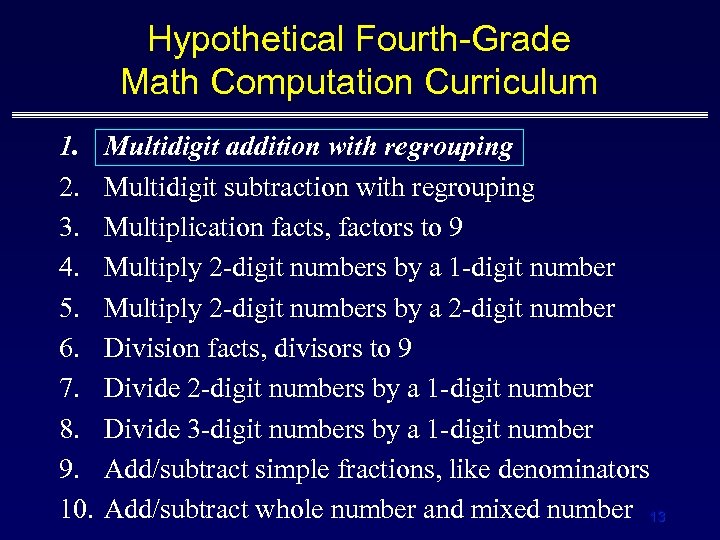
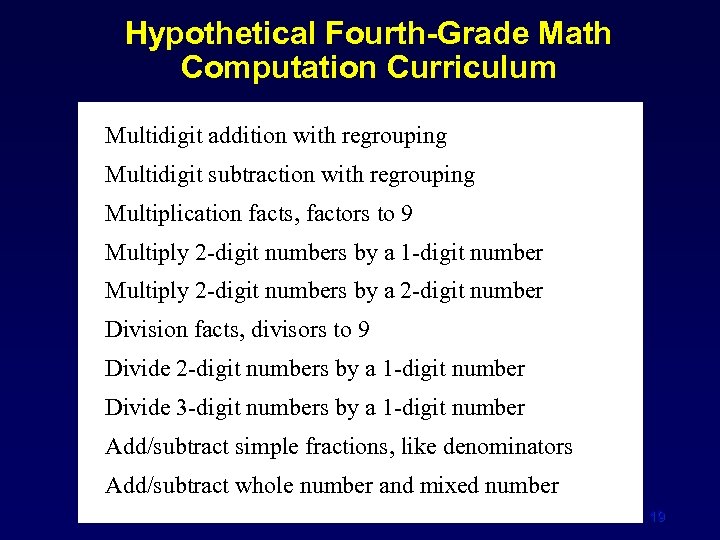
Hypothetical Fourth-Grade Math Computation Curriculum 1. 2. 3. 4. 5. 6. 7. 8. 9. 10. Multidigit addition with regrouping Multidigit subtraction with regrouping Multiplication facts, factors to 9 Multiply 2 -digit numbers by a 1 -digit number Multiply 2 -digit numbers by a 2 -digit number Division facts, divisors to 9 Divide 2 -digit numbers by a 1 -digit number Divide 3 -digit numbers by a 1 -digit number Add/subtract simple fractions, like denominators Add/subtract whole number and mixed number 13
Multidigit Addition Mastery Test 14
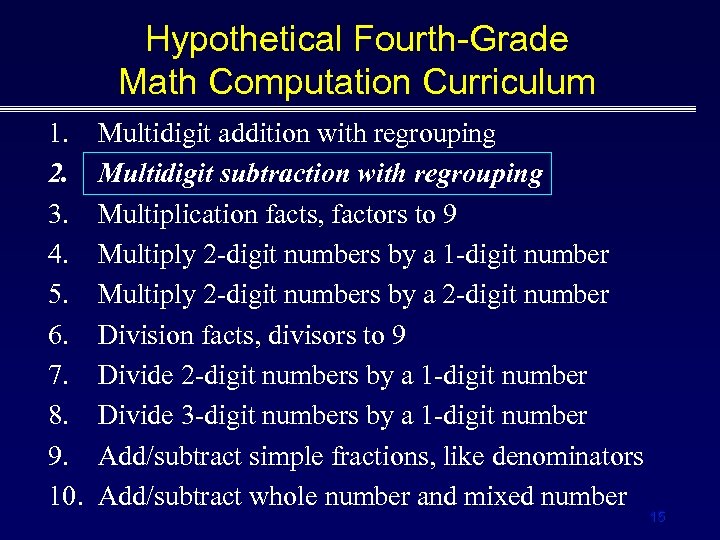
Hypothetical Fourth-Grade Math Computation Curriculum 1. 2. 3. 4. 5. 6. 7. 8. 9. 10. Multidigit addition with regrouping Multidigit subtraction with regrouping Multiplication facts, factors to 9 Multiply 2 -digit numbers by a 1 -digit number Multiply 2 -digit numbers by a 2 -digit number Division facts, divisors to 9 Divide 2 -digit numbers by a 1 -digit number Divide 3 -digit numbers by a 1 -digit number Add/subtract simple fractions, like denominators Add/subtract whole number and mixed number 15

Multidigit Subtraction Mastery Test 16
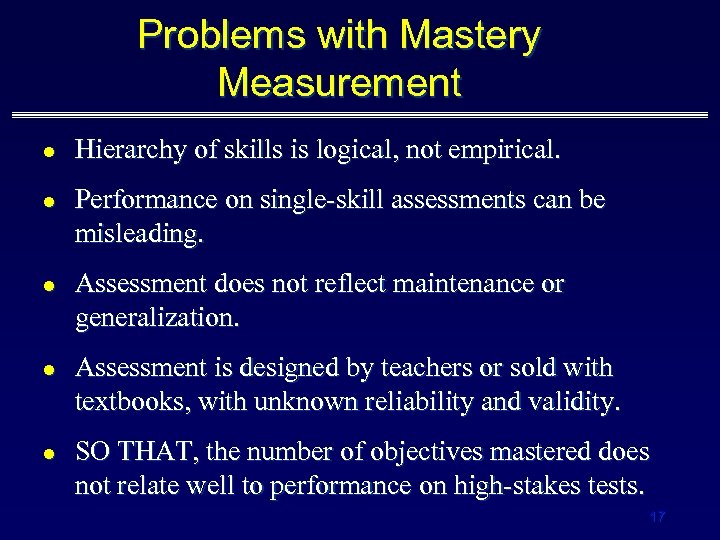
Problems with Mastery Measurement l l l Hierarchy of skills is logical, not empirical. Performance on single-skill assessments can be misleading. Assessment does not reflect maintenance or generalization. Assessment is designed by teachers or sold with textbooks, with unknown reliability and validity. SO THAT, the number of objectives mastered does not relate well to performance on high-stakes tests. 17
CBM was designed to address these problems. An Example of CBM: Math Computation 18
Hypothetical Fourth-Grade Math Computation Curriculum Multidigit addition with regrouping Multidigit subtraction with regrouping Multiplication facts, factors to 9 Multiply 2 -digit numbers by a 1 -digit number Multiply 2 -digit numbers by a 2 -digit number Division facts, divisors to 9 Divide 2 -digit numbers by a 1 -digit number Divide 3 -digit numbers by a 1 -digit number Add/subtract simple fractions, like denominators Add/subtract whole number and mixed number 19
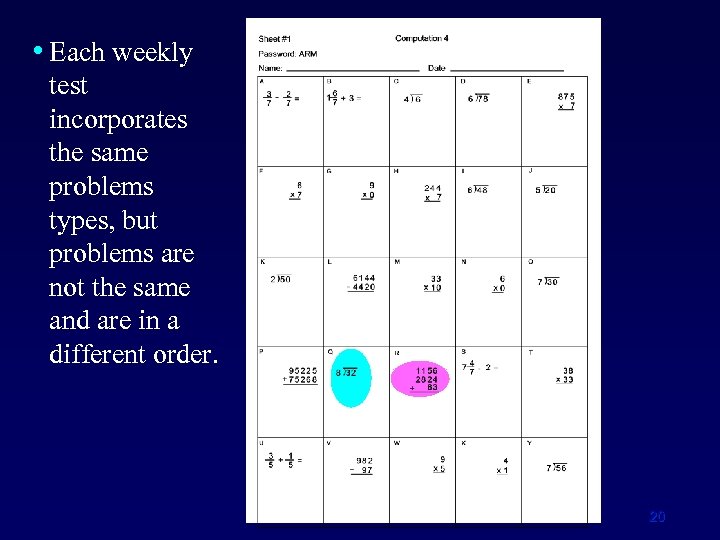
• Each weekly test incorporates the same problems types, but problems are not the same and are in a different order. 20
Donald’s Progress in Digits Correct Across the School Year 21
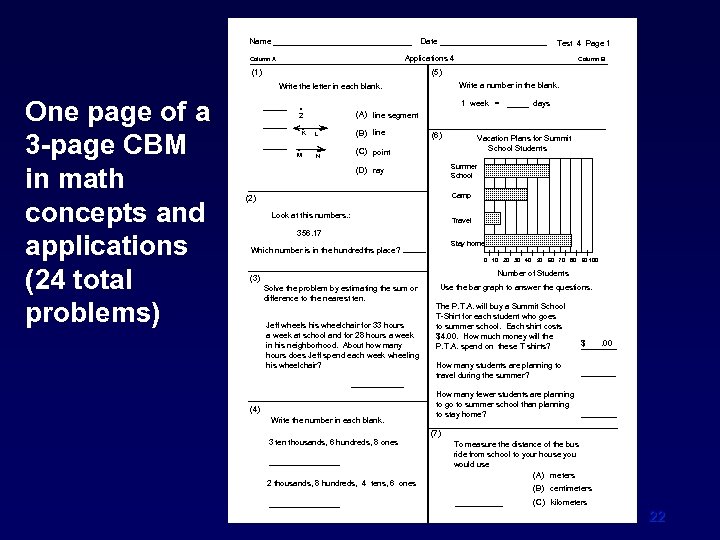
Name ________________ Date ____________ Applications 4 Column A (1) Column B (5) Write a number in the blank. Write the letter in each blank. One page of a 3 -page CBM in math concepts and applications (24 total problems) Test 4 Page 1 1 week = _____ days • (A) line segment Z • K • M L • • N (B) line (6) Vacation Plans for Summit School Students (C) point Summer School (D) ray Camp (2) Look at this numbers. : Travel 356. 17 Stay home Which number is in the hundredths place? 0 10 20 30 40 50 60 70 80 90 100 Number of Students (3) Solve the problem by estimating the sum or difference to the nearest ten. Jeff wheels his wheelchair for 33 hours a week at school and for 28 hours a week in his neighborhood. About how many hours does Jeff spend each week wheeling his wheelchair? (4) Write the number in each blank. 3 ten thousands, 6 hundreds, 8 ones 2 thousands, 8 hundreds, 4 tens, 6 ones Use the bar graph to answer the questions. The P. T. A. will buy a Summit School T-Shirt for each student who goes to summer school. Each shirt costs $4. 00. How much money will the P. T. A. spend on these T shirts? $ . 00 How many students are planning to travel during the summer? How many fewer students are planning to go to summer school than planning to stay home? (7) To measure the distance of the bus ride from school to your house you would use (A) meters (B) centimeters (C) kilometers 22
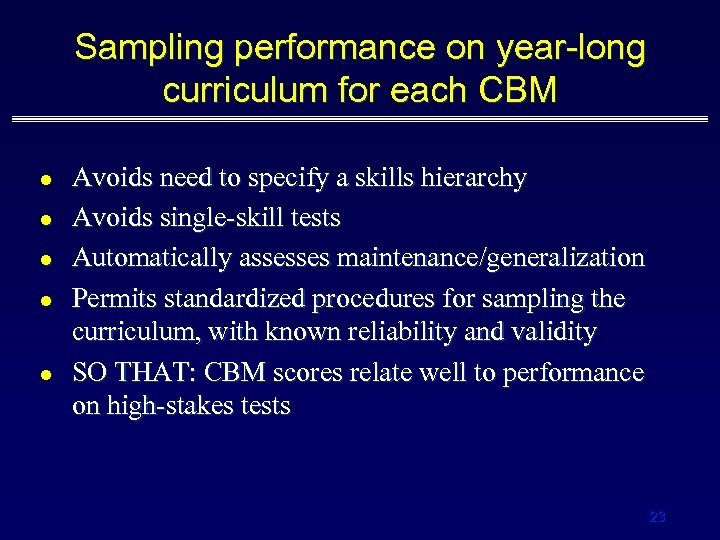
Sampling performance on year-long curriculum for each CBM l l l Avoids need to specify a skills hierarchy Avoids single-skill tests Automatically assesses maintenance/generalization Permits standardized procedures for sampling the curriculum, with known reliability and validity SO THAT: CBM scores relate well to performance on high-stakes tests 23
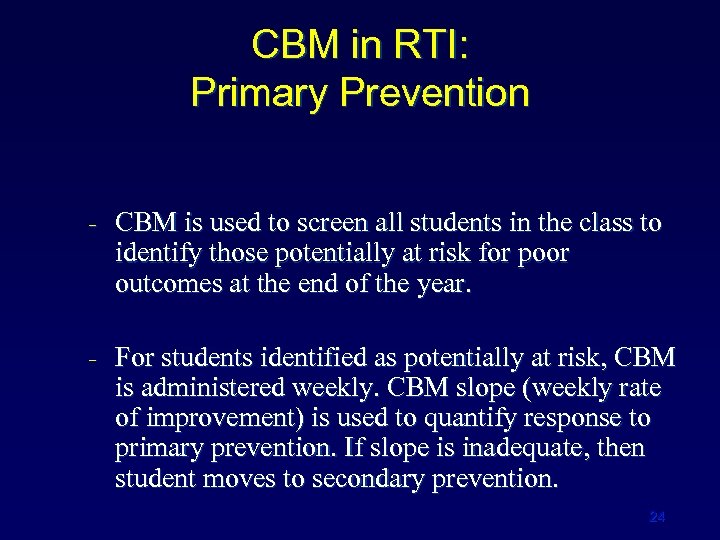
CBM in RTI: Primary Prevention − − CBM is used to screen all students in the class to identify those potentially at risk for poor outcomes at the end of the year. For students identified as potentially at risk, CBM is administered weekly. CBM slope (weekly rate of improvement) is used to quantify response to primary prevention. If slope is inadequate, then student moves to secondary prevention. 24
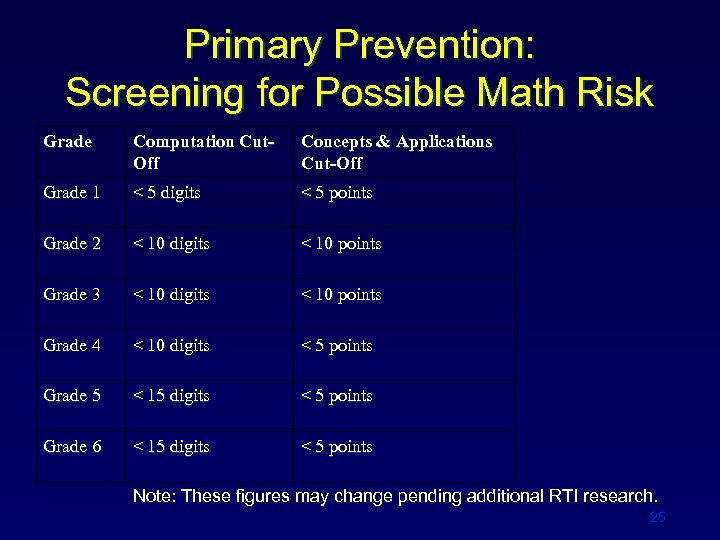
Primary Prevention: Screening for Possible Math Risk Grade Computation Cut. Off Concepts & Applications Cut-Off Grade 1 < 5 digits < 5 points Grade 2 < 10 digits < 10 points Grade 3 < 10 digits < 10 points Grade 4 < 10 digits < 5 points Grade 5 < 15 digits < 5 points Grade 6 < 15 digits < 5 points Note: These figures may change pending additional RTI research. 25
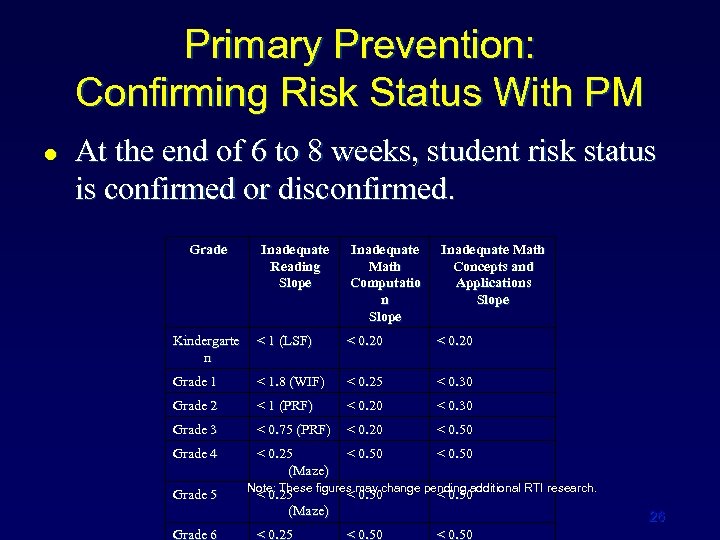
Primary Prevention: Confirming Risk Status With PM l At the end of 6 to 8 weeks, student risk status is confirmed or disconfirmed. Grade Inadequate Reading Slope Inadequate Math Computatio n Slope Inadequate Math Concepts and Applications Slope Kindergarte n < 1 (LSF) < 0. 20 Grade 1 < 1. 8 (WIF) < 0. 25 < 0. 30 Grade 2 < 1 (PRF) < 0. 20 < 0. 30 Grade 3 < 0. 75 (PRF) < 0. 20 < 0. 50 Grade 4 < 0. 25 (Maze) < 0. 50 Grade 5 Grade 6 Note: These figures may change pending additional RTI research. < 0. 25 (Maze) < 0. 50 < 0. 25 < 0. 50 26 < 0. 50
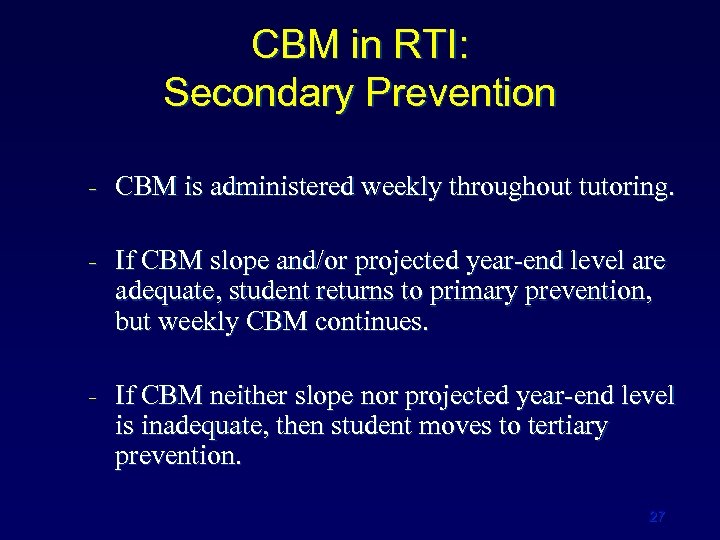
CBM in RTI: Secondary Prevention − − − CBM is administered weekly throughout tutoring. If CBM slope and/or projected year-end level are adequate, student returns to primary prevention, but weekly CBM continues. If CBM neither slope nor projected year-end level is inadequate, then student moves to tertiary prevention. 27
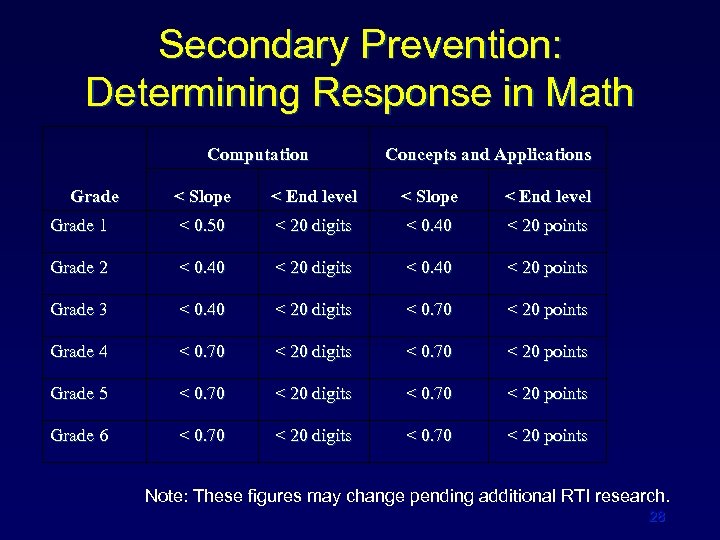
Secondary Prevention: Determining Response in Math Computation Concepts and Applications < Slope < End level Grade 1 < 0. 50 < 20 digits < 0. 40 < 20 points Grade 2 < 0. 40 < 20 digits < 0. 40 < 20 points Grade 3 < 0. 40 < 20 digits < 0. 70 < 20 points Grade 4 < 0. 70 < 20 digits < 0. 70 < 20 points Grade 5 < 0. 70 < 20 digits < 0. 70 < 20 points Grade 6 < 0. 70 < 20 digits < 0. 70 < 20 points Grade Note: These figures may change pending additional RTI research. 28
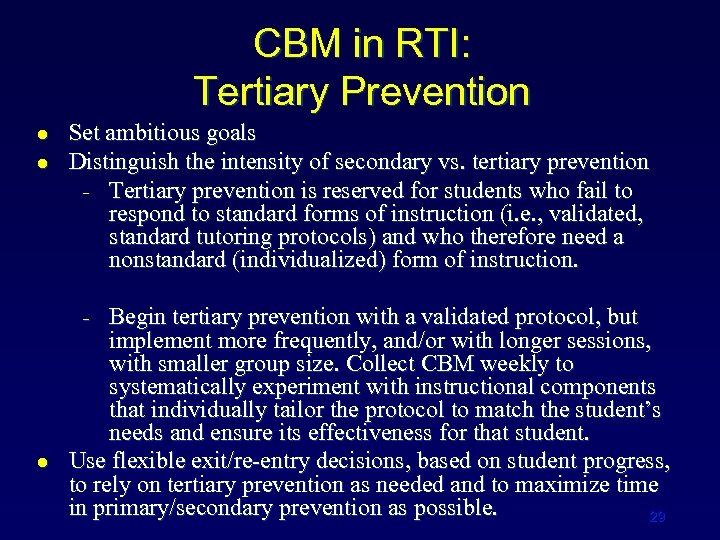
CBM in RTI: Tertiary Prevention l l Set ambitious goals Distinguish the intensity of secondary vs. tertiary prevention − Tertiary prevention is reserved for students who fail to respond to standard forms of instruction (i. e. , validated, standard tutoring protocols) and who therefore need a nonstandard (individualized) form of instruction. Begin tertiary prevention with a validated protocol, but implement more frequently, and/or with longer sessions, with smaller group size. Collect CBM weekly to systematically experiment with instructional components that individually tailor the protocol to match the student’s needs and ensure its effectiveness for that student. Use flexible exit/re-entry decisions, based on student progress, to rely on tertiary prevention as needed and to maximize time in primary/secondary prevention as possible. 29 − l
Part 3: Secondary Tutoring at First Grade Lynn Fuchs, Don Compton, Doug Fuchs, Kim Paulsen, Joan Bryant, and Carol Hamlett Vanderbilt University Journal of Educational Psychology, 2005 Funded by OSEP Grant #H 324 U 010004 National Research Center on Learning Disabilities 30
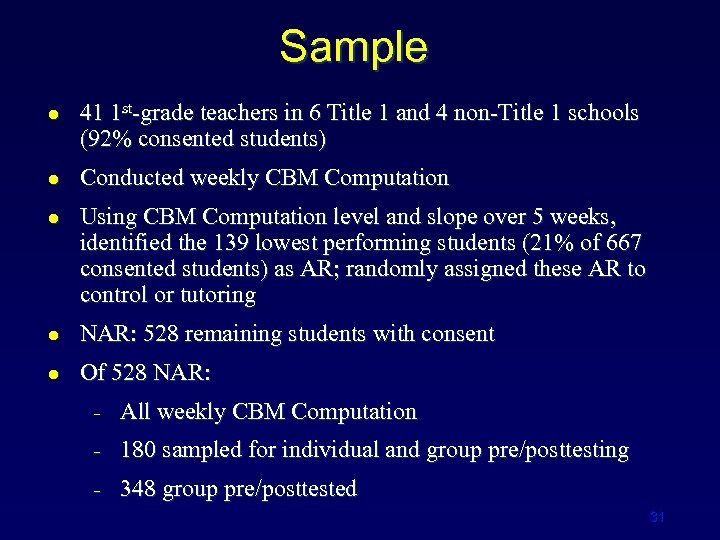
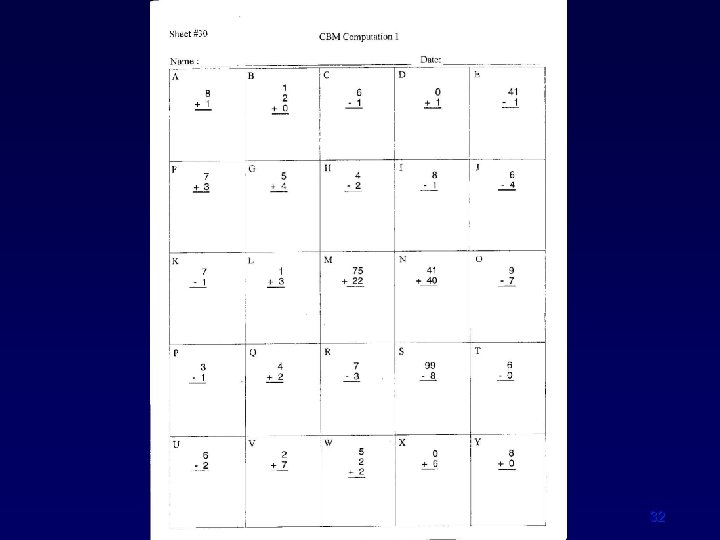
Sample l l l 41 1 st-grade teachers in 6 Title 1 and 4 non-Title 1 schools (92% consented students) Conducted weekly CBM Computation Using CBM Computation level and slope over 5 weeks, identified the 139 lowest performing students (21% of 667 consented students) as AR; randomly assigned these AR to control or tutoring l NAR: 528 remaining students with consent l Of 528 NAR: − All weekly CBM Computation − 180 sampled for individual and group pre/posttesting − 348 group pre/posttested 31
32
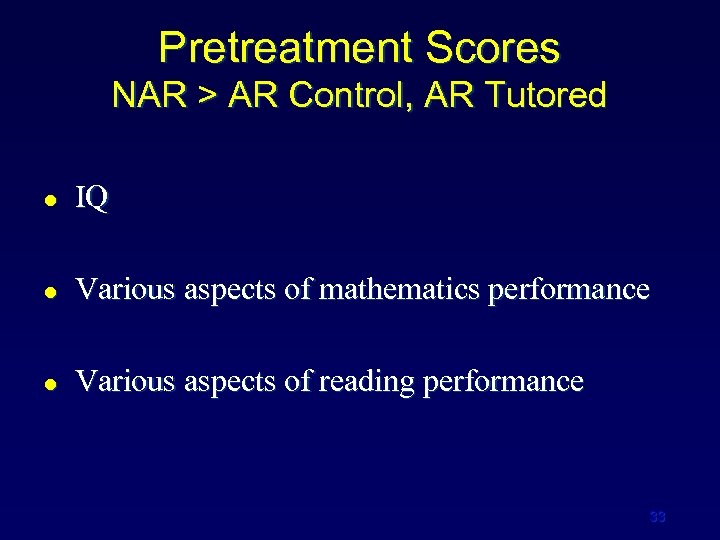
Pretreatment Scores NAR > AR Control, AR Tutored l IQ l Various aspects of mathematics performance l Various aspects of reading performance 33
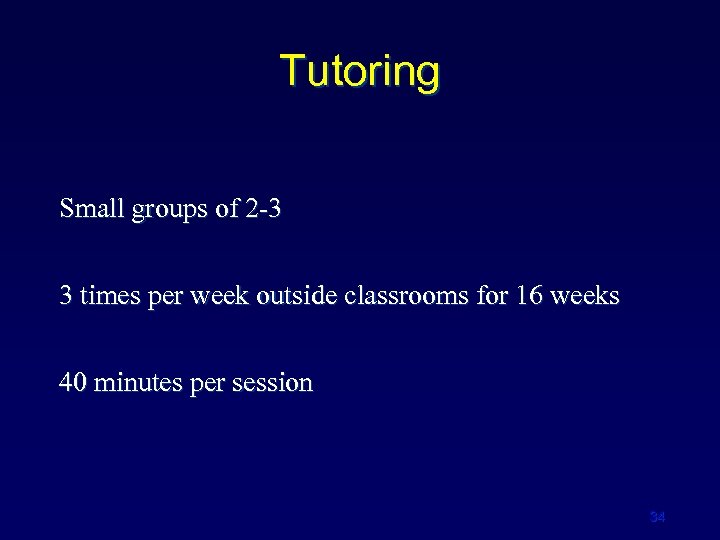
Tutoring Small groups of 2 -3 3 times per week outside classrooms for 16 weeks 40 minutes per session 34
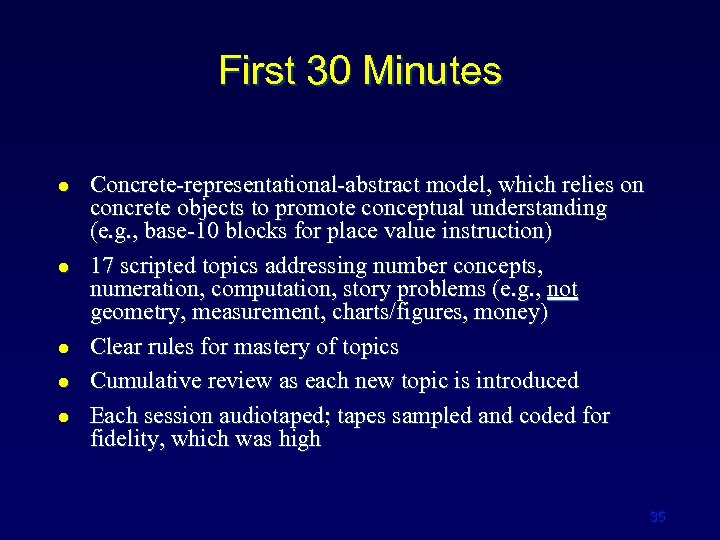
First 30 Minutes l l l Concrete-representational-abstract model, which relies on concrete objects to promote conceptual understanding (e. g. , base-10 blocks for place value instruction) 17 scripted topics addressing number concepts, numeration, computation, story problems (e. g. , not geometry, measurement, charts/figures, money) Clear rules for mastery of topics Cumulative review as each new topic is introduced Each session audiotaped; tapes sampled and coded for fidelity, which was high 35
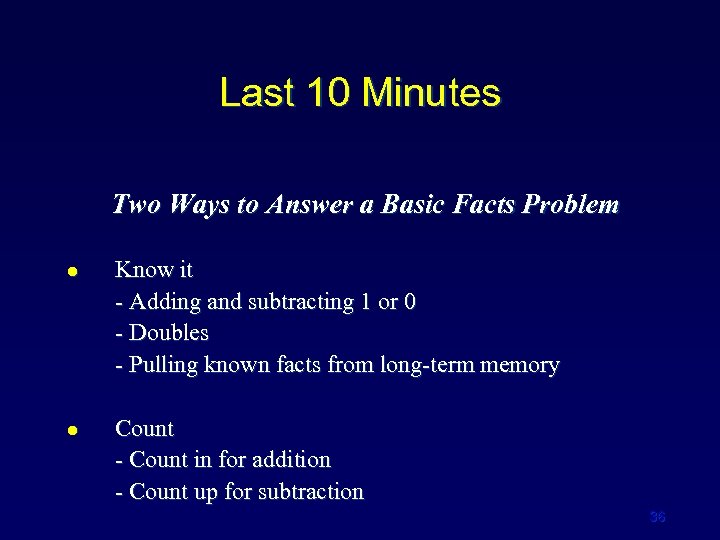
Last 10 Minutes Two Ways to Answer a Basic Facts Problem l l Know it - Adding and subtracting 1 or 0 - Doubles - Pulling known facts from long-term memory Count - Count in for addition - Count up for subtraction 36
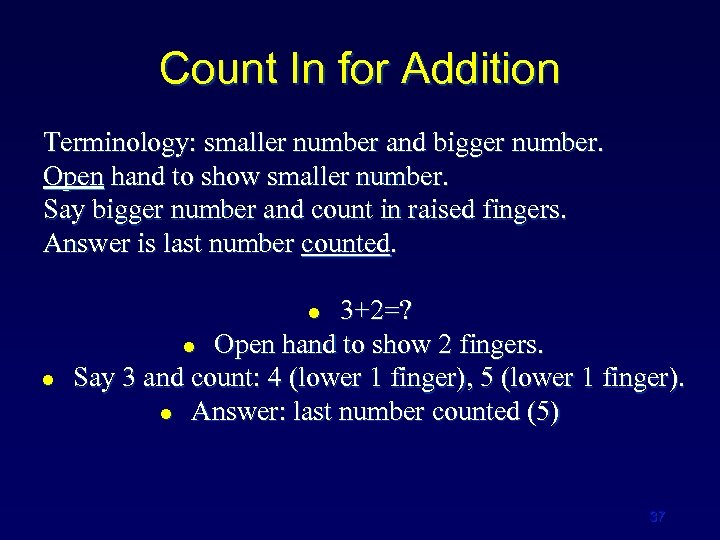
Count In for Addition Terminology: smaller number and bigger number. Open hand to show smaller number. Say bigger number and count in raised fingers. Answer is last number counted. 3+2=? l Open hand to show 2 fingers. Say 3 and count: 4 (lower 1 finger), 5 (lower 1 finger). l Answer: last number counted (5) l l 37
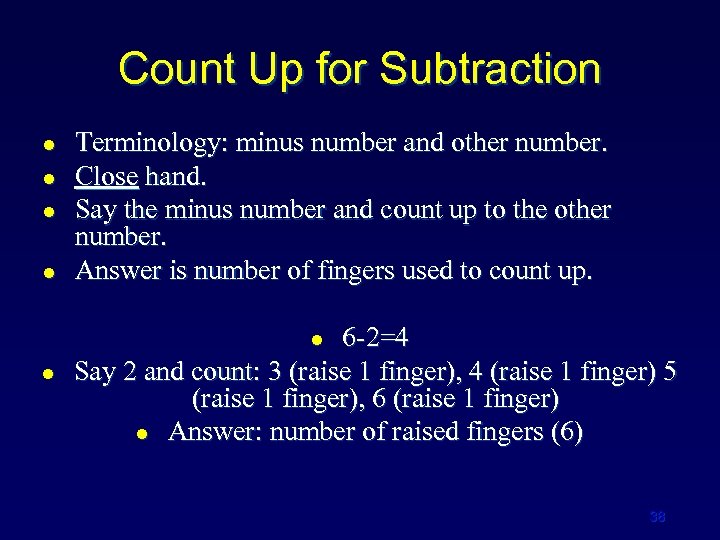
Count Up for Subtraction l l Terminology: minus number and other number. Close hand. Say the minus number and count up to the other number. Answer is number of fingers used to count up. 6 -2=4 Say 2 and count: 3 (raise 1 finger), 4 (raise 1 finger) 5 (raise 1 finger), 6 (raise 1 finger) l Answer: number of raised fingers (6) l l 38
Know It or Count-Up Practice l l l “Round Robin” timed practice Shuffle deck of basic fact flashcards (sums 09; minuends 0 -9) Each student − − Has 1 minute; when errors occur, immediately asked to count up (uses time) Has another minute to “beat own score” 39
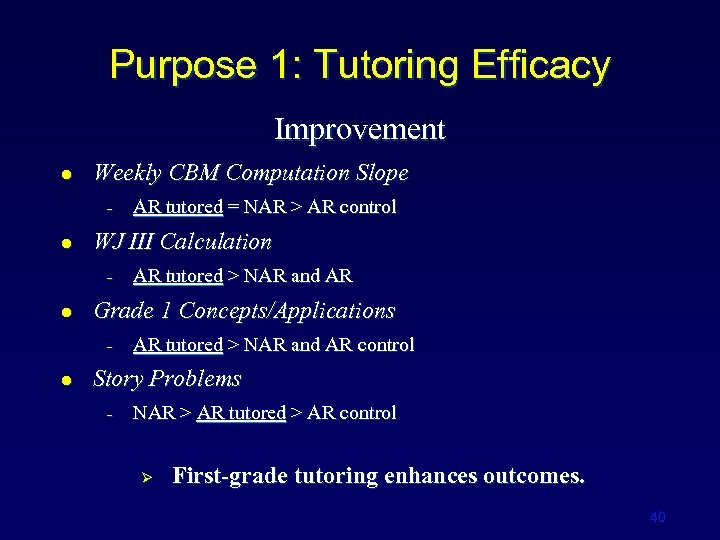
Purpose 1: Tutoring Efficacy Improvement l Weekly CBM Computation Slope − l WJ III Calculation − l AR tutored > NAR and AR Grade 1 Concepts/Applications − l AR tutored = NAR > AR control AR tutored > NAR and AR control Story Problems − NAR > AR tutored > AR control Ø First-grade tutoring enhances outcomes. 40
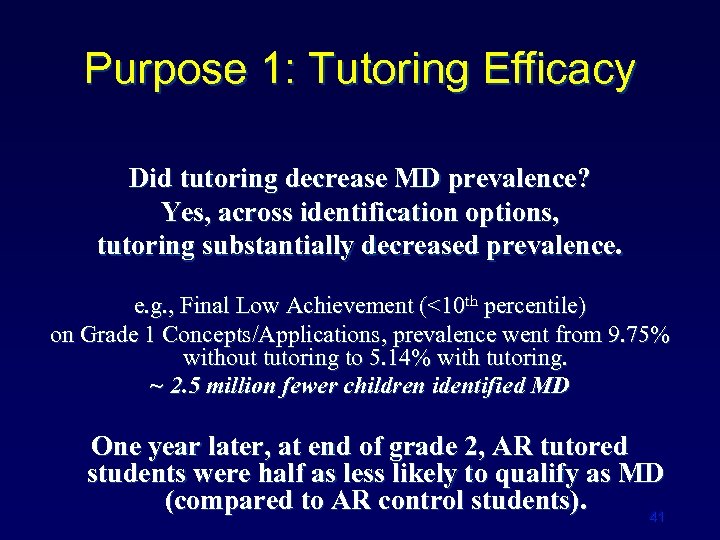
Purpose 1: Tutoring Efficacy Did tutoring decrease MD prevalence? Yes, across identification options, tutoring substantially decreased prevalence. e. g. , Final Low Achievement (<10 th percentile) on Grade 1 Concepts/Applications, prevalence went from 9. 75% without tutoring to 5. 14% with tutoring. ~ 2. 5 million fewer children identified MD One year later, at end of grade 2, AR tutored students were half as less likely to qualify as MD (compared to AR control students). 41

Part 4: Secondary Tutoring at Third Grade Lynn Fuchs, Sarah Powell, Pamela Seethaler, Paul Cirino, Jack Fletcher, Doug Fuchs, Carol Hamlett, and Rebecca Zumeta Vanderbilt University and University of Houston Journal of Educational Psychology, in press Grant #P 01046261 National Institute of Child Health and Human Development 42
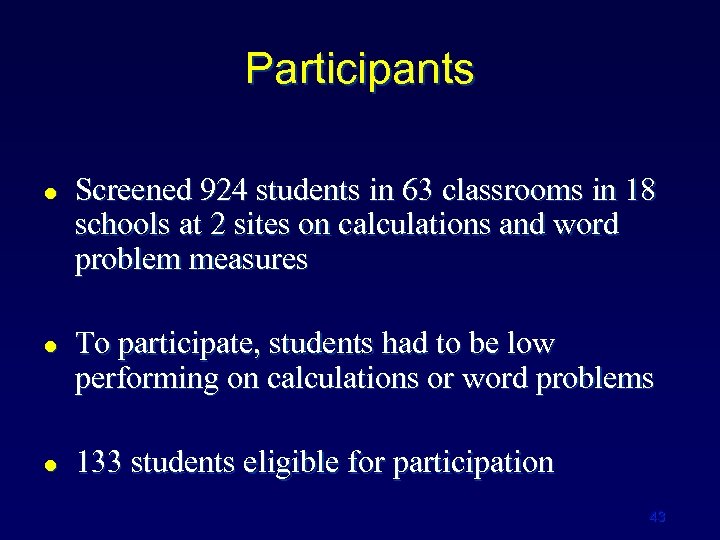
Participants l l l Screened 924 students in 63 classrooms in 18 schools at 2 sites on calculations and word problem measures To participate, students had to be low performing on calculations or word problems 133 students eligible for participation 43
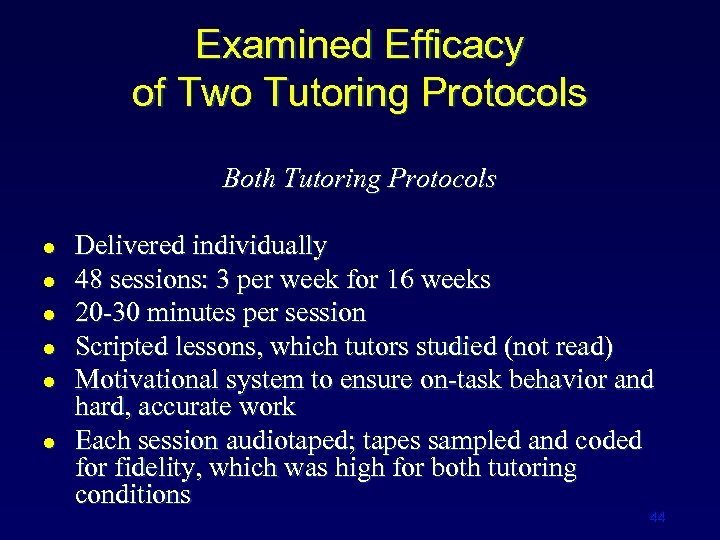
Examined Efficacy of Two Tutoring Protocols Both Tutoring Protocols l l l Delivered individually 48 sessions: 3 per week for 16 weeks 20 -30 minutes per session Scripted lessons, which tutors studied (not read) Motivational system to ensure on-task behavior and hard, accurate work Each session audiotaped; tapes sampled and coded for fidelity, which was high for both tutoring conditions 44
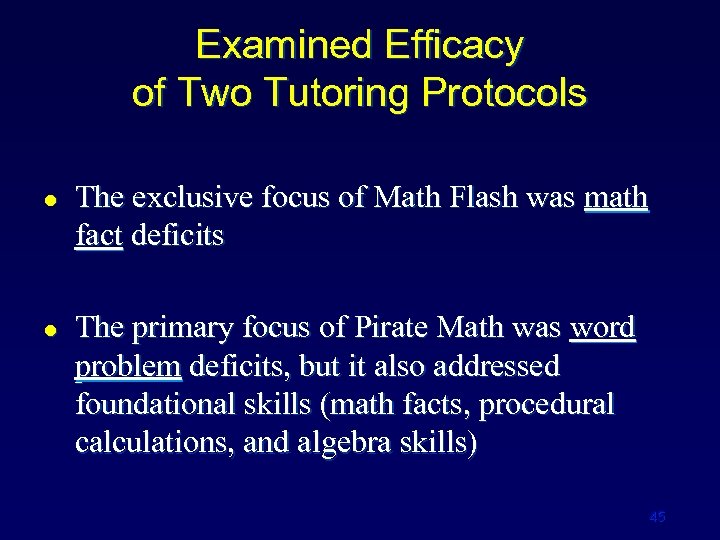
Examined Efficacy of Two Tutoring Protocols l l The exclusive focus of Math Flash was math fact deficits The primary focus of Pirate Math was word problem deficits, but it also addressed foundational skills (math facts, procedural calculations, and algebra skills) 45
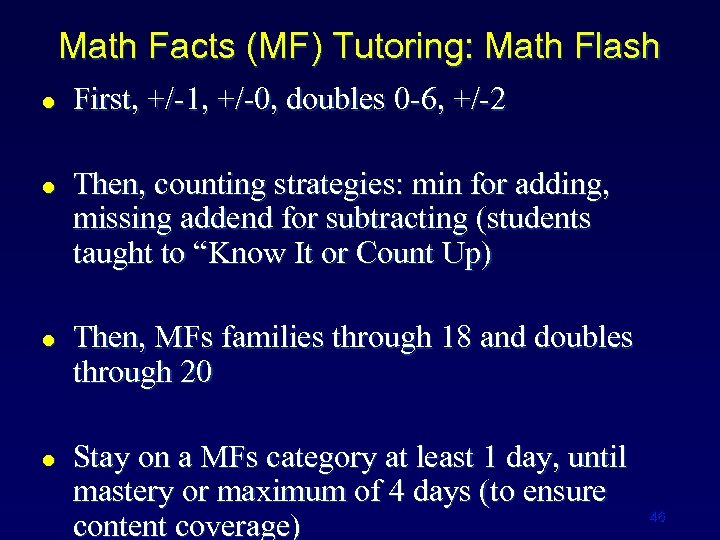
Math Facts (MF) Tutoring: Math Flash l l First, +/-1, +/-0, doubles 0 -6, +/-2 Then, counting strategies: min for adding, missing addend for subtracting (students taught to “Know It or Count Up) Then, MFs families through 18 and doubles through 20 Stay on a MFs category at least 1 day, until mastery or maximum of 4 days (to ensure content coverage) 46
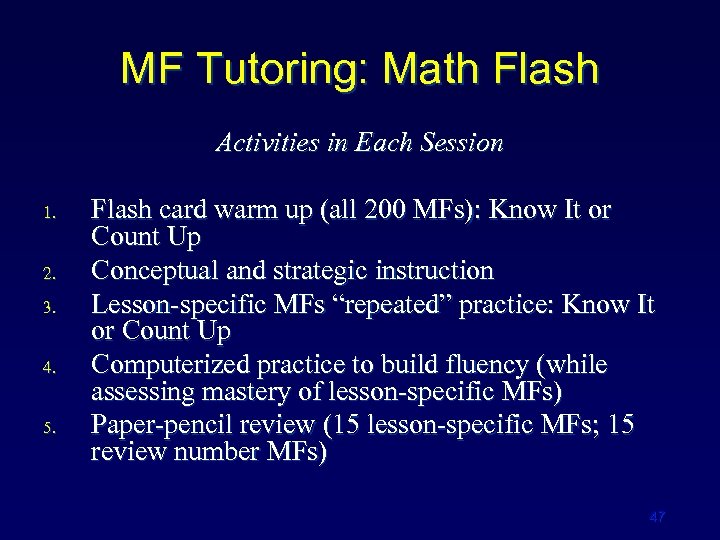
MF Tutoring: Math Flash Activities in Each Session 1. 2. 3. 4. 5. Flash card warm up (all 200 MFs): Know It or Count Up Conceptual and strategic instruction Lesson-specific MFs “repeated” practice: Know It or Count Up Computerized practice to build fluency (while assessing mastery of lesson-specific MFs) Paper-pencil review (15 lesson-specific MFs; 15 review number MFs) 47
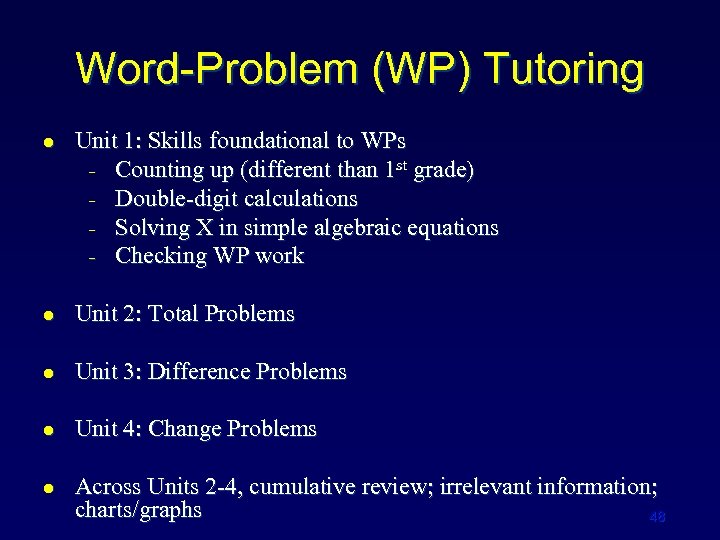
Word-Problem (WP) Tutoring l Unit 1: Skills foundational to WPs − Counting up (different than 1 st grade) − Double-digit calculations − Solving X in simple algebraic equations − Checking WP work l Unit 2: Total Problems l Unit 3: Difference Problems l Unit 4: Change Problems l Across Units 2 -4, cumulative review; irrelevant information; charts/graphs 48
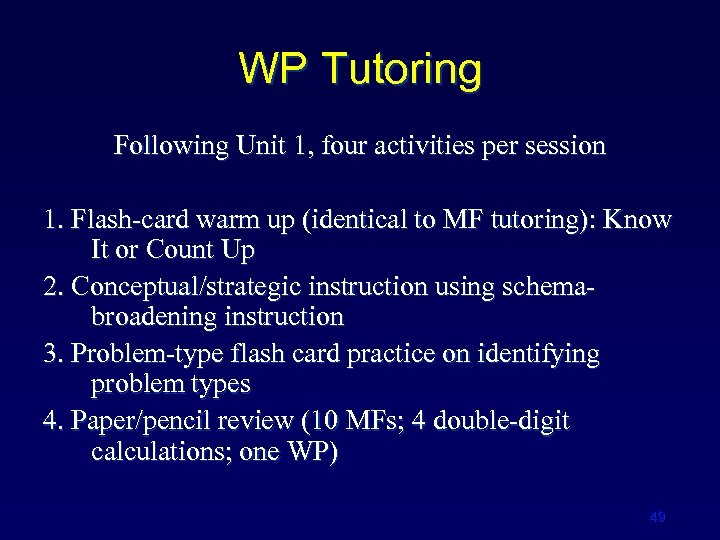
WP Tutoring Following Unit 1, four activities per session 1. Flash-card warm up (identical to MF tutoring): Know It or Count Up 2. Conceptual/strategic instruction using schemabroadening instruction 3. Problem-type flash card practice on identifying problem types 4. Paper/pencil review (10 MFs; 4 double-digit calculations; one WP) 49
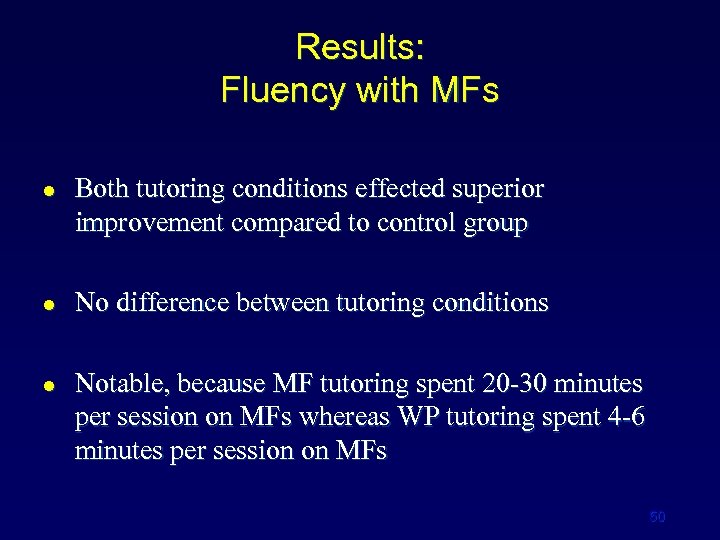
Results: Fluency with MFs l l l Both tutoring conditions effected superior improvement compared to control group No difference between tutoring conditions Notable, because MF tutoring spent 20 -30 minutes per session on MFs whereas WP tutoring spent 4 -6 minutes per session on MFs 50
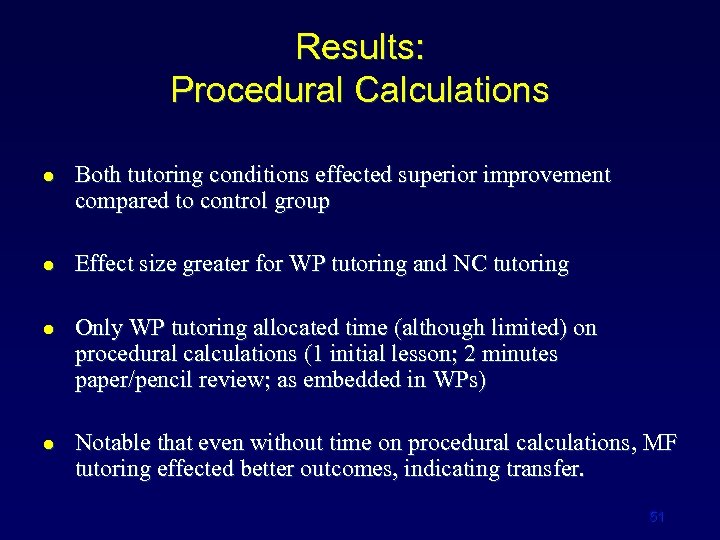
Results: Procedural Calculations l l Both tutoring conditions effected superior improvement compared to control group Effect size greater for WP tutoring and NC tutoring Only WP tutoring allocated time (although limited) on procedural calculations (1 initial lesson; 2 minutes paper/pencil review; as embedded in WPs) Notable that even without time on procedural calculations, MF tutoring effected better outcomes, indicating transfer. 51
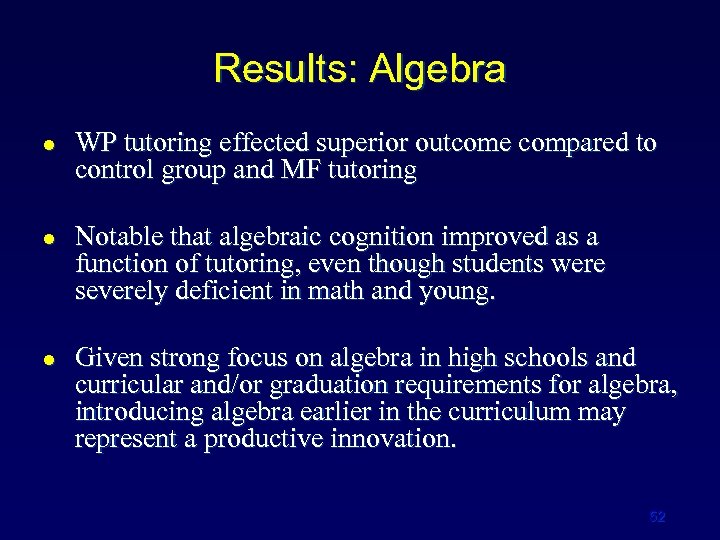
Results: Algebra l l l WP tutoring effected superior outcome compared to control group and MF tutoring Notable that algebraic cognition improved as a function of tutoring, even though students were severely deficient in math and young. Given strong focus on algebra in high schools and curricular and/or graduation requirements for algebra, introducing algebra earlier in the curriculum may represent a productive innovation. 52
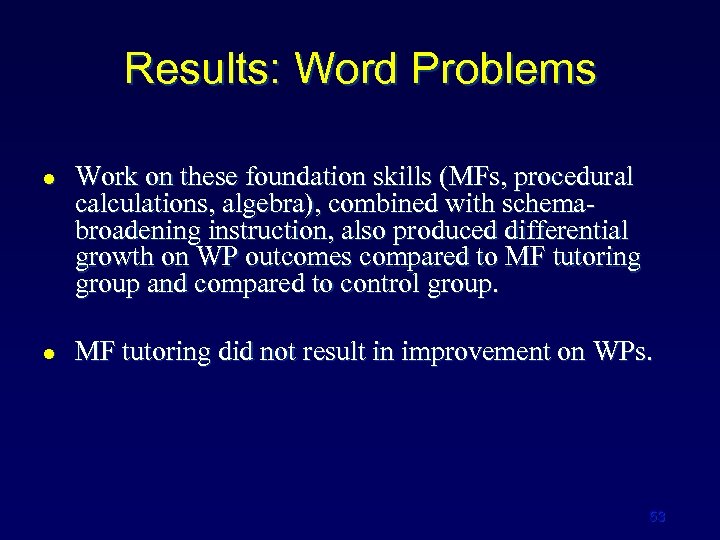
Results: Word Problems l l Work on these foundation skills (MFs, procedural calculations, algebra), combined with schemabroadening instruction, also produced differential growth on WP outcomes compared to MF tutoring group and compared to control group. MF tutoring did not result in improvement on WPs. 53
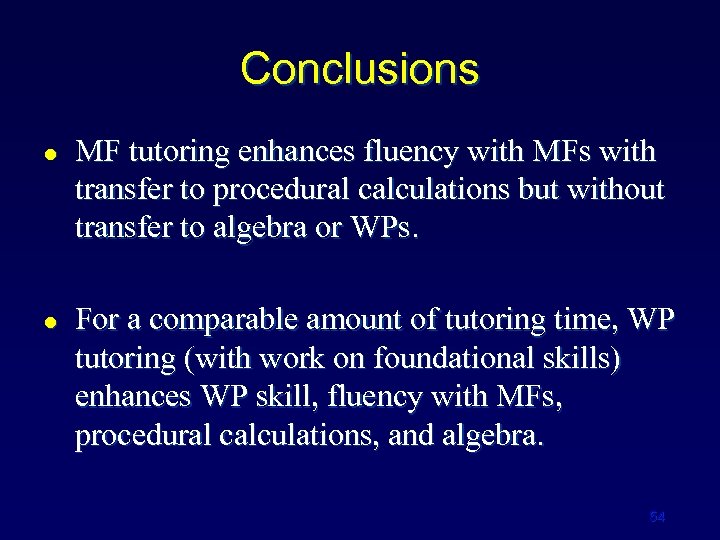
Conclusions l l MF tutoring enhances fluency with MFs with transfer to procedural calculations but without transfer to algebra or WPs. For a comparable amount of tutoring time, WP tutoring (with work on foundational skills) enhances WP skill, fluency with MFs, procedural calculations, and algebra. 54
Tutoring Manuals l First-Grade Secondary Prevention Tutoring Manual l Third-Grade Pirate Math Manual l Also: Hot Math (Whole Class and Tutoring) 55

Contact Flora Murray flora. murray@vanderbilt. edu Vanderbilt University 328 Peabody College Department of Special Education Nashville, TN 37203 (615) 343 -4782 56
CBM Math Materials l Mc. Graw-Hill: Web-based math (and reading) systems Pro-Ed, Inc. : Math computation and concepts/applications tests (Monitoring Basic Skills Progress) l www. studentprogress. org l 57
Скачать презентацию The Prevention and Identification of Math Disability Using
2699ee2de0412f2e48a8702d05c57ea2.ppt