 Скачать презентацию The President as a Person The Background
bd6ac0f9ccc0aa9de2536354cd72f55c.ppt
- Количество слайдов: 22



The President as a Person
The Background of Various Presidents u Presidents are not typical Americans. u The Constitution requires that they be older which implies greater maturity. Of the 45 who have served, 25 have been in their 50 s. Only 8 have been in their 40 s. Teddy Roosevelt 42; Kennedy 43, Clinton 46; Obama 47. Four were 65 or over upon taking office. Ronald Reagan two weeks shy of 70. One was elected in his 70 s. u Most presidents have been well-educated and attorneys (27 out of 44). Since the turn of the century, 9 presidents have been attorneys; 1 journalist; 1 engineer; 4 business men; 1 actor; 1 military; 2 educators; 1 store owner. Of modern presidents, only Truman did not have a college degree. u 25 of 45 had expensive private higher education. 6 Harvard. 3 Yale.
u Presidents have also tended to be from an elite social and economic status. Kennedy came from a wealthy family, as did both Bushes. http: //247 wallst. com/bankingfinance/2010/05/17/the-net-worthof-the-american-presidentswashington-to-obama/2/ u Ten of our presidents have come from the same families. – John Adams and John Q. Adams were father and son – William Henry and Benjamin Harrison were grandfather and grandson – Theodore and F. D. Roosevelt were cousins – James Madison and Zachary Taylor had common grandparents. – George H. W. Bush and George W. Bush father and son. u A few modern presidents came from poor backgrounds: Truman, LBJ, Clinton, Nixon came closest to having grown up in poverty, though hardly from the ghetto. Lyndon Johnson had poor depression era beginnings.
u Political experience: 27 of 45 served at least some time in Congress. 16 served some time as governor of a state. 14 served at least some time as vicepresident. There has been a recent trend for service at the state level to be the dominant career path. u There is a predominance of Southerners as president, especially in modern times. Since 1952, 6 of 13 presidents have been from the South. (Eisenhower, Johnson, Carter, GHW Bush, Clinton, GW Bush) Why? u Presidents have generally had poorer health than the general population, having more ailments while in office, and generally dying at a younger age. Roosevelt and polio; Eisenhower and multiple heart attacks; Kennedy and nerve and back conditions; Johnson, heart and kidney ailments; Reagan, cancer; Bush I, hyperthyroid. Clinton, oversexed, no heart ailments. George W. Bush, “foot-in-mouth” disease. Trump, “tweetitis” and likely “psychiatric” issues.
u There is a gender and racial bias for those holding the presidency. Also bias toward having protestant, white, male presidents. No Jew or female; one African-American. u Religion. Here is a link to the religious affiliations of all the presidents. Note that most early presidents were Episcopalian in name, but actually deists. Many had no religious affiliation prior to leaving office. u Many of our presidents have also been freemasons. Here are records. Link omits Jefferson, Madison, and Lyndon Johnson for certainty reasons. Johson was a first degree who went no further. Some evidence that Jefferson and Madison were. u Catholicism is largest denomination in U. S. Yet, there has been only one Catholic president. Catholic Al Smith (1928) was defeated by largest electoral vote margin in American history, and second largest popular vote margin. Smith was the first Democrat to lose the deeply Democratic and protestant South.
u John Kennedy, also Catholic, won against Richard Nixon in 1960 by the slimmest of margins. u What difference do all of these demographic characteristics make? Some would argue that they are the building blocks of personality. u This may be, but it is not very scientific to say that Nixon had problems because he grew up in poverty. Or that Clinton had problems because he grew up in a singleparent home? How does one know this is why he had problems? u It may also be that demographic characteristics affect the president’s ability to lead. Some might argue that there is a bias toward viewing men as leaders, and women as followers. The bible? ? ? u Does race affect the ability to lead? http: //nyti. ms/15 Ziodf
Psychological Orientations u Personality is an important influence on how the White House is run. u Control orientation u Degree of involvement u Organization of the White House u Willingness to listen to advice.
u Political psychologist Fred Greenstein outlined the conditions under which we might expect personal factors to affect the impacts of presidents. u The president’s ability to restructure the environment. For example, organization and design of the White House staff may be affected by presidential personality. u Location. The president’s capacity to lead depends on structural factors. Sitting at the top of the executive branch is an advantage, but not uniformly so. The president may have an easier time controlling an executive agency than an independent agency. Under this circumstance the ability to persuade becomes more important. u Personal Strengths and Weaknesses. Intellect, speaking skills, integrity, leadership, reputation.
u Situational ambiguity. The more ambiguous a situation is, the more likely that personal attributes will be important. Situations that are new are often ambiguous (e. g. , response to September 11 th). Ambiguity may also arise when a situation is extremely complex (e. g. , Kennedy during the Cuban missile crisis). Ambiguity may also arise when there are conflicting perspectives (Homeland security vs. loss of personal freedoms). u When evaluating the effect of personality, we must ask ourselves whether circumstances are present that allow the person to have an impact. See especially the work by Steve Skowronek.
u James David Barber’s comparative presidency work is seminal in the literature on the impact of presidential personality. u He developed psychological profiles of the presidents and sought to explain presidential performance and behavior in terms of these psychological profiles. u Barber’s three elements of presidential personality: u Character-The way the president orients himself toward life. Selfesteem and the pleasure the person takes in meeting challenges. Openness to criticism. How does the president feel about himself. Thinking rationally under criticism or stress. Attitude toward learning the job. Develops early in life during childhood. Character colors both the president’s style and world view, but does not determine them directly.
u Style-The way the president goes about doing what the office requires him to do. The habitual way the president has of doing things. Things like reliance on rhetoric, personal relations, and homework. To speak directly to the media, the public, to large audiences, to deal face to face with other politicians, to read, write and calculate by himself in order to manage the endless flow of details. A predictable mechanism explaining how the president deals with people, tasks, and communications. u World View-How the president sees the world and his lasting opinions about what he sees. Primary, politically relevant beliefs, particularly his conceptions of 1) social causality, 2) human nature, 3) and the central moral conflicts of the time.
u Presidential character conditions the processing of information, the consideration of options, and the making of decisions. u Presidential style-presidents set the tone for their White House. Formal or informal, consensual or promotive of diverse viewpoints, hierarchical or decentralized. Some presidents have a desire to dominate (Johnson and Nixon). Some hate conflict (Reagan). Some have to be involved in almost everything (Carter, to a fault wanted to micromanage which was inefficient); others are extremely detached (Reagan, to a fault because he didn’t have command of the details and was too dependent on advisors). u World views- Presidents bring to office a set of beliefs about politics, policy, human nature, and social causality, in other words beliefs about how the world works, that affect a frame of reference, serve as a filter for processing information, potential boundaries of action, and even supply an approach to decision-making itself.
u Other features Barber discusses: – Power situation-What is the relative power of the president with regard to other institutions and actors? Personality may have more or less impact, depending on the power situation. – Climate of expectations-What are the expectations placed on the president in a particular situations? One could argue that George W. Bush’s reaction to September 11 was the perfect condition for a cowboy mentality. The public expected a John Wayne act, and Bush was perfectly suited to provide it. In contrast, how would Bush have reacted to the Iran hostage crisis in 1979? u According to Barber, the three psychological components of character, style, and world view comprise a pattern of motives, habits, and beliefs that result in behaviors that are evident throughout life. They are a psychological foundation that are not easily changed. Once developed they tend to persist.
u Barber develops a typology of presidents based on two concepts: their activity levels and their affective orientations. u Activity levels are the energy brought to the job. u Affect is the level of pleasure that is obtained from doing the job. u Active-Passive dimension describes activity levels. u Positive-Negative dimension describes affective orientation toward the work.
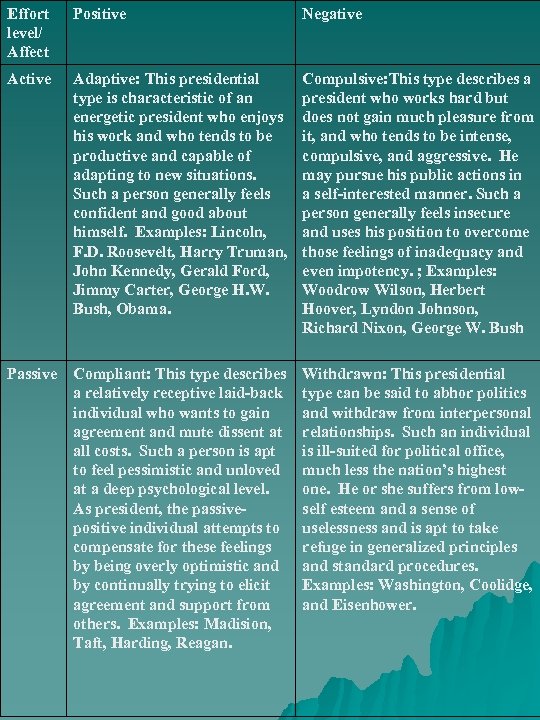
Effort level/ Affect Positive Negative Active Adaptive: This presidential type is characteristic of an energetic president who enjoys his work and who tends to be productive and capable of adapting to new situations. Such a person generally feels confident and good about himself. Examples: Lincoln, F. D. Roosevelt, Harry Truman, John Kennedy, Gerald Ford, Jimmy Carter, George H. W. Bush, Obama. Compulsive: This type describes a president who works hard but does not gain much pleasure from it, and who tends to be intense, compulsive, and aggressive. He may pursue his public actions in a self-interested manner. Such a person generally feels insecure and uses his position to overcome those feelings of inadequacy and even impotency. ; Examples: Woodrow Wilson, Herbert Hoover, Lyndon Johnson, Richard Nixon, George W. Bush Passive Compliant: This type describes a relatively receptive laid-back individual who wants to gain agreement and mute dissent at all costs. Such a person is apt to feel pessimistic and unloved at a deep psychological level. As president, the passivepositive individual attempts to compensate for these feelings by being overly optimistic and by continually trying to elicit agreement and support from others. Examples: Madision, Taft, Harding, Reagan. Withdrawn: This presidential type can be said to abhor politics and withdraw from interpersonal relationships. Such an individual is ill-suited for political office, much less the nation’s highest one. He or she suffers from lowself esteem and a sense of uselessness and is apt to take refuge in generalized principles and standard procedures. Examples: Washington, Coolidge, and Eisenhower.
u Barber retired around the time of the Clinton presidency and died in 2004. He did not rate later presidents. Others have, though. u What was Clinton? Barber rated active-positive. See also John Dean. http: //verdict. justia. com/2012/02 /10/predicting-presidentialperformance u What was George W. Bush? Dean rated Active. Negative. http: //writ. news. findlaw. co m/dean/20040521. html u What was Obama? Dean rated Active. Positivehttp: //writ. news. findlaw. com /dean/20081114. html u What is Trump?
u Critique of Barber’s work. u Classification of presidents using Barber’s scheme is highly subjective and may result from confounding factors. For example, Eisenhower is classified as Passive-Negative. He was clearly a passive president, but how do we know that this was a function of personality, rather than ideology. Ike was a believer in less government. Could it be that he was passive so as to not have an activist presidency due to this ideology? Barber actually changed his mind about Eisenhower. u Barber’s scheme may also be too simplistic. Presidents may vary on continua from active to passive and positive to negative. So why try to place them in discrete cells. Some presidents may be hyperactive: Clinton is probably an example. Other presidents may just be active without the expenditure of frenetic energy: Kennedy and FDR would be examples.

u Also, it is not so easy to classify presidents as positive or negative. Clinton was classified by Barber as positive. He enjoyed politics, relished the work of the presidency, and was a very public person. On the other hand, he reacted negatively to attacks from the media and the continual criticisms that came from the right wing of the Republican party. u Barber claims that the activepositive makes the best president. However, not all active-positives have been good presidents: Jimmy Carter, George H. W. Bush, and William J. Clinton. Likewise, there have been some great presidents who were active-negative: Woodrow Wilson and Abraham Lincoln.
Classifying Presidential Greatness u Commonly, historians have developed rankings of presidential greatness based on polls of historians. Arthur Schlesinger, Sr. started this in the 1940 s. u The most highly ranked presidents are consistently Washington, Lincoln, Franklin Roosevelt, Theodore Roosevelt, Woodrow Wilson, and Harry S. Truman.
u A more objective approach is taken by the C-Span rankings. The criteria for evaluation are: – Public persuasion – Relations with Congress – International relations – Economic management – Administrative skills – Moral authority – Crisis leadership – Vision and agenda setting – Performance within the context of the times – Pursued equal justice for all u Question: On a scale from 1 to 10, how would you rank George W. Bush on each of these criteria? Obama? Discuss. u Is there political bias in how one would rank Bush? Obama?
u A variety of polls have been conducted through the years, based largely on public opinion. Bias? u Simonton attempted to get around the political bias problem by using some purely objective indicators. His indicators are: Length of service. – War-time presidency – Assassinated president – Scandal – War hero prior to entering office – Intellectual brilliance u Question: How would you rank George W. Bush on each of these dimensions? Obama?
u Let’s look at the various rankings. u http: //en. wikipedia. org/wiki/Historic al_rankings_of_Presidents_of_the_U nited_States#2012_Gallup_poll
Скачать презентацию The President as a Person The Background
bd6ac0f9ccc0aa9de2536354cd72f55c.ppt