


 Скачать презентацию The President AP U S Government Politics
13712943fc5888afdc6ae0a954d86c14.ppt
- Количество слайдов: 36
 The President AP U. S. Government & Politics Mr. S. Kolesar 2016 -2017
 Who can become President • Article II, Section 1 • Natural-born citizen • At least 35 years old at the time you assume office • Resident of the US for 14 years
 Expressed Powers (includes both constitutional, and statutory) • Article II, Section 2 • Commander in Chief • Grant reprieves and pardons (except for impeachment) • To make treaties (w/ advice & consent of the Senate 2/3 rd’s) • Nominate & appoint ambassadors & other public Ministers & Consuls, Judges of the Supreme Court, & all other Officers of the US noted, but which will be established by law • Power to fill vacancies during the recess of the Senate
 Expressed Powers (continued) Duties of the President • Article II, Section 3 • State of the Union to Congress • On extraordinary occasions convene both houses or either of them. He may also adjourn them. • Receive ambassadors and other public ministers • Take care that all laws be faithfully executed • Commission all the Officers of the United States
 Inherent (Implied) Powers of the President • A power of the President derived from the statements in the Constitution that “the executive Power shall be vested in a President” and that the president should “take care that the laws be faithfully executed” • Defined through practice rather than law • Executive orders – a rule or regulation issued by the president that has the effect of law. They can implement and give administrative effect to provisions in the Constitution, to treaties, and to statutes. • Executive agreements – An international agreement made by the president, without senatorial ratification, with the head of a foreign state.
 Inherent (Implied) Powers of the President (continued) • Signing Statement – a written declaration that a president may make when signing a bill into law. Usually, such statement point out sections of the law that the president deems unconstitutional. • Executive privilege – the right of executive officials to withhold information from or to refuse to appear before a legislative committee. • Emergency powers – i. e. Lincoln placing Maryland under martial law, and suspending the writ of habeas corpus during the Civil War
 The 6 Main Roles of the President 1. Head of State 2. Chief Executive 3. Commander in Chief 4. Chief Diplomat 5. Chief Legislator 6. Party Chief
 Head of State • Ceremonial head of the government • Decorating war heroes • Going on official state visits to other countries • Receiving visiting heads of state at the White House • Representing the nation at times of mourning (Newtown)
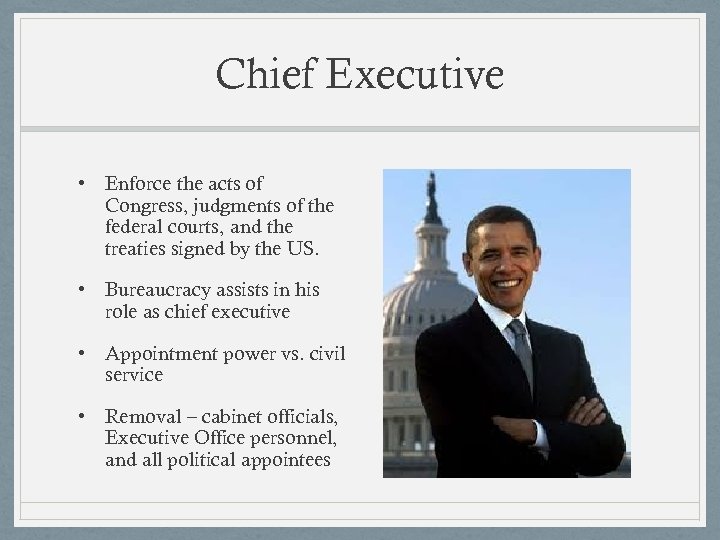 Chief Executive • Enforce the acts of Congress, judgments of the federal courts, and the treaties signed by the US. • Bureaucracy assists in his role as chief executive • Appointment power vs. civil service • Removal – cabinet officials, Executive Office personnel, and all political appointees
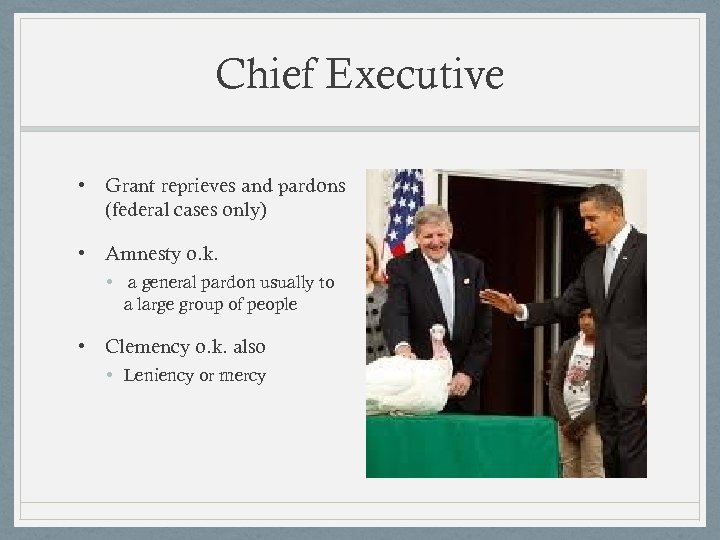 Chief Executive • Grant reprieves and pardons (federal cases only) • Amnesty o. k. • a general pardon usually to a large group of people • Clemency o. k. also • Leniency or mercy
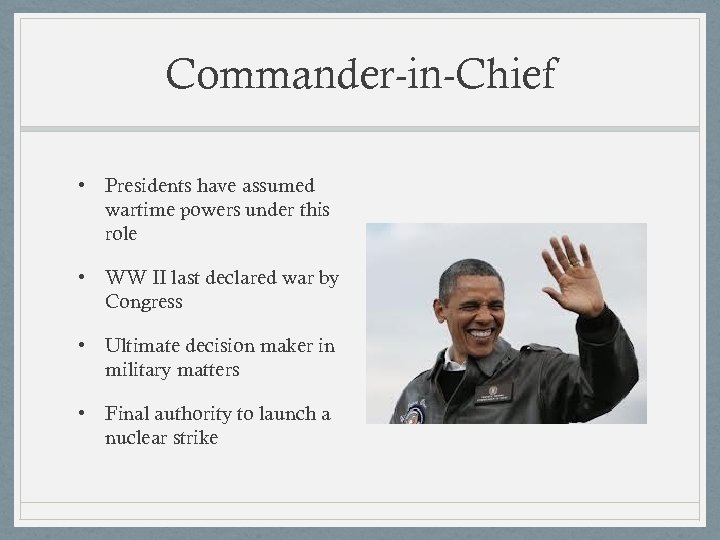 Commander-in-Chief • Presidents have assumed wartime powers under this role • WW II last declared war by Congress • Ultimate decision maker in military matters • Final authority to launch a nuclear strike
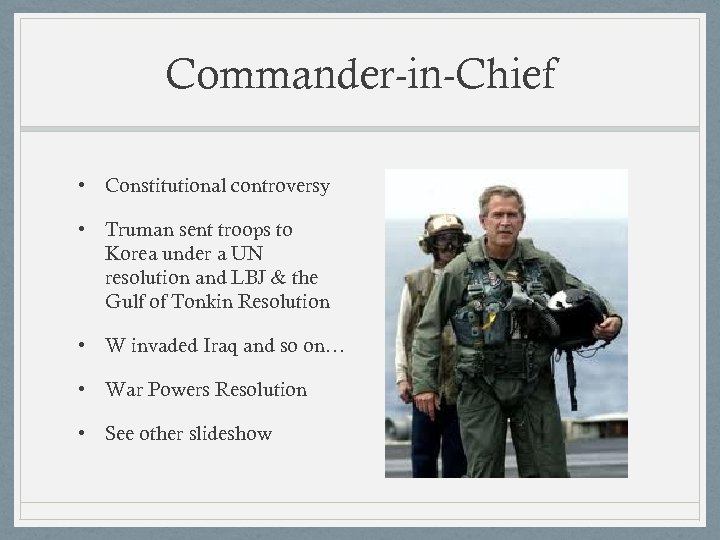 Commander-in-Chief • Constitutional controversy • Truman sent troops to Korea under a UN resolution and LBJ & the Gulf of Tonkin Resolution • W invaded Iraq and so on… • War Powers Resolution • See other slideshow
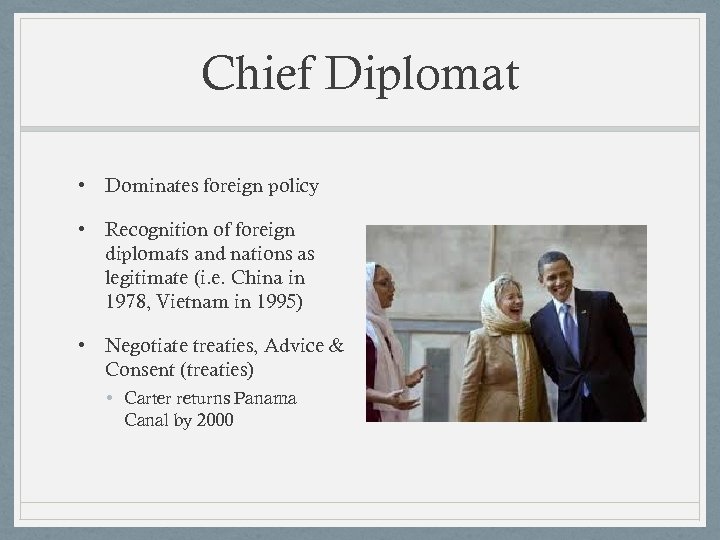 Chief Diplomat • Dominates foreign policy • Recognition of foreign diplomats and nations as legitimate (i. e. China in 1978, Vietnam in 1995) • Negotiate treaties, Advice & Consent (treaties) • Carter returns Panama Canal by 2000
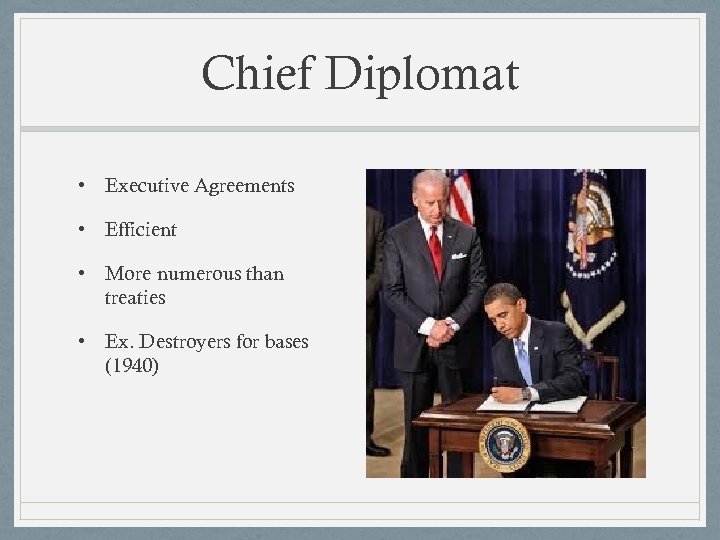 Chief Diplomat • Executive Agreements • Efficient • More numerous than treaties • Ex. Destroyers for bases (1940)
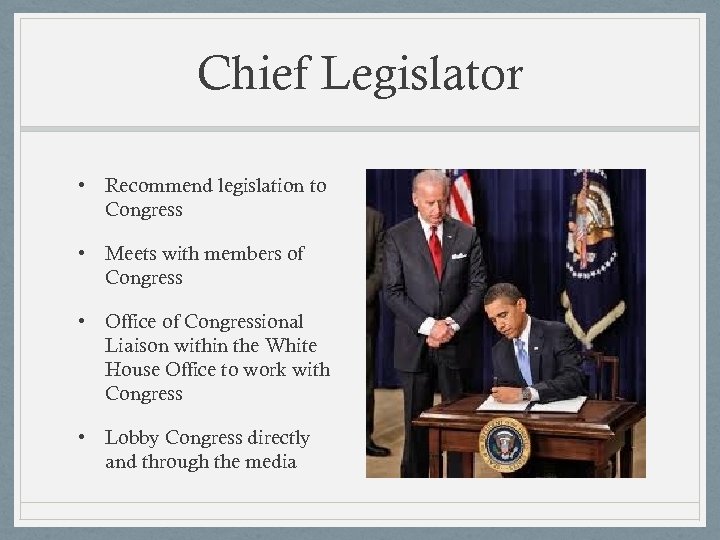 Chief Legislator • Recommend legislation to Congress • Meets with members of Congress • Office of Congressional Liaison within the White House Office to work with Congress • Lobby Congress directly and through the media
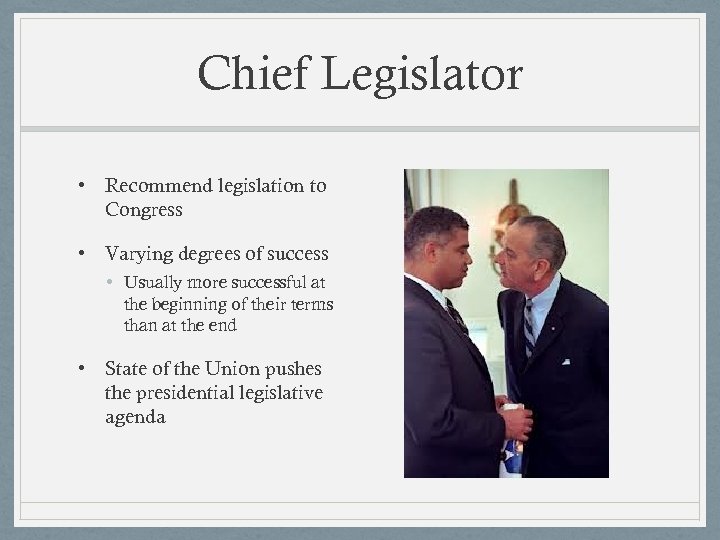 Chief Legislator • Recommend legislation to Congress • Varying degrees of success • Usually more successful at the beginning of their terms than at the end • State of the Union pushes the presidential legislative agenda
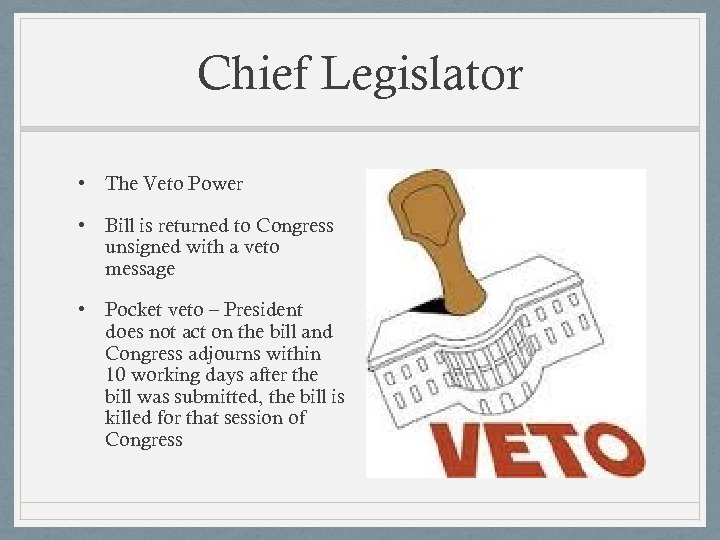 Chief Legislator • The Veto Power • Bill is returned to Congress unsigned with a veto message • Pocket veto – President does not act on the bill and Congress adjourns within 10 working days after the bill was submitted, the bill is killed for that session of Congress
 Chief Legislator • Bill is signed, it becomes law • If the bill is not sent back to Congress within 10 Congressional working days it becomes law w/o presidential signature
 Chief Legislator • Line-item-veto • 1996 passed by Congress • 1998 Supreme Court ruled it unconstitutional • Congress can override presidential vetoes 2/3 rd’s of the members of each chamber (who are present) must agree to override the veto
 Party Chief • Leader of their political party • Chooses National Committee Chairperson • Disciplines party members? • Political appointments, (Doles out jobs through patronage) • Party fundraiser
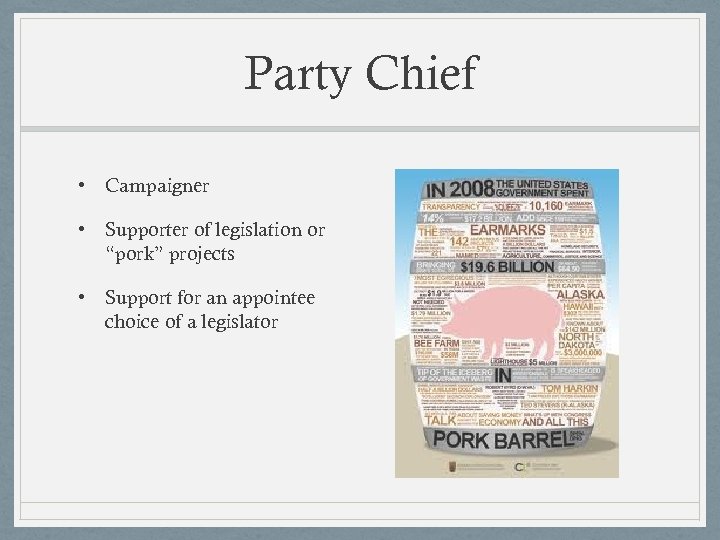 Party Chief • Campaigner • Supporter of legislation or “pork” projects • Support for an appointee choice of a legislator
 The President’s Power to Persuade • Adds to his ability to “lead” • Constitution gives most of the power to Congress • Beholden to the entire electorate, not just their supporters • Washington community? • Presidential popularity helps or hinders his ability to persuade
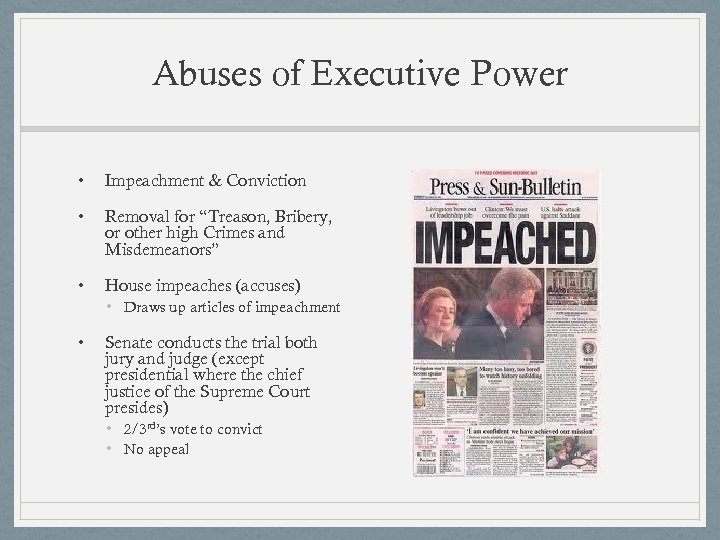 Abuses of Executive Power • Impeachment & Conviction • Removal for “Treason, Bribery, or other high Crimes and Misdemeanors” • House impeaches (accuses) • Draws up articles of impeachment • Senate conducts the trial both jury and judge (except presidential where the chief justice of the Supreme Court presides) • 2/3 rd’s vote to convict • No appeal
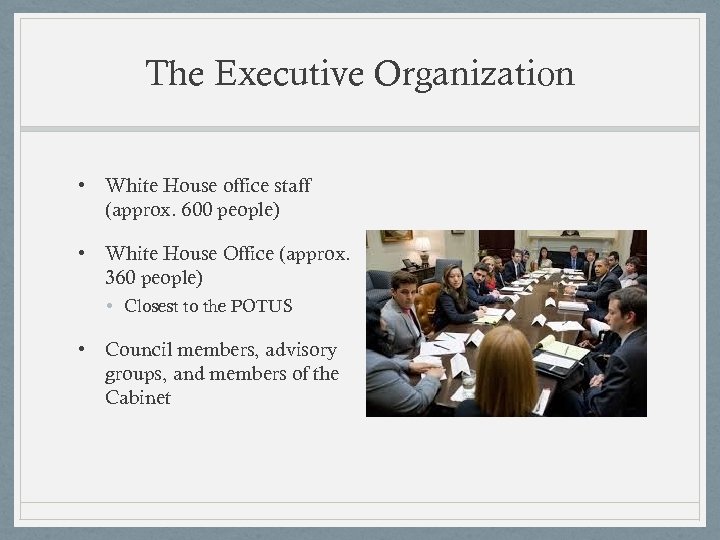 The Executive Organization • White House office staff (approx. 600 people) • White House Office (approx. 360 people) • Closest to the POTUS • Council members, advisory groups, and members of the Cabinet
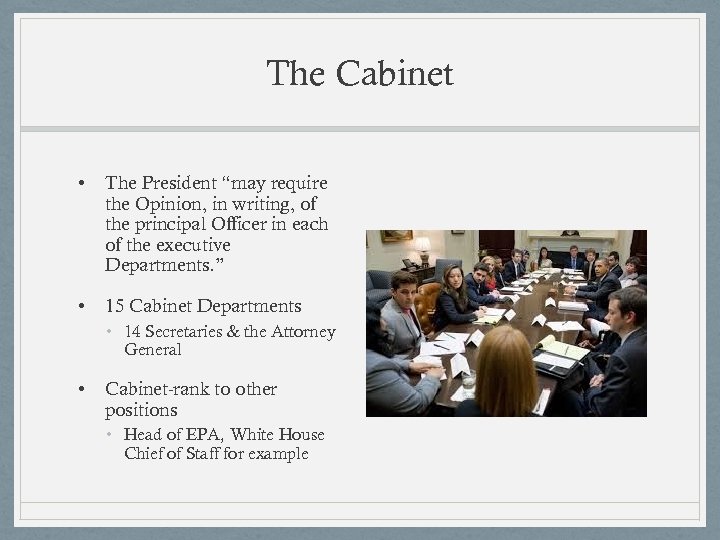 The Cabinet • The President “may require the Opinion, in writing, of the principal Officer in each of the executive Departments. ” • 15 Cabinet Departments • 14 Secretaries & the Attorney General • Cabinet-rank to other positions • Head of EPA, White House Chief of Staff for example
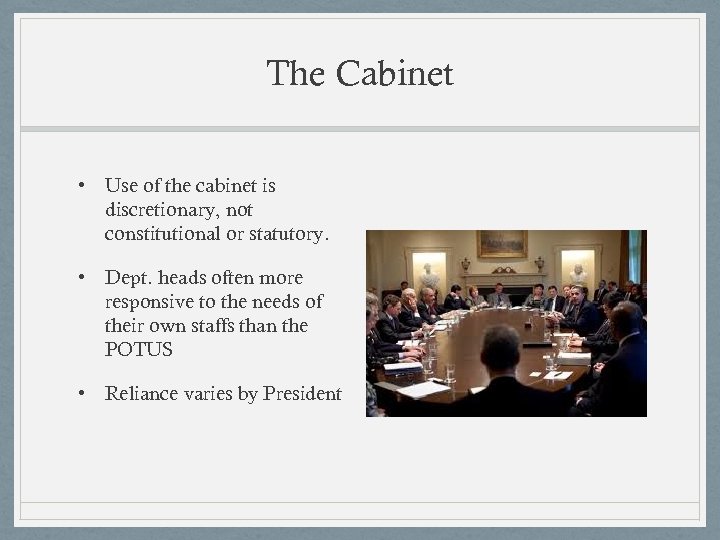 The Cabinet • Use of the cabinet is discretionary, not constitutional or statutory. • Dept. heads often more responsive to the needs of their own staffs than the POTUS • Reliance varies by President
 The Executive Office of the President • To provide staff assistance to the chief executive and to help coordinate the entire bureaucracy (since FDR) • Agencies include but are not limited to: • White House Office • Council of Economic Advisers • Office of Management & Budget (OMB) • National Security Council
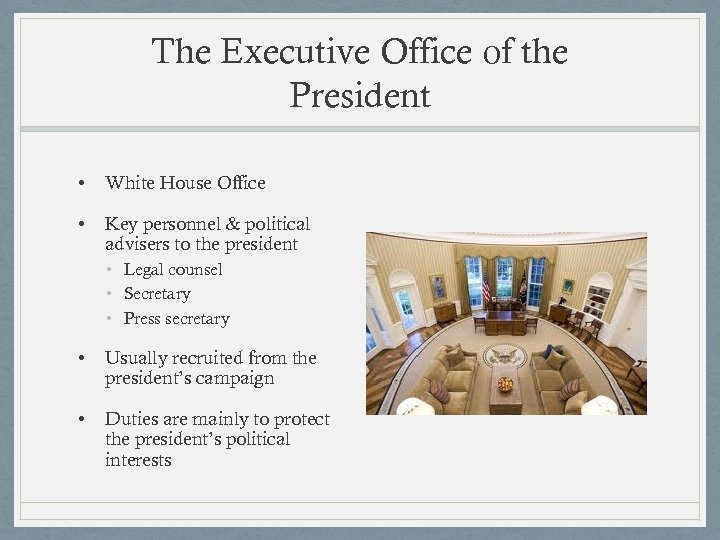 The Executive Office of the President • White House Office • Key personnel & political advisers to the president • Legal counsel • Secretary • Press secretary • Usually recruited from the president’s campaign • Duties are mainly to protect the president’s political interests
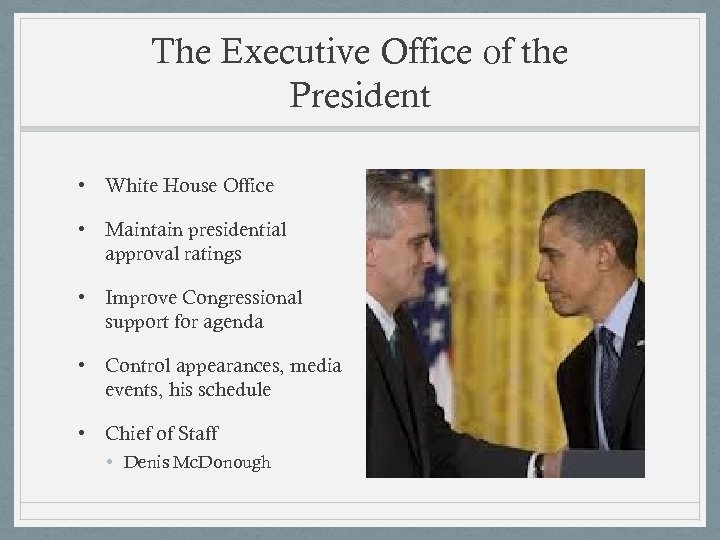 The Executive Office of the President • White House Office • Maintain presidential approval ratings • Improve Congressional support for agenda • Control appearances, media events, his schedule • Chief of Staff • Denis Mc. Donough
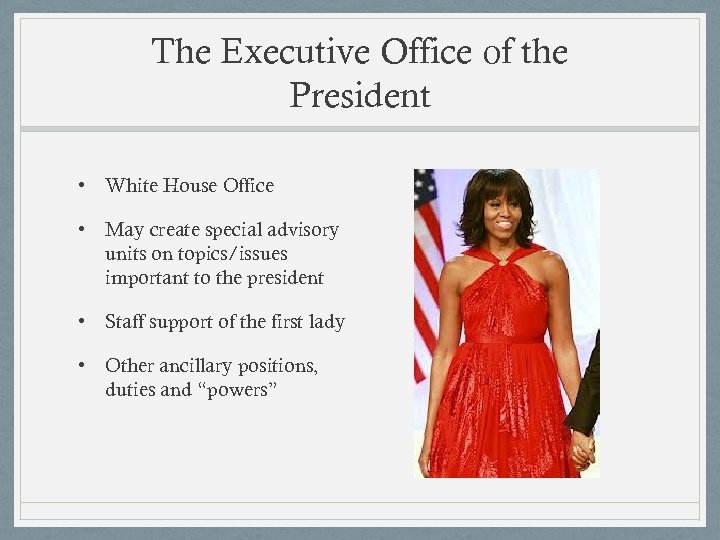 The Executive Office of the President • White House Office • May create special advisory units on topics/issues important to the president • Staff support of the first lady • Other ancillary positions, duties and “powers”
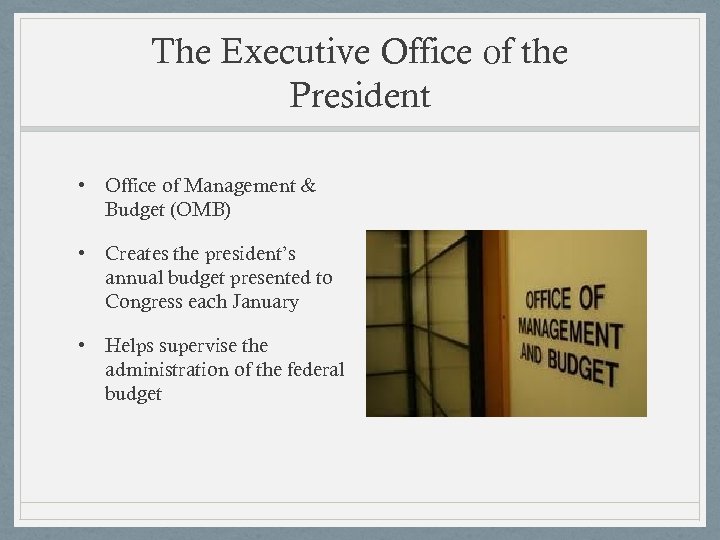 The Executive Office of the President • Office of Management & Budget (OMB) • Creates the president’s annual budget presented to Congress each January • Helps supervise the administration of the federal budget
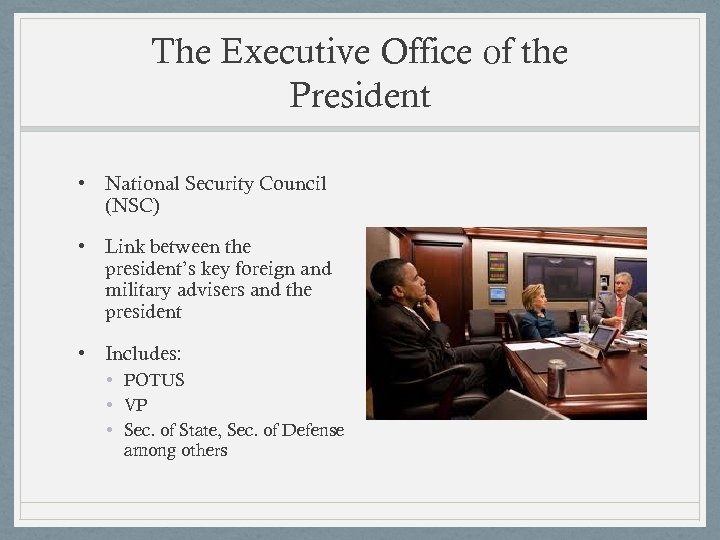 The Executive Office of the President • National Security Council (NSC) • Link between the president’s key foreign and military advisers and the president • Includes: • POTUS • VP • Sec. of State, Sec. of Defense among others
 The Executive Office of the President • Policy Tsars • Positions created that focus on one specific policy area • Last only as long as the president • Generally do not require Senate confirmation • Ex. AIDS Tsar
 The Vice Presidency • Same Constitutional requirements as the President • Constitutional Duty • Preside over the Senate • Cast a tie-breaking vote • Usually chosen to balance the presidential ticket
 The Vice Presidency • Support the president • Legislative liaison • Head presidential initiatives • Assumes the office in cases of presidential death or incapacity. • 25 th Amendment & presidential succession
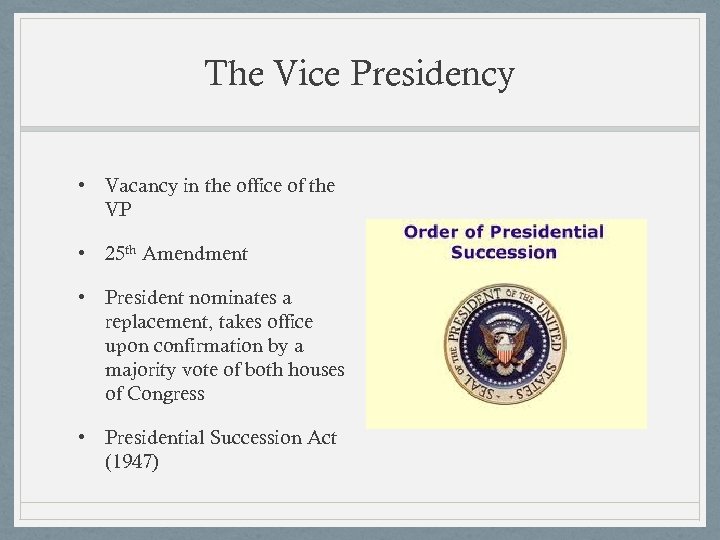 The Vice Presidency • Vacancy in the office of the VP • 25 th Amendment • President nominates a replacement, takes office upon confirmation by a majority vote of both houses of Congress • Presidential Succession Act (1947)