


 Скачать презентацию The Presidency Department of Performance Monitoring and Evaluation
d1bad1a8896c680d4b5e80aaaf69327a.ppt
- Количество слайдов: 25
 The Presidency Department of Performance Monitoring and Evaluation MANAGEMENT PERFORMANCE ASSESSMENT TOOL (MPAT) Portfolio Committee on Rural Development 6 March 2013
 Why? Improved management practices key to improved service delivery Ø Weak administration (financial management, supply chain management, asset management, human resource management, planning, monitoring, facilities management) is a recurring theme across the priorities and is leading to poor service delivery, e. g. Ø § Textbook delivery problems in some provinces § Shortages of ARVs in some provinces § Undermining of small business development policy through non-payment of suppliers within 30 days § Appointment of unqualified people in key municipal positions, leading to poor municipal service delivery Develop a culture of continuous improvement and sharing of good practice Ø Link institutional performance to individual assessment of Ho. D Ø The Presidency: Department of Performance Monitoring and Evaluation 2
 Background Ø MPAT first implemented in the 2011/12 financial year, after Cabinet approval to annually assess national and provincial departments using MPAT – Based on international experience (Canada, Kenya, New Zealand) where Office of President or Premier assesses management practices with aim of driving improvements through competition and sharing of good practice § 103 out of 158 departments participated in the first round of assessments § 2011/12 self-assessment results for national departments have been published on the DPME website § Important base-line established § Many departments have implemented improvements as a result of this initial assessment § For 2012/13 all (156) national and provincial departments participated in assesment The Presidency: Department of Performance Monitoring and Evaluation 3
 How? Ø Assessment is against 31 management standards, in 17 management areas Ø Standards based on legislation and regulations Ø Standards developed collaboratively (with National Treasury, DPSA, Office of the Public Service Commission, Office of the Auditor General and Offices of the Premier) Ø Joint initiative with Offices of the Premier – DPME facilitates national departments, Oo. P facilitates provincial departments The Presidency: Department of Performance Monitoring and Evaluation 4
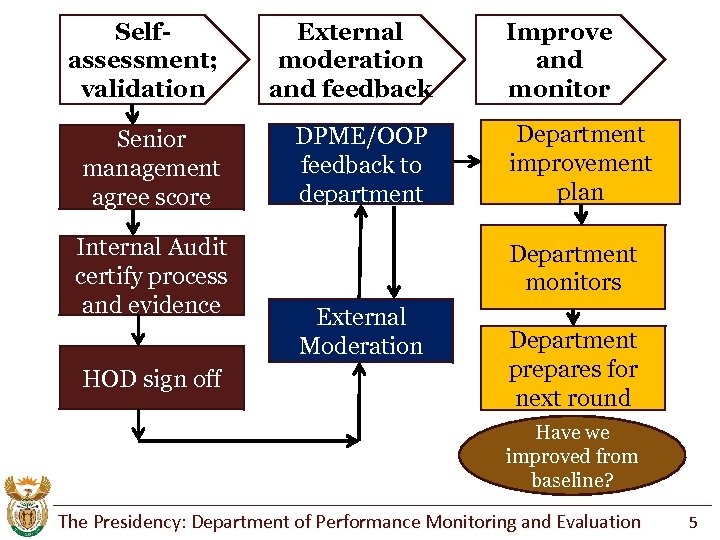 Selfassessment; validation External moderation and feedback Senior management agree score DPME/OOP feedback to department Internal Audit certify process and evidence HOD sign off Improve and monitor Department improvement plan Department monitors External Moderation Department prepares for next round Have we improved from baseline? The Presidency: Department of Performance Monitoring and Evaluation 5
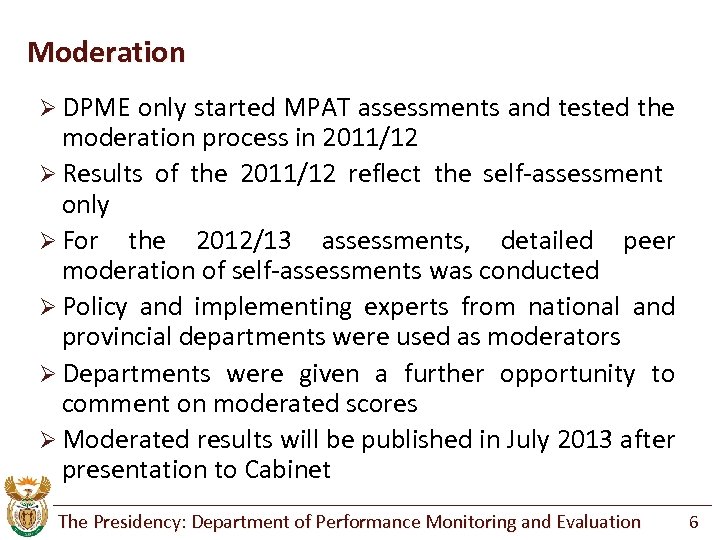 Moderation Ø DPME only started MPAT assessments and tested the moderation process in 2011/12 Ø Results of the 2011/12 reflect the self-assessment only Ø For the 2012/13 assessments, detailed peer moderation of self-assessments was conducted Ø Policy and implementing experts from national and provincial departments were used as moderators Ø Departments were given a further opportunity to comment on moderated scores Ø Moderated results will be published in July 2013 after presentation to Cabinet The Presidency: Department of Performance Monitoring and Evaluation 6
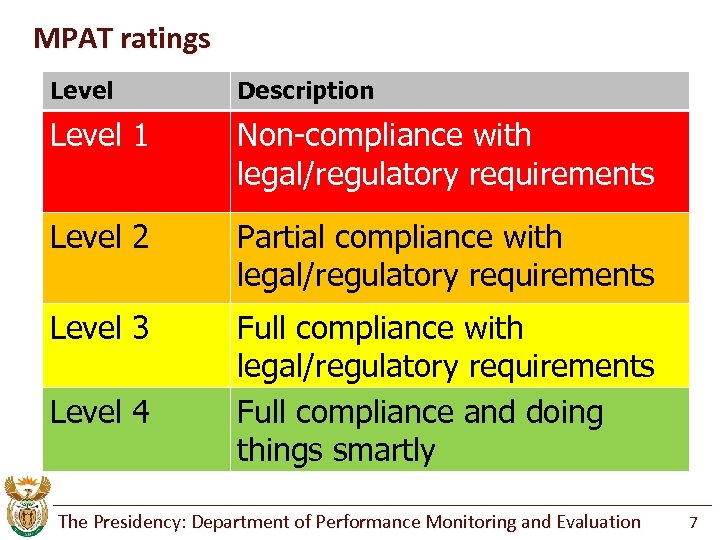 MPAT ratings Level Description Level 1 Non-compliance with legal/regulatory requirements Level 2 Partial compliance with legal/regulatory requirements Level 3 Full compliance with legal/regulatory requirements Full compliance and doing things smartly Level 4 The Presidency: Department of Performance Monitoring and Evaluation 7
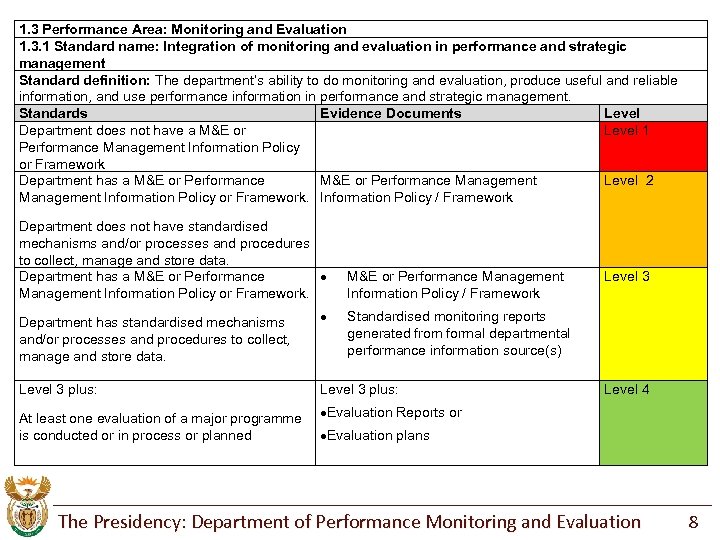 1. 3 Performance Area: Monitoring and Evaluation 1. 3. 1 Standard name: Integration of monitoring and evaluation in performance and strategic management Standard definition: The department’s ability to do monitoring and evaluation, produce useful and reliable information, and use performance information in performance and strategic management. Standards Evidence Documents Level Department does not have a M&E or Level 1 Performance Management Information Policy or Framework Department has a M&E or Performance Management Level 2 Management Information Policy or Framework. Information Policy / Framework Department does not have standardised mechanisms and/or processes and procedures to collect, manage and store data. Department has a M&E or Performance Management Information Policy or Framework. Department has standardised mechanisms and/or processes and procedures to collect, manage and store data. Level 3 plus: At least one evaluation of a major programme is conducted or in process or planned M&E or Performance Management Information Policy / Framework Level 3 Standardised monitoring reports generated from formal departmental performance information source(s) Level 3 plus: Level 4 Evaluation Reports or Evaluation plans The Presidency: Department of Performance Monitoring and Evaluation 8
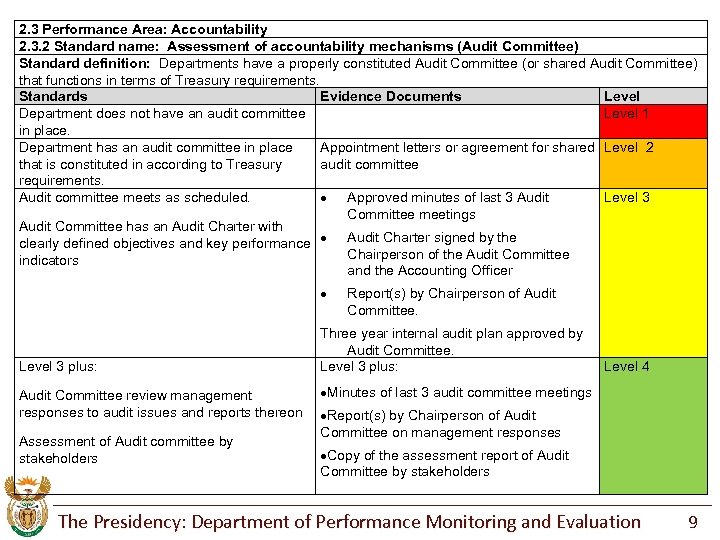 2. 3 Performance Area: Accountability 2. 3. 2 Standard name: Assessment of accountability mechanisms (Audit Committee) Standard definition: Departments have a properly constituted Audit Committee (or shared Audit Committee) that functions in terms of Treasury requirements. Standards Evidence Documents Level Department does not have an audit committee Level 1 in place. Department has an audit committee in place Appointment letters or agreement for shared Level 2 that is constituted in according to Treasury audit committee requirements. Audit committee meets as scheduled. Approved minutes of last 3 Audit Level 3 Committee meetings Audit Committee has an Audit Charter with clearly defined objectives and key performance Audit Charter signed by the Chairperson of the Audit Committee indicators and the Accounting Officer Report(s) by Chairperson of Audit Committee. Level 3 plus: Audit Committee review management responses to audit issues and reports thereon Assessment of Audit committee by stakeholders Three year internal audit plan approved by Audit Committee. Level 3 plus: Level 4 Minutes of last 3 audit committee meetings Report(s) by Chairperson of Audit Committee on management responses Copy of the assessment report of Audit Committee by stakeholders The Presidency: Department of Performance Monitoring and Evaluation 9
 Improving management performance Ø In most management areas some departments have been able to reach level 4 § This means that it is possible for all departments to reach level 4 Ø DPME has developed good practice case studies of level 4 performance in various management areas § Case studies have been documented independently and available on www. goodxample. org § Focused workshops on the case studies are been held with departments § Aim is to encourage departments to learn from each other § New case studies currently been finalised Ø DPME, DPSA and NT offer support to departments to improve management practices The Presidency: Department of Performance Monitoring and Evaluation 10
 Self-assessment scores for 2011/12 The Presidency: Department of Performance Monitoring and Evaluation 11
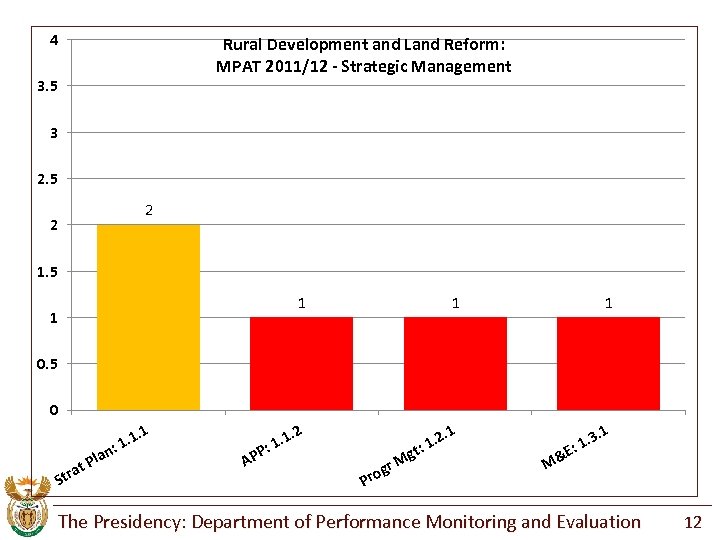 4 Rural Development and Land Reform: MPAT 2011/12 - Strategic Management 3. 5 3 2. 5 2 2 1. 5 1 1 0. 5 0 a Str la t. P . 1 n . 1 : 1 P AP . 2 . 1 . 1 : 1 P rog . 2 t: 1 g r. M . 3 : 1 E M& The Presidency: Department of Performance Monitoring and Evaluation 12
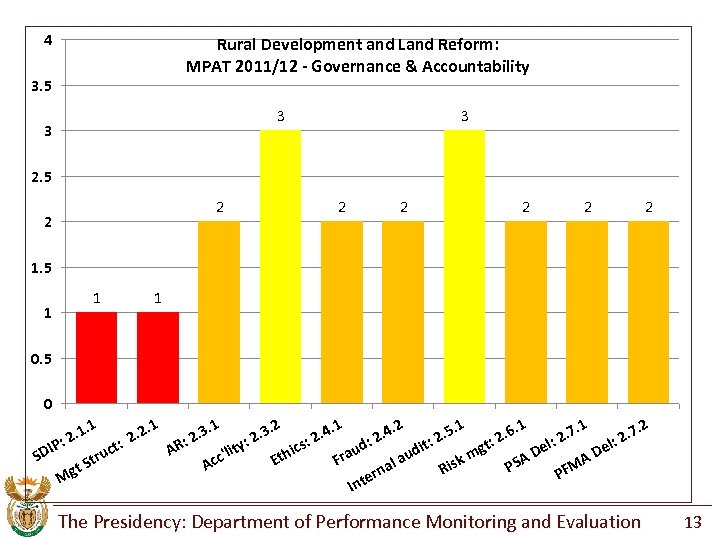 4 Rural Development and Land Reform: MPAT 2011/12 - Governance & Accountability 3. 5 3 3 3 2. 5 2 2 2 2 1. 5 1 . 1 1 1 0. 5 0. 1 : 2 2. 2 P t: I c SD tru t. S Mg . 1. 1. 2. 2. 1. 1 2. 3 2. 7 2. 4 2. 3 2. 6 2. 5 : : l: l: s: y: d: gt: dit AR De De 'lit au hic u c A A km Fr Et Ac al a PS Ris rn PFM e Int The Presidency: Department of Performance Monitoring and Evaluation 13
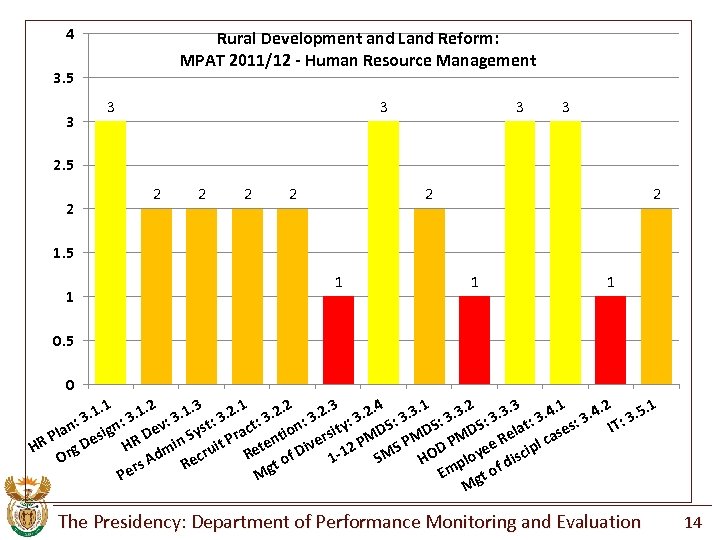 4 Rural Development and Land Reform: MPAT 2011/12 - Human Resource Management 3. 5 3 3 3 2. 5 2 2 2 2 1. 5 1 1 0. 5 0. 1. 2. 3. 3. 2. 1. 1. 3. 2. 4. 1. 1. 2 3. 1 : 3. 1 v: 3. 1 t: 3. 2 y: 3. 2 S: 3. 3 t: 3. 4 s: 3. 4 T: 3. 5 : n I lan esign De Sys Prac ntio ersit PMD PMD Rela l case P R n i e it H iv te S HR rg D 2 OD loye iscip dm ecru Re of D O SM 1 -1 A H d p R gt ers Em gt of P M M The Presidency: Department of Performance Monitoring and Evaluation 14
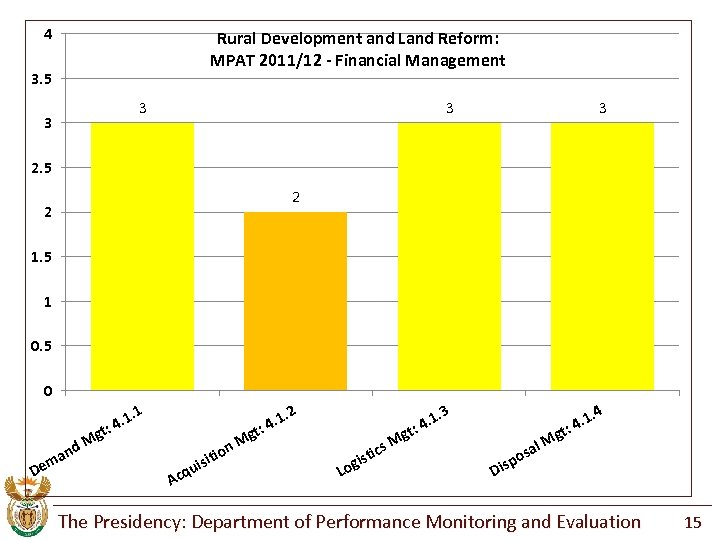 4 Rural Development and Land Reform: MPAT 2011/12 - Financial Management 3. 5 3 3 . 3 . 4 4. 1 t: Mg 2. 5 2 2 1. 5 1 0. 5 0. 1 . 2 . 1 : 4 t D a em . 1 : 4 t g d. M n A cqu i g n. M o siti Log i s stic Mg . 1 : 4 t l osa sp Di The Presidency: Department of Performance Monitoring and Evaluation 15
 Final moderated scores for 2012/13 The Presidency: Department of Performance Monitoring and Evaluation 16
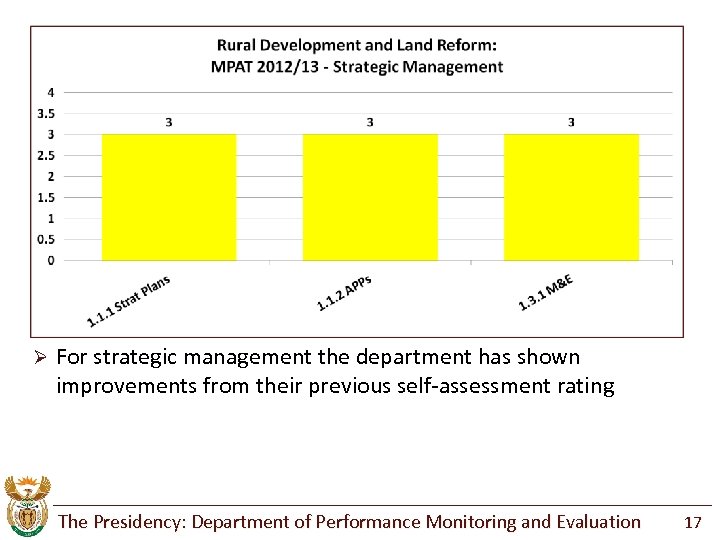 Ø For strategic management the department has shown improvements from their previous self-assessment rating The Presidency: Department of Performance Monitoring and Evaluation 17
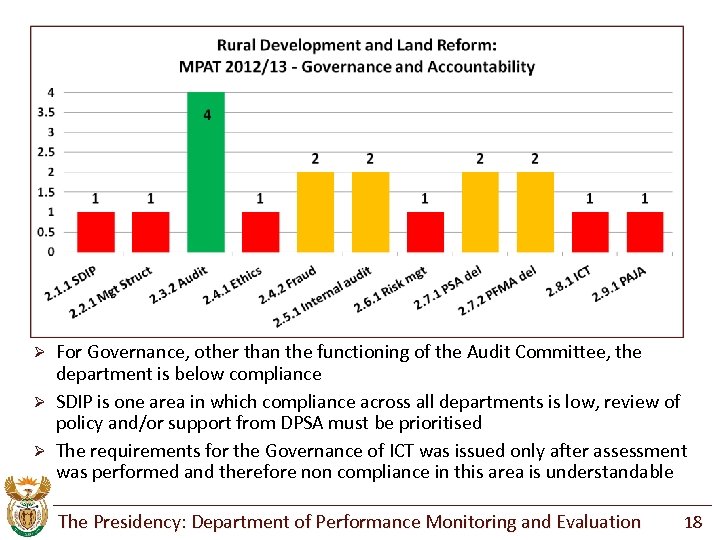 For Governance, other than the functioning of the Audit Committee, the department is below compliance Ø SDIP is one area in which compliance across all departments is low, review of policy and/or support from DPSA must be prioritised Ø The requirements for the Governance of ICT was issued only after assessment was performed and therefore non compliance in this area is understandable Ø The Presidency: Department of Performance Monitoring and Evaluation 18
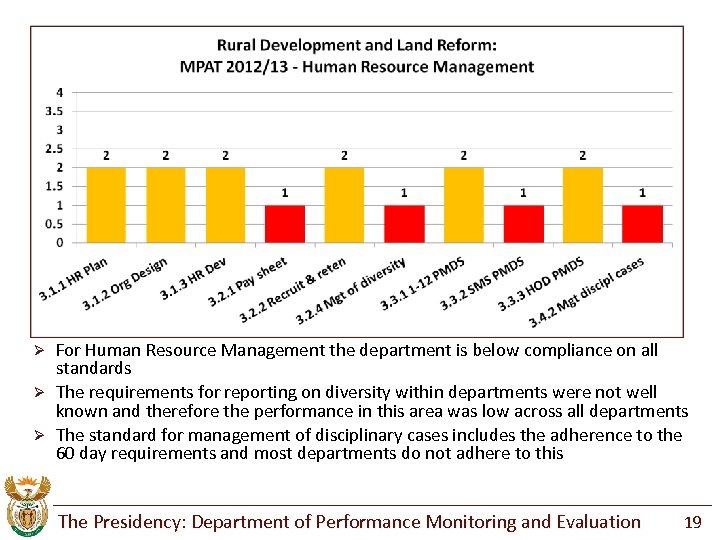 For Human Resource Management the department is below compliance on all standards Ø The requirements for reporting on diversity within departments were not well known and therefore the performance in this area was low across all departments Ø The standard for management of disciplinary cases includes the adherence to the 60 day requirements and most departments do not adhere to this Ø The Presidency: Department of Performance Monitoring and Evaluation 19
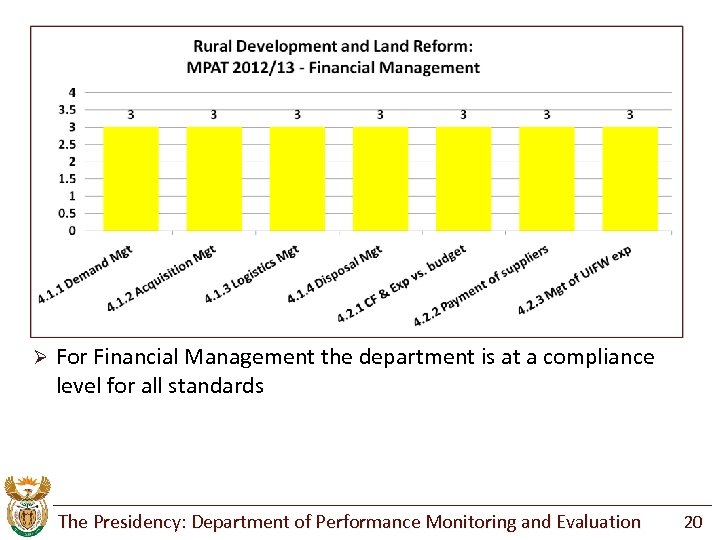 Ø For Financial Management the department is at a compliance level for all standards The Presidency: Department of Performance Monitoring and Evaluation 20
 Conclusions and Recommendation regarding DRDLR 2012/13 MPAT assessments Ø Significant improvements in strategic and financial management are evident and the department is at a compliant level for these KPAs Ø To get to level 4, management needs to be more proactive in acting on data and information it generates Ø Improvement plans of the department should focus on Governance and Accountability and Human Resource Management to get to a compliance level at minimum Ø DPME has provided feedback to the department regarding their moderated scores and is aware of plans and improvements already in place that should impact positively on the DRDLR next assessment The Presidency: Department of Performance Monitoring and Evaluation 21
 Value add of this process Ø MPAT provides a single holistic picture of the state of a department Ø Generally audits focus on compliance only, whereas MPAT focuses on getting managers to work more smartly Ø MPAT also covers a broader range of management areas than audits cover Ø Getting all departments to level 4 will improve levels and quality of service delivery § For example getting departments to procure smartly would result in better service delivery by suppliers and contractors, and savings from reducing corruption and increasing value for money The Presidency: Department of Performance Monitoring and Evaluation 22
 Value add… cont Ø The process of getting top management as a whole to assess itself against a holistic set of good practice management standards and to agree on required improvements is the main value add of the MPAT assessment process § Management practices in departments are generally weak because top management has not paid sufficient attention to improving them § By carrying out annual MPAT assessments the Presidency and the Offices of the Premier are sending out a clear message that improving administration is a priority of government The Presidency: Department of Performance Monitoring and Evaluation 23
 Limitations of this process Ø MPAT focuses on processes related to converting inputs into outputs § Does not focus on assessing whether the right outputs are been produced to achieved desired outcomes and impacts § Risk that departments may be producing the wrong outputs very efficiently and effectively Ø In viewing the overall performance of a department it is therefore also important to consider the achievement of outcomes and impacts § DPME is doing this through monitoring of the 12 priority outcomes and related delivery agreements § Departments’ performance against targets for outcome and impact indicators in their strategic plans and APPs, as reported in their annual reports, should also be used to assess this The Presidency: Department of Performance Monitoring and Evaluation 24
 Ke ya leboga Ke a leboha Ke a leboga Ngiyabonga Ndiyabulela Ngiyathokoza Ngiyabonga Inkomu Ndi khou livhuha Dankie Thank you The Presidency: Department of Performance Monitoring and Evaluation