


 Скачать презентацию The Prescription Drug Action Committee PDAC Overview and
3341ac55bbf3a674f1b20b1992f341ee.ppt
- Количество слайдов: 11
 The Prescription Drug Action Committee (PDAC) Overview and Recommendations April 22, 2013
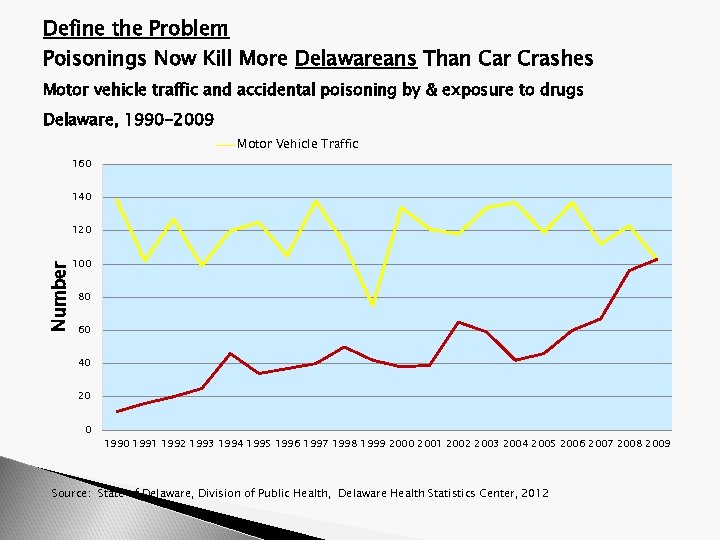 Define the Problem Poisonings Now Kill More Delawareans Than Car Crashes Motor vehicle traffic and accidental poisoning by & exposure to drugs Delaware, 1990 -2009 Motor Vehicle Traffic 160 140 120 Number 100 80 60 40 20 0 1991 1992 1993 1994 1995 1996 1997 1998 1999 2000 2001 2002 2003 2004 2005 2006 2007 2008 2009 Source: State of Delaware, Division of Public Health, Delaware Health Statistics Center, 2012
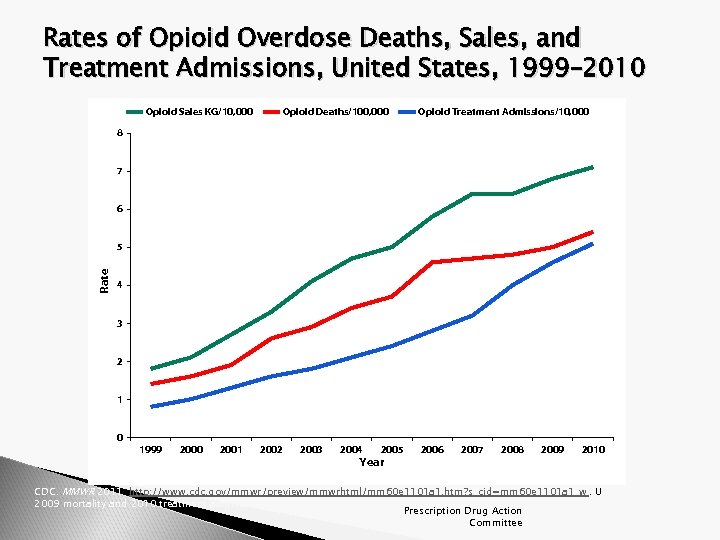 Rates of Opioid Overdose Deaths, Sales, and Treatment Admissions, United States, 1999– 2010 Opioid Sales KG/10, 000 Opioid Deaths/100, 000 Opioid Treatment Admissions/10, 000 8 7 6 Rate 5 4 3 2 1 0 1999 2000 2001 2002 2003 2004 2005 2006 2007 2008 2009 2010 Year CDC. MMWR 2011. http: //www. cdc. gov/mmwr/preview/mmwrhtml/mm 60 e 1101 a 1. htm? s_cid=mm 60 e 1101 a 1_w. Updated with 2009 mortality and 2010 treatment admission data. Prescription Drug Action Committee
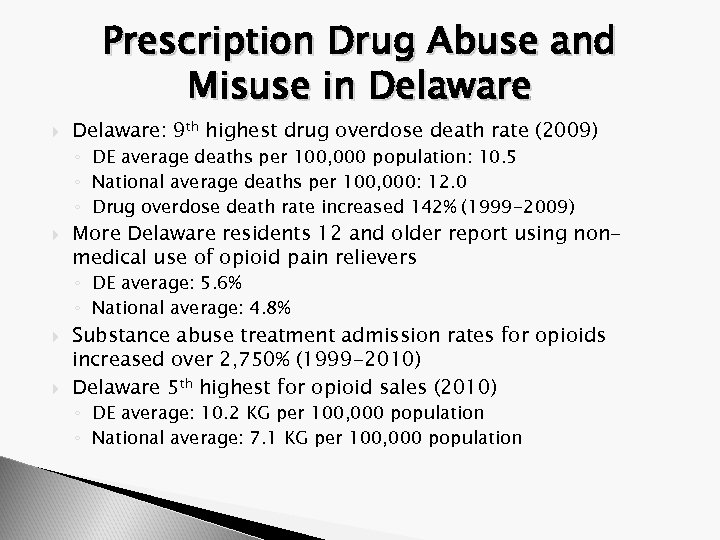 Prescription Drug Abuse and Misuse in Delaware: 9 th highest drug overdose death rate (2009) ◦ DE average deaths per 100, 000 population: 10. 5 ◦ National average deaths per 100, 000: 12. 0 ◦ Drug overdose death rate increased 142% (1999 -2009) More Delaware residents 12 and older report using nonmedical use of opioid pain relievers ◦ DE average: 5. 6% ◦ National average: 4. 8% Substance abuse treatment admission rates for opioids increased over 2, 750% (1999 -2010) Delaware 5 th highest for opioid sales (2010) ◦ DE average: 10. 2 KG per 100, 000 population ◦ National average: 7. 1 KG per 100, 000 population
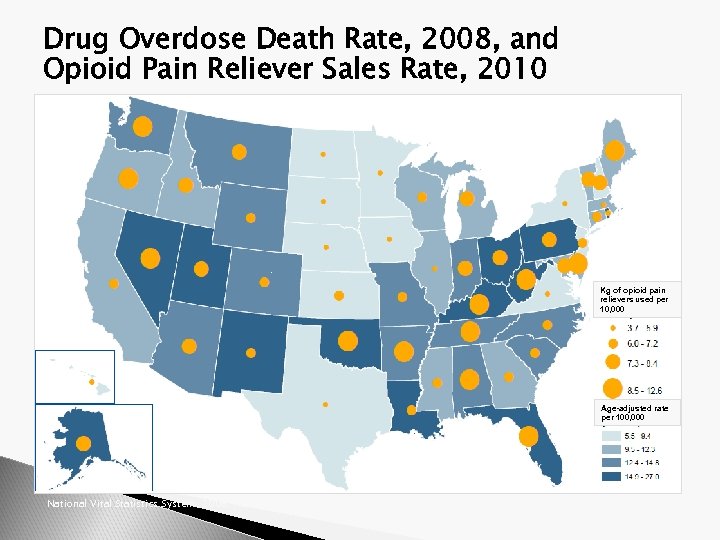 Drug Overdose Death Rate, 2008, and Opioid Pain Reliever Sales Rate, 2010 Kg of opioid pain relievers used per 10, 000 Age-adjusted rate per 100, 000 National Vital Statistics System, 2008; Automated Reports Consolidated Orders System, 2010.
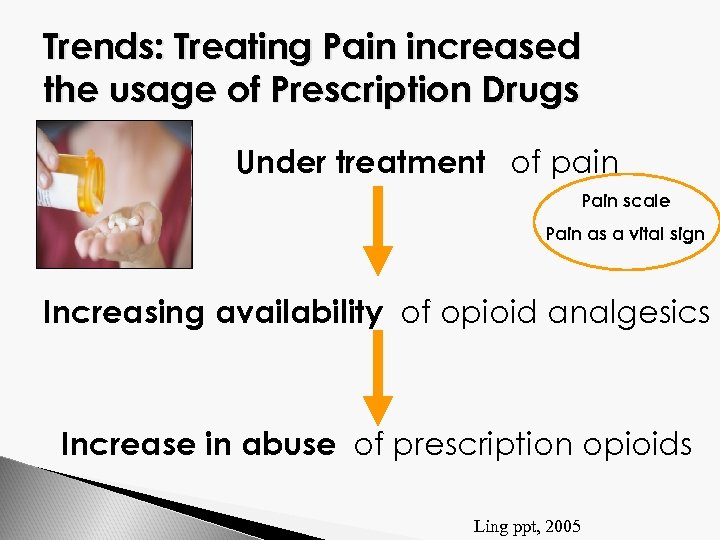 Trends: Treating Pain increased the usage of Prescription Drugs Under treatment of pain Pain scale Pain as a vital sign Increasing availability of opioid analgesics Increase in abuse of prescription opioids Ling ppt, 2005
 CADP , eettimmo. C noitc. A gur. D noitpircser. P eh. T q History and Accomplishment § Established in February 2012 by Governor Markell. A Coordinated and Comprehensive Approach to Action – § Focused on coordinating public, private and community efforts under the leadership of the Division of Public Health and the Medical Society of Delaware. § The PDAC has a broad and diverse membership. § To date, PDAC has conducted over 15 full committee public meetings and over 45 sub committee meetings.
 Policy Recommendations • • Require all prescribers with a controlled substance registration and pharmacists to complete 2 hours of continuing education training. Two hours of prescriber training will focus on safe and effective prescribing methods. For Pharmacists, training will focus on recognizing patient abuse seeking behaviors. Require controlled substance prescribers to take a one hour, one time only CME on Delaware specific prescription drug abuse and pain management topics to include: the Prescription Monitoring Program (PMP), Delaware Regulation 31 and other state specific programs and policies. Standardize continuing education of law enforcement regarding controlled substance related abuse and impairment. Require hospice agencies to implement a uniform procedure to dispose of controlled substances after a patient passes away.
 Policy Recommendations • • • Require practitioners with controlled substance licenses to register for access to the Prescription Monitoring Program (PMP). Enable provider authorized support staff to delegate access to the PMP via their own log-in identification and password. Require substance abuse treatment centers to use the PMP to evaluate patient risk of abuse. Require pharmacists to obtain a Prescription Monitoring Program (PMP) patient profile when there is a suspicion of abuse seeking behaviors. Eliminate the 72 hour exemption for reporting dispensing of controlled substances to the PMP.
 Program Recommendations • • • Launch a statewide public education and outreach campaign based upon the successful school nurse partnership. Ensure that chronic pain patients have safe and consistent access to care and support provider education by increasing access to pain management and substance abuse experts. Integrate multiple data sources to develop a robust surveillance system. Implement Electronic Prescribing for Controlled Substances. Implement long term drug take-back solution; federal guidance expected late 2013. Implement a pilot program for BLS to use Narcan.
 PDAC http: //dhss. delaware. gov/dhss/dph/pdachome. html