


 Скачать презентацию The Power of Quantum Advice Scott Aaronson Andrew
7ccedd2748f560ad530f8a94000590e3.ppt
- Количество слайдов: 18
 The Power of Quantum Advice Scott Aaronson Andrew Drucker
 Freeze-Dried Computation Motivating Question: How much useful computational work can one “store” in a quantum state, for later retrieval? If quantum states are exponentially large objects, then possibly a huge amount! Yet we also know that quantum states have no more “generalpurpose storage capacity” than classical strings of the same size
 Cast of Characters BQP/qpoly is the class of problems solvable in quantum polynomial time, with the help of polynomial-size “quantum advice states” Formally: a language L is in BQP/qpoly if there exists a polynomial time quantum algorithm A, as well as quantum advice states {| n }n on poly(n) qubits, such that for every input x of size n, A(x, | n ) decides whether or not x L with error probability at most 1/3 YQP (“Yoda Quantum Polynomial-Time”) is the same, except we also require that for every alleged advice state , A(x, ) outputs either the right answer or “FAIL” with probability at least 2/3 BQP YQP QMA BQP/qpoly
 QUANTUM ADVICE IS POWERFUL Watrous 2000: For any fixed, finite black-box group Gn and subgroup Hn≤Gn, deciding membership in Hn is in BQP/qpoly The quantum advice state is just an equal superposition |Hn over the elements of Hn We don’t know how to solve the same problem in BQP/poly A. -Kuperberg 2007: There exists a “quantum oracle” separating BQP/qpoly from BQP/poly NO IT ISN’T A. 2004: BQP/qpoly PP/poly = Post. BQP/poly Quantum advice can be simulated by classical advice, combined with postselection on unlikely measurement outcomes A. 2006: Heur. BQP/qpoly = Heur. YQP/poly Trusted quantum advice can be simulated on most inputs by trusted classical advice combined with untrusted quantum advice
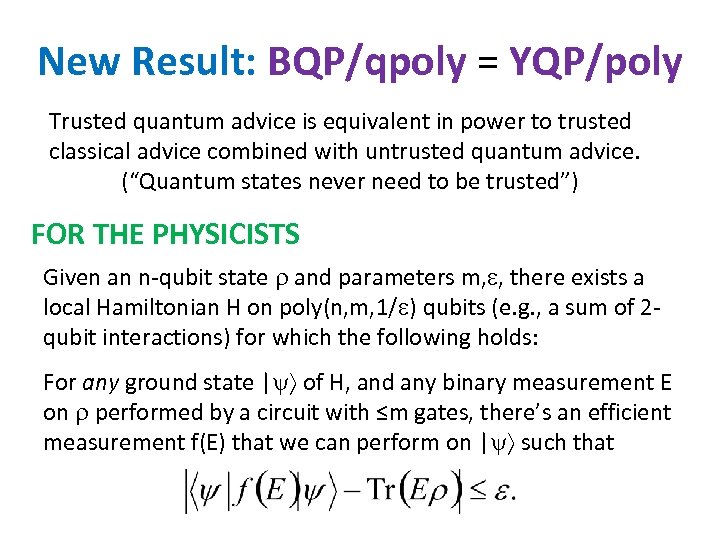 New Result: BQP/qpoly = YQP/poly Trusted quantum advice is equivalent in power to trusted classical advice combined with untrusted quantum advice. (“Quantum states never need to be trusted”) FOR THE PHYSICISTS Given an n-qubit state and parameters m, , there exists a local Hamiltonian H on poly(n, m, 1/ ) qubits (e. g. , a sum of 2 qubit interactions) for which the following holds: For any ground state | of H, and any binary measurement E on performed by a circuit with ≤m gates, there’s an efficient measurement f(E) that we can perform on | such that
 What Does It Mean? Preparing quantum advice states is no harder than preparing ground states of local Hamiltonians This explains a once-mysterious relationship between quantum proofs and quantum advice: efficient preparability of ground states would imply both QMA=QCMA and BQP/qpoly=BQP/poly “Quantum Karp-Lipton Theorem”: NP-complete problems are not efficiently solvable using quantum advice, unless some uniform complexity classes collapse unexpectedly QCMA/qpoly QMA/poly: classical proofs and quantum advice can be simulated with quantum proofs and classical advice
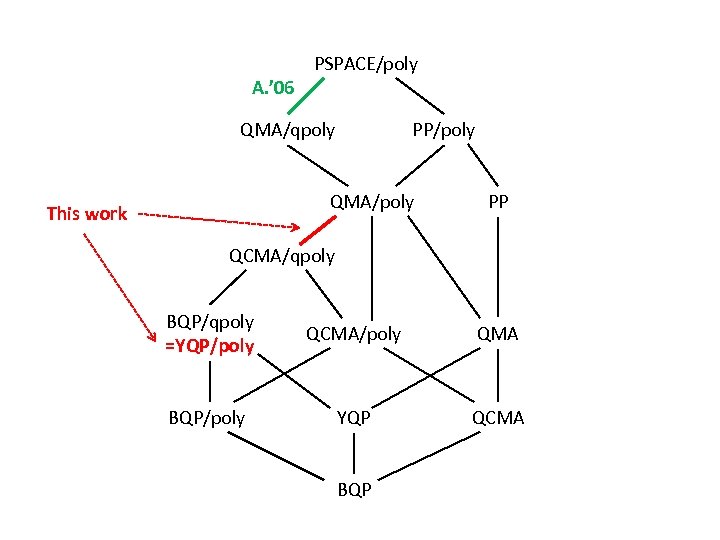 A. ’ 06 PSPACE/poly QMA/qpoly PP/poly QMA/poly This work PP QCMA/qpoly BQP/qpoly =YQP/poly QCMA/poly QMA BQP/poly YQP QCMA BQP
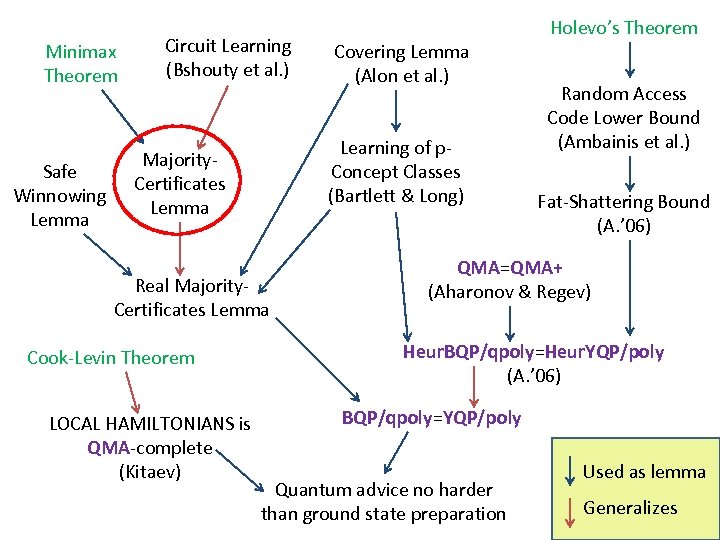 Minimax Theorem Safe Winnowing Lemma Circuit Learning (Bshouty et al. ) Learning of p. Concept Classes (Bartlett & Long) Majority. Certificates Lemma Real Majority. Certificates Lemma Cook-Levin Theorem LOCAL HAMILTONIANS is QMA-complete (Kitaev) Covering Lemma (Alon et al. ) Holevo’s Theorem Random Access Code Lower Bound (Ambainis et al. ) Fat-Shattering Bound (A. ’ 06) QMA=QMA+ (Aharonov & Regev) Heur. BQP/qpoly=Heur. YQP/poly (A. ’ 06) BQP/qpoly=YQP/poly Quantum advice no harder than ground state preparation Used as lemma Generalizes
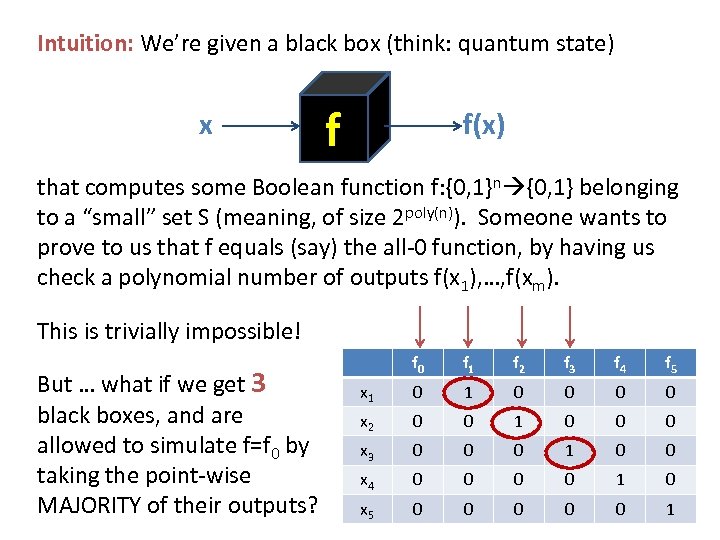 Intuition: We’re given a black box (think: quantum state) x f f(x) that computes some Boolean function f: {0, 1}n {0, 1} belonging to a “small” set S (meaning, of size 2 poly(n)). Someone wants to prove to us that f equals (say) the all-0 function, by having us check a polynomial number of outputs f(x 1), …, f(xm). This is trivially impossible! But … what if we get 3 black boxes, and are allowed to simulate f=f 0 by taking the point-wise MAJORITY of their outputs? f 0 f 1 f 2 f 3 f 4 f 5 x 1 0 0 0 0 x 2 0 0 1 0 0 0 x 3 0 0 0 1 0 0 x 4 0 0 1 0 x 5 0 0 0 1
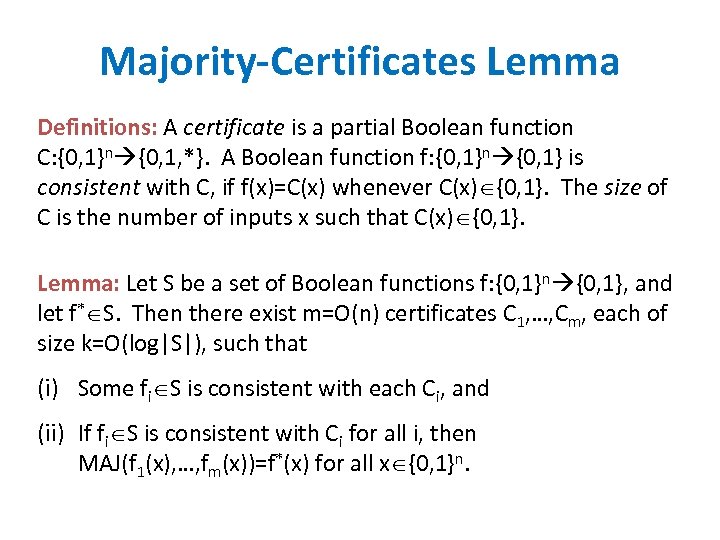 Majority-Certificates Lemma Definitions: A certificate is a partial Boolean function C: {0, 1}n {0, 1, *}. A Boolean function f: {0, 1}n {0, 1} is consistent with C, if f(x)=C(x) whenever C(x) {0, 1}. The size of C is the number of inputs x such that C(x) {0, 1}. Lemma: Let S be a set of Boolean functions f: {0, 1}n {0, 1}, and let f* S. Then there exist m=O(n) certificates C 1, …, Cm, each of size k=O(log|S|), such that (i) Some fi S is consistent with each Ci, and (ii) If fi S is consistent with Ci for all i, then MAJ(f 1(x), …, fm(x))=f*(x) for all x {0, 1}n.
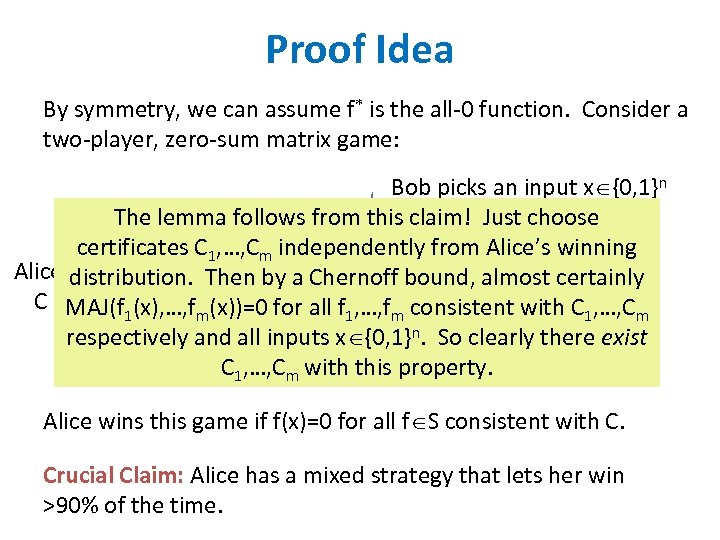 Proof Idea By symmetry, we can assume f* is the all-0 function. Consider a two-player, zero-sum matrix game: Bob picks an input x {0, 1}n The lemma follows from this claim! Just choose certificates C 1, …, Cm independently from Alice’s winning Alice picks a certificate by a Chernoff bound, almost certainly distribution. Then C of size k(x), …, fm(x))=0 for all f 1, …, fm consistent with C 1, …, Cm MAJ(f 1 consistent with some f S respectively and all inputs x {0, 1}n. So clearly there exist C 1, …, Cm with this property. Alice wins this game if f(x)=0 for all f S consistent with C. Crucial Claim: Alice has a mixed strategy that lets her win >90% of the time.
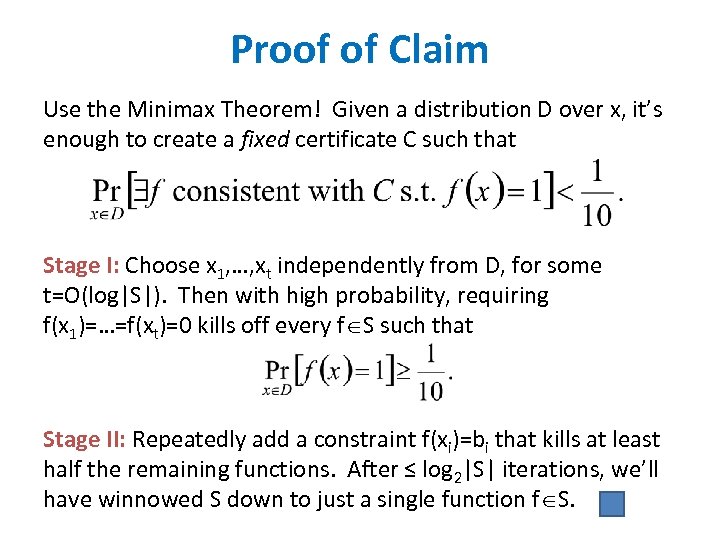 Proof of Claim Use the Minimax Theorem! Given a distribution D over x, it’s enough to create a fixed certificate C such that Stage I: Choose x 1, …, xt independently from D, for some t=O(log|S|). Then with high probability, requiring f(x 1)=…=f(xt)=0 kills off every f S such that Stage II: Repeatedly add a constraint f(xi)=bi that kills at least half the remaining functions. After ≤ log 2|S| iterations, we’ll have winnowed S down to just a single function f S.
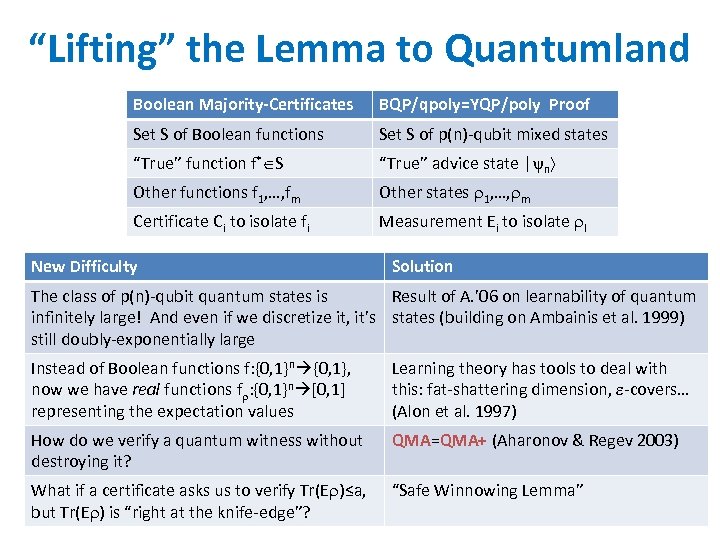 “Lifting” the Lemma to Quantumland Boolean Majority-Certificates BQP/qpoly=YQP/poly Proof Set S of Boolean functions Set S of p(n)-qubit mixed states “True” function f* S “True” advice state | n Other functions f 1, …, fm Other states 1, …, m Certificate Ci to isolate fi Measurement Ei to isolate I New Difficulty Solution The class of p(n)-qubit quantum states is Result of A. ’ 06 on learnability of quantum infinitely large! And even if we discretize it, it’s states (building on Ambainis et al. 1999) still doubly-exponentially large Instead of Boolean functions f: {0, 1}n {0, 1}, now we have real functions f : {0, 1}n [0, 1] representing the expectation values Learning theory has tools to deal with this: fat-shattering dimension, -covers… (Alon et al. 1997) How do we verify a quantum witness without destroying it? QMA=QMA+ (Aharonov & Regev 2003) What if a certificate asks us to verify Tr(E )≤a, but Tr(E ) is “right at the knife-edge”? “Safe Winnowing Lemma”
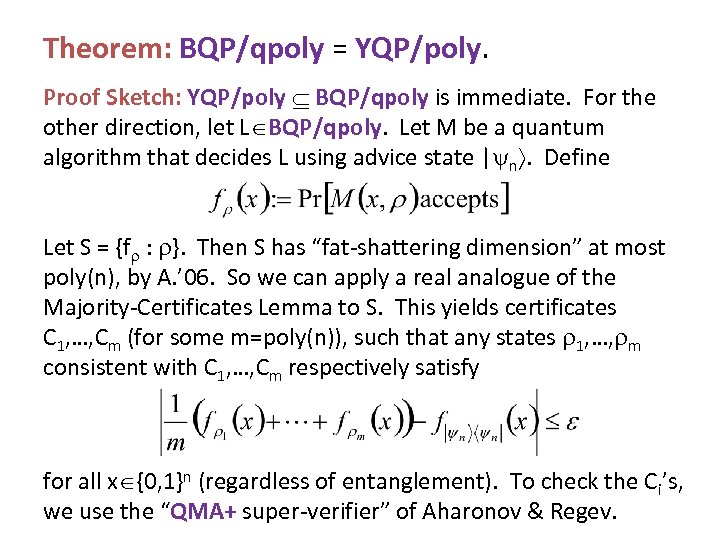 Theorem: BQP/qpoly = YQP/poly. Proof Sketch: YQP/poly BQP/qpoly is immediate. For the other direction, let L BQP/qpoly. Let M be a quantum algorithm that decides L using advice state | n. Define Let S = {f : }. Then S has “fat-shattering dimension” at most poly(n), by A. ’ 06. So we can apply a real analogue of the Majority-Certificates Lemma to S. This yields certificates C 1, …, Cm (for some m=poly(n)), such that any states 1, …, m consistent with C 1, …, Cm respectively satisfy for all x {0, 1}n (regardless of entanglement). To check the Ci’s, we use the “QMA+ super-verifier” of Aharonov & Regev.
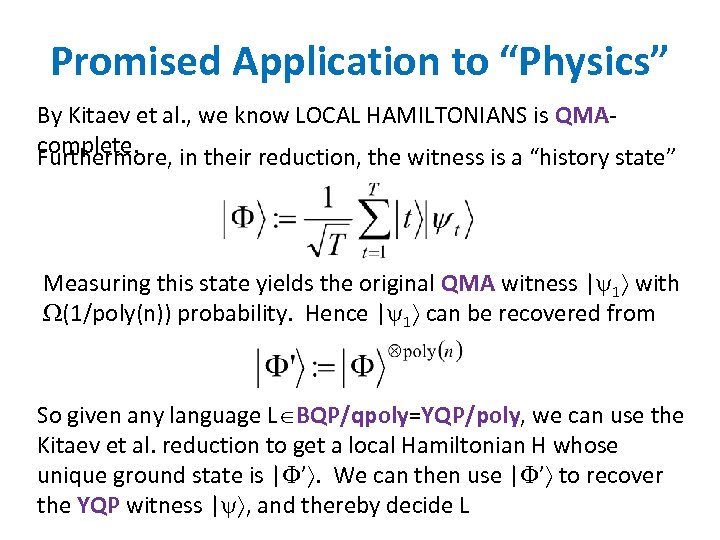 Promised Application to “Physics” By Kitaev et al. , we know LOCAL HAMILTONIANS is QMAcomplete. Furthermore, in their reduction, the witness is a “history state” Measuring this state yields the original QMA witness | 1 with (1/poly(n)) probability. Hence | 1 can be recovered from So given any language L BQP/qpoly=YQP/poly, we can use the Kitaev et al. reduction to get a local Hamiltonian H whose unique ground state is | ’. We can then use | ’ to recover the YQP witness | , and thereby decide L
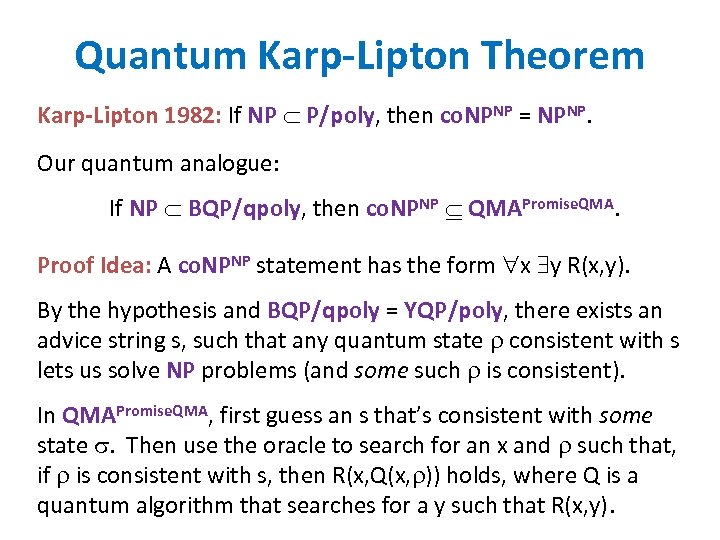 Quantum Karp-Lipton Theorem Karp-Lipton 1982: If NP P/poly, then co. NPNP = NPNP. Our quantum analogue: If NP BQP/qpoly, then co. NPNP QMAPromise. QMA. Proof Idea: A co. NPNP statement has the form x y R(x, y). By the hypothesis and BQP/qpoly = YQP/poly, there exists an advice string s, such that any quantum state consistent with s lets us solve NP problems (and some such is consistent). In QMAPromise. QMA, first guess an s that’s consistent with some state . Then use the oracle to search for an x and such that, if is consistent with s, then R(x, Q(x, )) holds, where Q is a quantum algorithm that searches for a y such that R(x, y).
 A Theory of Isolatability We can generalize the majority-certificates idea well beyond what we have any application for We study the following abstract question, inspired by computational learning theory: Which classes of functions C are “isolatable”—in the sense that for any f C, one can give a small number of conditions such that any f 1, …, fm C satisfying the conditions can be used to compute f efficiently on all inputs? Another application of the Majority-Certificates Lemma: it substantially simplifies the proof that BQPSPACE/coin = PSPACE/poly
 Although this work closes off a chapter in the quantum advice story, there are still Open Problems Find other applications of the majority-certificates technique Circuit complexity? Communication complexity? Learning theory? Quantum information? Is the dependence on n, log|S|, and 1/ optimal? Improve QMA/qpoly PSPACE/poly to QMA/qpoly P#P/poly Prove a classical oracle separation between BQP/poly and BQP/qpoly=YQP/poly