


 Скачать презентацию The Power of a Tag How the Right
69b38c560d205dd3b3f9074d00784924.ppt
- Количество слайдов: 33
 The Power of a Tag: How the Right Technology Can Benefit You Julia Deets Metalcraft
 What This Presentation Will Cover • How to measure “Power of the Tag” • Steps to take when selecting tracking technology • Possible alternatives for ID – Pros and cons • Benefits of a dual technology tag • Transitioning from bar code to RFID • Asset tracking case studies
 How to Measure “Power of the Tag” • • Efficiency gains Savings from not having to replace Lost productivity Lost contract if tag is missing
 How to Measure “Power of the Tag” • Total impact right tag can have on an application – Wrong technology for application – Wrong tag for application
 Selecting a Tracking Technology • Step 1: Define Objective of Application – What do you want to accomplish? • Implement tracking system • Expand existing system • Improve efficiencies of existing system – Maximize power of tag by matching right technology to application • Does not always mean using newest technology
 Selecting a Tracking Technology • Step 2: Assess Environment – Determine level of exposure to: • • • Sunlight (UV rays) Chemicals, i. e. caustics and acids Solvents Temperatures – both hot and cold Abrasion Other environmental factors, i. e. salt water
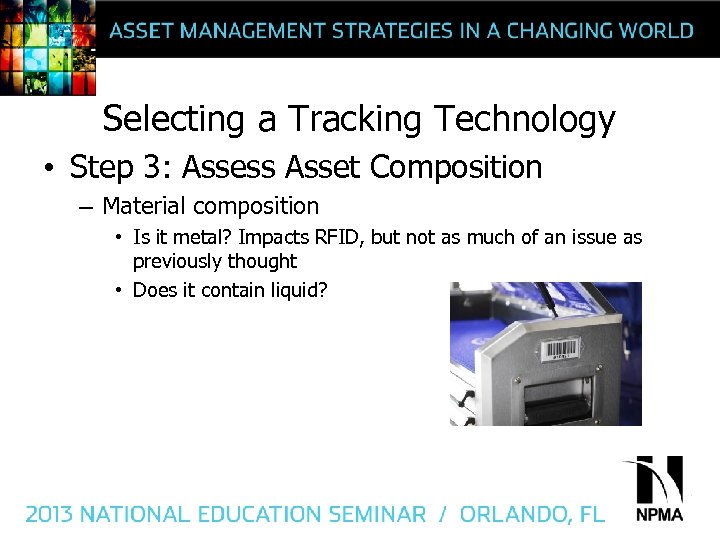 Selecting a Tracking Technology • Step 3: Assess Asset Composition – Material composition • Is it metal? Impacts RFID, but not as much of an issue as previously thought • Does it contain liquid?
 Selecting a Tracking Technology • Step 3: Assess Asset Composition – Material composition • High surface energy or low surface energy? – Painted surface? – Oily surface? – Smooth or rough surface? • How will ID be attached? i. e. , does surface allow for holes with mechanical fasteners? • Flat surface or curved surface?
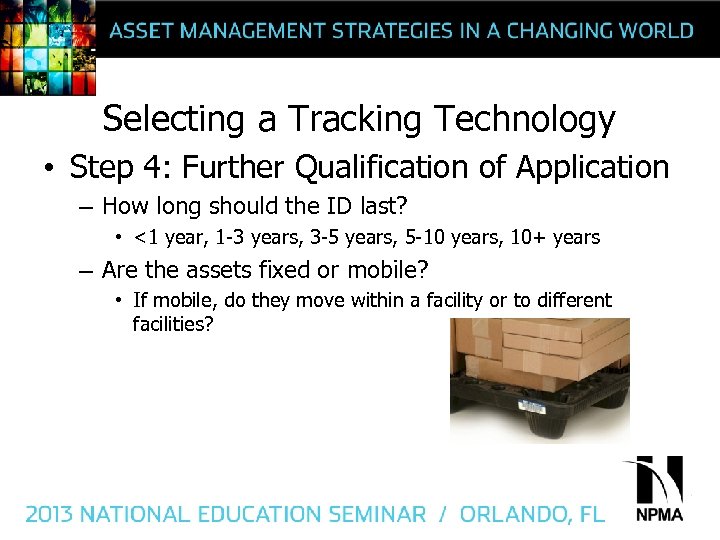 Selecting a Tracking Technology • Step 4: Further Qualification of Application – How long should the ID last? • <1 year, 1 -3 years, 3 -5 years, 5 -10 years, 10+ years – Are the assets fixed or mobile? • If mobile, do they move within a facility or to different facilities?
 Selecting a Tracking Technology • Step 4: Further Qualification of Application – What is the expected read range? • • • Near field: inches Short range: up to 2 ft. . Medium range: > 2 ft. to 10 ft. Long range: > 10 ft. to 40 ft. Extended range: >40 ft.
 Selecting a Tracking Technology • Step 5: Estimated Timeframe and Budget – How far out is the project? – Is there a budget for this project? – Do you have a projected ROI?
 Selecting a Tracking Technology • Step 6: Determine Tracking Technology – Bar Code • Linear or 2 D (i. e. QR code) – RFID – Bar Code and RFID?
 Possible ID Solutions • • Pre-printed bar code products On-site printable bar code products Pre-printed RFID tags On-site printable RFID tags
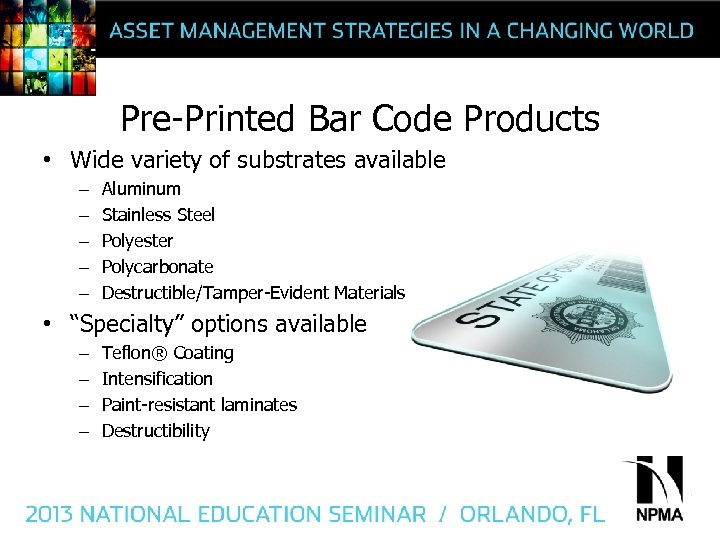 Pre-Printed Bar Code Products • Wide variety of substrates available – – – Aluminum Stainless Steel Polyester Polycarbonate Destructible/Tamper-Evident Materials • “Specialty” options available – – Teflon® Coating Intensification Paint-resistant laminates Destructibility
 Pre-Printed Bar Code Products • Various attachment methods available – Adhesives matched to application surface • High surface energy/low surface energy • Design with holes for mechanical fasteners – Timeframe – lead time could be an issue – Anticipated quantities – higher quantities equals lower cost per label
 On-Site Printable Bar Code Products • Many different methods, i. e. thermal transfer, ink jet, laser engraved, photo composed, etc. • Timeframe – if have materials on hand, can get products instantly • Anticipated quantities – smaller quantities may make sense
 On-Site Printable Bar Code Products • Personnel – who will run equipment? – Training – Maintenance • Matching technology to substrate – Lasing on different materials • Investment in equipment – Initial investment and ongoing costs
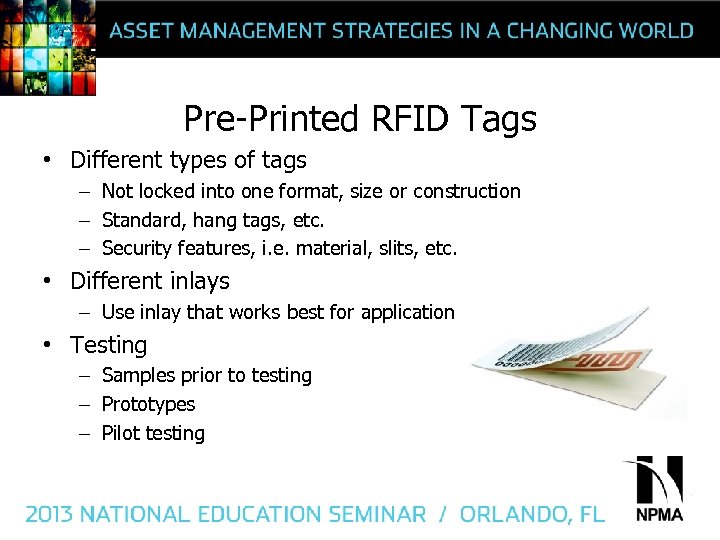 Pre-Printed RFID Tags • Different types of tags – Not locked into one format, size or construction – Standard, hang tags, etc. – Security features, i. e. material, slits, etc. • Different inlays – Use inlay that works best for application • Testing – Samples prior to testing – Prototypes – Pilot testing
 On-Site Printable RFID Tags • Timeframe – How quickly are they needed? – How frequently are they needed? – Is information known ahead of time? • Anticipated quantities – Is this a one-time thing or ongoing?
 On-Site Printable RFID Tags • Programming the tags – How to do it? – Who does it? • Verification of good incoming inlays • Verification of produced RFID label • Inlay inventory
 Benefits of Dual Technology Tag • Minimal additional investment for bar code • Not all locations may be able to support RFID infrastructure – Mobile assets • Integrate bar code information into RFID tag • Triple redundancy with RFID, bar code and human readable number
 Transitioning from Bar Code to RFID • Should you transition? – Has original objective changed? • Keep it simple – Make connections on back end using software (license plate approach)
 Transitioning from Bar Code to RFID • Consult an integrator – RF analysis and site survey • Continue to use bar code information until new infrastructure is ready – Transition facility by facility
 Bar Code Case Study • Lens. Rental. com • Problem – Manual entry of serial number to track nation’s largest rental inventory of cameras, lenses, etc. • • • Stocks 8, 000 copies of 700 different items Increased potential for errors Increased time for processing orders – 3 hours daily High asset turnover Very small items
 Bar Code Case Study • Solution – Tagging all assets with two-dimensional bar code tags containing unique serial number • 2 D bar code fits on smaller tag • Serial number linked to all information they have on item in inventory – For rental transaction tag scanned and item pulled from inventory software • When item returns scanned again to return to inventory
 Bar Code Case Study • Result – Greatly reduced time for order process making smoother rental transaction for customer – Ensured accuracy with inspection and testing of equipment
 Bar Code Case Study • City of Ames • Problem – Needed better way of tracking traffic signs • Very generic data did not associate specific signs with locations • No way of knowing where downed signs belonged
 Bar Code Case Study • Solution – Assigning each sign unique ID number associated with GPS location – New system also allowed for easier compliance with retroreflectivity requirement – System associates unique ID with sign type, location, history and retroreflectivity
 Bar Code Case Study • Result – Saves time and money • Knowing retroreflectivity and life span helps budgeting • Don’t need blanket replacement of signs
 RFID Case Study • Applied Engineering • Problem • Wanted to improve inventory management of machining tools • No record of what was being used by whom • Lack of control creating significant expense
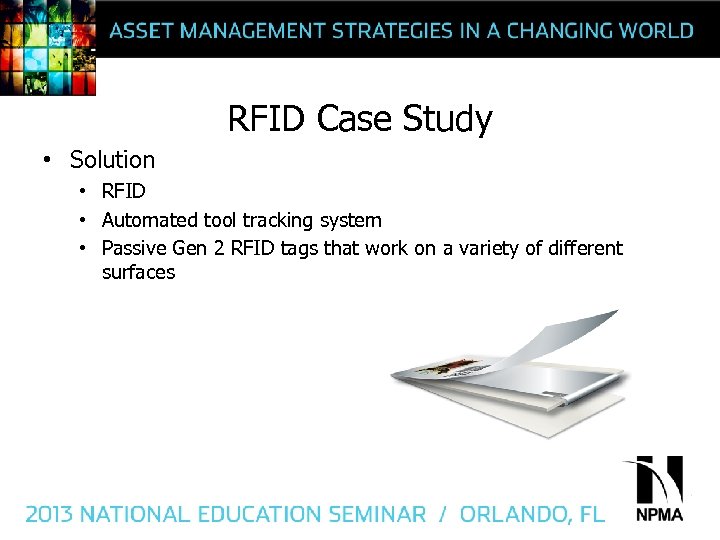 RFID Case Study • Solution • RFID • Automated tool tracking system • Passive Gen 2 RFID tags that work on a variety of different surfaces
 RFID Case Study • Result • Reliable RFID reads • Save time and money • Eliminated time hunting for tools • System manages availability • Company saved $250, 000 by not having to replace lost tooling
 Thank you!