


 Скачать презентацию The political system of the USA Plan to
Лекц. 3 -political_system_of_the_usa.pptx
- Количество слайдов: 17
 The political system of the USA Plan to the lecture 1. US GOVERNMENT Ø Executive Branch Ø Legislative Branch Ø Judicial Branch 2. POLITICAL PARTIES IN THE UNITED STATES 3. ELECTION SYSTEM 4. THE PRESIDENTS OF THE UNITED STATES 5. NATIONAL SYMBOLS OF UNITED STATES OF AMERICA 6. ADMINISTRATIVE DIVISION OF THE UNITED STATES 7. US ECONOMY
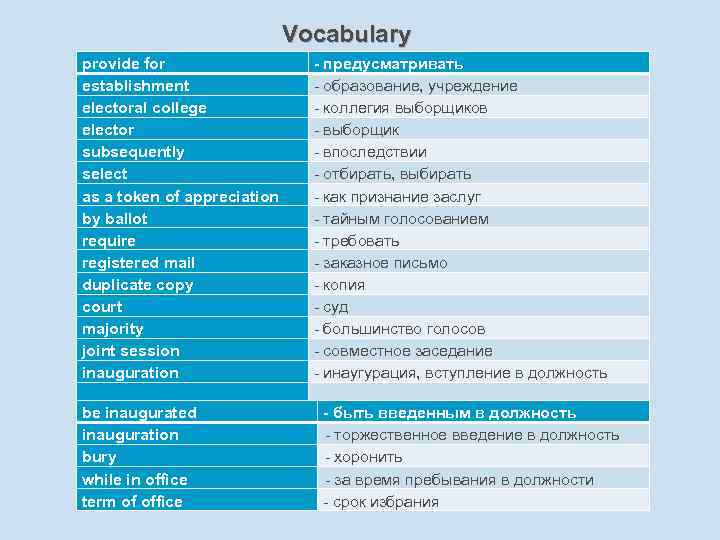 Vocabulary provide for establishment electoral college elector subsequently select as a token of appreciation by ballot require registered mail duplicate copy court majority joint session inauguration be inaugurated inauguration bury while in office term of office - предусматривать - образование, учреждение - коллегия выборщиков - выборщик - впоследствии - отбирать, выбирать - как признание заслуг - тайным голосованием - требовать - заказное письмо - копия - суд - большинство голосов - совместное заседание - инаугурация, вступление в должность - быть введенным в должность - торжественное введение в должность - хоронить - за время пребывания в должности - срок избрания
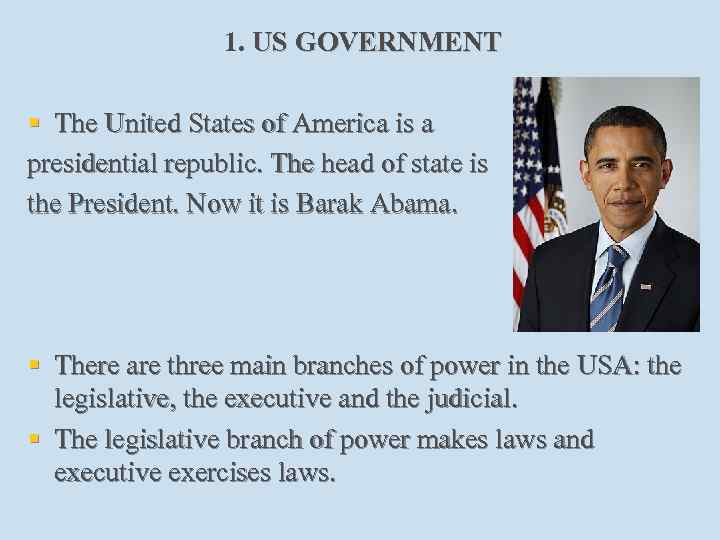 1. US GOVERNMENT § The United States of America is a presidential republic. The head of state is the President. Now it is Barak Abama. § There are three main branches of power in the USA: the legislative, the executive and the judicial. § The legislative branch of power makes laws and executive exercises laws.
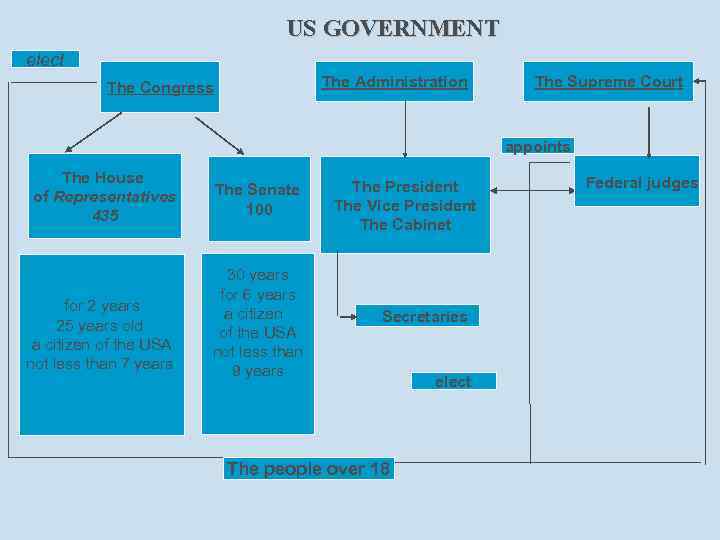 US GOVERNMENT elect The Administration The Congress The Supreme Court appoints The House of Representatives 435 The Senate 100 for 2 years 25 years old a citizen of the USA not less than 7 years 30 years for 6 years a citizen of the USA not less than 9 years The President The Vice President The Cabinet Secretaries The people over 18 elect Federal judges
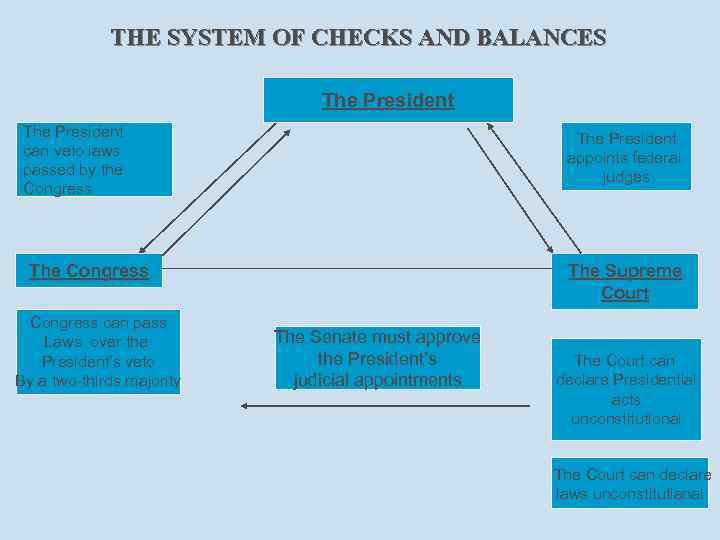 THE SYSTEM OF CHECKS AND BALANCES The President can veto laws passed by the Congress The President appoints federal judges The Congress can pass Laws over the President’s veto By a two-thirds majority The Supreme Court The Senate must approve the President’s judicial appointments The Court can declare Presidential acts unconstitutional The Court can declare laws unconstitutianal
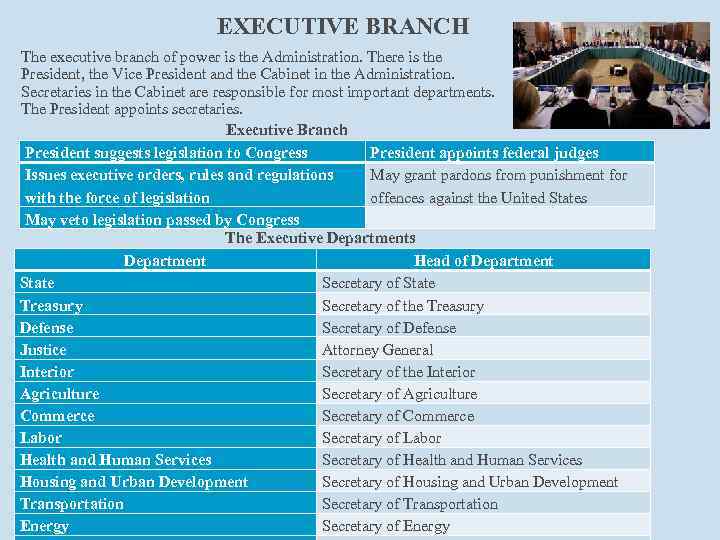 EXECUTIVE BRANCH The executive branch of power is the Administration. There is the President, the Vice President and the Cabinet in the Administration. Secretaries in the Cabinet are responsible for most important departments. The President appoints secretaries. Executive Branch President suggests legislation to Congress President appoints federal judges Issues executive orders, rules and regulations May grant pardons from punishment for with the force of legislation offences against the United States May veto legislation passed by Congress The Executive Departments Department Head of Department State Secretary of State Treasury Secretary of the Treasury Defense Secretary of Defense Justice Attorney General Interior Secretary of the Interior Agriculture Secretary of Agriculture Commerce Secretary of Commerce Labor Secretary of Labor Health and Human Services Secretary of Health and Human Services Housing and Urban Development Secretary of Housing and Urban Development Transportation Secretary of Transportation Energy Secretary of Energy
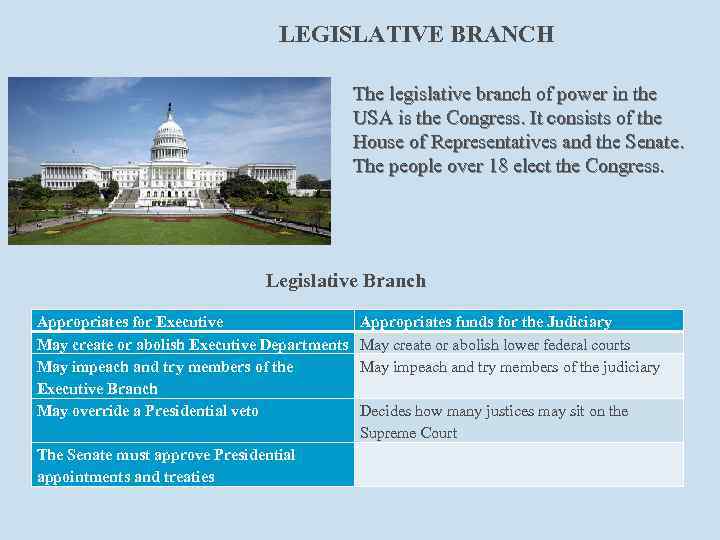 LEGISLATIVE BRANCH The legislative branch of power in the USA is the Congress. It consists of the House of Representatives and the Senate. The people over 18 elect the Congress. Legislative Branch Appropriates for Executive May create or abolish Executive Departments May impeach and try members of the Executive Branch May override a Presidential veto The Senate must approve Presidential appointments and treaties Appropriates funds for the Judiciary May create or abolish lower federal courts May impeach and try members of the judiciary Decides how many justices may sit on the Supreme Court
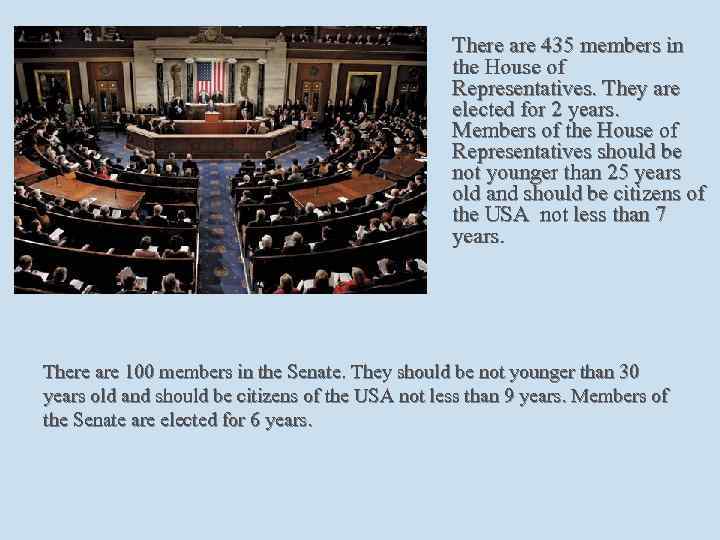 There are 435 members in the House of Representatives. They are elected for 2 years. Members of the House of Representatives should be not younger than 25 years old and should be citizens of the USA not less than 7 years. There are 100 members in the Senate. They should be not younger than 30 years old and should be citizens of the USA not less than 9 years. Members of the Senate are elected for 6 years.
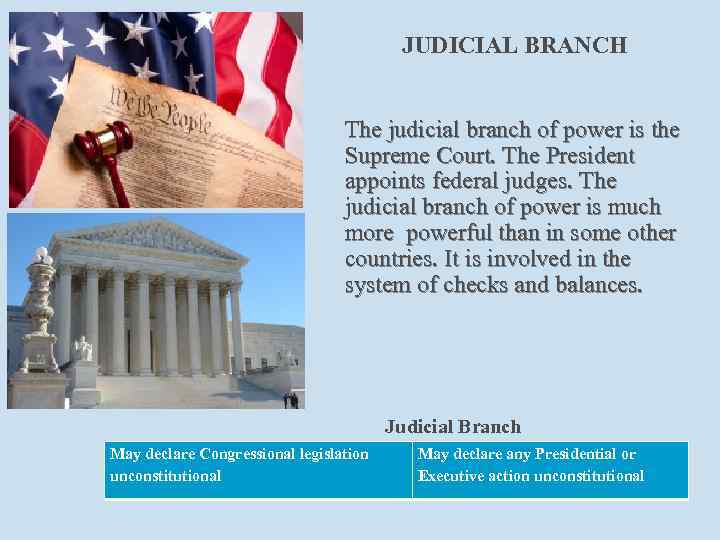 JUDICIAL BRANCH The judicial branch of power is the Supreme Court. The President appoints federal judges. The judicial branch of power is much more powerful than in some other countries. It is involved in the system of checks and balances. Judicial Branch May declare Congressional legislation unconstitutional May declare any Presidential or Executive action unconstitutional
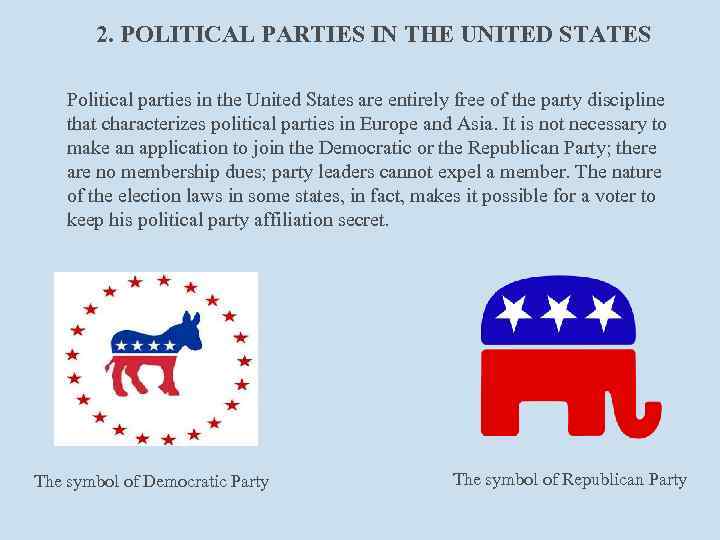 2. POLITICAL PARTIES IN THE UNITED STATES Political parties in the United States are entirely free of the party discipline that characterizes political parties in Europe and Asia. It is not necessary to make an application to join the Democratic or the Republican Party; there are no membership dues; party leaders cannot expel a member. The nature of the election laws in some states, in fact, makes it possible for a voter to keep his political party affiliation secret. The symbol of Democratic Party The symbol of Republican Party
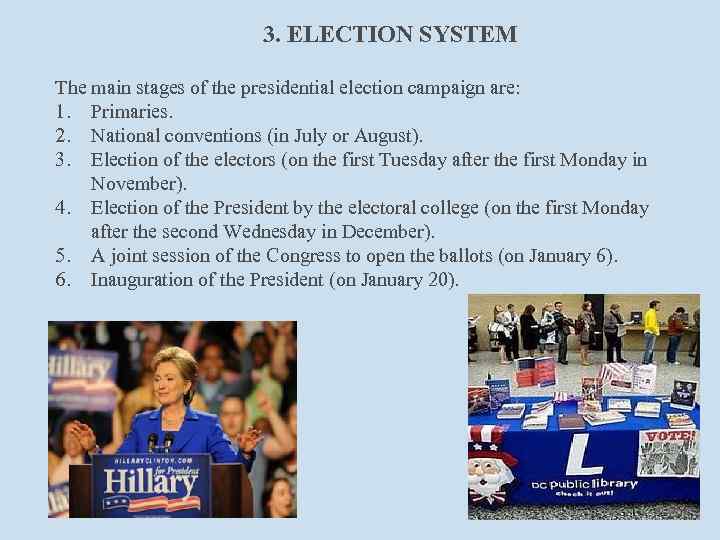 3. ELECTION SYSTEM The main stages of the presidential election campaign are: 1. Primaries. 2. National conventions (in July or August). 3. Election of the electors (on the first Tuesday after the first Monday in November). 4. Election of the President by the electoral college (on the first Monday after the second Wednesday in December). 5. A joint session of the Congress to open the ballots (on January 6). 6. Inauguration of the President (on January 20).
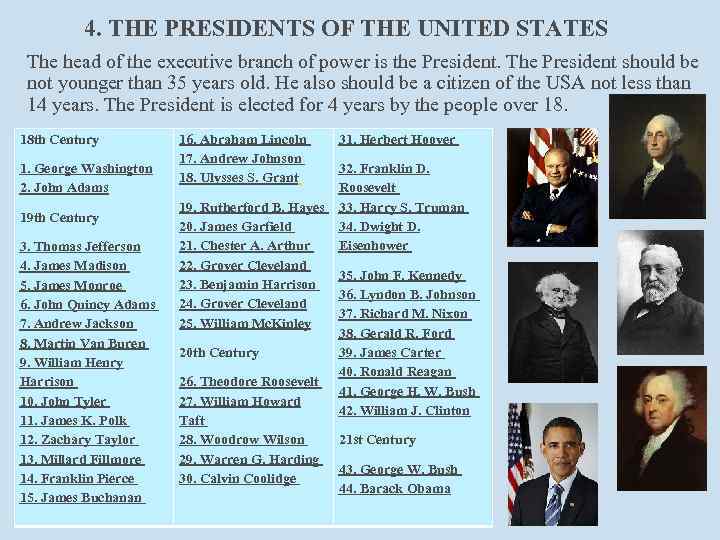 4. THE PRESIDENTS OF THE UNITED STATES The head of the executive branch of power is the President. The President should be not younger than 35 years old. He also should be a citizen of the USA not less than 14 years. The President is elected for 4 years by the people over 18. 18 th Century 1. George Washington 2. John Adams 19 th Century 3. Thomas Jefferson 4. James Madison 5. James Monroe 6. John Quincy Adams 7. Andrew Jackson 8. Martin Van Buren 9. William Henry Harrison 10. John Tyler 11. James K. Polk 12. Zachary Taylor 13. Millard Fillmore 14. Franklin Pierce 15. James Buchanan 16. Abraham Lincoln 17. Andrew Johnson 18. Ulysses S. Grant 31. Herbert Hoover 32. Franklin D. Roosevelt 19. Rutherford B. Hayes 33. Harry S. Truman 20. James Garfield 34. Dwight D. 21. Chester A. Arthur Eisenhower 22. Grover Cleveland 35. John F. Kennedy 23. Benjamin Harrison 36. Lyndon B. Johnson 24. Grover Cleveland 37. Richard M. Nixon 25. William Mc. Kinley 38. Gerald R. Ford 20 th Century 39. James Carter 40. Ronald Reagan 26. Theodore Roosevelt 41. George H. W. Bush 27. William Howard 42. William J. Clinton Taft 21 st Century 28. Woodrow Wilson 29. Warren G. Harding 43. George W. Bush 30. Calvin Coolidge 44. Barack Obama
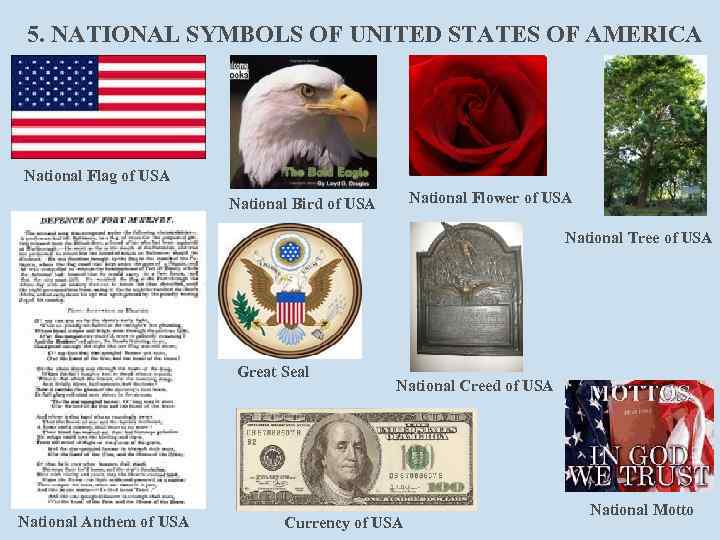 5. NATIONAL SYMBOLS OF UNITED STATES OF AMERICA National Flag of USA National Flower of USA National Bird of USA National Tree of USA Great Seal National Anthem of USA National Creed of USA Currency of USA National Motto
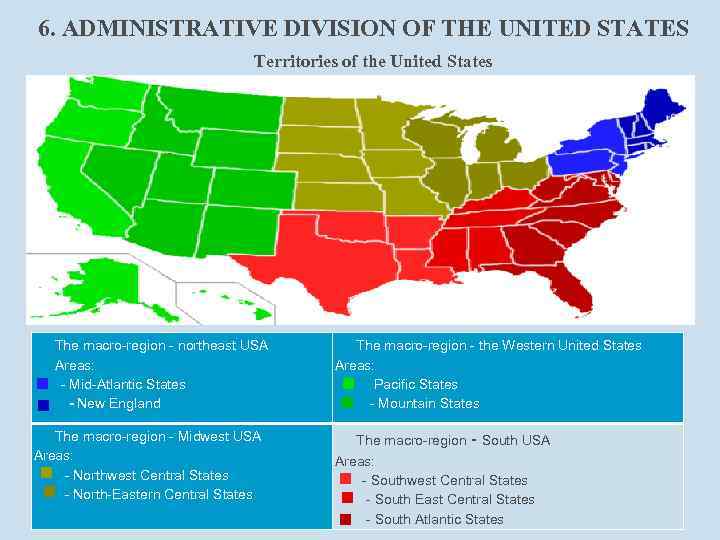 6. ADMINISTRATIVE DIVISION OF THE UNITED STATES Territories of the United States The macro-region - northeast USA Areas: - Mid-Atlantic States - New England The macro-region - the Western United States Areas: Pacific States - Mountain States The macro-region - Midwest USA Areas: - Northwest Central States - North-Eastern Central States The macro-region - South USA Areas: - Southwest Central States - South East Central States - South Atlantic States
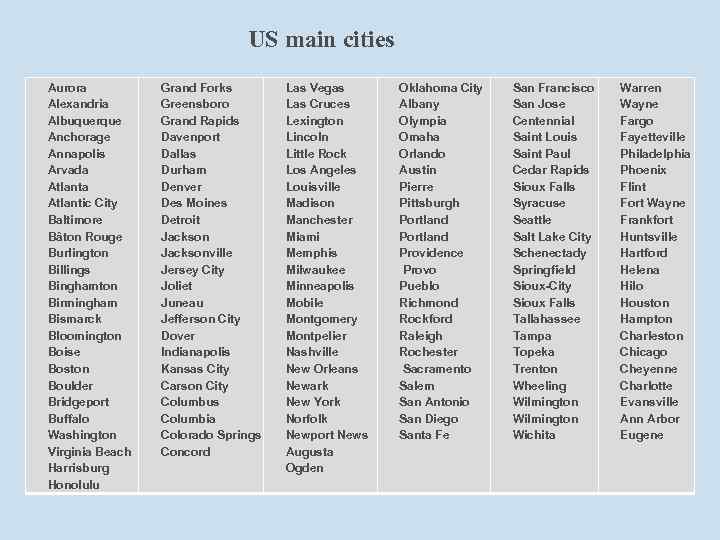 US main cities Aurora Alexandria Albuquerque Anchorage Annapolis Arvada Atlantic City Baltimore Bâton Rouge Burlington Billings Binghamton Birmingham Bismarck Bloomington Boise Boston Boulder Bridgeport Buffalo Washington Virginia Beach Harrisburg Honolulu Grand Forks Greensboro Grand Rapids Davenport Dallas Durham Denver Des Moines Detroit Jacksonville Jersey City Joliet Juneau Jefferson City Dover Indianapolis Kansas City Carson City Columbus Columbia Colorado Springs Concord Las Vegas Las Cruces Lexington Lincoln Little Rock Los Angeles Louisville Madison Manchester Miami Memphis Milwaukee Minneapolis Mobile Montgomery Montpelier Nashville New Orleans Newark New York Norfolk Newport News Augusta Ogden Oklahoma City Albany Olympia Omaha Orlando Austin Pierre Pittsburgh Portland Providence Provo Pueblo Richmond Rockford Raleigh Rochester Sacramento Salem San Antonio San Diego Santa Fe San Francisco San Jose Centennial Saint Louis Saint Paul Cedar Rаріds Sioux Falls Syracuse Seattle Salt Lake City Schenectady Springfield Sioux-City Sioux Falls Tallahassee Tampa Topeka Trenton Wheeling Wilmington Wichita Warren Wayne Fargo Fayetteville Philadelphia Phoenix Flint Fort Wayne Frankfort Huntsville Hartford Helena Hilo Houston Hampton Charleston Chicago Cheyenne Charlotte Evansville Ann Arbor Eugene
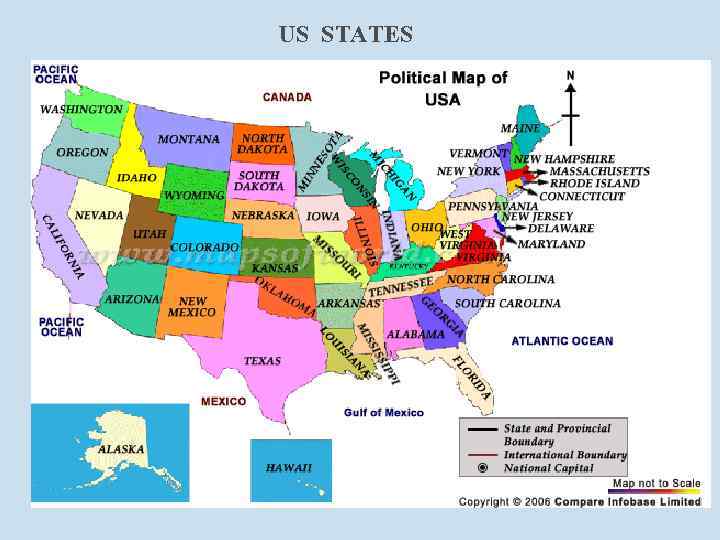 US STATES
 6. US ECONOMY The United States is a large country and is rich in natural resources. It is a leading producer of fuel-of oil, natural gas, and coal. It is also a leading producer of many other minerals, including copper, aluminium, iron, and lead. The United States grows wheat, corn, and other crops and raises many cows, pigs, and chickens. In the 1950 s and 1960 s, the US economy grew rapidly. Many companies moved to the South and Southwest, and these areas experienced change and growth. Then, in the mid-1970 s, economic growth began to slow down. American industry is changing. Old industries, like steel, textiles, and shoes, are losing their places in the international market. Many new industries, such as those that use computer techniques do not need to employ many people. As a result, people who worked in the factories often years ago are working in restaurants, offices, or airlines today. People who earn more than four to five thousand dollars per year must pay a certain percentage of their salaries to the federal government. The percentage depends on their salaries. The federal government has a two-level income tax; that is 15 or 28 percent. People are not very happy on April 15 when the federal taxes are due because they are very high.