


 Скачать презентацию The Political Frame Moliere s The Misanthrope It
ef4ece05a9c7ba79cee67a553c5d2042.ppt
- Количество слайдов: 64
 The Political Frame
 Moliere’s The Misanthrope It is hard to dislike politics without also disliking people. Like it or not, political dynamics are inevitable under conditions most managers face every day: Ambiguity Diversity Scarcity
 Five Propositions: Organizations are coalitions of various individuals and interest groups. Enduring differences among coalition members in values, beliefs, information, interests, and perceptions of reality. Scarce resources & enduring differences give conflict a central role & make power the most important resource. Goals & decisions emerge from bargaining, negotiation, & jockeying for position.
 Concept of Power - the ability to influence another person Influence - the process of affecting the thoughts, behavior, & feelings of another person Authority - the right to influence another person
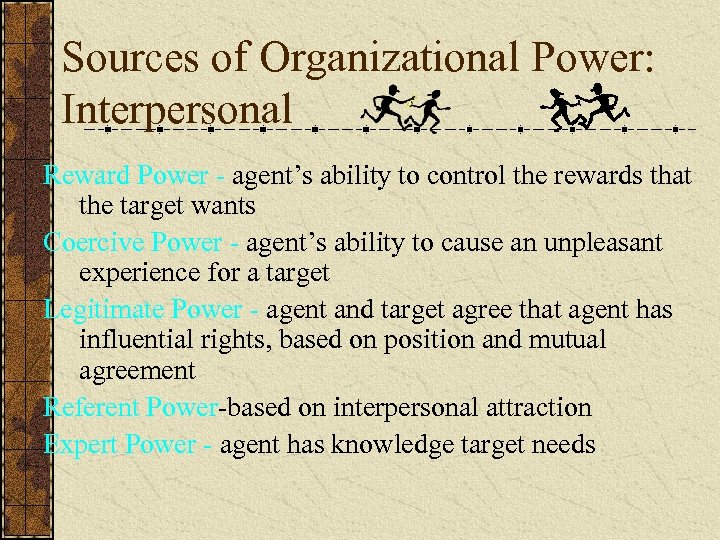 Sources of Organizational Power: Interpersonal Reward Power - agent’s ability to control the rewards that the target wants Coercive Power - agent’s ability to cause an unpleasant experience for a target Legitimate Power - agent and target agree that agent has influential rights, based on position and mutual agreement Referent Power-based on interpersonal attraction Expert Power - agent has knowledge target needs
 Using Power Ethically Does the behavior produce a good outcome for people both inside and outside the organization? Does the behavior respect the rights of all parties? Does the behavior treat all parties equitably and fairly?
 Successful Power Users Have high need for social power; low need for affiliation Have these power-oriented characteristics belief in the authority system preference for work & discipline belief in justice altruism
 Sources of Organizational Power: Intergroup Control of critical resources Control of strategic contingencies - activities that other groups need to complete their tasks Ways groups hold power over other groups Ability to reduce uncertainty High centrality - functionality central to organization’s success Nonsubstitutability - group’s activities are difficult to replace
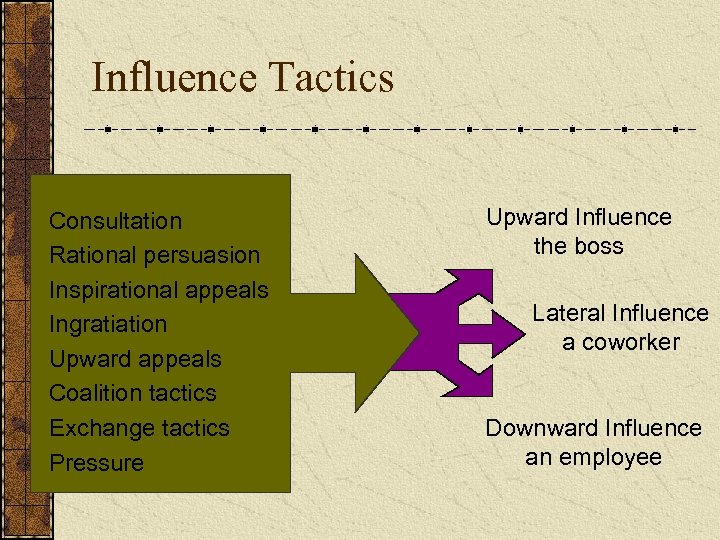 Influence Tactics Consultation Rational persuasion Inspirational appeals Ingratiation Upward appeals Coalition tactics Exchange tactics Pressure Upward Influence the boss Lateral Influence a coworker Downward Influence an employee
 Managing Political Behavior Maintain open communication Clarify performance expectations Use participative management Encourage cooperation among work groups Manage scarce resources well Provide a supportive organizational climate
 Managing Up: The Boss Make sure you understand your boss and his/her context including · · Goals and objectives Pressures Strengths, weaknesses, blind spots Preferred work style
 Managing Up: The Boss Assess yourself and your needs, including · · · Strengths, weaknesses, & blind spots Personal style Relation to authority figures
 Using Power Effectively 1. Use power in ethical ways 2. Understand use all of the various types of power and influence 3. Seek out jobs that allow you to develop your power skills 4. Use power tempered by maturity and selfcontrol 5. Accept that influencing people is an important part of the management job
 Nature of Organizational Conflict - any situation in which incompatible goals, attitudes, emotions, or behaviors lead to disagreement or opposition between two or more parties Functional conflict - a healthy, constructive disagreement between two or more people Dysfunctional conflict - an unhealthy, destructive disagreement between two or more people
 Conflict Ø Substantive and Emotional Conflict substantive conflict: conflict that occurs in the form of a fundamental disagreement over ends or goals to be pursued and the means for their accomplishment Emotional Conflict: conflict that involves interpersonal difficulties that arise over feeling of anger, mistrust, dislike, fear, resentment, and the like
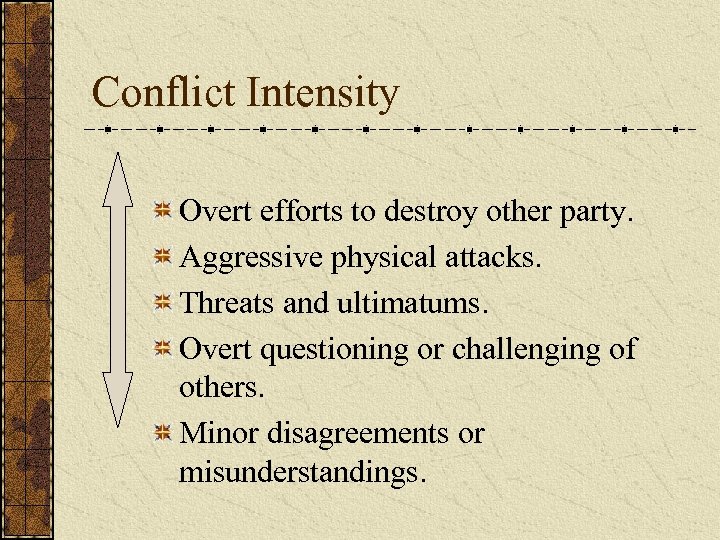 Conflict Intensity Overt efforts to destroy other party. Aggressive physical attacks. Threats and ultimatums. Overt questioning or challenging of others. Minor disagreements or misunderstandings.
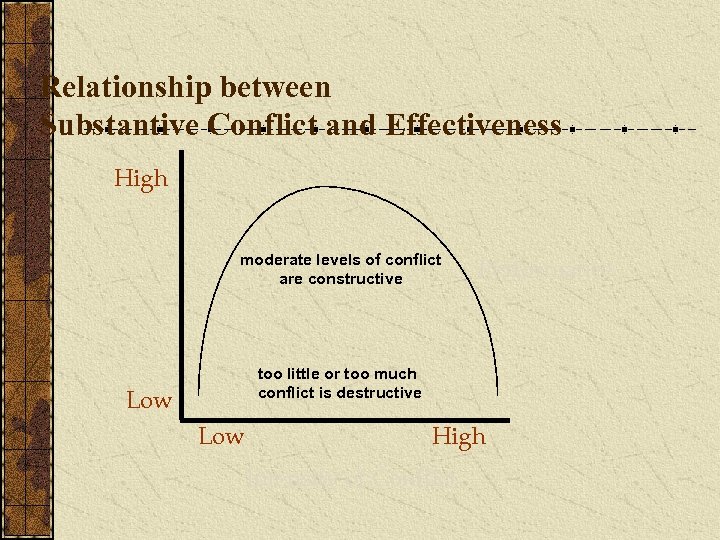 Relationship between Substantive Conflict and Effectiveness High moderate levels of conflict are constructive Performance too little or too much conflict is destructive Low High Intensity of Conflict
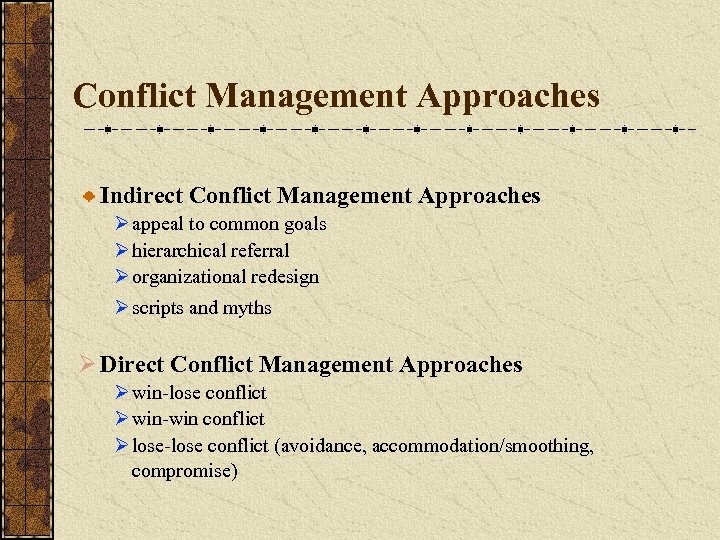 Conflict Management Approaches Indirect Conflict Management Approaches Ø appeal to common goals Ø hierarchical referral Ø organizational redesign Ø scripts and myths Ø Direct Conflict Management Approaches Ø win-lose conflict Ø win-win conflict Ø lose-lose conflict (avoidance, accommodation/smoothing, compromise)
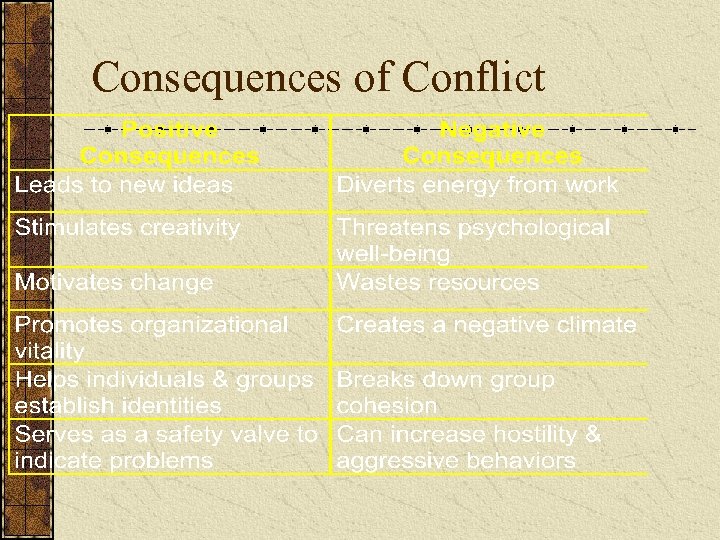 Consequences of Conflict
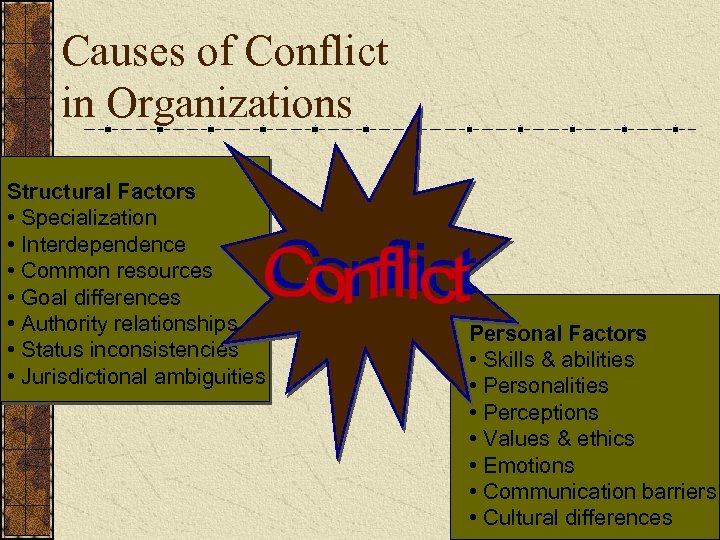 Causes of Conflict in Organizations Structural Factors • Specialization • Interdependence • Common resources • Goal differences • Authority relationships • Status inconsistencies • Jurisdictional ambiguities Personal Factors • Skills & abilities • Personalities • Perceptions • Values & ethics • Emotions • Communication barriers • Cultural differences
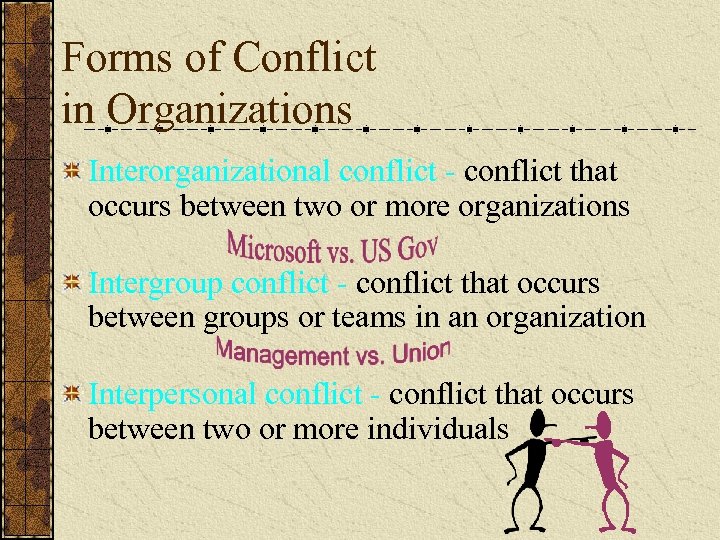 Forms of Conflict in Organizations Interorganizational conflict - conflict that occurs between two or more organizations Intergroup conflict - conflict that occurs between groups or teams in an organization Interpersonal conflict - conflict that occurs between two or more individuals
 Forms of Conflict in Organizations Intrapersonal conflict - conflict that occurs within an individual Interrole conflict - a person’s experience of conflict among the multiple roles in his/her life
 Forms of Conflict in Organizations Intrarole conflict - conflict that occurs within a single role, such as when a person receives conflicting messages from role senders about how to perform a certain role Person-role conflict - conflict that occurs when an individual is expected to perform behaviors in a certain role that conflict with his/her personal values
 Defense Mechanisms Aggressive Mechanisms. Fixation - an aggressive mechanism in which an individual keeps up a dysfunctional behavior that obviously will not solve the conflict. Displacement - An aggressive mechanism in which an individual directs his/her anger toward someone who is not the source of the conflict. Negativism - an aggressive mechanism in which a person responds with pessimism to any attempt at solving a problem.
 Defense Mechanisms Compromise Mechanisms Compensation - a compromise mechanism in which an individual attempts to make up for a negative situation by devoting himself/herself to another pursuit with increased vigor Identification - a compromise mechanism whereby an individual patterns his or her behavior after another’s Rationalization - a compromise mechanism characterized by trying to justify one’s behavior by constructing bogus reasons for it
 Defense Mechanisms Withdrawal Mechanisms Flight/withdrawal - a withdrawal mechanism that entails physically escaping a conflict (flight) or psychologically escaping (withdrawal) Conversion - a withdrawal mechanism in which emotional conflicts are expressed in physical symptoms Fantasy - a withdrawal mechanism that provides an escape from a conflict through daydreaming
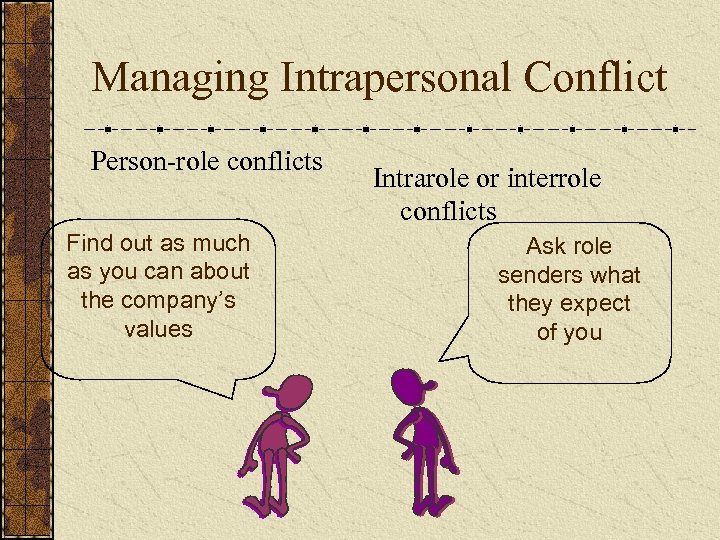 Managing Intrapersonal Conflict Person-role conflicts Find out as much as you can about the company’s values Intrarole or interrole conflicts Ask role senders what they expect of you
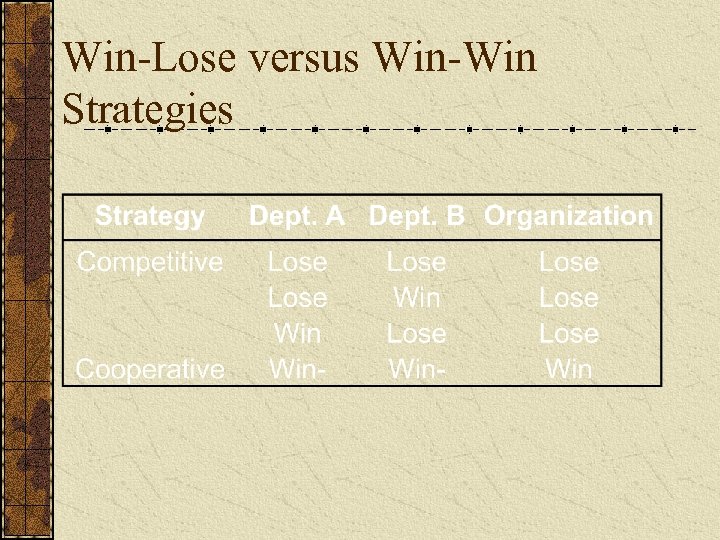 Win-Lose versus Win-Win Strategies
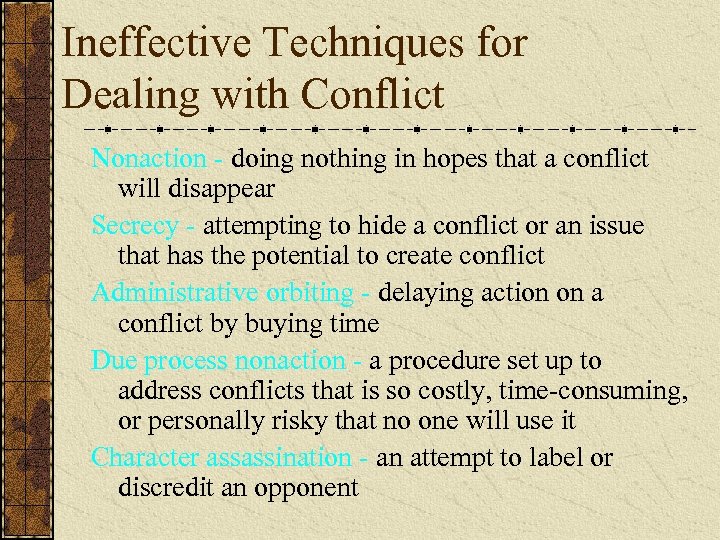 Ineffective Techniques for Dealing with Conflict Nonaction - doing nothing in hopes that a conflict will disappear Secrecy - attempting to hide a conflict or an issue that has the potential to create conflict Administrative orbiting - delaying action on a conflict by buying time Due process nonaction - a procedure set up to address conflicts that is so costly, time-consuming, or personally risky that no one will use it Character assassination - an attempt to label or discredit an opponent
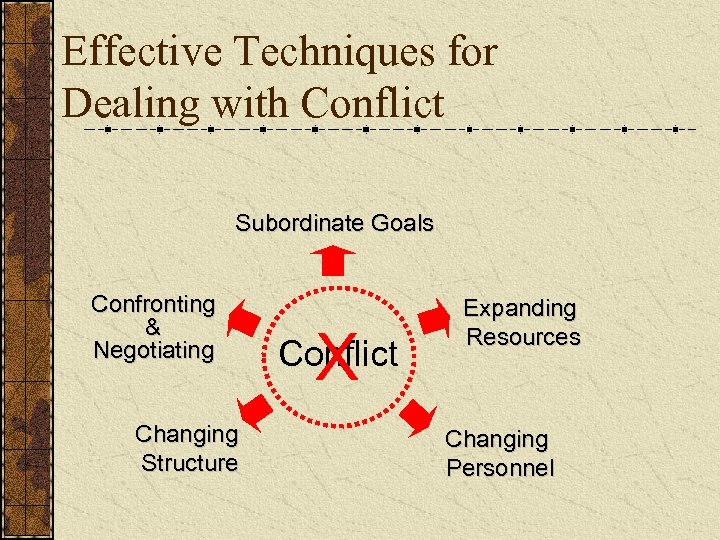 Effective Techniques for Dealing with Conflict Subordinate Goals Confronting & Negotiating Changing Structure X Conflict Expanding Resources Changing Personnel
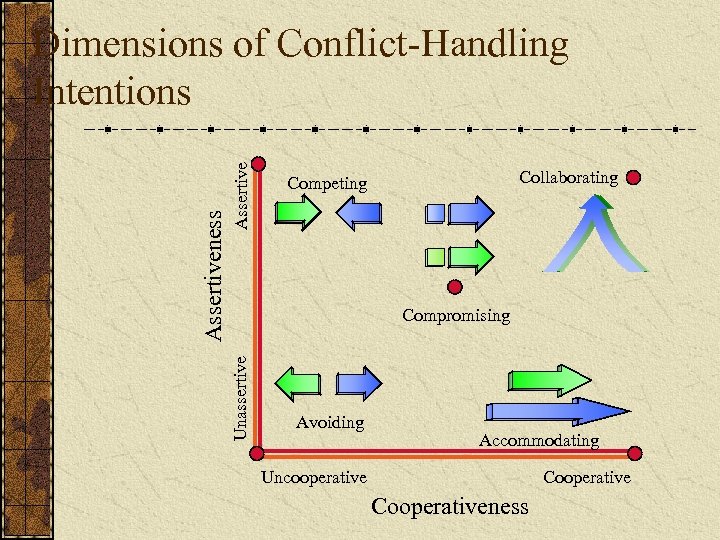 Assertive Collaborating Competing Compromising Unassertive Assertiveness Dimensions of Conflict-Handling Intentions Avoiding Accommodating Uncooperative Cooperativeness
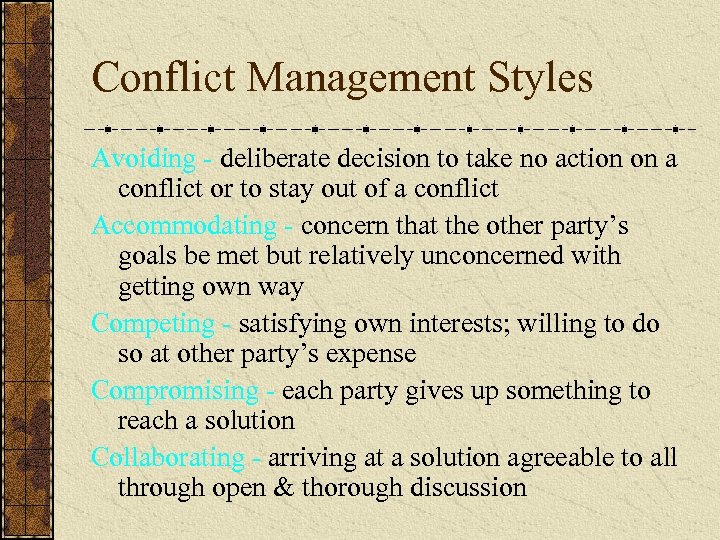 Conflict Management Styles Avoiding - deliberate decision to take no action on a conflict or to stay out of a conflict Accommodating - concern that the other party’s goals be met but relatively unconcerned with getting own way Competing - satisfying own interests; willing to do so at other party’s expense Compromising - each party gives up something to reach a solution Collaborating - arriving at a solution agreeable to all through open & thorough discussion
 Avoidance Is Appropriate When. . . You have no chance of satisfying your concerns let people cool down
 Accommodation Is Appropriate When. . . You realize you are wrong Issue is much more important to other party To build up credit for later negotiations To preserve harmony
 Competition Is Appropriate When. . . No long term relationship To protect yourself against untrustworthy parties Unpopular courses of action need implementation Issues are vital to your welfare
 Collaboration Is Appropriate When. . . Both parties’ concerns are too important to be compromised To gain commitment Time is not an issue
 Compromising Is Appropriate When. . . Goals are less important to you than collaboration Mutually exclusive goals To achieve temporary settlements Under intense time pressure
 Summary and Implications for Managers Conflict can be either constructive or destructive to the functioning of a group. An optimal level of conflict: prevents stagnation. stimulates creativity. releases tension. and initiates the seeds for change.
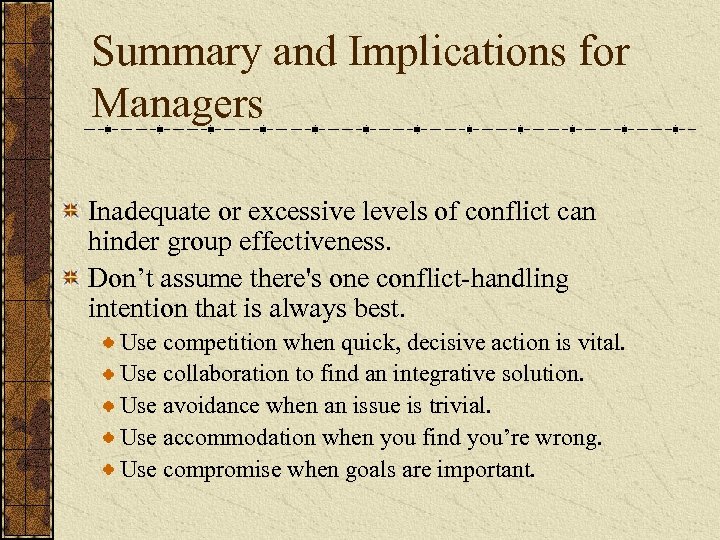 Summary and Implications for Managers Inadequate or excessive levels of conflict can hinder group effectiveness. Don’t assume there's one conflict-handling intention that is always best. Use competition when quick, decisive action is vital. Use collaboration to find an integrative solution. Use avoidance when an issue is trivial. Use accommodation when you find you’re wrong. Use compromise when goals are important.
 Skills of the Manager as Politician Agenda Setting Mapping the Political Terrain Networking & Building Coalitions
 Negotiation - a joint process of finding a mutually acceptable solution to a complex conflict Useful under these conditions Two or more parties Conflict of interest between the parties Parties are willing to negotiate Parties prefer to work together rather than to fight openly, give in, break off contact, or take the dispute to a higher authority
 Negotiation An exchange relationship between two parties where it is determined what will be exchanged and the rate of exchange. NET OUTCOMES: Benefits minus costs (hassles, stress and what you have to give up). ASPIRATIONS: What each party reasonable expects to get out of the negotiation. BEST ALTERNATIVE TO A NEGOTIATED AGREEMENT (BATNA): If you walked away from the negotiation, the worst that could happen to you.
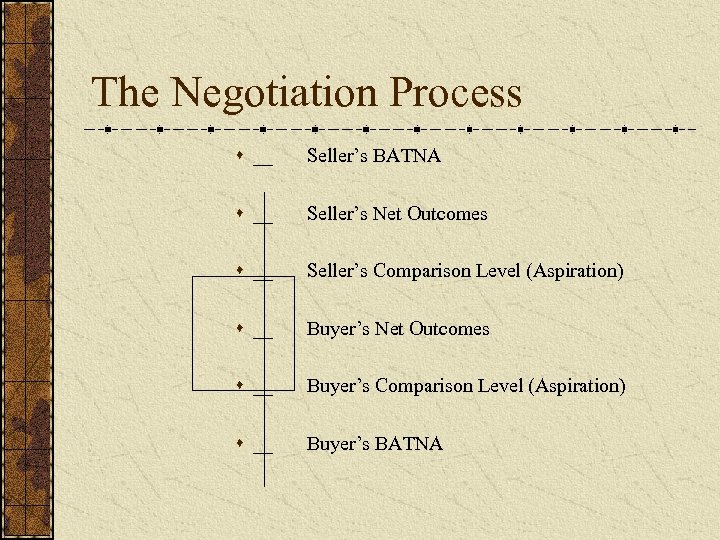 The Negotiation Process s __ Seller’s BATNA s __ Seller’s Net Outcomes s __ Seller’s Comparison Level (Aspiration) s __ Buyer’s Net Outcomes s __ Buyer’s Comparison Level (Aspiration) s __ Buyer’s BATNA
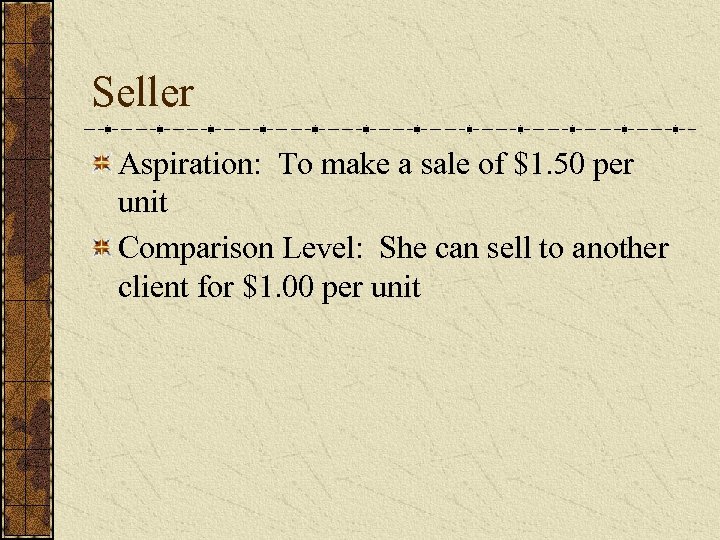 Seller Aspiration: To make a sale of $1. 50 per unit Comparison Level: She can sell to another client for $1. 00 per unit
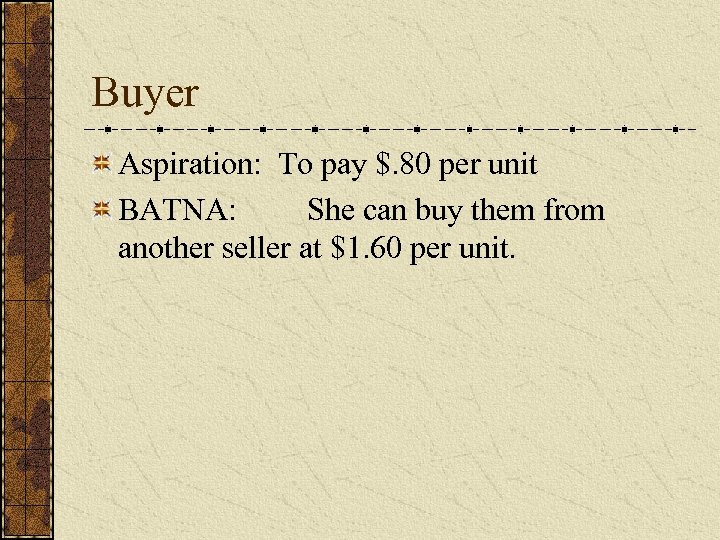 Buyer Aspiration: To pay $. 80 per unit BATNA: She can buy them from another seller at $1. 60 per unit.
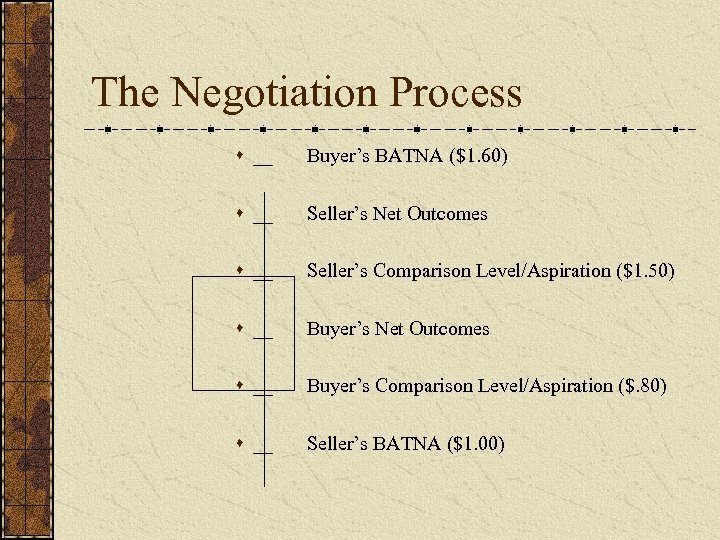 The Negotiation Process s __ Buyer’s BATNA ($1. 60) s __ Seller’s Net Outcomes s __ Seller’s Comparison Level/Aspiration ($1. 50) s __ Buyer’s Net Outcomes s __ Buyer’s Comparison Level/Aspiration ($. 80) s __ Seller’s BATNA ($1. 00)
 Will we Negotiate? The bargaining range will fall between the salesperson’s and the purchaser’s limits. In this case there is overlap. If there is no overlap, then the negotiation will not be successfully concluded. How do you know when you start if there is any overlap?
 Agreement Where our net outcomes meet. BATNA: Affects comparison level, limits.
 Distributive Bargaining Fixed Pie Mentality We normally frame as Distributive, leads to bargaining over issues. We like to cut to the chase We like to ignore the interpersonal
 Maximizing Joint Outcomes Instead of bargaining over each individual issue, try to bargain in ‘packages’ Each issue does not carry the same level of importance to all Give concessions of things that are not important to you, but are important to the other
 Joint Outcomes We almost never get maximized joint outcomes by bargaining sequentially (now this issue, now that issue) It’s hard to calculate the importance of issues for ourselves, and others When we view the ‘other’ as the ‘opponent’ all of a sudden every issue seems important So, we are not honest about our issues
 Linking Issues Find ways to link issues (what’s important to me with what’s not important to me but IS important to the opponent)
 Is the Process Complex? People tend to see negotiation as complex, and see it as undefined CHAOS We try to package simply Or tend to separate each issue
 The Best Way to Negotiate Cognitively figure out packages (Planning) Come up with 4 -5 items that I give that the other wants And where the other gives that I want Get some momentum by getting some up front agreements Try not to maximize EACH ISSUE but maximize the ENTIRE PACKAGE
 Planning Yes, negotiation requires planning and patience Know issues to keep in mind Know the levels of each issue Know the value of each issue Get the other guy to agree on issues (find a way of thinking about same issues)
 Reactance The other guy knows you are trying to move him/her and may balk How about reciprocity?
 Do’s and Don’ts Do develop more than 1 alternative, actually enough so you are ambivalent to current alternative Do negotiate over as little as possible Don’t negotiate with friends
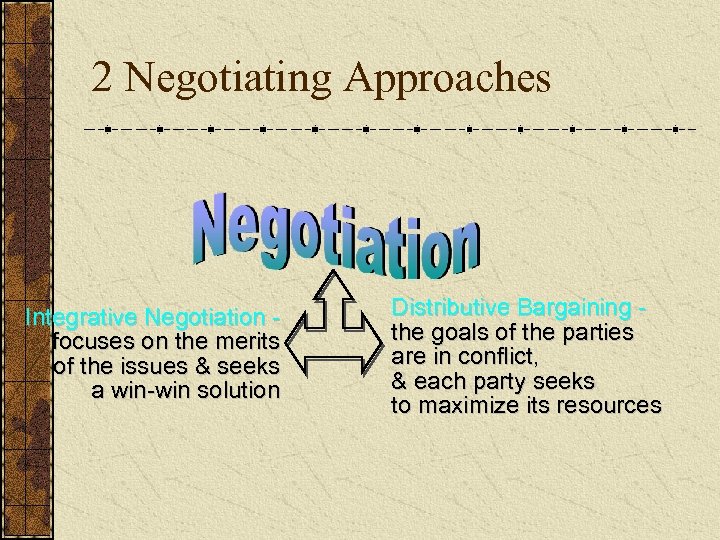 2 Negotiating Approaches Integrative Negotiation focuses on the merits of the issues & seeks a win-win solution Distributive Bargaining the goals of the parties are in conflict, & each party seeks to maximize its resources
 What Makes Integrative Negotiation Different? A focus on Commonalities (Frames) An attempt to address needs and interests (Covey) Commitment to meeting the needs of all parties Exchange of information and ideas Invention of options for mutual gain Objective criteria for standards of performance
 Issues in Negotiation Personality Traits Gender Differences Cultural Differences Third-Party Negotiations Mediators Arbitrators Conciliators Consultants
 What is Ethical? (Lax & Sebenius, 1986) Are you following rules that are understood and accepted? Are you comfortable discussing and defending your action? Would you want someone to do it to you? What if everyone acted that way? Are there alternatives that rest on firmer ethical ground?
 Organizations as Arenas house contests As such, the help determine What game will be played Who will be on the field What interests will be pursued
 What is often ignored Lowerarchy Groups in lower positions devise a host of creative and maddening ways to resist, divert, undermine, ignore, or overthrow change efforts.
 Organizations As Political Agents Organizations are tools for achieving the purposes of those who control them. They exist, compete, and coevolve in business or political ecosystems. Relationships are fiercely competitive, sometimes collaborative and interdependent.