


 Скачать презентацию The Political Economy of Digital Archives Copyright and
f3d54c492a3bff9fec4ecd087d72e431.ppt
- Количество слайдов: 26
 The Political Economy of Digital Archives, Copyright and Commons Summer School on Records, Archives and Memory Studies , Zadar, Croatia, May 7 2013 Ivacs Gabriella ivacsg@ceu. hu
 Access Discourses in Public Policies l l l Long-term Access: ensuring continued access to content regardless of format, medium; digital curation, preservation Short-term Access: making digital content available online; active dissemination to discovery services. Enhanced Access: technology and human interaction; user-friendly finding aids, catalogs, visualization, data enrichment for scholarly use Open Access: belongs to public domain or licensed to the public. Social Access: inclusion of socially disadvantaged groups; expansion of collection.
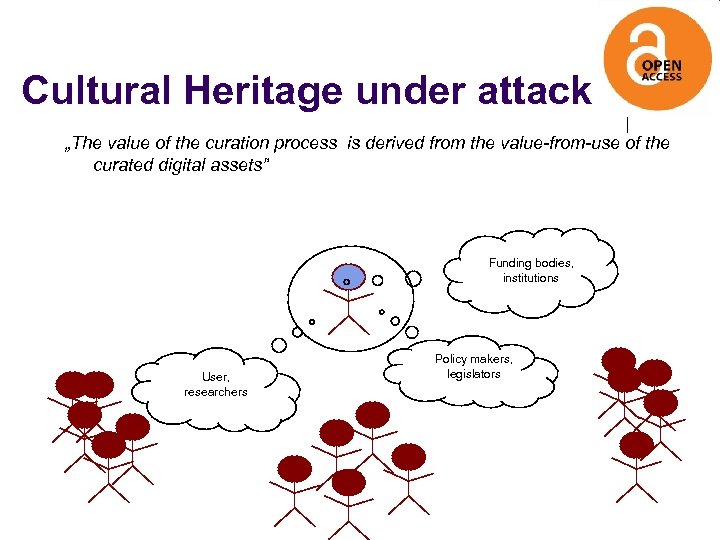 Cultural Heritage under attack „The value of the curation process is derived from the value-from-use of the curated digital assets” Funding bodies, institutions User, researchers Policy makers, legislators
 Access to Knowledge (A 2) l l l Dichotomy: Access to Knowledge (A 2 K) and Access to Information? Human rights: equal sharing of information Neoliberal economics: l Robert Solow (1950 s): connection between knowledge and economic growth l Harold Demsetz (1980 s) about private property to solve the “tragedy of the commons” Democratization and Information Society concept New set of values and a model for social organizations Information Society can be considered as an ideology (a dominant way of thinking)
 Manuel Castells: Networked Information Society l l l Knowledge: “a set of organized statements of facts or ideas, presenting a reasoned judgment or an experimental result, which is transmitted to others through some communication medium in some systematic form. ” Information society is not optional, the result of technology development Globalisation and information revolution is connected Knowledge based economy: the value is in information productivity Global competition in technology development: economic and social changes
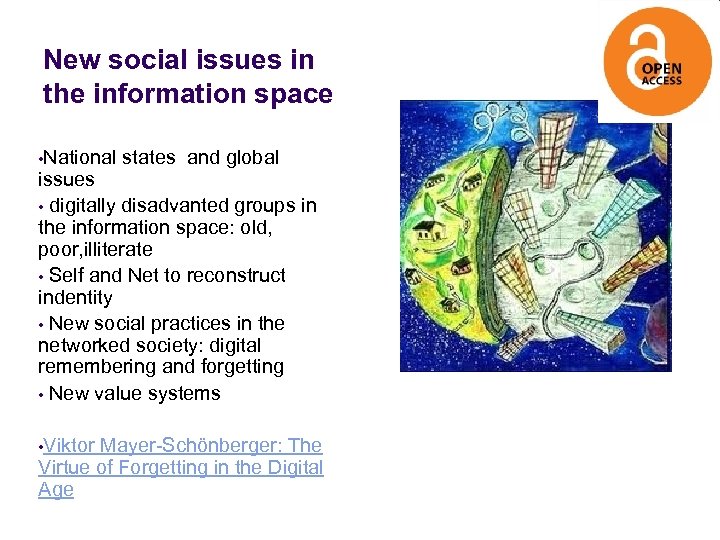 New social issues in the information space • National states and global issues • digitally disadvanted groups in the information space: old, poor, illiterate • Self and Net to reconstruct indentity • New social practices in the networked society: digital remembering and forgetting • New value systems • Viktor Mayer-Schönberger: The Virtue of Forgetting in the Digital Age
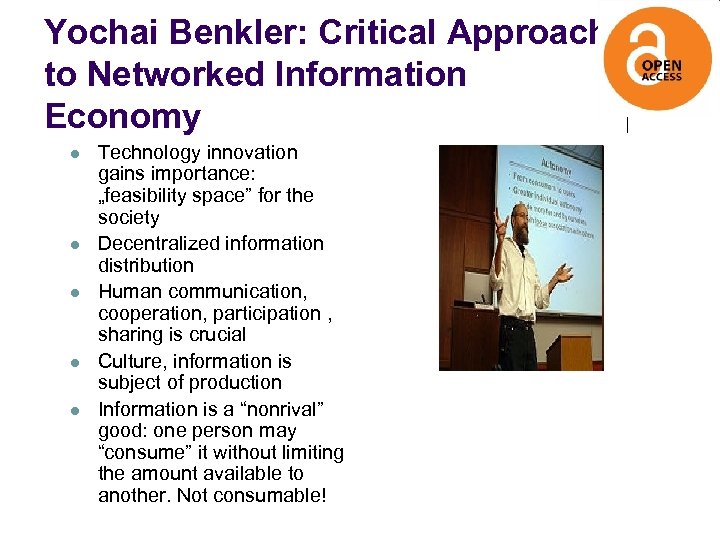 Yochai Benkler: Critical Approach to Networked Information Economy l l l Technology innovation gains importance: „feasibility space” for the society Decentralized information distribution Human communication, cooperation, participation , sharing is crucial Culture, information is subject of production Information is a “nonrival” good: one person may “consume” it without limiting the amount available to another. Not consumable!
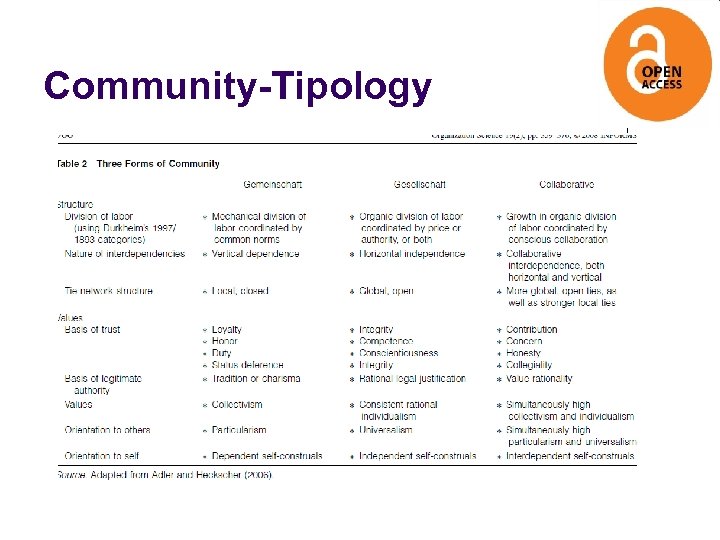 Community-Tipology
 Cultural Heritage and Commoditization l l Before the “digital revolution”. The French cultural policy (1980 s)to put the emphasis on cultural industries and the marketing of cultural products. Cultural heritage and tourism discourse Growth of digital networks: tensions between democratization and commercial exploitation Information Society: culture = information = content for the production of goods and services (dubbed “new economy”).
 Anomalies in Public Policies l Mostly iconographic collections (photography and audiovisual in particular) are subject to Commoditization l l Short-term economic exploitation and the long-term preservation and transmission of historical heritage Private and public sector partnership vs. national cultural heritage in the face of corporate power
 Use/reuse context for digital content l l LAW, criminalization NORM, defined by a community MARKET, depending on the value of the product regardless of the NORM and LAW ENVIRONMENT can restric access by physical attributes
 Prevasive IPR l l Intellectual property rights are legal entitlements that give their holders the ability to prevent others from copying or deploying the covered information in specific ways: Patents, copyrights, and trademarks Copyright also endemically shapes how we learn and think, because: it affects the prices of textbooks and the viability of archives…
 Commons … is to insist that communities, without the imposition of market or governmental ordering systems, have the power and perhaps the right to set the terms of their collective endeavors.
 Public domain … consists of works that are publicly available; while according to the formal definition, it consists of works that are unavailable for private ownership or are available for public use.
 What does Law do? l Intervens at the level of content! Longer Copyright restriction from the 1990 s (Sony Bono, Millenium Digital Copyright Act) l Retroactive legislation l Expanded to everything what is considered creative l WIPO, international harmonization l IPR expansion: TRIPS, ACTA l Database protection: EU 1994 l
 Quantification of „archive” l l l digitization is a costly operation new copyright regimes on images that are legally in the public domain cultural heritage as a source of data for cultural industries: quantity matters! Level of technological changes: physical, logical and content = Infrastructure peer-to-peer production and copying
 Piracy and Cultural Content l l Daniel Heller Roazen: The Enemy of All. Piracy and the Law of Nations Historical Model: nowadays it includes illegal users copying, sharing, transmitting copyrighted content Peer to peer file sharing: huge impact on the market and information commodities Market needs meet with the availability of content, product. No profit making! But the transactions are illegal!
 Why Piracy exists? l Correlation between underground distribution of digital content and markets? l Does piracy complement or replace? l File Sharing is a black market? l What are the anomalies behind?
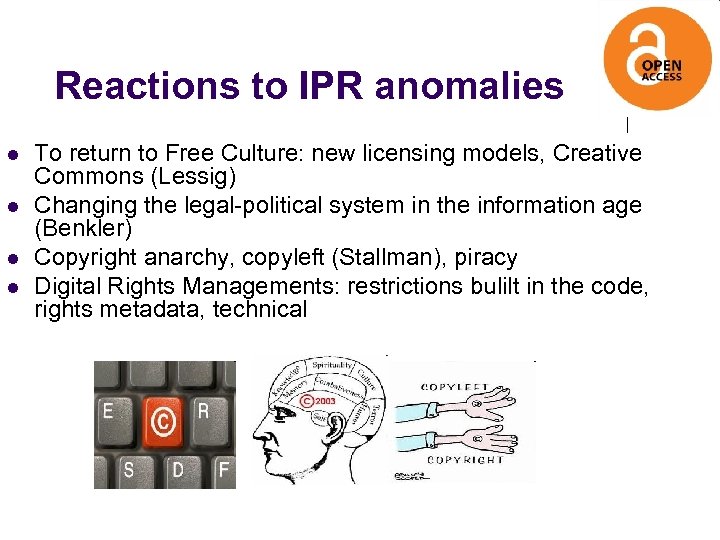 Reactions to IPR anomalies l l To return to Free Culture: new licensing models, Creative Commons (Lessig) Changing the legal-political system in the information age (Benkler) Copyright anarchy, copyleft (Stallman), piracy Digital Rights Managements: restrictions bulilt in the code, rights metadata, technical
 Case Study: HOPE (2010 -2013) • Domain: 12 social history institutions; libraries and archives • Content: a range of formats, multilingual content; digital collections and metadata • Target Community: social history researchers, European citizens, global public • Management: HOPE Consortium > IALHI Foundation • Funded by CIP-PSP • Goals: 1) Aggregate content to Europeana, 2) Best Practice Network 3) Towards Trusted Digital Repositories • http: //www. peoplesheritage. eu/pdf/D 2 -4 -Grant 250549 -HOPEBest. Practices. Trusted. Digital. Content. Repositories 2 -0. pdf
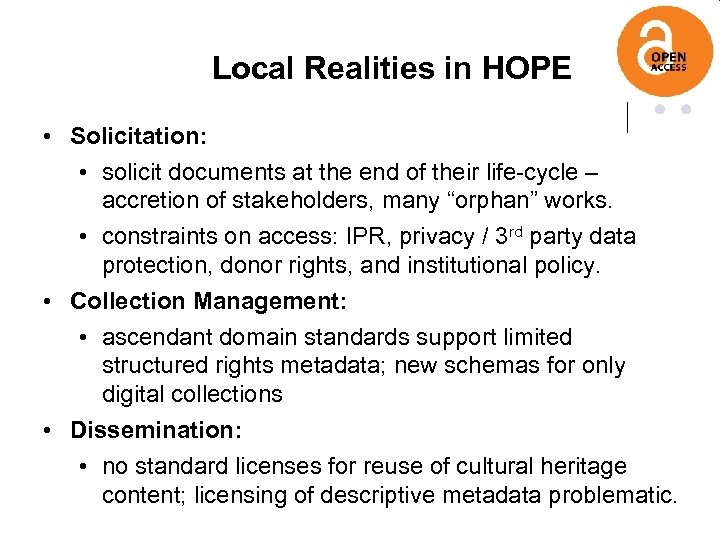 Local Realities in HOPE • Solicitation: • solicit documents at the end of their life-cycle – accretion of stakeholders, many “orphan” works. • constraints on access: IPR, privacy / 3 rd party data protection, donor rights, and institutional policy. • Collection Management: • ascendant domain standards support limited structured rights metadata; new schemas for only digital collections • Dissemination: • no standard licenses for reuse of cultural heritage content; licensing of descriptive metadata problematic.
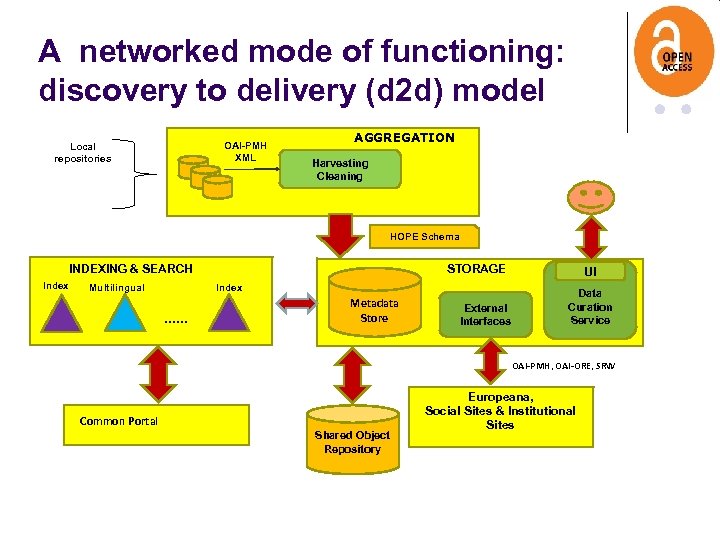 A networked mode of functioning: discovery to delivery (d 2 d) model OAI-PMH XML Local repositories AGGREGATION Harvesting Cleaning HOPE Schema INDEXING & SEARCH Index Multilingual STORAGE Index …… Metadata Store External Interfaces UI Data Curation Service OAI-PMH, OAI-ORE, SRW Common Portal Shared Object Repository Europeana, Social Sites & Institutional Sites
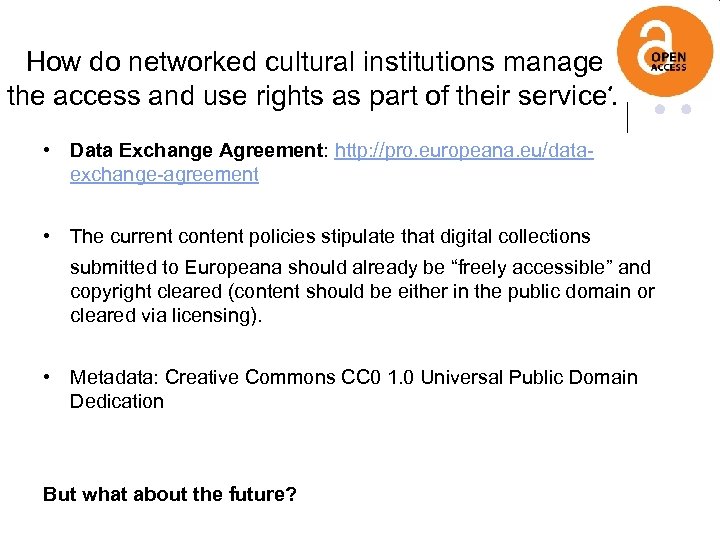 How do networked cultural institutions manage the access and use rights as part of their service? • Data Exchange Agreement: http: //pro. europeana. eu/dataexchange-agreement • The current content policies stipulate that digital collections submitted to Europeana should already be “freely accessible” and copyright cleared (content should be either in the public domain or cleared via licensing). • Metadata: Creative Commons CC 0 1. 0 Universal Public Domain Dedication But what about the future?
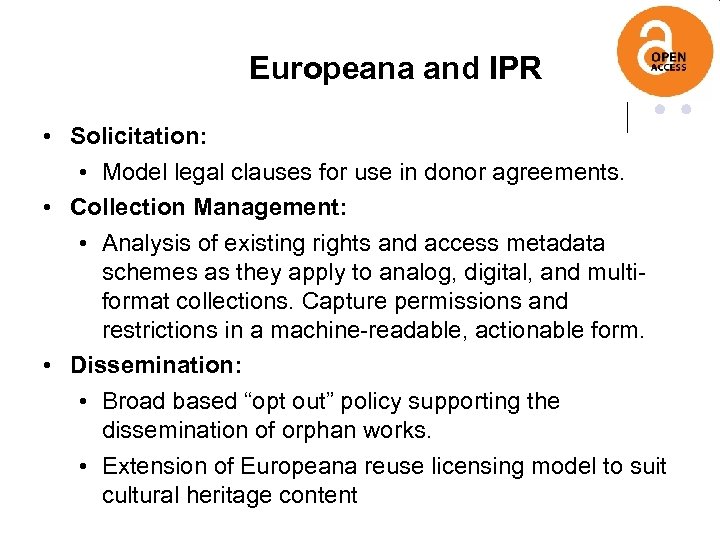 Europeana and IPR • Solicitation: • Model legal clauses for use in donor agreements. • Collection Management: • Analysis of existing rights and access metadata schemes as they apply to analog, digital, and multiformat collections. Capture permissions and restrictions in a machine-readable, actionable form. • Dissemination: • Broad based “opt out” policy supporting the dissemination of orphan works. • Extension of Europeana reuse licensing model to suit cultural heritage content
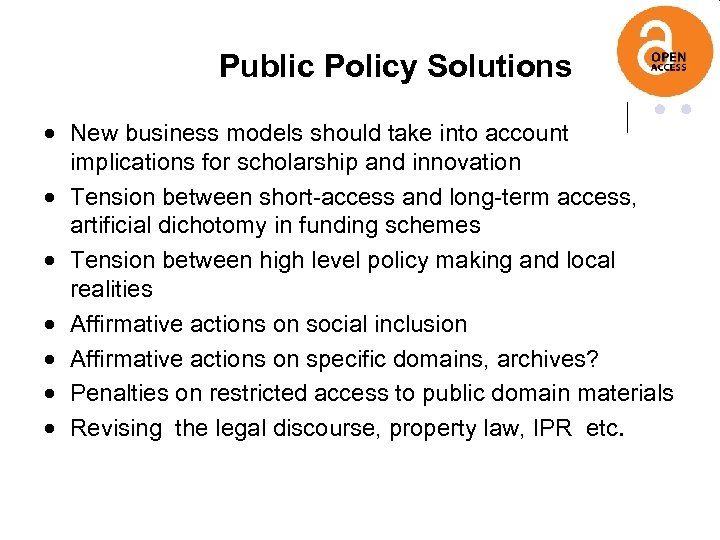 Public Policy Solutions • New business models should take into account implications for scholarship and innovation • Tension between short-access and long-term access, artificial dichotomy in funding schemes • Tension between high level policy making and local realities • Affirmative actions on social inclusion • Affirmative actions on specific domains, archives? • Penalties on restricted access to public domain materials • Revising the legal discourse, property law, IPR etc.
![Shifting the perspective beyond the distribution of cultural artifacts […] and considering the development](https://present5.com/presentation/f3d54c492a3bff9fec4ecd087d72e431/image-26.jpg "Shifting the perspective beyond the distribution of cultural artifacts […] and considering the development") Shifting the perspective beyond the distribution of cultural artifacts […] and considering the development of expressive practices as a modality of exchange and relation allow us to leave behind the goals of cultural democratization and open up the way for a cultural democracy […]” (Caune, 2006)
Shifting the perspective beyond the distribution of cultural artifacts […] and considering the development of expressive practices as a modality of exchange and relation allow us to leave behind the goals of cultural democratization and open up the way for a cultural democracy […]” (Caune, 2006)