Скачать презентацию The Poisoned Patient Core Clerkship in Emergency Medicine
073b3804c6a6ac57a14a3a8dd09b0894.ppt
- Количество слайдов: 47
 The Poisoned Patient Core Clerkship in Emergency Medicine University of Colorado at Denver Health Sciences Center
 Objectives Apply general emergency medicine management principles to the poisoned patient n Review basic pharmacology and toxicology of common poisons n Utilize clues from the history, physical exam, and diagnostics to identify the poisons involved n
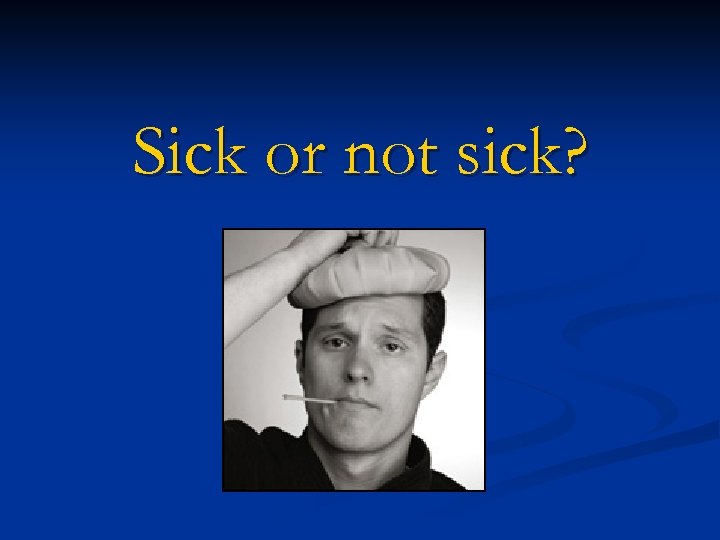
 First principle in poisoning management Sick or not sick? n Poisoned patients can present with a broad spectrum of illness n If sick, start treatment n Resuscitation is always the first stepremember your ABCs n
 General principles of emergency management Resuscitation/Stabilization n Evaluation n Rule out the life-threats n Identify what you can n n Symptomatic care/monitoring Prevention of deterioration n Treat symptoms n Antidotes n
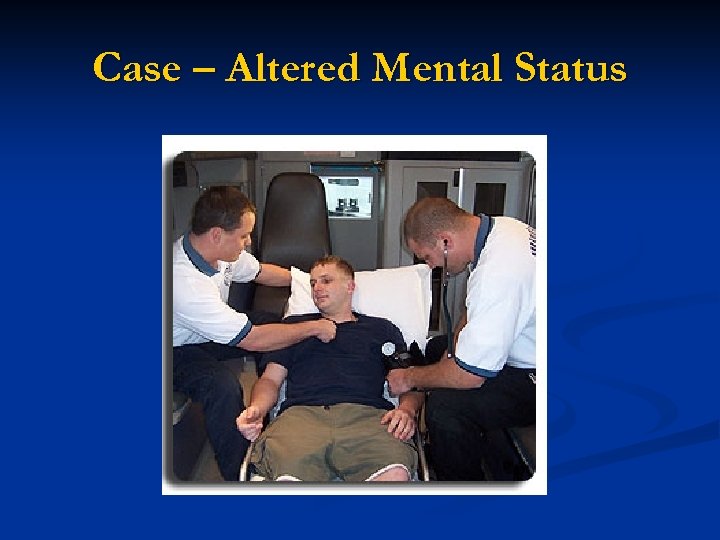 Case – Altered Mental Status
 EMS Report n n n “This is a 57 yo male. We were called to his house by his son, who found him confused. The son is on the way here. “On our arrival, we found a somnolent male who is not able to answer questions, is mildly diaphoretic, and had BP 135/75, HR 100, RR 32, and oxygen sat of 99% on room air. We have a 16 gauge IV in the left AC. Dstick was 95. “Any questions for us before we leave? ”
 EMS Report House was clean, no signs of an assault, etc. n No drug paraphernalia around n No medicalert bracelet or necklace n No open pill bottles near patient n Patient was found 5 ft from the bottom of a staircase n
 The patient’s son arrives… What would you like to ask his son?
 His son tells you… He talked to his dad yesterday, seemed normal n No significant PMH n PSHX: gallbladder taken out about 10 years ago n No medications except for something he occasionally takes for a “stomach flu bug” n SH: smoker : 40 pack/year hx, occasional social drinker n Wife died of cancer about a month ago—dad took her death “very hard” n
 Physical Exam n n n n n Vitals – T 38. 2; BP 134/78; Pulse 102; RR 30; Sa. O 2 98% on RA Gen: Confused, drowsy Skin: moist and flushed, no lesions, no cyanosis Pupils: mid position (not constricted or dilated) and reactive CV: tachy RR, no murmur/rubs/gallops Lungs: CTA bilaterally Bowel sounds: present No evidence of trauma, neck is not stiff Neuro: otherwise nonfocal
 Sick or not sick?
 Sick or not sick Sick but stable n No immediate airway, breathing or circulation interventions required n But altered mental status may be due to a lifethreatening condition that requires prompt intervention n
 What’s our differential diagnosis for this patient?
 Broad Differential Diagnoses Neurologic n Malignant n Endocrine n Infection n Trauma n Toxicologic n
 Altered Mental Status n Four life-threatening causes that require immediate treatment Hypoxia (ruled out by normal pulse ox) n Hypotension/severe hypertension (ruled out by normal BP) n Herniation of the brainstem (ruled out by non-focal neurological exam) n Hypoglycemia (needs to be evaluated in every patient with altered mental status) n
 Get the best history possible Often unreliable or unobtainable from patient n Rely on EMS, bystanders, family members and other physicians n Psychiatric files n Obtain bottles/medications from home n n Any missing pills, amount, time of ingestion Environmental setting n Check pockets, bags, belongings n
 Physical Exam n Thorough exam looking for clues: Toxidromes- constellation of signs and symptoms of a particular poison n In the ED we always look for the “classic” presentation n n Also look for signs of non-toxicologic causes: n Evidence of trauma, infection, metabolic or neurological causes, etc.
 Common Toxidromes Sympathomimetics n Anti-cholinergics n Cholinergics n Sedatives n Opiates n
 Sympathomimetics n Cocaine, Amphetamines, PCP Hypertension n Tachycardia n Diaphoresis n Mydriasis n Agitation n n Does this sound like our guy?
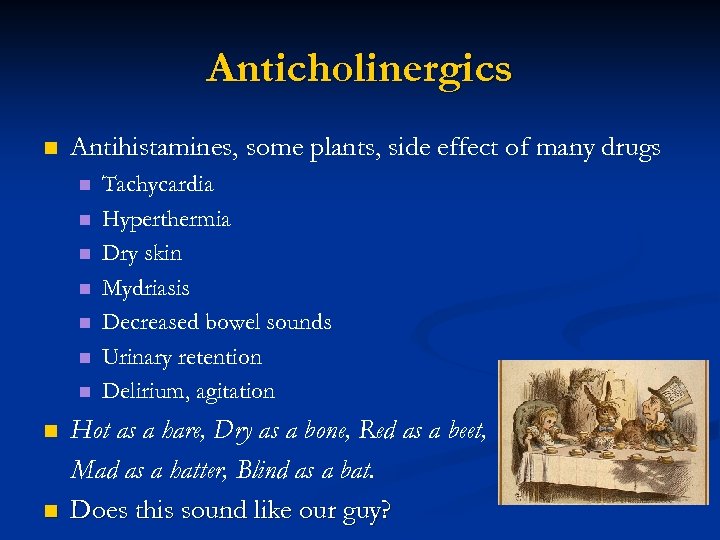 Anticholinergics n Antihistamines, some plants, side effect of many drugs n n n n n Tachycardia Hyperthermia Dry skin Mydriasis Decreased bowel sounds Urinary retention Delirium, agitation Hot as a hare, Dry as a bone, Red as a beet, Mad as a hatter, Blind as a bat. Does this sound like our guy?
 Cholinergics n Organophosphates, Carbamates, Nerve agents n Effects both muscarinic and nicotinic receptors Muscarinic effects n n n n S- SALIVATION, SEIZURE L- LACRIMATION U- URINATION G- GI DISTRESS (diarrhea & vomiting) B- BRONCHORRHEA A- ABDOMINAL CRAMPS M- MIOSIS
 Cholinergics n Nicotinic effects - MTWTh. F M-Mydriasis n T-Tachycardia n W-Weakness n TH-Hyperthermia n F-Fasciculations n n Does this sound like our guy?
 Opiates, Clonidine Miosis n Hypotension n Bradypnea n Bradycardia n Hypothermia n CNS Depression n Does this look like our guy?
 Sedatives Benzodiazepines, GHB “Coma with normal vital signs” CNS Depression n Normotensive n Mild bradypnea or normal RR n n Does this look like our guy?
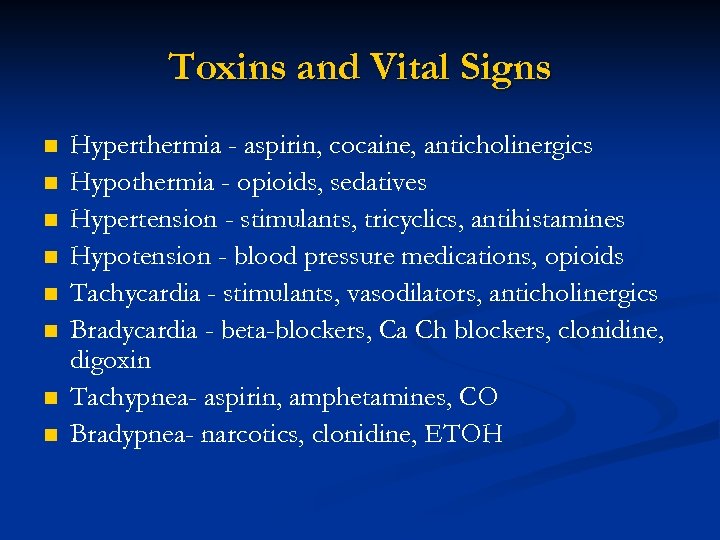 Toxins and Vital Signs n n n n Hyperthermia - aspirin, cocaine, anticholinergics Hypothermia - opioids, sedatives Hypertension - stimulants, tricyclics, antihistamines Hypotension - blood pressure medications, opioids Tachycardia - stimulants, vasodilators, anticholinergics Bradycardia - beta-blockers, Ca Ch blockers, clonidine, digoxin Tachypnea- aspirin, amphetamines, CO Bradypnea- narcotics, clonidine, ETOH
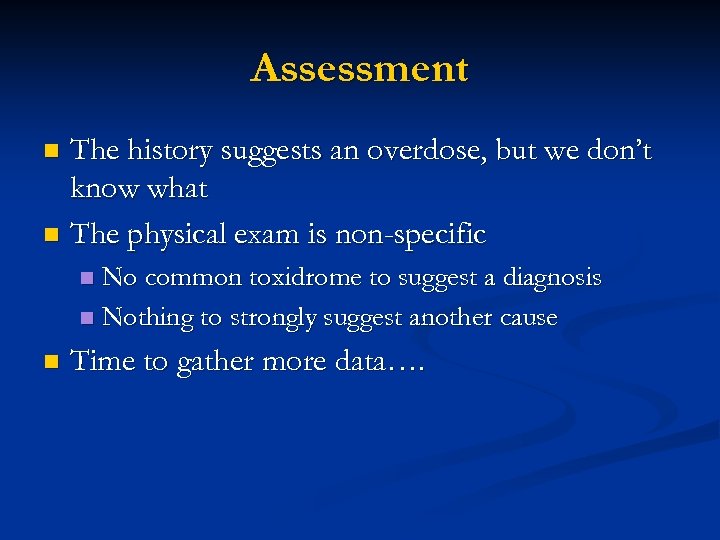 Assessment The history suggests an overdose, but we don’t know what n The physical exam is non-specific n No common toxidrome to suggest a diagnosis n Nothing to strongly suggest another cause n n Time to gather more data….
 Diagnostic Testing What diagnostics might be helpful in this case?
 Diagnostics n General lab testing Serum chemistry, blood gas to identify metabolic abnormalities n CBC, UA, CSF analysis to identify infection n Drug/alcohol screen to identify common drugs of abuse n n Specific lab testing n Some poisons require specific testing
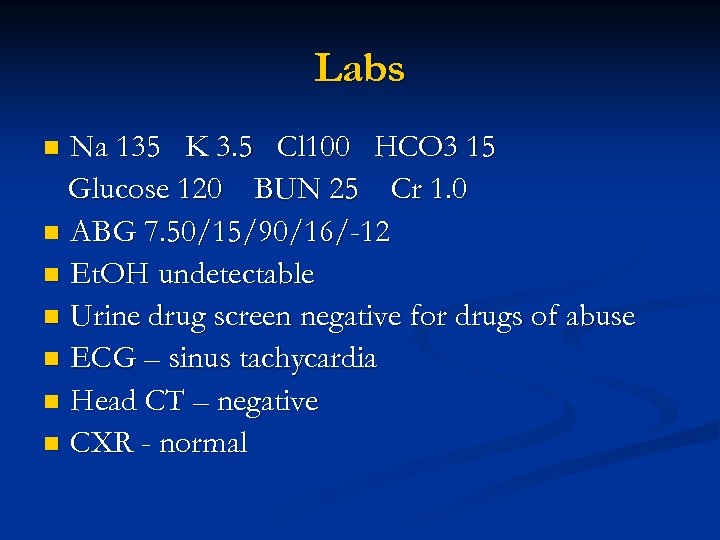 Labs Na 135 K 3. 5 Cl 100 HCO 3 15 Glucose 120 BUN 25 Cr 1. 0 n ABG 7. 50/15/90/16/-12 n Et. OH undetectable n Urine drug screen negative for drugs of abuse n ECG – sinus tachycardia n Head CT – negative n CXR - normal n
 What is your assessment now? What is the acid/base disturbance? n What is the differential for this acid/base disturbance? n Is this consistent with a common overdose? n How can we assess this problem? n Was the ECG, head CT, and CXR helpful? n
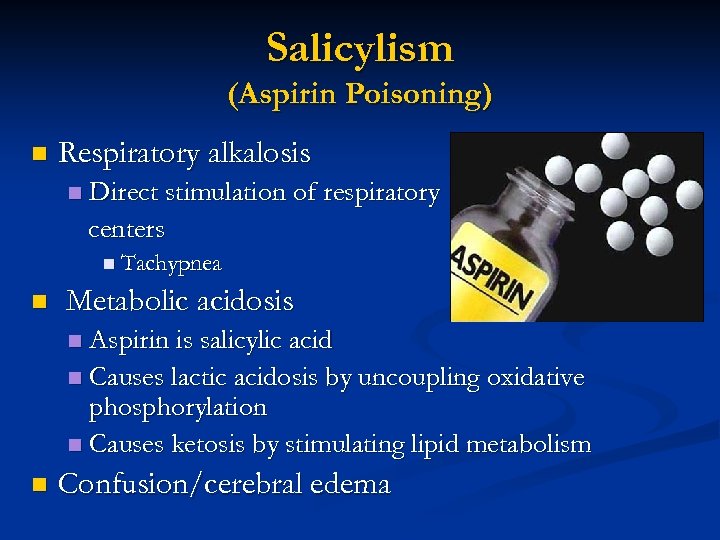 Salicylism (Aspirin Poisoning) n Respiratory alkalosis n Direct stimulation of respiratory centers n Tachypnea n Metabolic acidosis Aspirin is salicylic acid n Causes lactic acidosis by uncoupling oxidative phosphorylation n Causes ketosis by stimulating lipid metabolism n n Confusion/cerebral edema
 Evaluation In most poisonings, symptoms do not correlate well with serum drug levels, so levels are not useful n Acute salicylate ingestion is one case where symptoms DO correlate with levels n Therapeutic is up to 30 mg/dl n This patient’s level was 75 mg/dl n
 Poisoning Management n Supportive and symptomatic care required for all poisonings
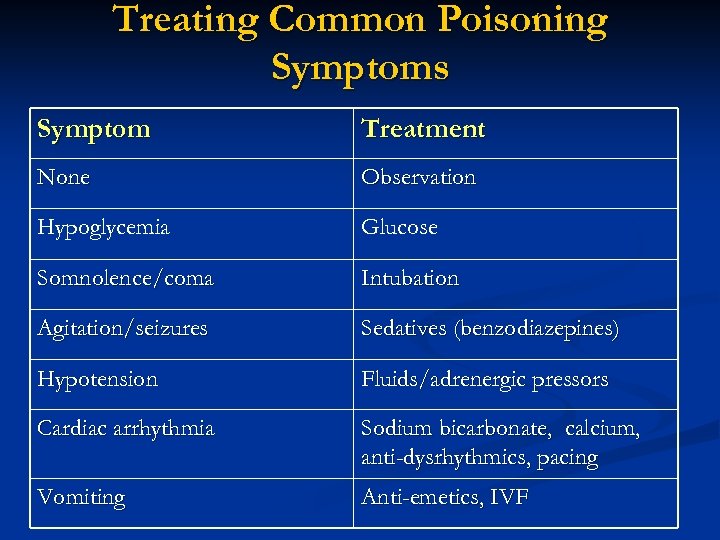 Treating Common Poisoning Symptoms Symptom Treatment None Observation Hypoglycemia Glucose Somnolence/coma Intubation Agitation/seizures Sedatives (benzodiazepines) Hypotension Fluids/adrenergic pressors Cardiac arrhythmia Sodium bicarbonate, calcium, anti-dysrhythmics, pacing Vomiting Anti-emetics, IVF
 Poisoning Management Antidotal therapies are needed for only a few poisons. (Consult your EM book for detailed listings. ) n Consider GI decontamination n n Removal of drug or decrease absorption from GI tract
 GI Decontamination n Ipecac syrup n n No longer recommended for poisonings Activated charcoal Binds to most medications and potentially decreases GI absorption n Potentially useful within 1 hour of ingestion but no evidence of improved clinical outcomes n Aspiration is uncommon unless given by an NG tube or in patient with altered mental status n
 GI Decontamination n Gastric Lavage Insertion of large orogastric tube into the stomach and lavaging with several liters of fluid n Potentially useful in life threatening ingestions < 1 hour n Aspiration occurs in around 5% of patients n
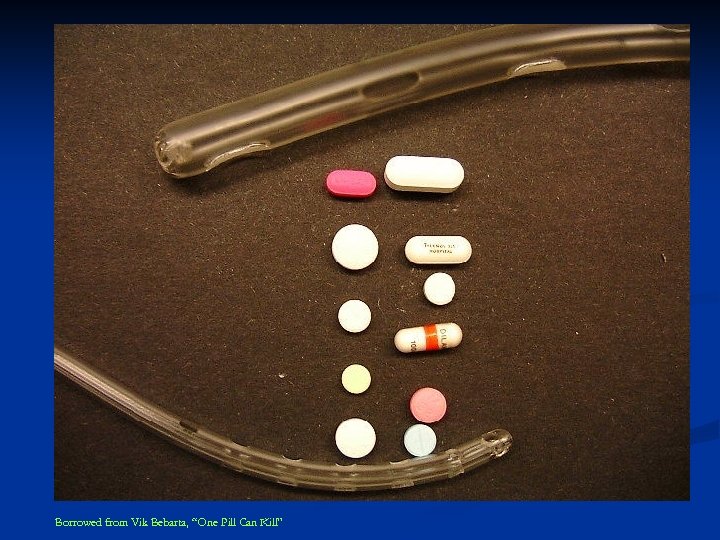 Borrowed from Vik Bebarta, “One Pill Can Kill”
 GI Decontamination n Whole Bowel Irrigation Decreases GI transit time using PEG n Useful in life threatening ingestions when other methods not helpful n
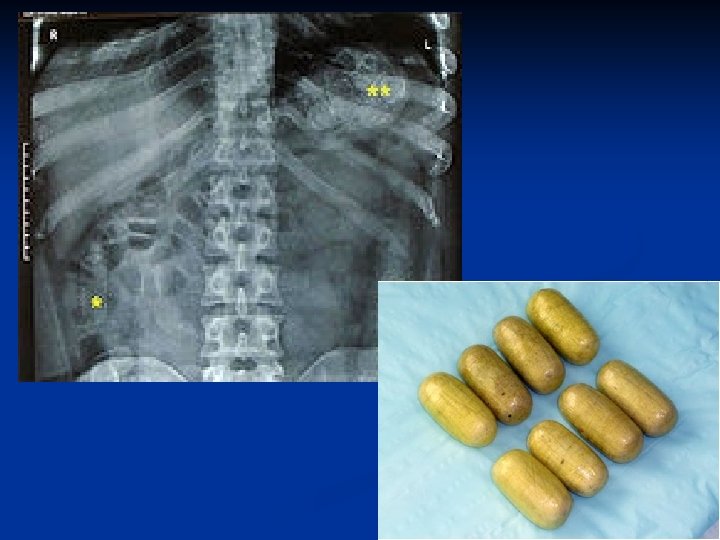
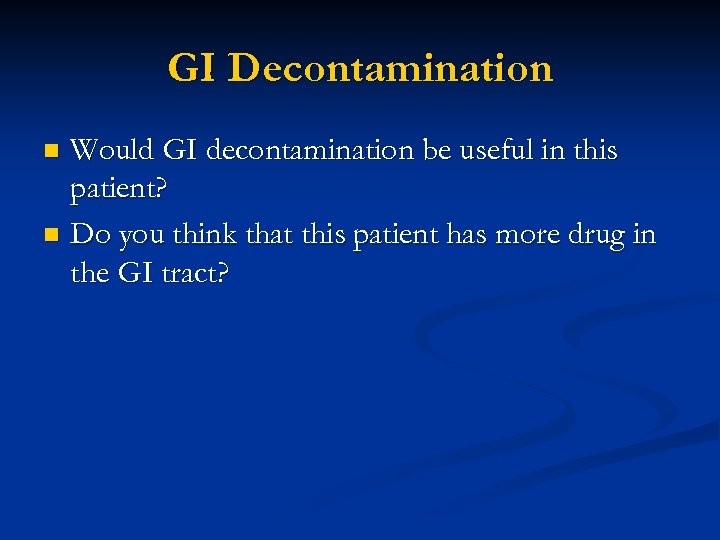 GI Decontamination Would GI decontamination be useful in this patient? n Do you think that this patient has more drug in the GI tract? n
 GI Decontamination He has a high salicylate level n He has been “confused for a couple of hours” n Probably not much drug left in the GI tract n
 Specific Treatments Very few poisons require specific treatments such as: Dialysis n Diuresis n Chelation n Cardiac pacing n
 Salicylism - Treatment n Salicylate poisoning has a specific treatment n Alkaline diuresis – increase in urine p. H favors movement of salicylate ion into urine n Dialysis for severe cases Is this patient sick enough to get dialysis?
 Non-Toxic Ingestions (Small amounts) n n n n Household bleach Cigarettes (<3) Cosmetics Glues/paste Hydrogen peroxide (medicinal) Matches Paint (indoor, latex) n n n n Shampoos, lotions Rat poison Detergents Chalk Laxatives Ink Antibiotics Antacids
 Summary Always start with the ABCs n Target your history and physical for clues to the diagnosis n Labs and other testing may be useful n Most poisons only require supportive care n If you have questions call the Rocky Mountain Poison Center n