


 Скачать презентацию — The Plague — Death — Loss of
bbbd948031747f6b8b4f821d562f7e4d.ppt
- Количество слайдов: 23
 - The Plague - Death - Loss of 1/3 of the population - Trade slows - Learning all but disappears 8 >> 0 >> 1 >> 2 >> 3 >> 4 >>
 “The Dark Days of Europe” >> 0 >> 1 >> 2 >> 3 >> 4 >>
 PICTURE START >> 0 >> 1 >> 2 >> 3 >> 4 >>
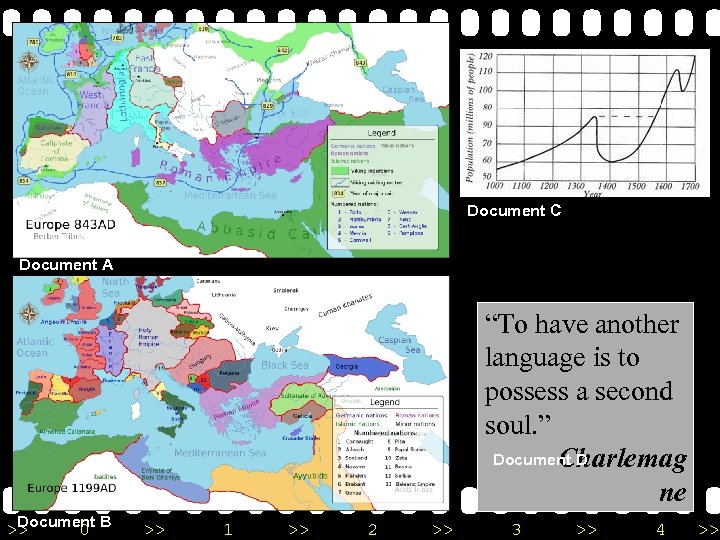 Document C Document A “To have another language is to possess a second soul. ” Document D Charlemag ne Document B >> 0 >> 1 >> 2 >> 3 >> 4 >>
 Germanic Kingdoms Merge Together Effects of Constant Invasions and Warfare • Germanic invaders overrun western Roman Empire in 400 s • Fighting disrupts trade and government; people abandon cities • Marks the beginning of the Middle Ages—period from 500 to 1500 The Decline of Learning • As cities are abandoned, level of learning declines • Knowledge of Greek language and culture is almost completely lost Loss of a Common Language • Introduction of German language changes Latin; dialects develop >> 0 >> 1 >> 2 >> 3 >> 4 >>
 Changes Government Society • Germanic kingdoms • Fighting disrupts trade replace Roman provinces and government; people abandon cities • Continual wars change borders between kingdoms • Small communities are governed by unwritten • The Church provides order rules and traditions and security • Drastic decline in learning >> 0 >> 1 >> 2 >> 3 >> 4 >>
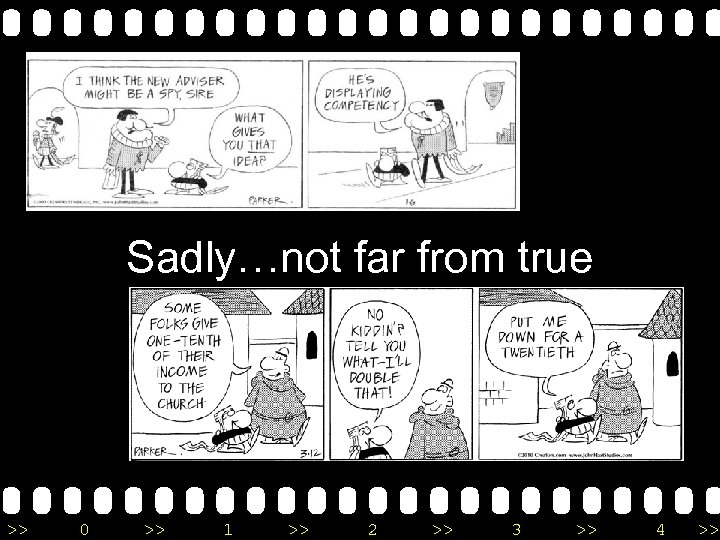 Sadly…not far from true >> 0 >> 1 >> 2 >> 3 >> 4 >>
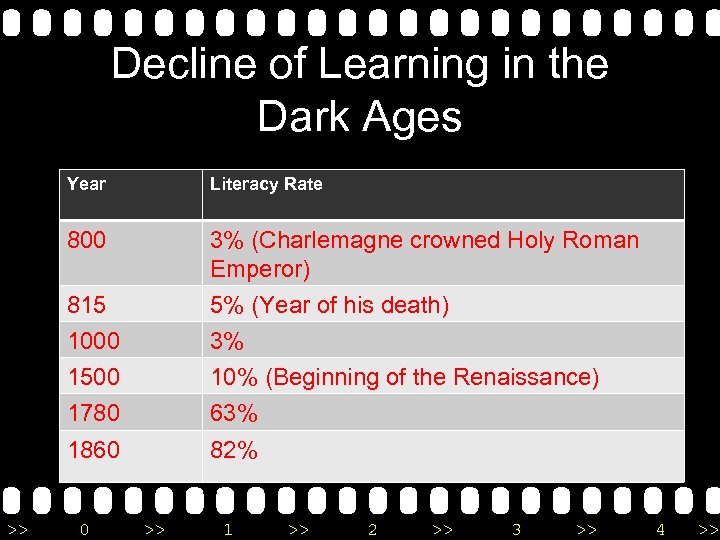 Decline of Learning in the Dark Ages Year 800 3% (Charlemagne crowned Holy Roman Emperor) 815 5% (Year of his death) 1000 3% 1500 10% (Beginning of the Renaissance) 1780 63% 1860 >> Literacy Rate 82% 0 >> 1 >> 2 >> 3 >> 4 >>
 The Progression of Leaders Who Made a Difference • Charles Martel – Leader of the Frankish people – Sees importance of a trained army – Defeats Muslims from Spain at Tours in 732; becomes a Christian hero – Son, Pepin, begins Carolingian Dynasty— family that ruled 751– 987 q Charles Martel q Pepin q Charlemagne >> 0 >> 1 >> 2 >> 3 >> 4 >>
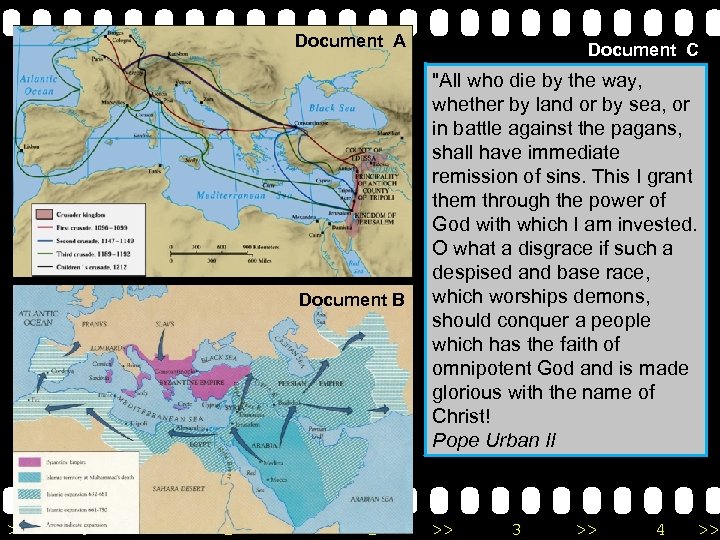 Document A Document B >> 0 >> 1 >> 2 Document C "All who die by the way, whether by land or by sea, or in battle against the pagans, shall have immediate remission of sins. This I grant them through the power of God with which I am invested. O what a disgrace if such a despised and base race, which worships demons, should conquer a people which has the faith of omnipotent God and is made glorious with the name of Christ! Pope Urban II >> 3 >> 4 >>
 The Progression of Leaders Who Made a Difference • Pepin – Continued to build strong army – Worked closely with son Charlemagne to train him to have a military mind – Pepin dies in 768, leaves kingdom to two sons; in 771 one son dies – Second son, Charlemagne (Charles the Great), rules kingdom q Charles Martel q Pepin q Charlemagne >> 0 >> 1 >> 2 >> 3 >> 4 >>
 The Progression of Leaders Who Made a Difference • Charlemagne (Charles the Great) – Unifies W. Europe – Crowed Holy Roman Emperor 800 A. D. q Charles Martel q Pepin q Charlemagne >> 0 >> 1 • Makes him the head of the church • Gives him access to the money and influence of the church >> 2 >> 3 >> 4 >>
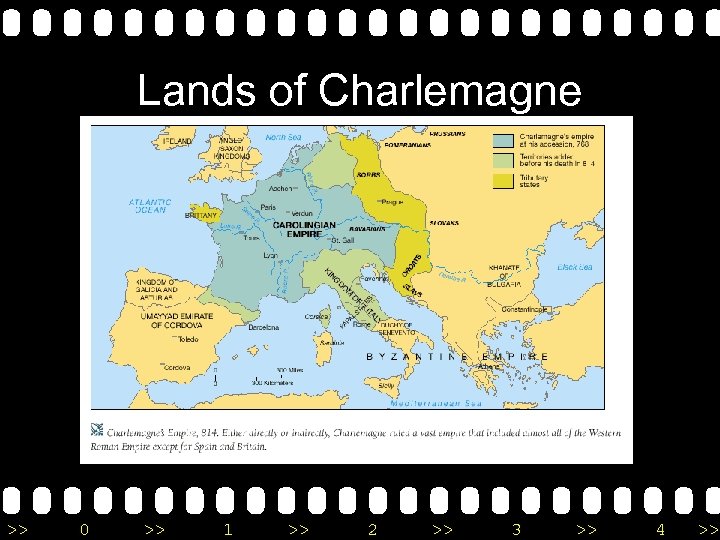 Lands of Charlemagne >> 0 >> 1 >> 2 >> 3 >> 4 >>
 The Legacy of a Great Man Changes • Created one consistent currency based on silver • Decreased the power of the nobility • All government officials were subject to inspections to ensure they weren’t abusing power >> 0 >> 1 >> • Required monasteries to open to education all, regardless of social class • Conquered land through diplomacy when possible • Military genius – Sent out cartographers to survey land before invasion – 68 successful battles in his 46 years of rule 2 >> 3 >> 4 >>
 The Legacy of a Great Man Did he earn his title of “Great”? If so Why? ? ? >> 0 >> 1 >> 2 >> 3 >> 4 >>
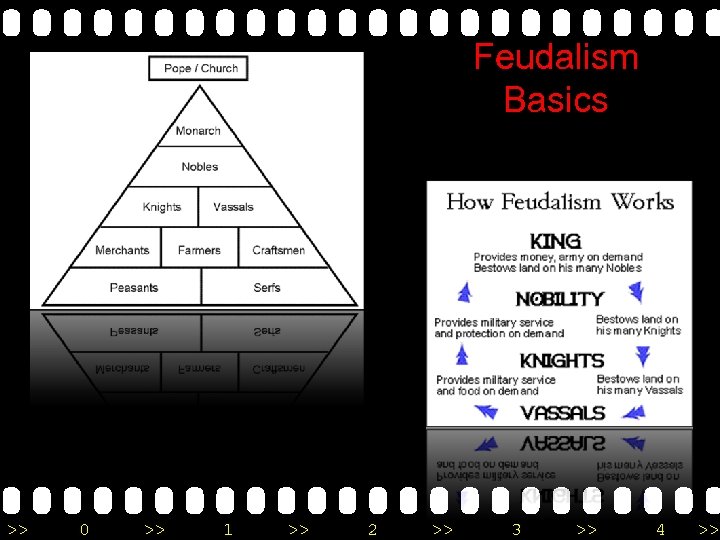 Feudalism Basics >> 0 >> 1 >> 2 >> 3 >> 4 >>
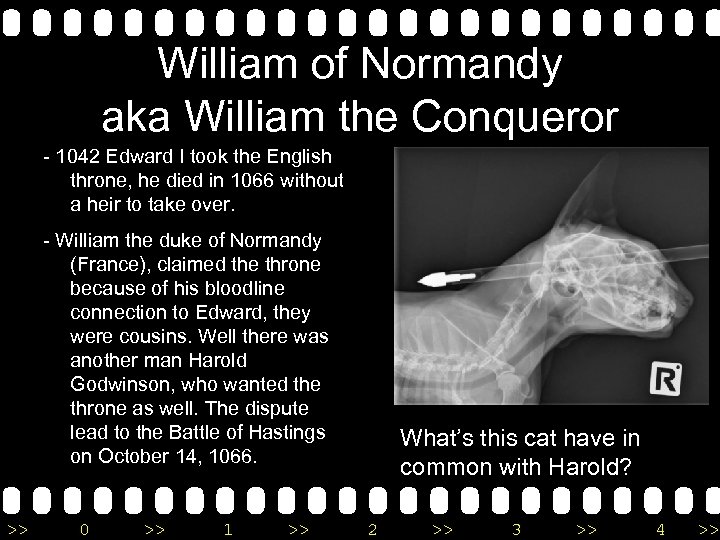 William of Normandy aka William the Conqueror - 1042 Edward I took the English throne, he died in 1066 without a heir to take over. - William the duke of Normandy (France), claimed the throne because of his bloodline connection to Edward, they were cousins. Well there was another man Harold Godwinson, who wanted the throne as well. The dispute lead to the Battle of Hastings on October 14, 1066. >> 0 >> 1 >> What’s this cat have in common with Harold? 2 >> 3 >> 4 >>
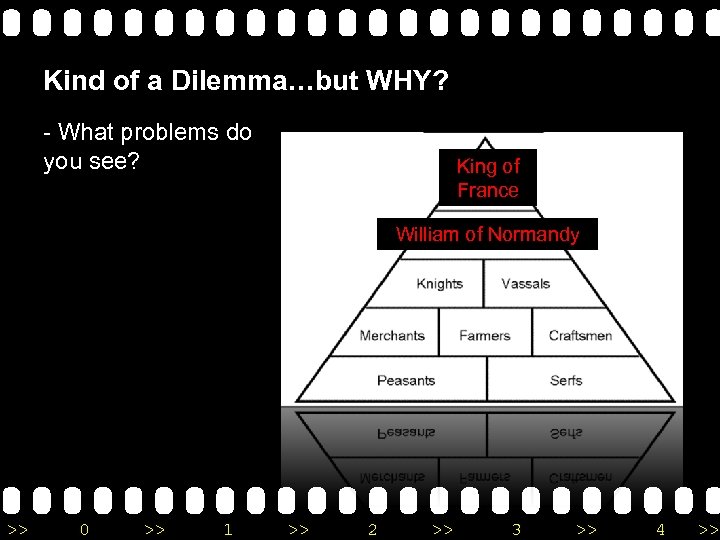 Kind of a Dilemma…but WHY? - What problems do you see? King of France William of Normandy >> 0 >> 1 >> 2 >> 3 >> 4 >>
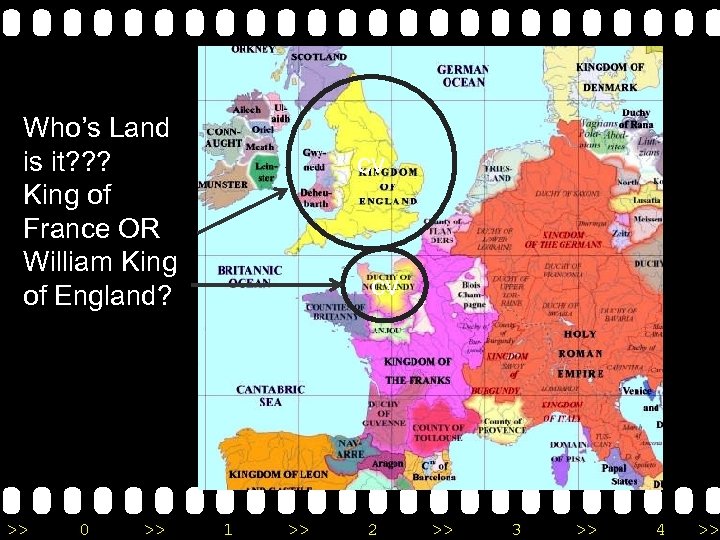 Who’s Land is it? ? ? King of France OR William King of England? >> 0 >> cv cv 1 >> 2 >> 3 >> 4 >>
 The Structure of the Church • Power within Church is organized by status; pope is supreme authority • Clergy—religious officials—includes bishops, priests, and others • Bishops supervise priests, settle Church disputes Religion as a Unifying Force • Religion important in Middle Ages; shared beliefs bond people • Clergy administers the sacraments—rites to achieve salvation • Village church is place of worship and celebration The Law of the Church • All medieval Christians expected to obey canon law—Church law • Canon law governs marriages and religious practices • Popes have power over political leaders through threat of - excommunication—banishment from Church, denial of salvation - interdiction—king’s subjects denied sacraments and services • Kings and emperors expected to obey pope’s commands >> 0 >> 1 >> 2 >> 3 >> 4 >>
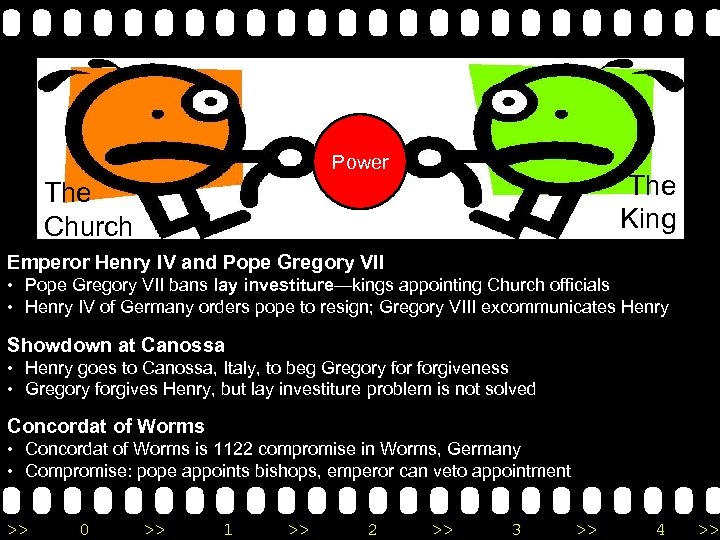 Power The King The Church Emperor Henry IV and Pope Gregory VII • Pope Gregory VII bans lay investiture—kings appointing Church officials • Henry IV of Germany orders pope to resign; Gregory VIII excommunicates Henry Showdown at Canossa • Henry goes to Canossa, Italy, to beg Gregory forgiveness • Gregory forgives Henry, but lay investiture problem is not solved Concordat of Worms • Concordat of Worms is 1122 compromise in Worms, Germany • Compromise: pope appoints bishops, emperor can veto appointment >> 0 >> 1 >> 2 >> 3 >> 4 >>
 What Problems Are Arising? • Imagine you’re a peasant living in the era of Gregory and Henry…what would make you nervous? • Why are there growing concerns with the validity of the church? • How do you feel about lay investiture? >> 0 >> 1 >> 2 >> 3 >> 4 >>
 The Lights Are Coming Back ON! Government Changes Social Changes The Magna Carta • In 1215 English nobles force King John to sign Magna Carta • Magna Carta—limits king’s power and guarantees basic political rights • English people argue the rights are for all people, not just nobles - Parliament forms in 1295 - House of Lords represent upper class - House of Commons represents working and lower class • One group who went to the Middle East during Crusades were successful…the merchants who began to reopen trade • Vernacular languages used • Banks are established = makes being a merchant safer • We see guilds emerging – Professionals in the same area – Set standards for goods and skills needed to be in guild >> 0 >> 1 >> 2 >> 3 >> 4 >>