


 Скачать презентацию The Physics Case for a Dedicated Muon EDM
978cd578325e8563e35ee5e0bfc66b42.ppt
- Количество слайдов: 33
 The Physics Case for a Dedicated Muon EDM Experiment in the Project X Era + - Lee Roberts BU (in collaboration with Jim Miller (BU), Gerco Onderwater (KVI) and Yannis Semertzidis (BNL) ) roberts @bu. edu http: //physics. bu. edu/show/roberts B. Lee Roberts, Fermilab – 9 November 2009 1
 Outline • Introduction to dipoles • search for electric dipole moments – overview – experimental considerations for a m EDM • Conclusions B. Lee Roberts, Fermilab – 9 November 2009 2
 I wish to acknowledge up front that I have borrowed heavily from articles in the new World Scientific book http: //www. worldscibooks. com/physics/7273. html Especially the articles by Czarnecki and Marciano, and Roberts, Miller and Semertzidis. Disclaimer: The physics presented here is compelling. The experimental details for m. EDM at Project X are preliminary, and illustrate the possibilities Clearly much work is needed. B. Lee Roberts, Fermilab – 9 November 2009 3
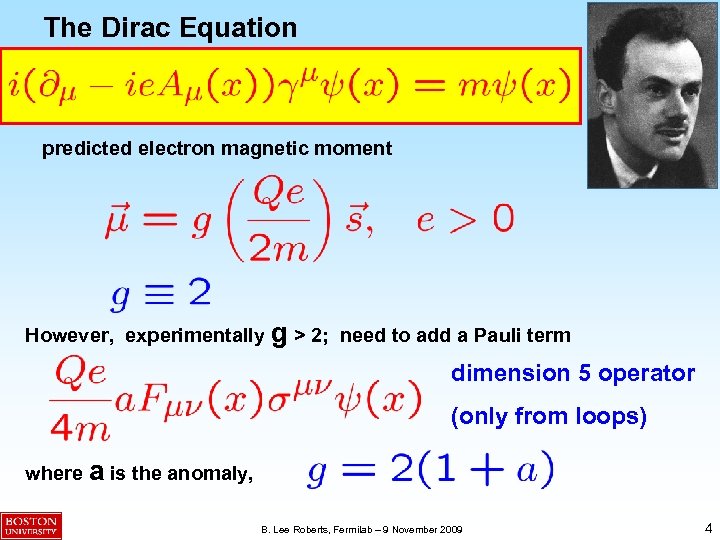 The Dirac Equation predicted electron magnetic moment However, experimentally g > 2; need to add a Pauli term dimension 5 operator (only from loops) where a is the anomaly, B. Lee Roberts, Fermilab – 9 November 2009 4
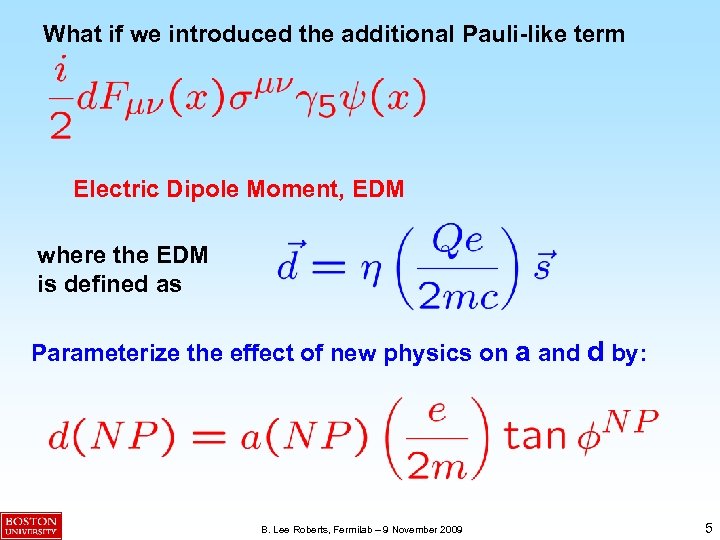 What if we introduced the additional Pauli-like term Electric Dipole Moment, EDM where the EDM is defined as Parameterize the effect of new physics on a and d by: B. Lee Roberts, Fermilab – 9 November 2009 5
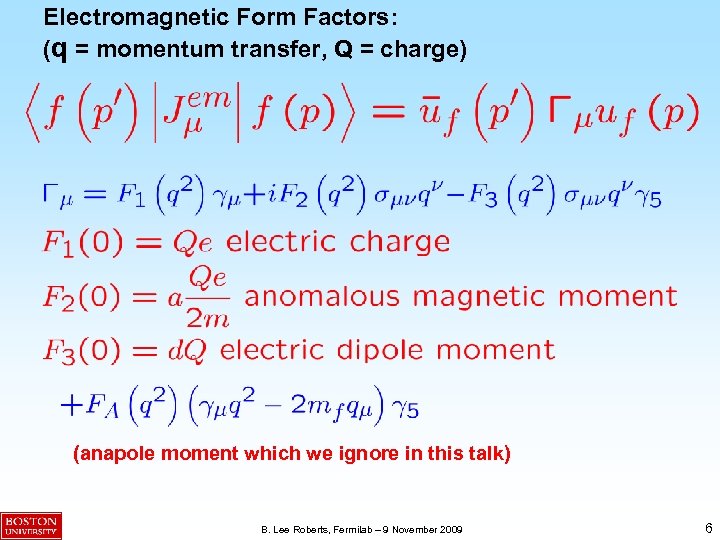 Electromagnetic Form Factors: (q = momentum transfer, Q = charge) (anapole moment which we ignore in this talk) B. Lee Roberts, Fermilab – 9 November 2009 6
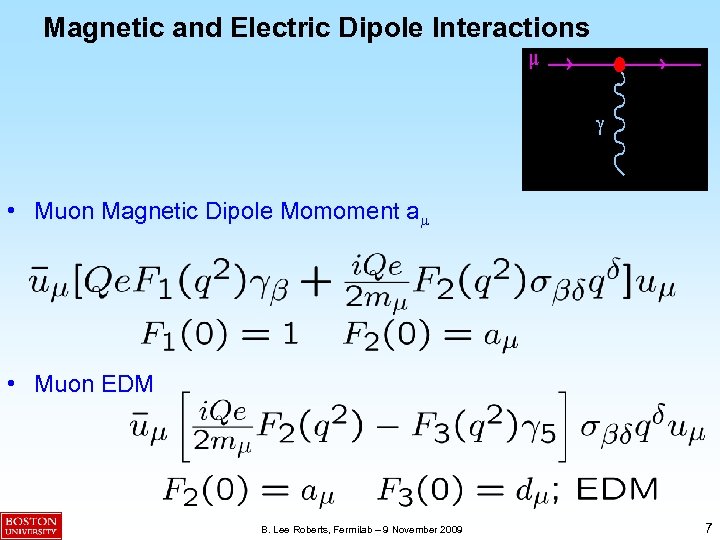 Magnetic and Electric Dipole Interactions • Muon Magnetic Dipole Momoment am • Muon EDM B. Lee Roberts, Fermilab – 9 November 2009 7
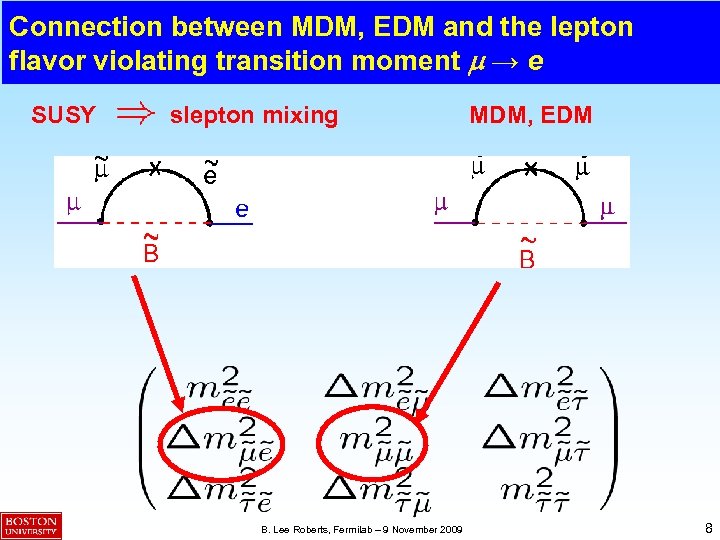 Connection between MDM, EDM and the lepton flavor violating transition moment m → e SUSY slepton mixing B. Lee Roberts, Fermilab – 9 November 2009 MDM, EDM 8
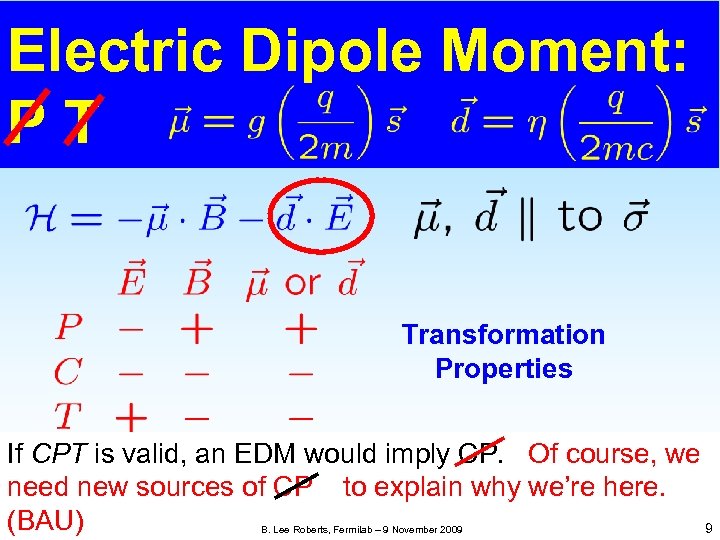 Electric Dipole Moment: PT Transformation Properties If CPT is valid, an EDM would imply CP. Of course, we need new sources of CP to explain why we’re here. (BAU) 9 B. Lee Roberts, Fermilab – 9 November 2009
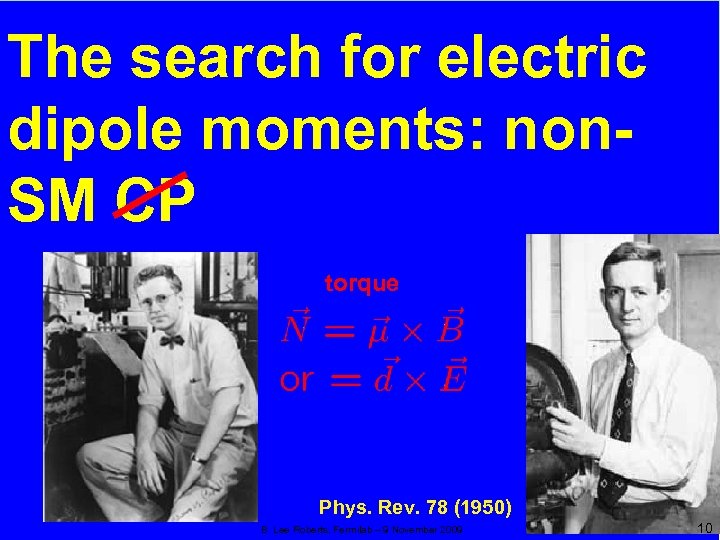 The search for electric dipole moments: non. SM CP torque Phys. Rev. 78 (1950) B. Lee Roberts, Fermilab – 9 November 2009 10
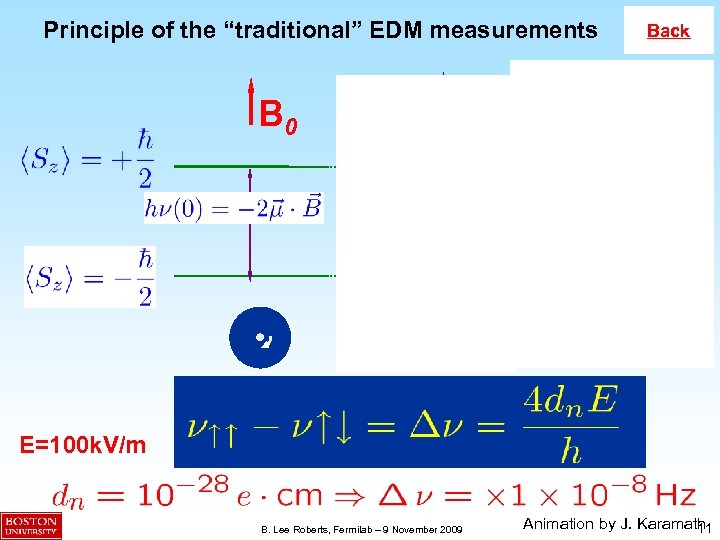 Principle of the “traditional” EDM measurements B 0 E Back B 0 E E=100 k. V/m B. Lee Roberts, Fermilab – 9 November 2009 Animation by J. Karamath 11
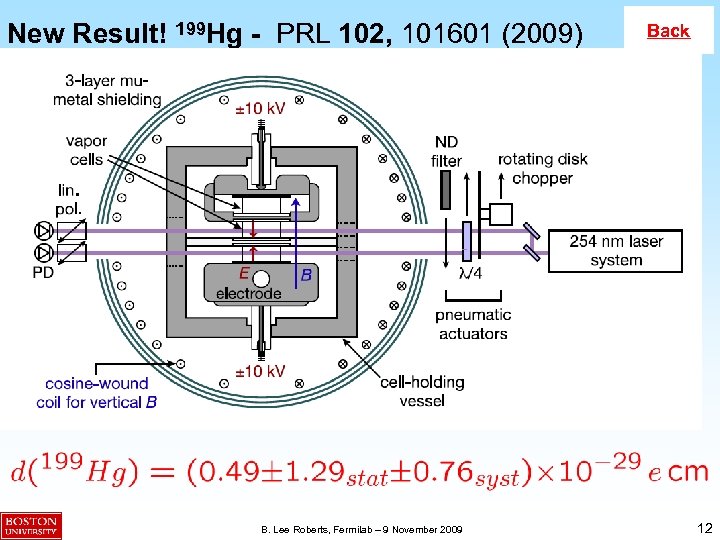 New Result! 199 Hg - PRL 102, 101601 (2009) B. Lee Roberts, Fermilab – 9 November 2009 Back 12
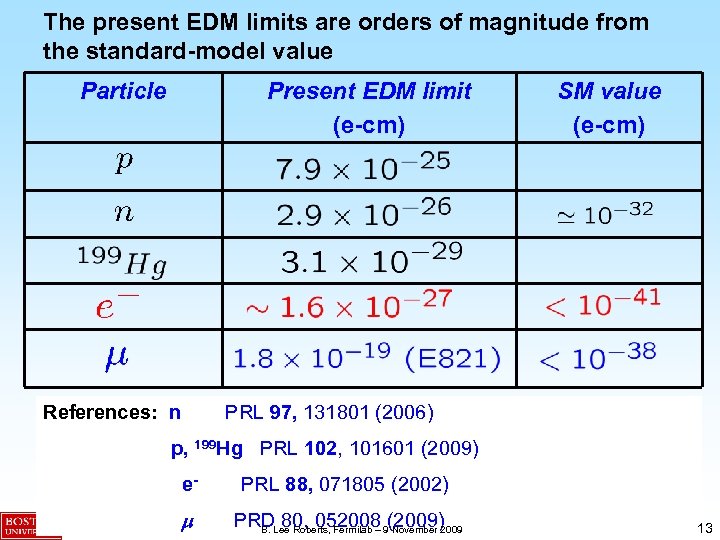 The present EDM limits are orders of magnitude from the standard-model value Particle Present EDM limit (e-cm) References: n SM value (e-cm) PRL 97, 131801 (2006) p, 199 Hg PRL 102, 101601 (2009) e- PRL 88, 071805 (2002) m PRDLee Roberts, Fermilab – 9(2009) 80, 052008 November 2009 B. 13
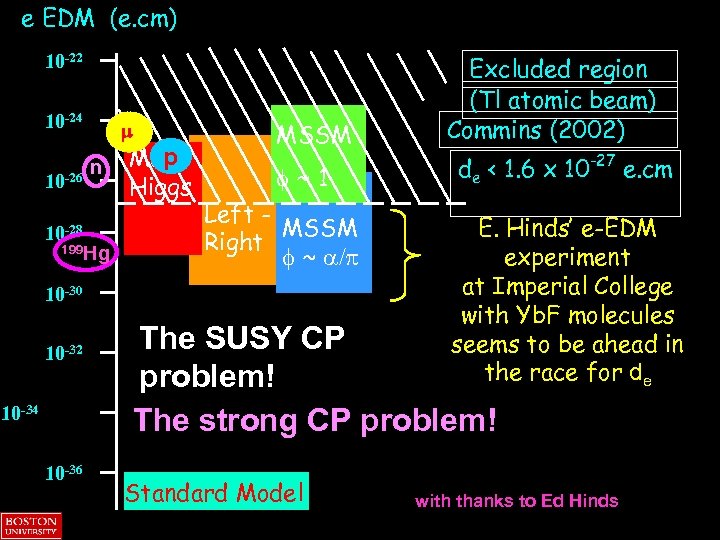 e EDM (e. cm) 10 -22 10 -24 10 -26 m n 10 -28 199 Hg p Multi Higgs MSSM f~1 Left MSSM Right f ~ a/p 10 -30 10 -32 10 -34 10 -36 Excluded region (Tl atomic beam) Commins (2002) de < 1. 6 x 10 -27 e. cm E. Hinds’ e-EDM experiment at Imperial College with Yb. F molecules seems to be ahead in the race for de The SUSY CP problem! The strong CP problem! Standard Model with thanks to Ed Hinds B. Lee Roberts, Fermilab – 9 November 2009 14
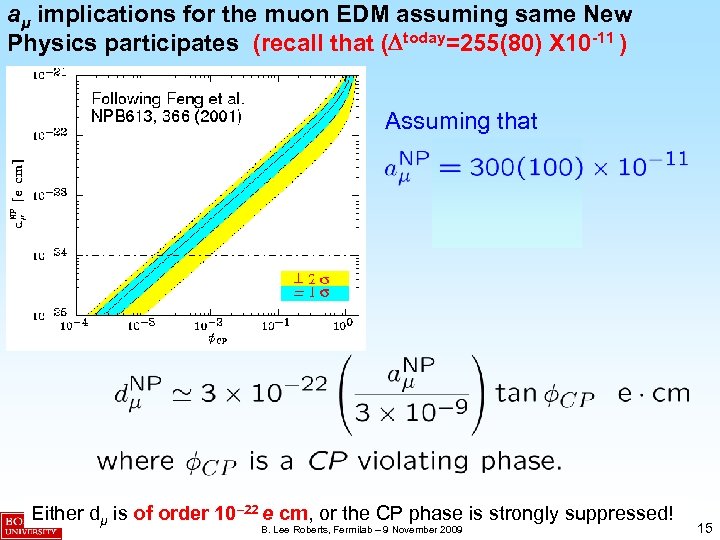 aμ implications for the muon EDM assuming same New Physics participates (recall that (Dtoday=255(80) X 10 -11 ) Assuming that Either dµ is of order 10– 22 e cm, or the CP phase is strongly suppressed! B. Lee Roberts, Fermilab – 9 November 2009 15
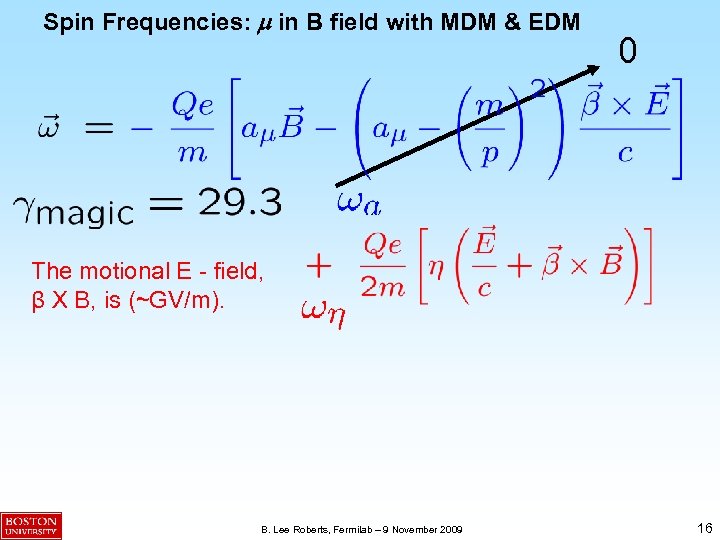 Spin Frequencies: m in B field with MDM & EDM 0 The motional E - field, β X B, is (~GV/m). B. Lee Roberts, Fermilab – 9 November 2009 16
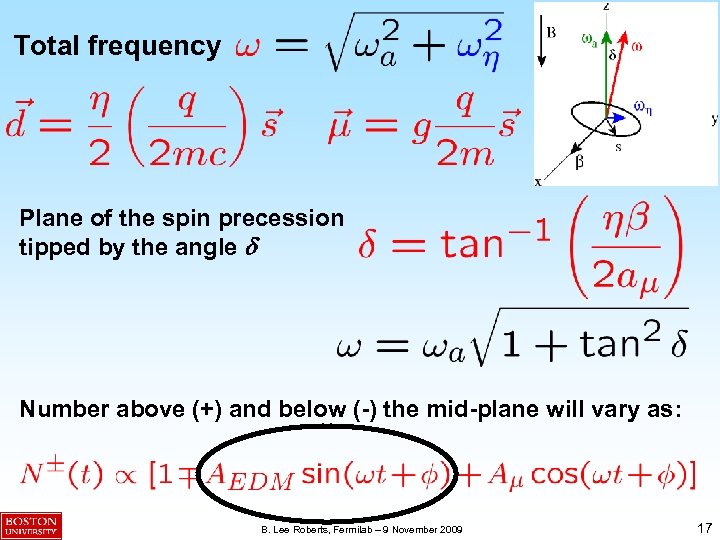 Total frequency Plane of the spin precession tipped by the angle d Number above (+) and below (-) the mid-plane will vary as: B. Lee Roberts, Fermilab – 9 November 2009 17
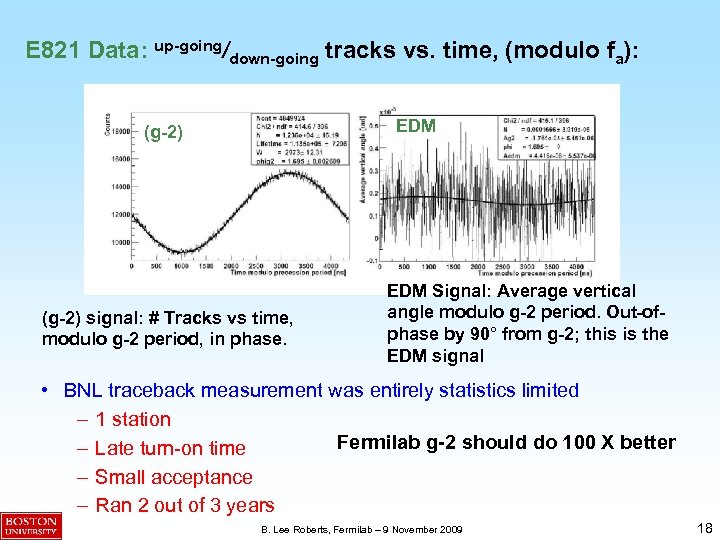 E 821 Data: up-going/down-going tracks vs. time, (modulo fa): EDM (g-2) signal: # Tracks vs time, modulo g-2 period, in phase. EDM Signal: Average vertical angle modulo g-2 period. Out-ofphase by 90° from g-2; this is the EDM signal • BNL traceback measurement was entirely statistics limited – 1 station Fermilab g-2 should do 100 X better – Late turn-on time – Small acceptance – Ran 2 out of 3 years B. Lee Roberts, Fermilab – 9 November 2009 18
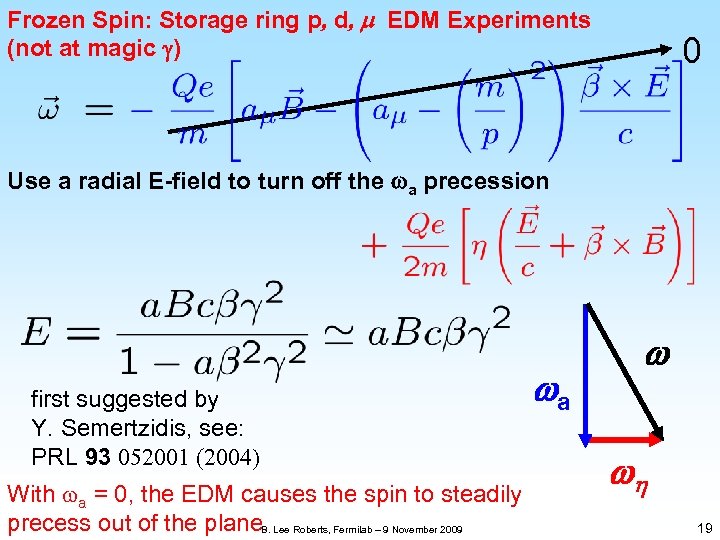 Frozen Spin: Storage ring p, d, m EDM Experiments (not at magic g) 0 Use a radial E-field to turn off the wa precession first suggested by Y. Semertzidis, see: PRL 93 052001 (2004) With wa = 0, the EDM causes the spin to steadily precess out of the plane. Lee Roberts, Fermilab – 9 November 2009 B. wa w wh 19
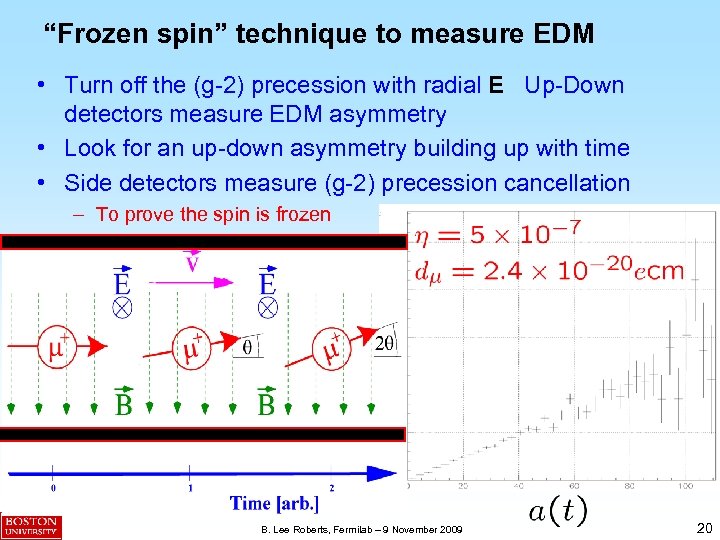 “Frozen spin” technique to measure EDM • Turn off the (g-2) precession with radial E Up-Down detectors measure EDM asymmetry • Look for an up-down asymmetry building up with time • Side detectors measure (g-2) precession cancellation – To prove the spin is frozen B. Lee Roberts, Fermilab – 9 November 2009 20
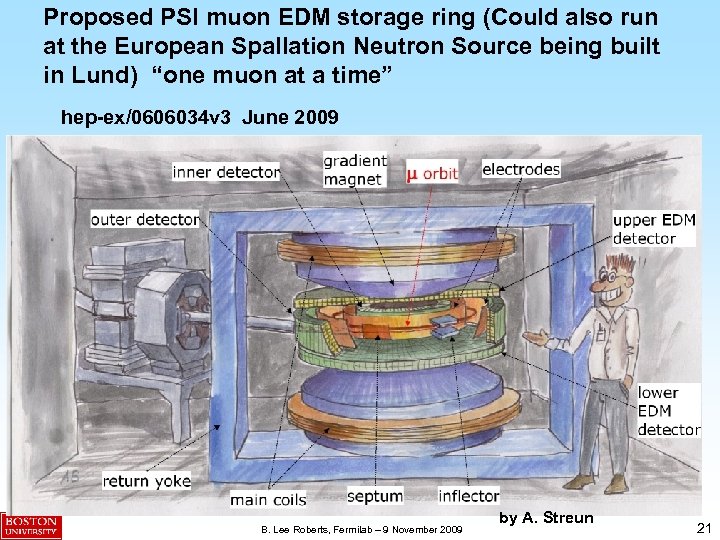 Proposed PSI muon EDM storage ring (Could also run at the European Spallation Neutron Source being built in Lund) “one muon at a time” hep-ex/0606034 v 3 June 2009 B. Lee Roberts, Fermilab – 9 November 2009 by A. Streun 21
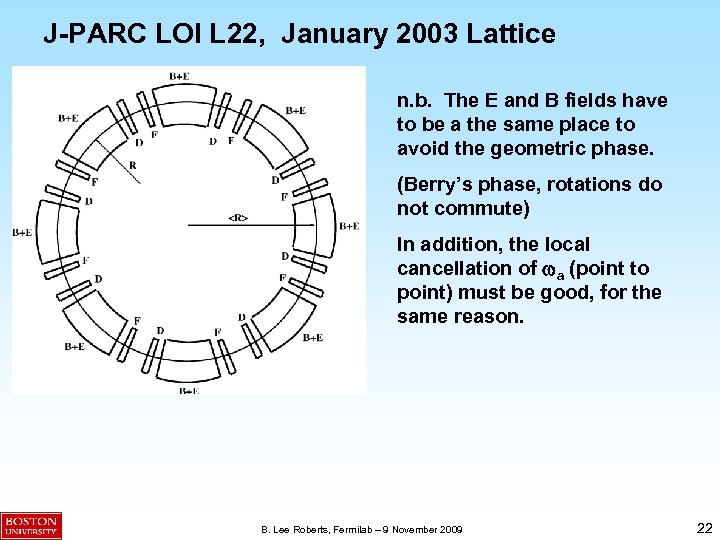 J-PARC LOI L 22, January 2003 Lattice n. b. The E and B fields have to be a the same place to avoid the geometric phase. (Berry’s phase, rotations do not commute) In addition, the local cancellation of wa (point to point) must be good, for the same reason. B. Lee Roberts, Fermilab – 9 November 2009 22
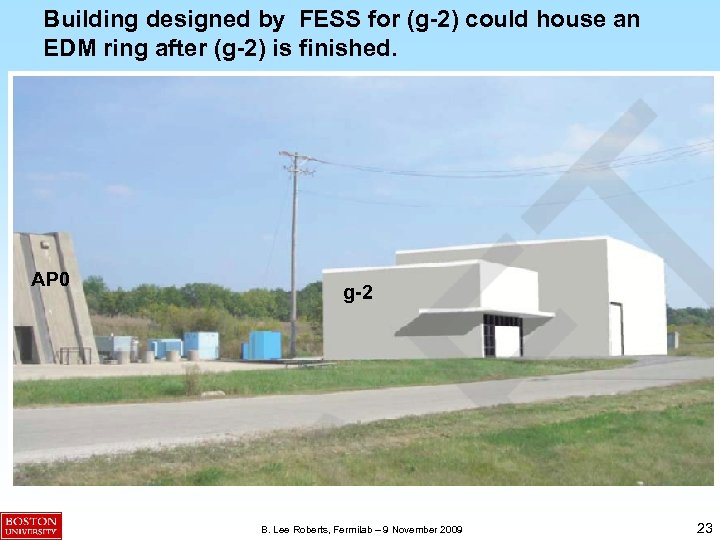 Building designed by FESS for (g-2) could house an EDM ring after (g-2) is finished. AP 0 g-2 B. Lee Roberts, Fermilab – 9 November 2009 23
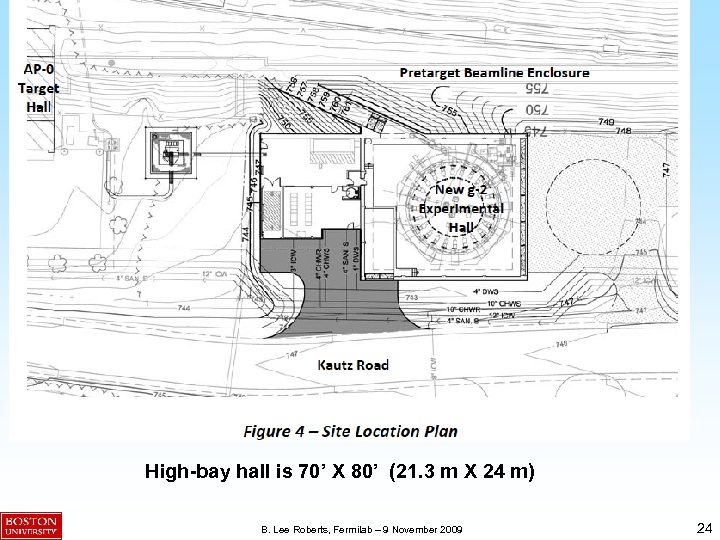 High-bay hall is 70’ X 80’ (21. 3 m X 24 m) B. Lee Roberts, Fermilab – 9 November 2009 24
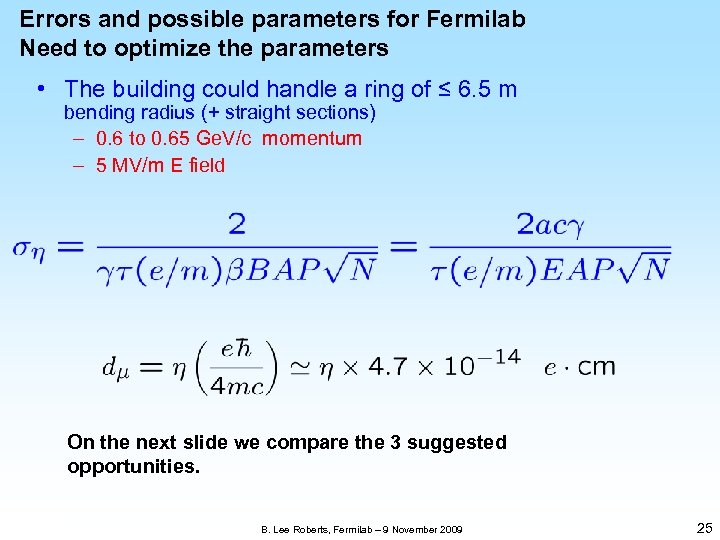 Errors and possible parameters for Fermilab Need to optimize the parameters • The building could handle a ring of ≤ 6. 5 m bending radius (+ straight sections) – 0. 6 to 0. 65 Ge. V/c momentum – 5 MV/m E field On the next slide we compare the 3 suggested opportunities. B. Lee Roberts, Fermilab – 9 November 2009 25
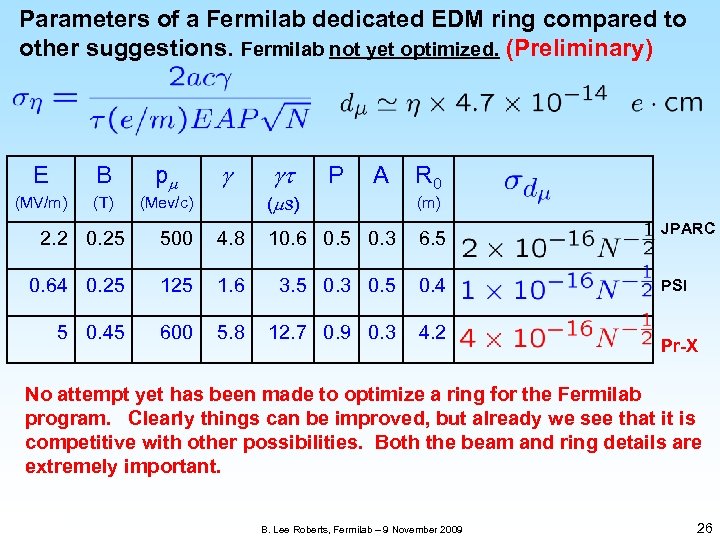 Parameters of a Fermilab dedicated EDM ring compared to other suggestions. Fermilab not yet optimized. (Preliminary) E B pm (MV/m) (T) g (Mev/c) gt P A (ms) R 0 (m) 2. 2 0. 25 500 4. 8 10. 6 0. 5 0. 3 6. 5 JPARC 0. 64 0. 25 1. 6 3. 5 0. 3 0. 5 0. 4 PSI 5 0. 45 600 5. 8 12. 7 0. 9 0. 3 4. 2 Pr-X No attempt yet has been made to optimize a ring for the Fermilab program. Clearly things can be improved, but already we see that it is competitive with other possibilities. Both the beam and ring details are extremely important. B. Lee Roberts, Fermilab – 9 November 2009 26
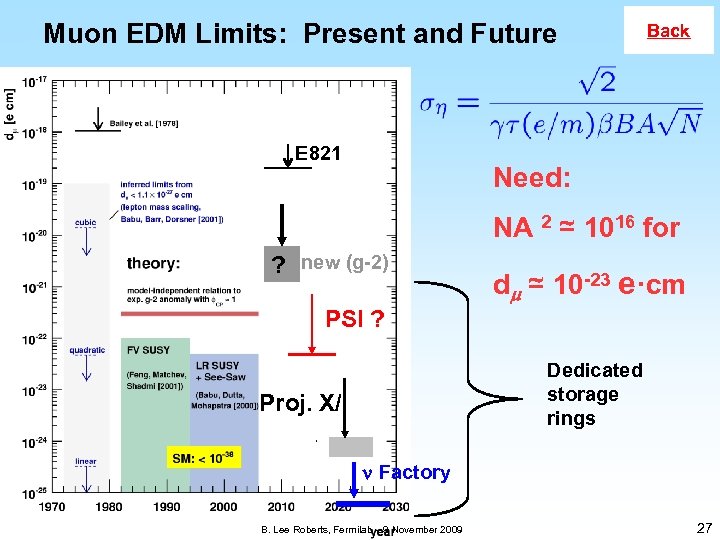 Muon EDM Limits: Present and Future E 821 Back Need: NA 2 ≃ 1016 for ? new (g-2) dm ≃ 10 -23 e·cm PSI ? Dedicated storage rings Proj. X/ n Factory B. Lee Roberts, Fermilab – 9 November 2009 27
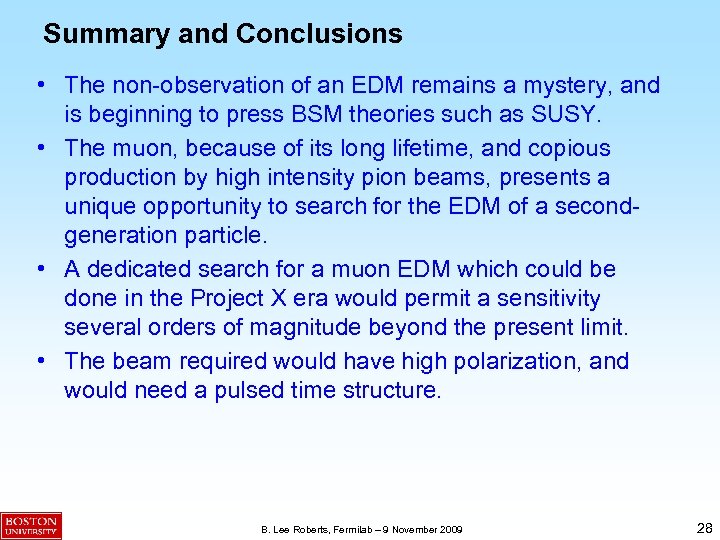 Summary and Conclusions • The non-observation of an EDM remains a mystery, and is beginning to press BSM theories such as SUSY. • The muon, because of its long lifetime, and copious production by high intensity pion beams, presents a unique opportunity to search for the EDM of a secondgeneration particle. • A dedicated search for a muon EDM which could be done in the Project X era would permit a sensitivity several orders of magnitude beyond the present limit. • The beam required would have high polarization, and would need a pulsed time structure. B. Lee Roberts, Fermilab – 9 November 2009 28
 B. Lee Roberts, Fermilab – 9 November 2009 29
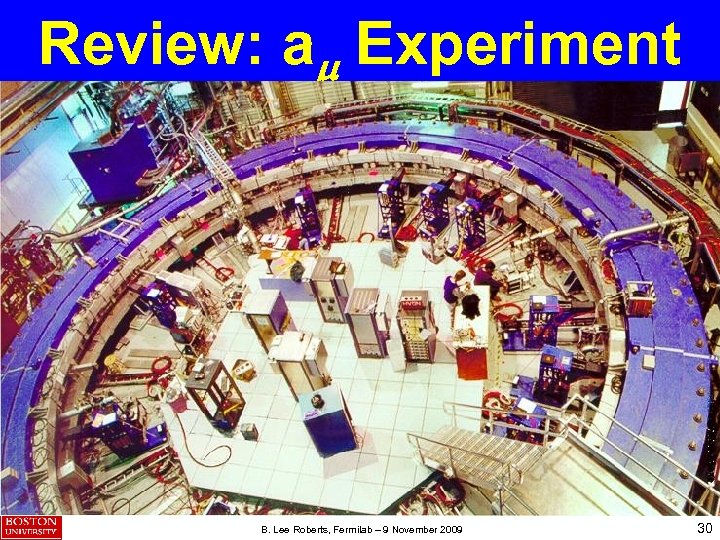 Review: am Experiment B. Lee Roberts, Fermilab – 9 November 2009 30
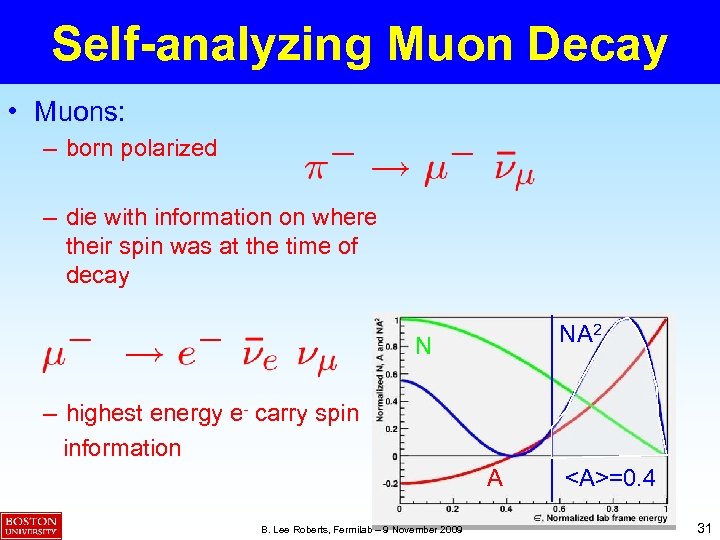 Self-analyzing Muon Decay • Muons: – born polarized – die with information on where their spin was at the time of decay NA 2 N – highest energy e- carry spin information A B. Lee Roberts, Fermilab – 9 November 2009 =0. 4 31
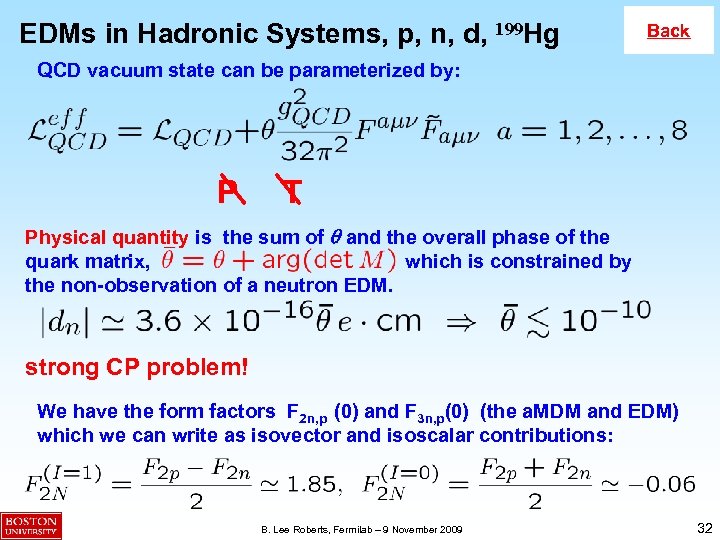 EDMs in Hadronic Systems, p, n, d, 199 Hg Back QCD vacuum state can be parameterized by: P T Physical quantity is the sum of q and the overall phase of the quark matrix, which is constrained by the non-observation of a neutron EDM. strong CP problem! We have the form factors F 2 n, p (0) and F 3 n, p(0) (the a. MDM and EDM) which we can write as isovector and isoscalar contributions: B. Lee Roberts, Fermilab – 9 November 2009 32
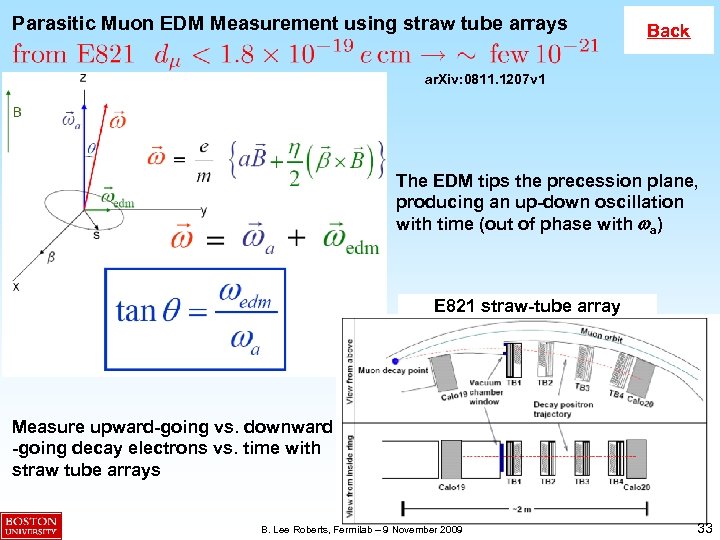 Parasitic Muon EDM Measurement using straw tube arrays Back ar. Xiv: 0811. 1207 v 1 The EDM tips the precession plane, producing an up-down oscillation with time (out of phase with wa) E 821 straw-tube array Measure upward-going vs. downward -going decay electrons vs. time with straw tube arrays B. Lee Roberts, Fermilab – 9 November 2009 33