 Скачать презентацию The Philip Crosby Philosophy on Quality Applied to
5203a667c2e9257b77da4512ce25b73c.ppt
- Количество слайдов: 56




The Philip Crosby Philosophy on Quality Applied to Software Development SPIN Montreal Feb 23, 2005 Prepared by Nicolae Giurescu
Presentation Outline • Introduction • The Four Absolutes of Quality Management • Teamwork • Measurements • Problem Analysis and Resolution • Conclusion

Introduction

“Quality is free. What costs money are the unquality things – all the actions that involve not doing jobs right the first time” Philip Crosby
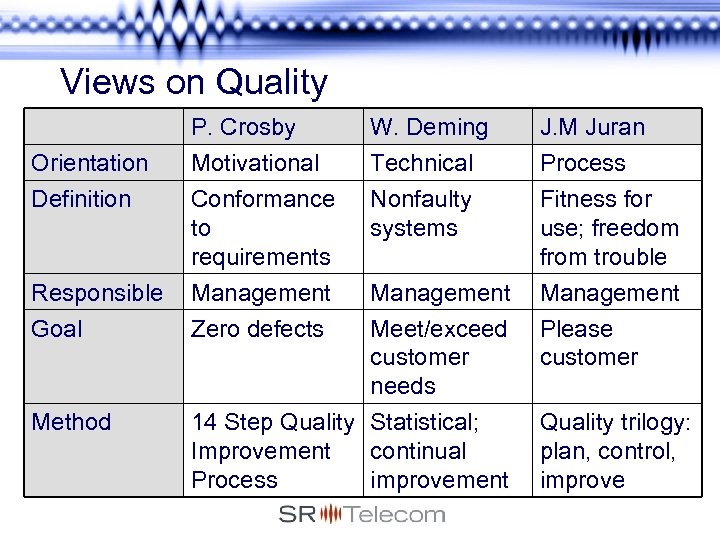
Views on Quality Orientation Definition Responsible Goal Method P. Crosby Motivational Conformance to requirements Management Zero defects W. Deming Technical Nonfaulty systems Management Meet/exceed customer needs 14 Step Quality Statistical; Improvement continual Process improvement J. M Juran Process Fitness for use; freedom from trouble Management Please customer Quality trilogy: plan, control, improve

The Four Absolutes of Quality Management

Four Absolutes of Quality Management™ 1. The definition of quality is conformance to requirements, not goodness. 2. Quality is achieved through prevention, not appraisal. 3. The quality performance standard is zero defects, not acceptable quality levels. 4. Quality is measured by the price of nonconformance, not indexes.

Process Model Worksheet PROCESS NAME PROCESS FLOW PERFORMANCE STANDARDS WHO DEFINES PROCESS OUTPUT R E Q U I R E M E N T S PROCEDURES WHO DEFINES REQUIREMENTS OUTPUTS REQUIREMENTS CUSTOMERS REQUIREMENTS WHO PROVIDES REQUIREMENTS Quality PROCESS SCOPE Cost Schedule INPUTS SUPPLIERS REQUIREMENTS Materials INITIAL ACTIVITYA Information FINAL ACTIVITYA FACILITIES & EQUIPMENT WHO PROVIDES REQUIREMENTS © Proudfoot TRAINING & KNOWLEDGE

1 st Abs: Requirements C C S Requirements • All work is a process – Personal processes – Organization’s processes • Requirements are “filters” S

1 st Abs: Identify Requirements • Sources: – – External customers; marketing; system design Quality control; validation Design standards Development process • Define: – Desired requirements – Needed requirements – Mandated requirements Implied requirements PROCESS NAME PROCESS FLOW PROCESS OUTPUT R E Q U I R E M E N T S PERFORMANCE STAND ARDS WHO DEFINES REQ UIREMENTS PR OCEDURES WHO DEFINES REQ UIREMENTS CUST OMERS REQ UIREMENTS WHO PRO VIDES REQ UIREMENTS Quality PROCESS Cost SCOPE Sc hedule INPUTS SUPPLIERS OUTPUTS REQ UIREMENTS Materials INITIAL ACTIVITYA Inf rmation o FINAL ACTIVITYA FA CILITIES & EQ UIPMENT WHO PRO VIDES © Proudfoot REQ UIREMENTS TRAINING & KNO WLEDGE

1 st Abs: Requirements Traceability • Love / hate relationship • Bi-directional traceability: – – Requirements Test cases Requirements Architectural components Requirements Design Requirements Implementation • Keep traceability matrix updated Consider using specialized tools

1 st Abs: Requirements Change • • Customers / Market Organization’s needs Technology Suppliers Government regulations Competition People Process

1 st Absolute of Quality Management Conformance to requirements Goodness

2 nd Abs: Prevention • Preventing defects to occur. • When the non-conformances are detected? – – – – Requirements review Architecture review Design review Code inspection Unit testing Integration testing Validation Process review

2 nd Abs: Planning Prevention • Establish policies for improvement – Defect-free software releases • Develop systems for preventing problems – Reviews (formal/informal; peers) – Code inspections (manual/automatic) – Process performance reviews

2 nd Abs: Implementing Prevention • Identify process scope • Four step implementation: – Define the output – Define the process (new or modified) • Take into consideration the controlling inputs: – – Facilities and equipment Training and knowledge Procedures Performance standards – Proof – Operate and manage PROCESS NAME PROCESS FLOW PROCESS OUTPUT R E Q U I R E M E N T S PERFORMANCE STAND ARDS WHO DEFINES REQ UIREMENTS PR OCEDURES WHO DEFINES REQ UIREMENTS CUST OMERS REQ UIREMENTS WHO PRO VIDES REQ UIREMENTS Quality PROCESS Cost SCOPE Sc hedule INPUTS SUPPLIERS OUTPUTS REQ UIREMENTS Materials INITIAL ACTIVITYA Inf rmation o FINAL ACTIVITYA FA CILITIES & EQ UIPMENT WHO PRO VIDES © Proudfoot REQ UIREMENTS TRAINING & KNO WLEDGE

2 nd Abs: Proof • Often skipped due to lack of time or overconfidence • Steps: – Define criteria for success – Perform process trial – Evaluate process outcome

2 nd Abs: Operate and Manage Process with Requirement Measurement Process Control Action Comparison © Proudfoot

2 nd Absolute of Quality Management Prevention Appraisal

3 rd Abs: Performance Standards • Type: – Quality – Schedule – Cost • Who defines – Management • Requirements – Meeting requirements – On-time – Within budget

3 rd Abs: That’s Close Enough vs. ZD • That’s close enough – Acceptable percent nonconforming < 10% known problems still not solved – Acceptable non-conformances per unit < 10 major defects per software component – Acceptable non-conformances per time unit < 10 system crash per year • Zero defects: a personal commitment – Understand the process and product requirements – Work to meet them – Recognize and expose the non-conformances

3 rd Absolute of Quality Management Zero defects Close enough

4 th Abs: Measuring Quality Costs • Get management attention • Prioritize problems • Show improvement

4 th Abs: Price of Nonconformance Error-Free Costs Price of Conformance What it costs to get things done right the first time Price of Nonconformance

4 th Abs: Calculation Techniques • Whole account – Warranty costs • Whole person – Maintenance team • Labor/resource claiming – Debugging • Unit pricing – Average cost to solve a defect • Deviation from the ideal

4 th Abs: Collecting Data • Gather actual expenditures • Use surveys • Include ripple costs

4 th Absolute of Quality Management Price of nonconformance Indexes

Teamwork

Working on Teams • Advantages – More knowledge and skills – Better communication – Different approaches to challenges (e. g. problems) • Disadvantages – Commitment of time and money – Presence of “strong” personalities • Imposing decisions without considering alternatives • Not supporting team decisions

Team Design • Type of teams – Life span: temporary, permanent – Function: department, project, QIT – Skills: specialized, cross-functional • Leadership skills • Member selection • Member education

Team Meetings • Mechanics – Agenda / minutes – Meeting procedure • Clear objectives, preparation • Consensus • Conflict resolution – Action assignment • Environment – Listening – Openness / trust

Better Teams Foster Trust Facts and information Ideas Feelings and values Trust

Measurements

Measure a Process to Improve PROCESS NAME PROCESS FLOW PERFORMANCE STANDARDS WHO DEFINES PROCESS OUTPUT R E Q U I R E M E N T S PROCEDURES WHO DEFINES REQUIREMENTS OUTPUTS REQUIREMENTS CUSTOMERS REQUIREMENTS WHO PROVIDES REQUIREMENTS Quality PROCESS SCOPE Cost Schedule INPUTS SUPPLIERS REQUIREMENTS Materials INITIAL ACTIVITYA Information FINAL ACTIVITYA FACILITIES & EQUIPMENT WHO PROVIDES REQUIREMENTS © Proudfoot TRAINING & KNOWLEDGE

Measurement System • Identify – Start with identified problems and their root cause – Learn from others Identify correlations • Record – Use dedicated tools (buy/make) – Determine correct sampling time • Communicate – Reports, management briefings – Use charts

Charts

Measurements: Product Defects • Identify and record defects – “Traditionally” during maintenance (reactive) • Identified during validation testing • Recorded into a formal defect database • Eliminated by maintenance, not development team – During requirement reviews (proactive) – During development (proactive) • Identified during design reviews, code inspections, unit testing and (partial) integration testing

Collect Defect Data • Record defects into dedicated databases • Defect record – State machine • States • Transition rights – Fields • • • When and where was found, and by whom Heading, description, what release, … Severity, priority Resolution, workaround, review comments, … Who worked on it Root cause


Reporting Defects, Based On… • Selected characteristics: – Number of defects per severity/priority levels • Distribution: – Number of defects per component • Root cause: – Number of defects per root cause class • Dynamics: – Number of defects submitted, closed, …, per time unit • Combinations of criteria

Measurements: Product Design (OO) • Number of model elements – Gives info on size, evolution • Size of model elements – Lines of code, number of functions, … • Level of complexity – Levels of inheritance – Levels of coupling • Number of changes – Gives info on component stability

Measurements: Product Verification • Review – Number of reviews per component – Number of defects / changes identified per review • Testing (unit, integration, validation) – Number of tests that failed / passed • Test plans – Number of completely specified test cases – Number of tests

Measurements: Project Schedule • Size: – Number of tasks, number of resources, duration • Tasks: – Number of tasks experiencing delays – Number of new tasks per time unit – Number of tasks on the critical path • Resources: – Number of over / under allocated resources – Number of unavailable resources

Problem Analysis and Resolution

Eliminating Non-conformances • Define the problem – Focus on data; determine PONC, not cause, not blame • Quick fix (not a permanent solution) • Identify the root cause(s) – Threads of similarities – Opportunities for error – Cause and effect diagram • Identify solution and take corrective action – Generate, select, plan, implement • Evaluate and follow up – Reviews, surveys, audits

Cause and Effect Diagram Inputs (Material) Performance Standards Procedures EFFECT Inputs (Information) Facilities & Equipment Training & Knowledge

Pareto Analysis

Broken Traceability Matrix • Problem: X % of bad links from requirements to design in subsequent documentation baselines • Quick fix: verify all and correct bad links • Root causes: – Links to old versions – Lack of time to properly update the traceability • Solution – Migrate from Word to DOORS – Store in the same database all engineering specs

“Forgotten” Requirement Changes • Problem: X% of requirement changes not reflected into the design and test cases • Quick fix: – Rework if possible – Report the change to future versions • Root causes: – Changes not communicated – Changes occurred to late to be considered • Solution: Automatic e-mail notification Joint requirement reviews

No Builds are Alike • Problem: Building the same version from different computers gives different results • Quick fix: – Define standard development environment – Audit environment on all development computers • Root causes: – Different versions of the development tools – Development tools installed with different options – “Local” environment variables • Solution: Recreate the standard environment for every build

Unmanaged Defect Reports • Problem: defects discovered during the development phase were solved in an ad-hoc way • Quick fix: none considered • Root causes: – No system to manage defects during development • Solution: Start managing defects during development, same way as during maintenance

Being Late • Problem: X% of missed schedule milestones • Quick fix: – Revised schedule • Root causes: Imposed schedule milestones – Ever changing WBS – Wrong task estimations – Insufficient resources • Solution: Incremental integration and development plan

Conclusion

Individual’s Role in Quality Improvement • Motivation – Respond to organization’s need and commitment to improve – Fulfill individual need and commitment to improve • Actions – – – Take requirements and quality improvement seriously Have long-term objectives Seek agreement on objectives Set specific, measurable goals Develop schedules Take action
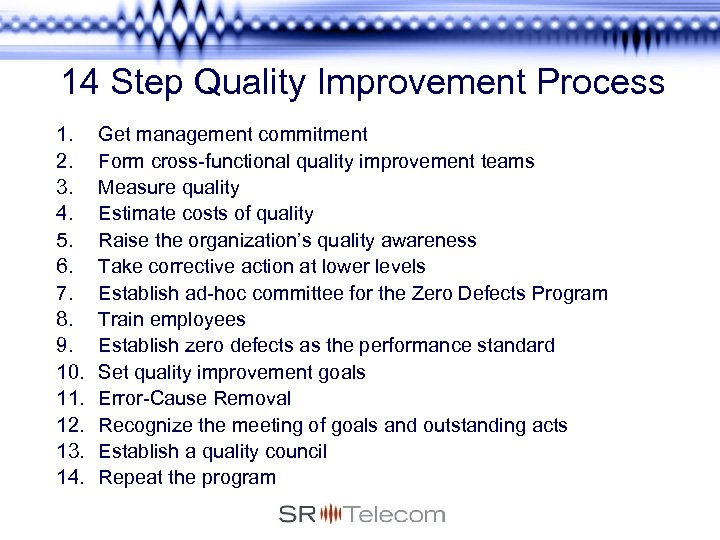
14 Step Quality Improvement Process 1. 2. 3. 4. 5. 6. 7. 8. 9. 10. 11. 12. 13. 14. Get management commitment Form cross-functional quality improvement teams Measure quality Estimate costs of quality Raise the organization’s quality awareness Take corrective action at lower levels Establish ad-hoc committee for the Zero Defects Program Train employees Establish zero defects as the performance standard Set quality improvement goals Error-Cause Removal Recognize the meeting of goals and outstanding acts Establish a quality council Repeat the program

Thank you!
Скачать презентацию The Philip Crosby Philosophy on Quality Applied to
5203a667c2e9257b77da4512ce25b73c.ppt