 Скачать презентацию The Periodic Table and Some Atomic Properties
Inorganic_2.ppt
- Количество слайдов: 34



The Periodic Table and Some Atomic Properties
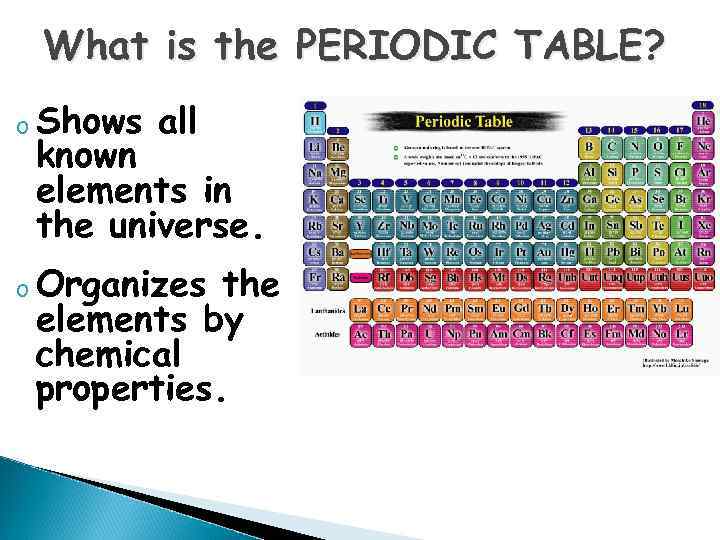
What is the PERIODIC TABLE? o Shows all known elements in the universe. o Organizes the elements by chemical properties.
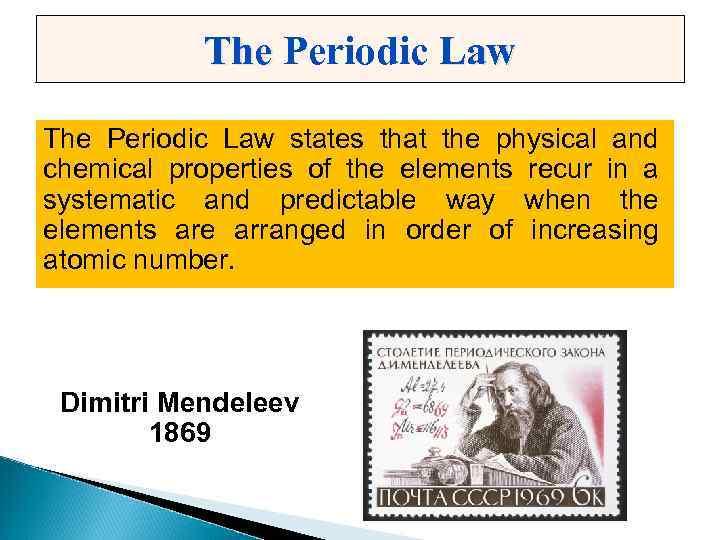
The Periodic Law states that the physical and chemical properties of the elements recur in a systematic and predictable way when the elements are arranged in order of increasing atomic number. Dimitri Mendeleev 1869
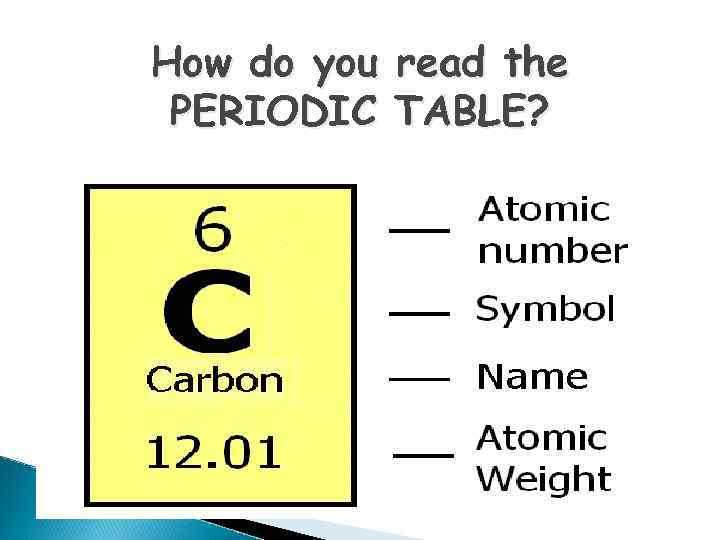
How do you read the PERIODIC TABLE?
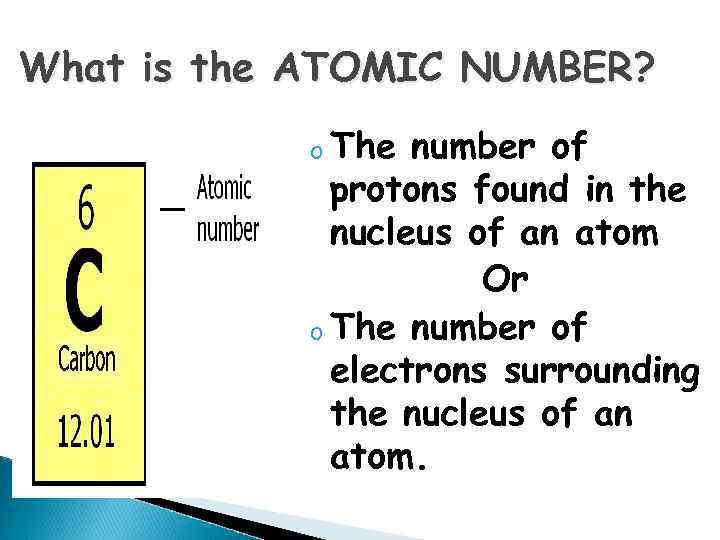
What is the ATOMIC NUMBER? o The number of protons found in the nucleus of an atom Or o The number of electrons surrounding the nucleus of an atom.
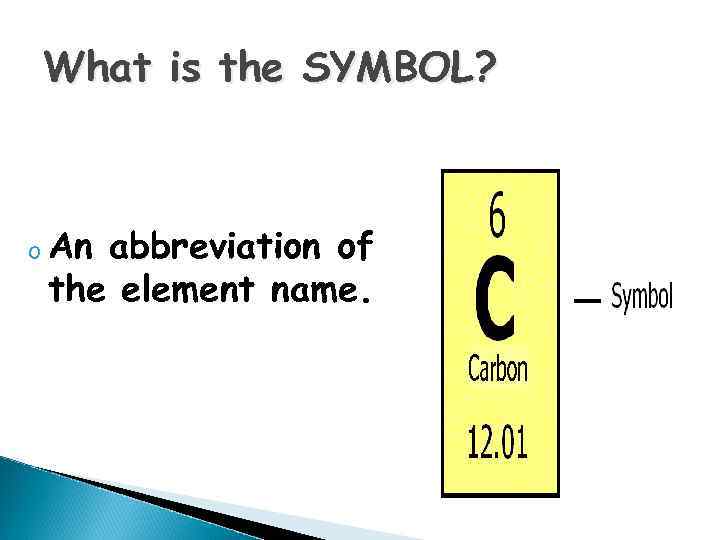
What is the SYMBOL? o An abbreviation of the element name.
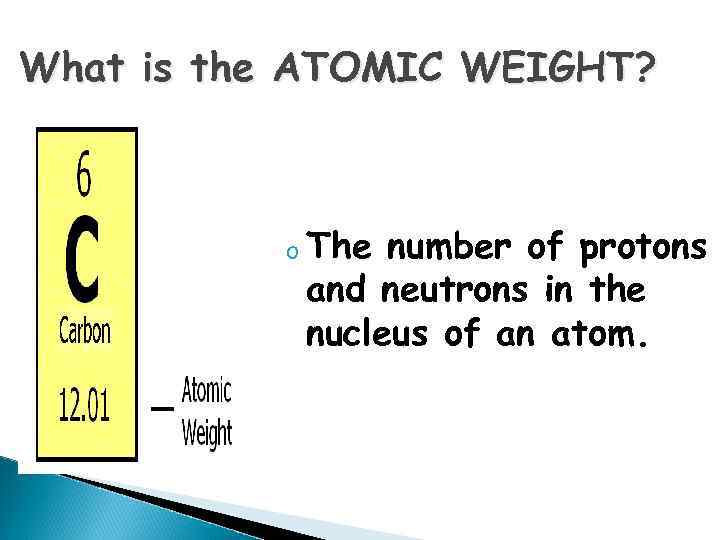
What is the ATOMIC WEIGHT? o The number of protons and neutrons in the nucleus of an atom.
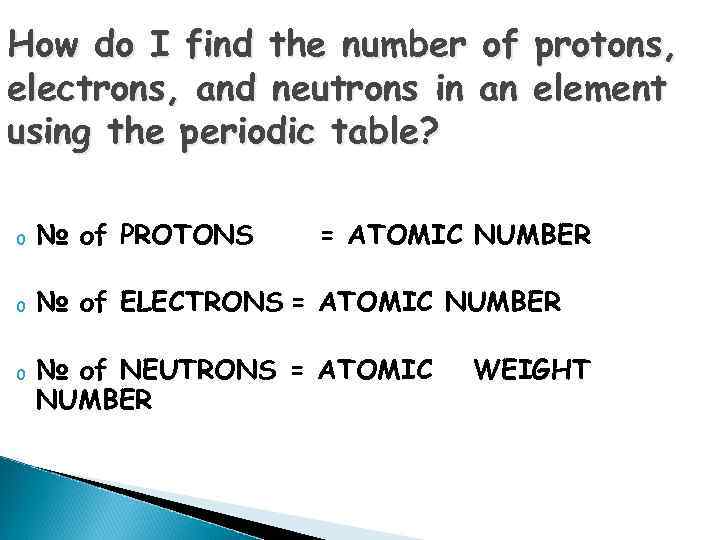
How do I find the number of protons, electrons, and neutrons in an element using the periodic table? o № of PROTONS = ATOMIC NUMBER o № of ELECTRONS = ATOMIC NUMBER o № of NEUTRONS = ATOMIC NUMBER WEIGHT
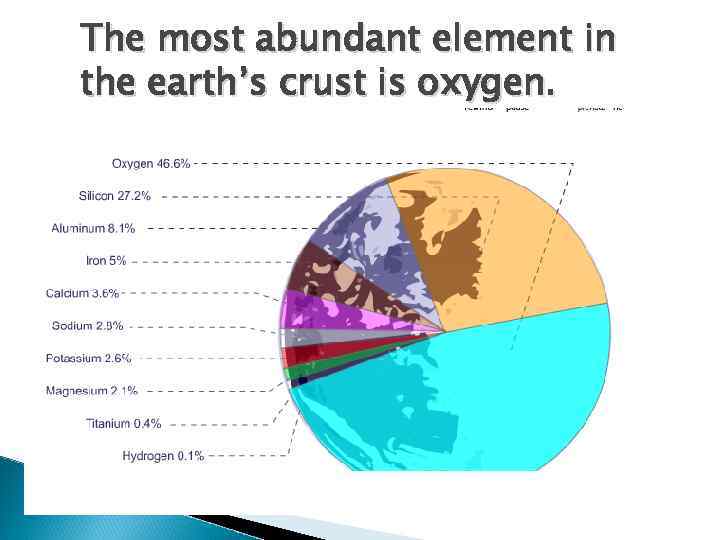
The most abundant element in the earth’s crust is oxygen.
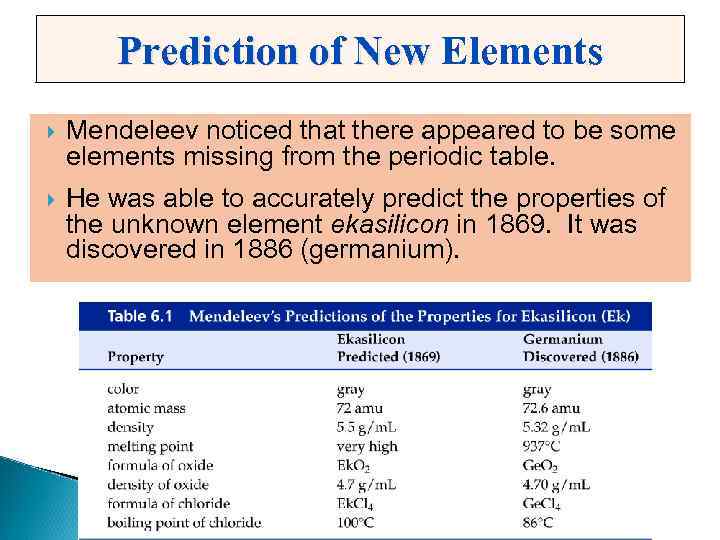
Prediction of New Elements Mendeleev noticed that there appeared to be some elements missing from the periodic table. He was able to accurately predict the properties of the unknown element ekasilicon in 1869. It was discovered in 1886 (germanium).
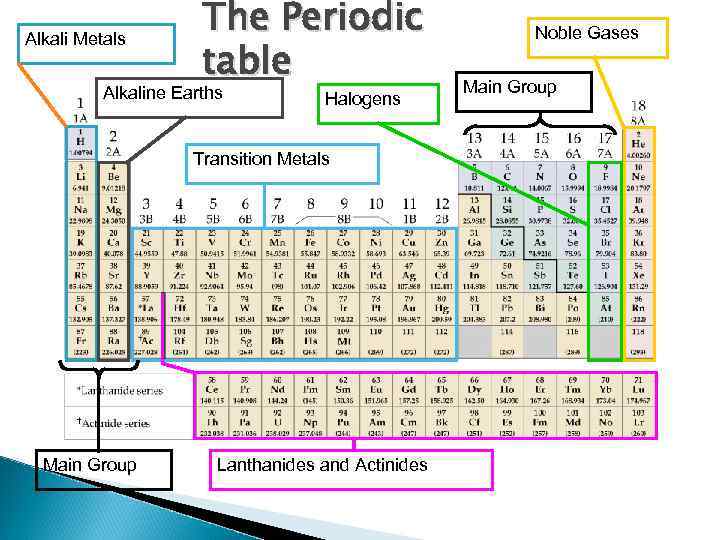
Alkali Metals The Periodic table Alkaline Earths Halogens Transition Metals Main Group Lanthanides and Actinides Noble Gases Main Group
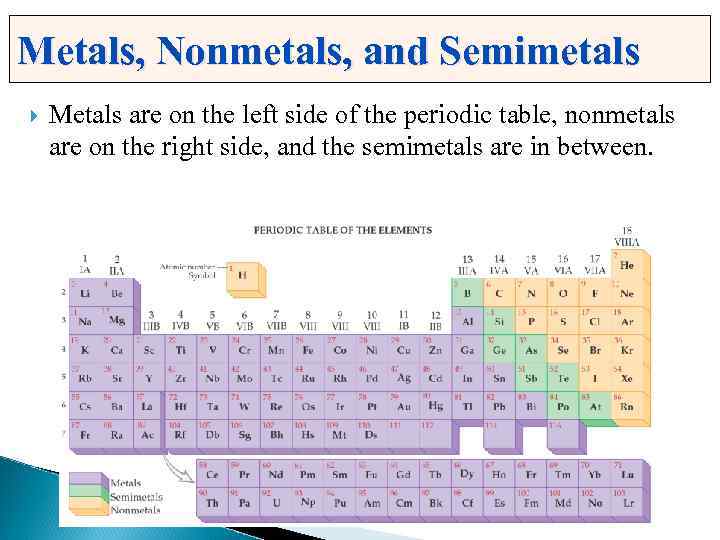
Metals, Nonmetals, and Semimetals Metals are on the left side of the periodic table, nonmetals are on the right side, and the semimetals are in between.
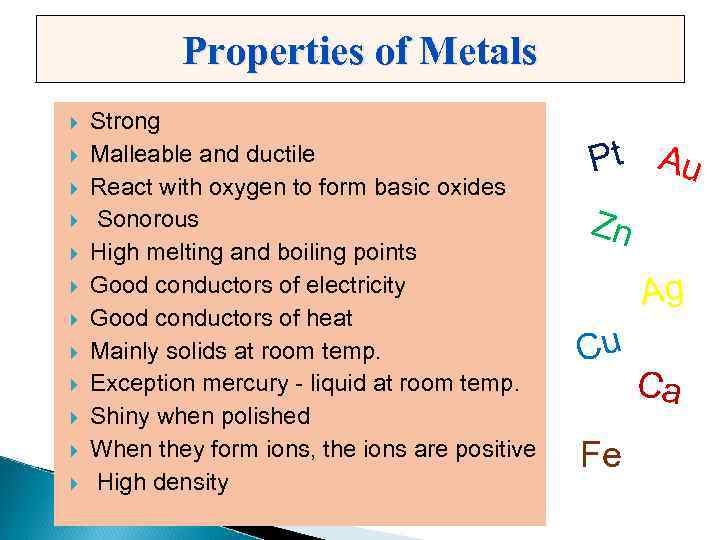
Properties of Metals Strong Malleable and ductile React with oxygen to form basic oxides Sonorous High melting and boiling points Good conductors of electricity Good conductors of heat Mainly solids at room temp. Exception mercury - liquid at room temp. Shiny when polished When they form ions, the ions are positive High density Pt Au Zn Ag Cu Fe Са
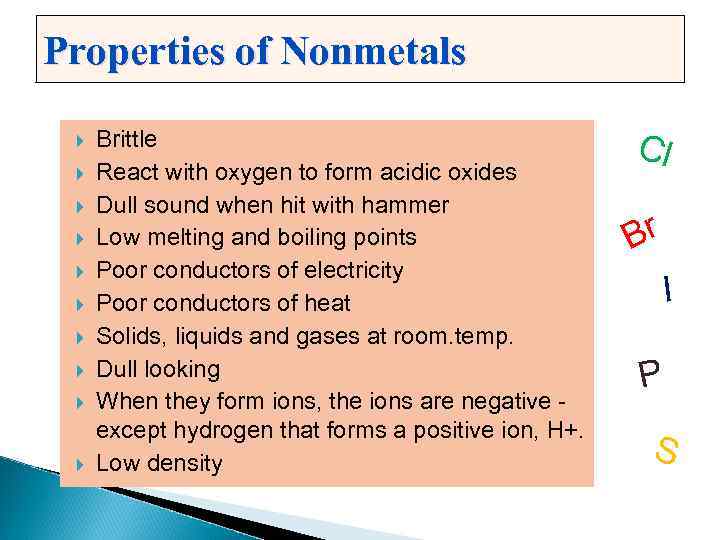
Properties of Nonmetals Brittle React with oxygen to form acidic oxides Dull sound when hit with hammer Low melting and boiling points Poor conductors of electricity Poor conductors of heat Solids, liquids and gases at room. temp. Dull looking When they form ions, the ions are negative - except hydrogen that forms a positive ion, H+. Low density Cl Br I P S
The Noble Gases The periodic table was expanded by one group at the far right of the periodic table with the discovery of argon in 1894. Helium, neon, krypton, xenon, and radon were subsequently discovered in the next 5 years. They were originally called the inert gases. Recently, several compounds of xenon and krypton have been made and the term noble gases is currently used.
Groups & Periods of Elements A vertical column on the periodic table is a group or family of elements. A horizontal row on the periodic table is a period or series of elements. There are 18 groups and 7 periods on the periodic table.
Periods on the Periodic Table The 7 periods are labeled 1 through 7. The first period has only 2 elements, H and He. The second and third periods have 8 elements each: ◦ Li through Ne and Na through Ar The fourth and fifth periods each have 18 elements: ◦ K through Kr and Rb through Xe

Hydrogen on the Periodic Table Hydrogen occupies a special position on the periodic table. It is a gas with properties similar to nonmetals. It also reacts by losing one electron, similar to metals. We will place hydrogen in the middle of the periodic table to recognize its unique behavior.
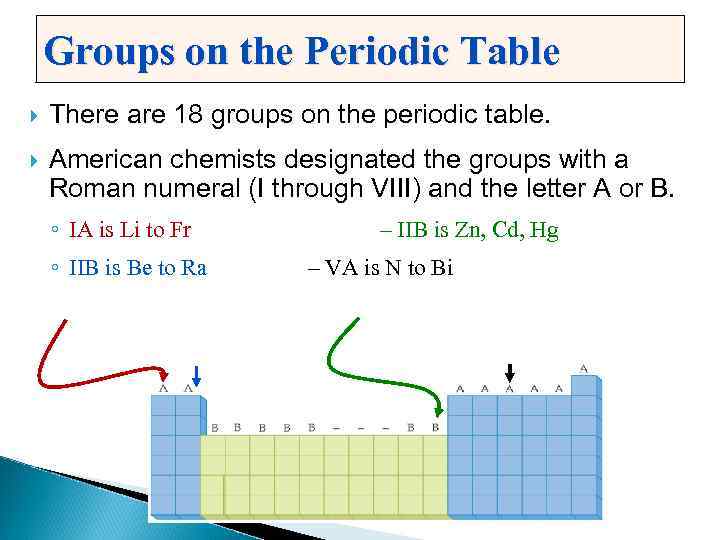
Groups on the Periodic Table There are 18 groups on the periodic table. American chemists designated the groups with a Roman numeral (I through VIII) and the letter A or B. ◦ IA is Li to Fr ◦ IIB is Be to Ra – IIB is Zn, Cd, Hg – VA is N to Bi
Groupings of Elements There are several groupings of elements. The representative elements or main-group elements, are in the A groups (groups 1, 2, and 12 – 18). The transition elements are in the B groups (groups 3 – 12). The inner transition elements are found below the periodic table. They are also referred to as the rare earth elements.
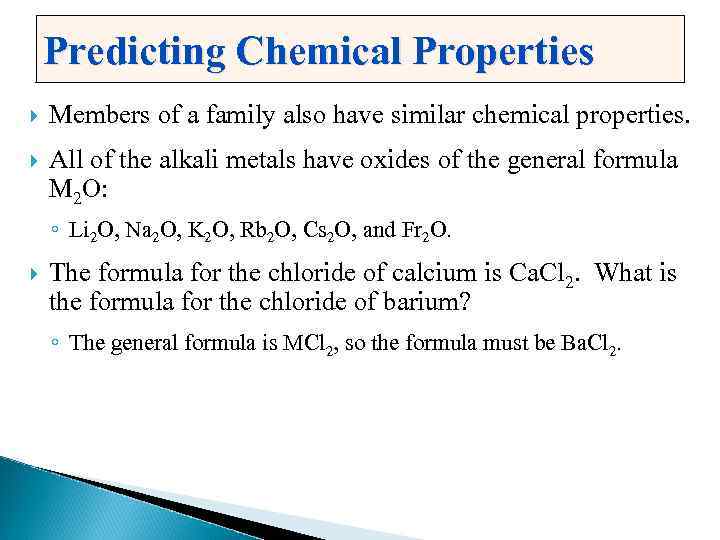
Predicting Chemical Properties Members of a family also have similar chemical properties. All of the alkali metals have oxides of the general formula M 2 O: ◦ Li 2 O, Na 2 O, K 2 O, Rb 2 O, Cs 2 O, and Fr 2 O. The formula for the chloride of calcium is Ca. Cl 2. What is the formula for the chloride of barium? ◦ The general formula is MCl 2, so the formula must be Ba. Cl 2.
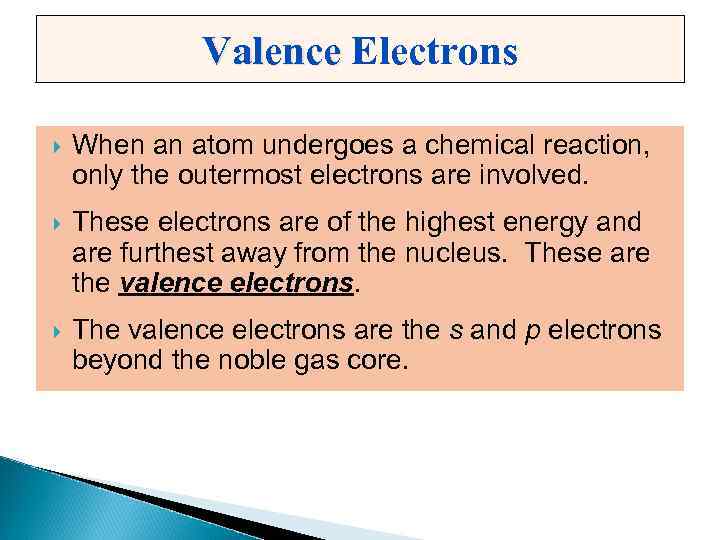
Valence Electrons When an atom undergoes a chemical reaction, only the outermost electrons are involved. These electrons are of the highest energy and are furthest away from the nucleus. These are the valence electrons. The valence electrons are the s and p electrons beyond the noble gas core.

Predicting Valence Electrons The Roman numeral in the American convention indicates the number of valence electrons. ◦ Group IA elements have 1 valence electron ◦ Group VA elements have 5 valence electrons When using the IUPAC designations for group numbers, the last digit indicates the number of valence electrons. ◦ Group 14 elements have 4 valence electrons ◦ Group 2 elements have 2 valence electrons
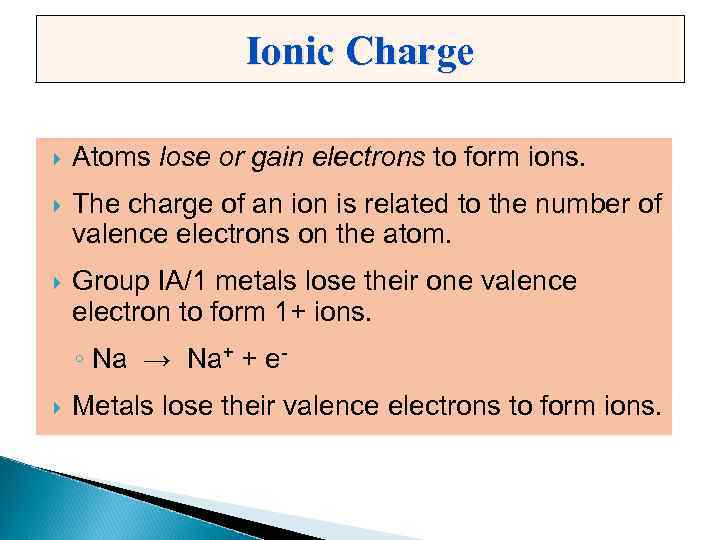
Ionic Charge Atoms lose or gain electrons to form ions. The charge of an ion is related to the number of valence electrons on the atom. Group IA/1 metals lose their one valence electron to form 1+ ions. ◦ Na → Na+ + e Metals lose their valence electrons to form ions.
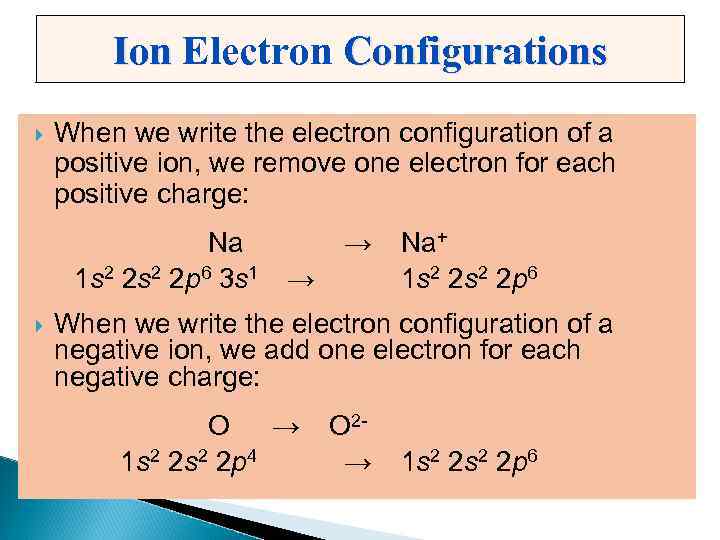
Ion Electron Configurations When we write the electron configuration of a positive ion, we remove one electron for each positive charge: Na → Na+ 1 s 2 2 p 6 3 s 1 → 1 s 2 2 p 6 When we write the electron configuration of a negative ion, we add one electron for each negative charge: O → O 2 1 s 2 2 p 4 → 1 s 2 2 p 6
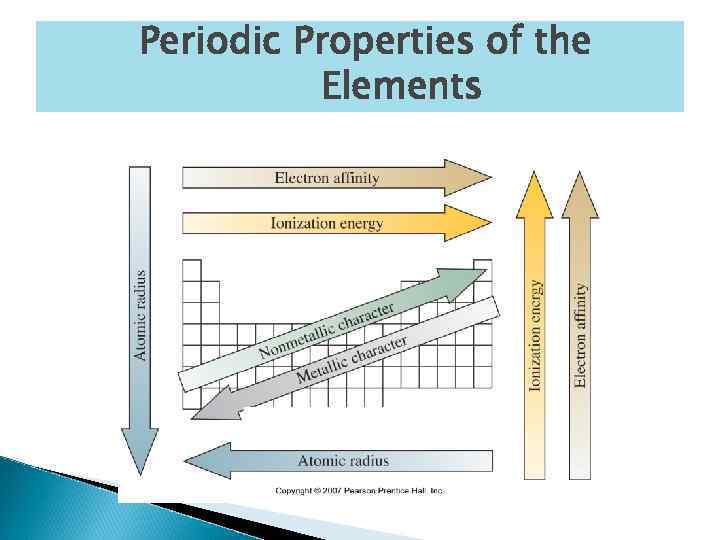
Periodic Trends The arrangement of the periodic table means that the physical properties of the elements follow a regular pattern. We can look at the size of atoms, or their atomic radius. There are two trends for atomic radius: ◦ Atomic radius decreases as you go up a group. ◦ Atomic radius decreases as you go left to right across a period.
Atomic Radius Trend Atoms get larger as you go top to bottom on the periodic table because as you travel down a group, there are more energy levels on the atom. (Shielding effect) Atomic radius decreases as you travel left to right across the periodic table because the number of protons in the nucleus increases. (Pull Effect) As the number of protons increases, the nucleus pulls the electrons closer and reduces the size of the atom.
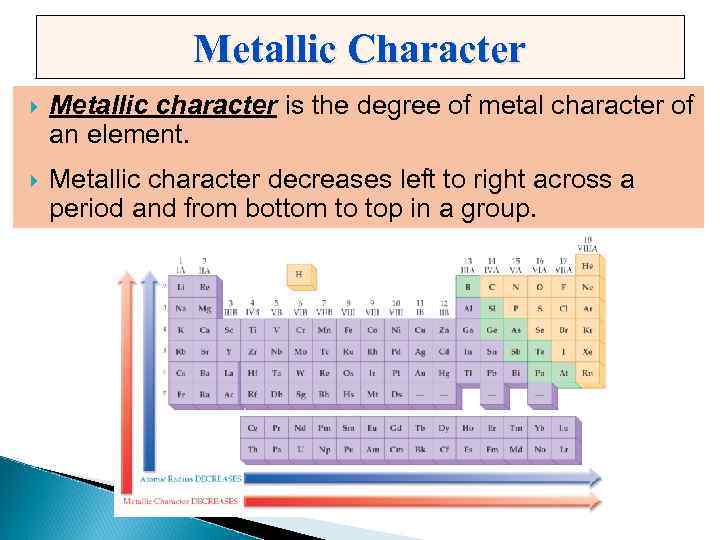
Metallic Character Metallic character is the degree of metal character of an element. Metallic character decreases left to right across a period and from bottom to top in a group.
Ionization Energy The ionization energy of an atom is the amount of energy required to remove an electron in the gaseous state. In general, the ionization energy increases as you go from the bottom to the top in a group. In general, the ionization energy increases as you go from left to right across a period of elements. The closer the electron to the nucleus, the more energy is required to remove the electron.
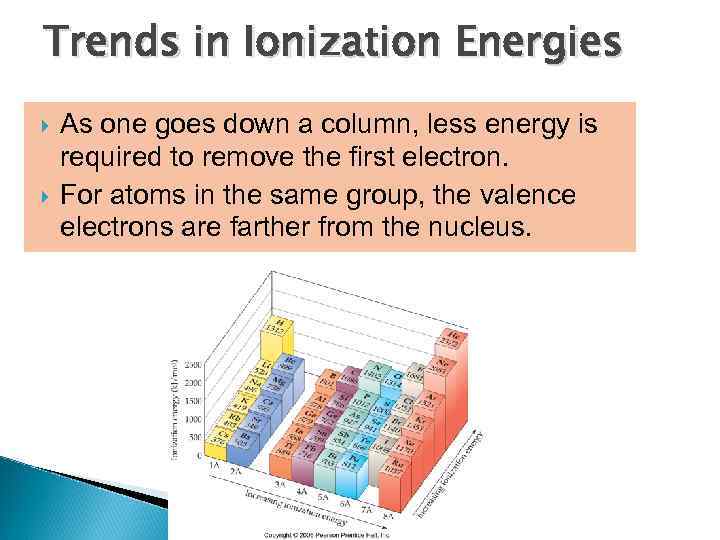
Trends in Ionization Energies As one goes down a column, less energy is required to remove the first electron. For atoms in the same group, the valence electrons are farther from the nucleus.
Periodic Properties of the Elements
Conclusions The elements in the periodic table arranged by increasing atomic number. The elements have, regular repeating chemical and physical properties. The periodic table can be broken down into blocks where a certain sublevel is being filled. The periodic table can be broken down into ◦ groups or families which are columns ◦ periods or series which are rows
Conclusions Continued Atomic radius and metallic character increase as you go from top to bottom and from right to left across the periodic table. Cations are smaller than their parent atoms, anions are larger than their parent ions. Ions increase in size as you go from top to bottom and from left to right across a periodic table. Ionization energy is the amount of energy that is required to remove an electron from an atom in the gaseous state.
Скачать презентацию The Periodic Table and Some Atomic Properties
Inorganic_2.ppt