 Скачать презентацию The Peculiar Market for Academic Journals Ted Bergstrom
bf97f6acadf9d10d11c0caefca582ea4.ppt
- Количество слайдов: 29




The Peculiar Market for Academic Journals Ted Bergstrom UCSB
Industry Leaders Conferring with an industry leader
A curious market structure • Private profit-maximizing firms and nonprofit societies and academic presses both are significant players. • Most of the workforce--authors and referees--work for free.
Pricing of Paper Editions • The 6 most-cited journals in economics are owned by non-profit groups. • Average price to libraries is $180 per year. • Only 5 of the 20 most-cited journals are owned by commercial publishers. • Average price to libraries is $1660 per year.
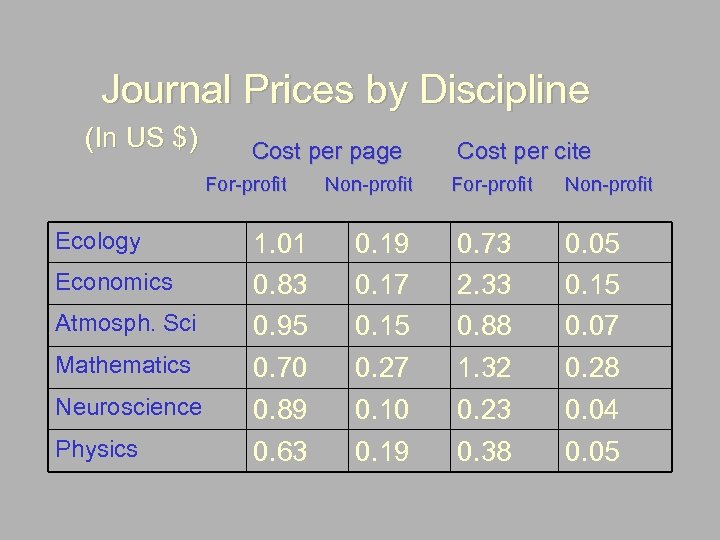
Journal Prices by Discipline (In US $) Cost per page For-profit Ecology Economics Atmosph. Sci Mathematics Neuroscience Physics 1. 01 0. 83 0. 95 0. 70 0. 89 0. 63 Non-profit Non 0. 19 0. 17 0. 15 0. 27 0. 10 0. 19 Cost per cite For-profit Non-profit 0. 73 2. 33 0. 88 1. 32 0. 23 0. 38 0. 05 0. 15 0. 07 0. 28 0. 04 0. 05
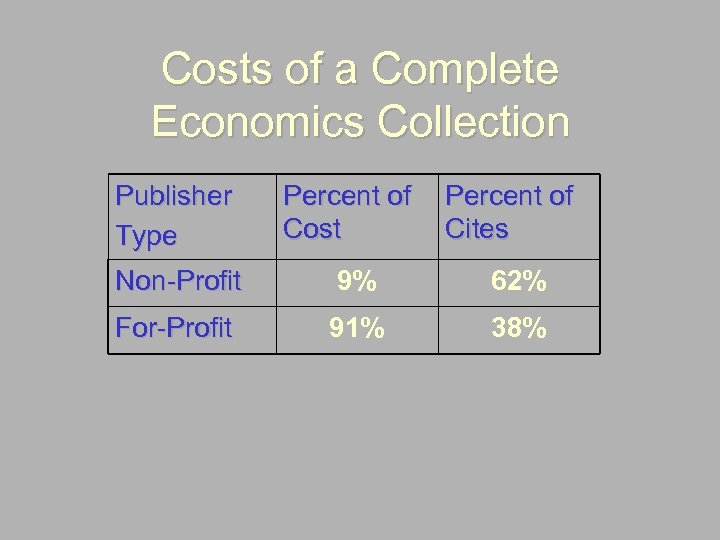
Costs of a Complete Economics Collection Publisher Type Percent of Cost Percent of Cites Non-Profit 9% 62% For-Profit 91% 38%
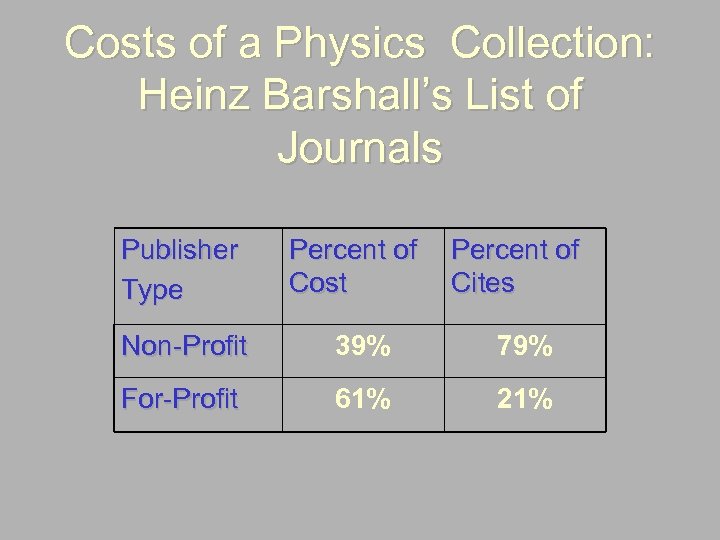
Costs of a Physics Collection: Heinz Barshall’s List of Journals Publisher Type Percent of Cost Percent of Cites Non-Profit 39% 79% For-Profit 61% 21%
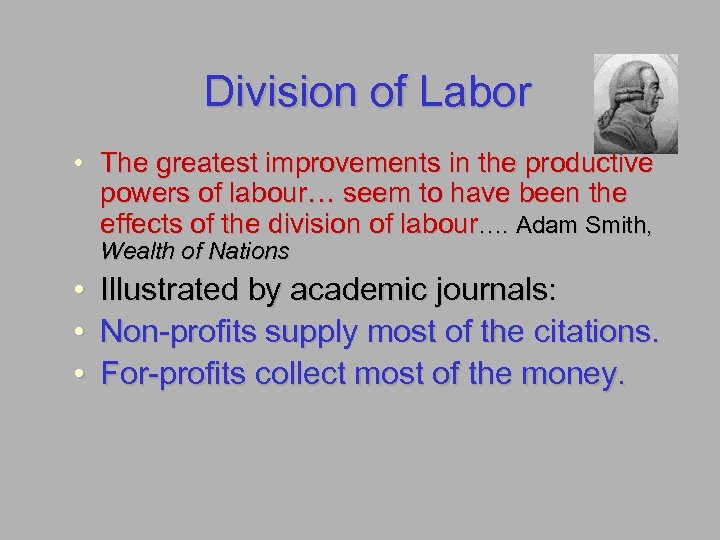
Division of Labor • The greatest improvements in the productive powers of labour… seem to have been the effects of the division of labour…. Adam Smith, Wealth of Nations • • • Illustrated by academic journals: Non-profits supply most of the citations. For-profits collect most of the money.
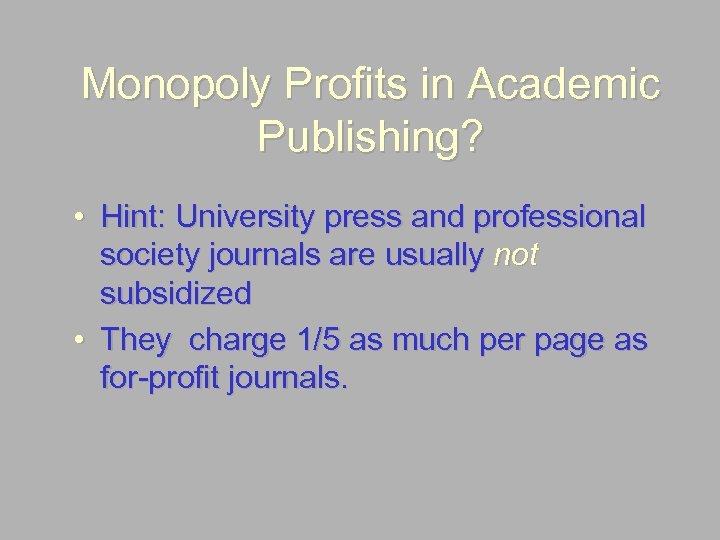
Monopoly Profits in Academic Publishing? • Hint: University press and professional society journals are usually not subsidized • They charge 1/5 as much per page as for-profit journals.
Elsevier Financial Statement • Elsevier reports revenue 2 billion Euros in 2002. • Claims to have 3 d biggest internet revenues, behind AOL and Amazon. • Reported profits equal 33. 6% of revenue.
Why “only” 33 % profit margin? • If they charge 5 times as much as non-profits, why aren’t Elsevier’s profits even greater? • Smaller subscription bases, due to high price • Rent dissipation – Elsevier CEO got ~$2 million pay and $8 million in shares this year. – New stock options of ~$32 million for top execs. – Armies of lobbyists
If there is free entry, how can there be monopoly? • Unlike shoes or groceries, competition from perfect substitutes is prevented by copyright. • Reputation makes it hard for new entrant to attract top quality articles. • Rents fall to owner of a coordinating signal– a journal name. • Like the rents to record companies for talentfree musicians who are popular because they are popular?
The strange economics of academic journals • If one brand of car cost 6 -15 times as much as others of better quality, how many would be sold? • Almost zero, because people would substitute low priced for high priced. • Why then do commercial journals that cost 615 times as much per cite as nonprofits continue to sell?
Journals as Complements • Academic journals tend to be complements, not substitutes. • Two copies of cheap society journal will not replace a subscription to Elsevier journal that costs 10 times as much per cite. • Many scientists want to read all significant research in their area, not just the top papers.
More strange economics • With most goods, middleman pays producer, consumer pays middleman. • With journals, producer pays middleman (often not much), consumer pays middleman
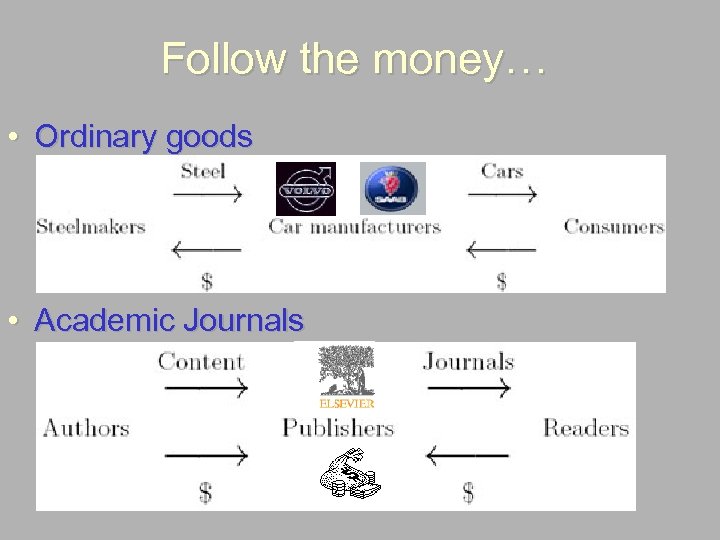
Follow the money… • Ordinary goods • Academic Journals
Open Access Model • Producer pays middleman, consumer pays nobody. • Would this work for nonprofits? • Would this work for profit-maximizers?
Non-profit open access? • To succeed, an open access journal must attract authors. • Are authors and their universities willing to pay to have their work read and cited? – Evidence that open access articles are more cited. – Economic study: avg citation worth $35 per year in salary. • Will they pay $1500 as for PLOS?
Open access and competition • Competition for authors will be stiffer than for readers. • Would an author submit papers to a journal with submission fees 6 -15 times as high as equivalent competitor? • Not likely. Why? • For authors, journals are substitutes, not complements.
University-paid author fees • University could limit amount it would pay per page. • Authors can choose to top up fees. • As outlets, competing journals are substitutes, not complements • Price competition for author fees is likely to prevent extreme fees.
Libraries as toll collectors? • In PNAS, CB and I argue that library purchase of site licenses from profit-maximizers reduces well-being of academic community. • Better outcome if Elseviers are forced to deal with individuals. • For nonprofit journals, the conclusion is opposite. • For these site licenses enhance efficiency by improvin access without increasing cost.
What should libraries do? • Decentralize some decision-making to academ departments. • Replace “allocation by whining” with money tradeoffs. • Subsidize new journals, submission fees for open access, or even pay-per-views. • Where does money come from? • Cutting subscriptions to the overpriced.
Overhead for overpriced? • Universities charge overhead on research grants. • They charge no overhead for journal editors and often give courses off. • This makes sense for publishers that cooperate in academic enterprise • But not for publishers that are extracting maxim rents.
How to deal with the Big Deal: A modest proposal • Stop being gatekeeper and revenue collector for overpriced journals. • Set a maximum price/citation a little higher than that of non-profits in the same field and refuse to buy electron subscriptions at any higher price. • Let journals that charge more sell to individual subscribers, subscriptions or pay-per-view.
What should scholars do? • Refuse to referee for overpriced journals. • Encourage cheap journals. – Referee for them. – Cite them. – Publish in them. • Encourage professional societies to expand their journals and start new ones. • Keep copyright on your own work and put all of your papers on the web.
Had enough? • OK, then, I’ll quit
Want more? www. econ. ucsb. edu/~tedb …papers, statistics, weasel’s manual, etc
Fable of the Anarchists’ Annual meeting • Once upon a time a bunch of anarchists happened to get together on January 3 in a hotel in Kansas City • They had a grand time. • Next year more anarchists came and they had even more fun. • The tradition grew and meetings got bigger and more enjoyable.
Trouble in Kansas City • One year, the hotel owner raised his rates at conference time. • Attendance fell a little and owner’s revenue rose a lot. • Next year owner did it again. • Anarchists groused, had less fun with the smaller crowd and higher prices. • Why didn’t they move to another hotel? • They are anarchists!
Скачать презентацию The Peculiar Market for Academic Journals Ted Bergstrom
bf97f6acadf9d10d11c0caefca582ea4.ppt