


 Скачать презентацию The Peacekeeping Successes of the UN Korea Suez
fe5f5804132547d1e845de9f25d534b3.ppt
- Количество слайдов: 31
 The Peacekeeping Successes of the UN Korea Suez Crisis The Congo The Gulf War Mozambique
 Vocabulary Boycott – refuse to take part UN Resolution – official decision Stalemate – both sides cannot act Ceasefire – agreement to stop fighting (temporary - not an end to the war) Civil War – fighting between sides within one country Arbitration – the UN hears both sides of a disagreement from the countries involved and makes a decision about how it should be settled Economic sanctions - actions taken by the UN to harm the economy of another nation or group, often to force a political change e. g. refusing to trade or sell certain goods Condemn – to express strong disaproval of the actions of a country
 Korea (1950 – 1953)
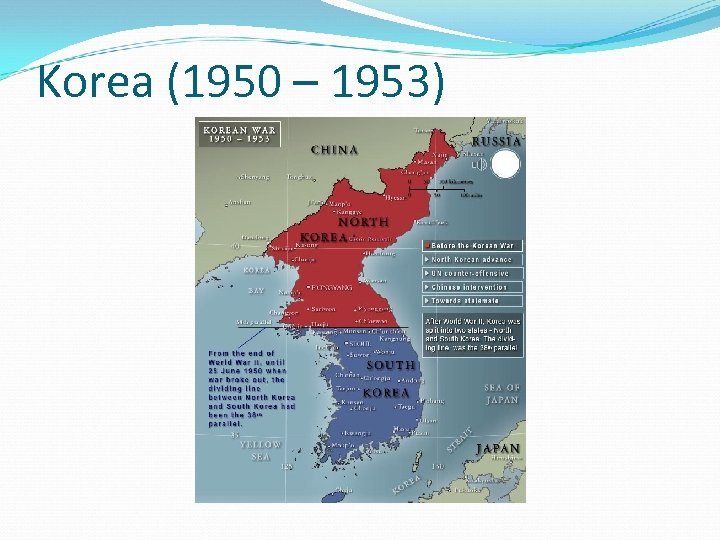
 Korea (1950 – 1953) Details of Aggression 25 th June 1950 Communist North Korea invaded South Korea (weapons from Russia) – crossed 38 th parallel UN’s response Security Council met at once (USSR was boycotting it) They had used veto 79 times from 1945 to 1955 The Council passed Resolution 82 Condemned (arbitration) North Korean aggression Ordered them back to 38 th parallel https: //www. youtube. com/watch? v=zugl. Tooo. ITY
 Korea (1950 – 1953) Details of Aggression North Korea refused to retreat UN’s response 2 days later – passed resolution allowing use of military force Army prepared Led by US General Douglas Mac. Arthur 600, 000 troops – 90% American (and 15 other countries) September 1950 Troops land push North Korea back – want to reunite Korea Mac. Arthur pushed north – past 38 th parallel (got close to Chinese border)
 Korea (1950 – 1953) Details of Aggression Mao Zedong sent troops to support North Korea UN response UN withdrew to 38 th parallel 1951 - stalemate Ceasefire in July 1953
 Korea (1950 – 1953) Why considered a success? UN acted quickly and assembled strong military force Repelled an aggressor and saved a state that had been attacked
 The Suez Crisis (1956)
 The Suez Crisis (1956) Background General Abdel Nasser was leader of Egypt from 1954 Creating international tension Helped Algerian rebels against France Supported terror attacks against Israel 26 th July 1956 – nationalised Suez Canal Breaking treaty obligation Taking property of shareholders (Britain and France) Threatening trade (Western Europe’s oil supplies)
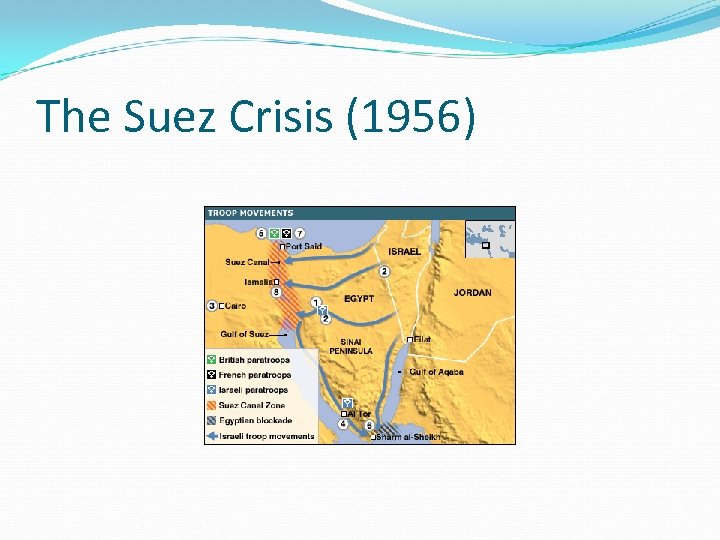
 The Suez Crisis (1956) Details of Aggression October 1956 Britain, France and Israel secret deal that Israel would attack Egypt 29 th October – attacks began (Israel) 30 th October – Britain demands Israel and Egypt withdraw all troops around Suez Canal Nasser refused (his country) November 1 st British and French troops bombed Egyptian airfields – destroyed airforce
 The Suez Crisis (1956) UN’s response Security Council could not act – French and British vetoes 2 nd November – General Assembly passed Resolution 997 (64 yes, 5 no) Ceasefire – withdrawal of all troops
 The Suez Crisis (1956) Details of Aggression 5 th November Following plan – British and French invaded Egypt – military success – British people said ‘Law not War’ 2 ministers resigned USA threatened to withdraw help with debt USSR threatened rocket attacks UN’s response 6 th November – Anglo-French forces agreed ceasefire UN posted 6, 000 peacekeepers to Egypt (15 th November) – stayed until 1967 (cost 89 lives and $200 million)
 The Suez Crisis (1956) Why success? Acted quickly using political and military pressure Repelled aggression and preserved peace
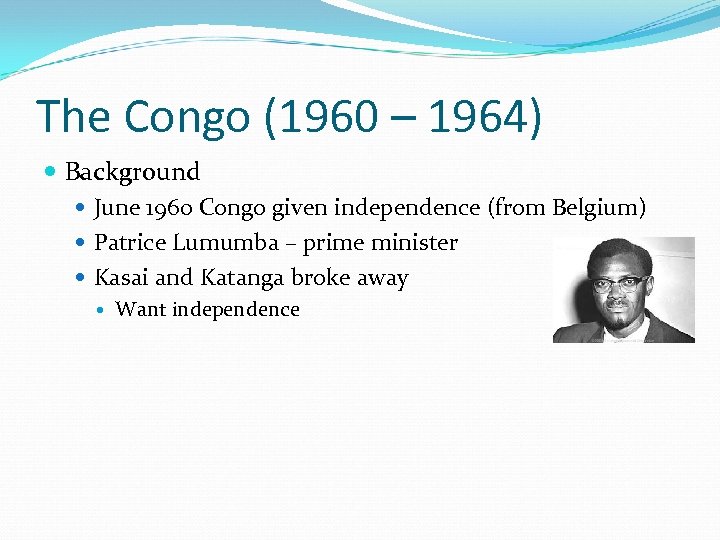 The Congo (1960 – 1964) Background June 1960 Congo given independence (from Belgium) Patrice Lumumba – prime minister Kasai and Katanga broke away Want independence
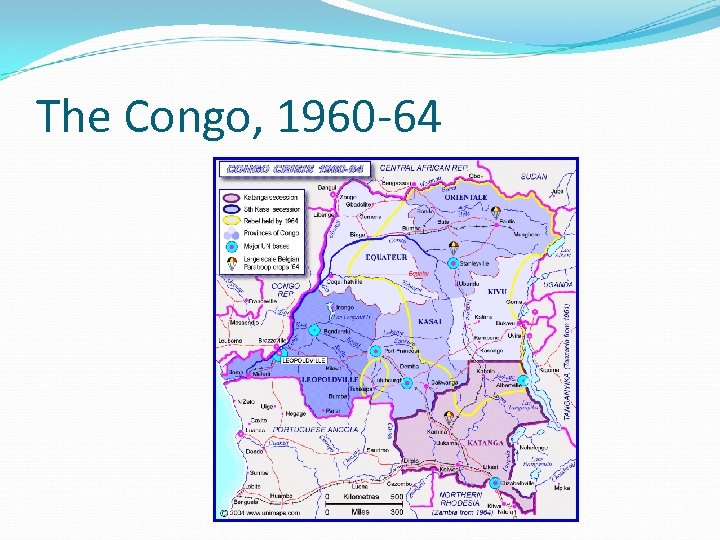 The Congo, 1960 -64
 The Congo (1960 – 1964) Details of Aggression Civil War Belgian government sent paratroops (100, 000 Belgians living there) 12 th July Lumumba asks UN for help UN Response Acted quickly 14 th July – Security Council Resolution 143 Ordered Belgium out and sent peackeeping force (arrived in 2 days) – at peak – 20, 000 men Aim to protect Congo’s government from rebels and restore political stabililty
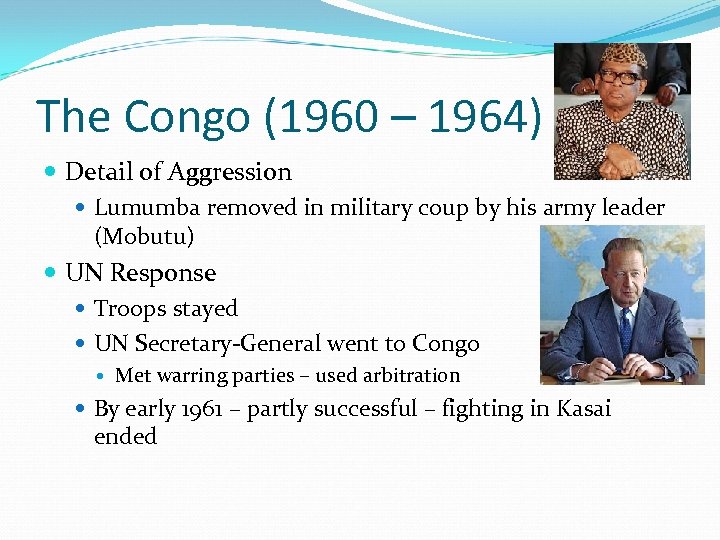 The Congo (1960 – 1964) Detail of Aggression Lumumba removed in military coup by his army leader (Mobutu) UN Response Troops stayed UN Secretary-General went to Congo Met warring parties – used arbitration By early 1961 – partly successful – fighting in Kasai ended
 The Congo (1960 – 1964) Detail of Aggression Still fighting in Katanga UN response ‘Operation Grand Slam’ – 1962 Military offensive Defeated rebels in Katanga
 The Congo (1960 – 1964) Why success? By January 1963 – Congo reunited Prevented Congo from breaking up UN force withdrawn by June 1964 Acted quickly using arbitration and troops Prevented outside troops intervening (Belgium) Gave humanitarian aid Achieved settlement to the civil war Although Congo not entirely successful https: //www. youtube. com/watch? v=Vk 4 Vxh 6 Vd. C 4
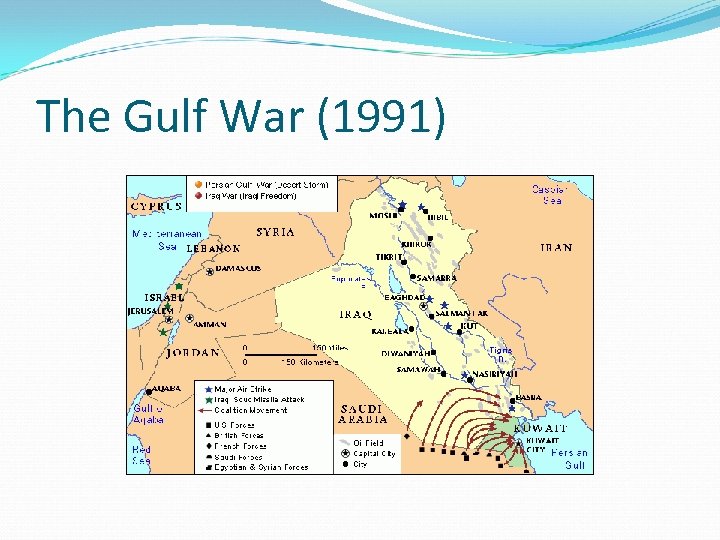 The Gulf War (1991)
 The Gulf War (1991) Details of Aggression 2 nd August 1990 – Iraq invaded Kuwait UN Response Acted at once Security Council condemned action and demanded withdrawal 6 th August – Resolution 661 – economic sanctions diplomacy
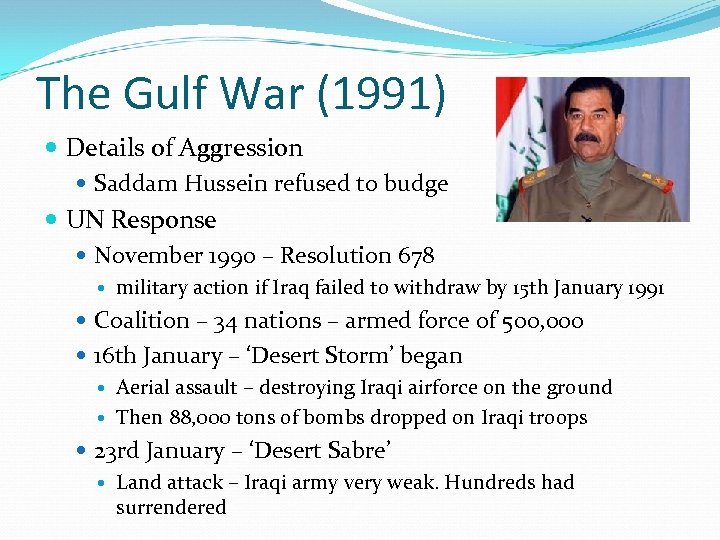 The Gulf War (1991) Details of Aggression Saddam Hussein refused to budge UN Response November 1990 – Resolution 678 military action if Iraq failed to withdraw by 15 th January 1991 Coalition – 34 nations – armed force of 500, 000 16 th January – ‘Desert Storm’ began Aerial assault – destroying Iraqi airforce on the ground Then 88, 000 tons of bombs dropped on Iraqi troops 23 rd January – ‘Desert Sabre’ Land attack – Iraqi army very weak. Hundreds had surrendered
 The Gulf War (1991) Why success? Ceasefire agreed on 27 th February Hussein still in power but weapons inspectors allowed in Used diplomatic, economic and military means Raised a powerful military force - Coalition Repelled an aggressor Used consensus among major powers – no real conflict
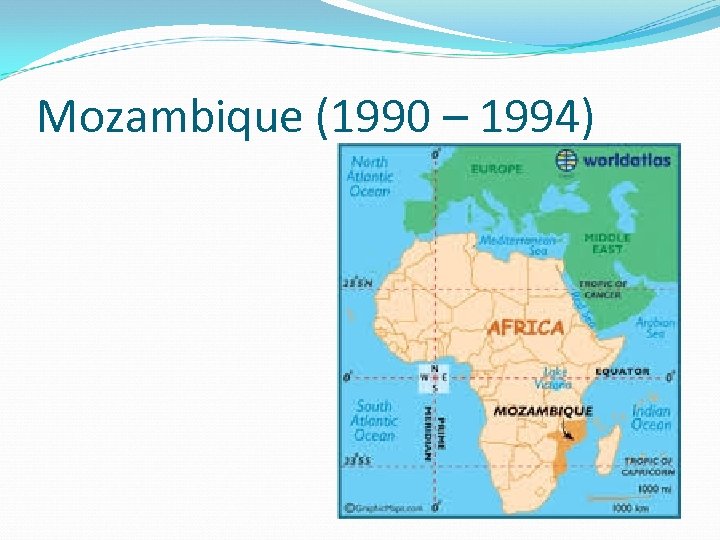 Mozambique (1990 – 1994)
 Mozambique (1990 – 1994) Background 1977 – civil war began in Mozambique Details of Aggression Civil war UN Response 1990 – asked to arbitrate Talks in Rome Took 12 rounds of meetings over two years to reach agreement UN kept talks alive
 Mozambique (1990 – 1994) Why success? October 1992 – two parties signed ‘General Peace Agreement’ – arbitration succeeded UN would monitor peace and disarm local troops UN would arrange elections for new government UN would provide humanitarian assistance as needed UN Response in 1993 Sent 6, 600 soliders, 1, 100 civilian police and 900 election observers (from 41 countries) 76, 000 soldiers demobilised, 155, 000 weapons seized Could begin humanitarian work
 Mozambique (1990 – 1994) Why success? By 1994 – 2. 5 million displaced people resettled Death rate of children halved 1994 – new elections held and formed new government Achieved peace by December 1994 Although lost 26 people and $500 million
 Key Factors in Successes of League and UN Speed of Response UN Security Council is in permanent session can act quickly (days). The League often took weeks if not months. Examples of quick responses Aaland Islands and Upper Silesia (weeks) Korean War and Congo (days) Examples of slow responses Manchuria and Abyssinia (months) Mozambique (months – problems with arbitration. UN kept talks going)
 Key Factors in Successes of League and UN Arbitration Research possible solutions to international disputes League and UN both tried to use political means first before using sanctions or force Has worked well when countries accept rulings. Only works when nations are willing to accept outcomes Examples of successful arbitration Aaland Islands, Greek-Bulgarian War, the Congo (Kasai reunited), Mozambique Examples of unsuccessful arbitration Manchuria, The Gulf War
 Key Factors in Successes of League and UN Military Force Key to solving disputes for the UN, but only against relatively small states. League had no army. UN more successful in using military force, but an expensive option! Examples of successful use of military Korea, Suez, Congo, Gulf War, Mozambique
 Key Factors in Successes of League and UN Humanitarian Aid Often sent by UN to support (follow-up on) military action Examples Congo and Mozambique League – after WWI e. g. Refugee assistance (Nansen)