


 Скачать презентацию The Payment of Special Minimum Wages to Workers
bd5c7a697bf37887290bd19352637619.ppt
- Количество слайдов: 94
 The Payment of Special Minimum Wages to Workers with Disabilities under Section 14(c) of the Fair Labor Standards Act Wage and Hour Division Employment Standards Administration U. S. Department of Labor DDS Refresher Training East Hartford CT March 4, 2011
 FLSA Major Provisions Coverage Minimum Wage Overtime Pay Child Labor Recordkeeping
 FLSA Coverage Individual Enterprise
 FLSA Coverage Two types of coverage § Enterprise coverage: if an enterprise is covered, all employees of the enterprise are entitled to FLSA protections § Individual coverage: Even if the enterprise is not covered, individual employees may be covered and entitled to FLSA protections
 FLSA Enterprise Coverage Enterprises with: § At least two (2) employees § At least $500, 000 a year in business • Named enterprises with at least two (2) employees such as hospitals, businesses providing medical or nursing care for residents, schools, preschools and government agencies
 FLSA Individual Coverage Workers who are engaged in: § Interstate commerce; § Production of goods for interstate commerce; § Closely related process or occupation directly essential (CRADE) to such production
 The FLSA Does Not Require Vacation, holiday, severance or sick pay Meal or rest periods, holidays off, or vacations Premium pay for weekend or holiday work A discharge notice, reason for discharge, or immediate payment of final wages to terminated employees Any limit on the number of hours in a day or days in a week an employee at least 16 years old may be required or scheduled to work Pay raises or fringe benefits
 Minimum Wage: Basics Covered, non-exempt employees must be paid not less than the minimum wage for all hours worked. Currently $7. 25* per hour Cash or equivalent – free and clear *$7. 25 was effective on July 24, 2009
 Overtime Pay Covered, non-exempt employees must receive one and one-half times their regular rate of pay for all hours worked over forty in a workweek. Each workweek stands alone Workweek is 7 consecutive 24 hour periods (168 hours)
 Section 14(c) of FLSA Authorizes the employment of workers with disabilities at special minimum wages when the disabilities impair their productivity for the work performed A special minimum wage is a wage below the federal minimum wage (currently $5. 15). For SCA contracts with a wage determination (WD), it is a wage below the WD rate applicable to the job, as listed on the WD.
 Section 14(c) of FLSA Is one more option available to help individuals with disabilities realize their full potentials. Allows Community Rehabilitation Programs (CRPs) and State Agencies to use “real work” as a tool in the vocational training of individuals with disabilities.
 Regulations 29 CFR Part 525 Set forth the conditions and terms governing the employment of workers with disabilities at special minimum wage(s).
 SPECIAL MINIMUM WAGE : Ø wage paid a worker with a disability Ø commensurate with the worker’s productivity as compared to the wage and productivity of experienced workers who do not have disabilities for the work Ø performing essentially the same type, quality, and quantity of work Ø in the vicinity where the worker with a disability is employed.
 Worker with a disability Worker whose earning or productive capacity is impaired by age, physical or mental disability, or injury for the work to be performed. The Section 14(c) definition of a worker with a disability differs from that of JWOD and ADA
 Records to support disability Medical, psychiatric, and/or psychological tests (Master’s level or above) that support the nature of disability(ies) AND staff notes on how disability affects productivity
 Employment Relationship Volunteers Trainee
 Volunteers Workers with disabilities A worker with disabilities must be legally competent to freely volunteer. If over 18 years of age and is not own guardian, parent or guardian, as appropriate, must approve volunteer work. Work must be substantially different from the work performed during duty hours.
 Volunteers Workers with disabilities Work must be of the type that would be normally classified as “volunteer”. Work must be performed outside normal duty hours.
 Vocational Rehabilitation Program Wage and Hour will not assert an employment relationship for certain vocational rehabilitation programs if seven criteria are met. All seven of the criteria must be met. Participants in the program are individuals with disabilities for whom competitive employment at or above the minimum wage is not immediately obtainable and who, because of their disability, will need intensive ongoing support to perform in a work setting.
 Vocational Rehabilitation Program Participation is for vocational exploration, assessment, or training in community-based worksite under the general supervision of rehabilitation organization personnel, or in the case of a student, public school personnel.
 Vocational Rehabilitation Program Community-based placements must be clearly defined components of individual rehabilitation programs developed and designed for the benefit of each individual. § Each student must have Individualized Education Program (IEP) § Each community-based rehabilitation organization participant must have an Individual Plan for Employment (IPE)
 Vocational Rehabilitation Program Documentation will be provided to Wage & Hour upon request that the individual is enrolled in the community-based placement program, that this enrollment is voluntary and that there is no expectation of remuneration.
 Vocational Rehabilitation Program While the existence of an employment relationship will not be determined exclusively on the basis of the number of hours spent in each activity, as a general rule, an employment relationship is presumed not to exist when each of the three components does not exceed the following limitations: Vocational explorations: 5 hours* Vocational assessment: 90 hours* Vocational training: 120 hours* * per job experienced
 Vocational Rehabilitation Program Individuals are not entitled to employment at the conclusion of the program. If an individual becomes an employee, he or she cannot be considered a trainee at that particular communitybased placement unless in a different, clearly distinguishable occupation.
 Prevailing Wage Prevailing wage rate is wage paid to an experienced worker who does not have a disability that impairs his/her ability to do the work, performing essentially the same type of work in the vicinity.
 Prevailing Wage Experienced worker is a worker who has learned the basic elements or requirements of the work to be performed § ordinarily by completion of a probationary or training period and § typically will have received at least one pay raise after successful completion of the probationary or training period.
 Prevailing Wage Vicinity – the geographic area from which the labor force of the community is drawn. Employer will normally be required to survey a representative number of comparable firms in the vicinity that primarily employ workers who do not have disabilities for the work being performed.
 Prevailing Wage § A comparable firm is one that is similar in size in terms of employees or competes for or bids on contracts of a similar size or nature.
 Prevailing Wage If comparable work cannot be found in the vicinity, the closest comparable community may be used. If data for the specific job to be performed cannot be found, it is acceptable to use the wage paid to experienced workers employed in similar jobs that require the same general skill levels.
 Prevailing Wage Employer may contact other sources such as the Bureau of Labor Statistics, private or State employment services where surveys are not practical. Foreign Labor Certification Data Center: flcdatacenter. com The prevailing wage rate may never be LESS the applicable State or Federal Minimum Wage and will usually be higher. An increase in the federal and/or state minimum wage does have an immediate impact on the
 Prevailing Wage Special situations When the employer’s workforce consists primarily of workers who do not have disabilities: § The employer may use as the prevailing wage rate the rate paid to his or her experienced workers who do not have disabilities who perform similar work
 Prevailing Wage Special Situations When the Section 14(c) employer has a subcontract to perform a job in essentially the same way and with the same type of equipment as the prime contractor: the Section 14(c) employer may use the wage rate the prime contractor pays to his or her experienced workers.
 Prevailing Wage “De-skilling” of prevailing wage rates (arbitrary downward adjustments made in prevailing wage rates to account for differences in duties, methods, equipment and responsibilities between the work of the worker with disabilities and the work done by employees who do not have disabilities in competitive industry) is not permitted by the Wage & Hour Division.
 Prevailing Wage Although work center certificates and patient worker certificates are now normally issued for a 2 -year period, the employer is still required to do an annual review of prevailing wage rate(s) and make any necessary adjustments of commensurate wages.
 Prevailing Wage Worker’s wages should be adjusted no later than the first complete pay period following each prevailing wage review.
 Prevailing Wage Don’t forget to document in your records that the prevailing survey was completed. 29 CFR Part 525. 10(g) requires that you record: The name, address and phone number of the firm and the date the contact was made. Individual contacted and his/her title. Brief description of work involved. Wage rate provided. Basis for concluding that wage data provided was not for an entry level position.
 Prevailing Wage When computing prevailing wage, the employer may use either a simple average or weighted average method, provided a consistent methodology is used. Special Rounding Go out to the 5 th decimal up to 4 th round
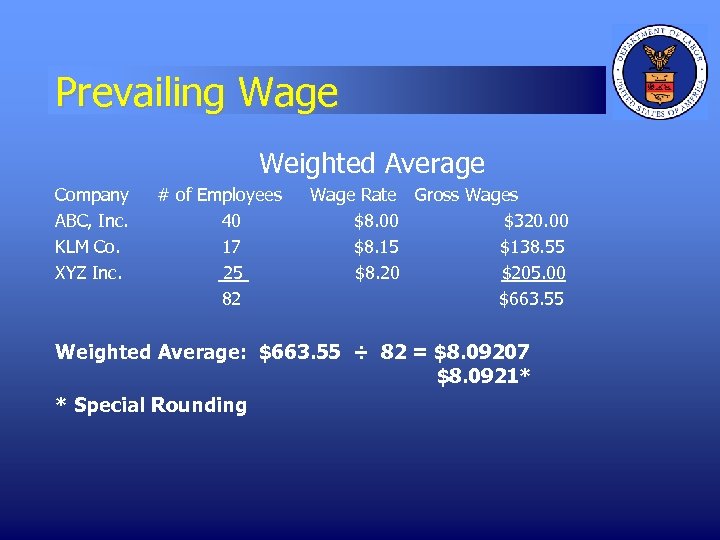 Prevailing Wage Weighted Average Company ABC, Inc. KLM Co. XYZ Inc. # of Employees 40 17 25 82 Wage Rate Gross Wages $8. 00 $320. 00 $8. 15 $138. 55 $8. 20 $205. 00 $663. 55 Weighted Average: $663. 55 ÷ 82 = $8. 09207 $8. 0921* * Special Rounding
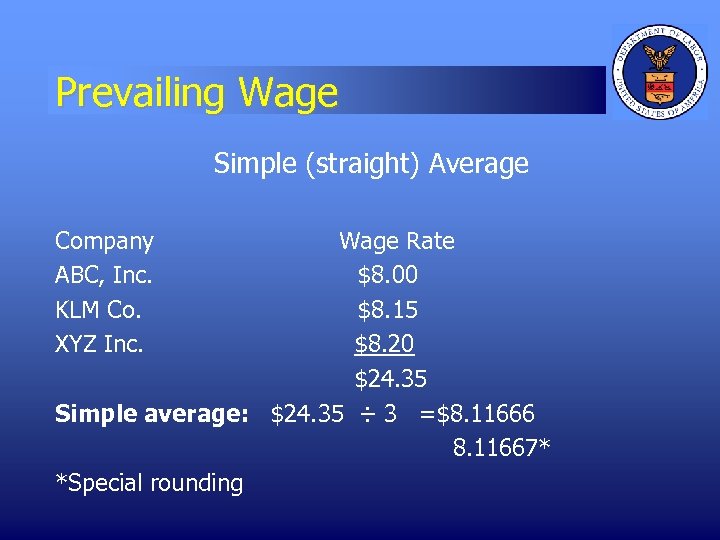 Prevailing Wage Simple (straight) Average Company ABC, Inc. KLM Co. XYZ Inc. Wage Rate $8. 00 $8. 15 $8. 20 $24. 35 Simple average: $24. 35 ÷ 3 =$8. 11666 8. 11667* *Special rounding
 Prevailing Wage An increase in the federal and/or state minimum wage does have an immediate impact on the prevailing wages paid in the vicinity. Wage and Hour will mail out written guidance concerning the adjustment of prevailing wages when the federal minimum wage increases.
 Prevailing Wage The Fair Minimum Wage Act of 2007 increases the minimum wage from $6. 55 per hour to: $7. 25 per hour on July 24, 2009
 Prevailing Wage What Happens When the Federal Minimum Wage is Increased? 1. Employers will have to review all prevailing wage rates. 2. Employers will have to determine if any of their current prevailing wage rates were established when the applicable state minimum wage exceeded $7. 25 per hour.
 Prevailing Wage What Happens When the Federal Minimum Wage is Increased? 3. Employers will have to adjust certain prevailing wage rates using one of two methods. a. Percentage Increase (10. 69%), or b. Conduct New Survey
 Prevailing Wage What Happens if the Federal Minimum Wage is Increased? Employers will have to review all prevailing wage rates. Are any below $7. 25 per hour? If yes, they must be raised to at least $7. 25 and a new survey will have to be conducted.
 Prevailing Wage What Happens if the Federal Minimum Wage is Increased? Employers will have to review all prevailing wage rates. Were any current surveys conducted when the applicable State minimum wage was at least $7. 25? If yes, and the resulting prevailing wage exceeds $7. 25, no new survey need be done until the next anniversary date of that survey or until the state minimum wage increases, whichever comes first.
 Prevailing Wage What Happens if the Federal Minimum Wage is Increased? If prevailing wage rates need to be adjusted, the employer may: a. Apply a percentage increase, or b. Conduct new prevailing wage surveys.
 Setting Production Standards Write job description Write task analysis Set the standard Work measurement must be verifiable
 Hourly production standards Develop job description and task analysis Define quality Set standard using workers without disability for the work 3 time measurements recommended Length of time study should be one that results in rate of production the worker can maintain over the course of a full work day
 Hourly Evaluations Must be based on the worker’s productivity as it compares to the standard of a worker without a disability for the quantity and quality of work performed. An initial evaluation of a worker’s productivity must be made within 1 month after employment begins.
 Hourly Evaluations Retroactive pay increase for the initial period is required if the commensurate wage exceeds the wage paid during that period. Review no less than every 6 months thereafter and after a worker changes jobs. Worker’s wages should be adjusted no later than first complete pay period following the review.
 Hourly Evaluations Behavioral factors or general work habits cannot be considered when setting hourly commensurate wages. Personal time, fatigue, and unavoidable delay (PFD) allowance is not required in setting hourly standard.
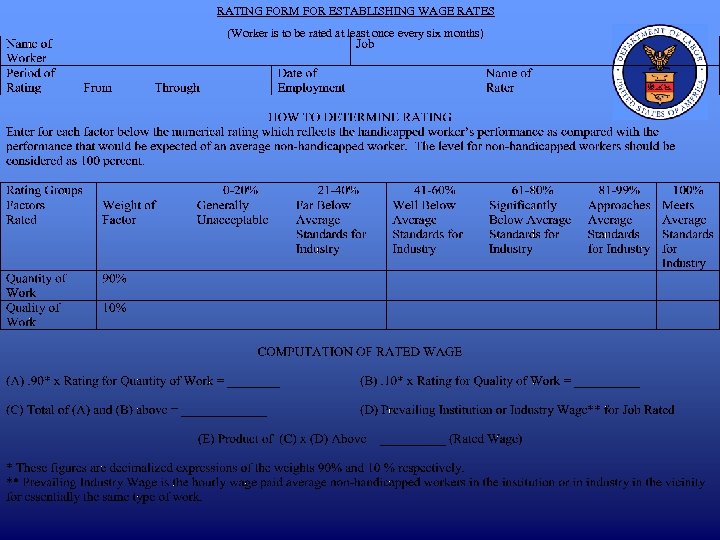
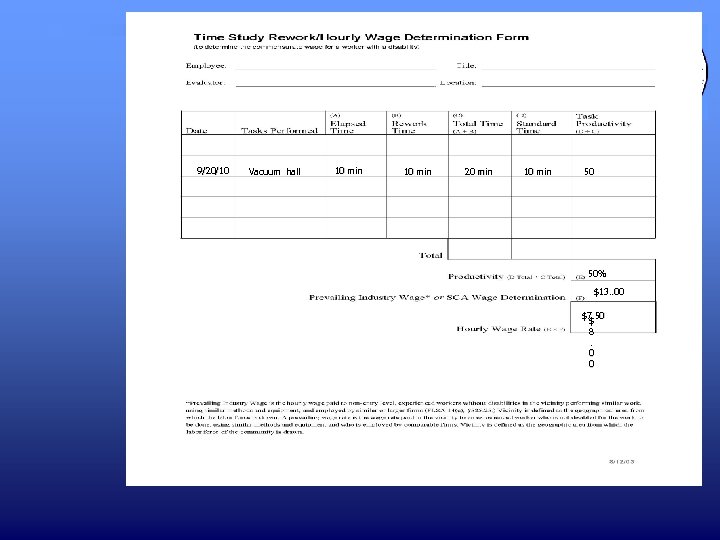
 Hourly Evaluations Re-work method 90/10 evaluation form Rounding
 RATING FORM FOR ESTABLISHING WAGE RATES (Worker is to be rated at least once every six months)
 9/20/10 Vacuum hall 10 min 20 min 10 min 50 50% $13. . 00 $7. 50 $ 8. 0 0
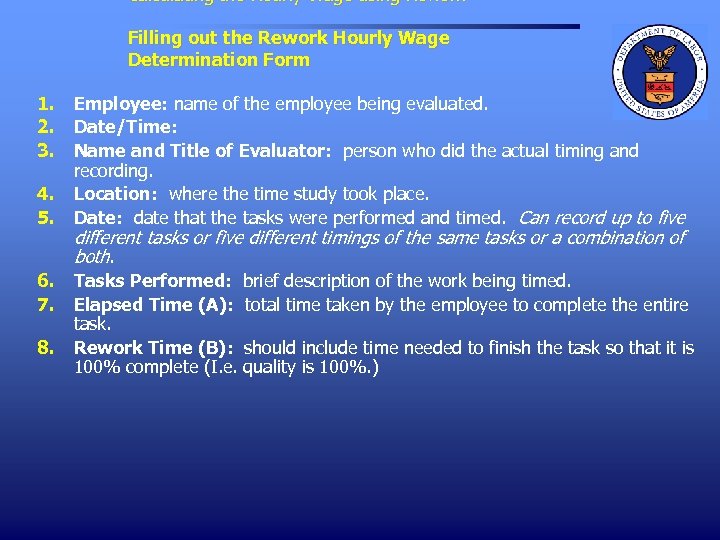 Calculating the Hourly Wage using Rework Filling out the Rework Hourly Wage Determination Form 1. 2. 3. 4. 5. 6. 7. 8. Employee: name of the employee being evaluated. Date/Time: Name and Title of Evaluator: person who did the actual timing and recording. Location: where the time study took place. Date: date that the tasks were performed and timed. Can record up to five different tasks or five different timings of the same tasks or a combination of both. Tasks Performed: brief description of the work being timed. Elapsed Time (A): total time taken by the employee to complete the entire task. Rework Time (B): should include time needed to finish the task so that it is 100% complete (I. e. quality is 100%. )
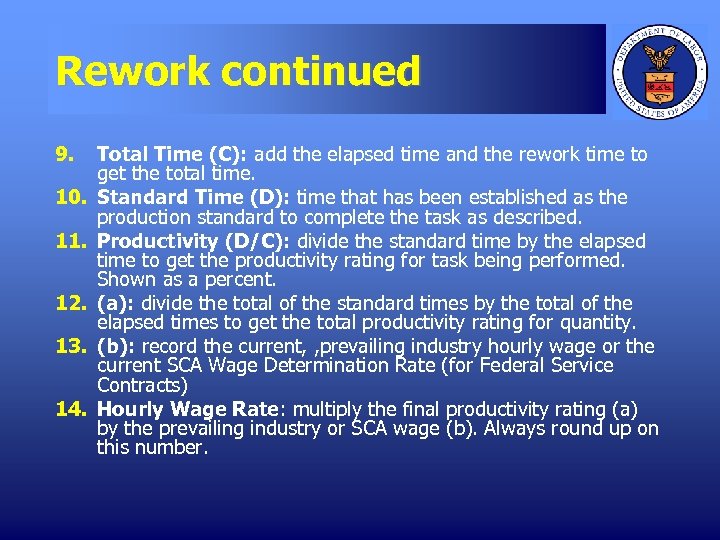 Rework continued 9. 10. 11. 12. 13. 14. Total Time (C): add the elapsed time and the rework time to get the total time. Standard Time (D): time that has been established as the production standard to complete the task as described. Productivity (D/C): divide the standard time by the elapsed time to get the productivity rating for task being performed. Shown as a percent. (a): divide the total of the standard times by the total of the elapsed times to get the total productivity rating for quantity. (b): record the current, , prevailing industry hourly wage or the current SCA Wage Determination Rate (for Federal Service Contracts) Hourly Wage Rate: multiply the final productivity rating (a) by the prevailing industry or SCA wage (b). Always round up on this number.
 Hourly Evaluations Factoring -An employer may rate a worker only on the job components actually performed by the worker. -An employer may not penalize a worker because he/she fails to perform, or is incapable of performing, certain component(s) of the job.
 Piece Rates When properly computed, piece rates accurately reflect the quality and quantity of the productivity of the individual worker. Employers must perform some type of work measurement to establish standard production rates of workers without disabilities.
 Piece Rates Detailed job description and task analysis should be developed for the job, including set-up activities, packaging, counting, boxing, clean-up activities, and other irregular operations. The time studies should utilize the same work methods, equipment, and materials used by the majority of the workers.
 Piece Rates Additional time study required when entirely different methods of production are used, or when a worker does not have access to certain equipment.
 Piece Rates Jigs: modifications made and used to accommodate the special needs of individual workers with disabilities or to help them be more productive -A separate time study does not have to be made utilizing these special modifications.
 Piece Rates Wage & Hour encourages the use of three testing periods. The length of time study should be one that results in rate of production the worker can maintain over the course of a full work day.
 Piece Rates The results of any work measurement must be verifiable. Determine average hourly production, allowing for personal time, fatigue, and unavoidable delays (9 -10 minutes per hour).
 Piece Rates PFD allowance factor -If using 9 minutes per hour, the PFD allowance factor should be 1. 1765 (60 minutes divided by 51 minutes equals 1. 1765). -If using 10 minutes per hour, the PFD allowance factor should be 1. 20 (60 minutes divided by 50 minutes equals 1. 20).
 Piece Rates Prevailing wage rate divided by standard of worker without disability= Piece rate Rounding Piece rate x Units Produced= Commensurate Wage
 Piece Rates THE GOLDEN RULE: Standard multiplied by piece rate must equal or exceed the prevailing wage rate
 Hours Worked: Issues Rehabilitation Services Downtime Work samples/simulations Travel time
 Rehabilitative services Not hours worked provided the services are not primarily for the purpose of increasing job productivity Examples: counseling, psychological testing, mobility training, medical treatments, personal care, physical or occupational therapy, recreation
 Downtime Workers with disabilities Refers to compensable time when worker is on the job but not producing because of factors not within his/her control. Downtime should be paid at the rate equal to the worker’s average hourly earnings during the most recently completed period, not to exceed a quarter.
 EXTENDED PERIOD(S) OF DOWN TIME The Wage & Hour Division has adopted an enforcement position which allows community rehabilitation programs to remove workers with disabilities who are paid special minimum wages under Section 14(c) from the production area during periods of extended down time and provide them with activities that are not compensable.
 EXTENDED PERIOD(S) OF DOWN TIME Worker(s) must be removed from production area so as not to interfere with others who are still involved in production. Employer must maintain a record of the time employees spend in non-compensable activities
 Work sample/simulations Not hours worked if: § Performed in area away from work area § Do not yield a product used to fulfill any of the facility’s contracts § No economic benefit is derived from the product
 Work sample/simulations -Supervised by non-production personnel -Are a specific part of well-defined program of rehabilitation -Typically materials or products are discarded or recycled for future use in work simulation
 Travel Time Workers with Disabilities Transportation provided to and from worksite and worker’s home by employer at beginning and end of work day is not hours worked. This transportation retains the characteristics of “normal home to work travel. ”
 Travel Time Workers with Disabilities Reporting to centralized pickup point to get a ride to remote job site not readily accessible by public transportation is not hours worked if: § Workers do not perform any work at the pickup point § Workers do not engage in any activities considered an integral part of their principal activity § Workers retain the option to transport themselves to the jobsite
 Travel Time Workers with Disabilities Any time spent in transportation provided by the facility between jobsites during the course of the workday is hours worked. The worker shall be paid a wage rate that is at least equal to his or her average hourly earnings during the most recently completed representative period, not to exceed a quarter.
 Recordkeeping Maintaining good records is essential to proper compliance Records need not be kept in any particular form and time clocks are not required Payroll records must be kept for 3 years and the time cards and wage computation records must be kept for 2 years An accurate record of the hours worked each day and total hours worked each week is critical to avoiding hours worked problems
 Required Records Employee’s name, home address, occupation, sex, and birth date if under 19 years of age Hour and day when workweek begins Total hours worked each workday and each workweek Total daily or weekly straight time earnings
 Recordkeeping-workers with disabilities employed at special minimum wages Prevailing wage survey documentation SCA contract information to include wage determination Productivity records Hours worked records Worker without disability production standards used to set piece rates or hourly rates
 Recordkeeping-workers with disabilities-continued Consumer productivity evaluations and supporting documents including time studies Posting of required special minimum wage poster Advising consumers orally and in writing of the terms of special minimum wage certificate
 Section 14(c) Certificates are issued with both an effective date and an expiration date. A certificate, along with the employer’s authorization to pay special minimum wages, will expire on the indicated date unless the employer files an application for renewal with the Wage & Hour Division before the expiration date.
 Section 14(c) Certificates Work Center and Patient Worker certificates are normally issued for 2 year period. Business and School Work Experience Program (SWEP) certificates are normally issued for 1 year period.
 Common Errors to Avoid Use of entry level rates or minimum wage for prevailing wage rates Failure to conduct prevailing wage survey at a minimum of annually Use of behavioral factors to evaluate hourly paid workers with disabilities Use of incorrect personal time, fatigue, and unavoidable delay (PFD) allowance factor in calculating piece rates
 Common Errors to Avoid Improper rounding of piece rates Recommendation: Carry out to 5 decimal places and round up to 4 places. Failure to use correct wage determination rate for SCA work classification Failure to pay full fringe benefits required by SCA wage determination
 Child Labor
 Minimum Age Standards 18 and above No limitations Minimum for occupations declared hazardous by the Department of Labor 16 and 17 year-olds General minimum for employment Limited to non hazardous occupations No limitations on hours or time
 Minimum Age Standards (Continued) 14 and 15 year-olds Minimum age for employment in specified occupations Limited to work outside school hours Total work hours limited per day and per week Only non-hazardous and non-manufacturing jobs Under 14 years of age Work only in jobs that are exempt from or are not covered by the FLSA g. NOTE: Rules differ in agricultural employment
 Wage & Hour Section 14(c) Investigations Complaint or directed Appointment letter Opening Conference Tour Review of records (both staff & consumers) -Payroll, time, production records -Disability records
 Wage & Hour Section 14(c) Investigations Verification of sample number of time studies Employee interviews Prevailing wage survey follow up Final conference Letter of findings
 Enforcement In the event there is not a voluntary agreement to comply and/or pay back wages, the Wage and Hour Division may: Obtain an injunction to restrain the employer from violating the FLSA, including the withholding of proper minimum wage and overtime Bring suit for back wages and an equal amount as liquidated damages
 Northeast Region Section 14 Team Leader Maggie Mac. Donald U. S. Dept. of Labor Wage & Hour Division JFK Federal Building, Room 525 Boston MA 0220 617 -624 -6720 E-mail: macdonald. margaret@dol. gov
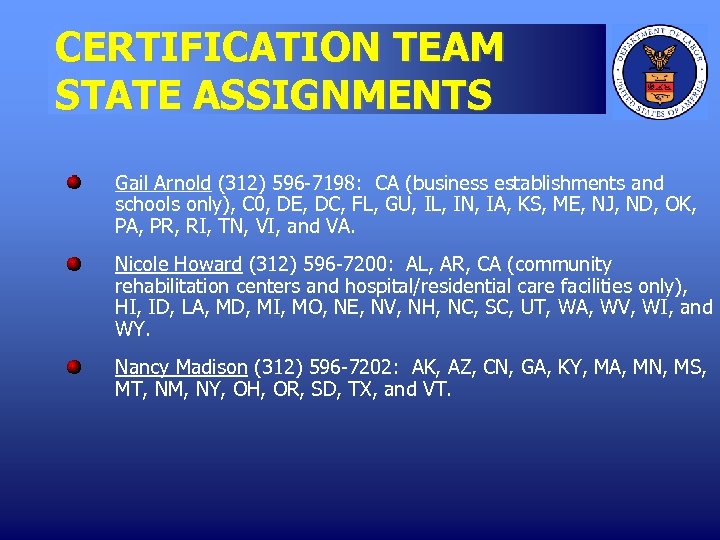 CERTIFICATION TEAM STATE ASSIGNMENTS Gail Arnold (312) 596 -7198: CA (business establishments and schools only), C 0, DE, DC, FL, GU, IL, IN, IA, KS, ME, NJ, ND, OK, PA, PR, RI, TN, VI, and VA. Nicole Howard (312) 596 -7200: AL, AR, CA (community rehabilitation centers and hospital/residential care facilities only), HI, ID, LA, MD, MI, MO, NE, NV, NH, NC, SC, UT, WA, WV, WI, and WY. Nancy Madison (312) 596 -7202: AK, AZ, CN, GA, KY, MA, MN, MS, MT, NM, NY, OH, OR, SD, TX, and VT.
 ADDITIONAL INFORMATION Visit the WHD homepage at: www. dol. gov/esa/whd_org. htm Call the WHD toll-free information and helpline at 1 -866 -487 -9243 Use the DOL interactive advisor system ELAWS (Employment Laws Assistance for Workers and Small Businesses at: www. dol. gov/elaws Call or visit the nearest Wage and Hour Division Office
 Thank you, Any Questions? § § Contact Maggie Mac. Donald 617 -624 -6720 Anonymous questions answered Stress free atmosphere