


 Скачать презентацию The Path to Discovery of the Pentaquark an
e742bef0d75d394dba675f75f387b8cb.ppt
- Количество слайдов: 46
 The Path to Discovery of the Pentaquark: an Exotic Baryon Announcements from LEPS (Japan), ITEP (Russia), CLAS (USA), and ELSA (Germany), provide evidence for the existence of an exotic baryon, a pentaquark with strangeness S=+1, called the Q+. Physics School (Bad Honnef, 03/10/7) Ken Hicks, Ohio University
 Media Interest • The pentaquark discovery received wide media coverage: • Newspapers (July, 2003): – New York Times, USA Today, L. A. Times, Boston Globe, Cleveland Plain Dealer, Dallas Morning News, Washington Times, Richmond Times, MSNBC (web), and others… – Le Figaro (Paris), Allgemeine Frankfurter (Germany), Times of India, HARRETZ (Israel), Italy, Netherlands, and many newspapers in Japan. • Magazines: – US News & World Report, The Economist, Discover Magazine, Science, Nature, Physics World (IOP), Cern Courier… • The reason? In part, because the idea is simple to explain. Physics School (Bad Honnef, 03/10/7) Ken Hicks, Ohio University
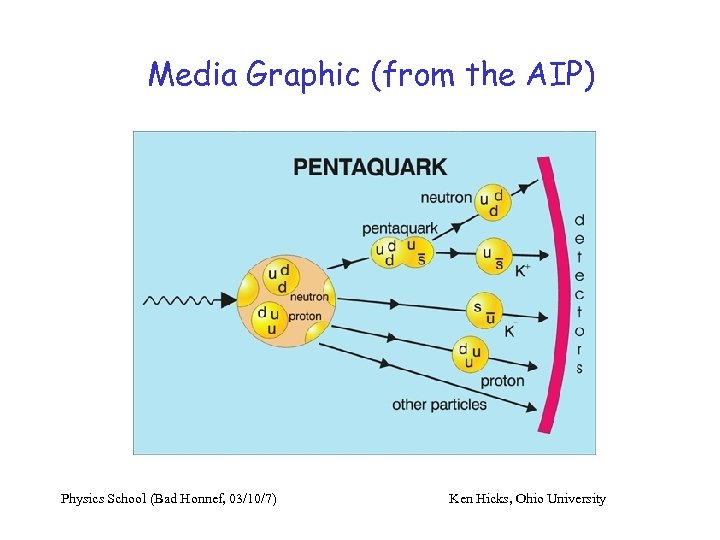 Media Graphic (from the AIP) Physics School (Bad Honnef, 03/10/7) Ken Hicks, Ohio University
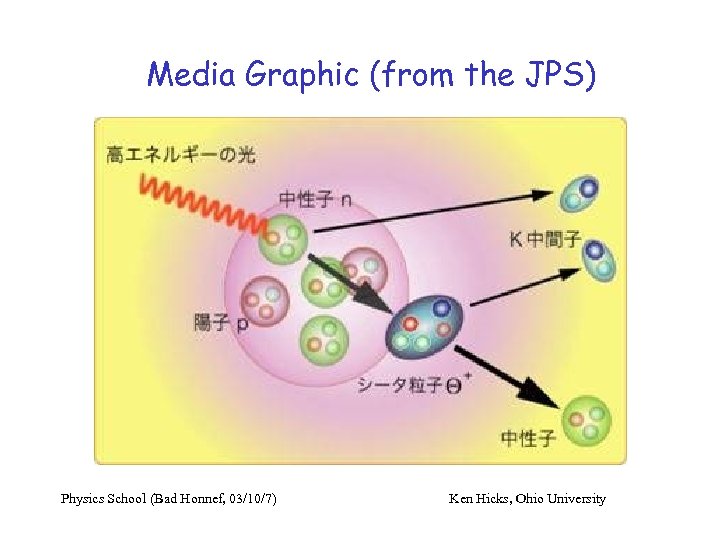 Media Graphic (from the JPS) Physics School (Bad Honnef, 03/10/7) Ken Hicks, Ohio University
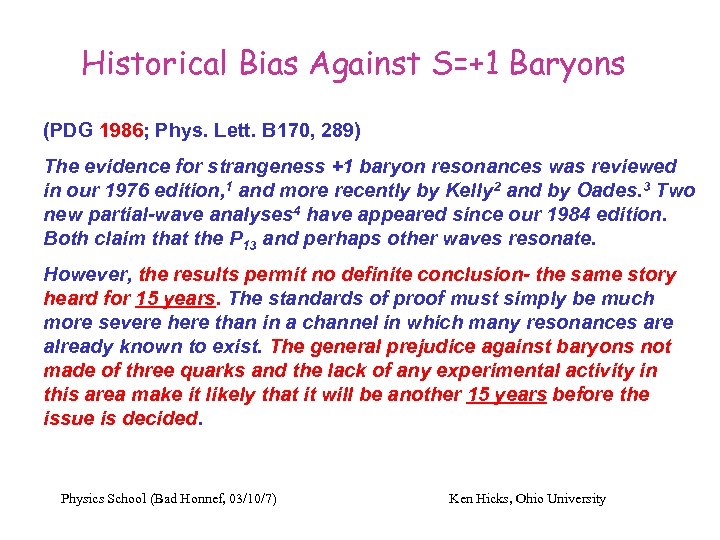 Historical Bias Against S=+1 Baryons (PDG 1986; Phys. Lett. B 170, 289) The evidence for strangeness +1 baryon resonances was reviewed in our 1976 edition, 1 and more recently by Kelly 2 and by Oades. 3 Two new partial-wave ana. Iyses 4 have appeared since our 1984 edition. Both claim that the P 13 and perhaps other waves resonate. However, the results permit no definite conclusion- the same story heard for 15 years. The standards of proof must simply be much more severe here than in a channel in which many resonances are already known to exist. The general prejudice against baryons not made of three quarks and the lack of any experimental activity in this area make it likely that it will be another 15 years before the issue is decided. Physics School (Bad Honnef, 03/10/7) Ken Hicks, Ohio University
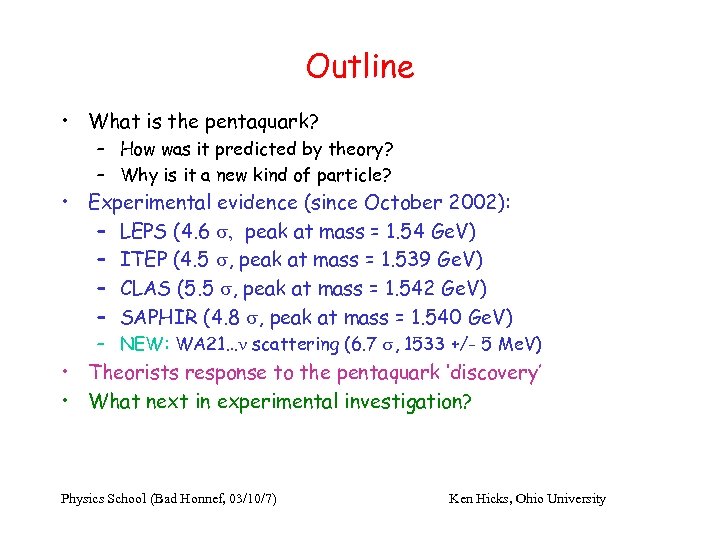 Outline • What is the pentaquark? – How was it predicted by theory? – Why is it a new kind of particle? • Experimental evidence (since October 2002): – LEPS (4. 6 s, peak at mass = 1. 54 Ge. V) – ITEP (4. 5 s, peak at mass = 1. 539 Ge. V) – CLAS (5. 5 s, peak at mass = 1. 542 Ge. V) – SAPHIR (4. 8 s, peak at mass = 1. 540 Ge. V) – NEW: WA 21…n scattering (6. 7 s, 1533 +/- 5 Me. V) • Theorists response to the pentaquark ‘discovery’ • What next in experimental investigation? Physics School (Bad Honnef, 03/10/7) Ken Hicks, Ohio University
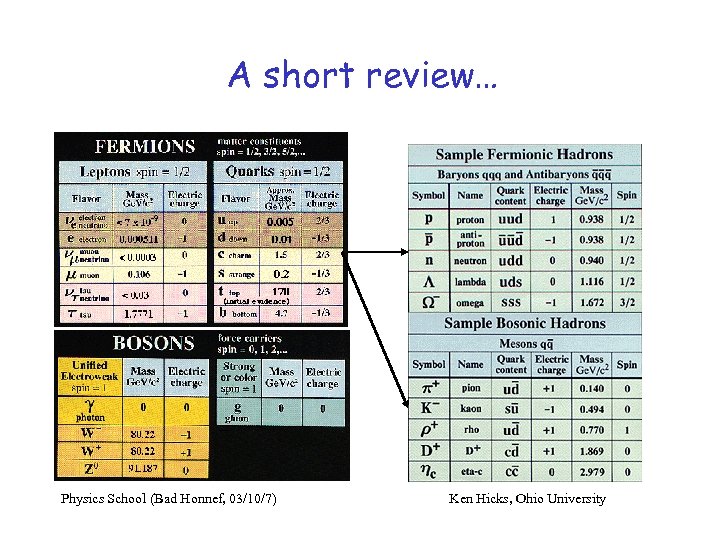 A short review… Physics School (Bad Honnef, 03/10/7) Ken Hicks, Ohio University
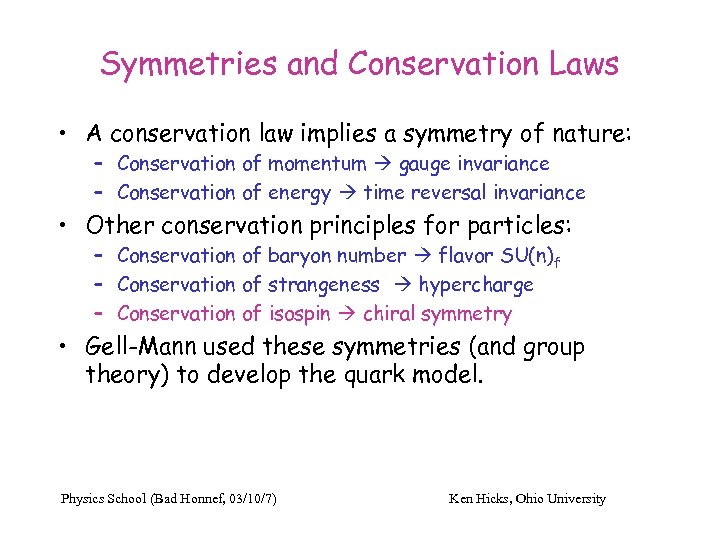 Symmetries and Conservation Laws • A conservation law implies a symmetry of nature: – Conservation of momentum gauge invariance – Conservation of energy time reversal invariance • Other conservation principles for particles: – Conservation of baryon number flavor SU(n)f – Conservation of strangeness hypercharge – Conservation of isospin chiral symmetry • Gell-Mann used these symmetries (and group theory) to develop the quark model. Physics School (Bad Honnef, 03/10/7) Ken Hicks, Ohio University
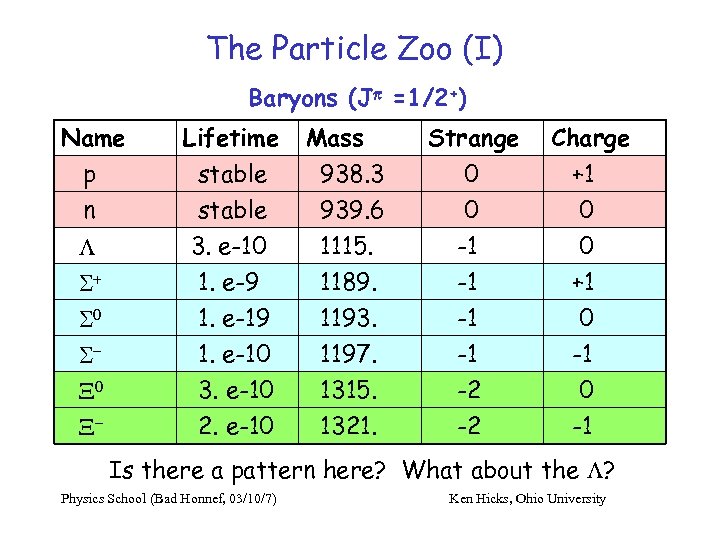 The Particle Zoo (I) Baryons (Jp =1/2+) Name p n L Lifetime stable 3. e-10 Mass 938. 3 939. 6 1115. Strange 0 0 -1 S+ S 0 SX 0 X- 1. e-9 1. e-10 3. e-10 2. e-10 1189. 1193. 1197. 1315. 1321. -1 -1 -1 -2 -2 Charge +1 0 0 +1 0 -1 Is there a pattern here? What about the L? Physics School (Bad Honnef, 03/10/7) Ken Hicks, Ohio University
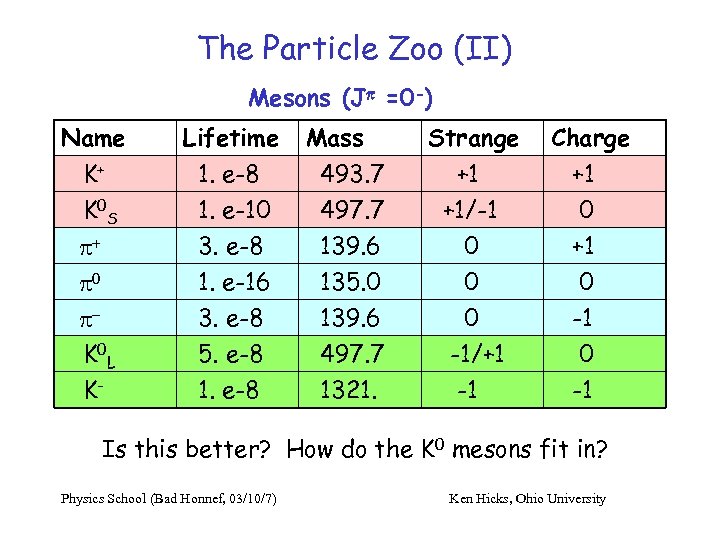 The Particle Zoo (II) Mesons (Jp =0 -) Name K+ K 0 S p+ p 0 p. K 0 L K- Lifetime 1. e-8 1. e-10 3. e-8 Mass 493. 7 497. 7 139. 6 Strange +1 +1/-1 0 1. e-16 3. e-8 5. e-8 135. 0 139. 6 497. 7 1321. 0 0 -1/+1 -1 Charge +1 0 -1 Is this better? How do the K 0 mesons fit in? Physics School (Bad Honnef, 03/10/7) Ken Hicks, Ohio University
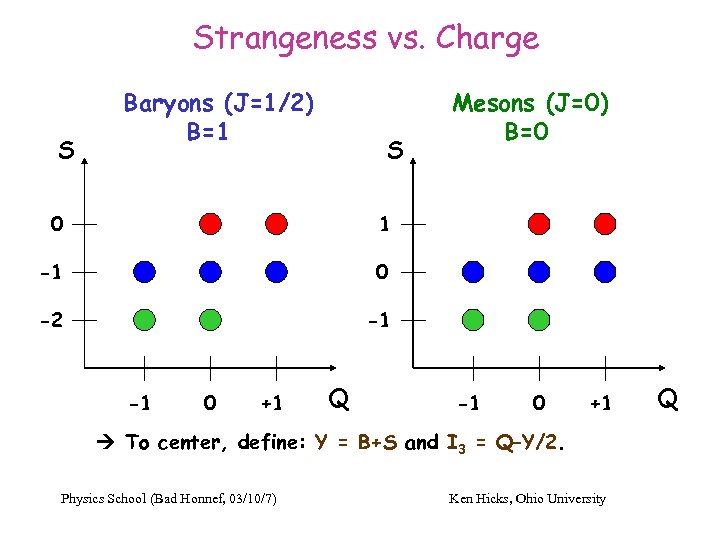 Strangeness vs. Charge S Baryons (J=1/2) B=1 S 0 1 -1 0 -2 Mesons (J=0) B=0 -1 -1 0 +1 Q -1 0 +1 To center, define: Y = B+S and I 3 = Q–Y/2. Physics School (Bad Honnef, 03/10/7) Ken Hicks, Ohio University Q
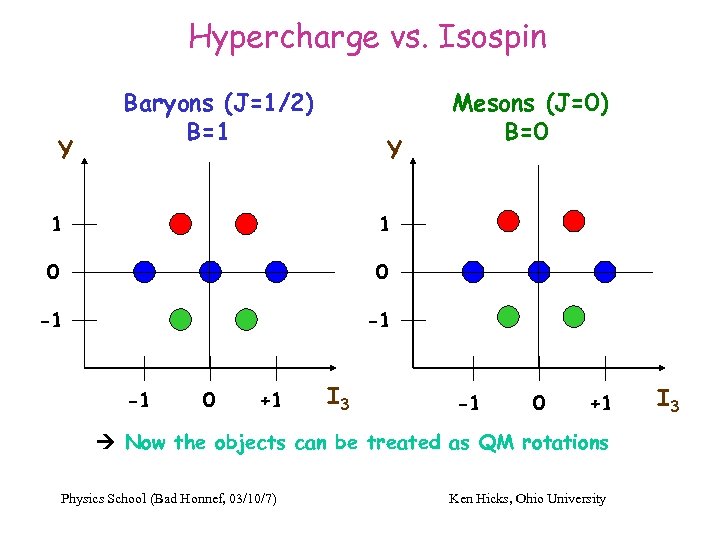 Hypercharge vs. Isospin Y Baryons (J=1/2) B=1 Y 1 1 0 0 -1 Mesons (J=0) B=0 -1 -1 0 +1 I 3 -1 0 +1 Now the objects can be treated as QM rotations Physics School (Bad Honnef, 03/10/7) Ken Hicks, Ohio University I 3
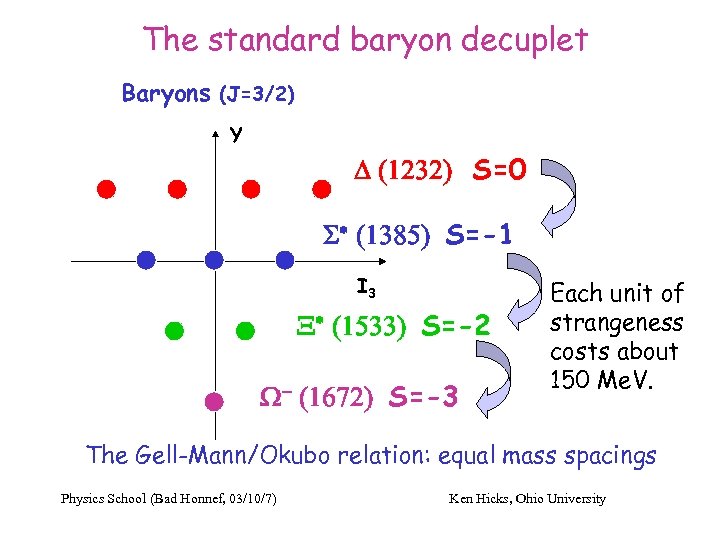 The standard baryon decuplet Baryons (J=3/2) Y D (1232) S=0 S* (1385) S=-1 I 3 X* (1533) S=-2 W- (1672) S=-3 Each unit of strangeness costs about 150 Me. V. The Gell-Mann/Okubo relation: equal mass spacings Physics School (Bad Honnef, 03/10/7) Ken Hicks, Ohio University
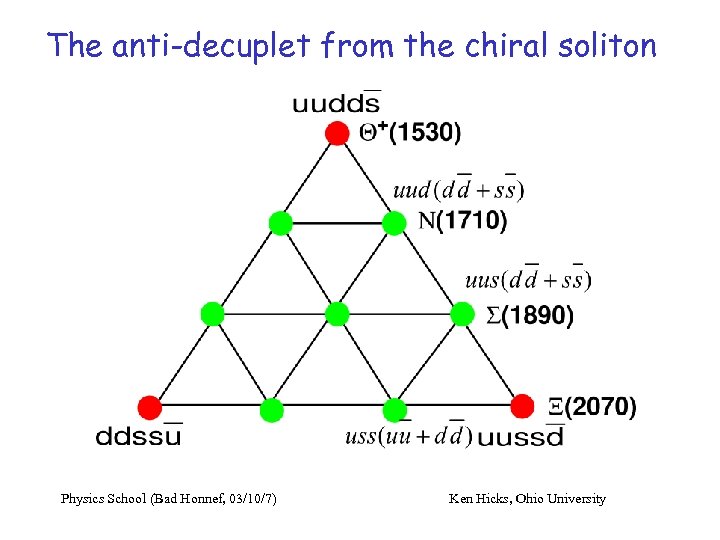 The anti-decuplet from the chiral soliton Physics School (Bad Honnef, 03/10/7) Ken Hicks, Ohio University
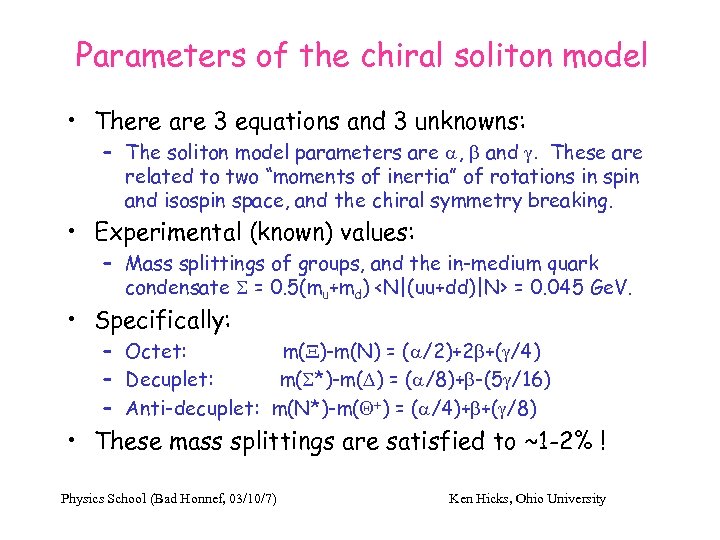 Parameters of the chiral soliton model • There are 3 equations and 3 unknowns: – The soliton model parameters are a, b and g. These are related to two “moments of inertia” of rotations in spin and isospin space, and the chiral symmetry breaking. • Experimental (known) values: – Mass splittings of groups, and the in-medium quark condensate S = 0. 5(mu+md)
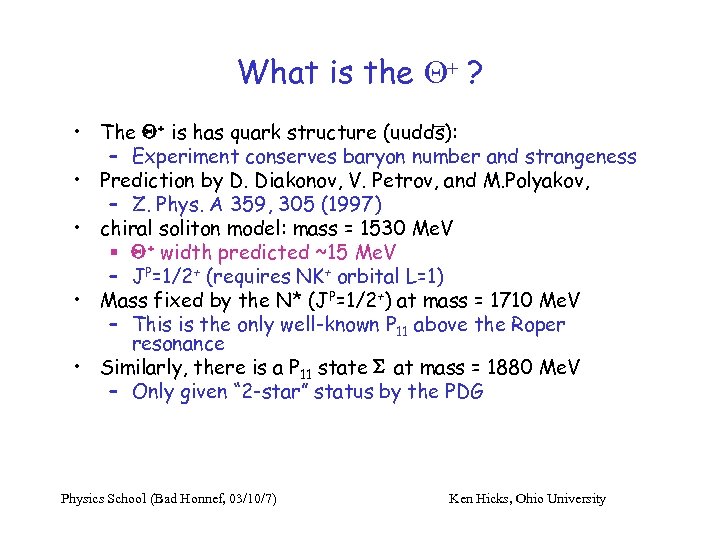 What is the Q+ ? • The Q+ is has quark structure (uudds): – Experiment conserves baryon number and strangeness • Prediction by D. Diakonov, V. Petrov, and M. Polyakov, – Z. Phys. A 359, 305 (1997) • chiral soliton model: mass = 1530 Me. V § Q+ width predicted ~15 Me. V – JP=1/2+ (requires NK+ orbital L=1) • Mass fixed by the N* (JP=1/2+) at mass = 1710 Me. V – This is the only well-known P 11 above the Roper resonance • Similarly, there is a P 11 state S at mass = 1880 Me. V – Only given “ 2 -star” status by the PDG Physics School (Bad Honnef, 03/10/7) Ken Hicks, Ohio University
 Why is the Q+ important? • QCD does not prohibit q 4 q states, but early searches failed to produce evidence for pentaquarks. This led people to believe that all baryonic matter comes in only one form: 3 -quark states. • The Q+, if found, is the first hard evidence of a new class of particle: the pentaquark. • One of the central activities at Jefferson Lab is to understand N* resonances. Do pentaquarks contribute to the resonance spectrum? Physics School (Bad Honnef, 03/10/7) Ken Hicks, Ohio University
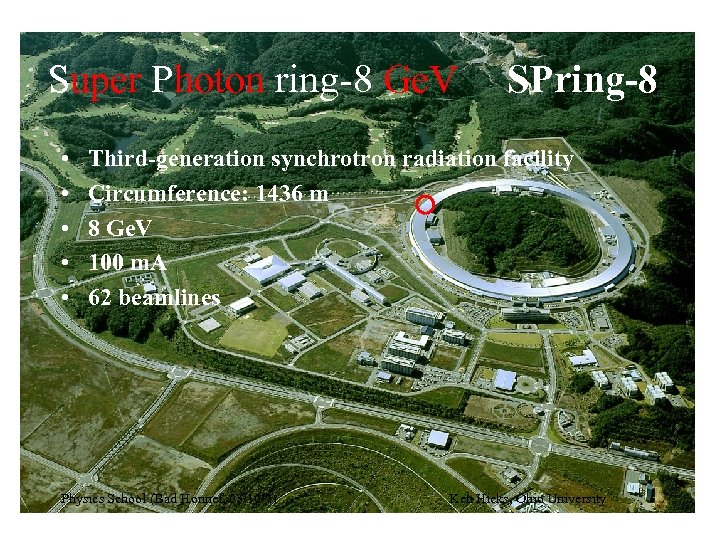 Super Photon ring-8 Ge. V • • • SPring-8 Third-generation synchrotron radiation facility Circumference: 1436 m 8 Ge. V 100 m. A 62 beamlines Physics School (Bad Honnef, 03/10/7) Ken Hicks, Ohio University
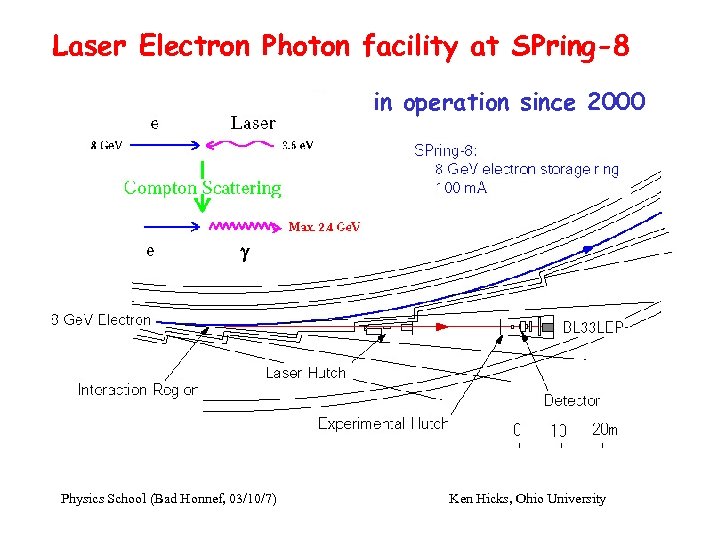 Laser Electron Photon facility at SPring-8 in operation since 2000 g Physics School (Bad Honnef, 03/10/7) Ken Hicks, Ohio University
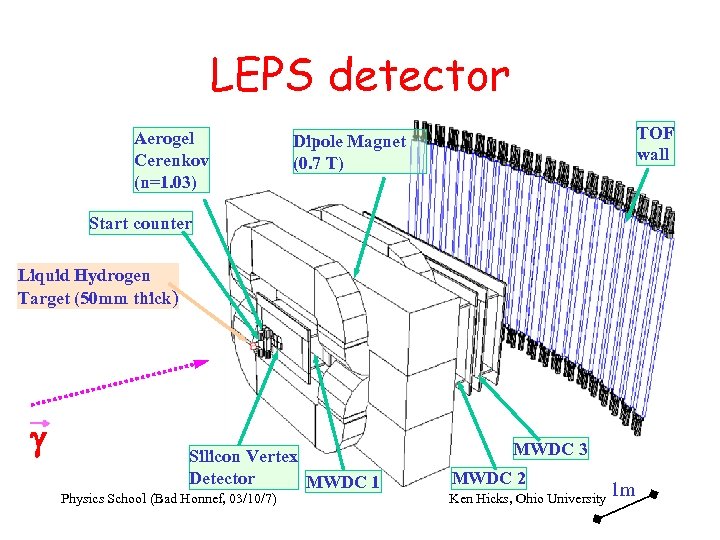 LEPS detector Aerogel Cerenkov (n=1. 03) TOF wall Dipole Magnet (0. 7 T) Start counter Liquid Hydrogen Target (50 mm thick) g Silicon Vertex Detector MWDC 1 Physics School (Bad Honnef, 03/10/7) MWDC 3 MWDC 2 Ken Hicks, Ohio University 1 m
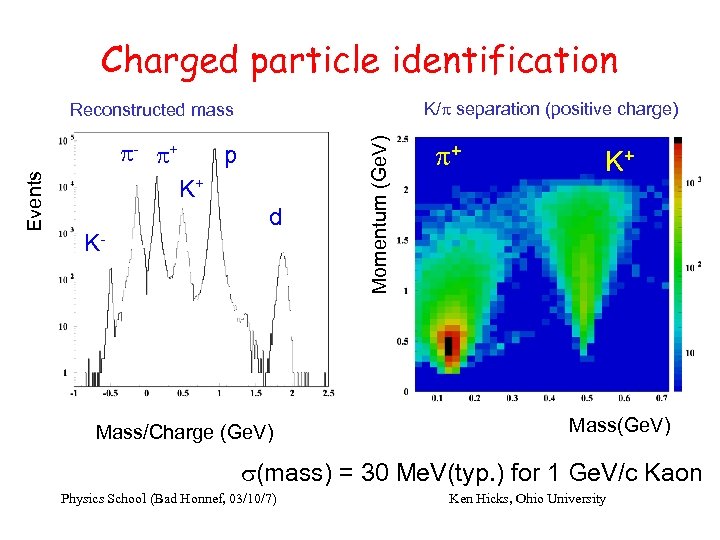 Charged particle identification K/p separation (positive charge) Events p- p+ p K+ K- d Mass/Charge (Ge. V) Momentum (Ge. V) Reconstructed mass p+ K+ Mass(Ge. V) s(mass) = 30 Me. V(typ. ) for 1 Ge. V/c Kaon Physics School (Bad Honnef, 03/10/7) Ken Hicks, Ohio University
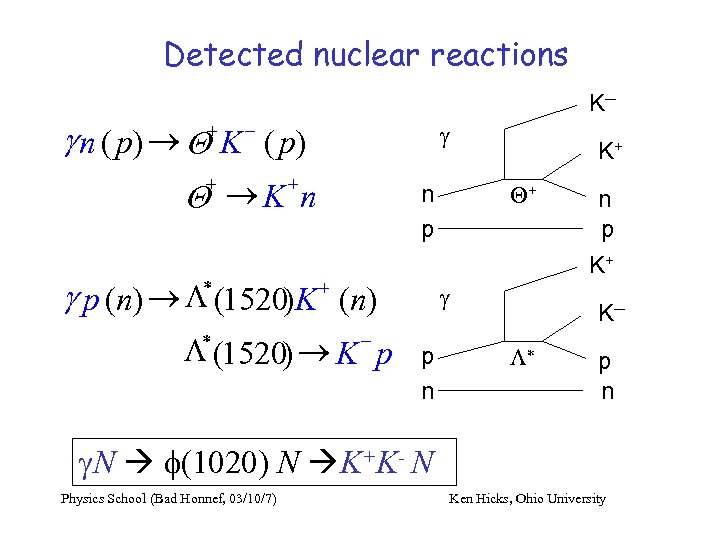 Detected nuclear reactions K─ g n ( p) ® Q K ( p) + - g + ® K +n Q Q+ n p - L (1520) ® K p n p K+ g p (n) ® L* (1520)K + (n) * K+ g p n K─ L* p n g. N f(1020) N K+K- N Physics School (Bad Honnef, 03/10/7) Ken Hicks, Ohio University
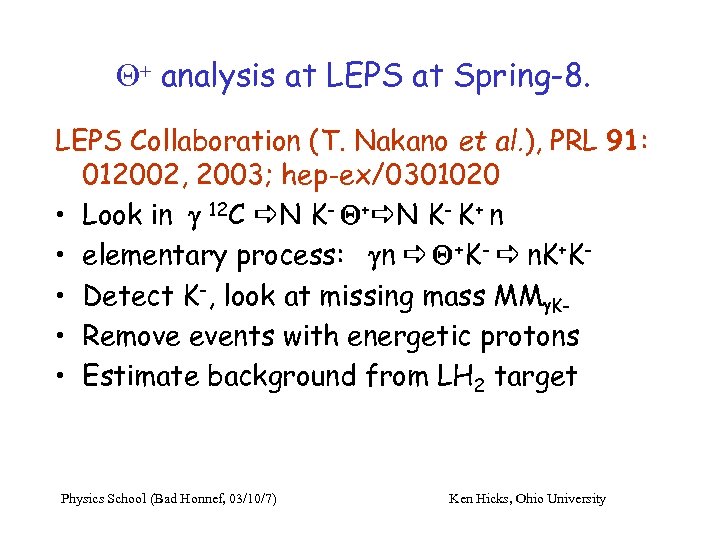 Q+ analysis at LEPS at Spring-8. LEPS Collaboration (T. Nakano et al. ), PRL 91: 012002, 2003; hep-ex/0301020 • Look in g 12 C a. N K- Q+a. N K- K+ n • elementary process: gn a Q+K- a n. K+K • Detect K-, look at missing mass MMg. K • Remove events with energetic protons • Estimate background from LH 2 target Physics School (Bad Honnef, 03/10/7) Ken Hicks, Ohio University
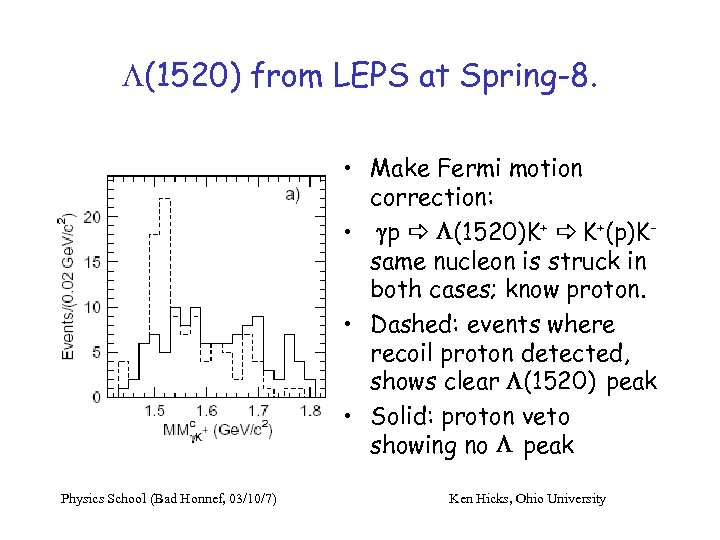 L(1520) from LEPS at Spring-8. • Make Fermi motion correction: • gp a L(1520)K+ a K+(p)Ksame nucleon is struck in both cases; know proton. • Dashed: events where recoil proton detected, shows clear L(1520) peak • Solid: proton veto showing no L peak Physics School (Bad Honnef, 03/10/7) Ken Hicks, Ohio University
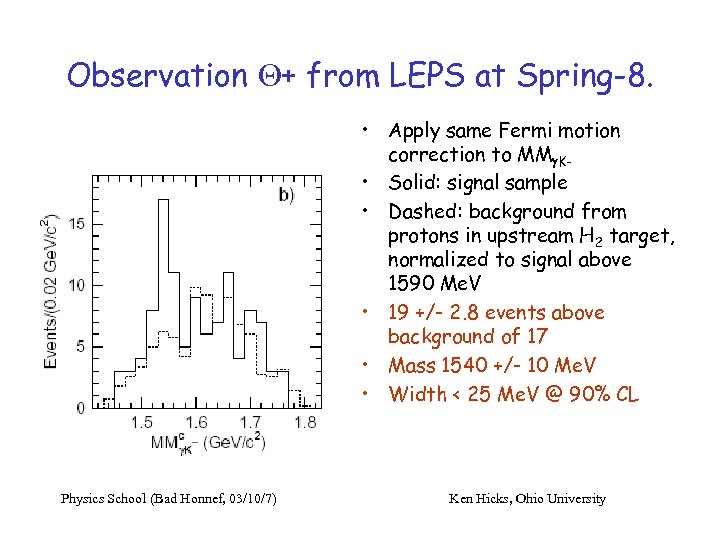 Observation Q+ from LEPS at Spring-8. • Apply same Fermi motion correction to MMg. K • Solid: signal sample • Dashed: background from protons in upstream H 2 target, normalized to signal above 1590 Me. V • 19 +/- 2. 8 events above background of 17 • Mass 1540 +/- 10 Me. V • Width < 25 Me. V @ 90% CL Physics School (Bad Honnef, 03/10/7) Ken Hicks, Ohio University
 Q+ from DIANA@ITEP… • DIANA Collaboration hep-ex/0304040 • Xe bubble chamber, 850 Me. V K+ beam from proton synchrotron at ITEP • K+ Xe a Q+ Xe’ a (K 0 p) Xe’ – 1539 +/- 2 Me. V, width < 9 Me. V (detector resolution), statistical significance 4. 4 s. • Criticism: not exclusive final state… Physics School (Bad Honnef, 03/10/7) Ken Hicks, Ohio University
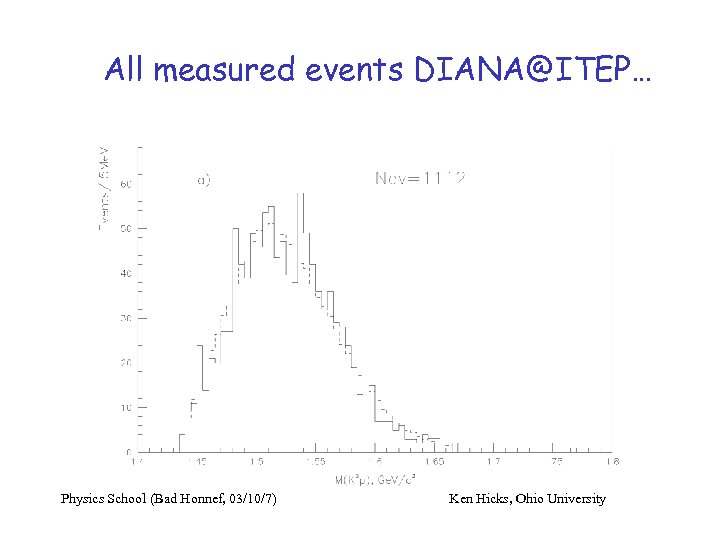 All measured events DIANA@ITEP… Physics School (Bad Honnef, 03/10/7) Ken Hicks, Ohio University
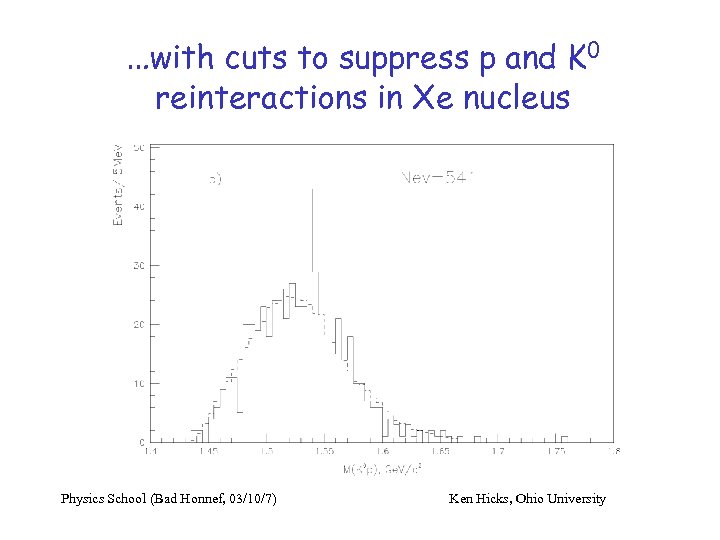 …with cuts to suppress p and K 0 reinteractions in Xe nucleus Physics School (Bad Honnef, 03/10/7) Ken Hicks, Ohio University
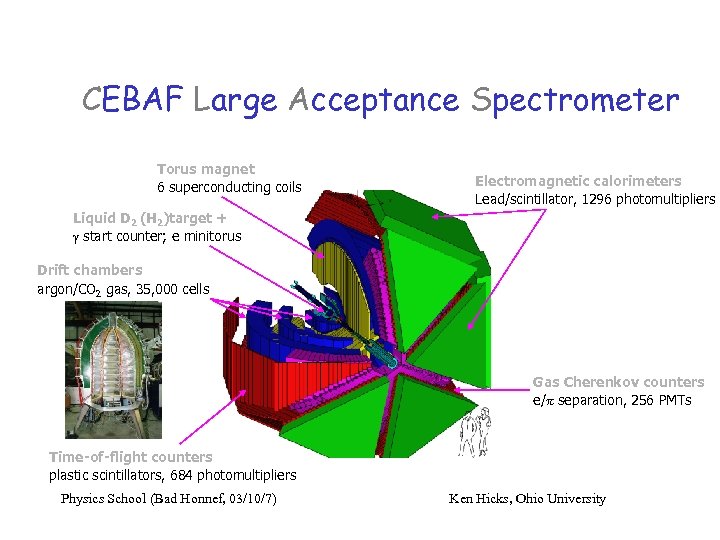 CEBAF Large Acceptance Spectrometer Torus magnet 6 superconducting coils Electromagnetic calorimeters Lead/scintillator, 1296 photomultipliers Liquid D 2 (H 2)target + g start counter; e minitorus Drift chambers argon/CO 2 gas, 35, 000 cells Gas Cherenkov counters e/p separation, 256 PMTs Time-of-flight counters plastic scintillators, 684 photomultipliers Physics School (Bad Honnef, 03/10/7) Ken Hicks, Ohio University
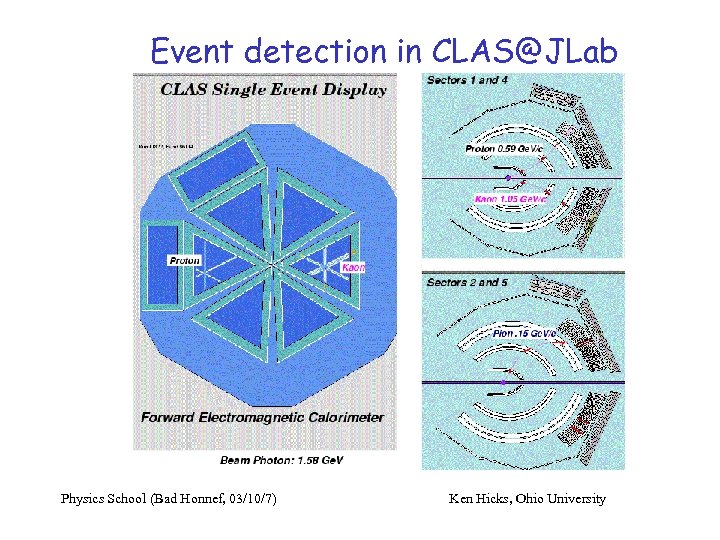 Event detection in CLAS@JLab Physics School (Bad Honnef, 03/10/7) Ken Hicks, Ohio University
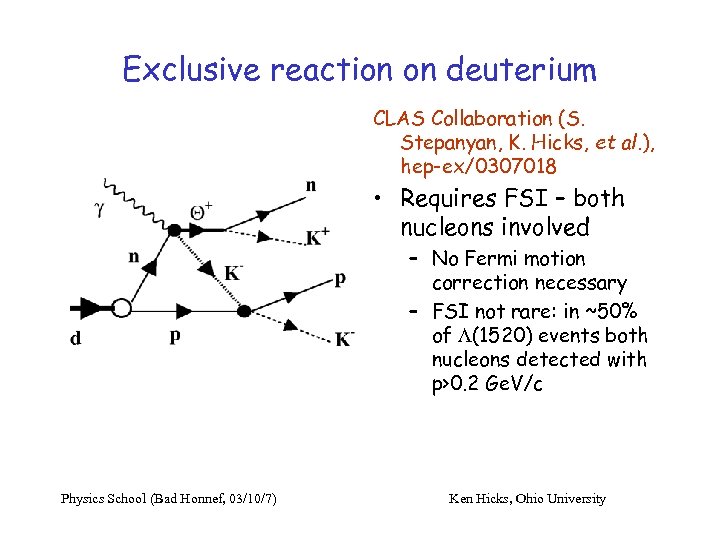 Exclusive reaction on deuterium CLAS Collaboration (S. Stepanyan, K. Hicks, et al. ), hep-ex/0307018 • Requires FSI – both nucleons involved – No Fermi motion correction necessary – FSI not rare: in ~50% of L(1520) events both nucleons detected with p>0. 2 Ge. V/c Physics School (Bad Honnef, 03/10/7) Ken Hicks, Ohio University
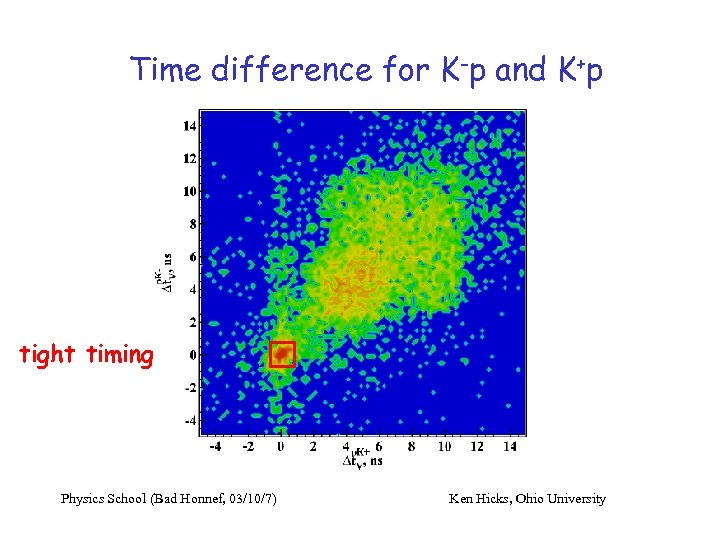 Time difference for K-p and K+p tight timing Physics School (Bad Honnef, 03/10/7) Ken Hicks, Ohio University
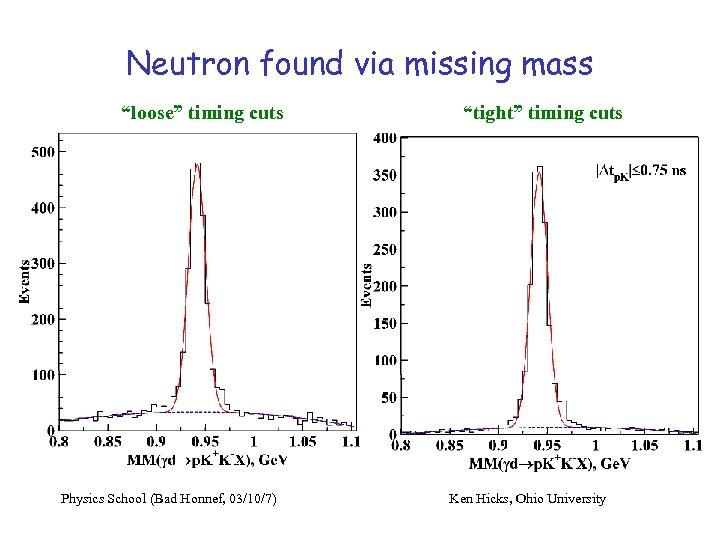 Neutron found via missing mass “loose” timing cuts Physics School (Bad Honnef, 03/10/7) “tight” timing cuts Ken Hicks, Ohio University
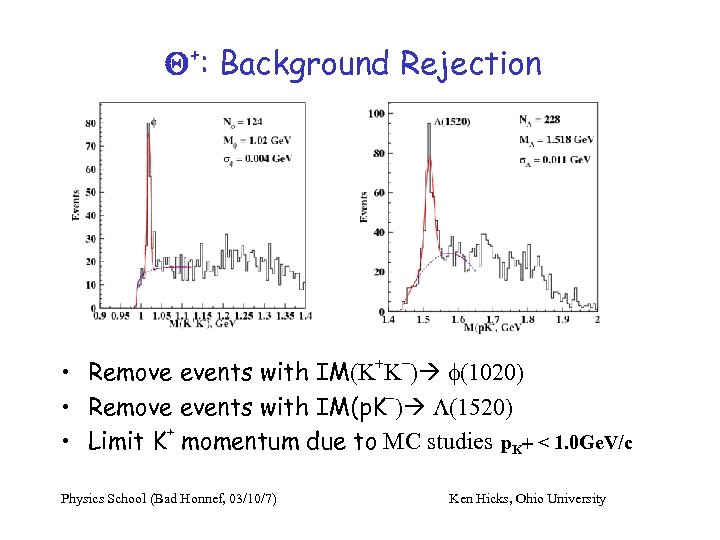 Q+: Background Rejection • Remove events with IM(K+K-) f(1020) • Remove events with IM(p. K-) L(1520) • Limit K+ momentum due to MC studies p. K+ < 1. 0 Ge. V/c Physics School (Bad Honnef, 03/10/7) Ken Hicks, Ohio University
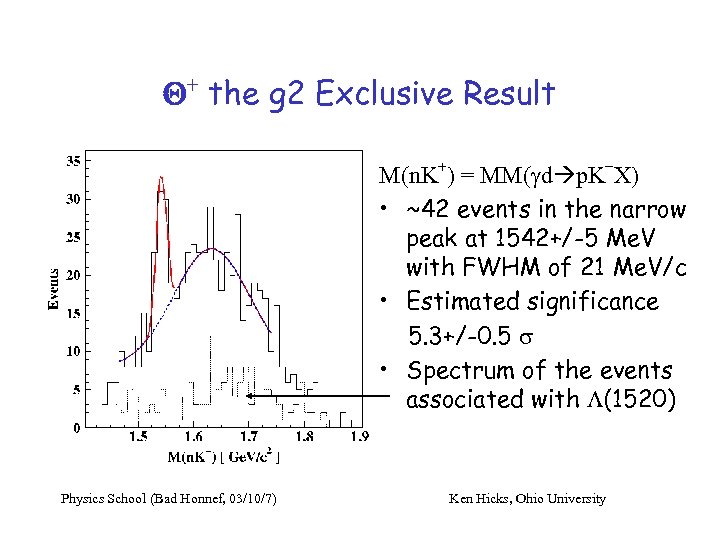 Q+ the g 2 Exclusive Result M(n. K+) = MM(gd p. K-X) • ~42 events in the narrow peak at 1542+/-5 Me. V with FWHM of 21 Me. V/c • Estimated significance 5. 3+/-0. 5 s • Spectrum of the events associated with L(1520) Physics School (Bad Honnef, 03/10/7) Ken Hicks, Ohio University
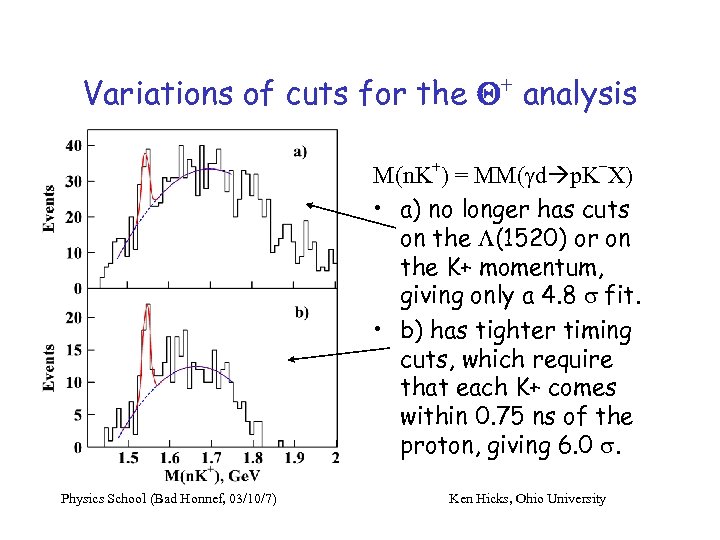 Variations of cuts for the Q+ analysis M(n. K+) = MM(gd p. K-X) • a) no longer has cuts on the L(1520) or on the K+ momentum, giving only a 4. 8 s fit. • b) has tighter timing cuts, which require that each K+ comes within 0. 75 ns of the proton, giving 6. 0 s. Physics School (Bad Honnef, 03/10/7) Ken Hicks, Ohio University
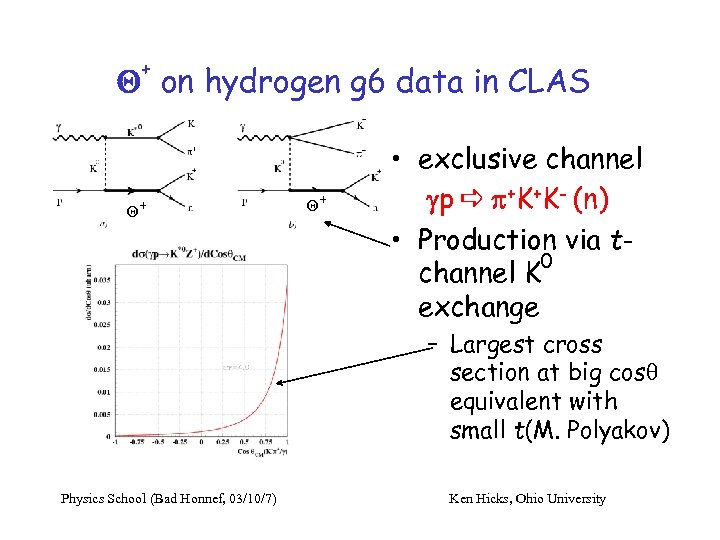 + Q on hydrogen g 6 data in CLAS Q + • exclusive channel gp a p+K+K- (n) • Production via t 0 channel K exchange – Largest cross section at big cosq equivalent with small t(M. Polyakov) Physics School (Bad Honnef, 03/10/7) Ken Hicks, Ohio University
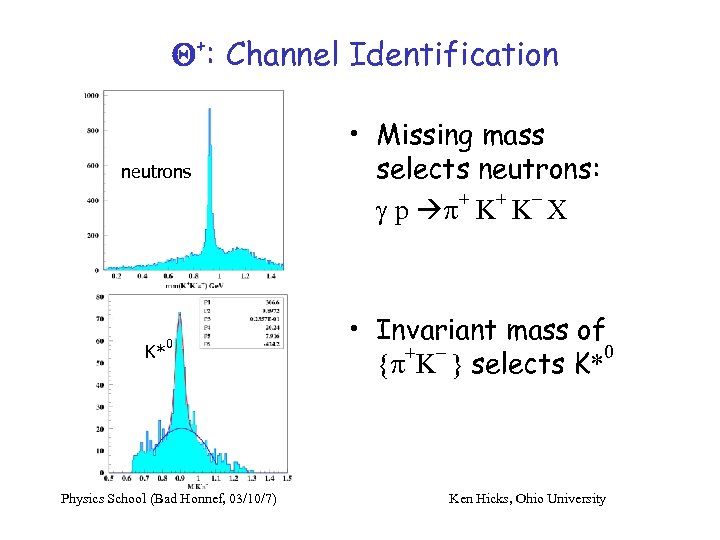 Q+: Channel Identification neutrons K* 0 Physics School (Bad Honnef, 03/10/7) • Missing mass selects neutrons: + + g p p K K X • Invariant mass of 0 + {p K } selects K* Ken Hicks, Ohio University
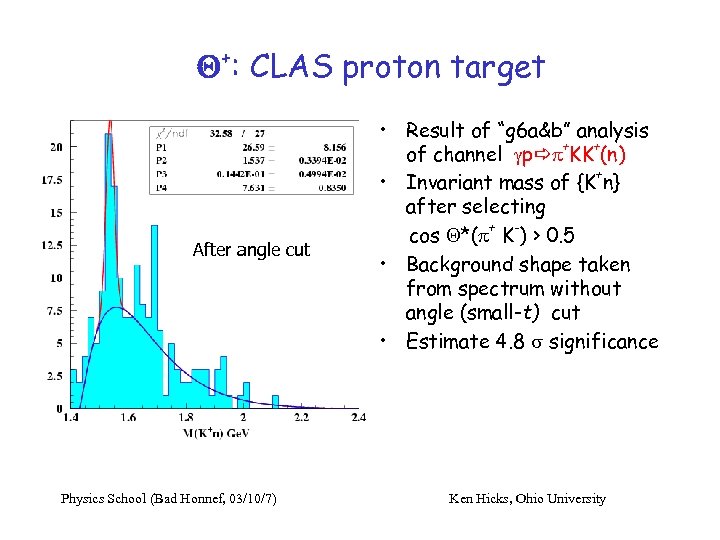 Q+: CLAS proton target After angle cut Physics School (Bad Honnef, 03/10/7) • Result of “g 6 a&b” analysis of channel gpap+KK+(n) • Invariant mass of {K+n} after selecting cos Q*(p+ K-) > 0. 5 • Background shape taken from spectrum without angle (small-t) cut • Estimate 4. 8 s significance Ken Hicks, Ohio University
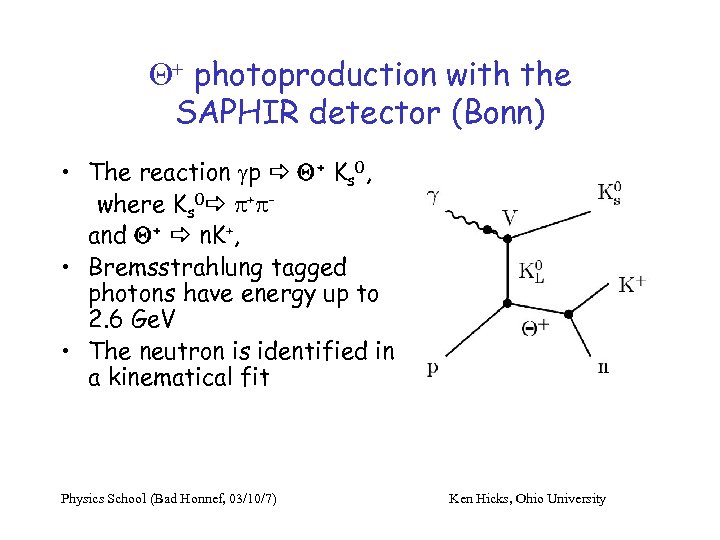 Q+ photoproduction with the SAPHIR detector (Bonn) • The reaction gp a Q+ Ks 0, where Ks 0 a p+pand Q+ a n. K+, • Bremsstrahlung tagged photons have energy up to 2. 6 Ge. V • The neutron is identified in a kinematical fit Physics School (Bad Honnef, 03/10/7) Ken Hicks, Ohio University
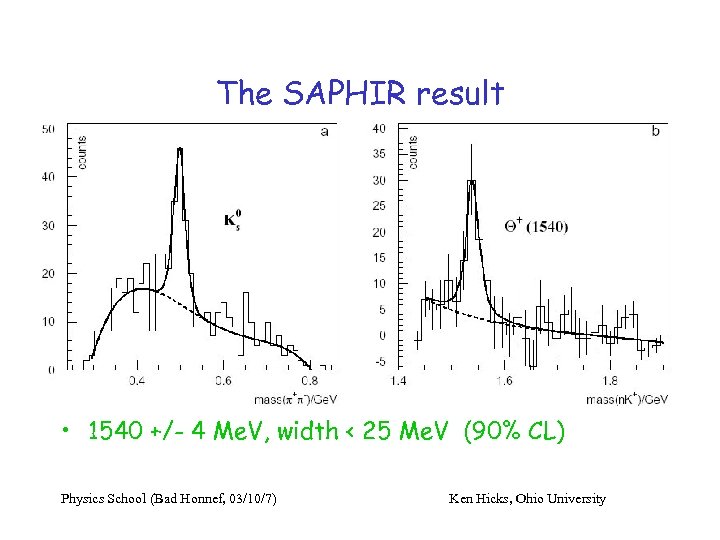 The SAPHIR result • 1540 +/- 4 Me. V, width < 25 Me. V (90% CL) Physics School (Bad Honnef, 03/10/7) Ken Hicks, Ohio University
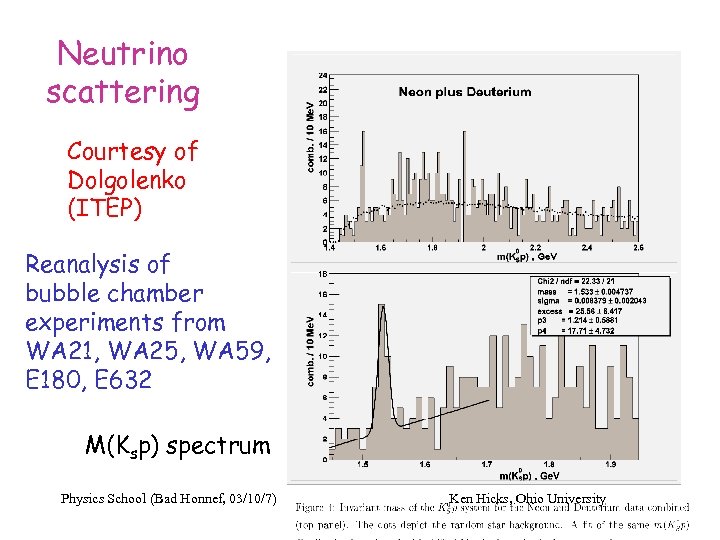 Neutrino scattering Courtesy of Dolgolenko (ITEP) Reanalysis of bubble chamber experiments from WA 21, WA 25, WA 59, E 180, E 632 M(Ksp) spectrum Physics School (Bad Honnef, 03/10/7) Ken Hicks, Ohio University
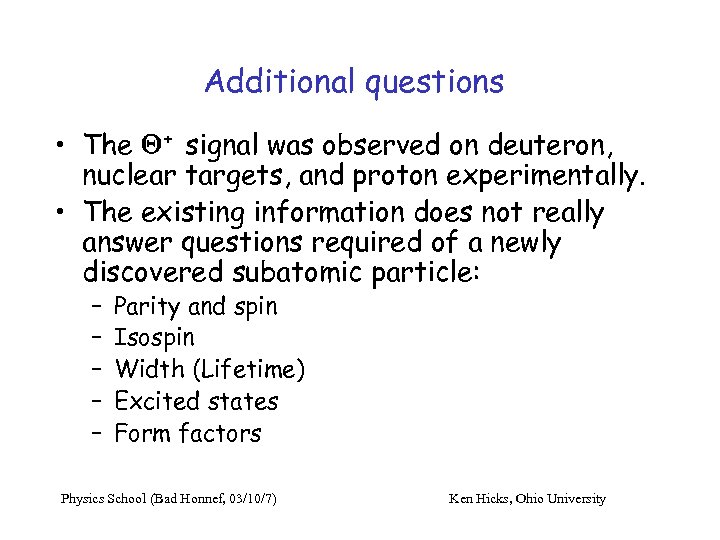 Additional questions • The Q+ signal was observed on deuteron, nuclear targets, and proton experimentally. • The existing information does not really answer questions required of a newly discovered subatomic particle: – – – Parity and spin Isospin Width (Lifetime) Excited states Form factors Physics School (Bad Honnef, 03/10/7) Ken Hicks, Ohio University
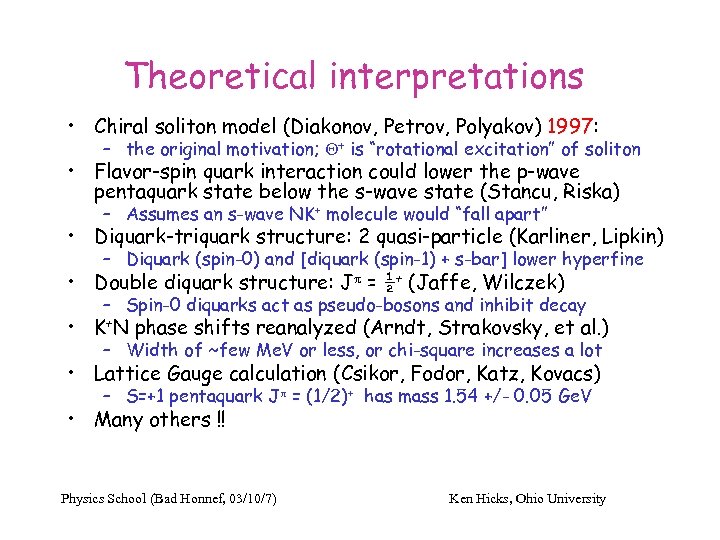 Theoretical interpretations • Chiral soliton model (Diakonov, Petrov, Polyakov) 1997: – the original motivation; Q+ is “rotational excitation” of soliton • Flavor-spin quark interaction could lower the p-wave pentaquark state below the s-wave state (Stancu, Riska) – Assumes an s-wave NK+ molecule would “fall apart” • Diquark-triquark structure: 2 quasi-particle (Karliner, Lipkin) – Diquark (spin-0) and [diquark (spin-1) + s-bar] lower hyperfine • Double diquark structure: Jp = ½+ (Jaffe, Wilczek) – Spin-0 diquarks act as pseudo-bosons and inhibit decay • K+N phase shifts reanalyzed (Arndt, Strakovsky, et al. ) – Width of ~few Me. V or less, or chi-square increases a lot • Lattice Gauge calculation (Csikor, Fodor, Katz, Kovacs) – S=+1 pentaquark Jp = (1/2)+ has mass 1. 54 +/- 0. 05 Ge. V • Many others !! Physics School (Bad Honnef, 03/10/7) Ken Hicks, Ohio University
 What is next at CLAS? • New data set being analyzed – Will double the statistics. • New experiment E 03 -113 (Hicks/Stepanyan) approved by PAC, to run in February 2004 – will provide 20 x more statistics. – obtain angular distribution of the decay of Q+ as well as the energy dependence of the cross section. • Continuing analysis effort with existing data gp K 0 Q+ shows surprising cross section suppression Physics School (Bad Honnef, 03/10/7) Ken Hicks, Ohio University
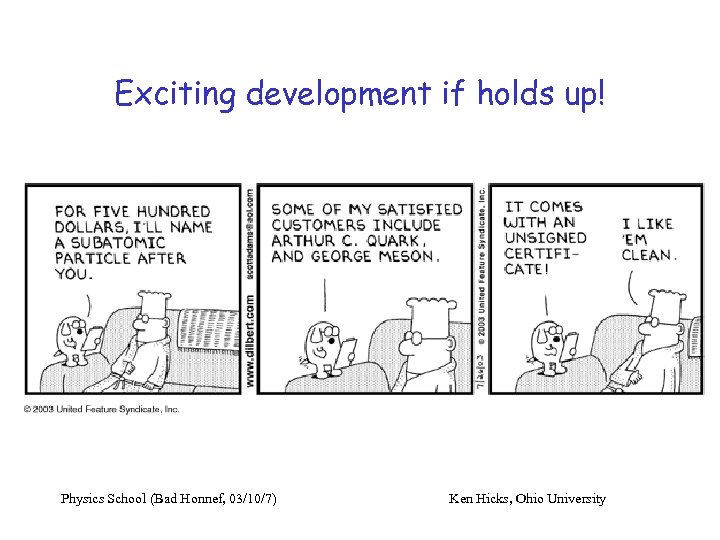 Exciting development if holds up! Physics School (Bad Honnef, 03/10/7) Ken Hicks, Ohio University