


 Скачать презентацию The Patent Process Mark R Powell U S
c5d04487666b7310491e52718c61a1b1.ppt
- Количество слайдов: 34
 The Patent Process Mark R. Powell U. S. Patent & Trademark Office
 Forms of Intellectual Property • • Patents Trademarks Copyrights Trade Secrets
 Patents • • Historical Context Definition Federal Statutes 35 U. S. C. Court of Appeals for the Federal Circuit
 Patenting vs. Trade Secrets • The bargain: protection of the invention as a reward for disclosing it to others • How this advances technology in general
 What Patents Can Protect • Virtually any item, compound, or process made by man • Exceptions vary by laws of individual countries
 Timelines • In general, one year limit from public disclosure to filing • Invention “for sale” starts the bar even if discussions private • Invention recordation at Science Centers may begin critical one-year period
 Types of Applications • • • Utility Designs Plant Provisional Applications Continuing Applications
 Patent Applications • Title, abstract, declaratory documents • Specification – Background – Summary of Invention – Detailed description and drawings • Claims
 Specification • What should be included • What is not necessary • Examples of inadequate disclosures resulting in invalid patents
 Claims • Exact statements of precisely what the invention encompasses • Claims are what are substantively examined and eventually allowed or finally rejected • Broad vs. narrow • Examples
 Patent Examination • Laws and regulation similar world-wide • Whole application reviewed for technicalities (regulations—form) and well as substance (patentability) • Search • Action rendered by examiner
 Conclusion of Examination • • • Allowance Final rejection Appeal Filing of continuing applications Abandonment
 Patent Allowed to Issue • Means that you can prevent others from practicing the invention covered by the claims • Does not necessarily mean that you can practice it yourself • Licensing or sale of patent rights
 Inventorship • Those who contribute ideas that are embodied in the claims • A sole inventor must have conceived the ideas in all claims • Those who contribute ideas, but whose ideas don’t make into claims are not inventors
 Introduction to the Patent Cooperation Treaty
 The Patent Cooperation Treaty • A United Nations Treaty – signed in June of 1970 at the Washington Diplomatic Conference – became operational in June of 1978 – administered by the International Bureau (IB) of the World Intellectual Property Organization (WIPO) in Geneva, Switzerland
 Purposes of the PCT • To simplify the process of filing foreign patent applications • To give every regional or national patent Office designated by the applicant the benefit of – a search by a major patent Office – an optional examination by a major patent Office
 PCT Contracting State • A country which is a signatory to the PCT • Eighteen (18) Contracting States in 1978 • Currently one hundred and twenty-three (123) Contracting States • Patent protection is available in each PCT Contracting State through either – a national patent Office – a regional patent Office – or both
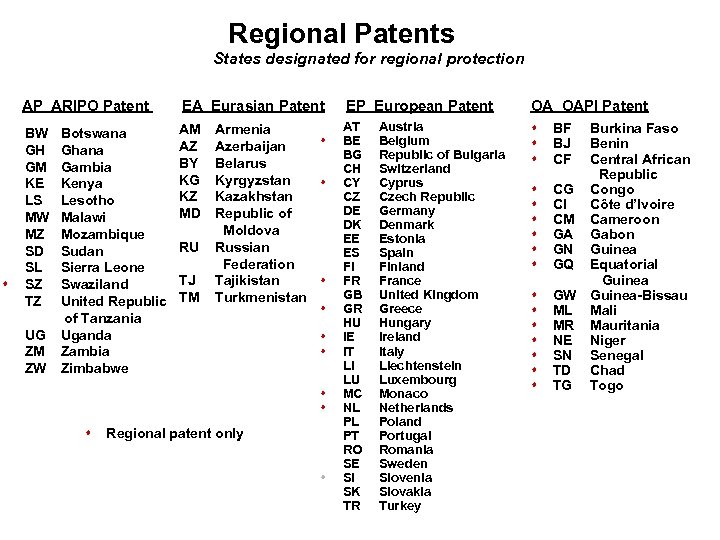 Regional Patents States designated for regional protection AP ARIPO Patent s EA Eurasian Patent EP European Patent OA OAPI Patent BW GH GM KE LS MW MZ SD SL SZ TZ AM AZ BY KG KZ MD AT BE BG CH CY CZ DE DK EE ES FI FR GB GR HU IE IT LI LU MC NL PL PT RO SE SI SK TR s s s UG ZM ZW Botswana Ghana Gambia Kenya Lesotho Malawi Mozambique Sudan Sierra Leone Swaziland United Republic of Tanzania Uganda Zambia Zimbabwe RU TJ TM Armenia s Azerbaijan Belarus Kyrgyzstan s Kazakhstan Republic of Moldova Russian Federation Tajikistan s Turkmenistan s s s Regional patent only s Austria Belgium Republic of Bulgaria Switzerland Cyprus Czech Republic Germany Denmark Estonia Spain Finland France United Kingdom Greece Hungary Ireland Italy Liechtenstein Luxembourg Monaco Netherlands Poland Portugal Romania Sweden Slovenia Slovakia Turkey s s s s BF BJ CF Burkina Faso Benin Central African Republic CG Congo CI Côte d’Ivoire CM Cameroon GA Gabon GN Guinea GQ Equatorial Guinea GW Guinea-Bissau ML Mali MR Mauritania NE Niger SN Senegal TD Chad TG Togo
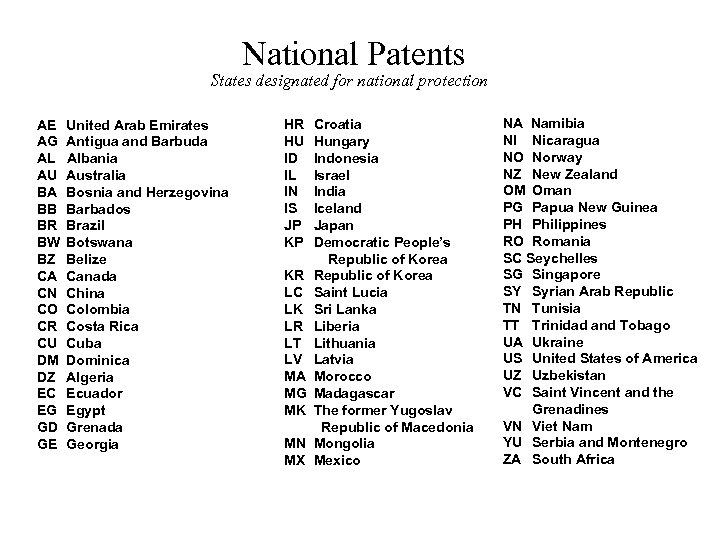 National Patents States designated for national protection AE AG AL AU BA BB BR BW BZ CA CN CO CR CU DM DZ EC EG GD GE United Arab Emirates Antigua and Barbuda Albania Australia Bosnia and Herzegovina Barbados Brazil Botswana Belize Canada China Colombia Costa Rica Cuba Dominica Algeria Ecuador Egypt Grenada Georgia HR HU ID IL IN IS JP KP KR LC LK LR LT LV MA MG MK MN MX Croatia Hungary Indonesia Israel India Iceland Japan Democratic People’s Republic of Korea Saint Lucia Sri Lanka Liberia Lithuania Latvia Morocco Madagascar The former Yugoslav Republic of Macedonia Mongolia Mexico NA Namibia NI Nicaragua NO Norway NZ New Zealand OM Oman PG Papua New Guinea PH Philippines RO Romania SC Seychelles SG Singapore SY Syrian Arab Republic TN Tunisia TT Trinidad and Tobago UA Ukraine US United States of America UZ Uzbekistan VC Saint Vincent and the Grenadines VN Viet Nam YU Serbia and Montenegro ZA South Africa
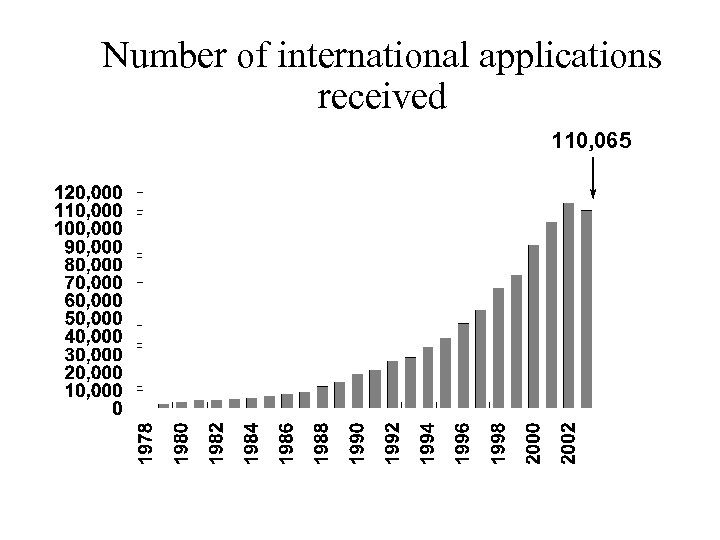 Number of international applications received 110, 065
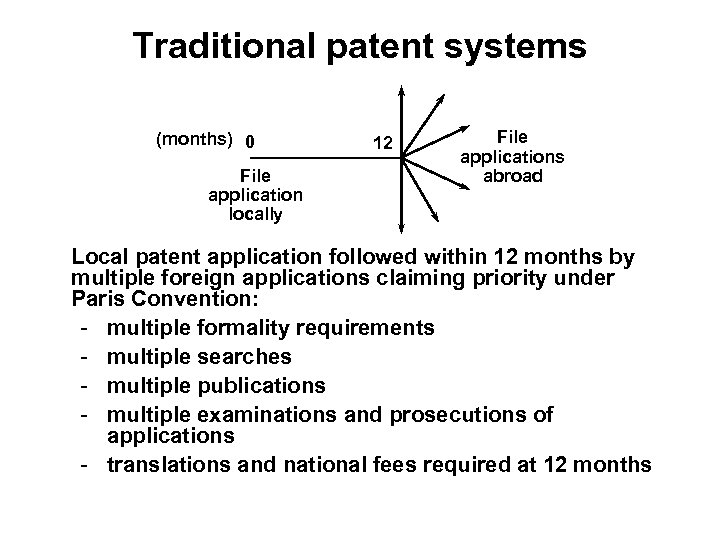 Traditional patent systems (months) 0 File application locally 12 File applications abroad Local patent application followed within 12 months by multiple foreign applications claiming priority under Paris Convention: - multiple formality requirements - multiple searches - multiple publications - multiple examinations and prosecutions of applications - translations and national fees required at 12 months
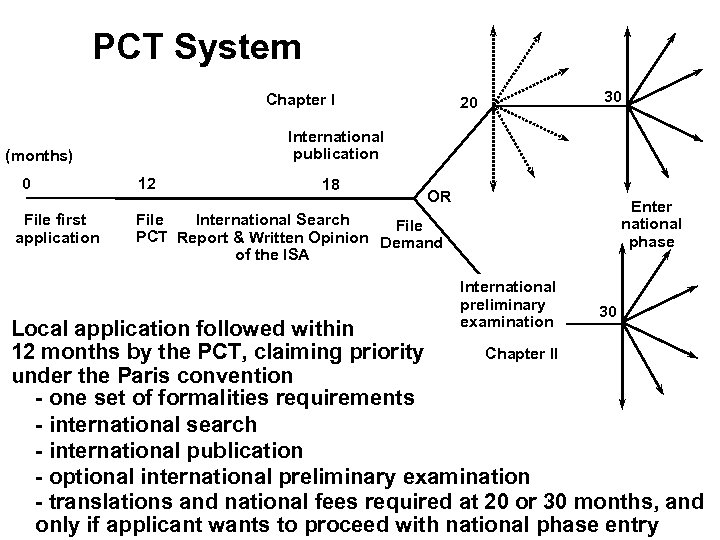 PCT System Chapter I File first application 30 International publication (months) 0 20 12 18 OR Enter national phase File International Search File PCT Report & Written Opinion Demand of the ISA International preliminary examination 30 Local application followed within Chapter II 12 months by the PCT, claiming priority under the Paris convention - one set of formalities requirements - international search - international publication - optional international preliminary examination - translations and national fees required at 20 or 30 months, and only if applicant wants to proceed with national phase entry
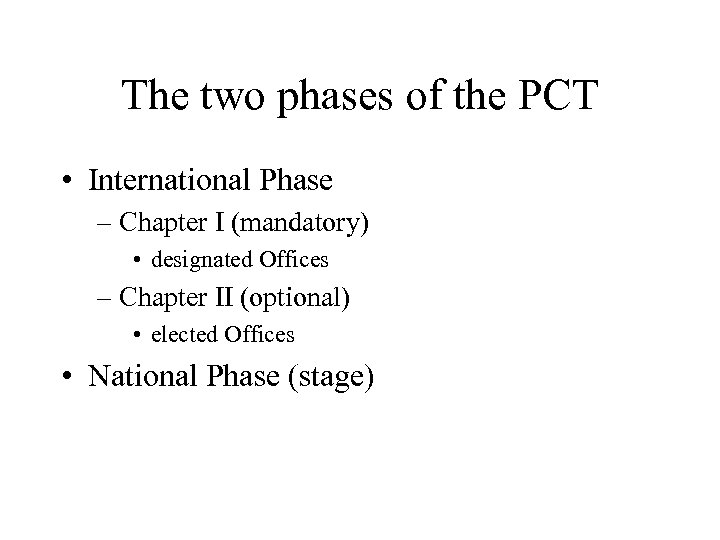 The two phases of the PCT • International Phase – Chapter I (mandatory) • designated Offices – Chapter II (optional) • elected Offices • National Phase (stage)
 The international application • A single application is – filed in one language – filed in one patent Office • the receiving Office (RO) • usually the applicant's home patent Office – treated as a national application in each designated State as of the international filing date • Compliance with the form prescribed for the international application must be accepted by all designated States during national stage
 Chapter I proceedings • International application filed • International search performed by the International Searching Authority (ISA) • International Search Report and Written Opinion of the International Searching Authority prepared • Optional amendment to the claims only – filed with the International Bureau (IB) of WIPO under Article 19 after Search Report mailed • International application, International Search Report and Article 19 amendment published by IB – published pamphlet sent to designated States by IB – Written Opinion of the International Searching Authority not published with pamphlet
 Chapter II proceedings • Demand electing at least one eligible State is filed with a competent International Preliminary Examining Authority (IPEA) – may include amendments to description, claims and drawings under Article 34 • Written Opinion of the International Searching Authority is considered the Written Opinion of the IPEA • A second Written Opinion will be prepared only in very rare circumstances • International Preliminary Report On Patentability or “IPRP” (form PCT/IPEA/409) is – prepared by IPEA and sent to applicant and IB – sent to elected States by IB
 Steps for national stage entry • Prepare translations of the international application into languages required by the desired patent offices as applicable – translations should be “accurate” – amendments, even those considered to be minor in nature, should not be made to the translation • applicant may file amendments to the application in each DO/EO • Transmit translation and necessary fees to each desired national or regional patent office previously designated/elected
 Purpose of national phase • Once national phase entry requirements have been met, each designated/elected Office decides whether to grant a patent or reject the claims
 Advantages of the PCT • To file in up to 123 countries with a single international application • To delay the expenses associated with – translations – foreign filing fees – local associates • To provide an early indication of pertinent prior art • To give extra time for assessment of commercial viability in designated States
 January 2004 changes • Enhanced international search and preliminary examination (EISPE) system • Change to time limit for filing a demand for international preliminary examination • Automatic designation and election of Contracting States • Simplified fee system
 PCT resources • PCT and Regulations under the PCT, the PCT Newsletter, the PCT Applicant's Guide, etc. , available on the Internet at the following URL: http: //www. wipo. int/pct/en/index. html
 Contact Information mark. powell@uspto. gov www. uspto. gov
 Thank You!