


 Скачать презентацию The Passive Voice Страдательный Залог Tense Formation
Passive Voice.ppt
- Количество слайдов: 17
 The Passive Voice Страдательный Залог
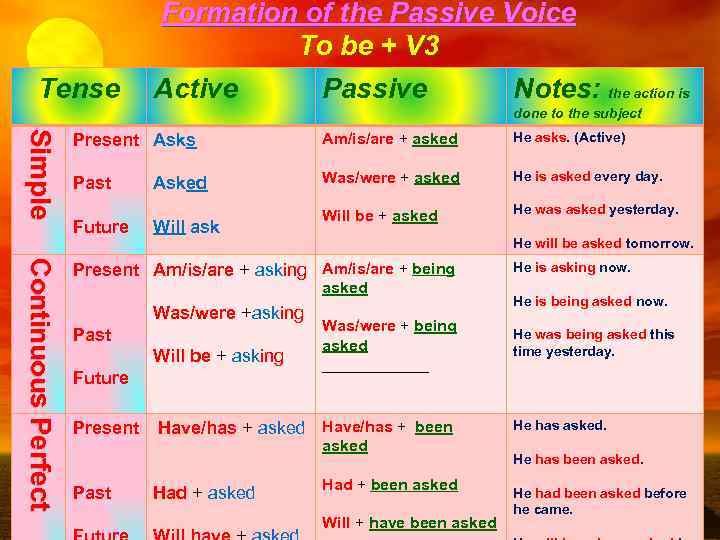 Tense Formation of the Passive Voice To be + V 3 Active Passive Notes: the action is done to the subject Simple Present Asks Am/is/are + asked He asks. (Active) Past Was/were + asked He is asked every day. Will be + asked He was asked yesterday. Future Asked Will ask He will be asked tomorrow. Continuous Perfect Present Am/is/are + asking Am/is/are + being asked Was/were +asking Past Will be + asking Future Present Past Was/were + being asked ______ Have/has + asked Have/has + been asked Had + been asked Will + have been asked He is asking now. He is being asked now. He was being asked this time yesterday. He has asked. He has been asked. He had been asked before he came.
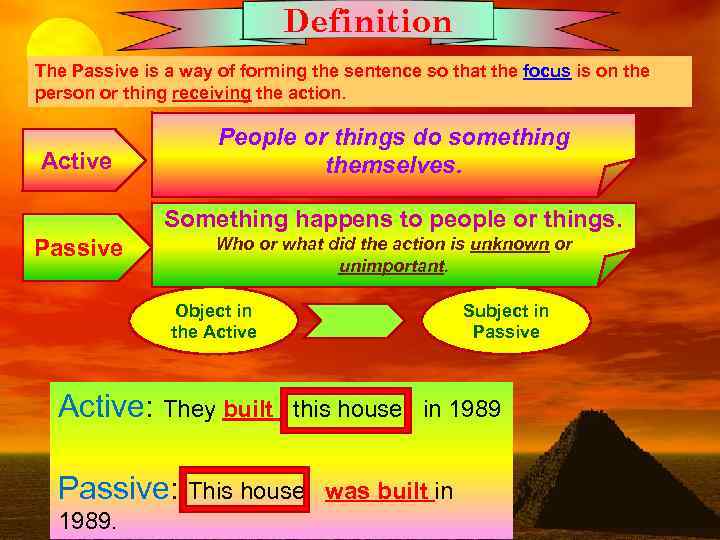 Definition The Passive is a way of forming the sentence so that the focus is on the person or thing receiving the action. Active People or things do something themselves. Something happens to people or things. Passive Who or what did the action is unknown or unimportant. Object in the Active: They built Subject in Passive this house in 1989 Passive: This house 1989. was built in
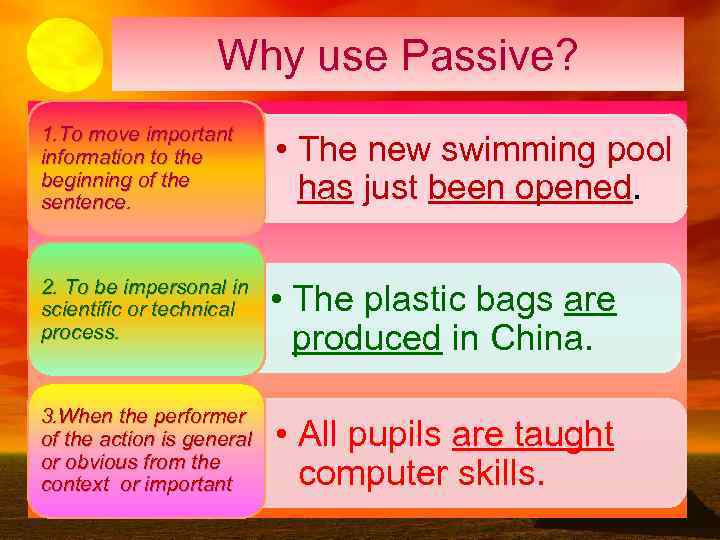 Why use Passive? 1. To move important information to the beginning of the sentence. • The new swimming pool has just been opened. 2. To be impersonal in scientific or technical process. • The plastic bags are produced in China. 3. When the performer of the action is general or obvious from the context or important • All pupils are taught computer skills.
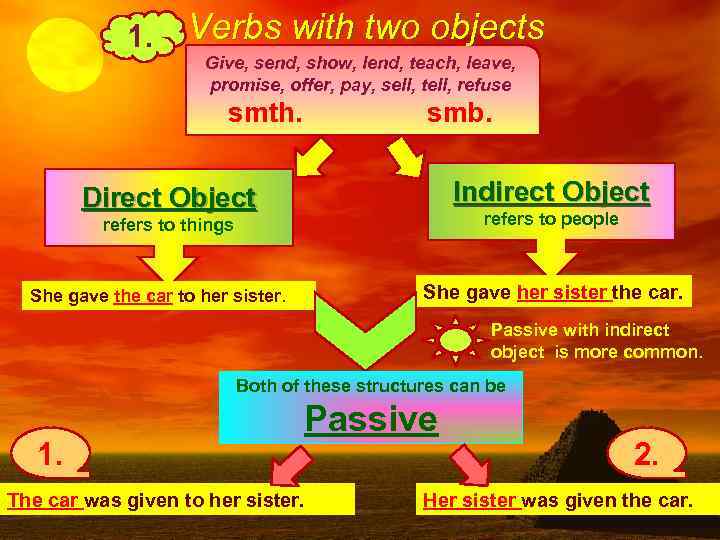 1. Verbs with two objects Give, send, show, lend, teach, leave, promise, offer, pay, sell, tell, refuse smth. smb. Indirect Object Direct Object refers to people refers to things She gave her sister the car. She gave the car to her sister. Passive with indirect object is more common. Both of these structures can be 1. Passive The car was given to her sister. 2. Her sister was given the car.
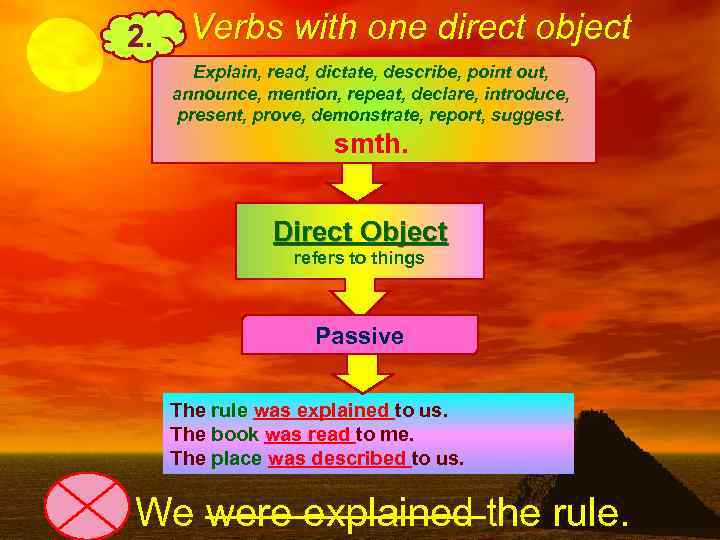 2. Verbs with one direct object Explain, read, dictate, describe, point out, announce, mention, repeat, declare, introduce, present, prove, demonstrate, report, suggest. smth. Direct Object refers to things Passive The rule was explained to us. The book was read to me. The place was described to us. We were explained the rule.
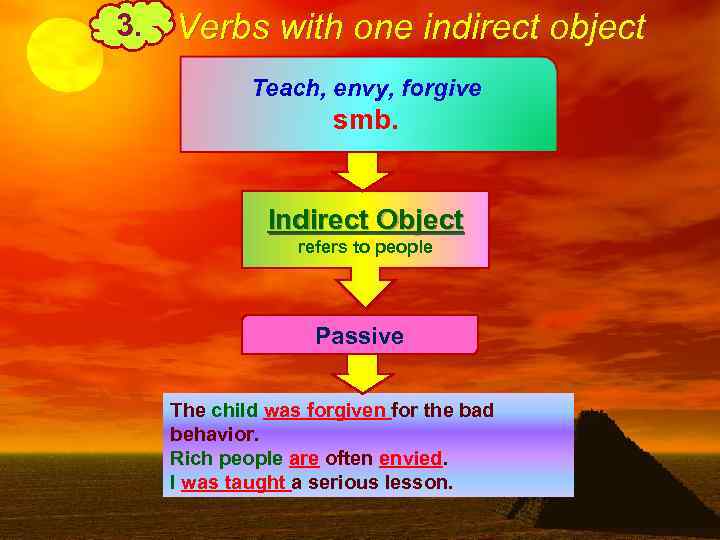 3. Verbs with one indirect object Teach, envy, forgive smb. Indirect Object refers to people Passive The child was forgiven for the bad behavior. Rich people are often envied. I was taught a serious lesson.
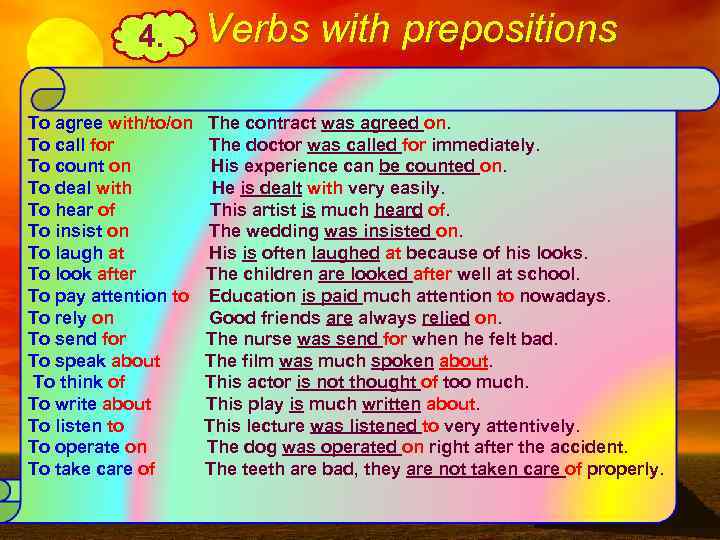 4. To agree with/to/on To call for To count on To deal with To hear of To insist on To laugh at To look after To pay attention to To rely on To send for To speak about To think of To write about To listen to To operate on To take care of Verbs with prepositions The contract was agreed on. The doctor was called for immediately. His experience can be counted on. He is dealt with very easily. This artist is much heard of. The wedding was insisted on. His is often laughed at because of his looks. The children are looked after well at school. Education is paid much attention to nowadays. Good friends are always relied on. The nurse was send for when he felt bad. The film was much spoken about. This actor is not thought of too much. This play is much written about. This lecture was listened to very attentively. The dog was operated on right after the accident. The teeth are bad, they are not taken care of properly.
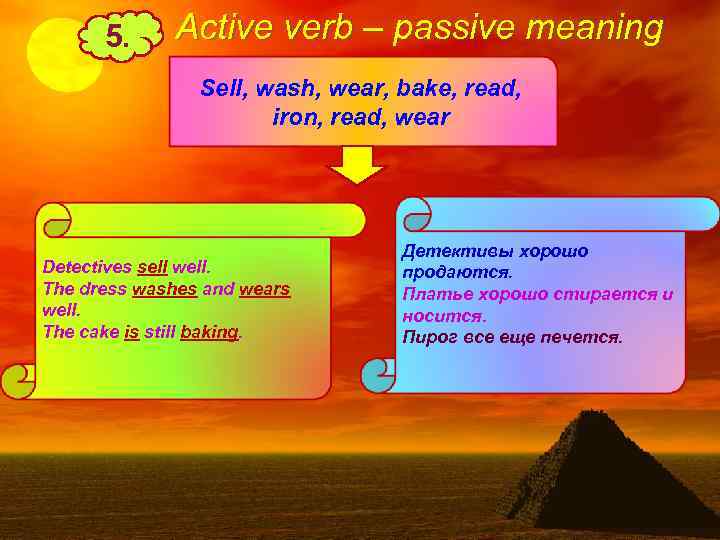 5. Active verb – passive meaning Sell, wash, wear, bake, read, iron, read, wear Detectives sell well. The dress washes and wears well. The cake is still baking. Детективы хорошо продаются. Платье хорошо стирается и носится. Пирог все еще печется.
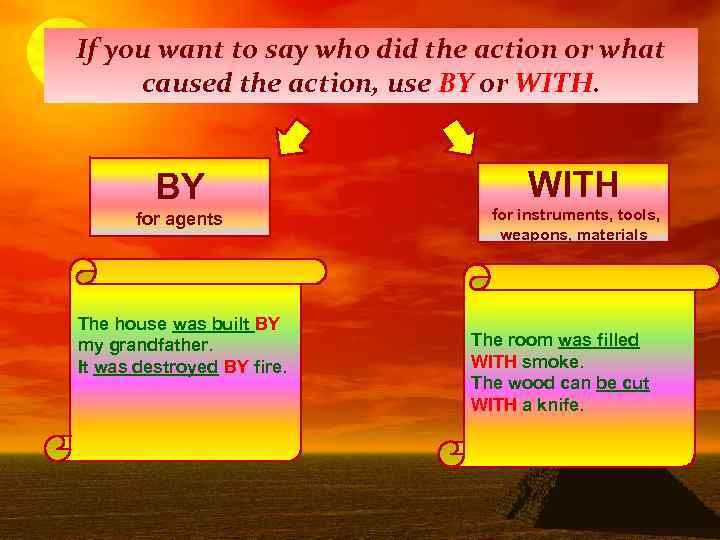 If you want to say who did the action or what caused the action, use BY or WITH. BY for agents The house was built BY my grandfather. It was destroyed BY fire. WITH for instruments, tools, weapons, materials The room was filled WITH smoke. The wood can be cut WITH a knife.
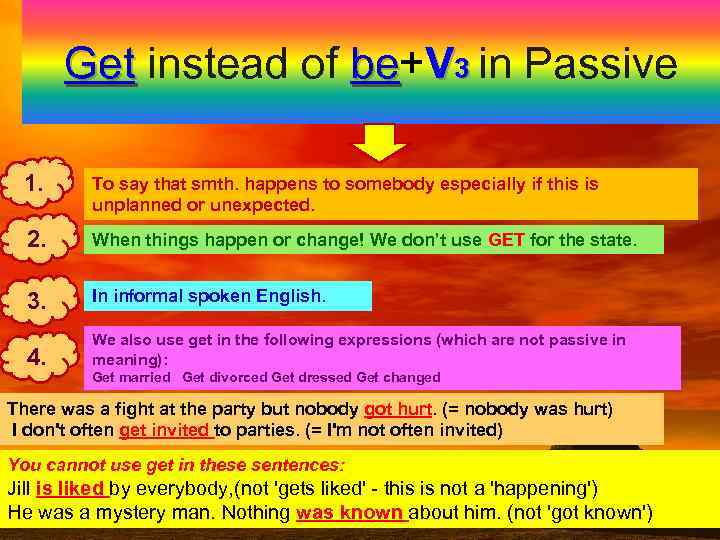 Get instead of be+V 3 in Passive be 1. To say that smth. happens to somebody especially if this is unplanned or unexpected. 2. When things happen or change! We don’t use GET for the state. 3. In informal spoken English. 4. We also use get in the following expressions (which are not passive in meaning): Get married Get divorced Get dressed Get changed There was a fight at the party but nobody got hurt. (= nobody was hurt) I don't often get invited to parties. (= I'm not often invited) You cannot use get in these sentences: Jill is liked by everybody, (not 'gets liked' - this is not a 'happening') He was a mystery man. Nothing was known about him. (not 'got known')
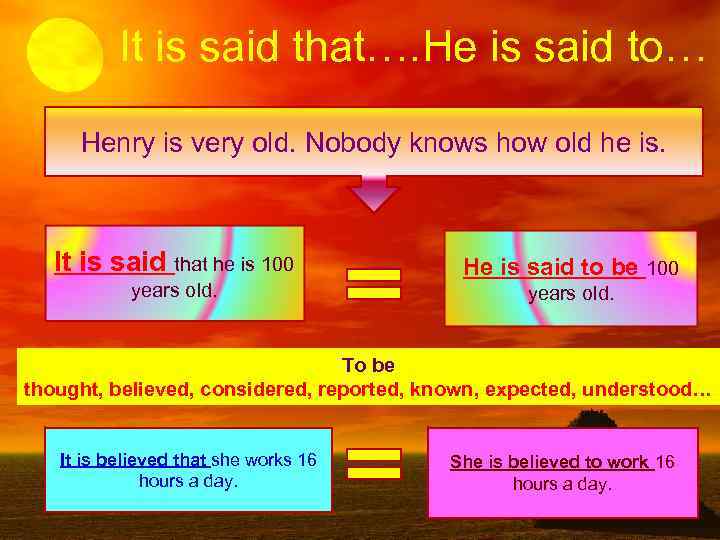 It is said that…. He is said to… Henry is very old. Nobody knows how old he is. It is said that he is 100 years old. He is said to be 100 years old. To be thought, believed, considered, reported, known, expected, understood… It is believed that she works 16 hours a day. She is believed to work 16 hours a day.
 Practice Complete with the verb in present simple and passive form. 1. He (find) in the garden. 2. She (tell) a story. 3. These cars (repair) by the mechanics. 4. People (allow) to walk on the grass. 5. Wine (produce) all over the world. 6. Sugar (add) to help fermentation. 7. Money (collect) to help this family. 8. Children (chase) by the horse. 9. The eggs (eat) with some bread. 10. The bottles (sell) to the wine dealers.
 Practice 1. Human beings are destroying the rainforests = The rainforests by human beings. 2. The woman is pouring water on the pavement = Water on the pavement by the woman. 3. The boys are throwing papers on the road = Papers on the road by the boys. 4. The fishermen are putting a liquid in the lake = A liquid in the lake by the fishermen. 5. The sellers are using plastic papers to cover foods = Plastic papers to cover foods by the sellers. 6. The child is breaking the table = The table by the child. 7. The students are learning English = English by the students. 8. The scientists are catching the butterflies with a net = The butterflies with a net by the scientists. 9. The girl is washing two babies = Two babies by the girl. 10. The father is hugging the child = The child by the father
 Practice Open the brackets and use the verb in the appropriate form of the Passive Voice. 1, The first draft resolution (not discuss) yesterday; it (withdraw) long before the beginning of the meeting. 2. He is not in town; he (send) on a special mission, 3. Don't come into the compartment; the berth (fix) now. 4. A new underground line (construct) now. They say one of its stations (build) in my street. 5. He wants to know when the final decision (take). The activities of the committee and their delays already much (speak) about. 6. It was three o'clock. We (tell) to hurry up because we (wait). 7. Do you believe that such a problem can (solve)? 8. It must (do) without delays. 9. On September 9, 1850, California (admit) to the Union as the thirty-first state. 10. Don't speak in a loud voice: we (listen). 11. The plan (approve)? — No, it (discuss) now. — How long it (discuss)? 12. By the time he arrives everything (settle). 13. Not all the necessary things (buy) for our trip that's why the departure (postpone). 14. The money (lend) to him two months ago, but it (not give) back yet. 15. The business day was in high gear: the mail (look) through, documents (type), letters (answer), talks (hold). 16. Wait a minute. The table (lay). 17. Dynamite (invent) by Alfred Bernhard Nobel. 18. This exercise may (write) with a pencil. 19. This work (do) before you went to Moscow? 20. If you (ask) about it, will you be able to answer?
 Practice Change the following sentences into the Passive Voice. A using the Indefinite Tenses (give two forms where possible). Example: Tom gave her a book. — She was given a book. The book was given to her. 1. He broke my watch. 2. The teacher explained the rule to the students. 3. He often asks me to help them. 4. They usually do written exercises in class. 5. She will make a new discovery soon. 6. Steve will make a report at the conference. 7» They play tennis all year round, 8. His friends never forgave his betrayal, 9, The manager offers me several jobs. 10. They will promise you much, but don't imagine they will give you everything. 11. His parents regularly sent him parcels with fruit from their garden. 12. They will give me a leave in July if there is no urgent work. 13. The Spanish government offered Columbus three ships, 14. They usually send their children to camp for summer. 15. The officer charged him with a very important mission, 16, I'm sure we'll settle the matter easily. 17. The policeman fined the driver for exceeding the speed limit 18. Somebody calls her every day. 19. We request the passengers leaving for London to register. 20. The manager will sign contracts tomorrow.
 Practice Change the following sentences into the Passive Voice. Example: He can do this work. — The work can be done (by him). 1. She can find a job easily. 2, The matter is urgent. They should phone her immediately. 3, The boss wants Mr. Black. You must find him. 4. I can make an interesting offer to you. 5. He's get a pay rise and LOW they can buy a new house. 6, You must send the document as quickly as possible. 7. The weather is warm. She may plant the flowers. 8. The document is of great importance. He must show it to us. 9. He must give back the book on Sunday. 10. Their kitchen is large and they can use it as a dining room. 11. Ecologists say that we should take care of our planet", 12. You must send for the doctor immediately. 13. The lecture is over. You may ask questions. 14. You should avoid the center of town during 1 rush hours. 15. They agreed that the club should raise membership fee.