


 Скачать презентацию The Parts of Speech Nouns I Defining
0deaefe6e20898b65eb1fa103be0b40d.ppt
- Количество слайдов: 13
 The Parts of Speech: Nouns, I • Defining Nouns • Types of Object of a preposition Nouns • Tips for Identifying Nouns
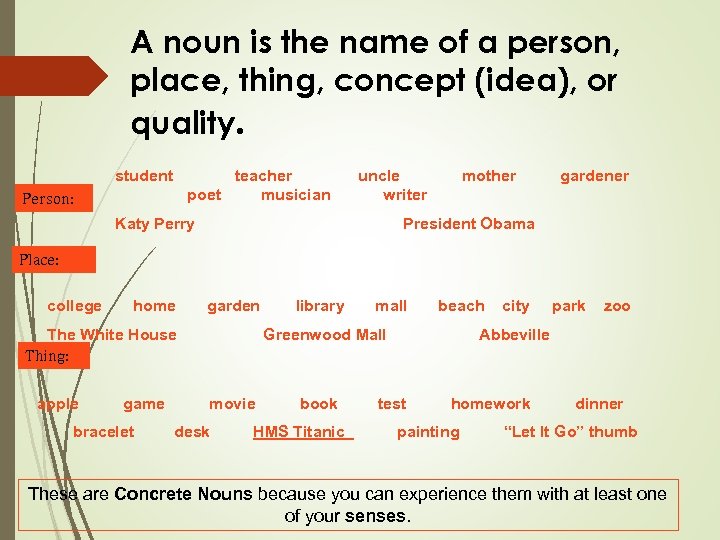 A noun is the name of a person, place, thing, concept (idea), or quality. student teacher poet musician Person: uncle writer Katy Perry mother gardener President Obama Place: college home garden The White House Thing: apple game bracelet library mall beach Greenwood Mall movie desk book HMS Titanic city park zoo Abbeville test homework painting dinner “Let It Go” thumb These are Concrete Nouns because you can experience them with at least one of your senses.
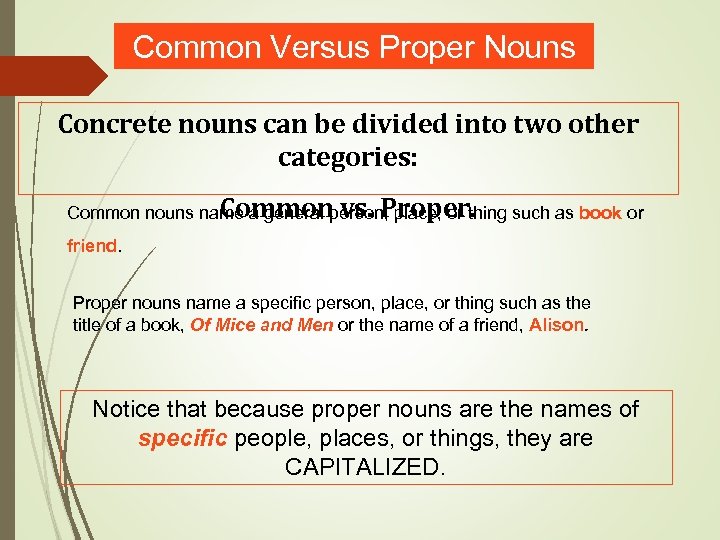 Common Versus Proper Nouns Concrete nouns can be divided into two other categories: Common vs. Proper. Common nouns name a general person, place, or thing such as book or friend. Proper nouns name a specific person, place, or thing such as the title of a book, Of Mice and Men or the name of a friend, Alison. Notice that because proper nouns are the names of specific people, places, or things, they are CAPITALIZED.
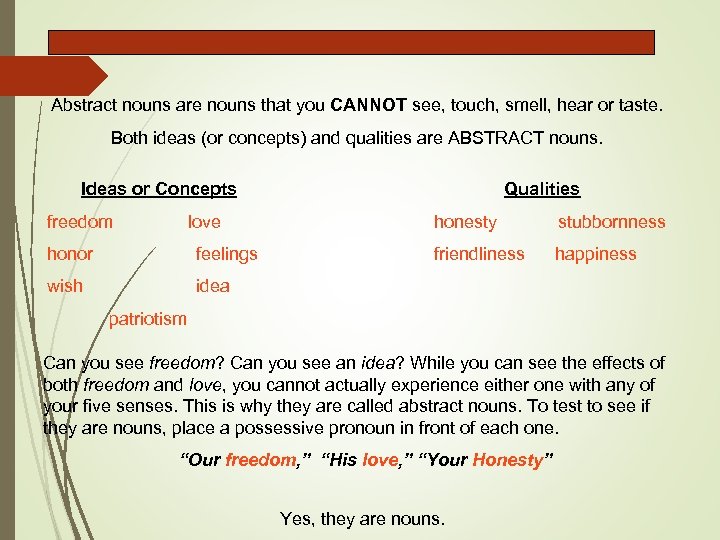 Abstract nouns are nouns that you CANNOT see, touch, smell, hear or taste. Both ideas (or concepts) and qualities are ABSTRACT nouns. Ideas or Concepts freedom love honor feelings wish Qualities honesty stubbornness friendliness happiness idea patriotism Can you see freedom? Can you see an idea? While you can see the effects of both freedom and love, you cannot actually experience either one with any of your five senses. This is why they are called abstract nouns. To test to see if they are nouns, place a possessive pronoun in front of each one. “Our freedom, ” “His love, ” “Your Honesty” Yes, they are nouns.
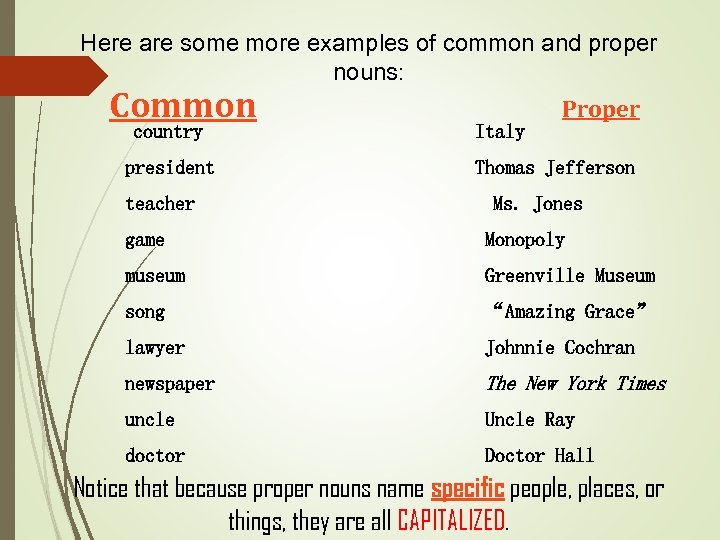 Here are some more examples of common and proper nouns: Common country president teacher Italy Proper Thomas Jefferson Ms. Jones game Monopoly museum Greenville Museum song “Amazing Grace” lawyer Johnnie Cochran newspaper The New York Times uncle Uncle Ray doctor Doctor Hall Notice that because proper nouns name specific people, places, or things, they are all CAPITALIZED.
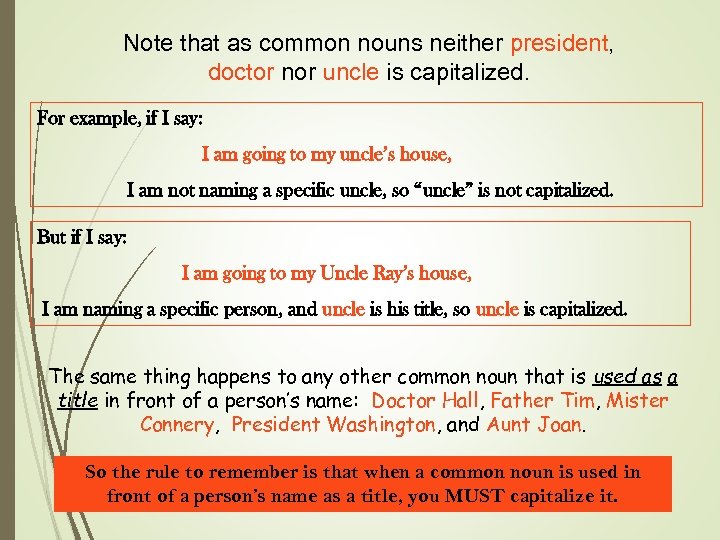 Note that as common nouns neither president, doctor nor uncle is capitalized. For example, if I say: I am going to my uncle’s house, I am not naming a specific uncle, so “uncle” is not capitalized. But if I say: I am going to my Uncle Ray’s house, I am naming a specific person, and uncle is his title, so uncle is capitalized. The same thing happens to any other common noun that is used as a title in front of a person’s name: Doctor Hall, Father Tim, Mister Connery, President Washington, and Aunt Joan. So the rule to remember is that when a common noun is used in front of a person’s name as a title, you MUST capitalize it.
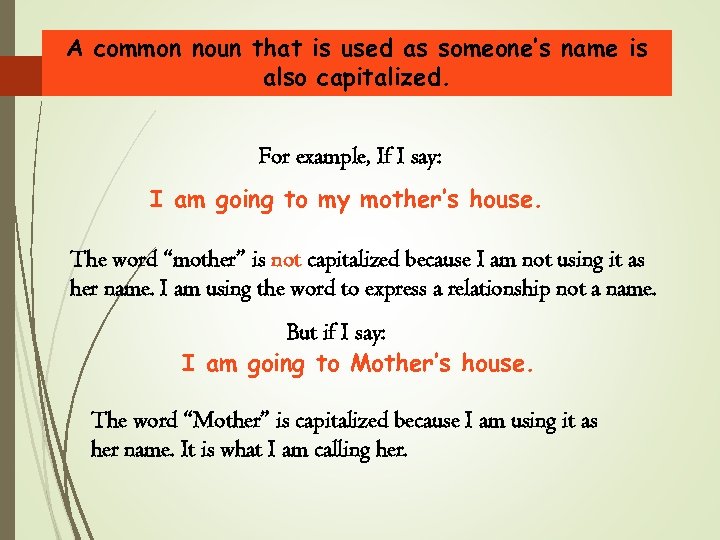 A common noun that is used as someone’s name is also capitalized. For example, If I say: I am going to my mother’s house. The word “mother” is not capitalized because I am not using it as her name. I am using the word to express a relationship not a name. But if I say: I am going to Mother’s house. The word “Mother” is capitalized because I am using it as her name. It is what I am calling her.
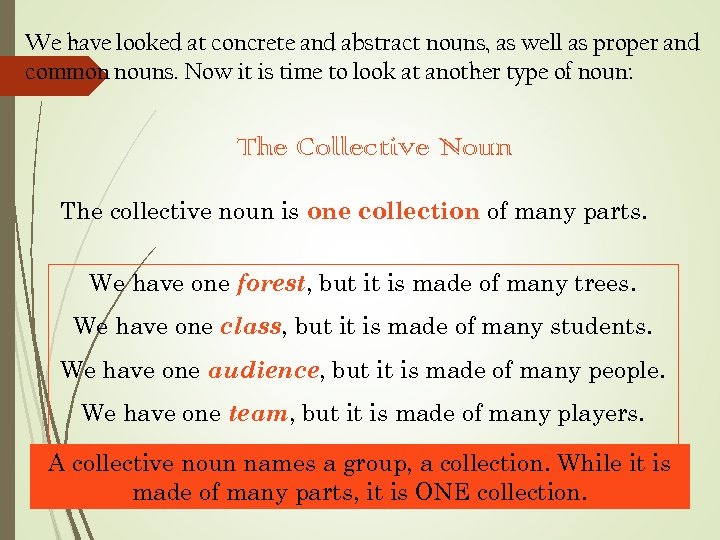 We have looked at concrete and abstract nouns, as well as proper and common nouns. Now it is time to look at another type of noun: The Collective Noun The collective noun is one collection of many parts. We have one forest, but it is made of many trees. We have one class, but it is made of many students. We have one audience, but it is made of many people. We have one team, but it is made of many players. We have noun names a it is made of many soldiers. A collective one troop, but group, a collection. While it is made of many parts, it is ONE collection.
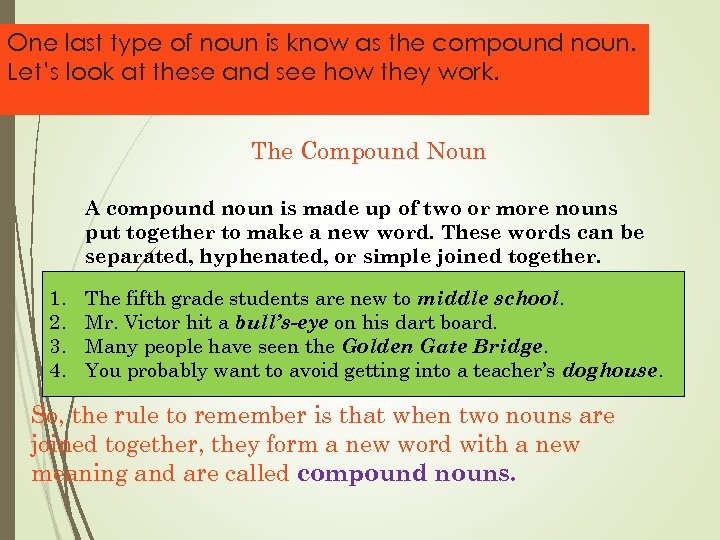 One last type of noun is know as the compound noun. Let’s look at these and see how they work. The Compound Noun A compound noun is made up of two or more nouns put together to make a new word. These words can be separated, hyphenated, or simple joined together. 1. 2. 3. 4. The fifth grade students are new to middle school. Mr. Victor hit a bull’s-eye on his dart board. Many people have seen the Golden Gate Bridge. You probably want to avoid getting into a teacher’s doghouse. So, the rule to remember is that when two nouns are joined together, they form a new word with a new meaning and are called compound nouns.
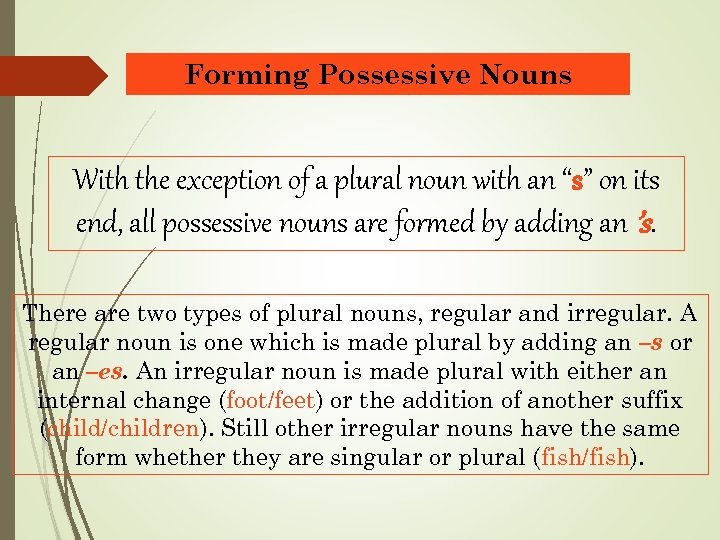 Forming Possessive Nouns With the exception of a plural noun with an “s” on its end, all possessive nouns are formed by adding an ’s. There are two types of plural nouns, regular and irregular. A regular noun is one which is made plural by adding an –s or an –es. An irregular noun is made plural with either an internal change (foot/feet) or the addition of another suffix (child/children). Still other irregular nouns have the same form whether they are singular or plural (fish/fish).
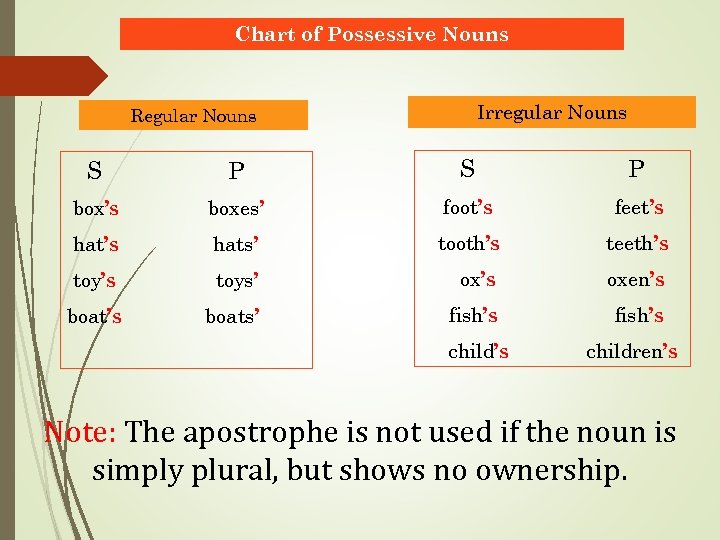 Chart of Possessive Nouns Irregular Nouns Regular Nouns S P box’s boxes’ foot’s feet’s hats’ tooth’s teeth’s toys’ ox’s oxen’s boats’ fish’s child’s children’s Note: The apostrophe is not used if the noun is simply plural, but shows no ownership.
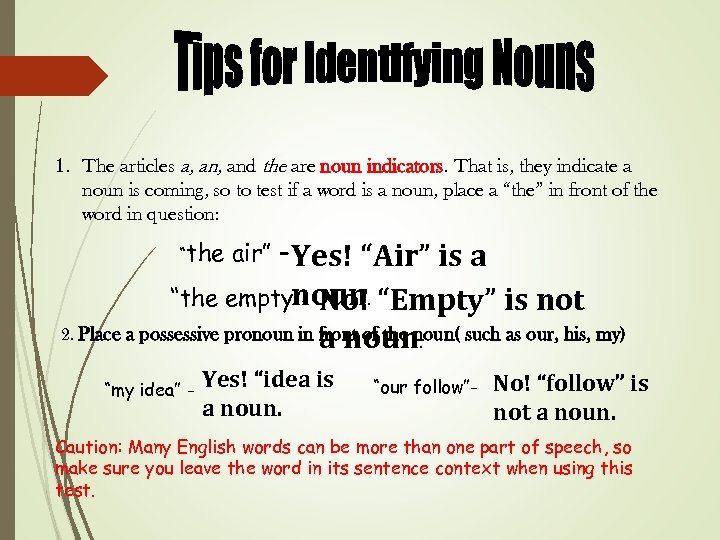 1. The articles a, and the are noun indicators. That is, they indicate a noun is coming, so to test if a word is a noun, place a “the” in front of the word in question: “the air” – Yes! “Air” is a “the emptynoun. “Empty” is not ”- No! a noun 2. Place a possessive pronoun in front of the noun( such as our, his, my). “my idea” - Yes! “idea is a noun. “our follow”- No! “follow” is not a noun. Caution: Many English words can be more than one part of speech, so make sure you leave the word in its sentence context when using this test.
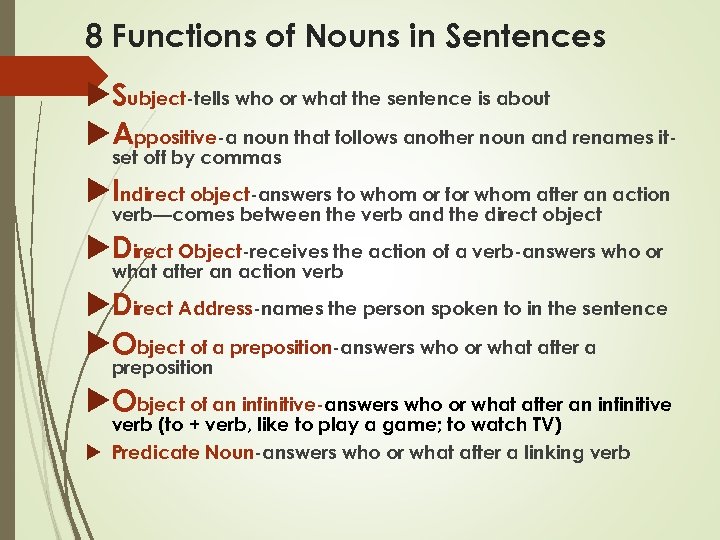 8 Functions of Nouns in Sentences Subject-tells who or what the sentence is about Appositive-a noun that follows another noun and renames itset off by commas Indirect object-answers to whom or for whom after an action verb—comes between the verb and the direct object Direct Object-receives the action of a verb-answers who or what after an action verb Direct Address-names the person spoken to in the sentence Object of a preposition-answers who or what after a preposition Object of an infinitive-answers who or what after an infinitive verb (to + verb, like to play a game; to watch TV) Predicate Noun-answers who or what after a linking verb