


 Скачать презентацию The Origins of Hospitality and Tourism Classical Rome
6afdd17188bc8e6dfa49557466ac9579.ppt
- Количество слайдов: 25
 The Origins of Hospitality and Tourism Classical Rome O’Gorman, The Origins of Hospitality and Tourism, Goodfellow Publishers © 2010
 DOMESTIC HOSPITALITY: CONSOLIDATION OF POWER O’Gorman, The Origins of Hospitality and Tourism, Goodfellow Publishers © 2010
 Domestic hospitality w Never exercised in the indiscriminate and the custom of observing the laws of hospitality were common to all the nations of Italy. w An honourable duty to receive distinguished guests into the house. w Hospitality and the culinary arts were very much at the centre of Roman life. w Feasts centred around the gods, some of whom were identified with hospitality, celebration, consumption, and hunting O’Gorman, The Origins of Hospitality and Tourism, Goodfellow Publishers © 2010
 Domestic hospitality w The tessera hospitalis or ‘hospitality token’ symbolised the bond of personal / familial hospitality w Once established private arrangements of hospitality could not be dissolved except by a formal declaration w Hospitality, lead to long-lasting friendships between the host and the guest; it was from these personal bonds that the public ties of hospitality were later to be formed. O’Gorman, The Origins of Hospitality and Tourism, Goodfellow Publishers © 2010
 CIVIC HOSPITALITY: GROWTH OF AN EMPIRE O’Gorman, The Origins of Hospitality and Tourism, Goodfellow Publishers © 2010
 Civic Hospitality w First direct mention of civic hospitality being established between Rome and another city is after the Gauls had departed from Rome. w Later, instead, towns were raised to the rank of municipia w When a town want a similar relation with Rome, it entered into clientela to some distinguished Roman, who then acted as patron of the client-town. w This hospitality when shared between states was applicable to individuals as well O’Gorman, The Origins of Hospitality and Tourism, Goodfellow Publishers © 2010
 Civic Hospitality w The custom of granting the honour of hospes publicus to a distinguished foreigner by a decree of the senate seems to have existed until the end of the republic w Public hospitality was, like the hospitium privatum, hereditary in the family of the person to whom it had been granted: O’Gorman, The Origins of Hospitality and Tourism, Goodfellow Publishers © 2010
 COMMERCIAL HOSPITALITY: DIVERSIFIED INDUSTRY Case Study: Pompeii O’Gorman, The Origins of Hospitality and Tourism, Goodfellow Publishers © 2010
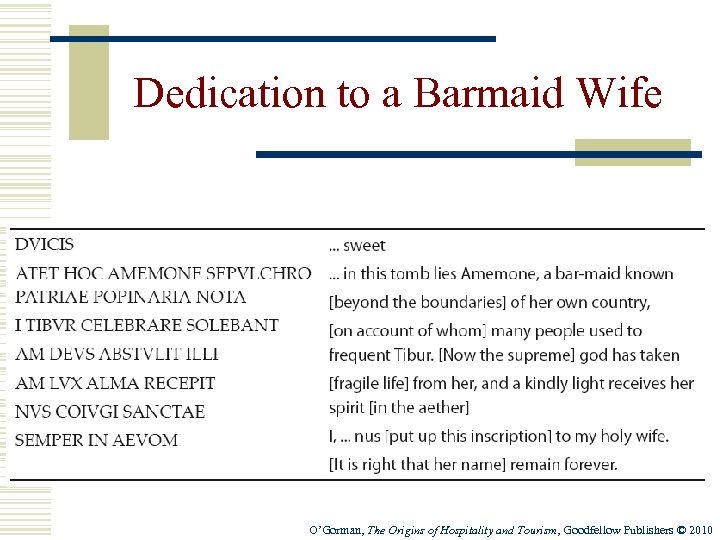 Dedication to a Barmaid Wife O’Gorman, The Origins of Hospitality and Tourism, Goodfellow Publishers © 2010
 “…search for him in some big bar. There he will be, lying next a cut-throat, in the company of sailors, thieves, and runaway slaves, beside hangmen and coffin-makers, or beside a passed out priest: This is liberty hall, one cup serves for all, no one has a bed to himself, nor a table apart from the rest. ” (Juvenal, Satires 8: 168 f) O’Gorman, The Origins of Hospitality and Tourism, Goodfellow Publishers © 2010
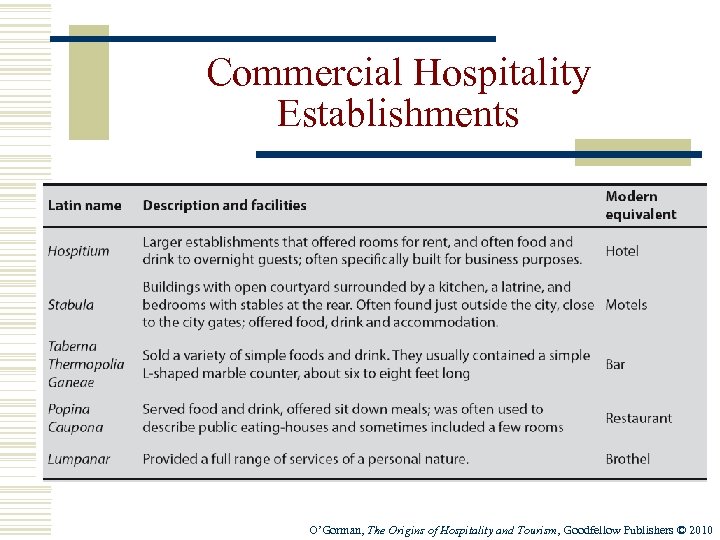 Commercial Hospitality Establishments O’Gorman, The Origins of Hospitality and Tourism, Goodfellow Publishers © 2010
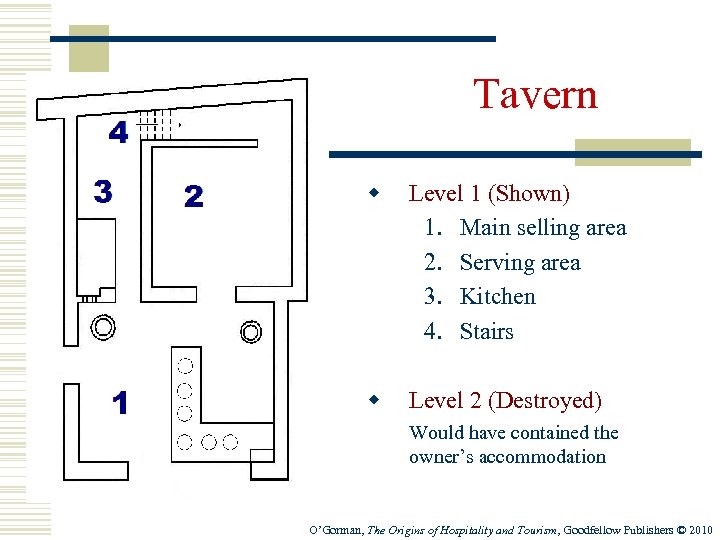 Tavern w Level 1 (Shown) 1. Main selling area 2. Serving area 3. Kitchen 4. Stairs w Level 2 (Destroyed) Would have contained the owner’s accommodation O’Gorman, The Origins of Hospitality and Tourism, Goodfellow Publishers © 2010
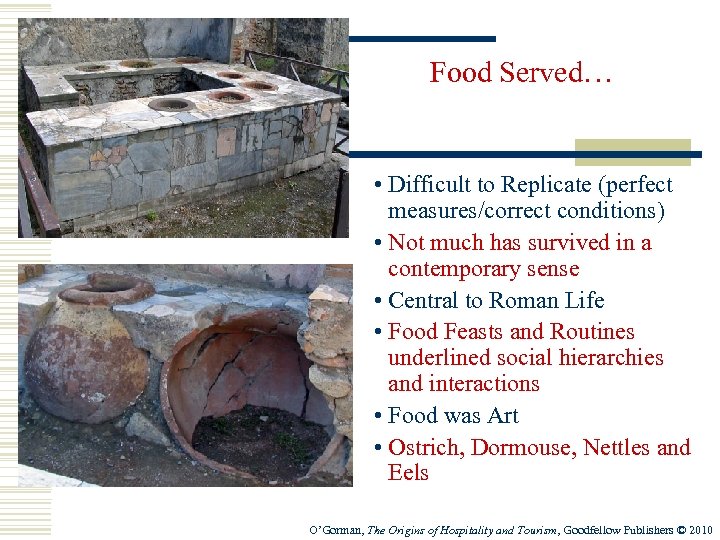 Food Served… • Difficult to Replicate (perfect measures/correct conditions) • Not much has survived in a contemporary sense • Central to Roman Life • Food Feasts and Routines underlined social hierarchies and interactions • Food was Art • Ostrich, Dormouse, Nettles and Eels O’Gorman, The Origins of Hospitality and Tourism, Goodfellow Publishers © 2010
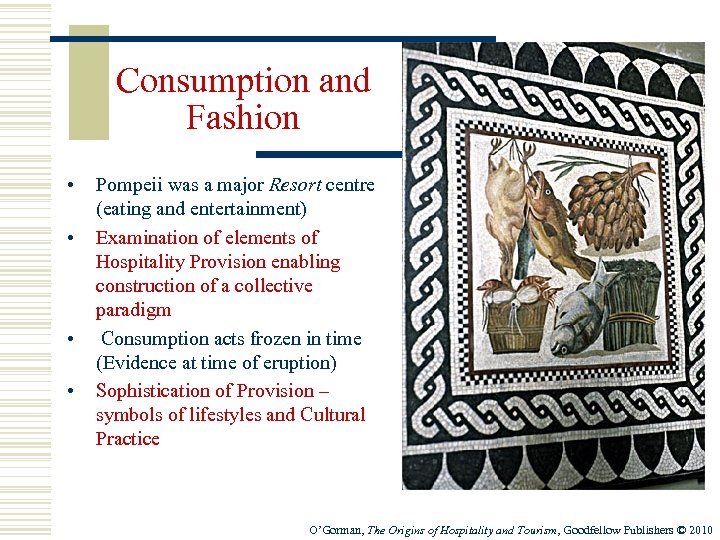 Consumption and Fashion • • Pompeii was a major Resort centre (eating and entertainment) Examination of elements of Hospitality Provision enabling construction of a collective paradigm Consumption acts frozen in time (Evidence at time of eruption) Sophistication of Provision – symbols of lifestyles and Cultural Practice O’Gorman, The Origins of Hospitality and Tourism, Goodfellow Publishers © 2010
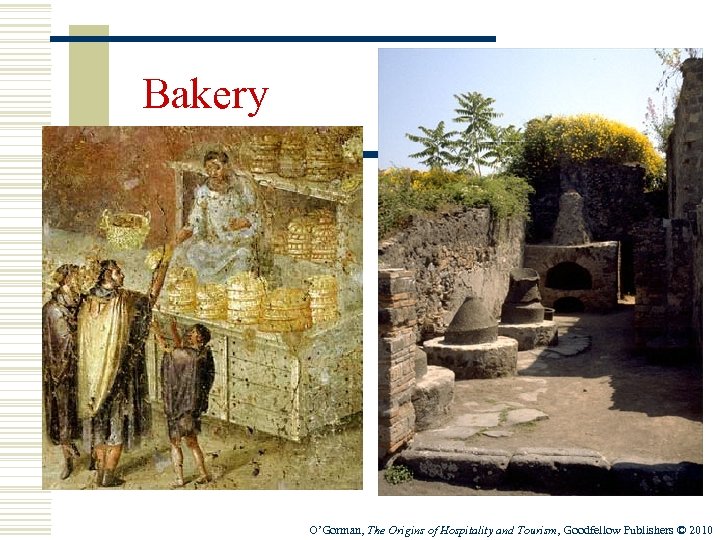 Bakery O’Gorman, The Origins of Hospitality and Tourism, Goodfellow Publishers © 2010
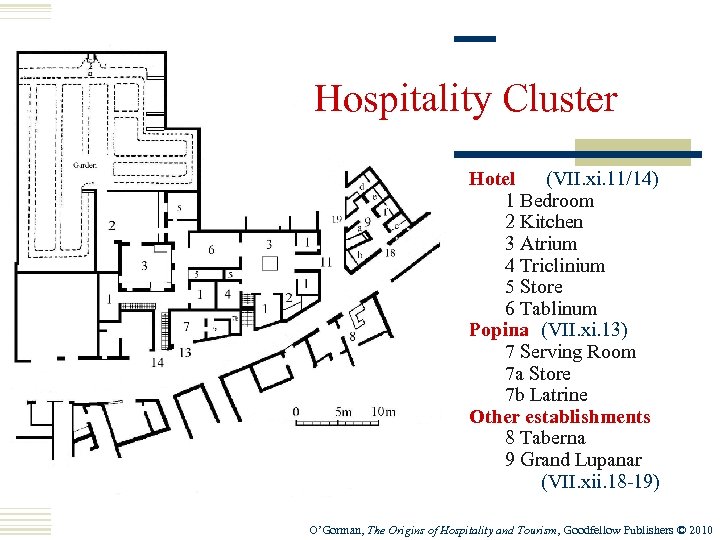 Hospitality Cluster Hotel (VII. xi. 11/14) 1 Bedroom 2 Kitchen 3 Atrium 4 Triclinium 5 Store 6 Tablinum Popina (VII. xi. 13) 7 Serving Room 7 a Store 7 b Latrine Other establishments 8 Taberna 9 Grand Lupanar (VII. xii. 18 -19) O’Gorman, The Origins of Hospitality and Tourism, Goodfellow Publishers © 2010
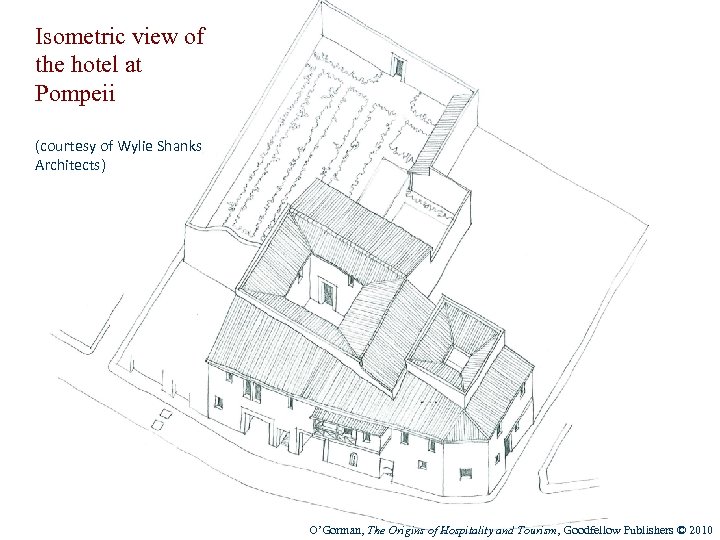 Isometric view of the hotel at Pompeii (courtesy of Wylie Shanks Architects) O’Gorman, The Origins of Hospitality and Tourism, Goodfellow Publishers © 2010
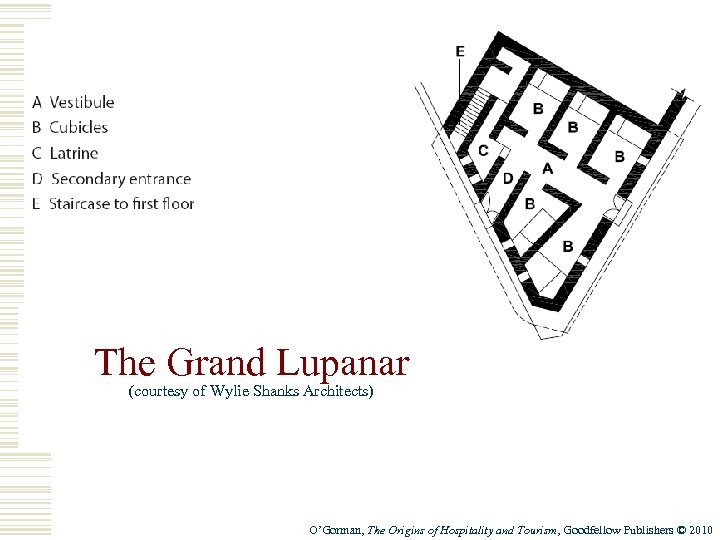 The Grand Lupanar (courtesy of Wylie Shanks Architects) O’Gorman, The Origins of Hospitality and Tourism, Goodfellow Publishers © 2010
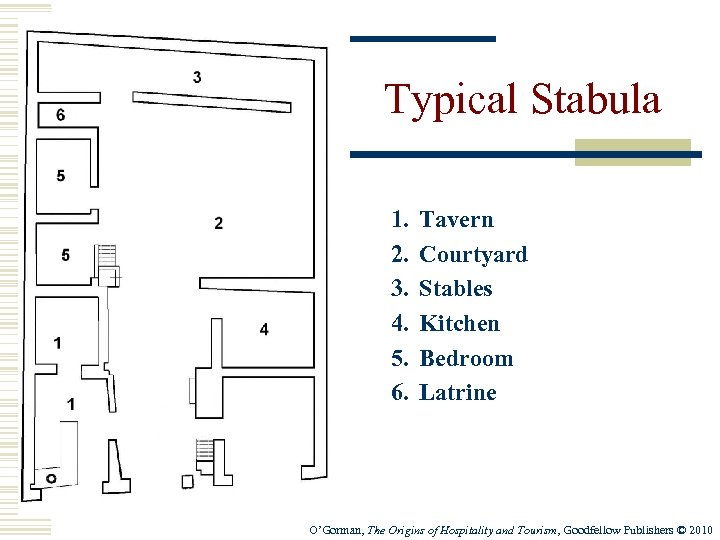 Typical Stabula 1. 2. 3. 4. 5. 6. Tavern Courtyard Stables Kitchen Bedroom Latrine O’Gorman, The Origins of Hospitality and Tourism, Goodfellow Publishers © 2010
 SUMMARY OF HOSPITALITY IN CLASSICAL ROME O’Gorman, The Origins of Hospitality and Tourism, Goodfellow Publishers © 2010
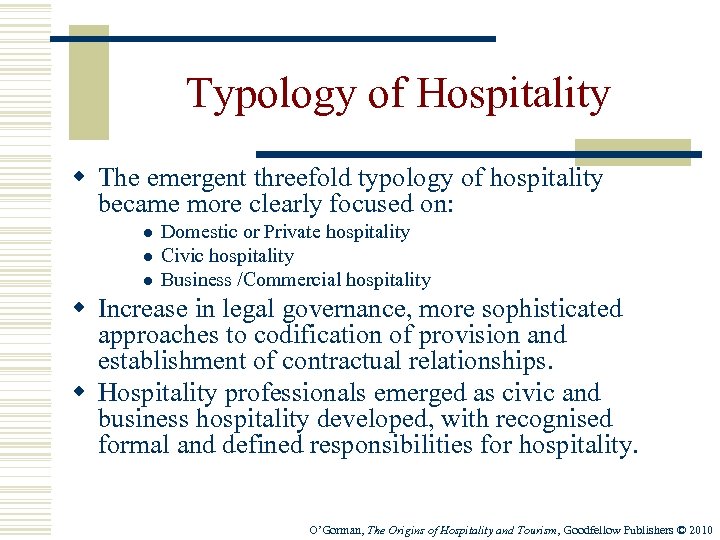 Typology of Hospitality w The emergent threefold typology of hospitality became more clearly focused on: l l l Domestic or Private hospitality Civic hospitality Business /Commercial hospitality w Increase in legal governance, more sophisticated approaches to codification of provision and establishment of contractual relationships. w Hospitality professionals emerged as civic and business hospitality developed, with recognised formal and defined responsibilities for hospitality. O’Gorman, The Origins of Hospitality and Tourism, Goodfellow Publishers © 2010
 Domestic Hospitality w More formal, in the style of a contract, entered into by mutual promise, the clasping of hands and exchange of an agreement in writing or of a token. w The tessera hospitalis gave hereditary character to hospitality and a reciprocal agreement, which could not be dissolved without a formal declaration. w Had the expectations of food, drink, accommodation and entertainment, etc. w Due to the reciprocal nature of private hospitality, not all travellers required the services of a commercial hospitality industry. w Formalised domestic hospitality was more binding and sacred than blood connections. O’Gorman, The Origins of Hospitality and Tourism, Goodfellow Publishers © 2010
 Civic Hospitality w Used to form strategic alliances between the nation states. w When individuals, or states, had common bond of hospitality; then also mutual recognition of their deities. w Failure to undertake hospitality in an appropriate manner could cause the wrath of the gods on the offending city or household for generations. w The reciprocity of hospitality became legally defined and was used to foster and further develop relationships between the states of the time. w Commercial hospitality did not eclipse domestic and civic hospitality – there were still the associated spiritual and strategic benefits that properly given and received hospitality brought. O’Gorman, The Origins of Hospitality and Tourism, Goodfellow Publishers © 2010
 Commercial Hospitality w Although linked to its domestic roots, formal eating and feasting often moved to commercial hospitality establishments w Commercial establishments were often homes that had been private houses and the owners often lived in rooms above. w Growth and flourishing of commercial hospitality changed everyday life: restaurants, bars and brothels were also common. w Commercial hospitality industry for travellers, merchants and sailors who came to trade and sell, or those who were stopping overnight along the way to other destinations. w Commercial hospitality establishments were often clustered in specific parts of the cities. O’Gorman, The Origins of Hospitality and Tourism, Goodfellow Publishers © 2010
 Further Reading w O’Gorman, K. D. (2007) ‘Commercial Hospitality in Pompeii’. The Hospitality Review Vol 9, No 2 pp 44 -52. http: //strathprints. strath. ac. uk/5846/1/strathprints 005846. pdf w O’Gorman, K. D. , Baxter, I. and Scott, B. (2007) ‘Exploring Pompeii: Discovering Hospitality through Research Synergy. ’ With Journal of Hospitality and Tourism Research. Vol. 7, No. 3, pp 89 -99. http: //www. palgravejournals. com/thr/journal/v 7/n 2/abs/6050043 a. html O’Gorman, The Origins of Hospitality and Tourism, Goodfellow Publishers © 2010