


 Скачать презентацию The Organizational Development Workshop An Introduction The OD
c1a4ac68833656f24243cc69933cb556.ppt
- Количество слайдов: 26
 The Organizational Development Workshop An Introduction ‘The OD Process’ 1 Patrick Trottier and Associates, 2011
 Introductions Name Your interest in being here. 2 Patrick Trottier and Associates, 2011
 1 minute 65% - 75% 3 Patrick Trottier and Associates, 2011
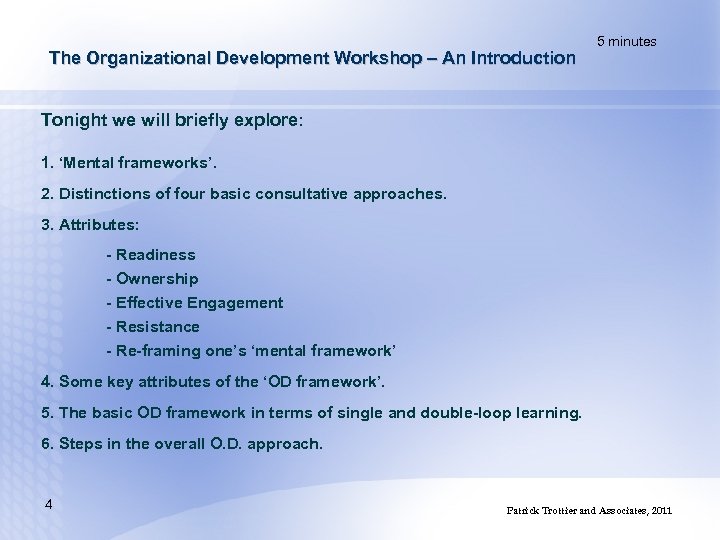 The Organizational Development Workshop – An Introduction 5 minutes Tonight we will briefly explore: 1. ‘Mental frameworks’. 2. Distinctions of four basic consultative approaches. 3. Attributes: - Readiness - Ownership - Effective Engagement - Resistance - Re-framing one’s ‘mental framework’ 4. Some key attributes of the ‘OD framework’. 5. The basic OD framework in terms of single and double-loop learning. 6. Steps in the overall O. D. approach. 4 Patrick Trottier and Associates, 2011
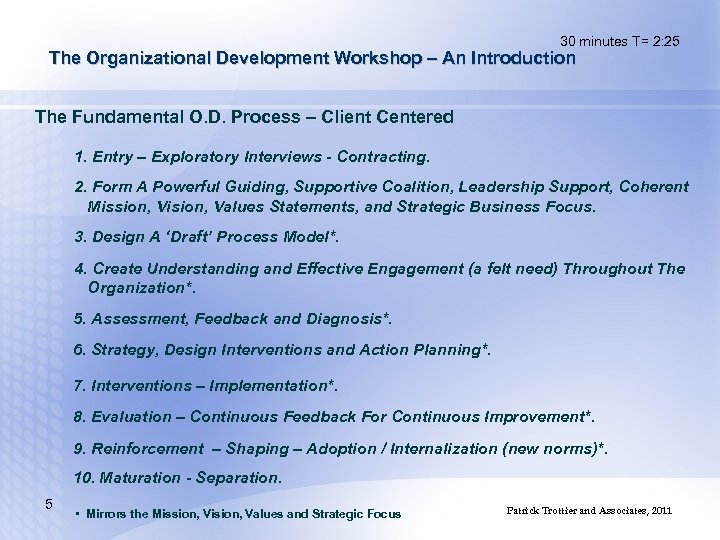 30 minutes T= 2: 25 The Organizational Development Workshop – An Introduction The Fundamental O. D. Process – Client Centered 1. Entry – Exploratory Interviews - Contracting. 2. Form A Powerful Guiding, Supportive Coalition, Leadership Support, Coherent Mission, Vision, Values Statements, and Strategic Business Focus. 3. Design A ‘Draft’ Process Model*. 4. Create Understanding and Effective Engagement (a felt need) Throughout The Organization*. 5. Assessment, Feedback and Diagnosis*. 6. Strategy, Design Interventions and Action Planning*. 7. Interventions – Implementation*. 8. Evaluation – Continuous Feedback For Continuous Improvement*. 9. Reinforcement – Shaping – Adoption / Internalization (new norms)*. 10. Maturation - Separation. 5 • Mirrors the Mission, Vision, Values and Strategic Focus Patrick Trottier and Associates, 2011
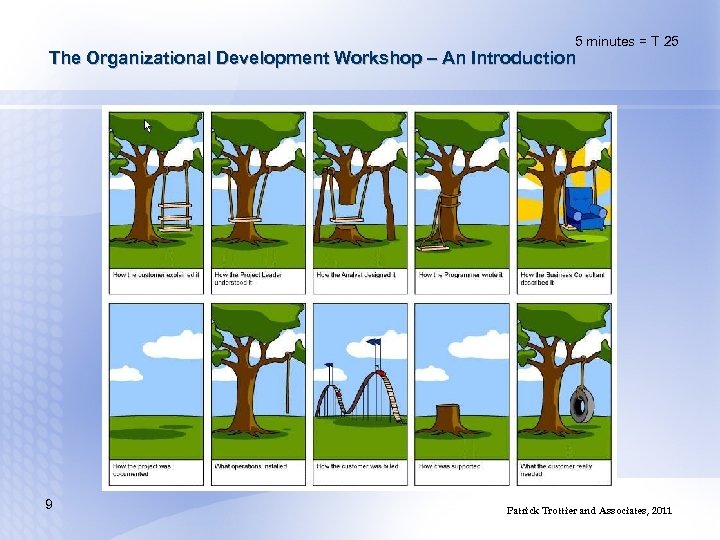
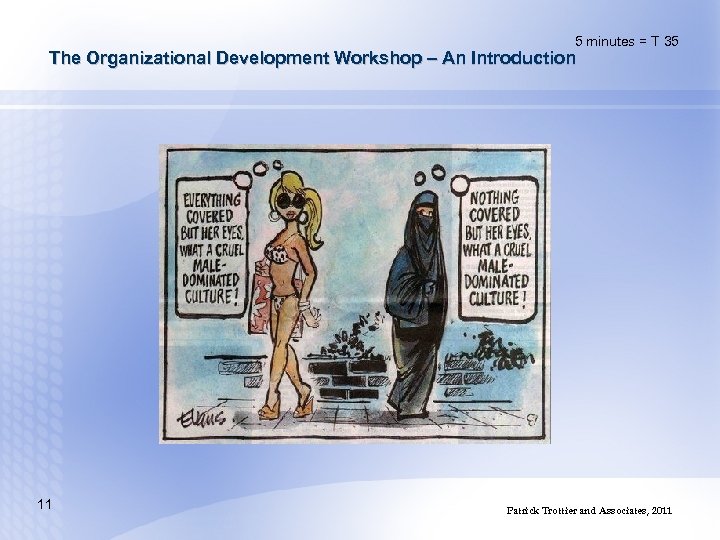
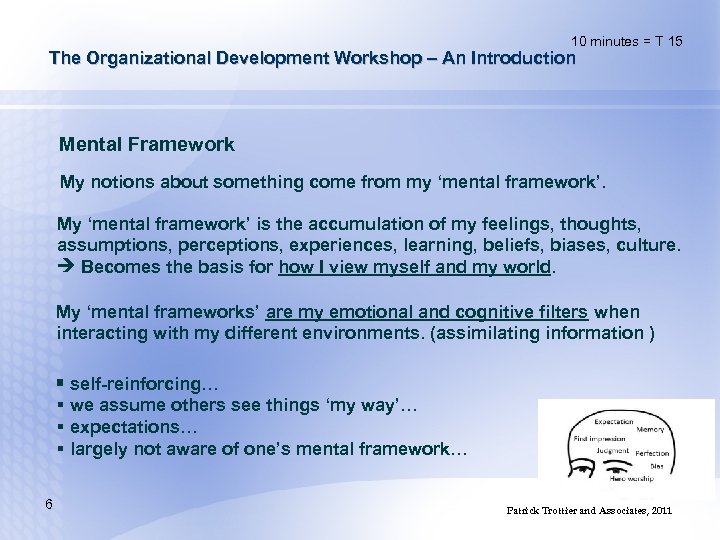 10 minutes = T 15 The Organizational Development Workshop – An Introduction Mental Framework My notions about something come from my ‘mental framework’. My ‘mental framework’ is the accumulation of my feelings, thoughts, assumptions, perceptions, experiences, learning, beliefs, biases, culture. Becomes the basis for how I view myself and my world. My ‘mental frameworks’ are my emotional and cognitive filters when interacting with my different environments. (assimilating information ) self-reinforcing… § we assume others see things ‘my way’… § expectations… § largely not aware of one’s mental framework… 6 Patrick Trottier and Associates, 2011
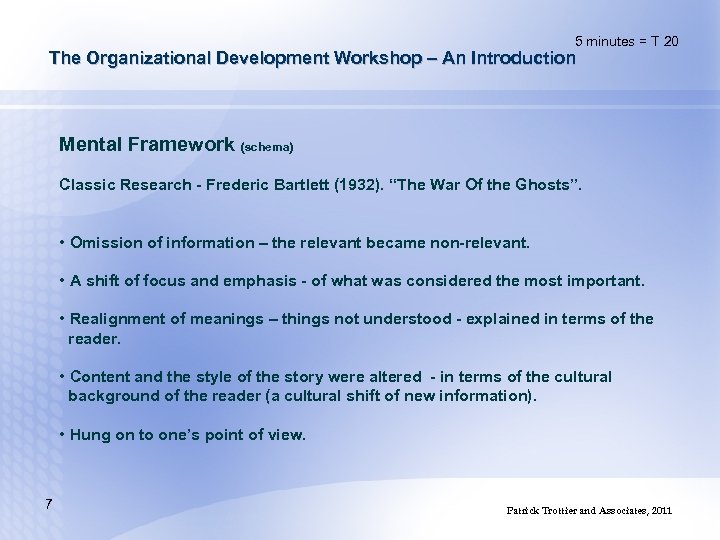 5 minutes = T 20 The Organizational Development Workshop – An Introduction Mental Framework (schema) Classic Research - Frederic Bartlett (1932). “The War Of the Ghosts”. • Omission of information – the relevant became non-relevant. • A shift of focus and emphasis - of what was considered the most important. • Realignment of meanings – things not understood - explained in terms of the reader. • Content and the style of the story were altered - in terms of the cultural background of the reader (a cultural shift of new information). • Hung on to one’s point of view. 7 Patrick Trottier and Associates, 2011
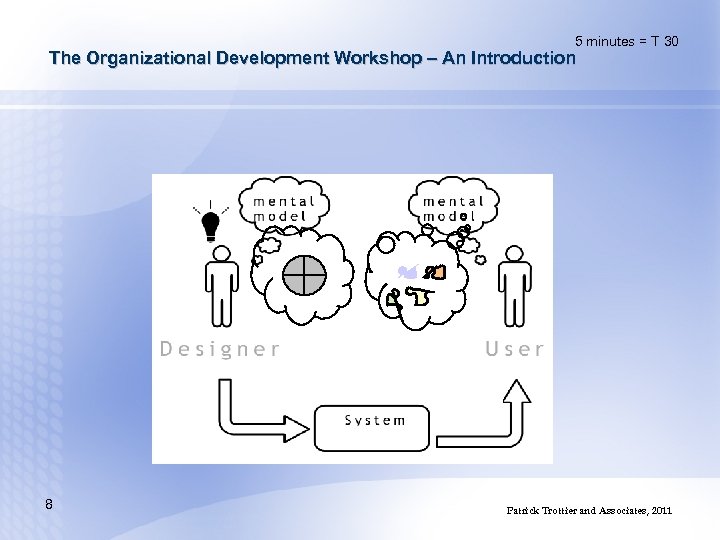 5 minutes = T 30 The Organizational Development Workshop – An Introduction 8 Patrick Trottier and Associates, 2011
 5 minutes = T 25 The Organizational Development Workshop – An Introduction 9 Patrick Trottier and Associates, 2011
 5 minutes = T 25 The Organizational Development Workshop – An Introduction 10 Patrick Trottier and Associates, 2011
 5 minutes = T 35 The Organizational Development Workshop – An Introduction 11 Patrick Trottier and Associates, 2011
 10 minutes: T=45 The Organizational Development Workshop – An Introduction A Basic Theorem: Any type of professional practice has a ‘mental framework’ that guides its practice. In what terms would these practices ‘see’ an organization: • Finance / Accounting • Project Managers • Sales • Operations Management Different ‘worlds’ within organizations. What is the relevance for those working in the realm of ‘Change and Development’? 12 Patrick Trottier and Associates, 2011
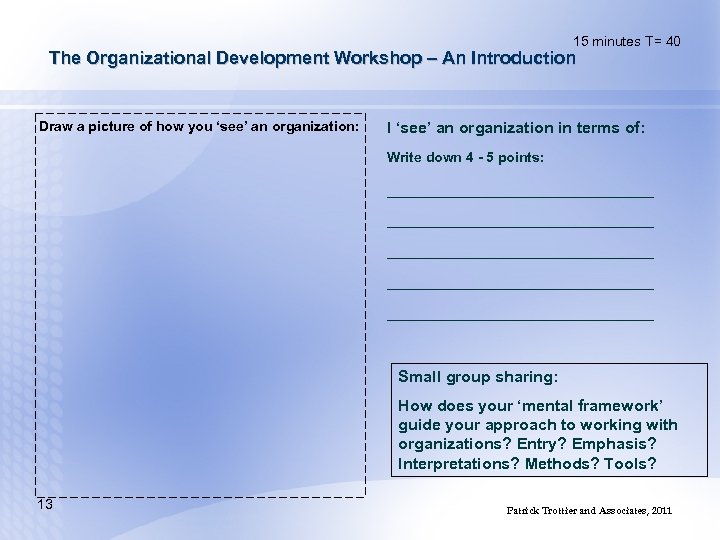 15 minutes T= 40 The Organizational Development Workshop – An Introduction Draw a picture of how you ‘see’ an organization: I ‘see’ an organization in terms of: Write down 4 - 5 points: ______________________________ _______________ Small group sharing: How does your ‘mental framework’ guide your approach to working with organizations? Entry? Emphasis? Interpretations? Methods? Tools? 13 Patrick Trottier and Associates, 2011
 20 minutes T= 60 The Organizational Development Workshop – An Introduction Four ‘Different Frameworks’ To Consulting Models (Edgar Schein, Process Consultation, Vol. I – II, 1987 - 88) 1. Expert Model – Someone states a need, consultant sells expertise, knows the problem, the solution, creates recommendations or fixes the problem. Responsibility lies with the consultant for its success. 2. Medical Doctor-Patient Model – Someone states a need, consultant sells expertise, consultant performs the diagnosis, consultant states the problem, offers the prescription (recommendations), or performs the implementation. Responsibility lies with the consultant for its success. 3. Process Model – Client centered. Client has a problem, Client /Consultant designs the change process, the client diagnoses the problem, defines the problem, makes the decisions, implements the solutions. The consultant facilitates the process. 4. Emergent Model – Client centered. New ways present themselves, the client explores emerging opportunities, makes decisions, continuously adapts, integrates and evolves the opportunity. Client / Consultant develops the organization’s openness, readiness and adaptability for emergence to be realized. 14 Patrick Trottier and Associates, 2011
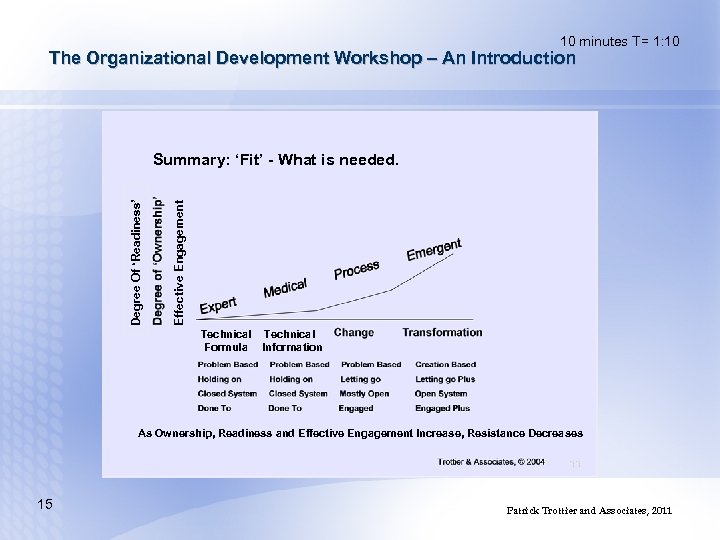 10 minutes T= 1: 10 The Organizational Development Workshop – An Introduction Effective Engagement Degree Of ‘Readiness’ Summary: ‘Fit’ - What is needed. Technical Formula Information As Ownership, Readiness and Effective Engagement Increase, Resistance Decreases 15 Patrick Trottier and Associates, 2011
 5 minutes T= 1: 15 The Organizational Development Workshop – An Introduction Consultative Models: OD Models / Approaches Process and Emergent 16 Patrick Trottier and Associates, 2011
 15 minutes T= 1: 25 The Organizational Development Workshop – An Introduction An OD ‘mental framework’ encompases such notions as: (Reference: Edger H. Schein – 1987, 1988) • An organization is an open learning system. • Process driven – the power is in the process (the customized design + the how). • Kurt Lewin's Field Theory; B = f (P, E), meaning that ‘behavior is a function of human and environmental dynamics’. • Chaos is a natural occurrence of real and viable change and development. • Diversity in any open system is necessary for sustainability and adaptability. • Readiness, ownership and effective engagement lessens resistance. Small group exercise: What other key attributes encompass an OD approach? 17 Patrick Trottier and Associates, 2011
 1 minutes T= 1: 25 The Organizational Development Workshop – An Introduction Moving Toward an OD Process… 18 Patrick Trottier and Associates, 2011
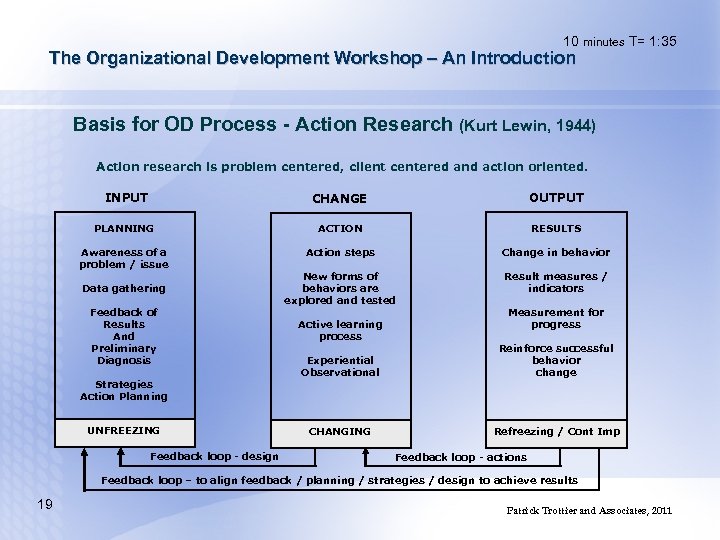 10 minutes T= 1: 35 The Organizational Development Workshop – An Introduction Basis for OD Process - Action Research (Kurt Lewin, 1944) Action research is problem centered, client centered and action oriented. INPUT CHANGE OUTPUT PLANNING ACTION RESULTS Awareness of a problem / issue Action steps Change in behavior New forms of behaviors are explored and tested Result measures / indicators Data gathering Feedback of Results And Preliminary Diagnosis Strategies Action Planning UNFREEZING Feedback loop - design Active learning process Measurement for progress Experiential Observational Reinforce successful behavior change CHANGING Refreezing / Cont Imp Feedback loop - actions Feedback loop – to align feedback / planning / strategies / design to achieve results 19 Patrick Trottier and Associates, 2011
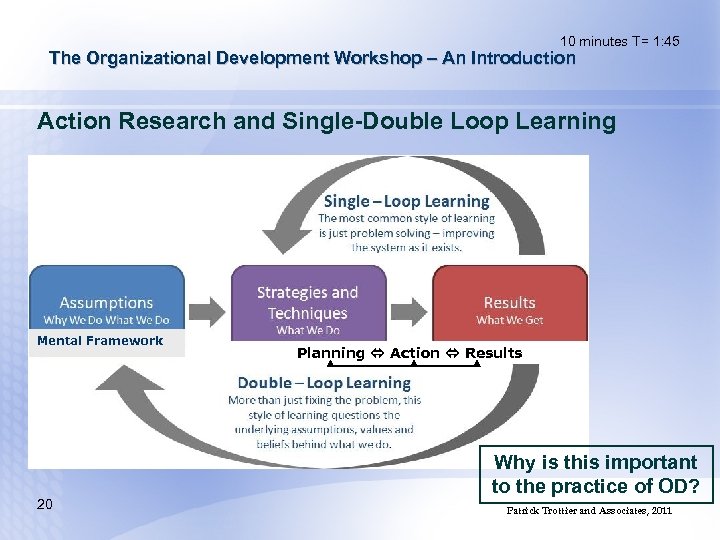 10 minutes T= 1: 45 The Organizational Development Workshop – An Introduction Action Research and Single-Double Loop Learning Mental Framework 20 Planning Action Results Why is this important to the practice of OD? Patrick Trottier and Associates, 2011
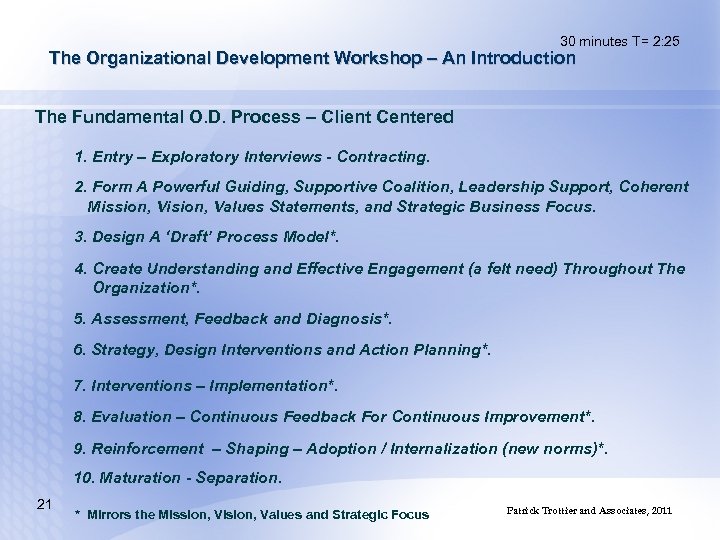 30 minutes T= 2: 25 The Organizational Development Workshop – An Introduction The Fundamental O. D. Process – Client Centered 1. Entry – Exploratory Interviews - Contracting. 2. Form A Powerful Guiding, Supportive Coalition, Leadership Support, Coherent Mission, Vision, Values Statements, and Strategic Business Focus. 3. Design A ‘Draft’ Process Model*. 4. Create Understanding and Effective Engagement (a felt need) Throughout The Organization*. 5. Assessment, Feedback and Diagnosis*. 6. Strategy, Design Interventions and Action Planning*. 7. Interventions – Implementation*. 8. Evaluation – Continuous Feedback For Continuous Improvement*. 9. Reinforcement – Shaping – Adoption / Internalization (new norms)*. 10. Maturation - Separation. 21 * Mirrors the Mission, Vision, Values and Strategic Focus Patrick Trottier and Associates, 2011
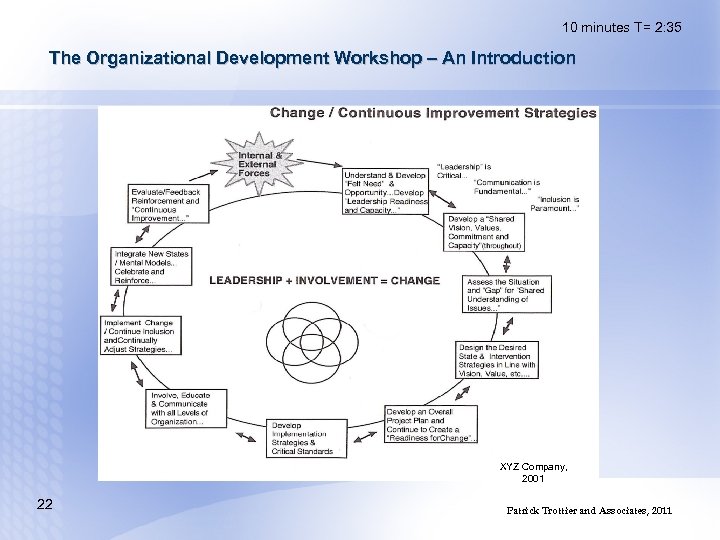 10 minutes T= 2: 35 The Organizational Development Workshop – An Introduction XYZ Company, 2001 22 Patrick Trottier and Associates, 2011
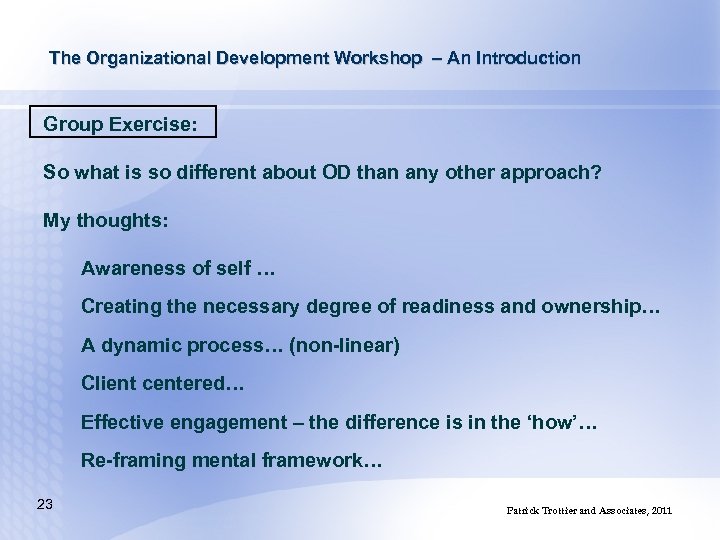 The Organizational Development Workshop – An Introduction Group Exercise: So what is so different about OD than any other approach? My thoughts: Awareness of self … Creating the necessary degree of readiness and ownership… A dynamic process… (non-linear) Client centered… Effective engagement – the difference is in the ‘how’… Re-framing mental framework… 23 Patrick Trottier and Associates, 2011
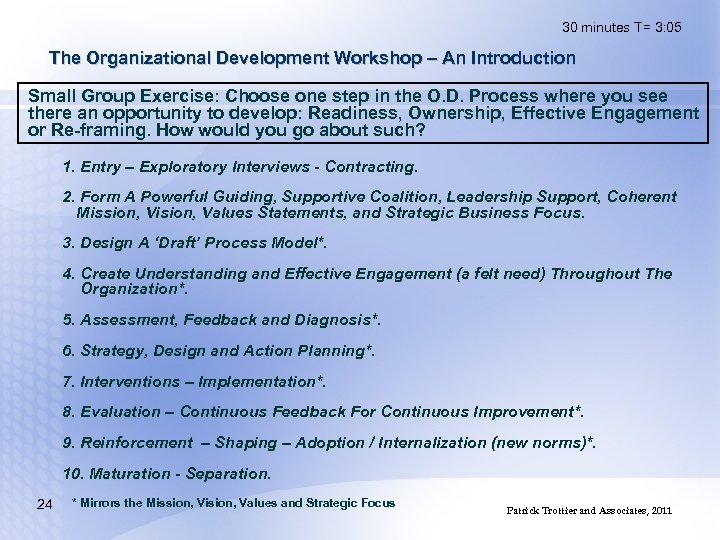 30 minutes T= 3: 05 The Organizational Development Workshop – An Introduction Small Group Exercise: Choose one step in the O. D. Process where you see there an opportunity to develop: Readiness, Ownership, Effective Engagement or Re-framing. How would you go about such? 1. Entry – Exploratory Interviews - Contracting. 2. Form A Powerful Guiding, Supportive Coalition, Leadership Support, Coherent Mission, Vision, Values Statements, and Strategic Business Focus. 3. Design A ‘Draft’ Process Model*. 4. Create Understanding and Effective Engagement (a felt need) Throughout The Organization*. 5. Assessment, Feedback and Diagnosis*. 6. Strategy, Design and Action Planning*. 7. Interventions – Implementation*. 8. Evaluation – Continuous Feedback For Continuous Improvement*. 9. Reinforcement – Shaping – Adoption / Internalization (new norms)*. 10. Maturation - Separation. 24 * Mirrors the Mission, Vision, Values and Strategic Focus Patrick Trottier and Associates, 2011
 20 minutes T= 3: 25 The Organizational Development Workshop – An Introduction Debrief / Feedback Liked: • • • 25 Areas of further interest: • • • Patrick Trottier and Associates, 2011
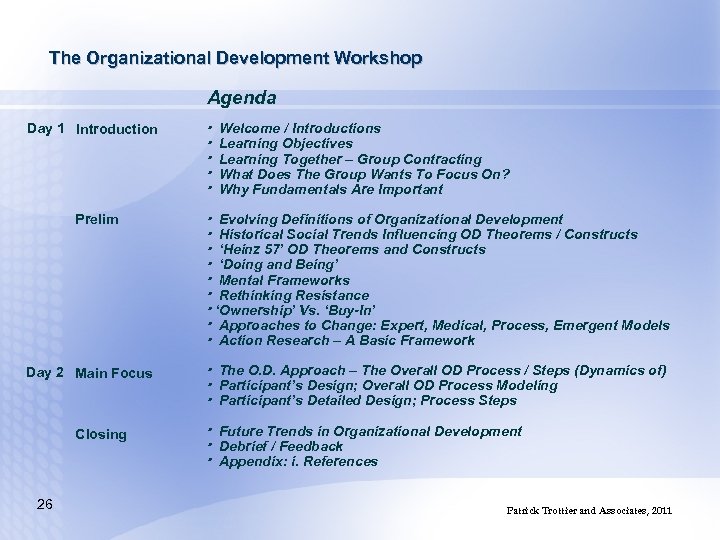 The Organizational Development Workshop Agenda Day 1 Introduction Prelim Day 2 Main Focus Closing 26 Welcome / Introductions Learning Objectives Learning Together – Group Contracting What Does The Group Wants To Focus On? Why Fundamentals Are Important Evolving Definitions of Organizational Development Historical Social Trends Influencing OD Theorems / Constructs ‘Heinz 57’ OD Theorems and Constructs ‘Doing and Being’ Mental Frameworks Rethinking Resistance ‘Ownership’ Vs. ‘Buy-In’ Approaches to Change: Expert, Medical, Process, Emergent Models Action Research – A Basic Framework The O. D. Approach – The Overall OD Process / Steps (Dynamics of) Participant’s Design; Overall OD Process Modeling Participant’s Detailed Design; Process Steps Future Trends in Organizational Development Debrief / Feedback Appendix: i. References Patrick Trottier and Associates, 2011