


 Скачать презентацию THE ORGANISATION OF POLICE FORCES Plan 1 The
The Organisation Of Police Forces.pptx
- Количество слайдов: 19
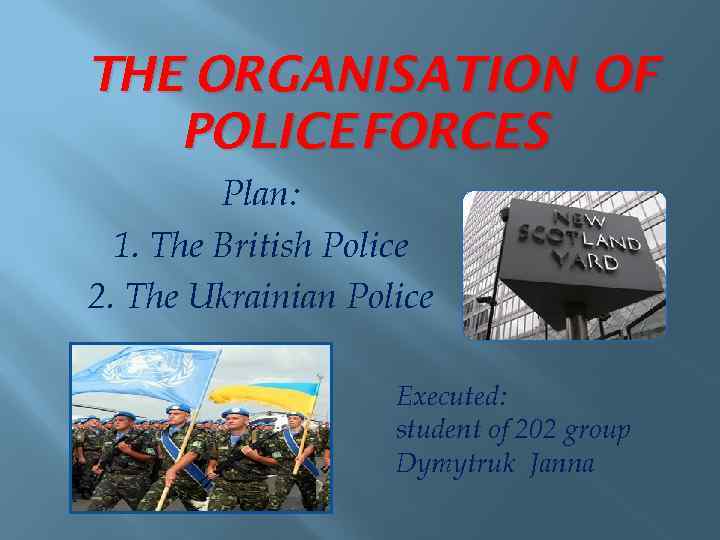 THE ORGANISATION OF POLICE FORCES Plan: 1. The British Police 2. The Ukrainian Police Executed: student of 202 group Dymytruk Janna
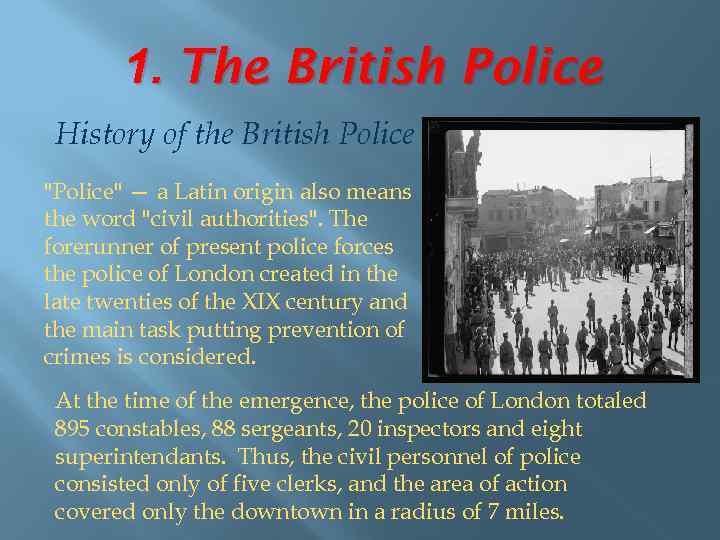 1. The British Police History of the British Police "Police" — a Latin origin also means the word "civil authorities". The forerunner of present police forces the police of London created in the late twenties of the XIX century and the main task putting prevention of crimes is considered. At the time of the emergence, the police of London totaled 895 constables, 88 sergeants, 20 inspectors and eight superintendants. Thus, the civil personnel of police consisted only of five clerks, and the area of action covered only the downtown in a radius of 7 miles.
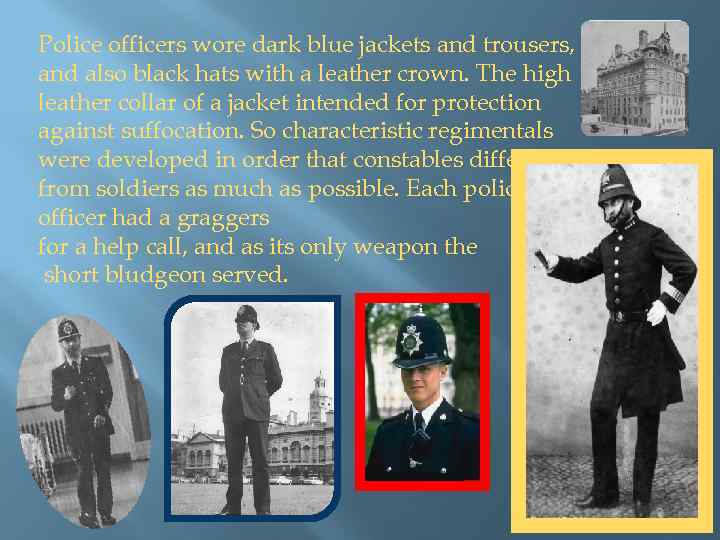 Police officers wore dark blue jackets and trousers, and also black hats with a leather crown. The high leather collar of a jacket intended for protection against suffocation. So characteristic regimentals were developed in order that constables differed from soldiers as much as possible. Each police officer had a graggers for a help call, and as its only weapon the short bludgeon served.
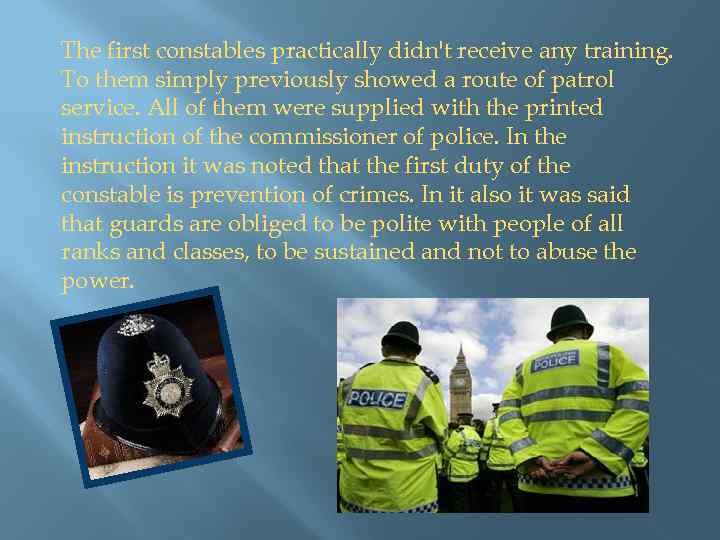 The first constables practically didn't receive any training. To them simply previously showed a route of patrol service. All of them were supplied with the printed instruction of the commissioner of police. In the instruction it was noted that the first duty of the constable is prevention of crimes. In it also it was said that guards are obliged to be polite with people of all ranks and classes, to be sustained and not to abuse the power.
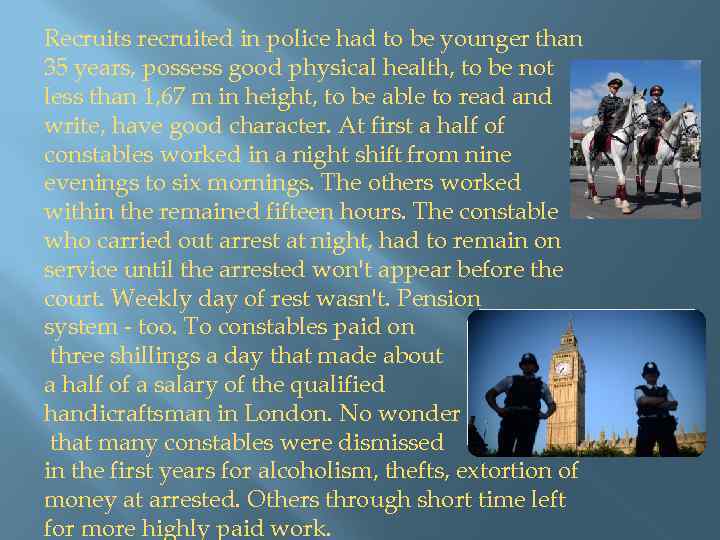 Recruits recruited in police had to be younger than 35 years, possess good physical health, to be not less than 1, 67 m in height, to be able to read and write, have good character. At first a half of constables worked in a night shift from nine evenings to six mornings. The others worked within the remained fifteen hours. The constable who carried out arrest at night, had to remain on service until the arrested won't appear before the court. Weekly day of rest wasn't. Pension system - too. To constables paid on three shillings a day that made about a half of a salary of the qualified handicraftsman in London. No wonder that many constables were dismissed in the first years for alcoholism, thefts, extortion of money at arrested. Others through short time left for more highly paid work.
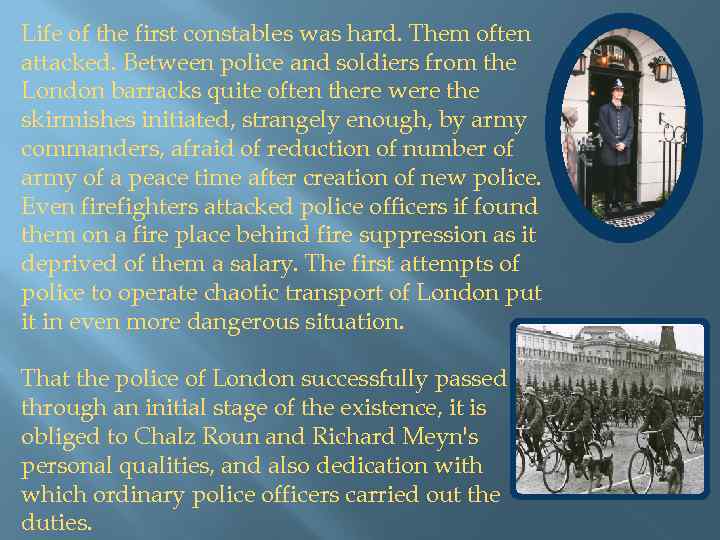 Life of the first constables was hard. Them often attacked. Between police and soldiers from the London barracks quite often there were the skirmishes initiated, strangely enough, by army commanders, afraid of reduction of number of army of a peace time after creation of new police. Even firefighters attacked police officers if found them on a fire place behind fire suppression as it deprived of them a salary. The first attempts of police to operate chaotic transport of London put it in even more dangerous situation. That the police of London successfully passed through an initial stage of the existence, it is obliged to Chalz Roun and Richard Meyn's personal qualities, and also dedication with which ordinary police officers carried out the duties.
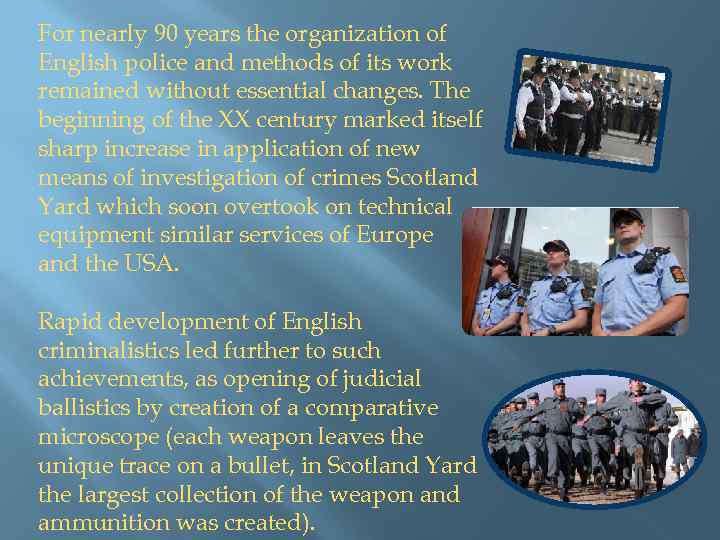 For nearly 90 years the organization of English police and methods of its work remained without essential changes. The beginning of the XX century marked itself sharp increase in application of new means of investigation of crimes Scotland Yard which soon overtook on technical equipment similar services of Europe and the USA. Rapid development of English criminalistics led further to such achievements, as opening of judicial ballistics by creation of a comparative microscope (each weapon leaves the unique trace on a bullet, in Scotland Yard the largest collection of the weapon and ammunition was created).
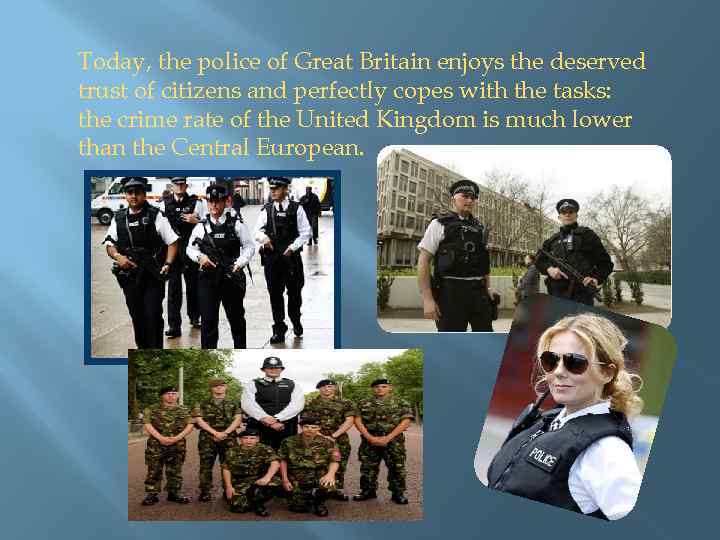 Today, the police of Great Britain enjoys the deserved trust of citizens and perfectly copes with the tasks: the crime rate of the United Kingdom is much lower than the Central European.
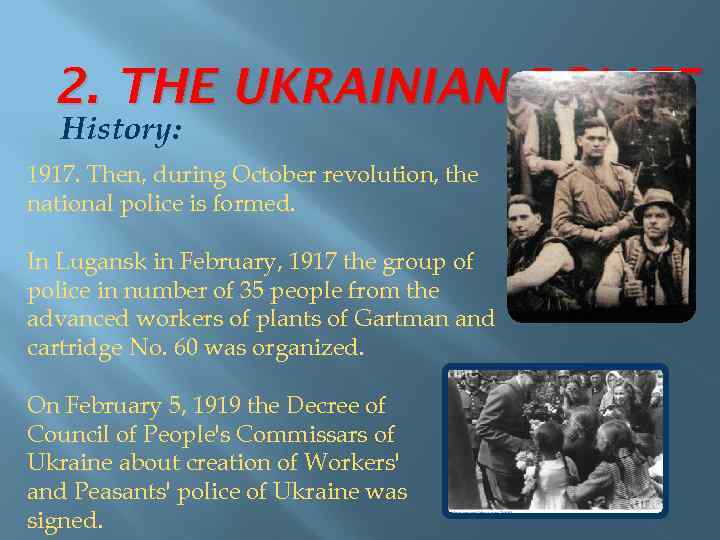 2. THE UKRAINIAN POLICE History: 1917. Then, during October revolution, the national police is formed. In Lugansk in February, 1917 the group of police in number of 35 people from the advanced workers of plants of Gartman and cartridge No. 60 was organized. On February 5, 1919 the Decree of Council of People's Commissars of Ukraine about creation of Workers' and Peasants' police of Ukraine was signed.
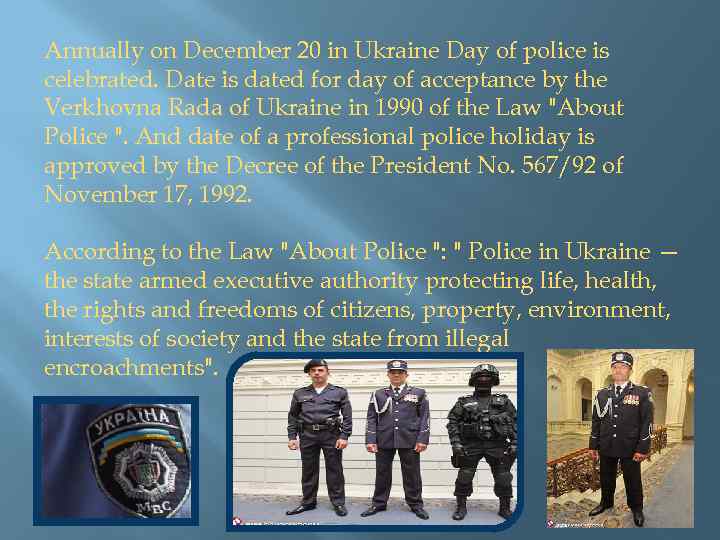 Annually on December 20 in Ukraine Day of police is celebrated. Date is dated for day of acceptance by the Verkhovna Rada of Ukraine in 1990 of the Law "About Police ". And date of a professional police holiday is approved by the Decree of the President No. 567/92 of November 17, 1992. According to the Law "About Police ": " Police in Ukraine — the state armed executive authority protecting life, health, the rights and freedoms of citizens, property, environment, interests of society and the state from illegal encroachments".
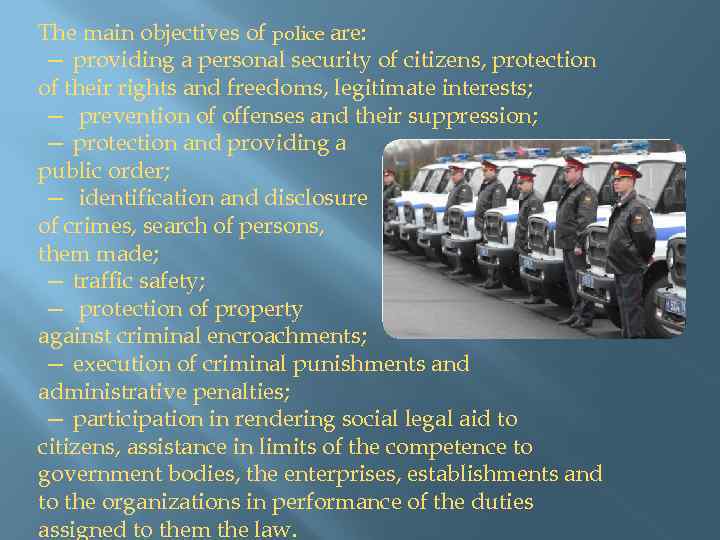 The main objectives of police are: — providing a personal security of citizens, protection of their rights and freedoms, legitimate interests; — prevention of offenses and their suppression; — protection and providing a public order; — identification and disclosure of crimes, search of persons, them made; — traffic safety; — protection of property against criminal encroachments; — execution of criminal punishments and administrative penalties; — participation in rendering social legal aid to citizens, assistance in limits of the competence to government bodies, the enterprises, establishments and to the organizations in performance of the duties assigned to them the law.
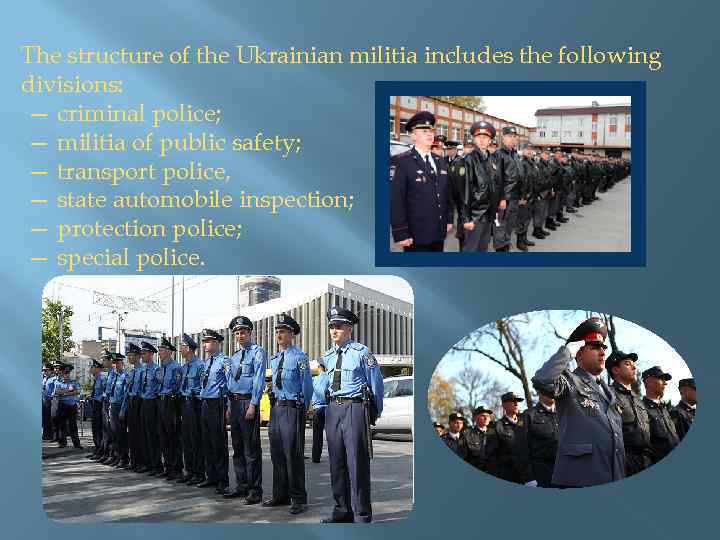 The structure of the Ukrainian militia includes the following divisions: — criminal police; — militia of public safety; — transport police, — state automobile inspection; — protection police; — special police.
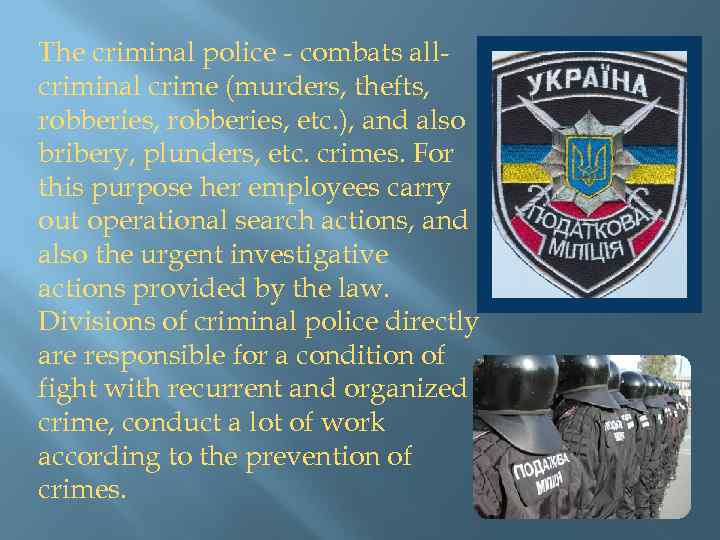 The criminal police - combats allcriminal crime (murders, thefts, robberies, etc. ), and also bribery, plunders, etc. crimes. For this purpose her employees carry out operational search actions, and also the urgent investigative actions provided by the law. Divisions of criminal police directly are responsible for a condition of fight with recurrent and organized crime, conduct a lot of work according to the prevention of crimes.
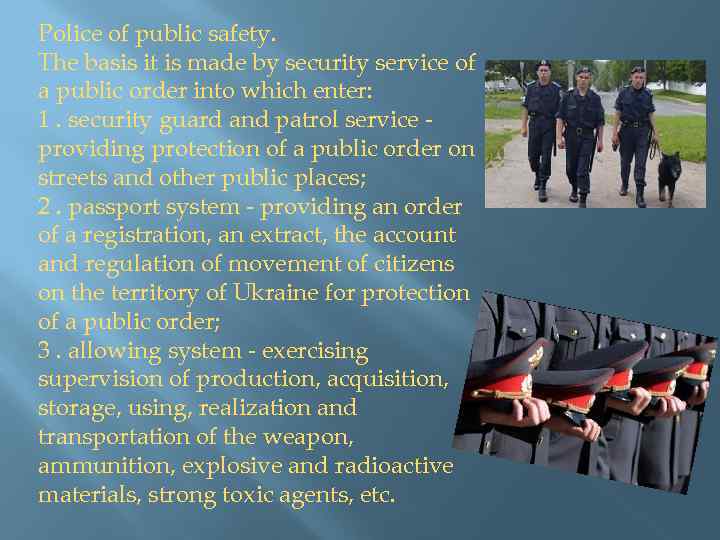 Police of public safety. The basis it is made by security service of a public order into which enter: 1. security guard and patrol service providing protection of a public order on streets and other public places; 2. passport system - providing an order of a registration, an extract, the account and regulation of movement of citizens on the territory of Ukraine for protection of a public order; 3. allowing system - exercising supervision of production, acquisition, storage, using, realization and transportation of the weapon, ammunition, explosive and radioactive materials, strong toxic agents, etc.
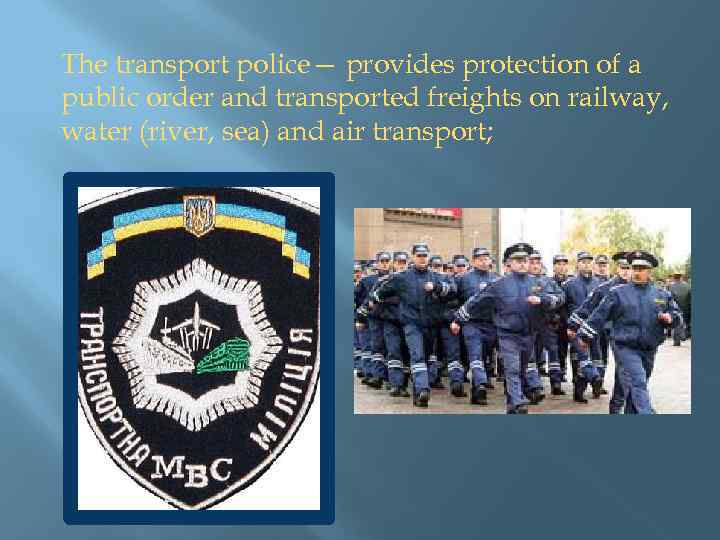 The transport police— provides protection of a public order and transported freights on railway, water (river, sea) and air transport;
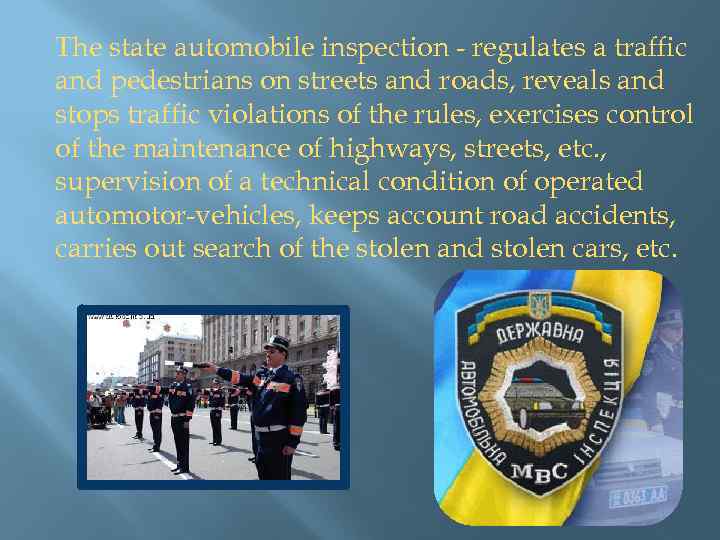 The state automobile inspection - regulates a traffic and pedestrians on streets and roads, reveals and stops traffic violations of the rules, exercises control of the maintenance of highways, streets, etc. , supervision of a technical condition of operated automotor-vehicles, keeps account road accidents, carries out search of the stolen and stolen cars, etc.
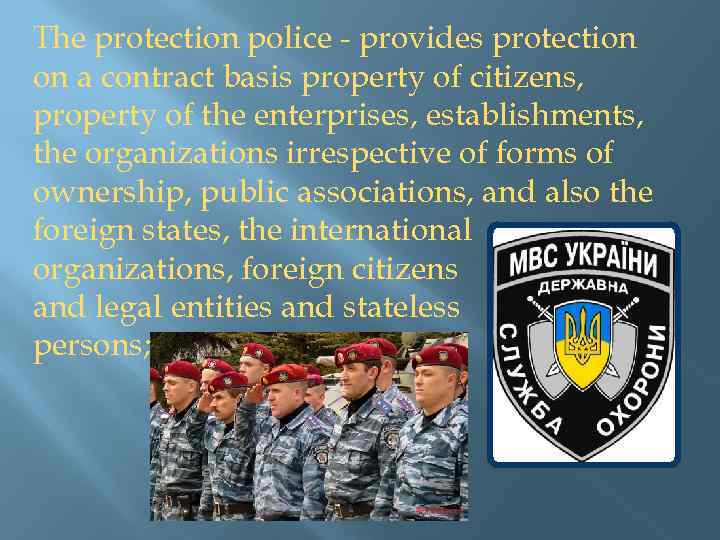 The protection police - provides protection on a contract basis property of citizens, property of the enterprises, establishments, the organizations irrespective of forms of ownership, public associations, and also the foreign states, the international organizations, foreign citizens and legal entities and stateless persons;
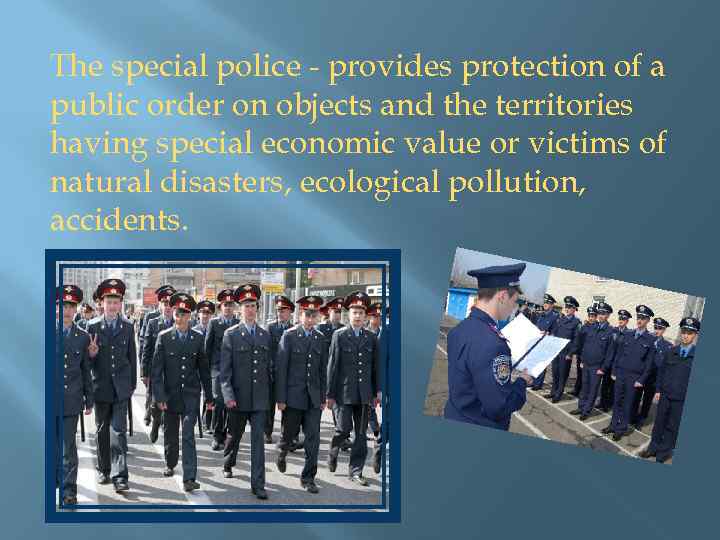 The special police - provides protection of a public order on objects and the territories having special economic value or victims of natural disasters, ecological pollution, accidents.
 The End