 Скачать презентацию The Orenburg State University orenburg in the abc s
Оренбург в алфавите_edit.pptx
- Количество слайдов: 43



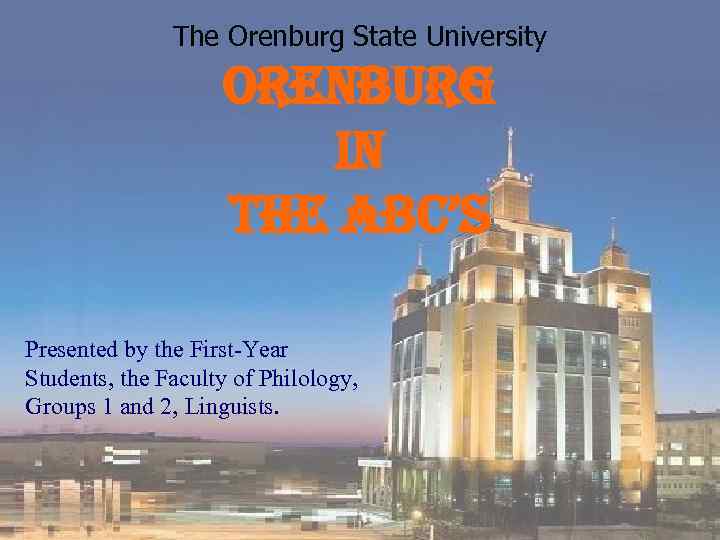
The Orenburg State University orenburg in the abc’s Presented by the First-Year Students, the Faculty of Philology, Groups 1 and 2, Linguists.
a g h i J k l m n o p Q r s t u x y z v w
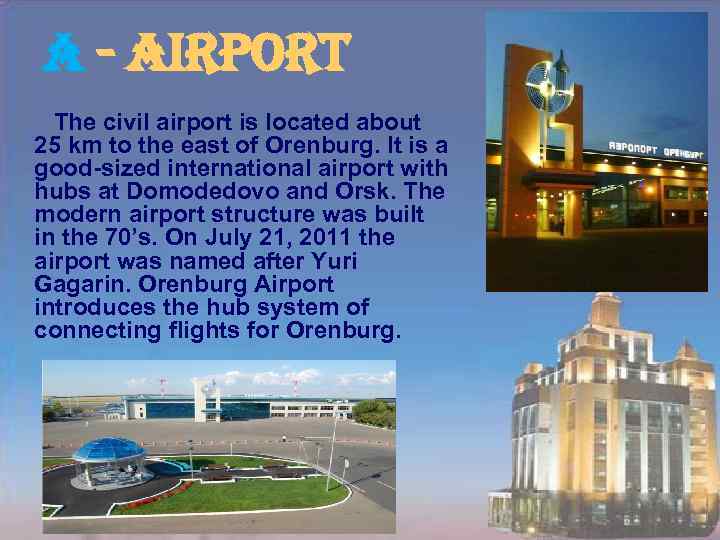
a - airport The civil airport is located about 25 km to the east of Orenburg. It is a good-sized international airport with hubs at Domodedovo and Orsk. The modern airport structure was built in the 70’s. On July 21, 2011 the airport was named after Yuri Gagarin. Orenburg Airport introduces the hub system of connecting flights for Orenburg.
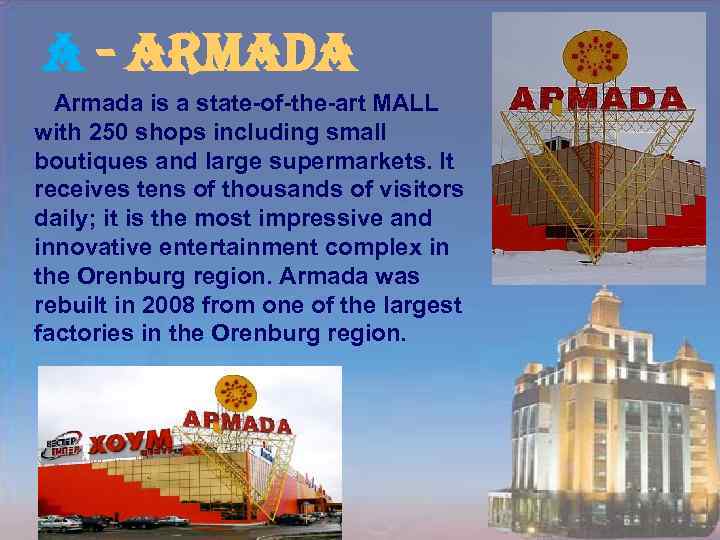
a - armada Armada is a state-of-the-art MALL with 250 shops including small boutiques and large supermarkets. It receives tens of thousands of visitors daily; it is the most impressive and innovative entertainment complex in the Orenburg region. Armada was rebuilt in 2008 from one of the largest factories in the Orenburg region.
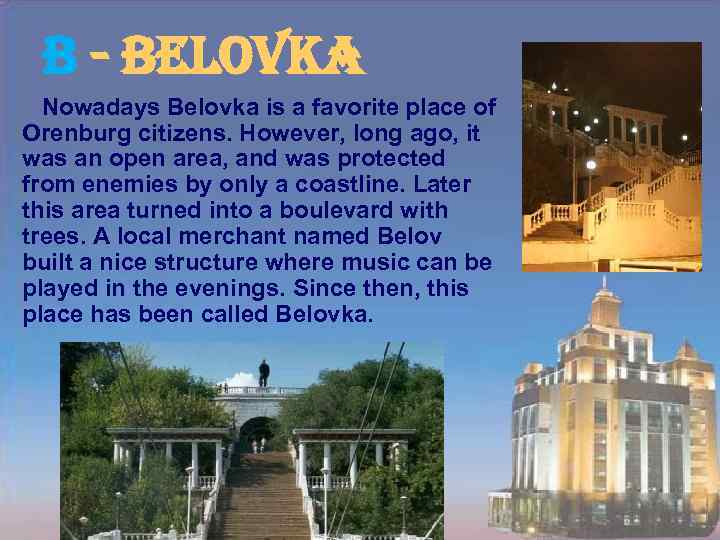
b - belovka Nowadays Belovka is a favorite place of Orenburg citizens. However, long ago, it was an open area, and was protected from enemies by only a coastline. Later this area turned into a boulevard with trees. A local merchant named Belov built a nice structure where music can be played in the evenings. Since then, this place has been called Belovka.
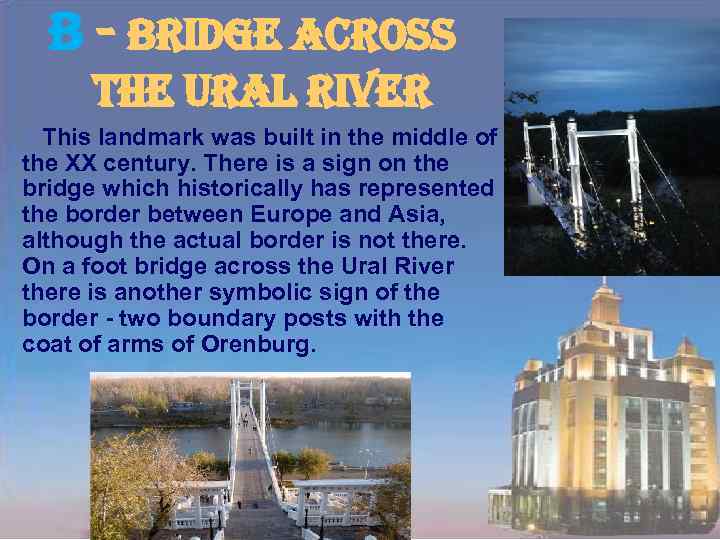
b - bridge across the ural river This landmark was built in the middle of the XX century. There is a sign on the bridge which historically has represented the border between Europe and Asia, although the actual border is not there. On a foot bridge across the Ural River there is another symbolic sign of the border - two boundary posts with the coat of arms of Orenburg.
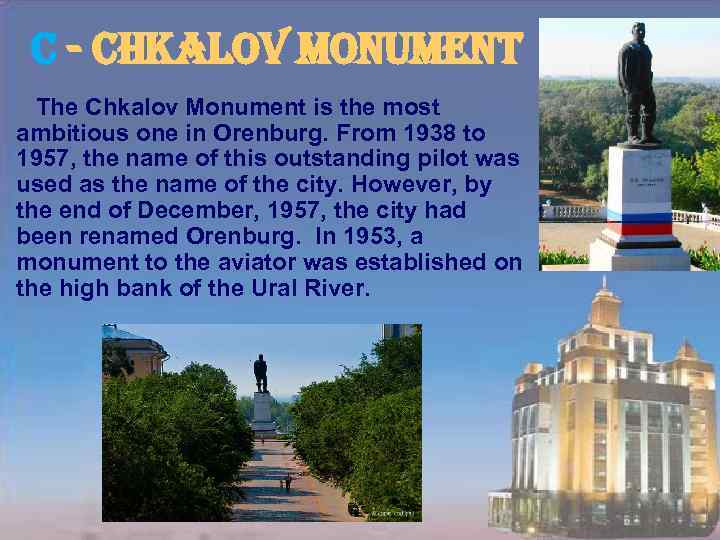
c - chkalov monument The Chkalov Monument is the most ambitious one in Orenburg. From 1938 to 1957, the name of this outstanding pilot was used as the name of the city. However, by the end of December, 1957, the city had been renamed Orenburg. In 1953, a monument to the aviator was established on the high bank of the Ural River.
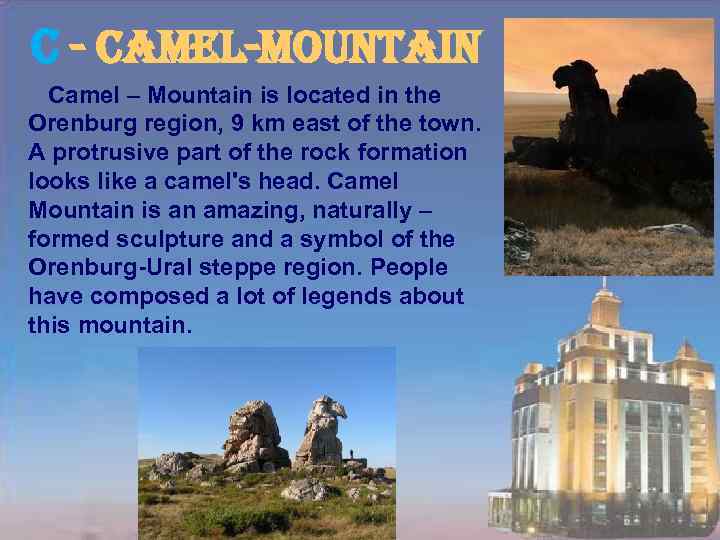
c - camel-mountain Camel – Mountain is located in the Orenburg region, 9 km east of the town. A protrusive part of the rock formation looks like a camel's head. Camel Mountain is an amazing, naturally – formed sculpture and a symbol of the Orenburg-Ural steppe region. People have composed a lot of legends about this mountain.
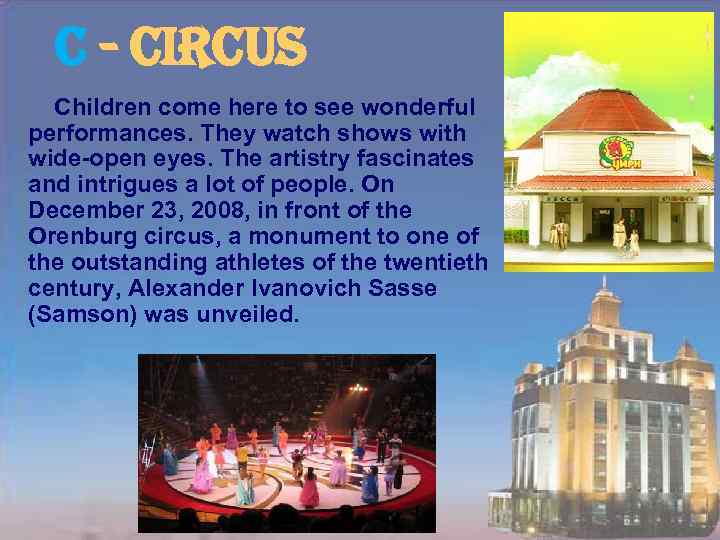
c - circus Children come here to see wonderful performances. They watch shows with wide-open eyes. The artistry fascinates and intrigues a lot of people. On December 23, 2008, in front of the Orenburg circus, a monument to one of the outstanding athletes of the twentieth century, Alexander Ivanovich Sasse (Samson) was unveiled.
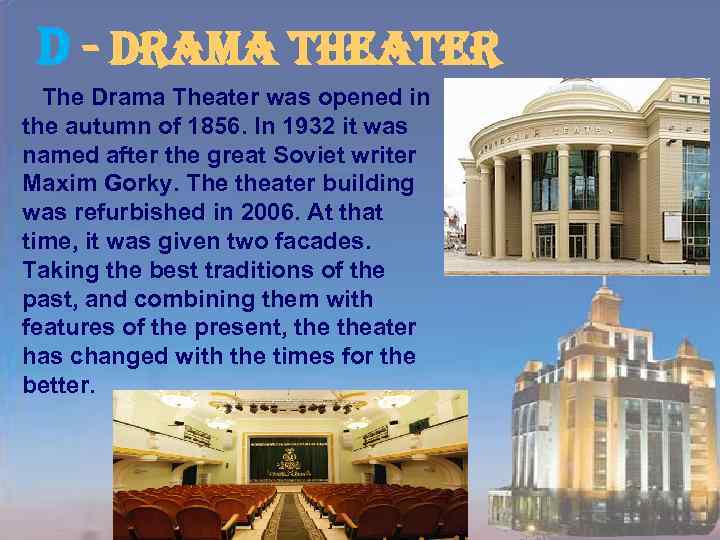
d - drama theater The Drama Theater was opened in the autumn of 1856. In 1932 it was named after the great Soviet writer Maxim Gorky. The theater building was refurbished in 2006. At that time, it was given two facades. Taking the best traditions of the past, and combining them with features of the present, theater has changed with the times for the better.
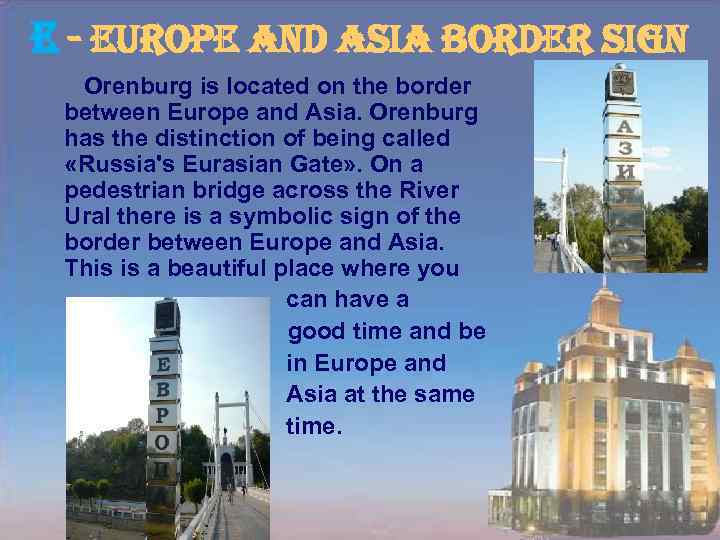
e - europe and asia border sign Orenburg is located on the border between Europe and Asia. Orenburg has the distinction of being called «Russia's Eurasian Gate» . On a pedestrian bridge across the River Ural there is a symbolic sign of the border between Europe and Asia. This is a beautiful place where you can have a good time and be in Europe and Asia at the same time.
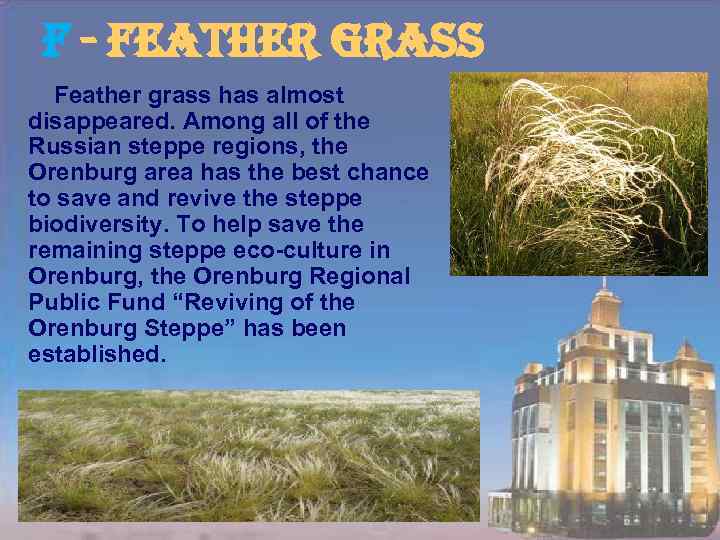
f - feather grass Feather grass has almost disappeared. Among all of the Russian steppe regions, the Orenburg area has the best chance to save and revive the steppe biodiversity. To help save the remaining steppe eco-culture in Orenburg, the Orenburg Regional Public Fund “Reviving of the Orenburg Steppe” has been established.
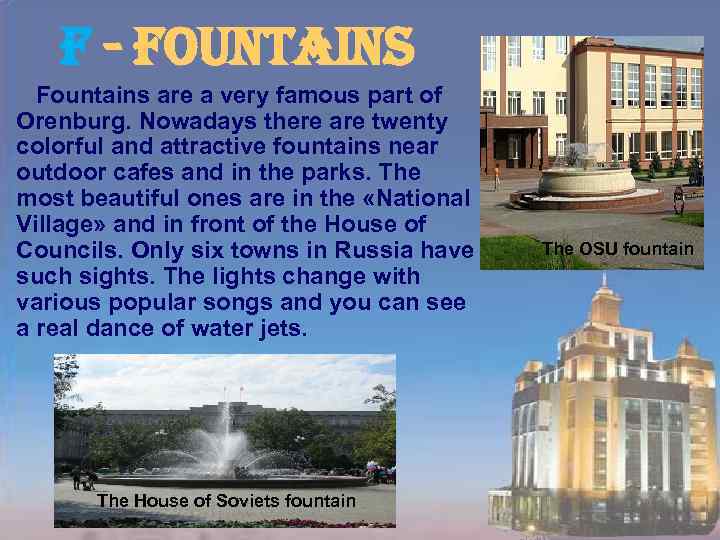
f - fountains Fountains are a very famous part of Orenburg. Nowadays there are twenty colorful and attractive fountains near outdoor cafes and in the parks. The most beautiful ones are in the «National Village» and in front of the House of Councils. Only six towns in Russia have such sights. The lights change with various popular songs and you can see a real dance of water jets. The House of Soviets fountain The OSU fountain
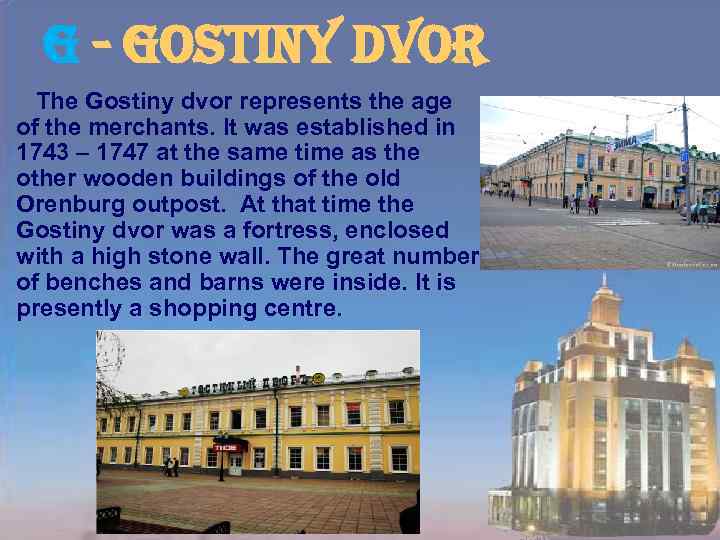
g - gostiny dvor The Gostiny dvor represents the age of the merchants. It was established in 1743 – 1747 at the same time as the other wooden buildings of the old Orenburg outpost. At that time the Gostiny dvor was a fortress, enclosed with a high stone wall. The great number of benches and barns were inside. It is presently a shopping centre.
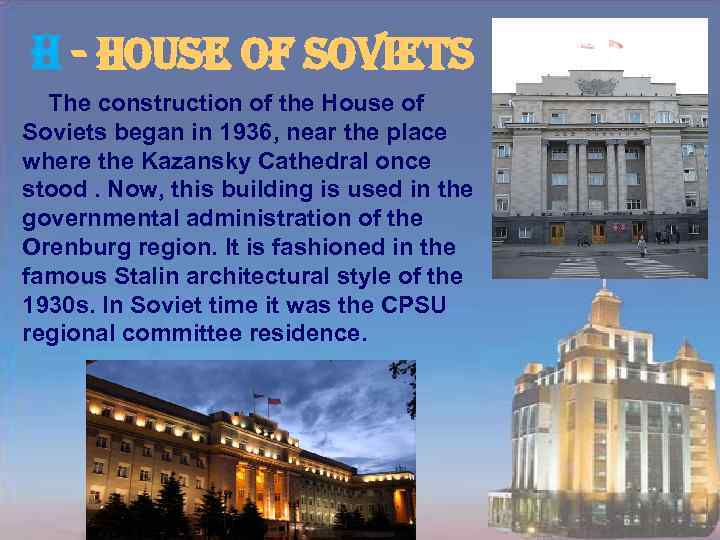
h - house of soviets The construction of the House of Soviets began in 1936, near the place where the Kazansky Cathedral once stood. Now, this building is used in the governmental administration of the Orenburg region. It is fashioned in the famous Stalin architectural style of the 1930 s. In Soviet time it was the CPSU regional committee residence.
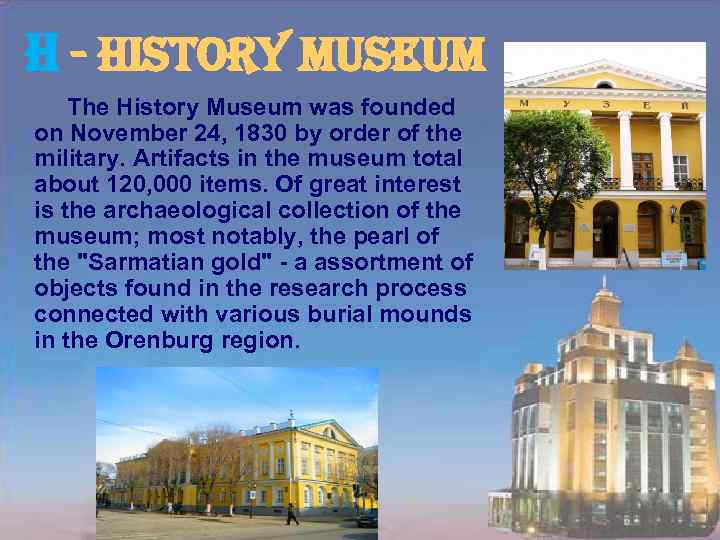
h - history museum The History Museum was founded on November 24, 1830 by order of the military. Artifacts in the museum total about 120, 000 items. Of great interest is the archaeological collection of the museum; most notably, the pearl of the "Sarmatian gold" - a assortment of objects found in the research process connected with various burial mounds in the Orenburg region.
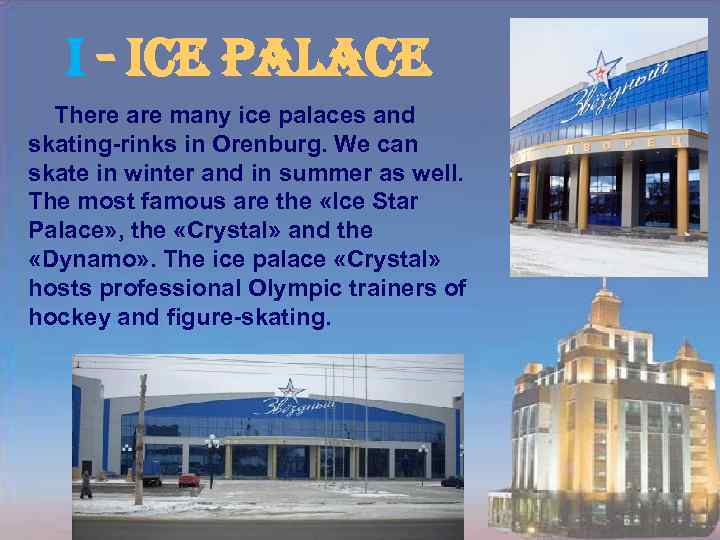
i - ice palace There are many ice palaces and skating-rinks in Orenburg. We can skate in winter and in summer as well. The most famous are the «Ice Star Palace» , the «Crystal» and the «Dynamo» . The ice palace «Crystal» hosts professional Olympic trainers of hockey and figure-skating.
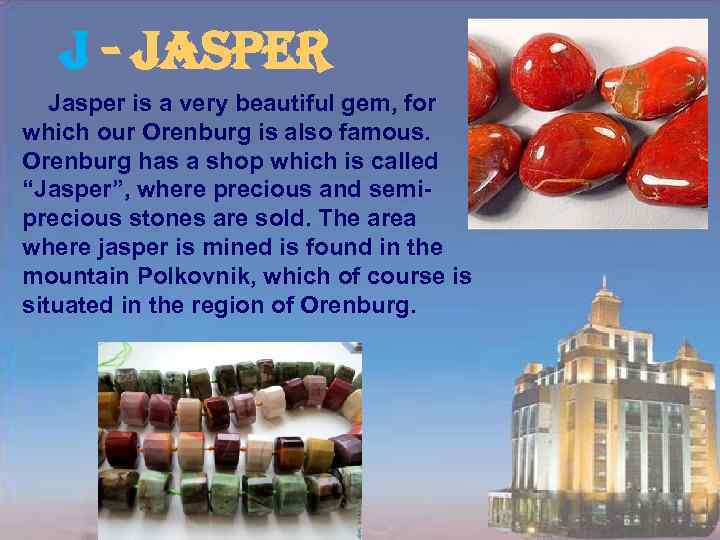
J - Jasper is a very beautiful gem, for which our Orenburg is also famous. Orenburg has a shop which is called “Jasper”, where precious and semiprecious stones are sold. The area where jasper is mined is found in the mountain Polkovnik, which of course is situated in the region of Orenburg.
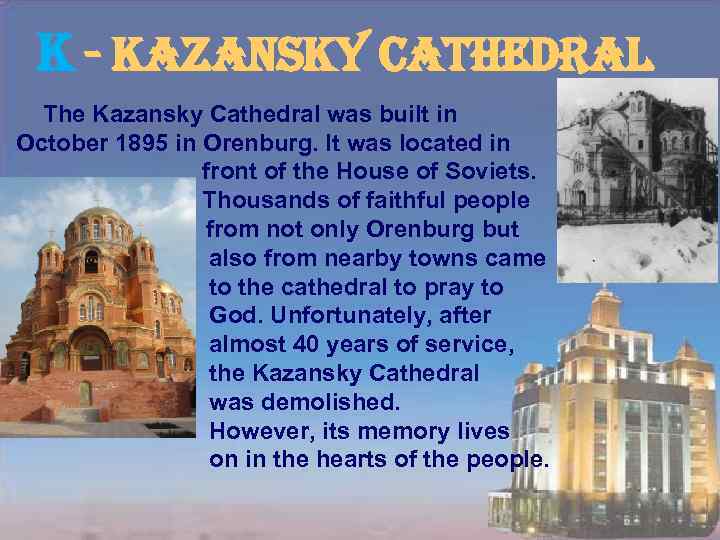
k - kazansky cathedral The Kazansky Cathedral was built in October 1895 in Orenburg. It was located in front of the House of Soviets. Thousands of faithful people from not only Orenburg but also from nearby towns came to the cathedral to pray to God. Unfortunately, after almost 40 years of service, the Kazansky Cathedral was demolished. However, its memory lives on in the hearts of the people.
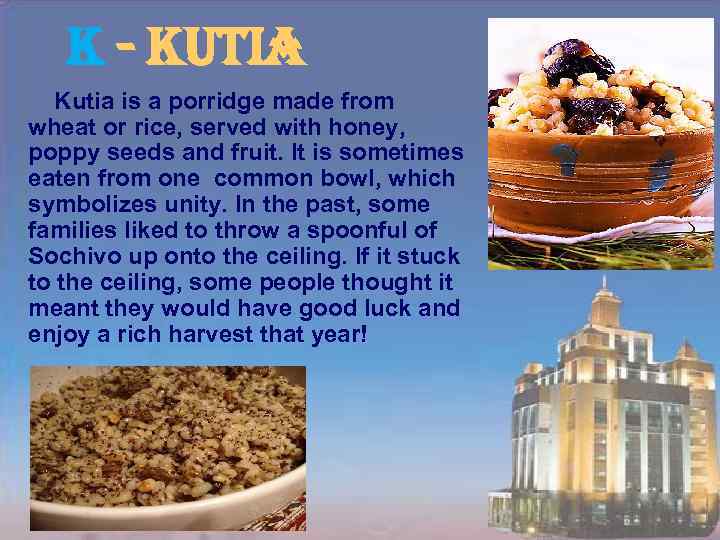
k - kutia Kutia is a porridge made from wheat or rice, served with honey, poppy seeds and fruit. It is sometimes eaten from one common bowl, which symbolizes unity. In the past, some families liked to throw a spoonful of Sochivo up onto the ceiling. If it stuck to the ceiling, some people thought it meant they would have good luck and enjoy a rich harvest that year!
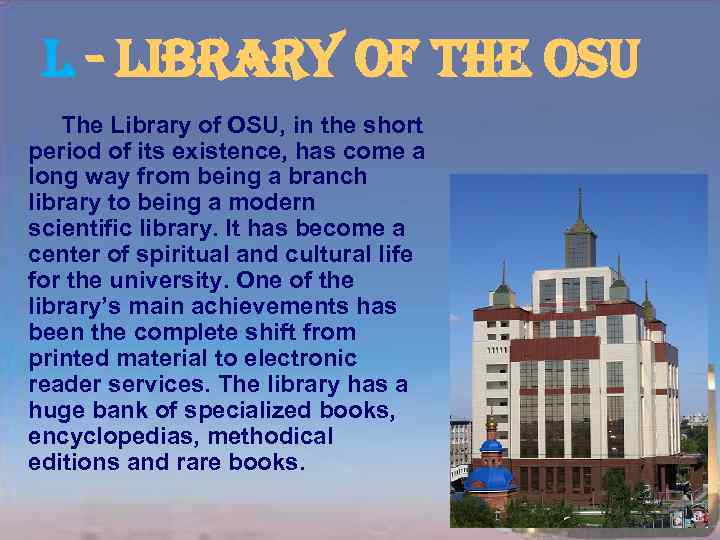
l - library of the osu The Library of OSU, in the short period of its existence, has come a long way from being a branch library to being a modern scientific library. It has become a center of spiritual and cultural life for the university. One of the library’s main achievements has been the complete shift from printed material to electronic reader services. The library has a huge bank of specialized books, encyclopedias, methodical editions and rare books.
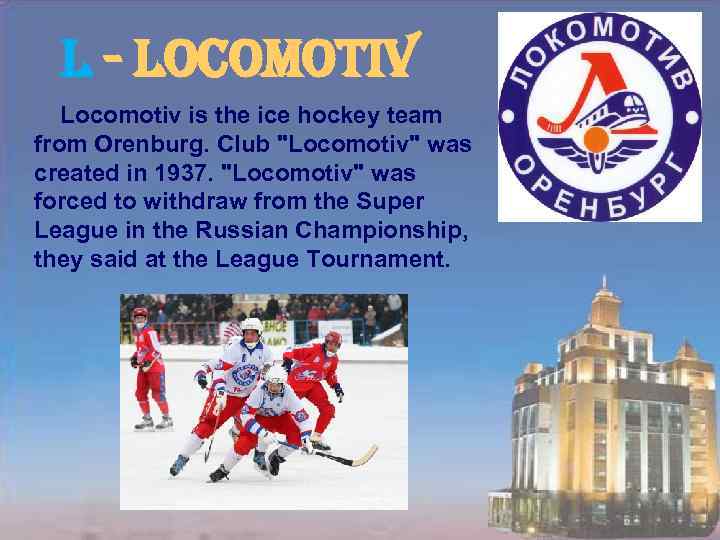
l - locomotiv Locomotiv is the ice hockey team from Orenburg. Club "Locomotiv" was created in 1937. "Locomotiv" was forced to withdraw from the Super League in the Russian Championship, they said at the League Tournament.
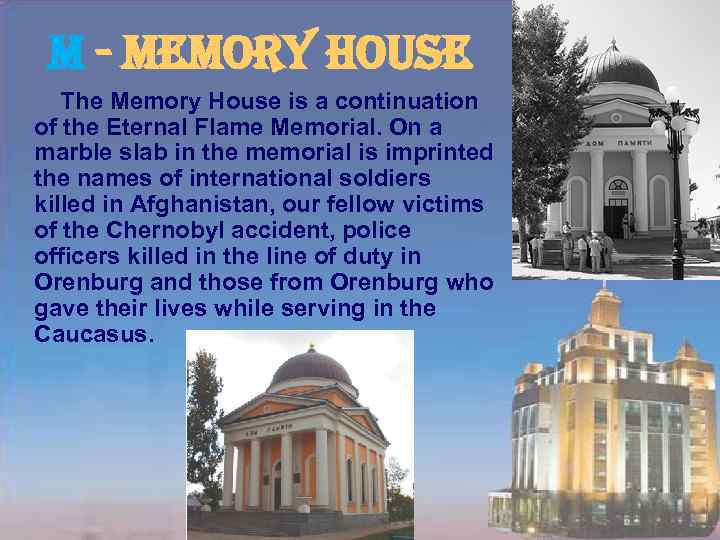
m - memory house The Memory House is a continuation of the Eternal Flame Memorial. On a marble slab in the memorial is imprinted the names of international soldiers killed in Afghanistan, our fellow victims of the Chernobyl accident, police officers killed in the line of duty in Orenburg and those from Orenburg who gave their lives while serving in the Caucasus.
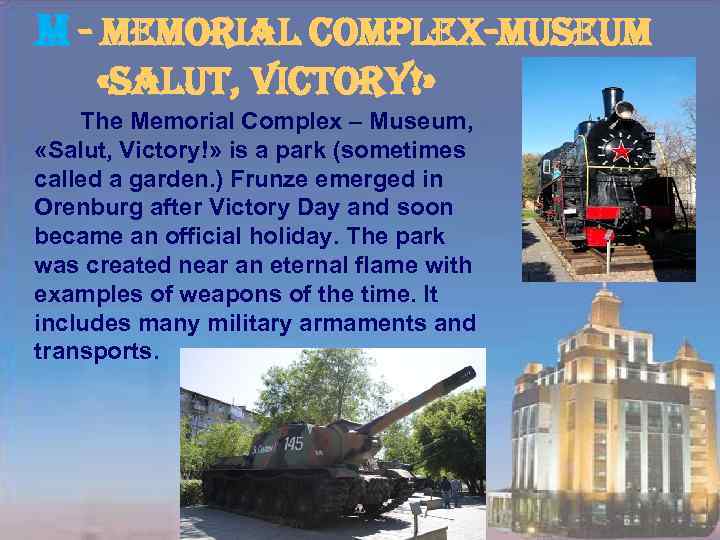
m - memorial complex-museum «salut, victory!» The Memorial Complex – Museum, «Salut, Victory!» is a park (sometimes called a garden. ) Frunze emerged in Orenburg after Victory Day and soon became an official holiday. The park was created near an eternal flame with examples of weapons of the time. It includes many military armaments and transports.
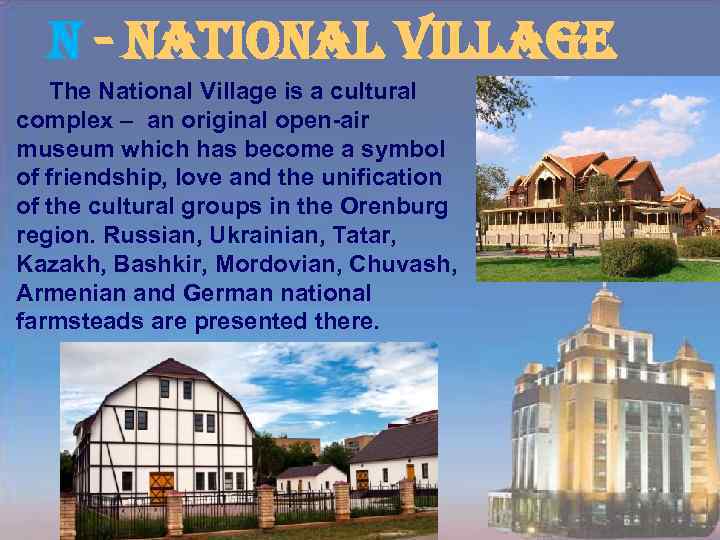
n - national village The National Village is a cultural complex – an original open-air museum which has become a symbol of friendship, love and the unification of the cultural groups in the Orenburg region. Russian, Ukrainian, Tatar, Kazakh, Bashkir, Mordovian, Chuvash, Armenian and German national farmsteads are presented there.
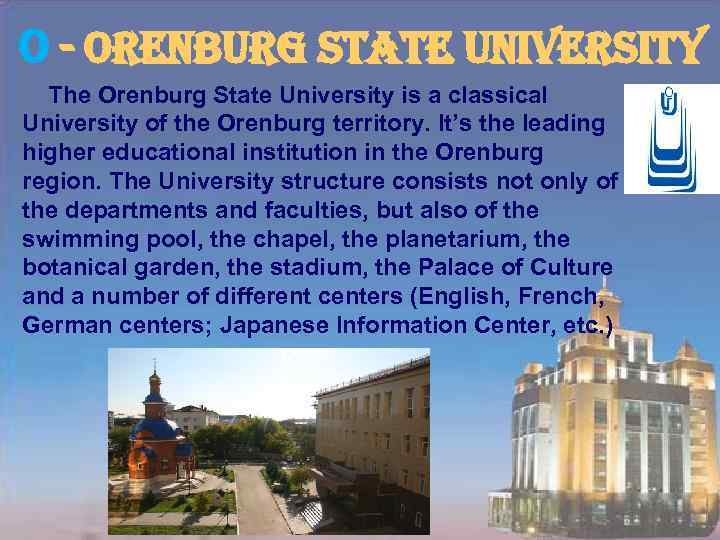
o - orenburg state university The Orenburg State University is a classical University of the Orenburg territory. It’s the leading higher educational institution in the Orenburg region. The University structure consists not only of the departments and faculties, but also of the swimming pool, the chapel, the planetarium, the botanical garden, the stadium, the Palace of Culture and a number of different centers (English, French, German centers; Japanese Information Center, etc. )
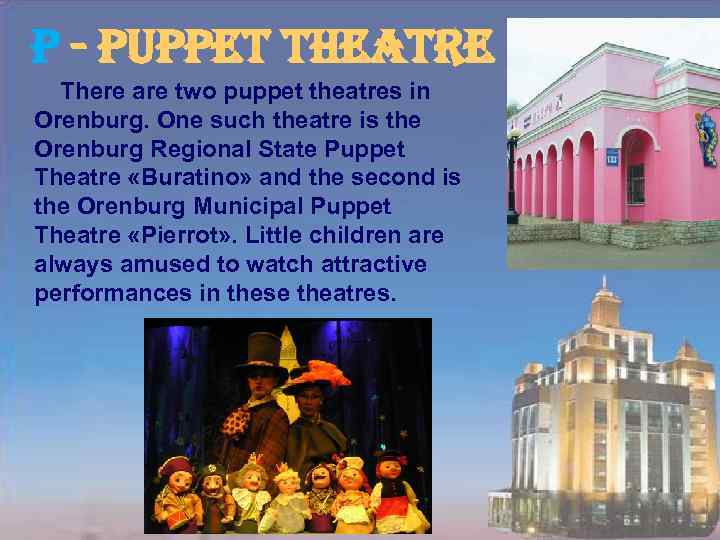
p - puppet theatre There are two puppet theatres in Orenburg. One such theatre is the Orenburg Regional State Puppet Theatre «Buratino» and the second is the Orenburg Municipal Puppet Theatre «Pierrot» . Little children are always amused to watch attractive performances in these theatres.
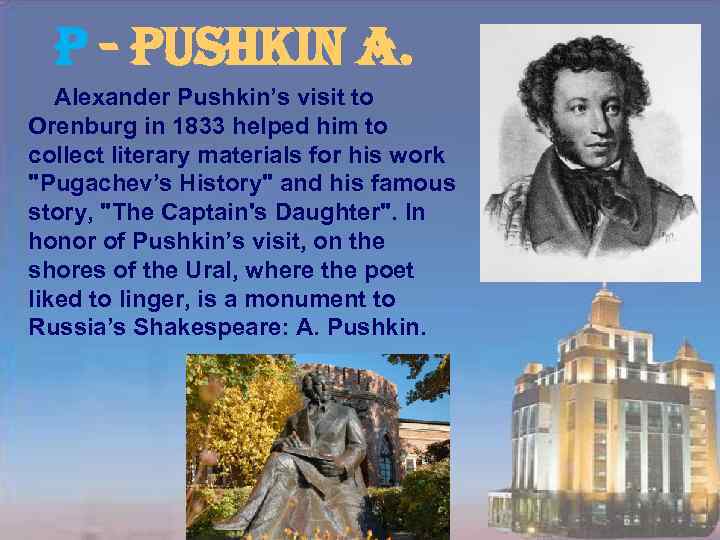
p - pushkin a. Alexander Pushkin’s visit to Orenburg in 1833 helped him to collect literary materials for his work "Pugachev’s History" and his famous story, "The Captain's Daughter". In honor of Pushkin’s visit, on the shores of the Ural, where the poet liked to linger, is a monument to Russia’s Shakespeare: A. Pushkin.
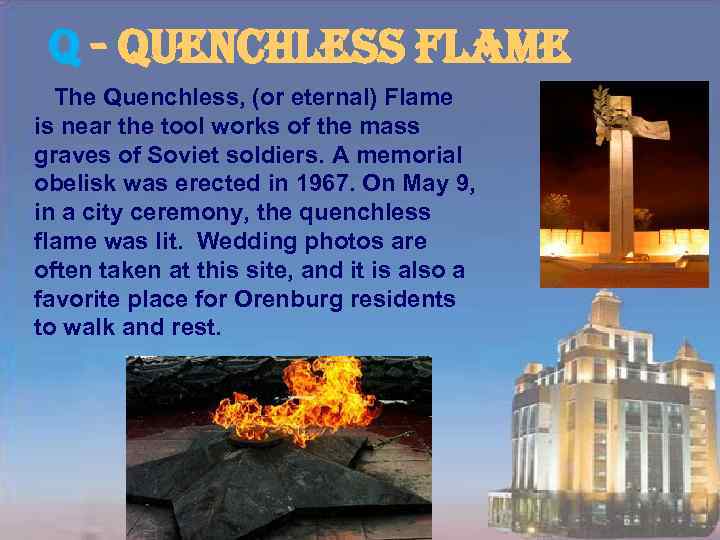
Q - Quenchless flame The Quenchless, (or eternal) Flame is near the tool works of the mass graves of Soviet soldiers. A memorial obelisk was erected in 1967. On May 9, in a city ceremony, the quenchless flame was lit. Wedding photos are often taken at this site, and it is also a favorite place for Orenburg residents to walk and rest.
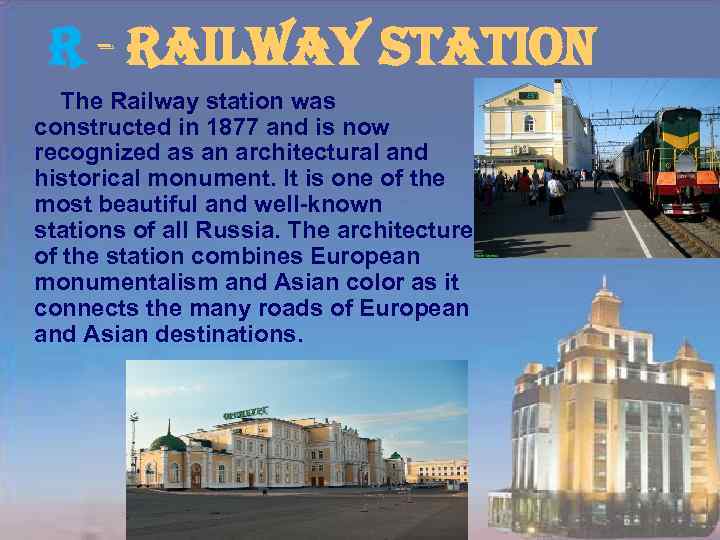
r - railway station The Railway station was constructed in 1877 and is now recognized as an architectural and historical monument. It is one of the most beautiful and well-known stations of all Russia. The architecture of the station combines European monumentalism and Asian color as it connects the many roads of European and Asian destinations.
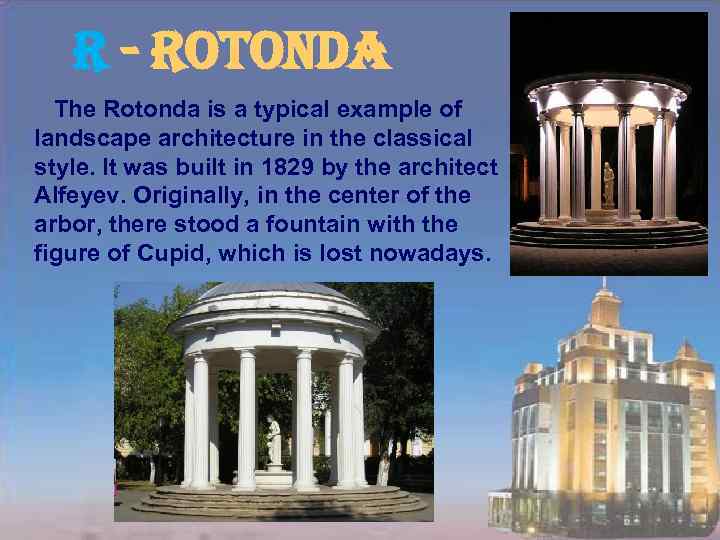
r - rotonda The Rotonda is a typical example of landscape architecture in the classical style. It was built in 1829 by the architect Alfeyev. Originally, in the center of the arbor, there stood a fountain with the figure of Cupid, which is lost nowadays.
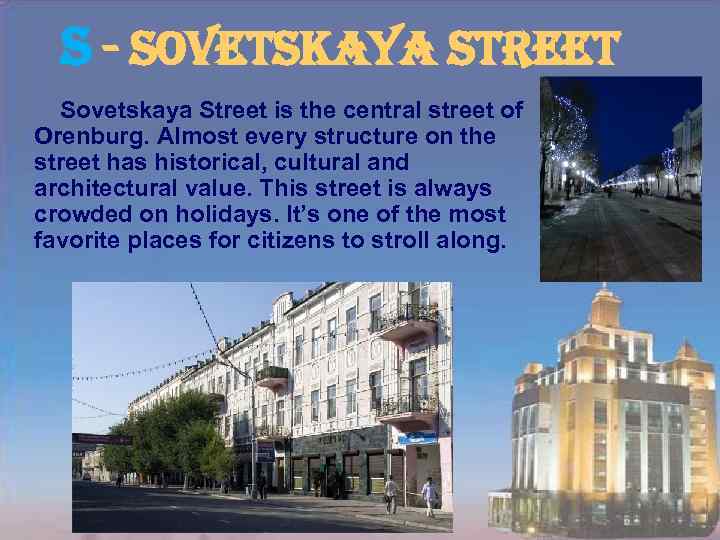
s - sovetskaya street Sovetskaya Street is the central street of Orenburg. Almost every structure on the street has historical, cultural and architectural value. This street is always crowded on holidays. It’s one of the most favorite places for citizens to stroll along.
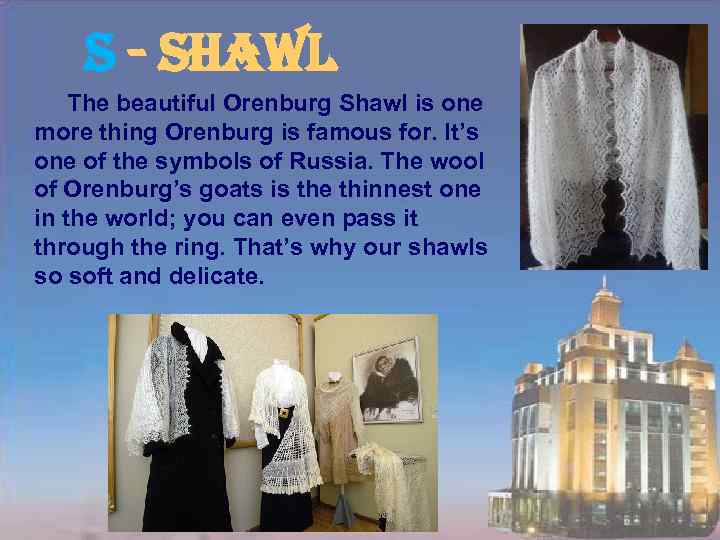
s - shawl The beautiful Orenburg Shawl is one more thing Orenburg is famous for. It’s one of the symbols of Russia. The wool of Orenburg’s goats is the thinnest one in the world; you can even pass it through the ring. That’s why our shawls so soft and delicate.
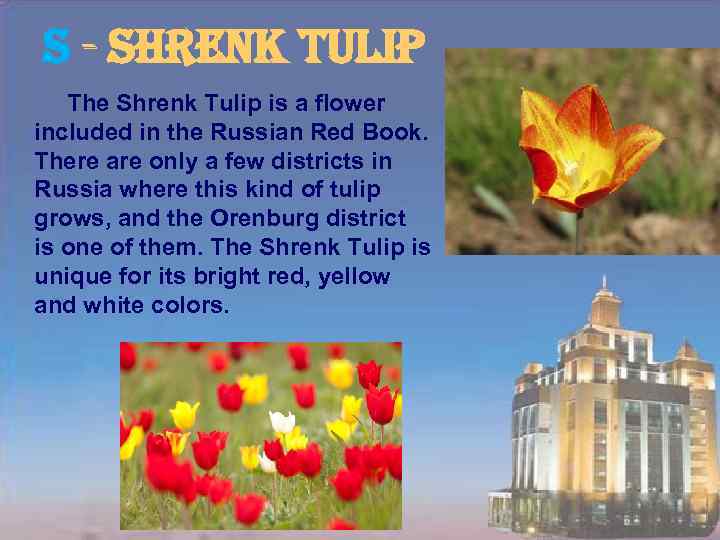
s - shrenk tulip The Shrenk Tulip is a flower included in the Russian Red Book. There are only a few districts in Russia where this kind of tulip grows, and the Orenburg district is one of them. The Shrenk Tulip is unique for its bright red, yellow and white colors.
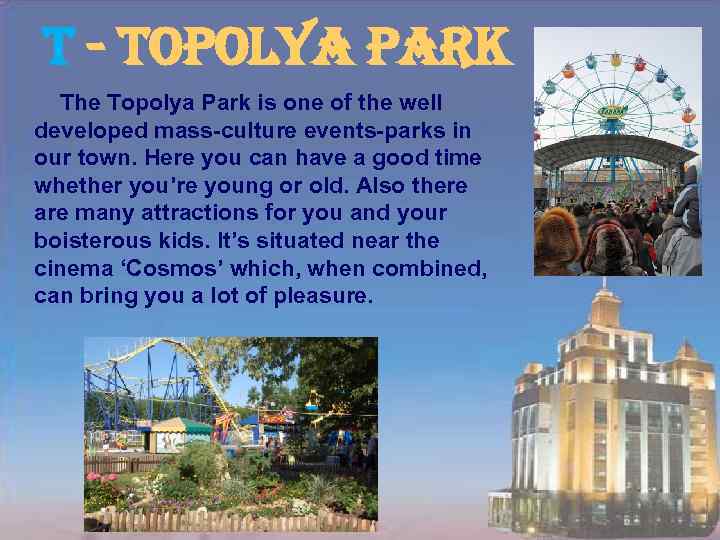
t - topolya park The Topolya Park is one of the well developed mass-culture events-parks in our town. Here you can have a good time whether you’re young or old. Also there are many attractions for you and your boisterous kids. It’s situated near the cinema ‘Cosmos’ which, when combined, can bring you a lot of pleasure.
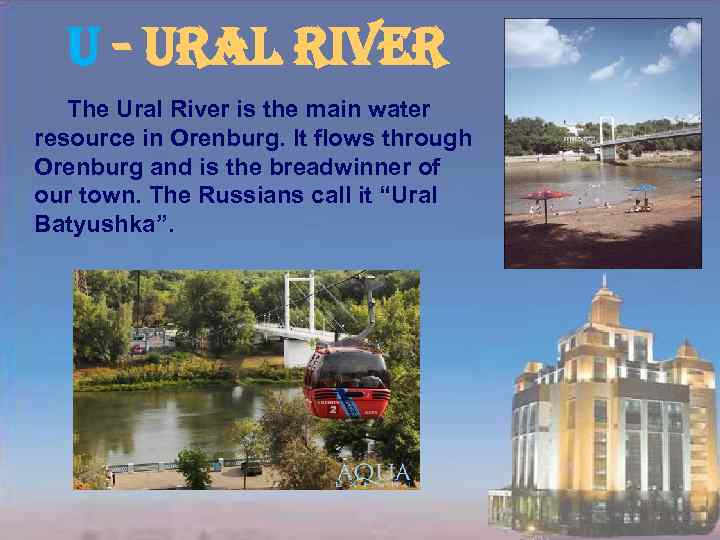
u - ural river The Ural River is the main water resource in Orenburg. It flows through Orenburg and is the breadwinner of our town. The Russians call it “Ural Batyushka”.
v - vecherny orenburg «Vecherny Orenburg» is the Russianlanguage social-political newspaper of Orenburg. «Vecherny Orenburg» prints information about the social, economic, cultural and sporting life of Orenburg. On its pages you will find not only information, but also comments on the lives of Orenburg citizens.
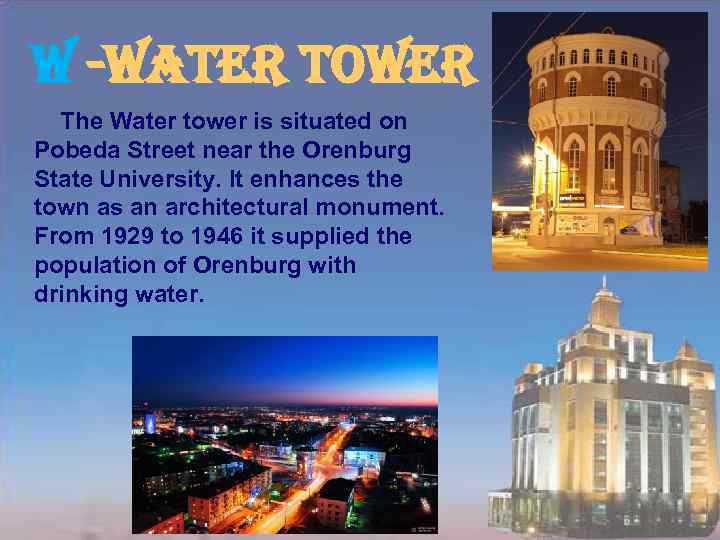
w -water tower The Water tower is situated on Pobeda Street near the Orenburg State University. It enhances the town as an architectural monument. From 1929 to 1946 it supplied the population of Orenburg with drinking water.
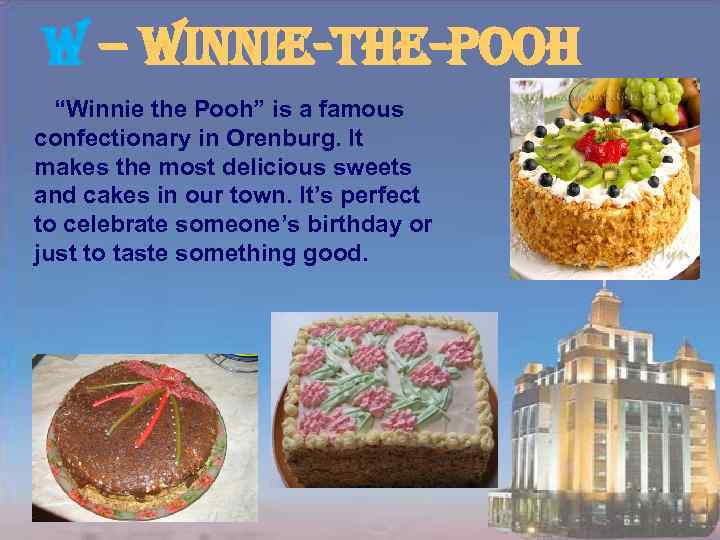
w – winnie-the-pooh “Winnie the Pooh” is a famous confectionary in Orenburg. It makes the most delicious sweets and cakes in our town. It’s perfect to celebrate someone’s birthday or just to taste something good.
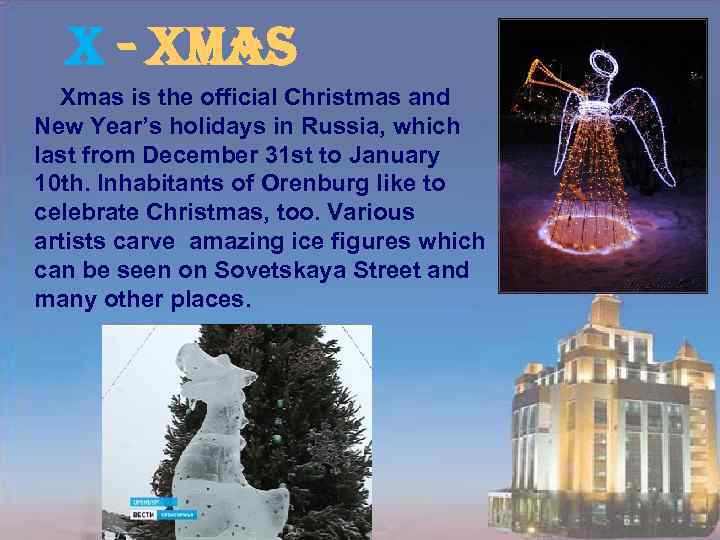
x - xmas Xmas is the official Christmas and New Year’s holidays in Russia, which last from December 31 st to January 10 th. Inhabitants of Orenburg like to celebrate Christmas, too. Various artists carve amazing ice figures which can be seen on Sovetskaya Street and many other places.
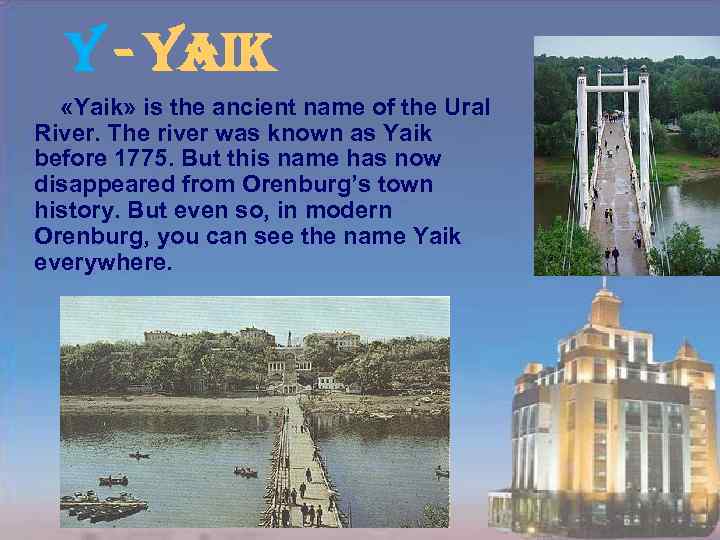
y - yaik «Yaik» is the ancient name of the Ural River. The river was known as Yaik before 1775. But this name has now disappeared from Orenburg’s town history. But even so, in modern Orenburg, you can see the name Yaik everywhere.
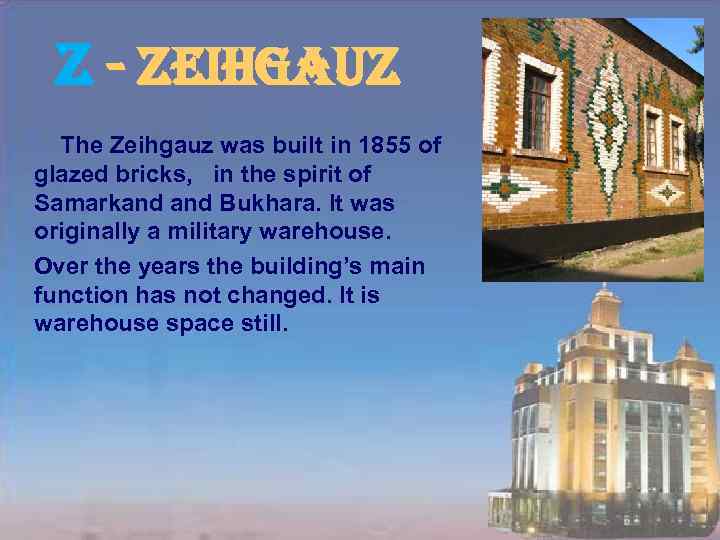
z - zeihgauz The Zeihgauz was built in 1855 of glazed bricks, in the spirit of Samarkand Bukhara. It was originally a military warehouse. Over the years the building’s main function has not changed. It is warehouse space still.
List of reference links Список использованных источников иллюстраций • • • • http: //orenburg. olx. ru http: //www. formula-divana. ru http: //www. google. ru http: //www. fototerra. ru http: //kraeved. opck. org http: //gorodurala. ru http: //foto. mail. ru http: //baikalnature. com http: //fotki. yandex. ru http: //7 r 1. ru http: //www. admin. orenburg. ru http: //images. esosedi. ru http: //www. trip-guide. ru
Скачать презентацию The Orenburg State University orenburg in the abc s
Оренбург в алфавите_edit.pptx