


 Скачать презентацию The OPERA experiment Oscillation Project with Emulsion t
8ce9564bed538868e905377ac46aa705.ppt
- Количество слайдов: 24
 The OPERA experiment Oscillation Project with Emulsion t. Racking Apparatus Direct search for the oscillation by looking at the appearance of in a pure beam CNGS program OPERA detector and experimental strategy Physics potential First operations of CNGS and OPERA Collaboration: Belgium (IIHE(ULB-VUB) Brussels), Bulgaria (Sofia University), China (IHEP Beijing Shandong University), Croatia (Zagreb University), France (LAPP Annecy, IPNL Lyon, LAL Orsay, IPHC Strasbourg), Germany (Berlin Humboldt University, Hagen, Hamburg University, Münster University, Rostock University), Israel (Technion Haifa), Italy (Bari, Bologna, LNF Frascati, L’Aquila, LNGS, Naples, Padova, Rome, Salerno), Japan (Aichi, Toho, Kobe, Nagoya, Utsunomiya), Russia (INR Moscow, ITEP Moscow, JINR Dubna, Obninsk), Switzerland (Bern, Neuchâtel, Zürich), Tunisia (Tunis University), Turkey (METU Ankara) Cécile Jollet, IN 2 P 3 -ULP Strasbourg on behalf of the OPERA collaboration 1 TAUP 07 Conference - Sendai - September 11 -15, 2007
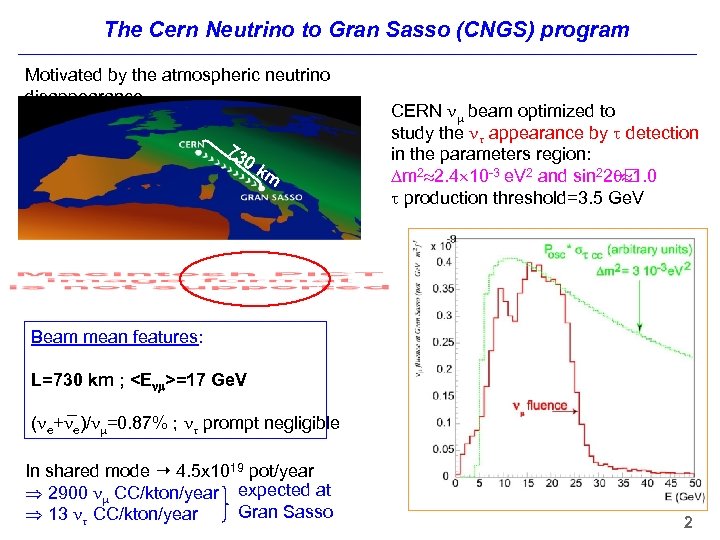 The Cern Neutrino to Gran Sasso (CNGS) program Motivated by the atmospheric neutrino disappearance 73 0 k m CERN beam optimized to study the appearance by detection in the parameters region: m 2 2. 4 10 -3 e. V 2 and sin 22 1. 0 production threshold=3. 5 Ge. V Beam mean features: L=730 km ;
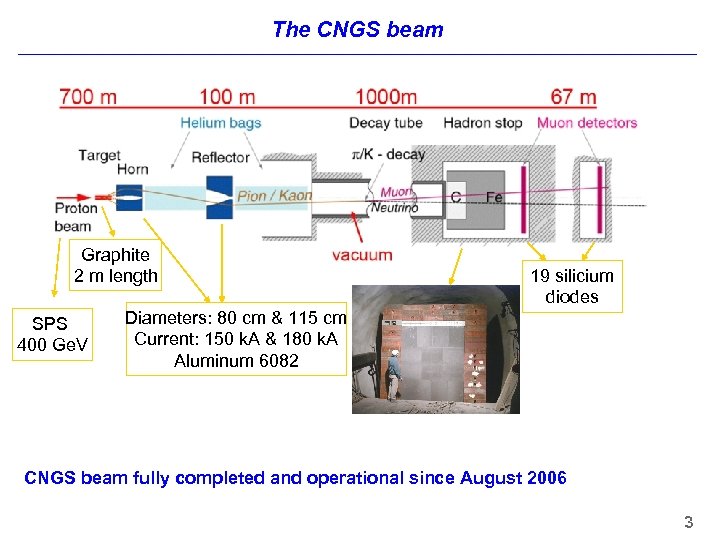 The CNGS beam Graphite 2 m length SPS 400 Ge. V 19 silicium diodes Diameters: 80 cm & 115 cm Current: 150 k. A & 180 k. A Aluminum 6082 CNGS beam fully completed and operational since August 2006 3
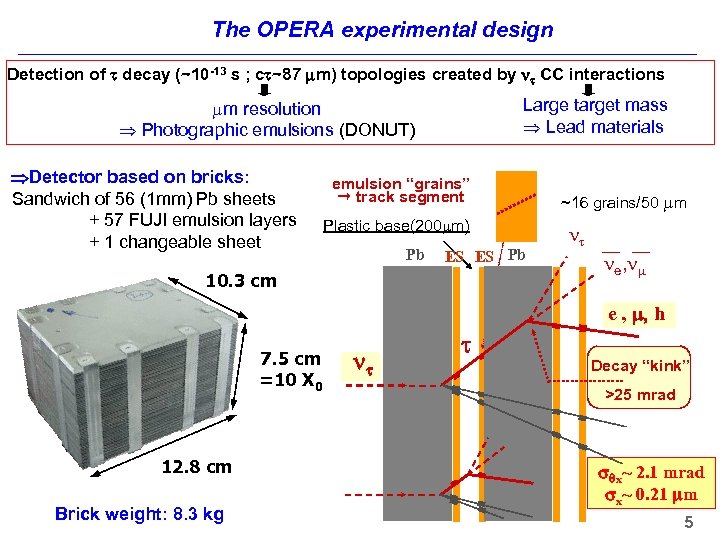 The OPERA experimental design Detection of decay (~10 -13 s ; c ~87 m) topologies created by CC interactions Large target mass Lead materials m resolution Photographic emulsions (DONUT) Detector based on bricks: Sandwich of 56 (1 mm) Pb sheets + 57 FUJI emulsion layers + 1 changeable sheet emulsion “grains” track segment Plastic base(200 m) Pb ES ES Pb 10. 3 cm ~16 grains/50 m e, e , h 7. 5 cm =10 X 0 12. 8 cm Brick weight: 8. 3 kg Decay “kink” >25 mrad x~ 2. 1 mrad x~ 0. 21 m 5
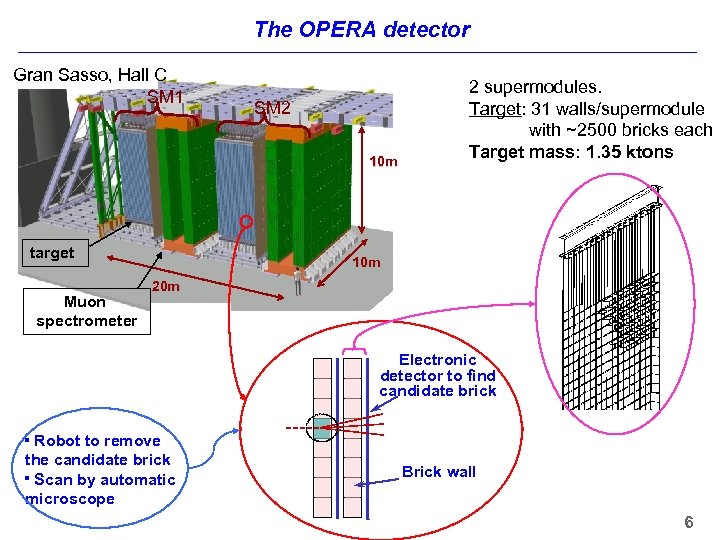 The OPERA detector Gran Sasso, Hall C SM 1 SM 2 10 m target Muon spectrometer 2 supermodules. Target: 31 walls/supermodule with ~2500 bricks each Target mass: 1. 35 ktons 10 m 20 m Electronic detector to find candidate brick Robot to remove the candidate brick Scan by automatic microscope Brick wall 6
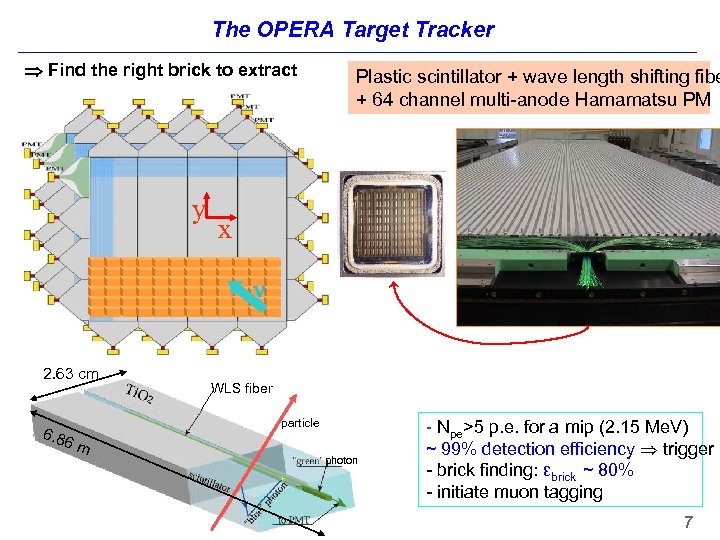 The OPERA Target Tracker Find the right brick to extract y Plastic scintillator + wave length shifting fibe + 64 channel multi-anode Hamamatsu PM x 2. 63 cm 6. 86 WLS fiber particle m photon - Npe>5 p. e. for a mip (2. 15 Me. V) ~ 99% detection efficiency trigger - brick finding: εbrick ~ 80% - initiate muon tagging 7
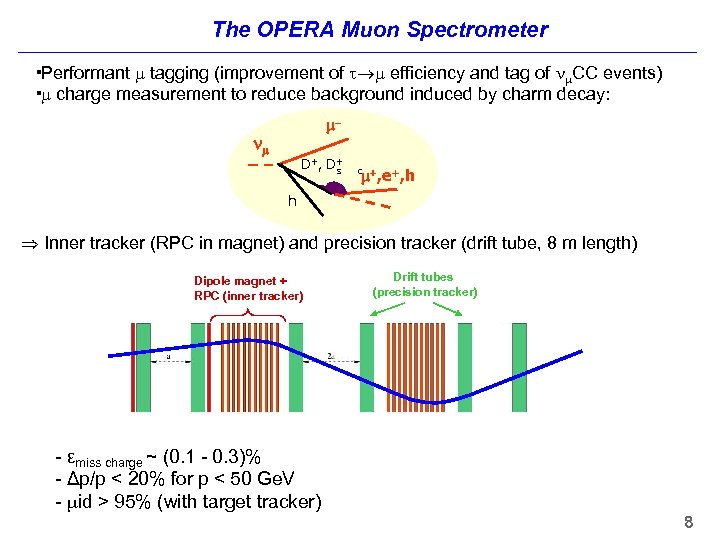 The OPERA Muon Spectrometer Performant tagging (improvement of efficiency and tag of CC events) charge measurement to reduce background induced by charm decay: D+ , D + s c , e+, h h Inner tracker (RPC in magnet) and precision tracker (drift tube, 8 m length) Dipole magnet + RPC (inner tracker) Drift tubes (precision tracker) - εmiss charge ~ (0. 1 - 0. 3)% - Δp/p < 20% for p < 50 Ge. V - id > 95% (with target tracker) 8
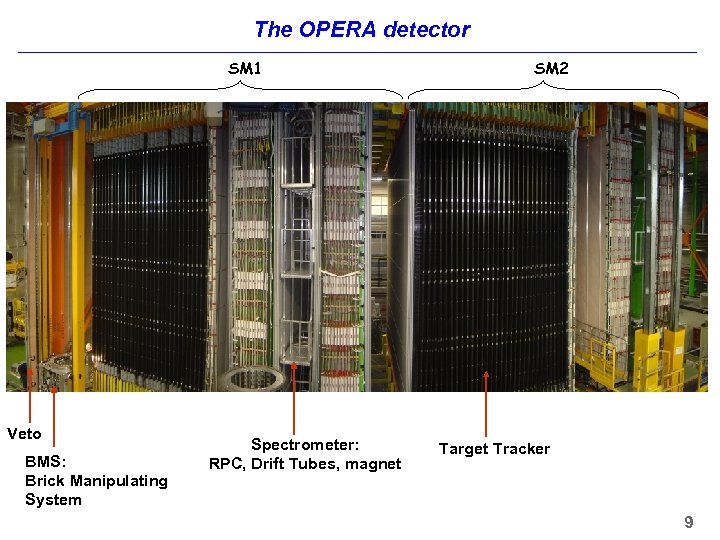 The OPERA detector SM 1 Veto BMS: Brick Manipulating System Spectrometer: RPC, Drift Tubes, magnet SM 2 Target Tracker 9
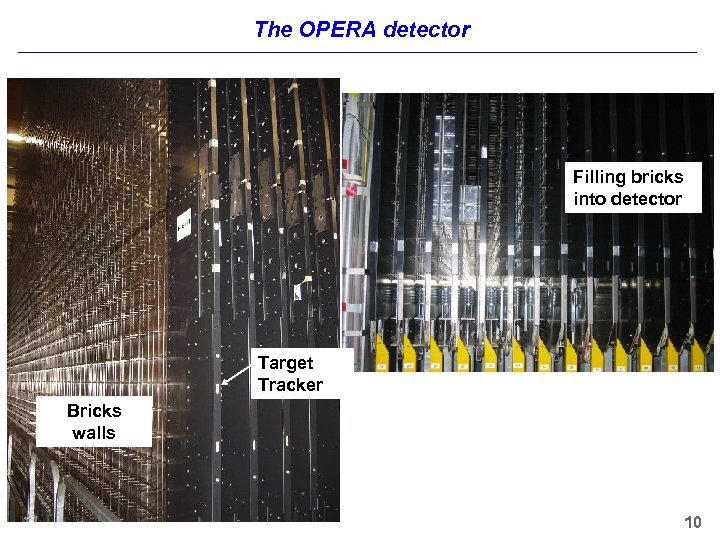 The OPERA detector Filling bricks into detector Target Tracker Bricks walls 10
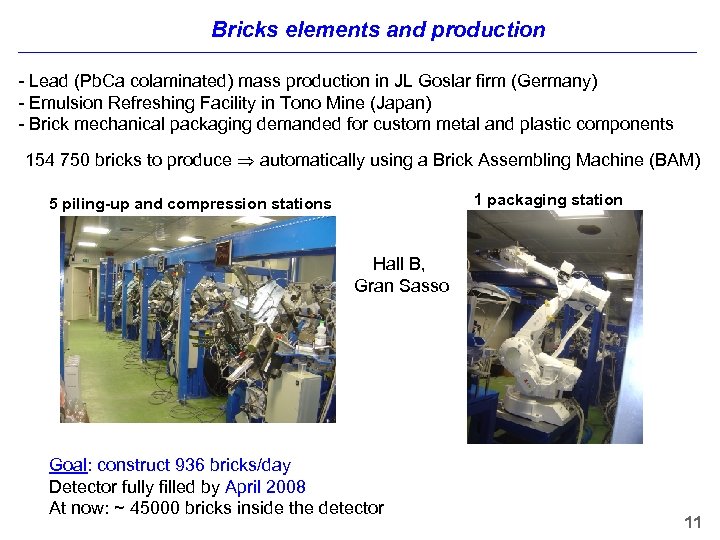 Bricks elements and production - Lead (Pb. Ca colaminated) mass production in JL Goslar firm (Germany) - Emulsion Refreshing Facility in Tono Mine (Japan) - Brick mechanical packaging demanded for custom metal and plastic components 154 750 bricks to produce automatically using a Brick Assembling Machine (BAM) 1 packaging station 5 piling-up and compression stations Hall B, Gran Sasso Goal: construct 936 bricks/day Detector fully filled by April 2008 At now: ~ 45000 bricks inside the detector 11
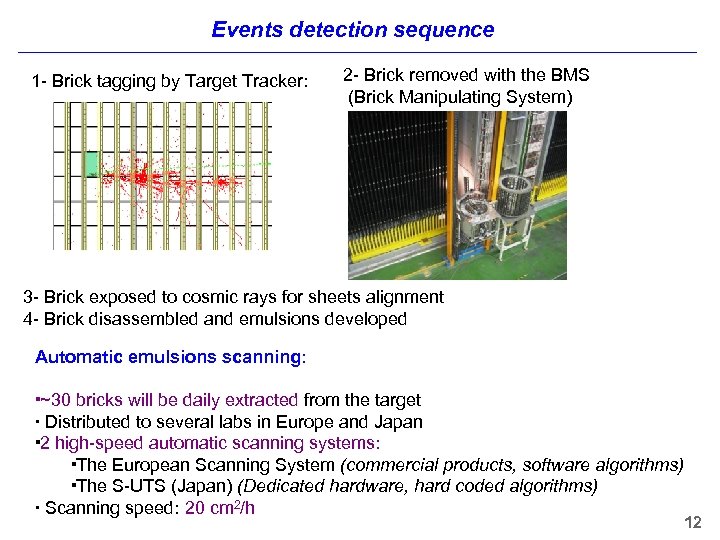 Events detection sequence 1 - Brick tagging by Target Tracker: 2 - Brick removed with the BMS (Brick Manipulating System) 3 - Brick exposed to cosmic rays for sheets alignment 4 - Brick disassembled and emulsions developed Automatic emulsions scanning: ~30 bricks will be daily extracted from the target Distributed to several labs in Europe and Japan 2 high-speed automatic scanning systems: The European Scanning System (commercial products, software algorithms) The S-UTS (Japan) (Dedicated hardware, hard coded algorithms) Scanning speed: 20 cm 2/h 12
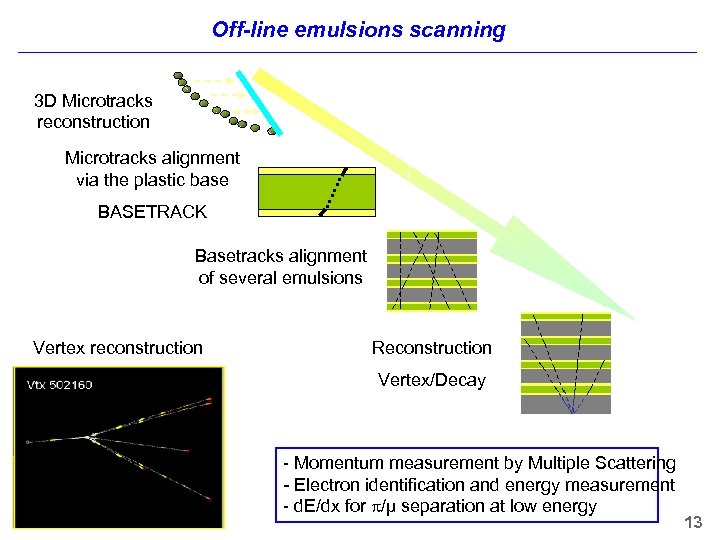 Off-line emulsions scanning 3 D Microtracks reconstruction Microtracks alignment via the plastic base BASETRACK Basetracks alignment of several emulsions Vertex reconstruction Reconstruction Vertex/Decay - Momentum measurement by Multiple Scattering - Electron identification and energy measurement - d. E/dx for /µ separation at low energy 13
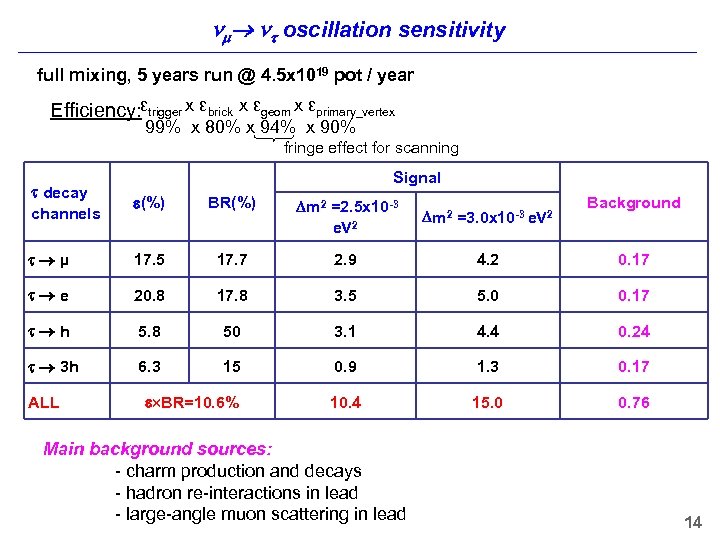 oscillation sensitivity full mixing, 5 years run @ 4. 5 x 10¹⁹ pot / year Efficiency: εtrigger x εbrick x εgeom x εprimary_vertex 99% x 80% x 94% x 90% fringe effect for scanning Signal decay channels (%) BR(%) m 2 =2. 5 x 10 -3 e. V 2 m 2 =3. 0 x 10 -3 e. V 2 µ 17. 5 17. 7 2. 9 4. 2 0. 17 e 20. 8 17. 8 3. 5 5. 0 0. 17 h 5. 8 50 3. 1 4. 4 0. 24 3 h 6. 3 15 0. 9 1. 3 0. 17 BR=10. 6% 10. 4 15. 0 0. 76 ALL Main background sources: - charm production and decays - hadron re-interactions in lead - large-angle muon scattering in lead Background 14
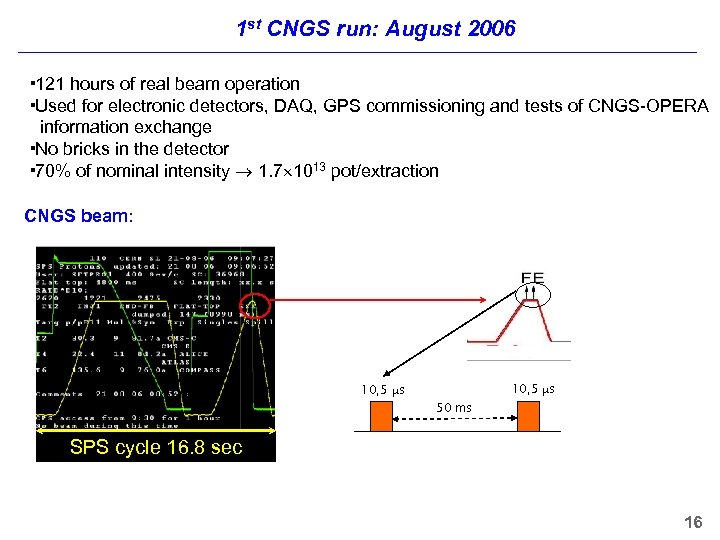 1 st CNGS run: August 2006 121 hours of real beam operation Used for electronic detectors, DAQ, GPS commissioning and tests of CNGS-OPERA information exchange No bricks in the detector 70% of nominal intensity 1. 7 1013 pot/extraction CNGS beam: 10, 5 s 50 ms SPS cycle 16. 8 sec 16
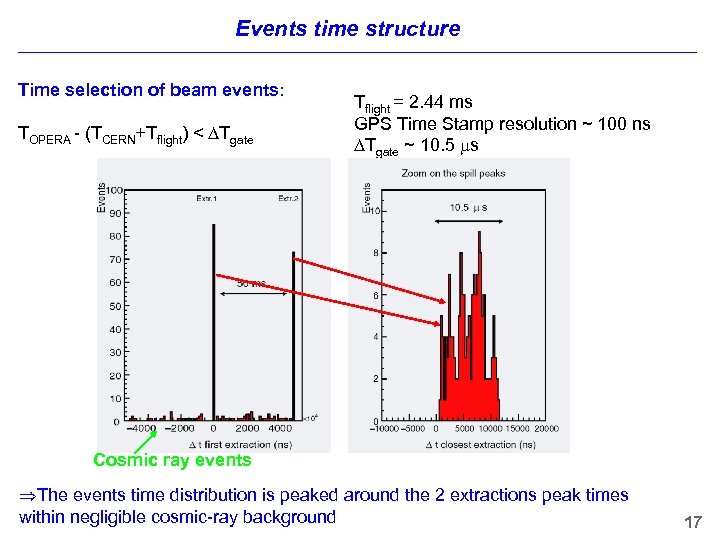 Events time structure Time selection of beam events: TOPERA - (TCERN+Tflight) < Tgate Tflight = 2. 44 ms GPS Time Stamp resolution ~ 100 ns Tgate ~ 10. 5 s Cosmic ray events The events time distribution is peaked around the 2 extractions peak times within negligible cosmic-ray background 17
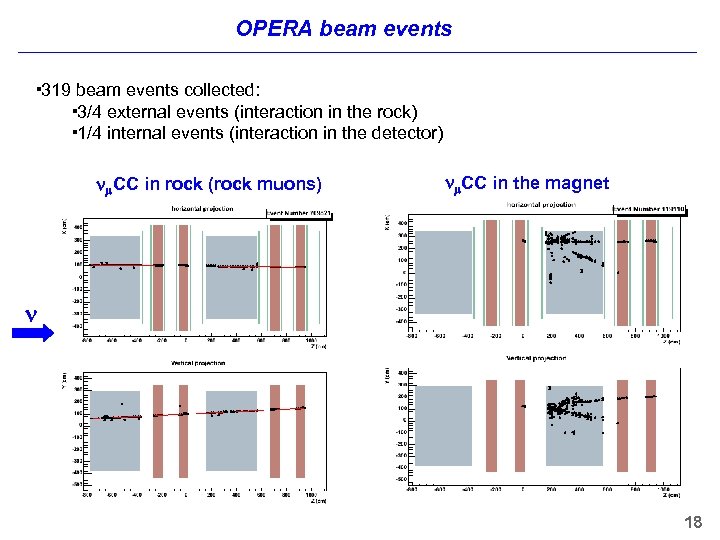 OPERA beam events 319 beam events collected: 3/4 external events (interaction in the rock) 1/4 internal events (interaction in the detector) CC in rock (rock muons) CC in the magnet 18
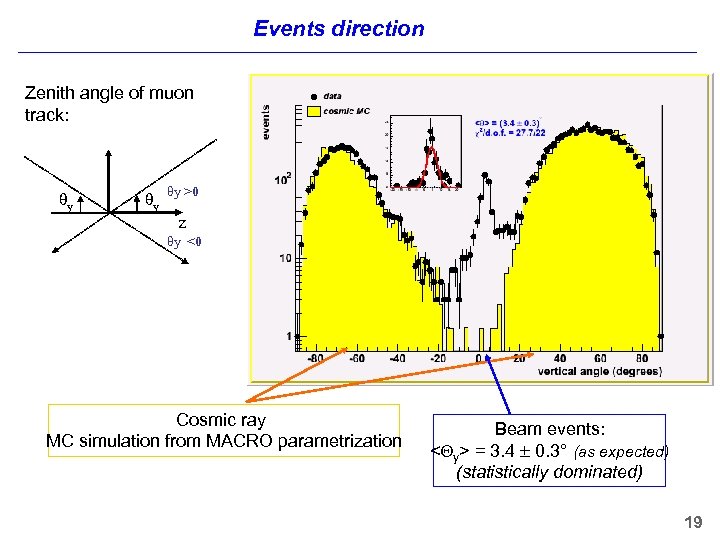 Events direction Zenith angle of muon track: θy θy θy >0 z θy <0 Cosmic ray MC simulation from MACRO parametrization Beam events: < y> = 3. 4 0. 3° (as expected) (statistically dominated) 19
 Physics commissioning runs CNGS run in October 2006: 3 double fast extraction distant by 6 seconds per 36 seconds SPS cycle 0. 6 1017 pot delivered and 30 events stored Run stopped due to a water leak in the reflector (2 nd horn) CNGS “reparation” Cosmic runs for commissioning of electronic detectors, target-tracker to brick connection Beam runs (CERN, Desy…) for emulsion development commissioning, scanning strategy tune the vertex finding methods CNGS run in 2007 (beginning 18 September): 3 weeks of CNGS commissioning 3 additional weeks of physics run 70% of nominal intensity: 1. 7 1013 pot/extraction 505 tons (~59000 bricks) at the start of the run 616 tons (~72000 bricks) at the end of the run 20
 Conclusions The OPERA experiment has completed almost entirely the construction of all electro detectors and faces the last effort of brick production and insertion. The electronic detectors took data almost continuously and with the expected tracking performances. The electronic detectors-brick connection has been tested with success. First, low intensity, CNGS run operated smoothly for both beam and detector with good quality and stability. The detector is ready for the next phase: observing neutrino inside bricks. More details in R. Acquafredda et al. , New J. Phys. 8 (2006 21
 Backup Slides
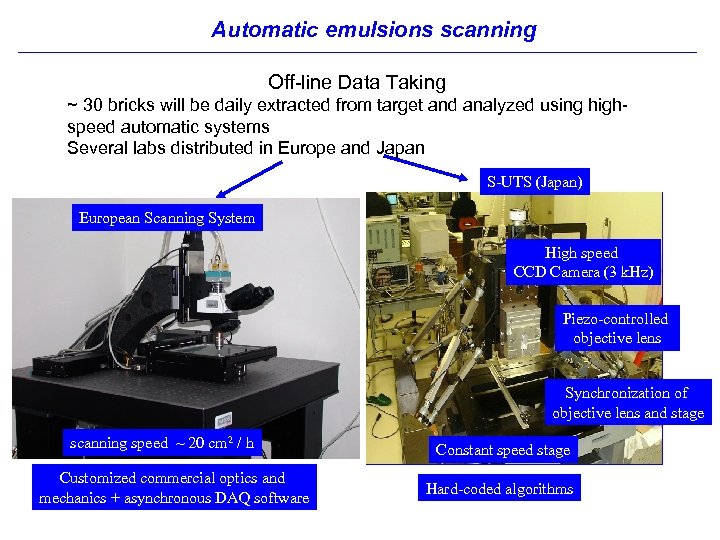 Automatic emulsions scanning Off-line Data Taking ~ 30 bricks will be daily extracted from target and analyzed using highspeed automatic systems Several labs distributed in Europe and Japan S-UTS (Japan) European Scanning System High speed CCD Camera (3 k. Hz) Piezo-controlled objective lens Synchronization of objective lens and stage scanning speed ~ 20 cm 2 / h Customized commercial optics and mechanics + asynchronous DAQ software Constant speed stage Hard-coded algorithms
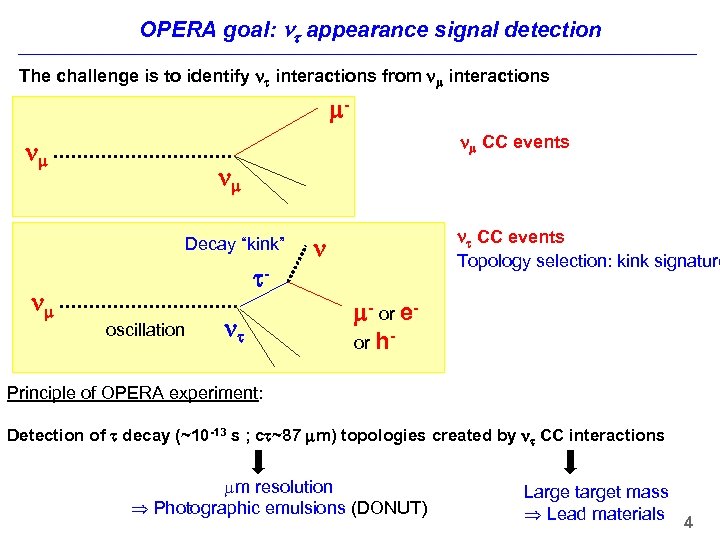 OPERA goal: appearance signal detection The challenge is to identify interactions from interactions CC events Decay “kink” oscillation CC events Topology selection: kink signature - or eor h- Principle of OPERA experiment: Detection of decay (~10 -13 s ; c ~87 m) topologies created by CC interactions m resolution Photographic emulsions (DONUT) Large target mass Lead materials 4
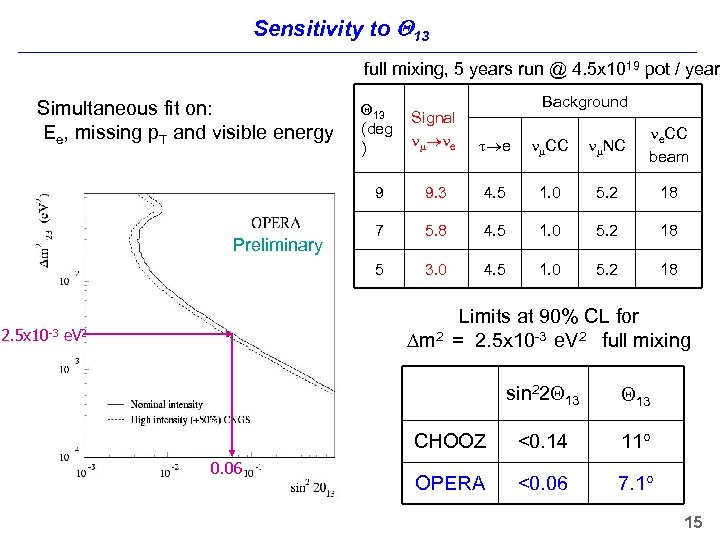 Sensitivity to 13 full mixing, 5 years run @ 4. 5 x 10¹⁹ pot / year Simultaneous fit on: Ee, missing p. T and visible energy Background Signal e e CC NC e. CC beam 9 9. 3 4. 5 1. 0 5. 2 18 7 5. 8 4. 5 1. 0 5. 2 18 5 Preliminary 13 (deg ) 3. 0 4. 5 1. 0 5. 2 18 Limits at 90% CL for m 2 = 2. 5 x 10 -3 e. V 2 full mixing 2. 5 x 10 -3 e. V 2 sin 22 13 CHOOZ 0. 06 13 <0. 14 11 OPERA <0. 06 7. 1 15
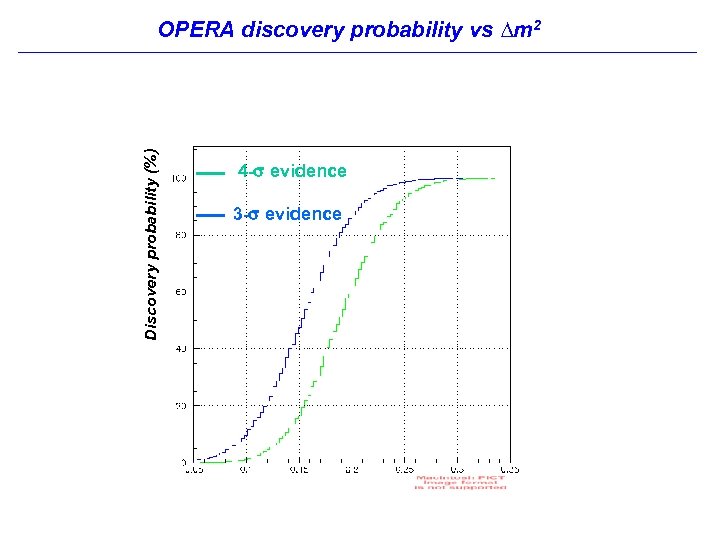 Discovery probability (%) OPERA discovery probability vs ∆m 2 4 - evidence 3 - evidence