


 Скачать презентацию The OPERA experiment H Pessard LAPP Annecy France
fc4524c84e4874f11770fa3928a101f5.ppt
- Количество слайдов: 22
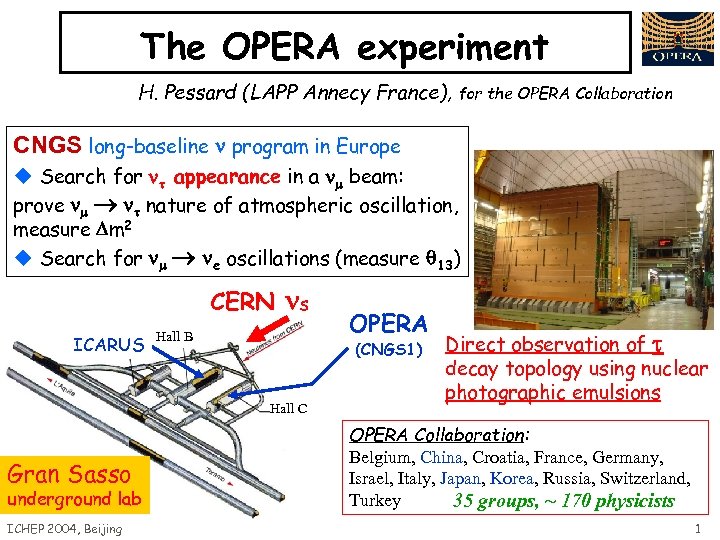 The OPERA experiment H. Pessard (LAPP Annecy France), for the OPERA Collaboration CNGS long-baseline program in Europe u Search for appearance in a beam: prove nature of atmospheric oscillation, measure Dm 2 u Search for e oscillations (measure 13) CERN s ICARUS Hall B (CNGS 1) Hall C Gran Sasso underground lab ICHEP 2004, Beijing OPERA Direct observation of decay topology using nuclear photographic emulsions OPERA Collaboration: Belgium, China, Croatia, France, Germany, Israel, Italy, Japan, Korea, Russia, Switzerland, Turkey 35 groups, ~ 170 physicists 1
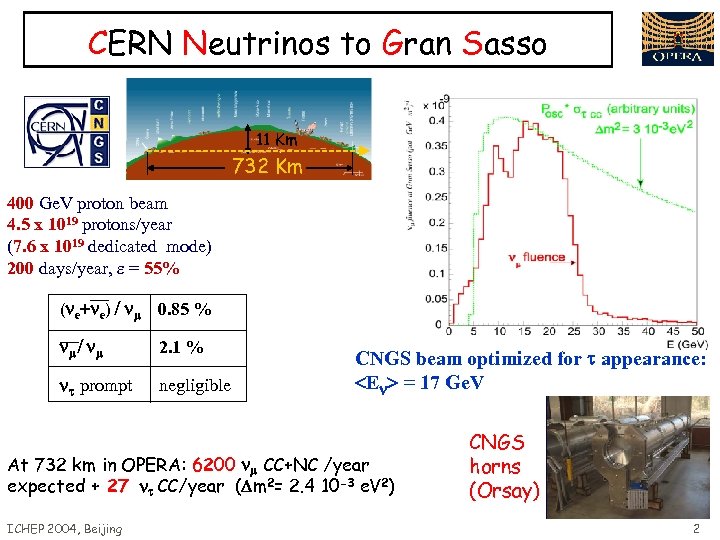 CERN Neutrinos to Gran Sasso 11 Km 732 Km 400 Ge. V proton beam 4. 5 x 10¹⁹ protons/year (7. 6 x 10¹⁹ dedicated mode) 200 days/year, e = 55% ( e+ e) / 0. 85 % / 2. 1 % prompt negligible CNGS beam optimized for appearance:
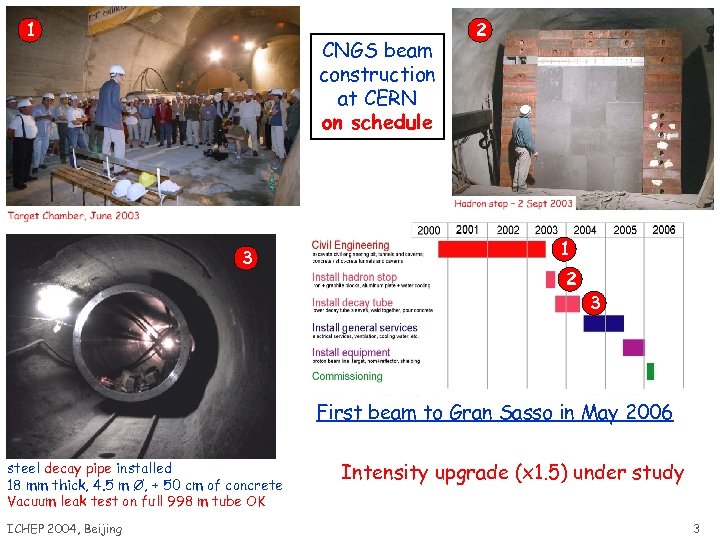 1 CNGS beam construction at CERN on schedule 3 2 1 2 3 First beam to Gran Sasso in May 2006 steel decay pipe installed 18 mm thick, 4. 5 m Ø, + 50 cm of concrete Vacuum leak test on full 998 m tube OK ICHEP 2004, Beijing Intensity upgrade (x 1. 5) under study 3
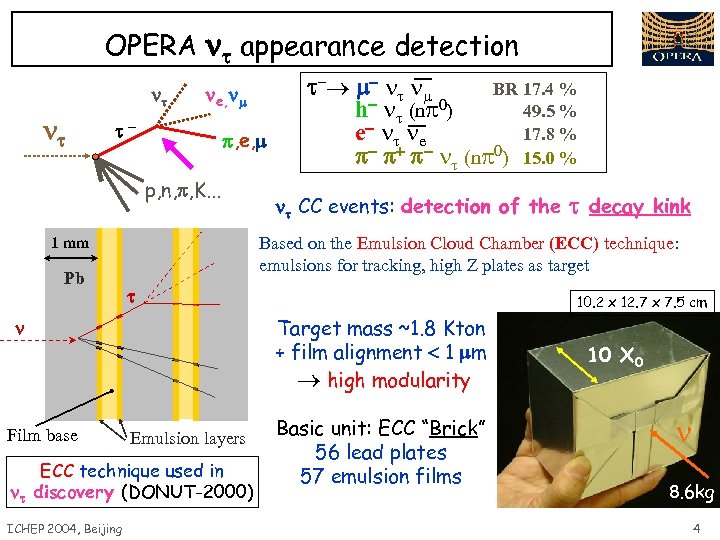 OPERA appearance detection e, - p, e, p, n, p, K. . . Emulsion layers ECC technique used in discovery (DONUT-2000) ICHEP 2004, Beijing decay kink 10. 2 x 12. 7 x 7. 5 cm Target mass ~1. 8 Kton + film alignment < 1 m high modularity Film base CC events: detection of the Based on the Emulsion Cloud Chamber (ECC) technique: emulsions for tracking, high Z plates as target 1 mm Pb - - n t n m BR 17. 4 % h- nt (np 0) 49. 5 % e- nt ne 17. 8 % p- p+ p- nt (np 0) 15. 0 % Basic unit: ECC “Brick” 56 lead plates 57 emulsion films 10 X 0 n 8. 6 kg 4
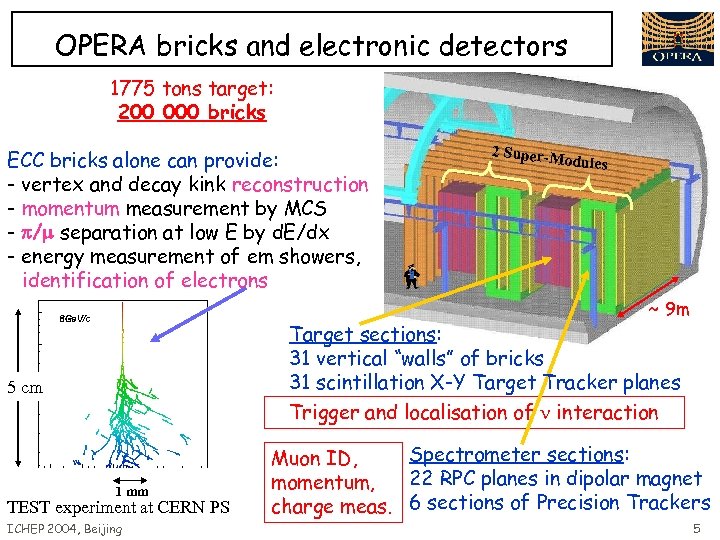 OPERA bricks and electronic detectors 1775 tons target: 200 000 bricks ECC bricks alone can provide: - vertex and decay kink reconstruction - momentum measurement by MCS - p/ separation at low E by d. E/dx - energy measurement of em showers, identification of electrons 2 Super-M odules ~ 9 m Target sections: 31 vertical “walls” of bricks 31 scintillation X-Y Target Tracker planes 5 cm Trigger and localisation of n interaction 1 mm TEST experiment at CERN PS ICHEP 2004, Beijing Spectrometer sections: Muon ID, 22 RPC planes in dipolar magnet momentum, charge meas. 6 sections of Precision Trackers 5
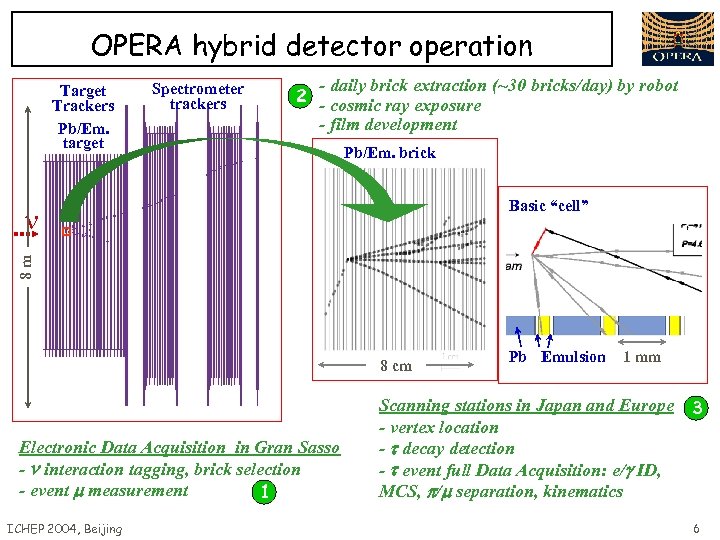 OPERA hybrid detector operation Target Trackers Pb/Em. target Spectrometer trackers - daily brick extraction (~30 bricks/day) by robot 2 - cosmic ray exposure - film development Pb/Em. brick Basic “cell” 8 m n 8 cm Electronic Data Acquisition in Gran Sasso - n interaction tagging, brick selection - event m measurement 1 ICHEP 2004, Beijing Pb Emulsion 1 mm Scanning stations in Japan and Europe - vertex location - t decay detection - t event full Data Acquisition: e/g ID, MCS, p/m separation, kinematics 3 6
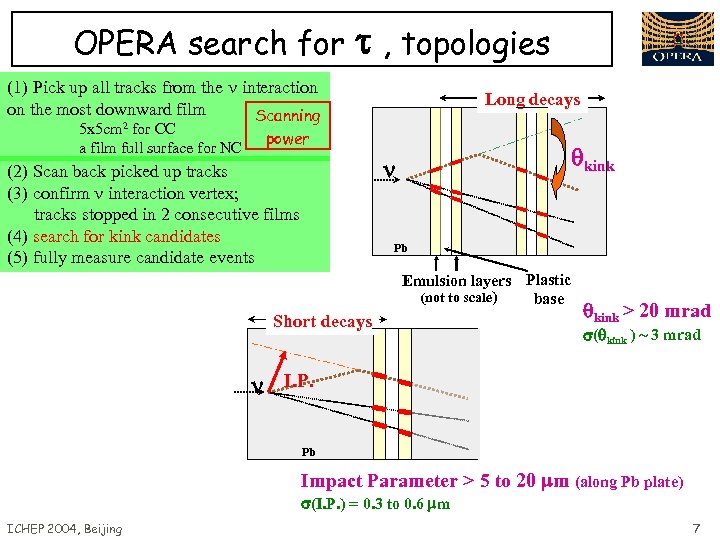 OPERA search for , topologies (1) Pick up all tracks from the n interaction on the most downward film Scanning 5 x 5 cm 2 for CC a film full surface for NC Long decays power kink (2) Scan back picked up tracks (3) confirm n interaction vertex; tracks stopped in 2 consecutive films (4) search for kink candidates (5) fully measure candidate events Pb Emulsion layers Plastic (not to scale) base Short decays kink > 20 mrad ( kink ) ~ 3 mrad I. P. Pb Impact Parameter > 5 to 20 m (along Pb plate) (I. P. ) = 0. 3 to 0. 6 m ICHEP 2004, Beijing 7
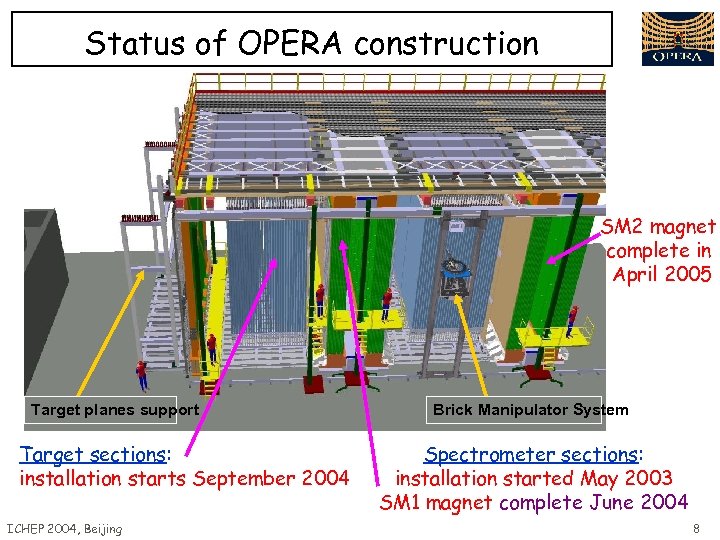 Status of OPERA construction SM 2 magnet complete in April 2005 Target planes support Target sections: installation starts September 2004 ICHEP 2004, Beijing Brick Manipulator System Spectrometer sections: installation started May 2003 SM 1 magnet complete June 2004 8
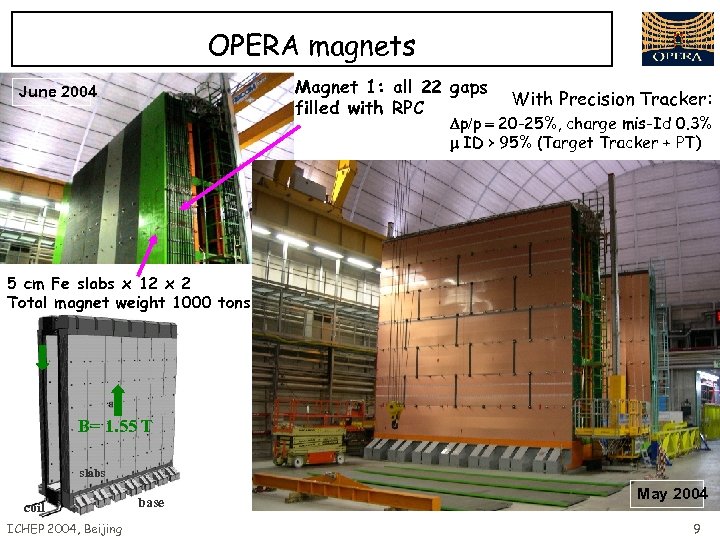 OPERA magnets Magnet 1: all 22 gaps filled with RPC June 2004 With Precision Tracker: Dp/p = 20 -25%, charge mis-Id 0. 3% ID > 95% (Target Tracker + PT) 5 cm Fe slabs x 12 x 2 Total magnet weight 1000 tons B= 1. 55 T slabs coil ICHEP 2004, Beijing base May 2004 9
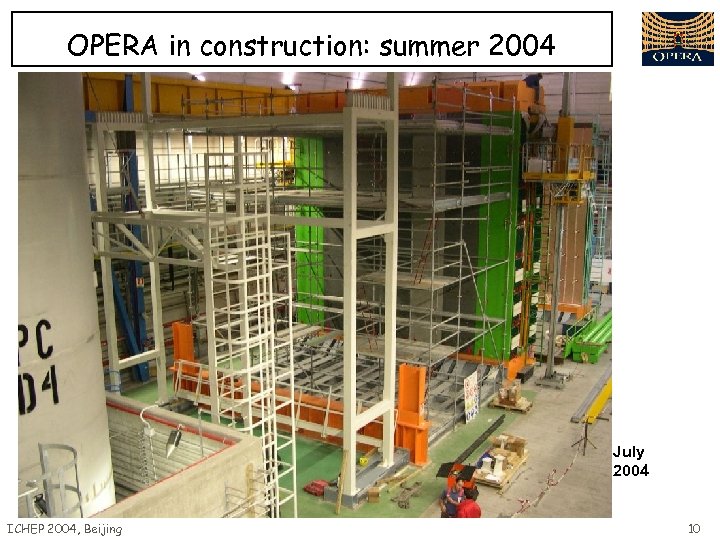 OPERA in construction: summer 2004 July 2004 ICHEP 2004, Beijing 10
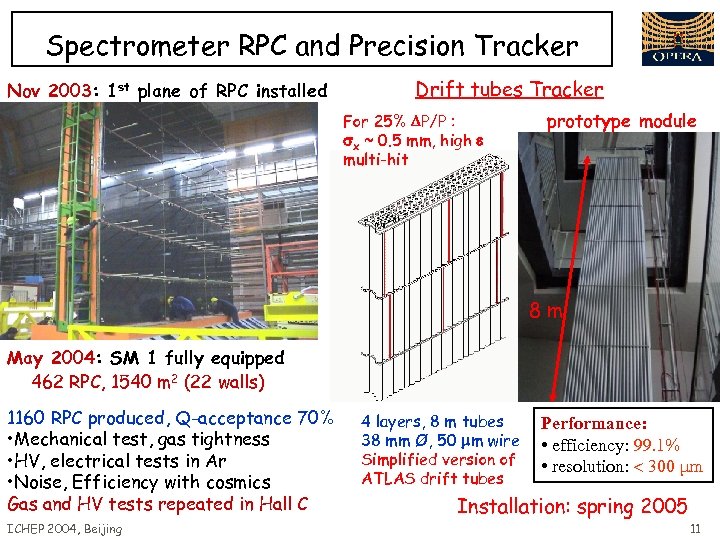 Spectrometer RPC and Precision Tracker Nov 2003: 1 st plane of RPC installed Drift tubes Tracker For 25% DP/P : x ~ 0. 5 mm, high e multi-hit prototype module 8 m May 2004: SM 1 fully equipped 462 RPC, 1540 m 2 (22 walls) 1160 RPC produced, Q-acceptance 70% • Mechanical test, gas tightness • HV, electrical tests in Ar • Noise, Efficiency with cosmics Gas and HV tests repeated in Hall C ICHEP 2004, Beijing 4 layers, 8 m tubes 38 mm Ø, 50 m wire Simplified version of ATLAS drift tubes Performance: • efficiency: 99. 1% • resolution: 300 μm Installation: spring 2005 11
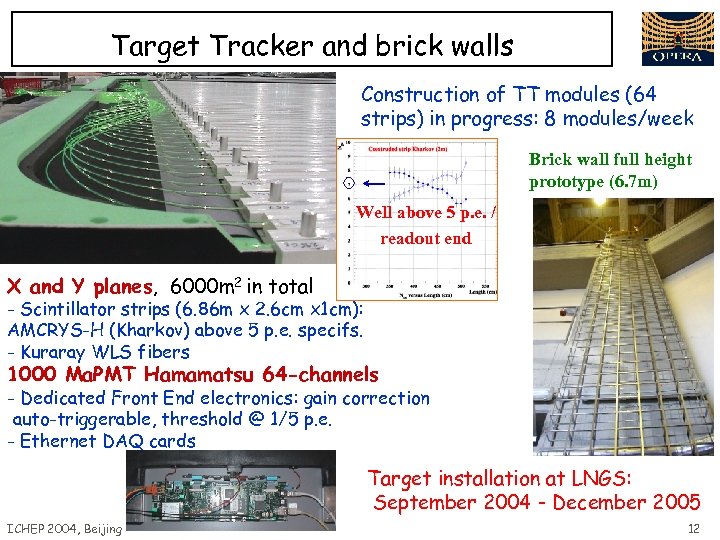 Target Tracker and brick walls Construction of TT modules (64 strips) in progress: 8 modules/week Brick wall full height prototype (6. 7 m) Well above 5 p. e. / readout end X and Y planes, 6000 m 2 in total - Scintillator strips (6. 86 m x 2. 6 cm x 1 cm): AMCRYS-H (Kharkov) above 5 p. e. specifs. - Kuraray WLS fibers 1000 Ma. PMT Hamamatsu 64 -channels - Dedicated Front End electronics: gain correction auto-triggerable, threshold @ 1/5 p. e. - Ethernet DAQ cards Target installation at LNGS: September 2004 - December 2005 ICHEP 2004, Beijing 12
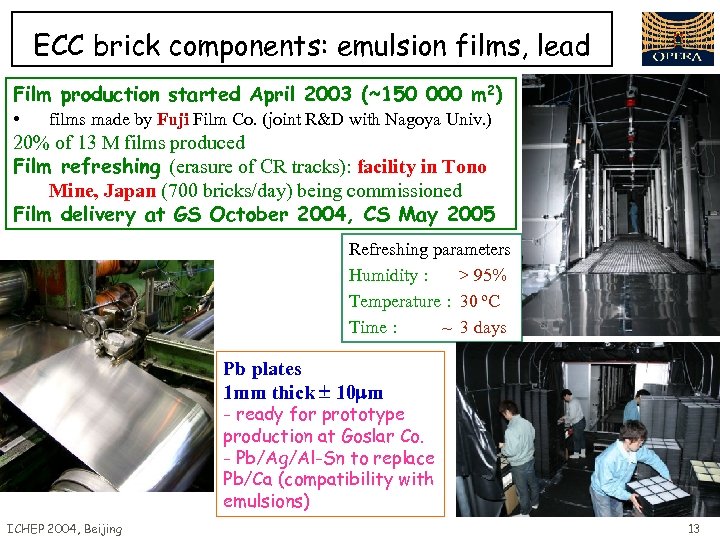 ECC brick components: emulsion films, lead Film production started April 2003 (~150 000 m 2) • films made by Fuji Film Co. (joint R&D with Nagoya Univ. ) 20% of 13 M films produced Film refreshing (erasure of CR tracks): facility in Tono Mine, Japan (700 bricks/day) being commissioned Film delivery at GS October 2004, CS May 2005 Refreshing parameters Humidity : > 95% Temperature : 30 ºC Time : ~ 3 days Pb plates 1 mm thick 10 m - ready for prototype production at Goslar Co. - Pb/Ag/Al-Sn to replace Pb/Ca (compatibility with emulsions) ICHEP 2004, Beijing 13
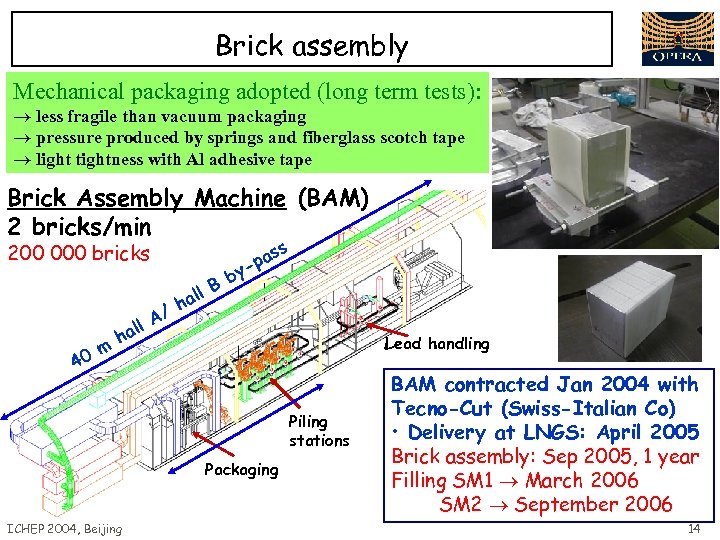 Brick assembly Mechanical packaging adopted (long term tests): less fragile than vacuum packaging pressure produced by springs and fiberglass scotch tape light tightness with Al adhesive tape Brick Assembly Machine (BAM) 2 bricks/min s 200 000 bricks 40 m B all /h A all h s pa y- b Lead handling Piling stations Packaging ICHEP 2004, Beijing BAM contracted Jan 2004 with Tecno-Cut (Swiss-Italian Co) • Delivery at LNGS: April 2005 Brick assembly: Sep 2005, 1 year Filling SM 1 March 2006 SM 2 September 2006 14
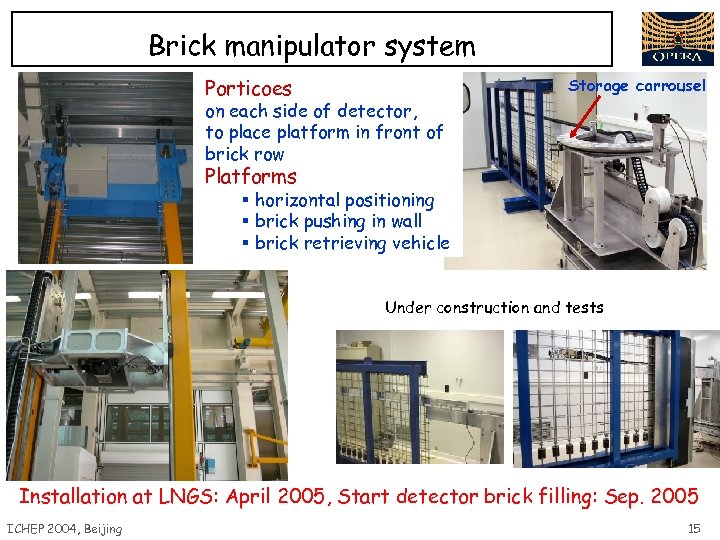 Brick manipulator system Porticoes Storage carrousel on each side of detector, to place platform in front of brick row Platforms § horizontal positioning § brick pushing in wall § brick retrieving vehicle Under construction and tests Installation at LNGS: April 2005, Start detector brick filling: Sep. 2005 ICHEP 2004, Beijing 15
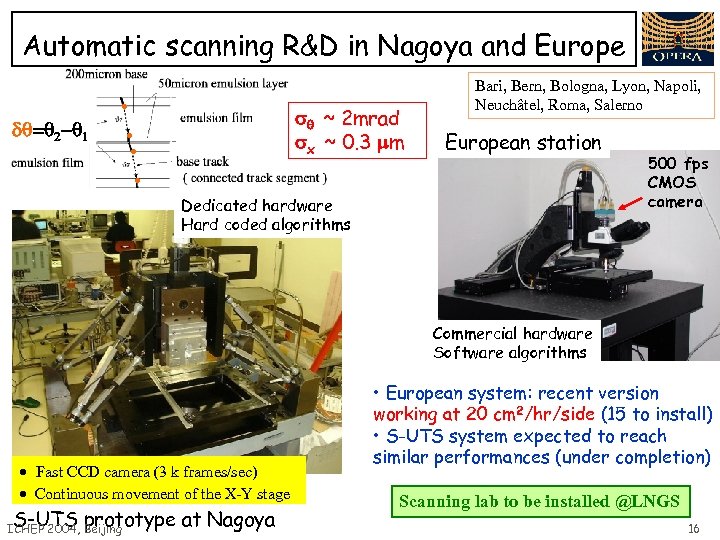 Automatic scanning R&D in Nagoya and Europe ~ 2 mrad x ~ 0. 3 m d = 2 - 1 Bari, Bern, Bologna, Lyon, Napoli, Neuchâtel, Roma, Salerno European station Dedicated hardware Hard coded algorithms 500 fps CMOS camera Commercial hardware Software algorithms Fast CCD camera (3 k frames/sec) Continuous movement of the X-Y stage S-UTS prototype at Nagoya ICHEP 2004, Beijing • European system: recent version working at 20 cm 2/hr/side (15 to install) • S-UTS system expected to reach similar performances (under completion) Scanning lab to be installed @LNGS 16
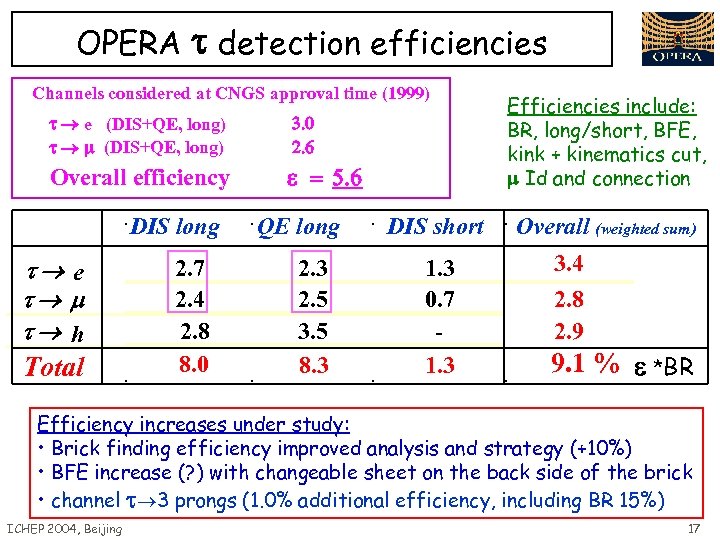 OPERA detection efficiencies Channels considered at CNGS approval time (1999) e (DIS+QE, long) 3. 0 2. 6 Overall efficiency e = 5. 6 DIS long t® e t® m t® h Total 2. 7 2. 4 2. 8 8. 0 QE long 2. 3 2. 5 3. 5 8. 3 DIS short 1. 3 0. 7 1. 3 Efficiencies include: BR, long/short, BFE, kink + kinematics cut, Id and connection Overall (weighted sum) 3. 4 2. 8 2. 9 9. 1 % e *BR Efficiency increases under study: • Brick finding efficiency improved analysis and strategy (+10%) • BFE increase (? ) with changeable sheet on the back side of the brick • channel 3 prongs (1. 0% additional efficiency, including BR 15%) ICHEP 2004, Beijing 17
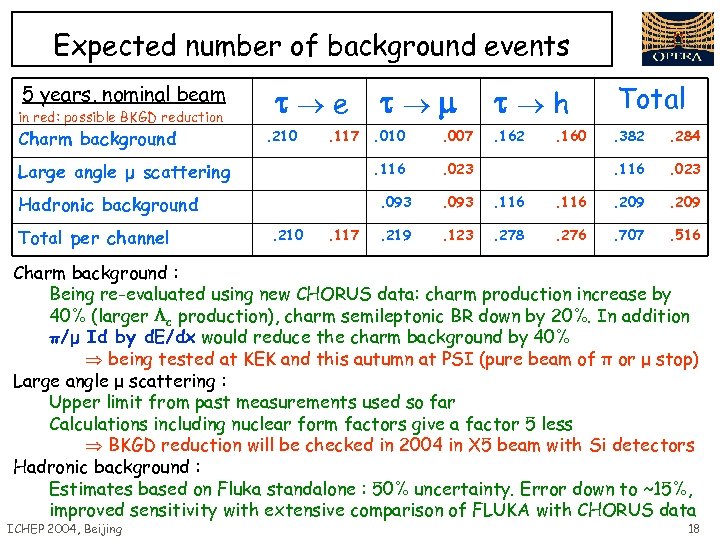 Expected number of background events 5 years, nominal beam in red: possible BKGD reduction Charm background e. 210 . 117. 010 . 007 . 116 h Total . 162 . 382 . 284 . 116 . 023 Large angle μ scattering Hadronic background Total per channel . 160 . 093. 210 . 117 . 093 . 116 . 209 . 219 . 123 . 278 . 276 . 707 . 516 Charm background : Being re-evaluated using new CHORUS data: charm production increase by 40% (larger Lc production), charm semileptonic BR down by 20%. In addition π/μ Id by d. E/dx would reduce the charm background by 40% being tested at KEK and this autumn at PSI (pure beam of π or μ stop) Large angle μ scattering : Upper limit from past measurements used so far Calculations including nuclear form factors give a factor 5 less BKGD reduction will be checked in 2004 in X 5 beam with Si detectors Hadronic background : Estimates based on Fluka standalone : 50% uncertainty. Error down to ~15%, improved sensitivity with extensive comparison of FLUKA with CHORUS data ICHEP 2004, Beijing 18
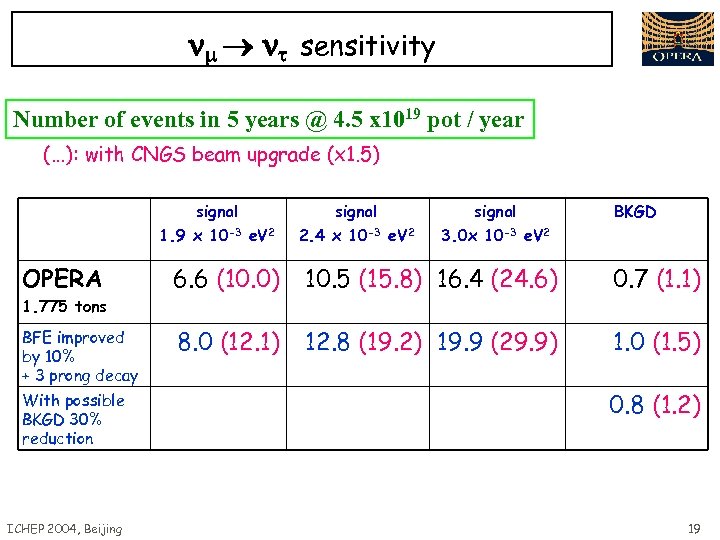 sensitivity Number of events in 5 years @ 4. 5 x 10¹⁹ pot / year (. . . ): with CNGS beam upgrade (x 1. 5) signal 1. 9 x 10 -3 e. V 2 OPERA signal 2. 4 x 10 -3 e. V 2 BKGD 3. 0 x 10 -3 e. V 2 6. 6 (10. 0) 10. 5 (15. 8) 16. 4 (24. 6) 0. 7 (1. 1) 8. 0 (12. 1) 12. 8 (19. 2) 19. 9 (29. 9) 1. 0 (1. 5) 1. 775 tons BFE improved by 10% + 3 prong decay With possible BKGD 30% reduction 0. 8 (1. 2) ICHEP 2004, Beijing 19
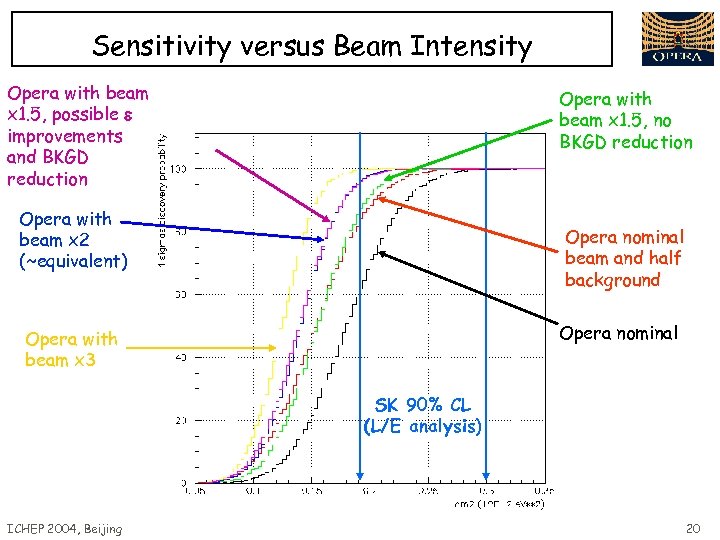 Sensitivity versus Beam Intensity Opera with beam x 1. 5, possible e improvements and BKGD reduction Opera with beam x 1. 5, no BKGD reduction Opera with beam x 2 (~equivalent) Opera nominal beam and half background Opera nominal Opera with beam x 3 SK 90% CL (L/E analysis) ICHEP 2004, Beijing 20
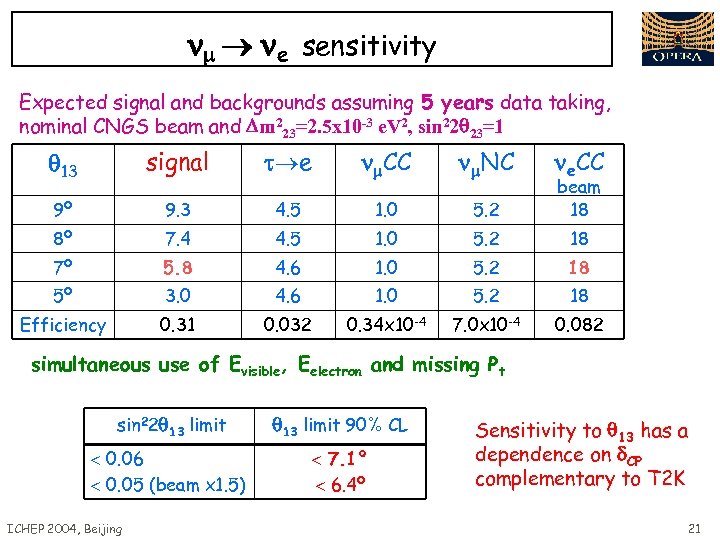 e sensitivity Expected signal and backgrounds assuming 5 years data taking, nominal CNGS beam and Dm 223=2. 5 x 10 -3 e. V 2, sin 22 23=1 13 signal e CC NC e. CC 9º 9. 3 4. 5 1. 0 5. 2 beam 18 8º 7. 4 4. 5 1. 0 5. 2 18 7º 5. 8 4. 6 1. 0 5. 2 18 5º 3. 0 4. 6 1. 0 5. 2 18 Efficiency 0. 31 0. 032 0. 34 x 10 -4 7. 0 x 10 -4 0. 082 simultaneous use of Evisible, Eelectron and missing Pt sin 22 13 limit 90% CL 0. 06 0. 05 (beam x 1. 5) 7. 1º 6. 4º ICHEP 2004, Beijing Sensitivity to 13 has a dependence on d. CP complementary to T 2 K 21
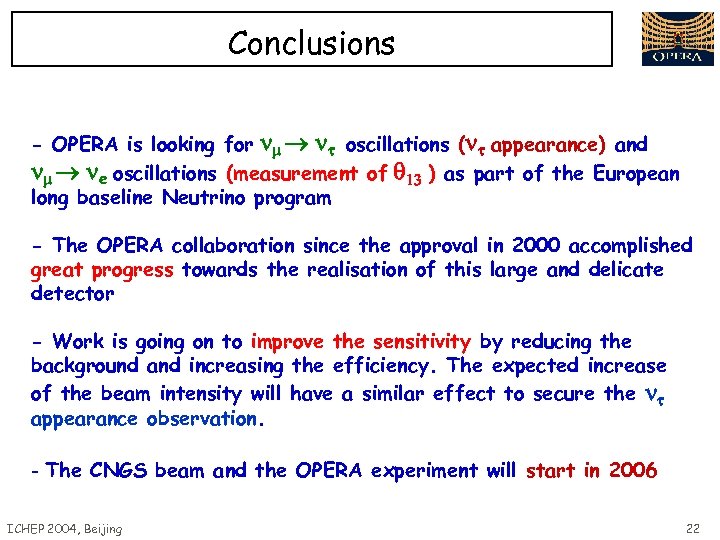 Conclusions - OPERA is looking for oscillations ( appearance) and e oscillations (measurement of 13 ) as part of the European long baseline Neutrino program - The OPERA collaboration since the approval in 2000 accomplished great progress towards the realisation of this large and delicate detector - Work is going on to improve the sensitivity by reducing the background and increasing the efficiency. The expected increase of the beam intensity will have a similar effect to secure the appearance observation. - The CNGS beam and the OPERA experiment will start in 2006 ICHEP 2004, Beijing 22