


 Скачать презентацию The NSF Tera Grid A Pre-Production Update 2
c835d370de06c14ec5b73086c33bbaa8.ppt
- Количество слайдов: 37
 The NSF Tera. Grid: A Pre-Production Update 2 nd Large Scale Cluster Computing Workshop FNAL 21 Oct 2002 Rémy Evard, evard@mcs. anl. gov Tera. Grid Site Lead. National Computational Science Argonne National Laboratory National Computational Science
 A Pre-Production Introspective • Overview of The Tera. Grid – For more information: – www. teragrid. org – See particularly the “Tera. Grid primer”. – Funded by the National Science Foundation – Participants: – – – NCSA SDSC ANL Caltech PSC, starting in October 2002 • Grid Project Pondering – Issues encountered while trying to build a complex, production grid.
 Motivation for Tera. Grid • The Changing Face of Science – Technology Drivers – Discipline Drivers – Need for Distributed Infrastructure • The NSF’s Cyberinfrastructure – “provide an integrated, high-end system of computing, data facilities, connectivity, software, services, and sensors that …” – “enables all scientists and engineers to work on advanced research problems that would not otherwise be solvable” – Peter Freeman, NSF • Thus the Terascale program • A key point for this workshop: – Tera. Grid is meant to be an infrastructure supporting many scientific disciplines and applications.
 Historical Context • Terascale funding arrived in FY 00 • Three competitions so far: – FY 00 – Terascale Computing System – Funded PSC’s EV 68 6 TF Alpha Cluster – FY 01 – Distributed Terascale Facility (DTF) – Initial Tera. Grid Project – FY 02 – Extensible Terascale Facility (ETF) – Expansion of the Tera. Grid • An additional competition is now underway for community participation in ETF
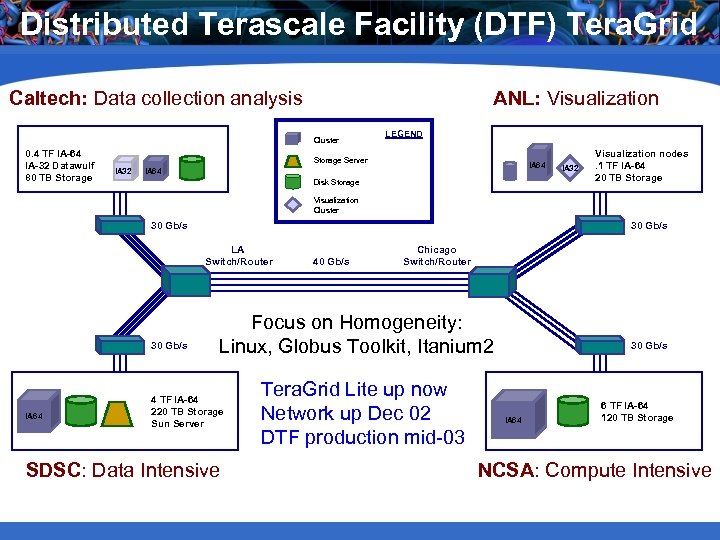 Distributed Terascale Facility (DTF) Tera. Grid Caltech: Data collection analysis ANL: Visualization Cluster 0. 4 TF IA-64 IA-32 Datawulf 80 TB Storage LEGEND Storage Server IA 32 IA 64 Disk Storage IA 32 Visualization nodes. 1 TF IA-64 20 TB Storage Visualization Cluster 30 Gb/s LA Switch/Router 30 Gb/s IA 64 40 Gb/s Chicago Switch/Router Focus on Homogeneity: Linux, Globus Toolkit, Itanium 2 4 TF IA-64 220 TB Storage Sun Server SDSC: Data Intensive Tera. Grid Lite up now Network up Dec 02 DTF production mid-03 30 Gb/s IA 64 6 TF IA-64 120 TB Storage NCSA: Compute Intensive
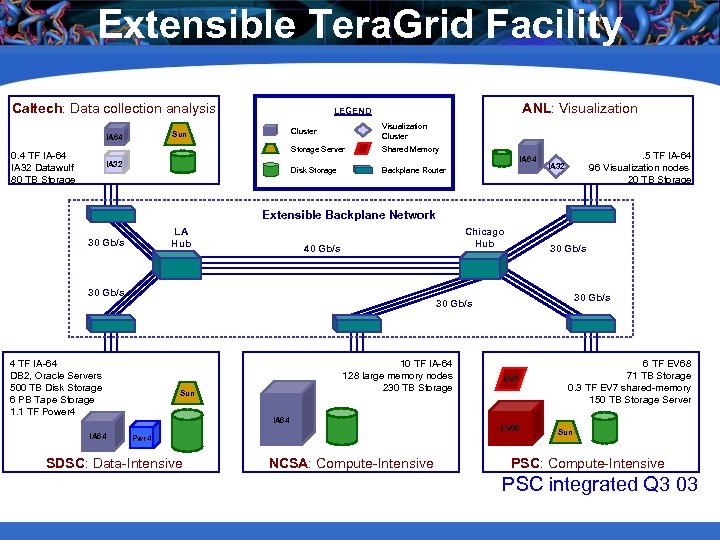 Extensible Tera. Grid Facility Caltech: Data collection analysis ANL: Visualization LEGEND Visualization Cluster Storage Server 0. 4 TF IA-64 IA 32 Datawulf 80 TB Storage Cluster Sun IA 64 Shared Memory IA 64 IA 32 Disk Storage Backplane Router . 5 TF IA-64 96 Visualization nodes 20 TB Storage IA 32 Extensible Backplane Network LA Hub 30 Gb/s Chicago Hub 40 Gb/s 30 Gb/s 4 TF IA-64 DB 2, Oracle Servers 500 TB Disk Storage 6 PB Tape Storage 1. 1 TF Power 4 IA 64 30 Gb/s 10 TF IA-64 128 large memory nodes 230 TB Storage Sun IA 64 Pwr 4 SDSC: Data-Intensive NCSA: Compute-Intensive EV 7 EV 68 6 TF EV 68 71 TB Storage 0. 3 TF EV 7 shared-memory 150 TB Storage Server Sun PSC: Compute-Intensive PSC integrated Q 3 03
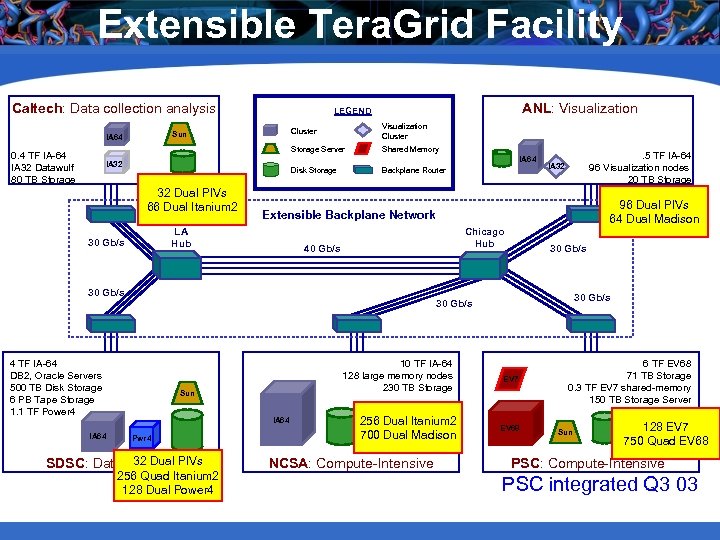 Extensible Tera. Grid Facility Caltech: Data collection analysis ANL: Visualization LEGEND Visualization Cluster Storage Server 0. 4 TF IA-64 IA 32 Datawulf 80 TB Storage Cluster Sun IA 64 Shared Memory IA 64 IA 32 Disk Storage 32 Dual PIVs 66 Dual Itanium 2 Chicago Hub 40 Gb/s 30 Gb/s 4 TF IA-64 DB 2, Oracle Servers 500 TB Disk Storage 6 PB Tape Storage 1. 1 TF Power 4 IA 64 96 Dual PIVs 64 Dual Madison Extensible Backplane Network LA Hub 30 Gb/s Backplane Router . 5 TF IA-64 96 Visualization nodes 20 TB Storage IA 32 10 TF IA-64 128 large memory nodes 230 TB Storage Sun IA 64 Pwr 4 32 Dual PIVs SDSC: Data-Intensive 256 Quad Itanium 2 128 Dual Power 4 256 Dual Itanium 2 700 Dual Madison NCSA: Compute-Intensive EV 7 EV 68 6 TF EV 68 71 TB Storage 0. 3 TF EV 7 shared-memory 150 TB Storage Server Sun 128 EV 7 750 Quad EV 68 PSC: Compute-Intensive PSC integrated Q 3 03
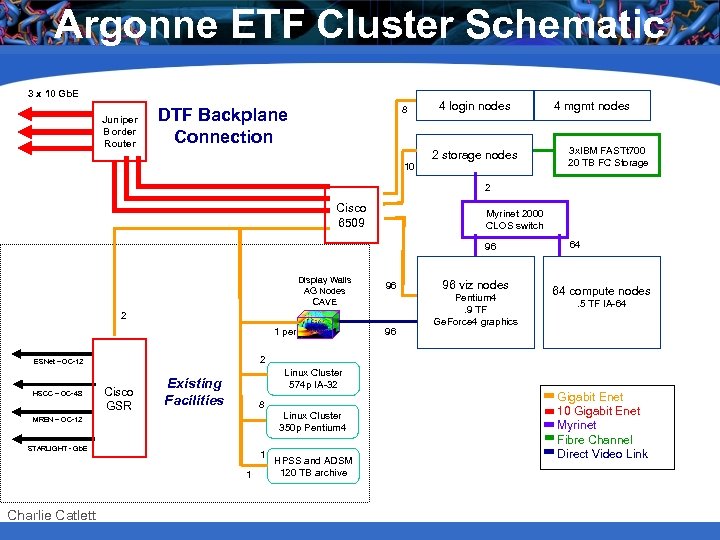 Argonne ETF Cluster Schematic 3 x 10 Gb. E Juniper Border Router 8 DTF Backplane Connection 10 4 login nodes 2 storage nodes 4 mgmt nodes 3 x. IBM FASTt 700 20 TB FC Storage 2 Cisco 6509 Myrinet 2000 CLOS switch 96 Display Walls AG Nodes CAVE 96 2 1 per Cisco GSR Linux Cluster 574 p IA-32 Existing Facilities 8 MREN – OC-12 STARLIGHT - Gb. E 1 1 Charlie Catlett Pentium 4. 9 TF Ge. Force 4 graphics 64 compute nodes. 5 TF IA-64 2 ESNet – OC-12 HSCC – OC-48 96 96 viz nodes 64 Linux Cluster 350 p Pentium 4 HPSS and ADSM 120 TB archive Gigabit Enet 10 Gigabit Enet Myrinet Fibre Channel Direct Video Link
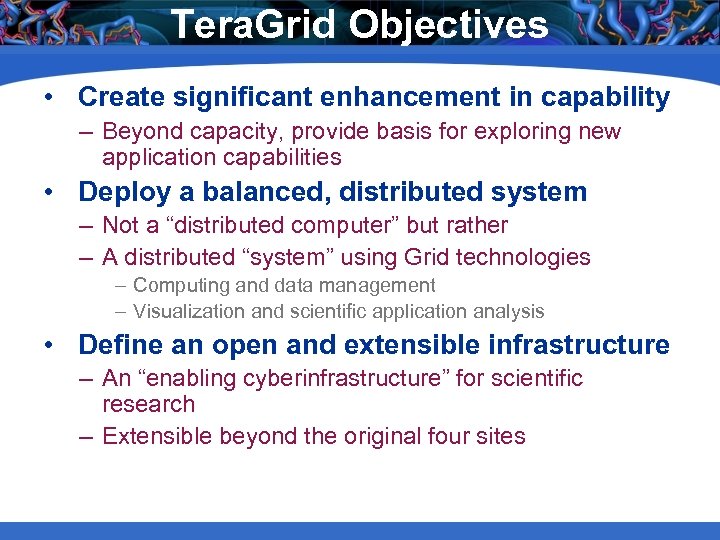 Tera. Grid Objectives • Create significant enhancement in capability – Beyond capacity, provide basis for exploring new application capabilities • Deploy a balanced, distributed system – Not a “distributed computer” but rather – A distributed “system” using Grid technologies – Computing and data management – Visualization and scientific application analysis • Define an open and extensible infrastructure – An “enabling cyberinfrastructure” for scientific research – Extensible beyond the original four sites
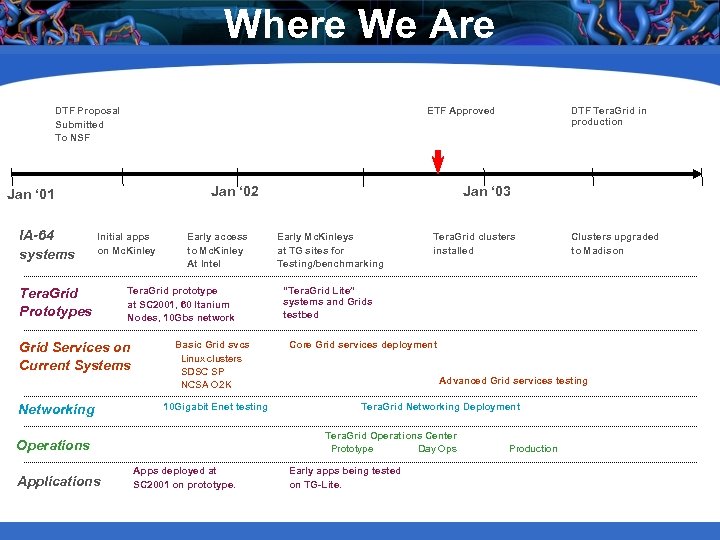 Where We Are DTF Proposal Submitted To NSF ETF Approved Jan ‘ 02 Jan ‘ 01 IA-64 systems Initial apps on Mc. Kinley Tera. Grid Prototypes Tera. Grid prototype at SC 2001, 60 Itanium Nodes, 10 Gbs network Grid Services on Current Systems Networking Early access to Mc. Kinley At Intel Basic Grid svcs Linux clusters SDSC SP NCSA O 2 K 10 Gigabit Enet testing Applications Jan ‘ 03 Early Mc. Kinleys at TG sites for Testing/benchmarking Tera. Grid clusters installed Apps deployed at SC 2001 on prototype. Clusters upgraded to Madison “Tera. Grid Lite” systems and Grids testbed Core Grid services deployment Advanced Grid services testing Tera. Grid Networking Deployment Tera. Grid Operations Center Prototype Day Ops Operations DTF Tera. Grid in production Early apps being tested on TG-Lite. Production
 Challenges and Issues • Technology and Infrastructure – Networking – Computing and Grids – Others (not covered in this talk): – – Data Visualization Operation … • Social Dynamics • To Be Clear… – While the following slides discuss problems and issues in the spirit of this workshop, the TG project is making appropriate progress and is on target for achieving milestones.
 Networking Goals • Support high bandwidth between sites – Remote access to large data stores – Large data transfers – Inter-cluster communication • Support extensibility to N sites – 4 <= N <= 20 (? ) • Operate in production, but support network experiments. • Isolate the clusters from network faults and vice versa.
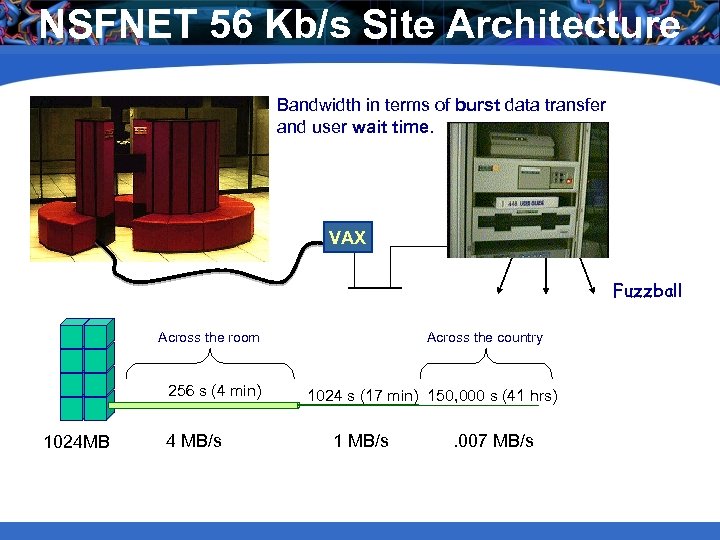 NSFNET 56 Kb/s Site Architecture Bandwidth in terms of burst data transfer and user wait time. VAX Fuzzball Across the room 256 s (4 min) 1024 MB 4 MB/s Across the country 1024 s (17 min) 150, 000 s (41 hrs) 1 MB/s . 007 MB/s
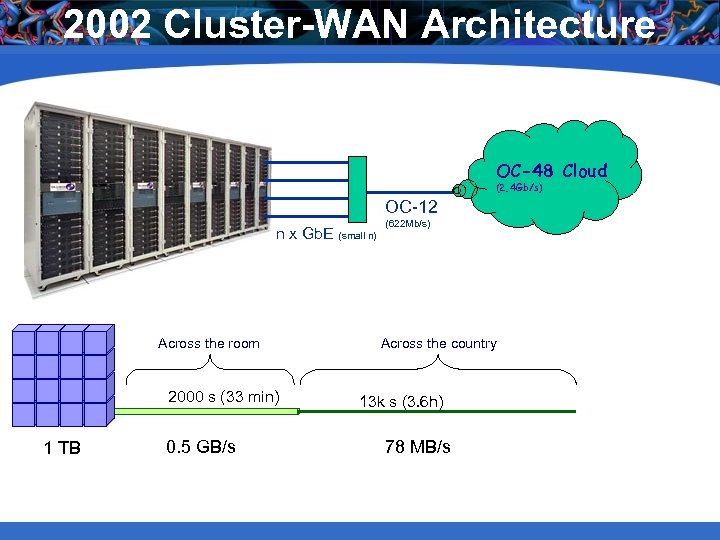 2002 Cluster-WAN Architecture OC-48 Cloud (2. 4 Gb/s) OC-12 n x Gb. E (small n) Across the room 2000 s (33 min) 1 TB 0. 5 GB/s (622 Mb/s) Across the country 13 k s (3. 6 h) 78 MB/s
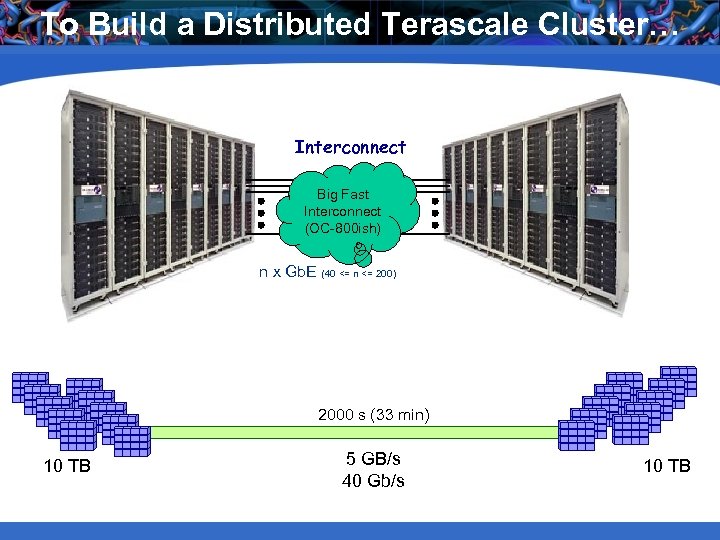 To Build a Distributed Terascale Cluster… Interconnect Big Fast Interconnect (OC-800 ish) n x Gb. E (40 <= n <= 200) 2000 s (33 min) 10 TB 5 GB/s 40 Gb/s 10 TB
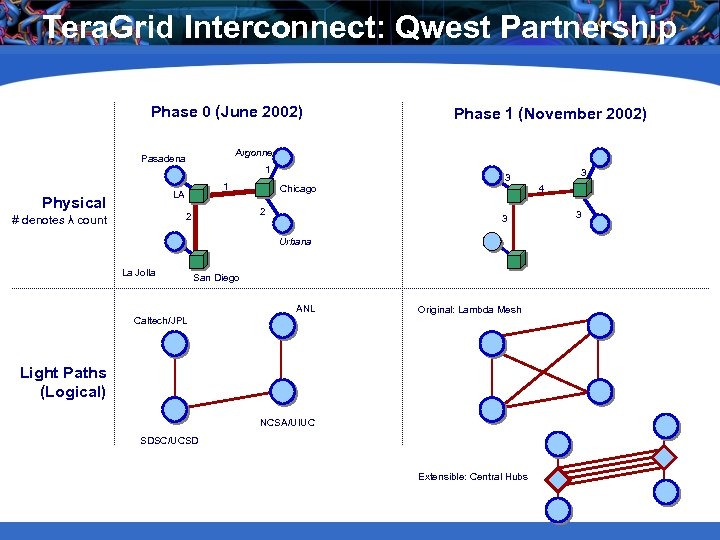 Tera. Grid Interconnect: Qwest Partnership Phase 0 (June 2002) Argonne Pasadena 1 1 LA Physical Chicago 2 2 # denotes λ count Phase 1 (November 2002) 3 3 Urbana La Jolla San Diego ANL Caltech/JPL Original: Lambda Mesh Light Paths (Logical) NCSA/UIUC SDSC/UCSD Extensible: Central Hubs 3 4 3
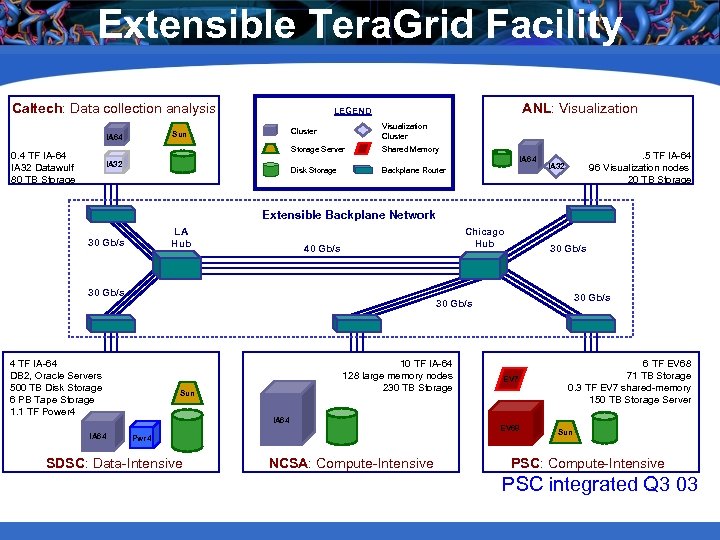 Extensible Tera. Grid Facility Caltech: Data collection analysis ANL: Visualization LEGEND Visualization Cluster Storage Server 0. 4 TF IA-64 IA 32 Datawulf 80 TB Storage Cluster Sun IA 64 Shared Memory IA 64 IA 32 Disk Storage Backplane Router . 5 TF IA-64 96 Visualization nodes 20 TB Storage IA 32 Extensible Backplane Network LA Hub 30 Gb/s Chicago Hub 40 Gb/s 30 Gb/s 4 TF IA-64 DB 2, Oracle Servers 500 TB Disk Storage 6 PB Tape Storage 1. 1 TF Power 4 IA 64 30 Gb/s 10 TF IA-64 128 large memory nodes 230 TB Storage Sun IA 64 Pwr 4 SDSC: Data-Intensive NCSA: Compute-Intensive EV 7 EV 68 6 TF EV 68 71 TB Storage 0. 3 TF EV 7 shared-memory 150 TB Storage Server Sun PSC: Compute-Intensive PSC integrated Q 3 03
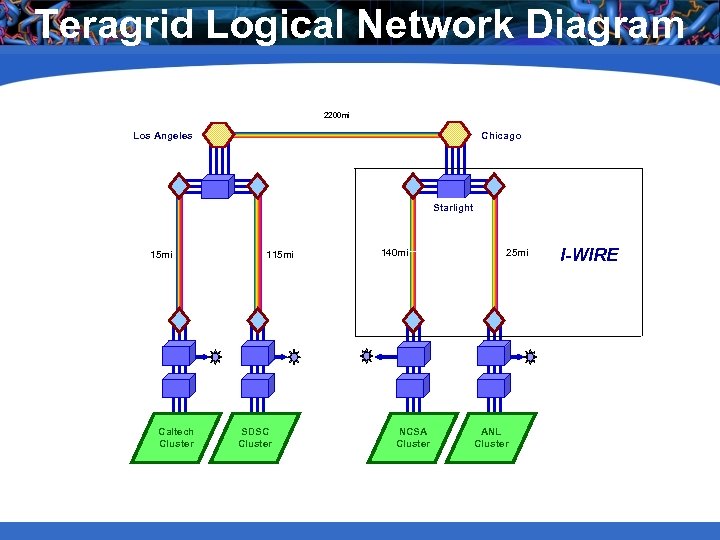 Teragrid Logical Network Diagram 2200 mi Los Angeles Chicago Starlight 15 mi Caltech Cluster 115 mi SDSC Cluster 140 mi NCSA Cluster 25 mi ANL Cluster I-WIRE
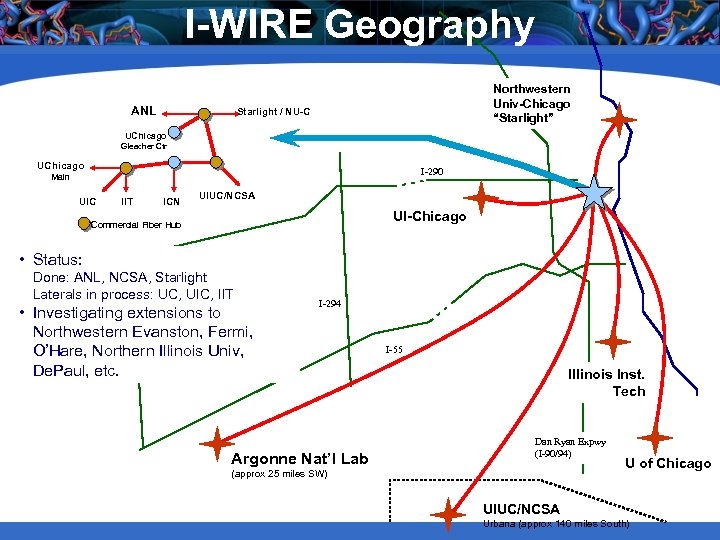 I-WIRE Geography ANL Northwestern Univ-Chicago “Starlight” Starlight / NU-C UChicago Gleacher Ctr UChicago I-290 Main UIC IIT ICN UIUC/NCSA UI-Chicago Commercial Fiber Hub • Status: Done: ANL, NCSA, Starlight Laterals in process: UC, UIC, IIT • Investigating extensions to Northwestern Evanston, Fermi, O’Hare, Northern Illinois Univ, De. Paul, etc. I-294 Argonne Nat’l Lab I-55 Illinois Inst. Tech Dan Ryan Expwy (I-90/94) (approx 25 miles SW) U of Chicago UIUC/NCSA Urbana (approx 140 miles South)
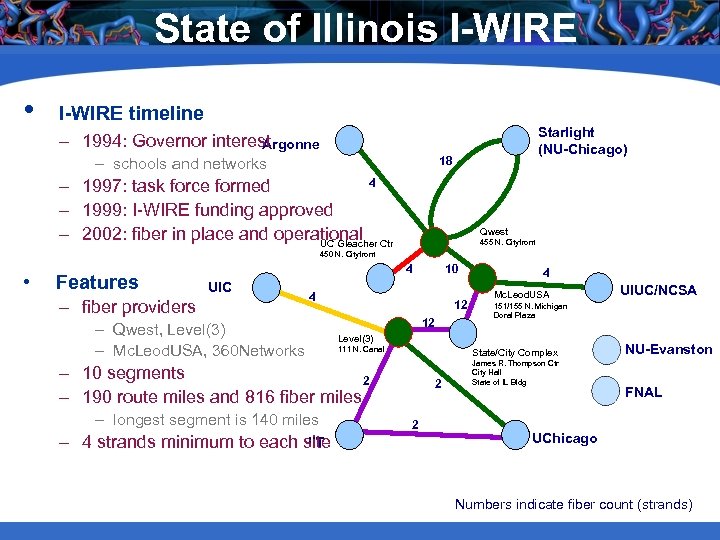 State of Illinois I-WIRE • I-WIRE timeline Starlight (NU-Chicago) – 1994: Governor interest Argonne – schools and networks 18 4 – 1997: task force formed – 1999: I-WIRE funding approved – 2002: fiber in place and operational Ctr UC Gleacher Qwest 455 N. Cityfront 450 N. Cityfront • Features 4 UIC – fiber providers 10 4 – Qwest, Level(3) – Mc. Leod. USA, 360 Networks 12 12 IIT – 4 strands minimum to each site Mc. Leod. USA 111 N. Canal State/City Complex 2 2 UIUC/NCSA 151/155 N. Michigan Doral Plaza Level(3) – 10 segments 2 – 190 route miles and 816 fiber miles – longest segment is 140 miles 4 James R. Thompson Ctr City Hall State of IL Bldg NU-Evanston FNAL UChicago Numbers indicate fiber count (strands)
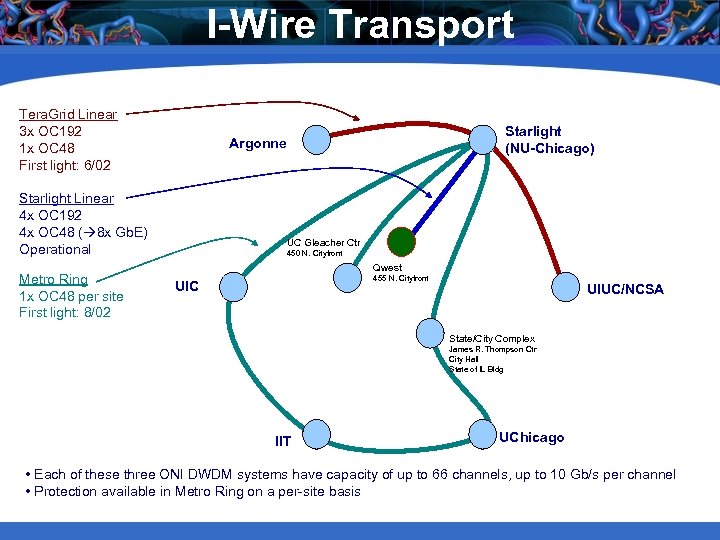 I-Wire Transport Tera. Grid Linear 3 x OC 192 1 x OC 48 First light: 6/02 Starlight Linear 4 x OC 192 4 x OC 48 ( 8 x Gb. E) Operational Metro Ring 1 x OC 48 per site First light: 8/02 Starlight (NU-Chicago) Argonne UC Gleacher Ctr 450 N. Cityfront Qwest 455 N. Cityfront UIC UIUC/NCSA State/City Complex James R. Thompson Ctr City Hall State of IL Bldg IIT UChicago • Each of these three ONI DWDM systems have capacity of up to 66 channels, up to 10 Gb/s per channel • Protection available in Metro Ring on a per-site basis
 Network Policy Decisions • The TG backplane is a closed network, internal to the TG sites. – Open question: what is a TG site? • The TG network gear is run by the TG network team. – I. e. not as individual site resources.
 Network Challenges • Basic Design and Architecture – We think we’ve got this right. • Construction – Proceeding well. • Operation – We’ll see.
 Computing and Grid Challenges • Hardware configuration and purchase – – – I’m still not 100% sure what we’ll be installing. The proposal was written in early 2001. The hardware is being installed in late 2002. The IA-64 line of processors is young. Several vendors, all defining new products, are involved. – Recommendations: – Try to avoid this kind of long-wait, multi vendor situation. – Have frequent communication with all vendors about schedule, expectations, configurations, etc.
 Computing and Grid Challenges • Understanding application requirements and getting people started before the hardware arrives. • Approach: TG-Lite – a small PIII testbed – 4 nodes at each site – Internet/Abilene connectivity – For early users and sysadmins to test configurations.
 Computing and Grid Challenges • Multiple sites, one environment: – Sites desire different configurations. – Distributed administration. – Need a coherent environment for applications. – Ideal: binary compatibility • Approach: service definitions.
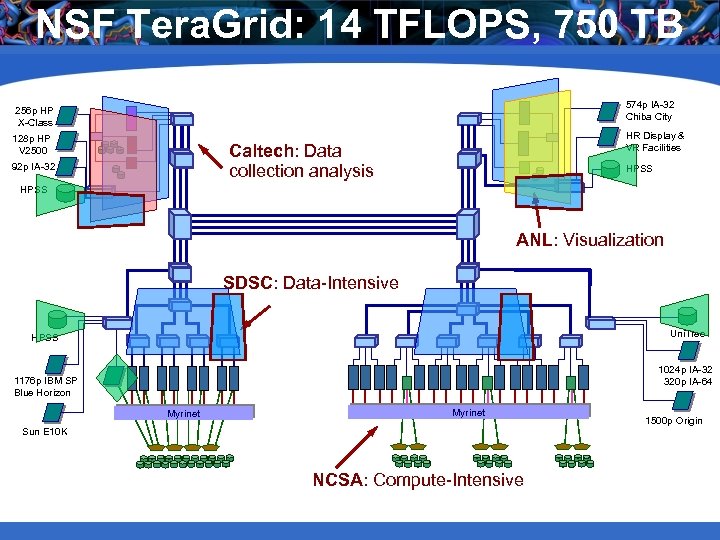 NSF Tera. Grid: 14 TFLOPS, 750 TB 574 p IA-32 Chiba City 256 p HP X-Class 128 p HP V 2500 HR Display & VR Facilities Caltech: Data collection analysis 92 p IA-32 HPSS ANL: Visualization SDSC: Data-Intensive Uni. Tree HPSS 1024 p IA-32 320 p IA-64 1176 p IBM SP Blue Horizon Myrinet Sun E 10 K NCSA: Compute-Intensive 1500 p Origin
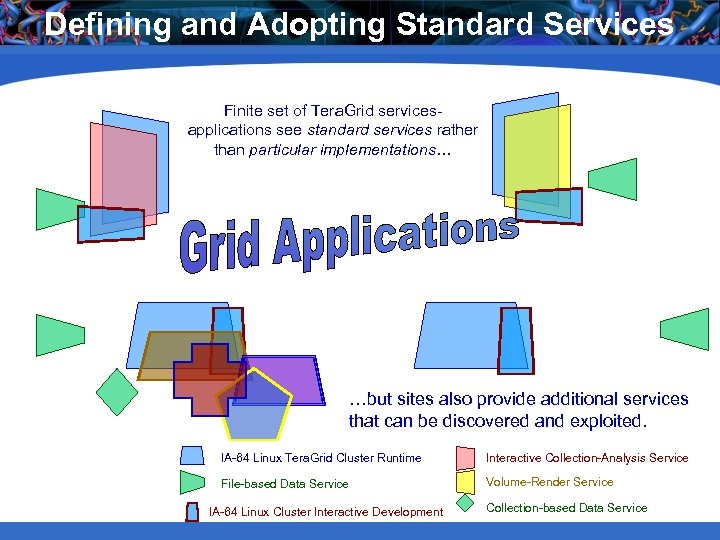 Defining and Adopting Standard Services Finite set of Tera. Grid servicesapplications see standard services rather than particular implementations… …but sites also provide additional services that can be discovered and exploited. IA-64 Linux Tera. Grid Cluster Runtime Interactive Collection-Analysis Service File-based Data Service Volume-Render Service IA-64 Linux Cluster Interactive Development Collection-based Data Service
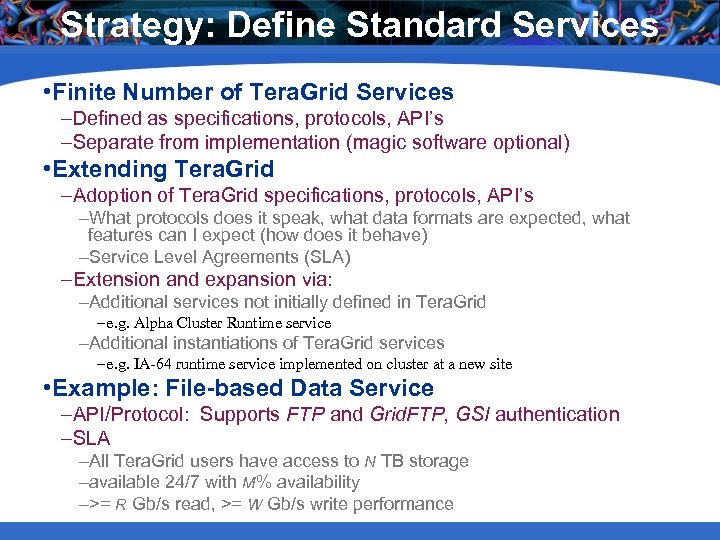 Strategy: Define Standard Services • Finite Number of Tera. Grid Services –Defined as specifications, protocols, API’s –Separate from implementation (magic software optional) • Extending Tera. Grid –Adoption of Tera. Grid specifications, protocols, API’s –What protocols does it speak, what data formats are expected, what features can I expect (how does it behave) –Service Level Agreements (SLA) –Extension and expansion via: –Additional services not initially defined in Tera. Grid – e. g. Alpha Cluster Runtime service –Additional instantiations of Tera. Grid services – e. g. IA-64 runtime service implemented on cluster at a new site • Example: File-based Data Service –API/Protocol: Supports FTP and Grid. FTP, GSI authentication –SLA –All Tera. Grid users have access to N TB storage –available 24/7 with M% availability –>= R Gb/s read, >= W Gb/s write performance
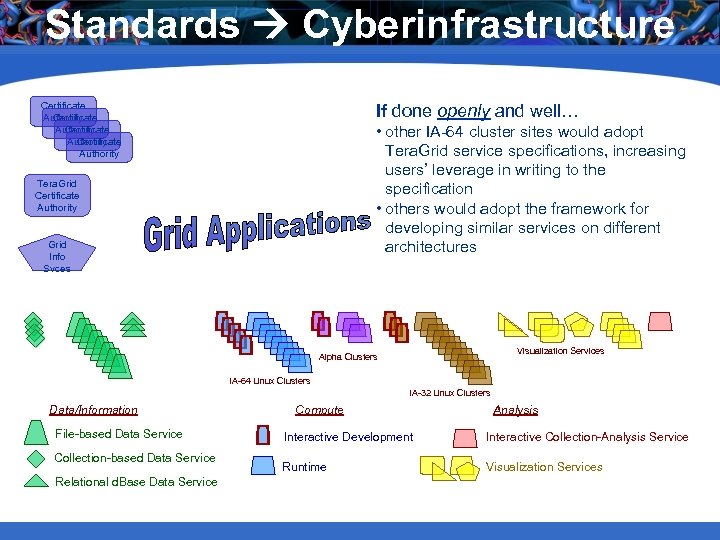 Standards Cyberinfrastructure Certificate Authority Certificate Authority If done openly and well… • other IA-64 cluster sites would adopt Tera. Grid service specifications, increasing users’ leverage in writing to the specification • others would adopt the framework for developing similar services on different architectures Tera. Grid Certificate Authority Grid Info Svces Visualization Services Alpha Clusters IA-64 Linux Clusters IA-32 Linux Clusters Data/Information File-based Data Service Collection-based Data Service Relational d. Base Data Service Compute Analysis Interactive Development Interactive Collection-Analysis Service Runtime Visualization Services
 Computing and Grid Challenges • Architecture – Individual clusters architectures are fairly solid. – Aggregate architecture is a bigger question. – Being defined in terms of services. • Construction and Deployment – We’ll see, starting in December. • Operation – We’ll see. Production by June 2003.
 Social Issues: Direction • 4 sites tend to have 4 directions. – NCSA and SDSC have been competitors for over a decade. – This has created surprising cultural barriers that must be recognized and overcome. – Including PSC, a 3 rd historical competitor, will complicate this. – ANL and Caltech are smaller sites with fewer resources but specific expertise. And opinions.
 Social Issues: Organization • Organization is a big deal. – Equal/fair participation among sites. – To the extreme credit of the large sites, this project has been approached as 4 peers, not 2 tiers. This has been extremely beneficial. – Project directions and decisions affect all sites. – How best to distribute responsibilities but make coordinated decisions? – Changing the org chart is a heavyweight operation, best to be avoided…
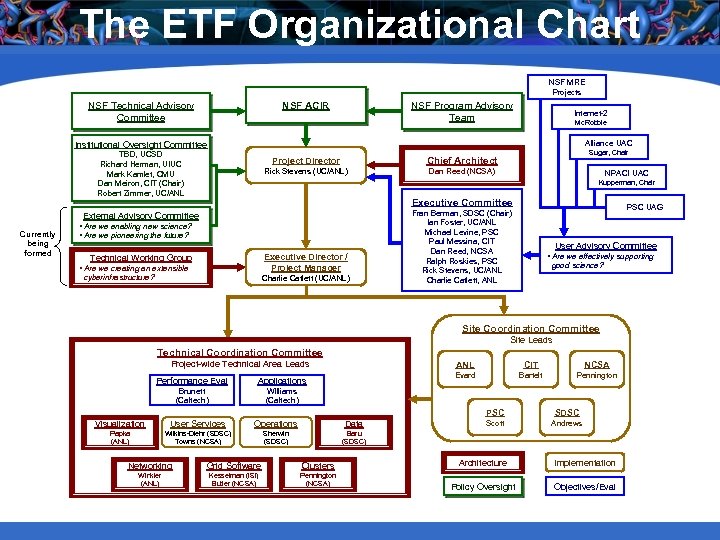 The ETF Organizational Chart NSF MRE Projects NSF Technical Advisory Committee NSF Program Advisory Team NSF ACIR Internet-2 Mc. Robbie Alliance UAC Institutional Oversight Committee TBD, UCSD Richard Herman, UIUC Mark Kamlet, CMU Dan Meiron, CIT (Chair) Robert Zimmer, UC/ANL Project Director Rick Stevens (UC/ANL) Dan Reed (NCSA) NPACI UAC Kupperman, Chair Executive Committee External Advisory Committee Currently being formed Sugar, Chair Chief Architect • Are we enabling new science? • Are we pioneering the future? Executive Director / Project Manager Technical Working Group • Are we creating an extensible cyberinfrastructure? Charlie Catlett (UC/ANL) PSC UAG Fran Berman, SDSC (Chair) Ian Foster, UC/ANL Michael Levine, PSC Paul Messina, CIT Dan Reed, NCSA Ralph Roskies, PSC Rick Stevens, UC/ANL Charlie Catlett, ANL User Advisory Committee • Are we effectively supporting good science? Site Coordination Committee Site Leads Technical Coordination Committee Project-wide Technical Area Leads Performance Eval Applications Brunett (Caltech) ANL CIT NCSA Evard Bartelt Pennington WIlliams (Caltech) PSC Visualization User Services Operations Data Papka (ANL) Wilkins-Diehr (SDSC) Towns (NCSA) Sherwin (SDSC) SDSC Scott Andrews Baru (SDSC) Networking Grid Software Clusters Winkler (ANL) Kesselman (ISI) Butler (NCSA) Pennington (NCSA) Architecture Implementation Policy Oversight Objectives/Eval
 Social Issues: Working Groups • Mixed effectiveness of working groups – The networking group has turned into a team. – The cluster working group is less cohesive. – Others range from teams to just email lists. • Why? – Not personality issues, not organizational issues. • What makes the networking group tick: – Networking people already work together: – – The individuals have a history of working together on other projects. They see each other at other events. They’re expected to travel. They held meetings to decide how to build the network before the proposal was completed. – The infrastructure is better understood: – Networks somewhat like this have been built before. – They are building one network, not four clusters. – There is no separation between design, administration, and operation. • Lessons: – Leverage past collaborations that worked. – Clearly define goals and responsibilities.
 Social Issues: Observations • There will nearly always be four opinions on every issue. – Reaching a common viewpoint takes a lot of communication. – Not every issue can actually be resolved. – Making project-wide decisions can be tough. • Thus far in the project, the social issues have been just as complex as the technical. – … but the technology is just starting to arrive… • It’s possible we should have focused more on this in the early proposal stage, or allocated more resources to helping with these. – We have, just appointed a new “Director of Engineering” to help guide technical decisions and maintain coherency.
 Conclusion • Challenges abound! Early ones include: – Network design and deployment. – Cluster design and deployment. – Building the right distributed system architecture into the grid. – Getting along and having fun. – Expansion. • The hardware arrives in December, production is in mid-2003. • Check back in a year to see how things are going…