 Скачать презентацию The NSF Middleware Initiative Presentation by T J
aad645221bd259ce58c2430a4403ae9f.ppt
- Количество слайдов: 12



The NSF Middleware Initiative, Presentation by T. J. GREENE Ph. D Senior Program Director, Advanced Networking Infrastructure For ALAN BLATECKY Program Director, of NMI The National Science Foundation , ANIR Division
NSF Middleware Initiative Purpose To design, develop, deploy and support a set of reusable, expandable set of middleware functions and services that benefit applications in a networked environment
NMI Program Status • On-going program in ANIR • $10 M total per year for at least 3 -5 years • First awards made in September, 2001 – includes 3 large Cooperative Agreements • Second set of awards in June, 2002 • Third round of proposals due March 7, 2003
NMI Organization Core NMI Team (3 Cooperative Agreements) – Provides System Integration, development, testing, packaging, deployment, and support for NMI – GRIDS Center (Grid middleware & technologies) • ISI, NCSA, U Chicago, UCSD & U Wisconsin – EDIT Team (Campus focus and desktop integration) • EDUCAUSE, Internet 2 & SURA Individual R&D projects – Year 1 -- 9 grants – Year 2 -- 9 grants (several to develop software for future NMI Releases)
A Vision for NMI To allow scientists and engineers the ability to transparently use and share distributed resources, such as computers, data, and instruments To develop effective collaboration and communications tools such as Grid technologies, desktop video, and other advanced services to expedite research and education, and To develop a working architecture and approach which can be extended to Internet users around the world. Middleware is the stuff that makes “transparently use” happen, providing persistency, consistency, security, privacy and capability
NMI Goals a) facilitate scientific productivity, b) increase research collaboration through shared data, computing, code, facilities and applications, c) support the education enterprise, d) encourage the participation of industry, government labs and agencies for more extensive development and wider adoption and deployment, e) establish a level of persistence and availability so that other applications developers and disciplines can take advantage of the middleware, f) encourage and support the development of standards and open source approaches and, g) enable scaling and sustainability to support the larger research and education communities.
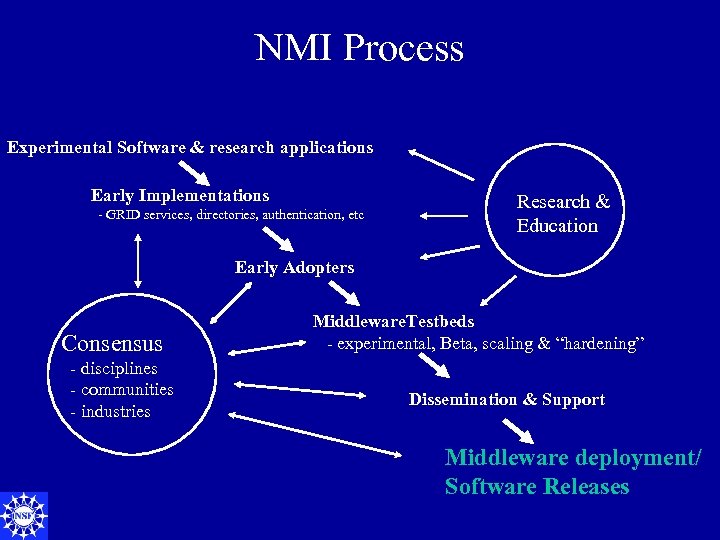
NMI Process Experimental Software & research applications Early Implementations - GRID services, directories, authentication, etc Research & Education Early Adopters Consensus - disciplines - communities - industries Middleware. Testbeds - experimental, Beta, scaling & “hardening” Dissemination & Support Middleware deployment/ Software Releases
NMI Releases (2 per year) • • • 1 st software release - May 2002 2 nd software release - October 2002 3 rd software release - April 2003 4 th software release - October 2003 NMI Releases currently being used by multiple Grid Projects • National and International interest in adopting and/or contributing software to NMI
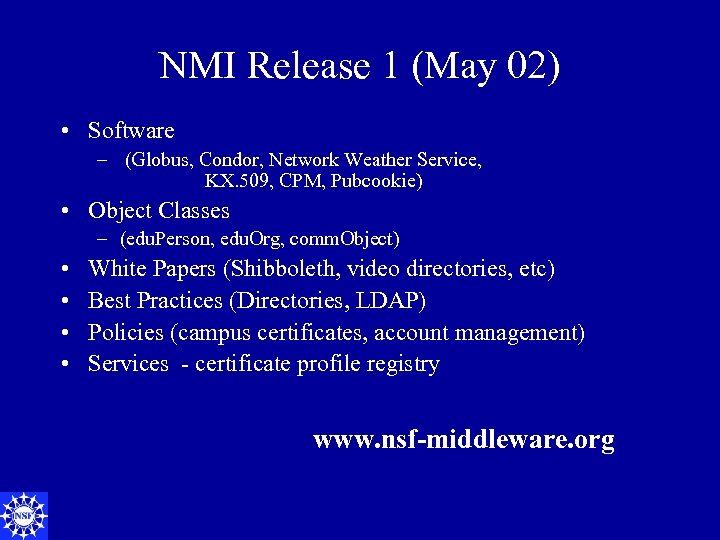
NMI Release 1 (May 02) • Software – (Globus, Condor, Network Weather Service, KX. 509, CPM, Pubcookie) • Object Classes – (edu. Person, edu. Org, comm. Object) • • White Papers (Shibboleth, video directories, etc) Best Practices (Directories, LDAP) Policies (campus certificates, account management) Services - certificate profile registry www. nsf-middleware. org
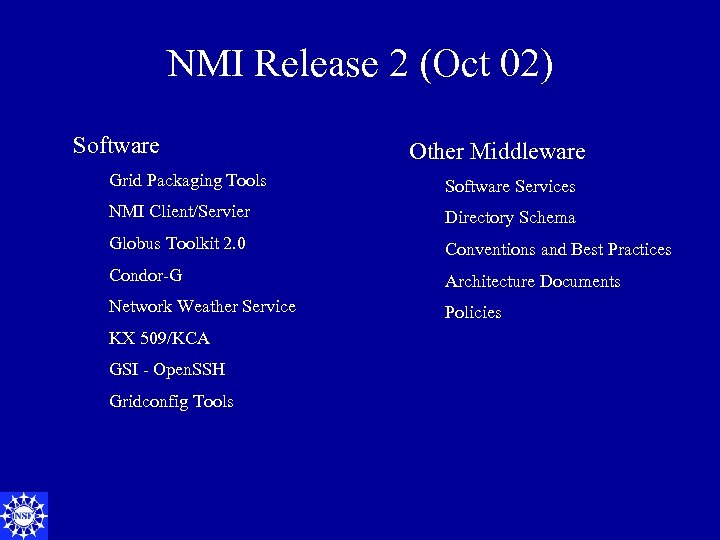
NMI Release 2 (Oct 02) Software Other Middleware Grid Packaging Tools Software Services NMI Client/Servier Directory Schema Globus Toolkit 2. 0 Conventions and Best Practices Condor-G Architecture Documents Network Weather Service Policies KX 509/KCA GSI - Open. SSH Gridconfig Tools
Thank You! See http: //cise. nsf. gov/div/anir/index. html
 Скачать презентацию The NSF Middleware Initiative Presentation by T J
aad645221bd259ce58c2430a4403ae9f.ppt