 Скачать презентацию The notion of system in the vocabulary Lecture
Vocabulary system - lecture 6.pptx
- Количество слайдов: 15



The notion of system in the vocabulary Lecture 6
1. General notion of the system in language. Types of system relation Vocabulary = system < words, word equivalents, phraseological units Relations: 1) paradigmatic; 2) syntagmatic. Paradigmatic relations exist in the system of language, between elements of the same class. They involve both the meaning and the form of the word.
Relations involving meaning relations of similarity between words (synonyms); relations of contrast (antonyms); relations of subordination (flower – tulip, rose, lily). The latter are called hypo-hyporonimic relations and build thematic groups.
Relations involving form • identity of form, meanings are different (homonyms) bark – bark, temple – temple, plain – plane (homophones), minute – minute, axes – axes (homographs); • partial similarity of form with different meanings (paronyms) accept – except, effect – affect, circuit – socket, specially – especially; • partial similarity of form and partial similarity of meaning. This type of relations underlies wordbuilding families (touching – touchy, careless – carefree, café - coffee).
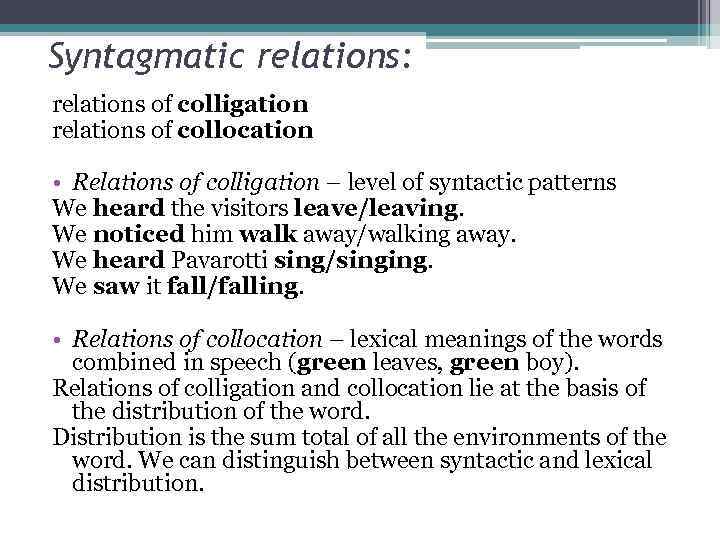
Syntagmatic relations: relations of colligation relations of collocation • Relations of colligation – level of syntactic patterns We heard the visitors leave/leaving. We noticed him walk away/walking away. We heard Pavarotti sing/singing. We saw it fall/falling. • Relations of collocation – lexical meanings of the words combined in speech (green leaves, green boy). Relations of colligation and collocation lie at the basis of the distribution of the word. Distribution is the sum total of all the environments of the word. We can distinguish between syntactic and lexical distribution.
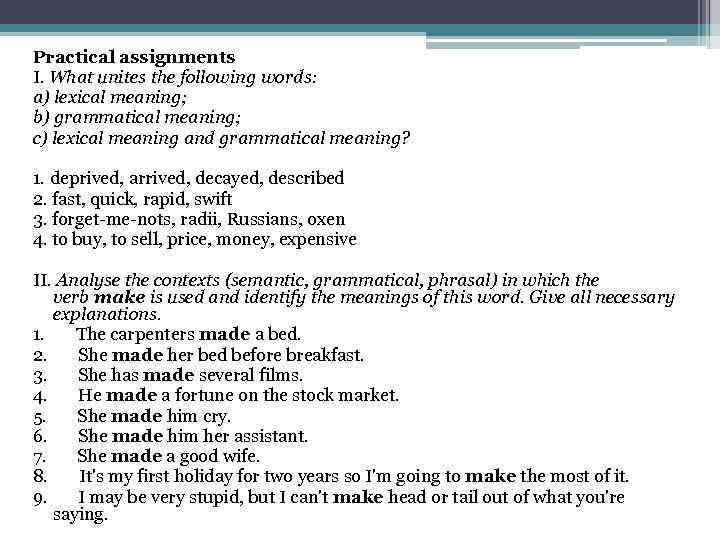
Practical assignments I. What unites the following words: а) lexical meaning; b) grammatical meaning; c) lexical meaning and grammatical meaning? 1. deprived, arrived, decayed, described 2. fast, quick, rapid, swift 3. forget-me-nots, radii, Russians, oxen 4. to buy, to sell, price, money, expensive II. Analyse the contexts (semantic, grammatical, phrasal) in which the verb make is used and identify the meanings of this word. Give all necessary explanations. 1. The carpenters made a bed. 2. She made her bed before breakfast. 3. She has made several films. 4. He made a fortune on the stock market. 5. She made him cry. 6. She made him her assistant. 7. She made a good wife. 8. It's my first holiday for two years so I'm going to make the most of it. 9. I may be very stupid, but I can't make head or tail out of what you're saying.
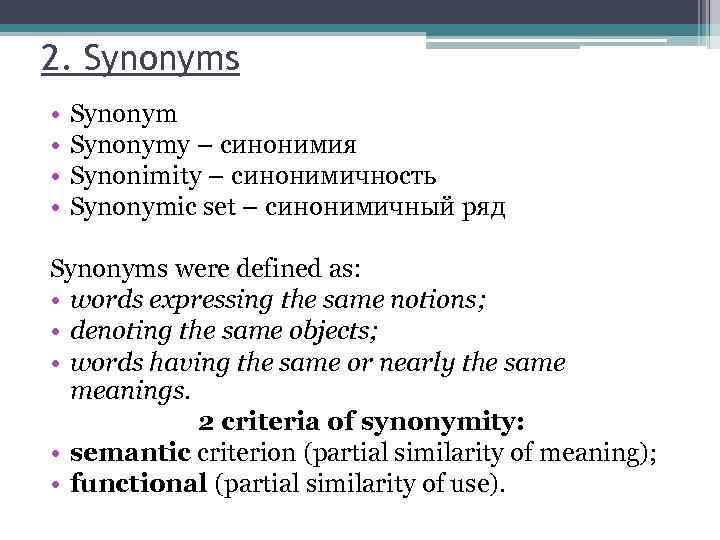
2. Synonyms • • Synonymy – синонимия Synonimity – синонимичность Synonymic set – синонимичный ряд Synonyms were defined as: • words expressing the same notions; • denoting the same objects; • words having the same or nearly the same meanings. 2 criteria of synonymity: • semantic criterion (partial similarity of meaning); • functional (partial similarity of use).
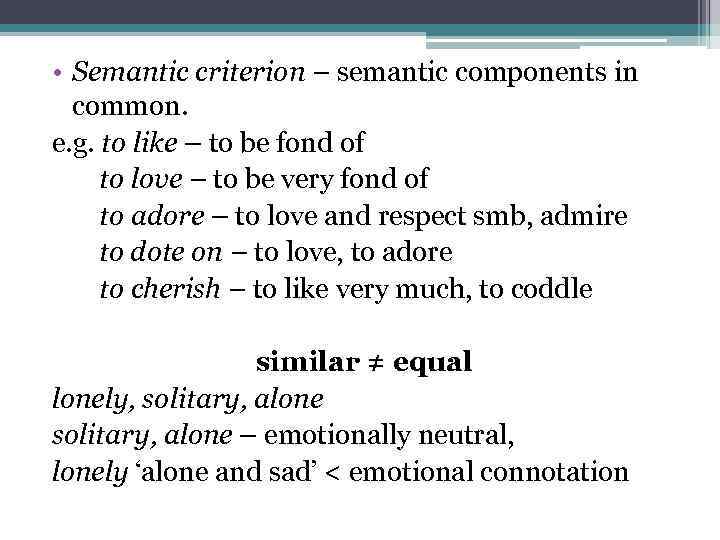
• Semantic criterion – semantic components in common. e. g. to like – to be fond of to love – to be very fond of to adore – to love and respect smb, admire to dote on – to love, to adore to cherish – to like very much, to coddle similar ≠ equal lonely, solitary, alone – emotionally neutral, lonely ‘alone and sad’ < emotional connotation
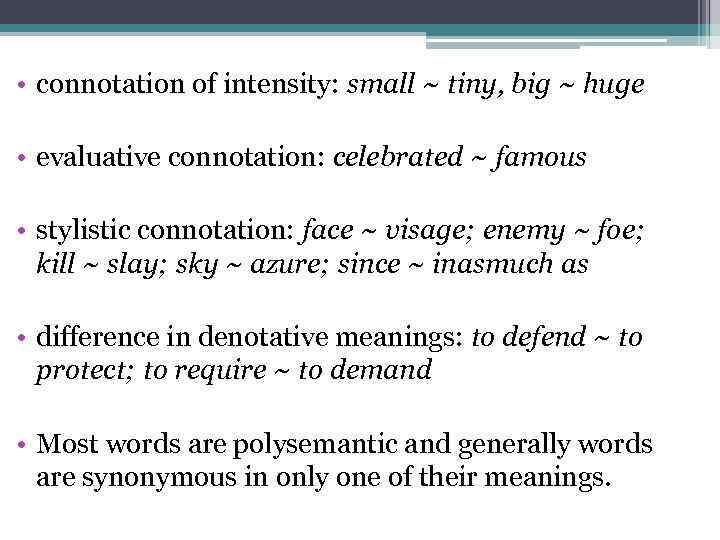
• connotation of intensity: small ~ tiny, big ~ huge • evaluative connotation: celebrated ~ famous • stylistic connotation: face ~ visage; enemy ~ foe; kill ~ slay; sky ~ azure; since ~ inasmuch as • difference in denotative meanings: to defend ~ to protect; to require ~ to demand • Most words are polysemantic and generally words are synonymous in only one of their meanings.
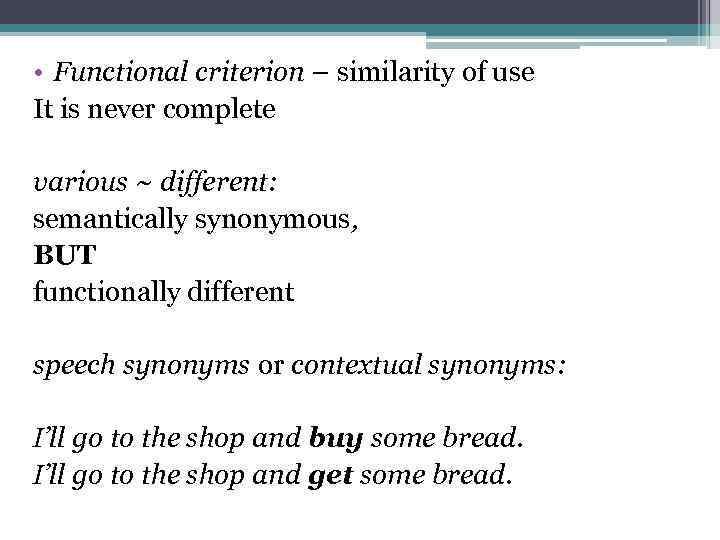
• Functional criterion – similarity of use It is never complete various ~ different: semantically synonymous, BUT functionally different speech synonyms or contextual synonyms: I’ll go to the shop and buy some bread. I’ll go to the shop and get some bread.
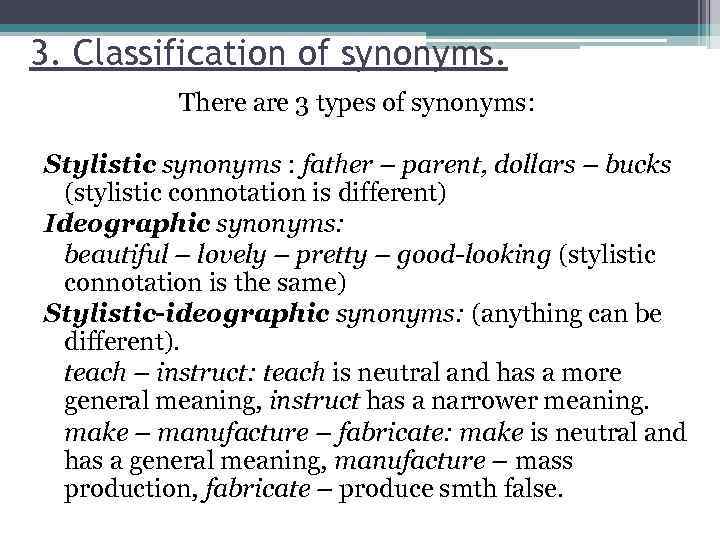
3. Classification of synonyms. There are 3 types of synonyms: Stylistic synonyms : father – parent, dollars – bucks (stylistic connotation is different) Ideographic synonyms: beautiful – lovely – pretty – good-looking (stylistic connotation is the same) Stylistic-ideographic synonyms: (anything can be different). teach – instruct: teach is neutral and has a more general meaning, instruct has a narrower meaning. make – manufacture – fabricate: make is neutral and has a general meaning, manufacture – mass production, fabricate – produce smth false.
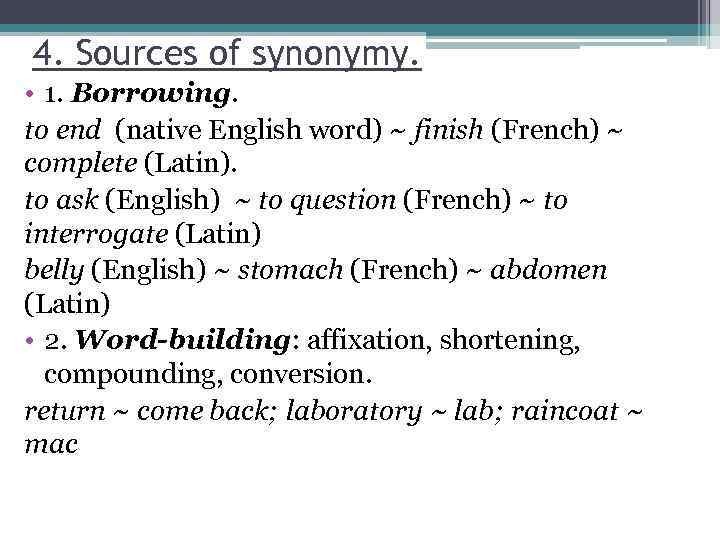
4. Sources of synonymy. • 1. Borrowing. to end (native English word) ~ finish (French) ~ complete (Latin). to ask (English) ~ to question (French) ~ to interrogate (Latin) belly (English) ~ stomach (French) ~ abdomen (Latin) • 2. Word-building: affixation, shortening, compounding, conversion. return ~ come back; laboratory ~ lab; raincoat ~ mac
• 3. Phraseology. to tease ~ to pull one’s leg; to decide ~ to make up one’s mind; soon ~ in no time, in twinkle of an eye • 4. Semantic change. a TVset ~ a box. Euphemisms are words with milder, less offensive meaning, more acceptable words which are used to substitute rough, unpleasant or unmentionable words. mad ~ queer, insane, not all there, not right in the upper storey. Christ ~ cripes, Jesus ~ Jee, Devil ~ old Henry, old Nick, old Dickens.
5. Antonyms. 2 main types of relations of contrast between notions: • relations of contrast between contrary notions; • relations of contrast between contradictory notions. Contrary notions are gradable, varying in the degree of quality. They imply a zero point, a norm which may or may not be expressed in English by a special term. young ~ middle-aged (a zero point) ~ elderly ~ old Contradictory notions always go in pairs and when taken together they cover completely the semantic sphere of the generic notion to which they are subordinated. e. g. gender male female

• Antonyms are words of the same part of speech expressing contrary or contradictory notions usually associated with each other and used together. Antonyms belong to the same stylistic group.
Скачать презентацию The notion of system in the vocabulary Lecture
Vocabulary system - lecture 6.pptx