


 Скачать презентацию The Non Govermental Organization NGO Kvinnekollektivet ARKEN 30
edc3abbb7de23981b6f8ca88091dcd27.ppt
- Количество слайдов: 14
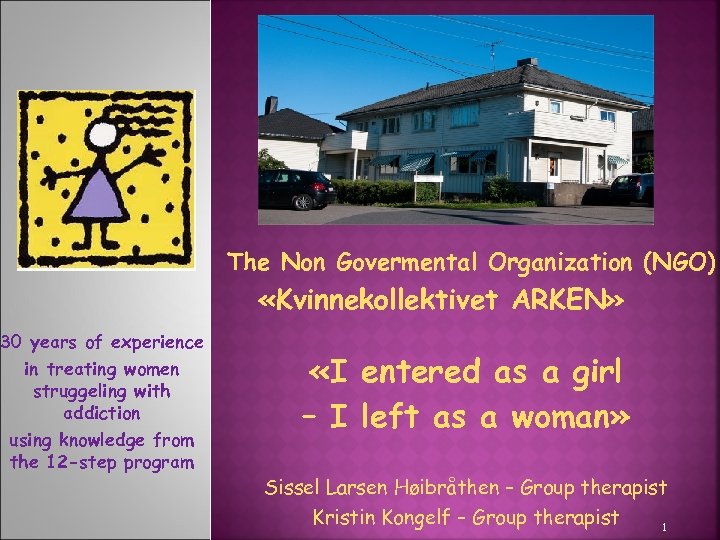 The Non Govermental Organization (NGO) «Kvinnekollektivet ARKEN» 30 years of experience in treating women struggeling with addiction using knowledge from the 12 -step program «I entered as a girl – I left as a woman» Sissel Larsen Høibråthen – Group therapist Kristin Kongelf – Group therapist 1
 We are located in Oslo – the capital of Norway We are celebrating 30 years, this year We have 10 treatment places in cooperation with the Department of Health in Southeast Norway Arken is an NGO ARKEN is nonreligious We only admit, and treat, women struggling with addiction Our patients are from the age of 23 years and upwards. Average is 34 years. The majority have additional diagnoses The majority have a varity of challenges – eating disorders, self harm and so on ARKEN is a full-time treatment program and the average treatment lasts for about 9 months We build on a 12 -step treatment methodology – “The Minnesota model” ARKEN is a treatment program without DAT (drug-assisted treatment with methadone/subutex/ subuxone) 2
 Primary Treatment: Group therapy Mandatory/individual treatment tasks Lectures (psychoeducative) Individual counselling Art and expression therapy Exercise/Meditation with a physiotherapist Mandatory meetings with AA (alcoholics anonymous) and NA (narcotics anonymous) twice a week where you share experiences, strenght and hope. «Relapse week» - preventing relapse program Weekend «off» – out to pratice a sober life The stay is intensive and has a structure that is mandatory. 3
 GROUPTHERAPY- GOALS: v Sharing experiences and identifying with others v Learning to empathise with each others v Recognise the tendency to escape painful experiences by using alcohol and drugs v Learning to understand express their needs, thoughts and emotions directly – as clean and sober v Learning to identify feelings/situations that leads to relapse v Acceptance and openness to share scary and shameful experiences and thoughts v Practicing better ways of relating to others. v Consciousness around different roles – roles through life - being a role model - motherhood etc. v Handling conflicts – and practicing direct communication v Learn to solve problems v Moving from secrets to openness – and from silence to sharing v We are working to help the women identify mechanisms of mental defence (like denial, repression and projection) 4
 IDEOLOGY - VALUES Our method are based on knowledge from the 12 -stepprogram The AA ideology consists of a system of ideas , understanding and attitudes about addiction and how someone with addiction can have a better life without alcohol and drugs All human beings have the capacity for change Our treatment model are based on our view of addiction as an disease/disorder but one that is treatable - through total absence – not medication!! The patient will learn about the dynamics of addiction – it is a complex problem that adresses all aspects of the patient’s life To learn the patients about themself and others, we use daily grouptreatment At ARKEN total absence from all narcotics and alcohol is mandatory
 v The treatment is especially aimed at changing addictive behaviour v Treatment happens through a lifestyle program, from the self-help movement combined with professional knowledge. v Group treatment with others in similar situations is widely used within 12 -step programs v The staff working with this kind of treatment often have experience based competence – 1/3 of our staff has this kind of competence – «ex-users» v The focus is to «Give back responsibility» ! v The treatment’s main goal is to provide a better quality of life parallel to abstaining from all addictive substances. We are helping the individual to discover and develop their own attitudes that can lead to a lifestyle that suits them. In this, the treatment has longterm aims besides simply abstaining from drugs. v In treatment we help the patient recognise their own situation and take consequences of their own actions. As a result, the patient can change their attitudes and behaviours, letting them actively choose a life of sobriety. v During the 12 -step program, relatives of patients are also involved and recieve psychoeducative training. The goal is to create healthier family relations in a dysfunctional family system. 6
 Demographic: Women suffering from chronic substance abuse where the consequences are serious (socially, physically, psychologically, ethically/morally) The women are often struggling with additional challenges tied to sexual assault, violence and attachment issues. The women are taught to value their own worth, and changes needs to be made in several – often all – areas of their lives. The women are encouraged: to examine their own lives to feel their emotions to set limits to ask for help to choose their own behaviours to take chances to not look too far into the future (one day at the time) to take responsibillity for their own lives to go from object to subject 7
 OUR FOCUS IS: All human beings/women have the ability to change We want the women to be active in their own life- to take responsibility for their own life and to focus on the self (feelings, thoughts, needs) Women with experience of sexual abuse often have a lot of different problems relating to gender roles, adaption to men and beeing a victim. The women are shielded from entering negative and dysfunctional relations to men when they are in treatment. We are offering an alternative to earlier experiences – our male staff are positive role models, where safety and predictability is a key Safety and trust are important for developing healthy relations 8
 New experiences with female relations, recognition and acceptance from other women. Our focus in theraphy is to accept emotions – feeling/crying will not kill you The relations to staff is essential in treatment, and it is therefor very important that employees are emotionally present, that they offer honest support and uses their own experiences. We use an engaged staff, with varied experience and that gives a clear message of hope To give hope, Arken use the self-help groups and learn the patients to look for similarities instead of differences. 9
 USER SURVEYS 70% complete the treatment Our last user survey in 2011: Showed that 64, 6% of our patients that fullfilled our treatment program were totally sober. The survey also showed that 87, 5% were sober if we included the ones that used (probably alkohol) 2 -3 times a month 10
 ALCOHOLICS ANONYMOUS (AA) OG NARCOTICS ANONYMOUS (NA) The Meetings The 12 -step ideology and their self help groups provides a clear path to change In the self-help groups you share experiences, strenght and hope. Through this, the patients are working on their common problem, as well as help each other to recovery AA/NA’s function in the aftercare/post treatment and onwards in restoration/recovery – vs. loneliness The core of the program is the 12 steps. We focus on the first four: Acknowledge that you are powerless Admit that you need help Act on the above, this means that you: Ask for help Accepts help Definition of an illness/disease/disorder by WHO: Diagnosable Primary Progressive Chronic Lethal No-blame illness Familial Treatable
 6 group terapists Experience across a variety of subjects (practical, psychologist, counselling, relevant major subjects and ex-users) Health Department Psychiatrist one day a week Nursing Staff Monday – Thursday Psychologist working 60% - including group theraphy Physiotherapist (individual and group), working 1/2 days a week Administration 12
 MOTIVATION The patient’s motivations are very varied. We can sustain motivation by: v Focusing on the patient’s resources v Respecting choices v Giving responsibility v Setting requirements v Not underestimating EMPOWERMENT «Empowerment is a process that is essential to: v Strengthen and activate ones ability to satisfy own needs v Solving ones own problems v Collecting the necessary resources to take control over ones own life» (S. Talseth, 1997) 13
 If one of our patients use drugs or alcohol while admidded to our institution, we will first isolate them on the premises untill we can transfer her to a detox institution. While the patient is at detox, we will discuss if we have anything to offer the patient and wether the patient is abel to receive our kind of treatment. If we deceide to give the patient another chance, she will stay at the detox for a few weeks and then start all over again at Arken. If we deceid to end the treatment, we will transfer the repsonsibility back to the homeplace. 14