

THE NON-FINITE FORMS OF THE VERB (THE VERBALS)

THE NON-FINITE FORMS OF THE VERB (THE VERBALS) The verb has finite and non-finite forms, the latter being also called verbals. The verbals, unlike the finite forms of the verb, do not express person, number or mood. Therefore they cannot be used as the predicate of a sentence. Like the finite forms of the verb the verbals have tense and voice distinctions, but their tense distinctions differ greatly from those of the finite verb. There are three verbals in English: the participle, the gerund and the infinitive. In Russian we also have three non-finite forms of the verb, but they do not fully coincide with those in the English language (причастие, деепричастие, инфинитив), in the Ukrainian language there are also three non-finites: інфінітив, дієприкметник, дієприслівник).
The characteristic traits of the verbals 1. They have a double nature, nominal and verbal. The participle combines the characteristics of a verb with those of an adjective; the gerund and the infinitive combine the characteristics of a verb with those of a noun. 2. The tense distinctions of the verbals are not absolute (like those of the finite verb), but relative; the form of a verbal does not show whether the action it denotes refers to the present, past or future; it shows only whether the action expressed by the verbal is simultaneous with the action expressed by the finite verb or prior to it. 3. All the verbals can form predicative constructions, i. e. constructions consisting of two elements, a nominal (noun or pronoun) and a verbal (participle, gerund or infinitive); the verbal element stands in predicate relation to the nominal element, i. e. in a relation similar to that between the subject and the predicate of the sentence. In most cases predicative constructions form syntactic units, serving as one part of the sentence. e.g. They sat down to supper, Manston still talking cheerfully (Hardy) — Они сели ужинать; Мэнстон продолжал весело разговаривать.
In the sentence a verbal may occur: a) singly, i. e. without accompanying words. She... went away smiling. (Dreiser) — Она... ушла, улыбаясь. b) in phrases, i.е. with one or several accompanying words (an object or an adverbial modifier to the verbal). These phrases form syntactic units serving as one part of the sentence. A phrase should not be confused with a predicative construction: between the elements of a phrase there is no predicate relation as it does not include a noun or a pronoun denoting the doer of the action expressed by a verbal. The windows of the drawing-room opened to a balcony overlooking the garden. (Mansfield) — Окна гостиной выходили на балкон, с которого был виден сад. She tried to tranquillize him by reading aloud. (Gaskell) — Она пыталась успокоить его тем, что читала ему вслух. c) in predicative constructions. My mistress being dead..., I had to look out for a new place. (Ch. Bronte) — Так как моя хозяйка умерла, мне пришлось искать другое место. She heard him unbar the door and go out into the yard. (Hardy) — Она слышала, как он отодвинул засов и вышел во двор.
The Participle The participle is a non-finite form of the verb which has a verbal and an adjectival or an adverbial character. There are two participles in English — Participle I and Participle II, traditionally called the Present Participle and the Past Participle.
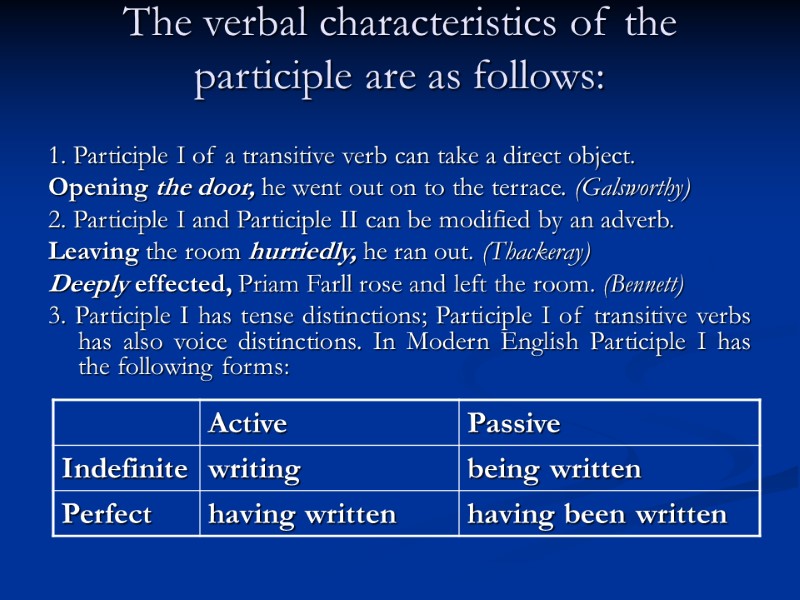
The verbal characteristics of the participle are as follows: 1. Participle I of a transitive verb can take a direct object. Opening the door, he went out on to the terrace. (Galsworthy) 2. Participle I and Participle II can be modified by an adverb. Leaving the room hurriedly, he ran out. (Thackeray) Deeply effected, Priam Farll rose and left the room. (Bennett) 3. Participle I has tense distinctions; Participle I of transitive verbs has also voice distinctions. In Modern English Participle I has the following forms:
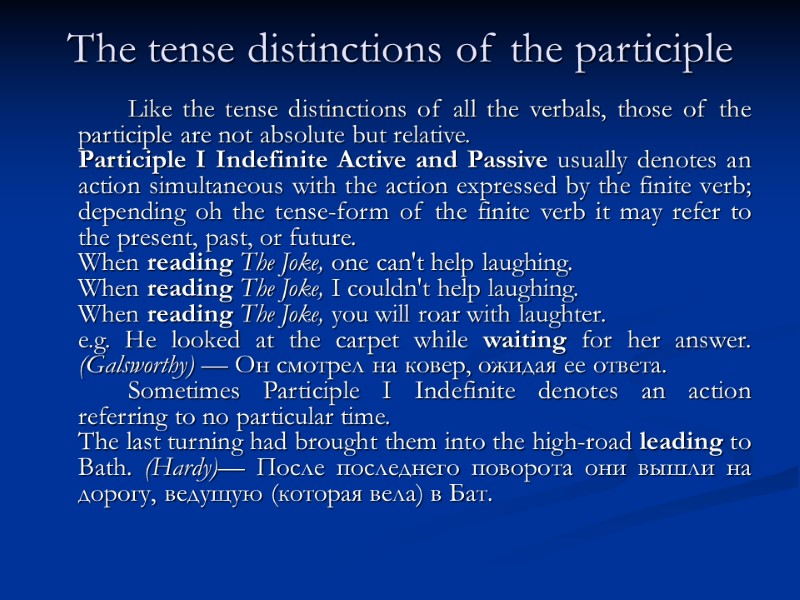
The tense distinctions of the participle Like the tense distinctions of all the verbals, those of the participle are not absolute but relative. Participle I Indefinite Active and Passive usually denotes an action simultaneous with the action expressed by the finite verb; depending oh the tense-form of the finite verb it may refer to the present, past, or future. When reading The Joke, one can't help laughing. When reading The Joke, I couldn't help laughing. When reading The Joke, you will roar with laughter. e.g. He looked at the carpet while waiting for her answer. (Galsworthy) — Он смотрел на ковер, ожидая ее ответа. Sometimes Participle I Indefinite denotes an action referring to no particular time. The last turning had brought them into the high-road leading to Bath. (Hardy)— После последнего поворота они вышли на дорогу, ведущую (которая вела) в Бат.
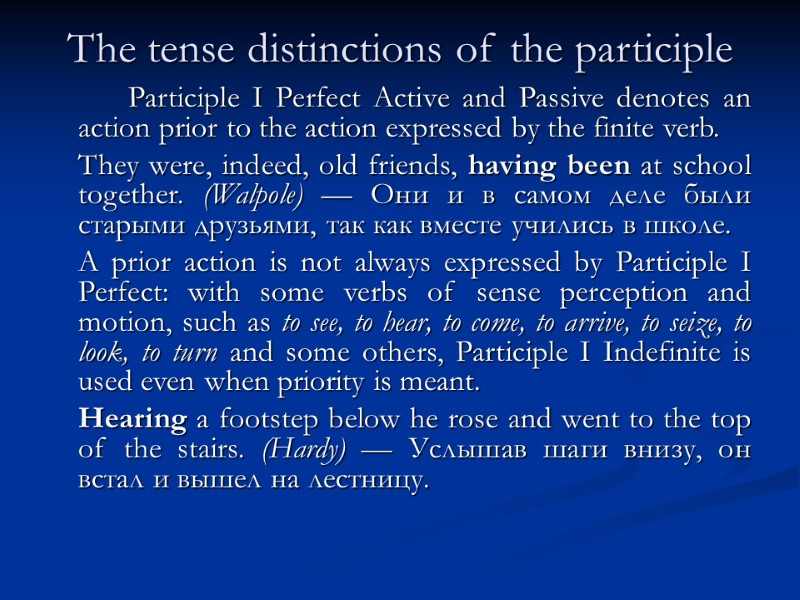
The tense distinctions of the participle Participle I Perfect Active and Passive denotes an action prior to the action expressed by the finite verb. They were, indeed, old friends, having been at school together. (Walpole) — Они и в самом деле были старыми друзьями, так как вместе учились в школе. A prior action is not always expressed by Participle I Perfect: with some verbs of sense perception and motion, such as to see, to hear, to come, to arrive, to seize, to look, to turn and some others, Participle I Indefinite is used even when priority is meant. Hearing a footstep below he rose and went to the top of the stairs. (Hardy) — Услышав шаги внизу, он встал и вышел на лестницу.
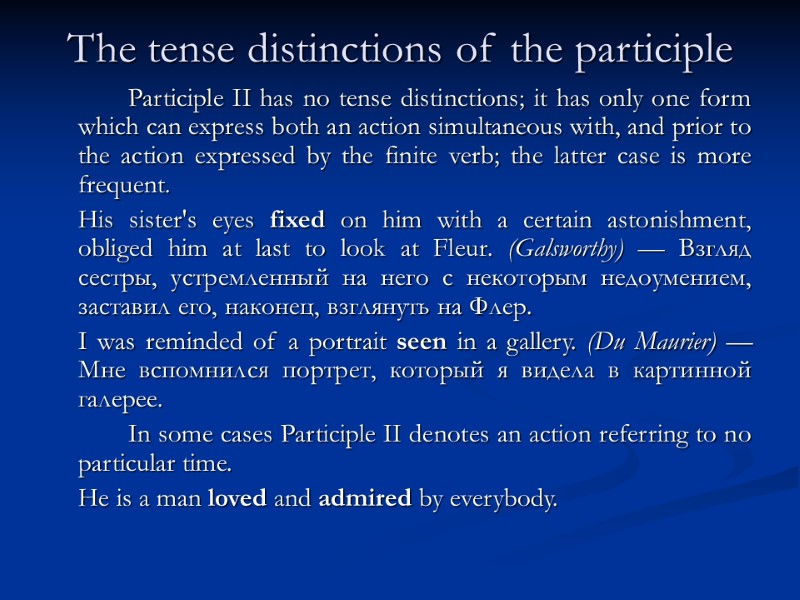
The tense distinctions of the participle Participle II has no tense distinctions; it has only one form which can express both an action simultaneous with, and prior to the action expressed by the finite verb; the latter case is more frequent. His sister's eyes fixed on him with a certain astonishment, obliged him at last to look at Fleur. (Galsworthy) — Взгляд сестры, устремленный на него с некоторым недоумением, заставил его, наконец, взглянуть на Флер. I was reminded of a portrait seen in a gallery. (Du Maurier) — Мне вспомнился портрет, который я видела в картинной галерее. In some cases Participle II denotes an action referring to no particular time. He is a man loved and admired by everybody.
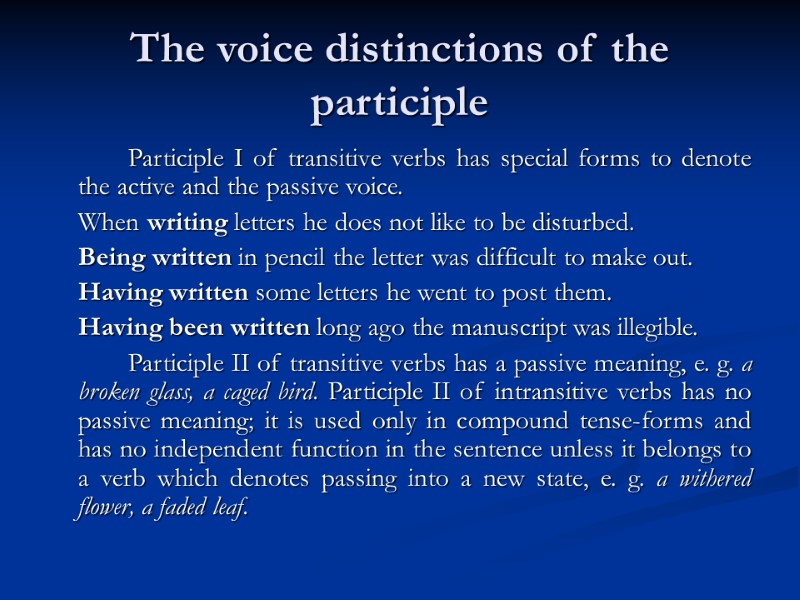
The voice distinctions of the participle Participle I of transitive verbs has special forms to denote the active and the passive voice. When writing letters he does not like to be disturbed. Being written in pencil the letter was difficult to make out. Having written some letters he went to post them. Having been written long ago the manuscript was illegible. Participle II of transitive verbs has a passive meaning, e. g. a broken glass, a caged bird. Participle II of intransitive verbs has no passive meaning; it is used only in compound tense-forms and has no independent function in the sentence unless it belongs to a verb which denotes passing into a new state, e. g. a withered flower, a faded leaf.
 Скачать презентацию THE NON-FINITE FORMS OF THE VERB (THE VERBALS)
18750-verbals.ppt
- Количество слайдов: 9