


 Скачать презентацию The NOn A Module Factory Quality Assurance System
14e402c2602a9e44cbfa81b9840ea234.ppt
- Количество слайдов: 21
 The NOn. A Module Factory Quality Assurance System Alex Smith University of Minnesota for the NOn. A Collaboration
 NOn. A Physics Goals • sin 2(2 q 13) • Determine neutrino mass hierarchy using MSW matter effects – Possible because Nu. MI can provide both neutrino and antineutrino beams • Limit parameter space of d. CP • Precise measurement of sin 2(2 q 23) • Potential to observe neutrino flux from galactic supernovae
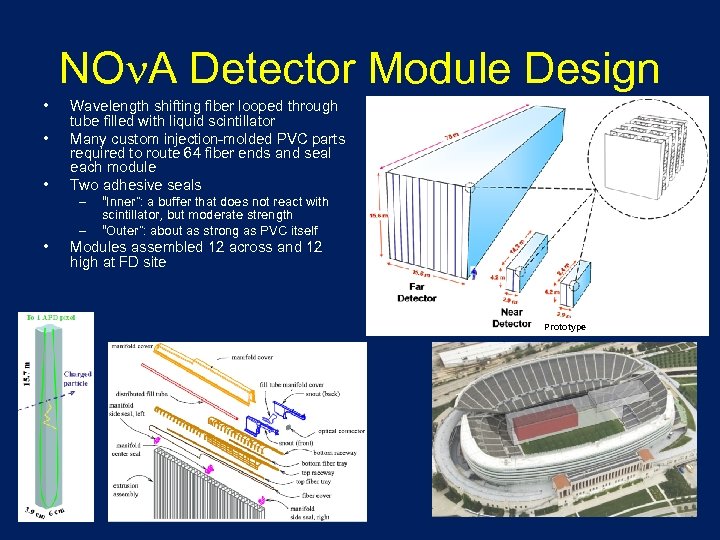 NOn. A Detector Module Design • • • Wavelength shifting fiber looped through tube filled with liquid scintillator Many custom injection-molded PVC parts required to route 64 fiber ends and seal each module Two adhesive seals – – • “Inner”: a buffer that does not react with scintillator, but moderate strength “Outer”: about as strong as PVC itself Modules assembled 12 across and 12 high at FD site Prototype
 A Matter of Scale and Cost… • Industry-scale production operation: – ~12, 000 modules – ~500 outgoing semi-truck loads of modules – Up to ~150 truck loads stored in factory – 125, 000 sf production space • Cost per module is critical – – Student labor Low reject rate: <2% • • ~$5000 for each rejected module Many part-time employees – – Up to 200 -250 student employees at a time (up to 70 in the factory at a time) 400 -500 total employees for ~2. 5 year duration of production
 Assembly Challenges • Build ~12000 far detector modules • Large part-time University of Minnesota student work force – ~70 part-time employees in factory at a time during peak – Small full-time crew of two senior managers and five full-time managers • Material handling – – Modules are 16 m x 1. 3 m x 0. 7 m and weigh about 450 kg (1000 lbs) Production of a single module spread over 5 days Work on up to 150 modules at a time Delay in any assembly step quickly leads to traffic jam • Stringent technical requirements: – Liquid leak rate (tested with air) • Test: detect air leak of ~3. 3 std. cc/min from a ~1, 000 cc volume • 12 hour minimum test duration to reach this sensitivity – Flatness requirement of 0. 5 mm over more than 20 m 2 – Wavelength shifting fiber light transmission • Fibers easily damaged • Three different tests to check for damage • Real-time tracking of assembly process is essential
 Goals of Quality Assurance Software • Ensure that modules meet specifications before shipping • Collect data during the assembly process to allow us to quickly identify, diagnose, and fix any problems that may arise. • Interface with test devices to collect data – Interpret, summarize, and archive data – Centralize calibration data • Guide assembly process to prevent mistakes • Provide tools to: – Manage large number of part-time employees with a small team of fulltime employees – Manage training of employees – Ensure quality and manage inventory of parts and materials – Guarantee maintenance and proper functioning of the large number of machines – Ensure compliance with safety standards – Ease reporting to safety agencies – Simplify reporting to project management
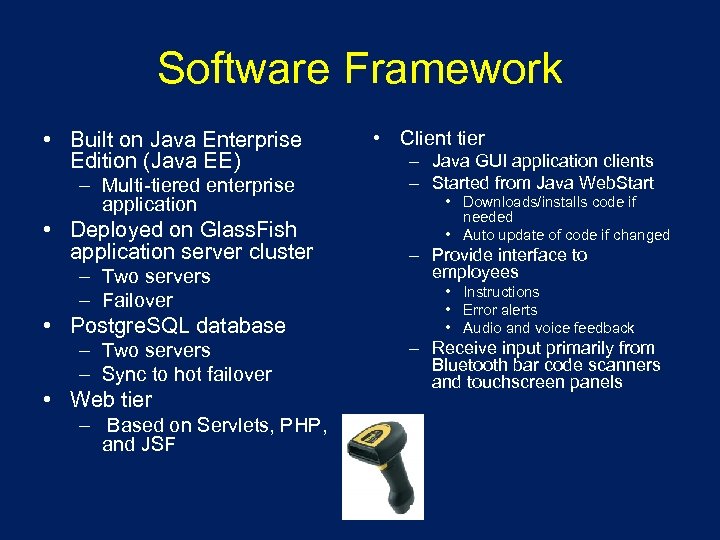 Software Framework • Built on Java Enterprise Edition (Java EE) – Multi-tiered enterprise application • Deployed on Glass. Fish application server cluster – Two servers – Failover • Postgre. SQL database – Two servers – Sync to hot failover • Web tier – Based on Servlets, PHP, and JSF • Client tier – Java GUI application clients – Started from Java Web. Start • Downloads/installs code if needed • Auto update of code if changed – Provide interface to employees • Instructions • Error alerts • Audio and voice feedback – Receive input primarily from Bluetooth bar code scanners and touchscreen panels
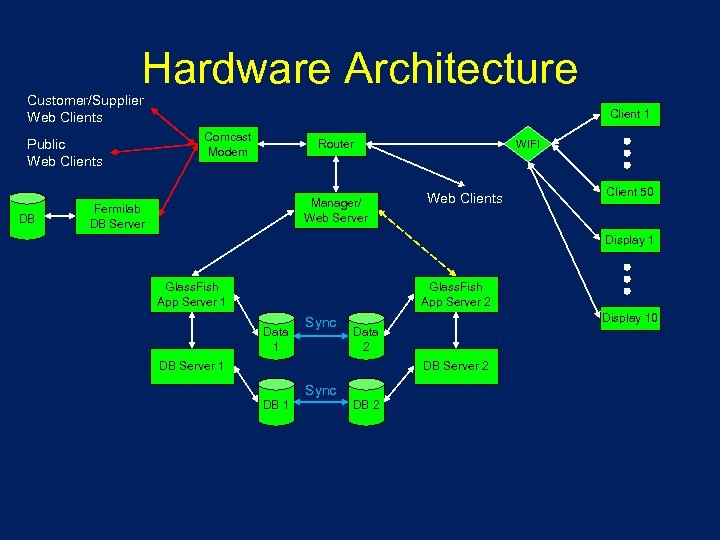 Hardware Architecture Customer/Supplier Web Clients Public Web Clients DB Client 1 Comcast Modem Router Manager/ Web Server Fermilab DB Server WIFI Web Clients Client 50 Display 1 Glass. Fish App Server 2 Data 1 Sync Display 10 Data 2 DB Server 1 Sync DB 1 DB 2
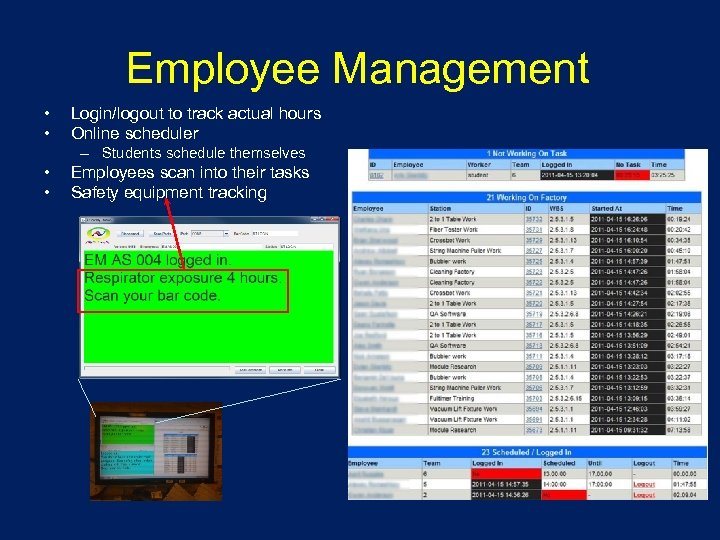 Employee Management • • Login/logout to track actual hours Online scheduler – Students schedule themselves • • Employees scan into their tasks Safety equipment tracking
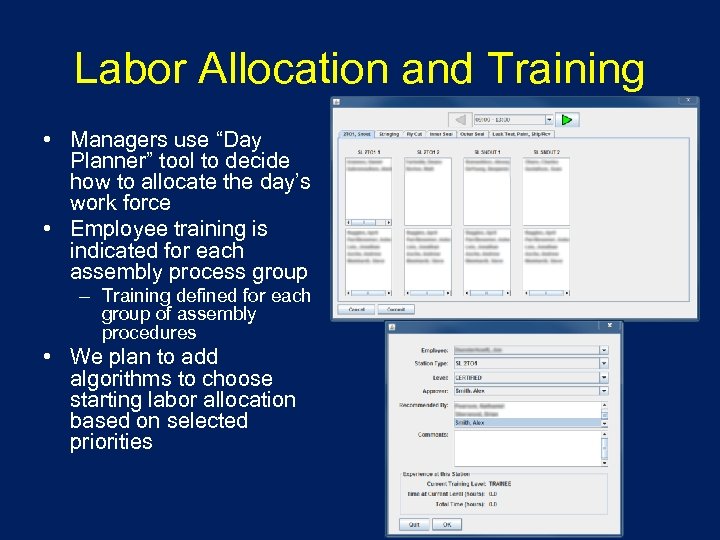 Labor Allocation and Training • Managers use “Day Planner” tool to decide how to allocate the day’s work force • Employee training is indicated for each assembly process group – Training defined for each group of assembly procedures • We plan to add algorithms to choose starting labor allocation based on selected priorities
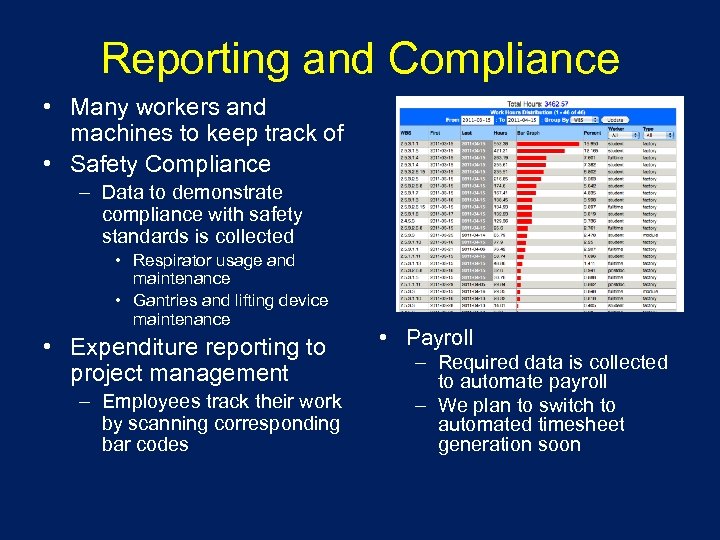 Reporting and Compliance • Many workers and machines to keep track of • Safety Compliance – Data to demonstrate compliance with safety standards is collected • Respirator usage and maintenance • Gantries and lifting device maintenance • Expenditure reporting to project management – Employees track their work by scanning corresponding bar codes • Payroll – Required data is collected to automate payroll – We plan to switch to automated timesheet generation soon
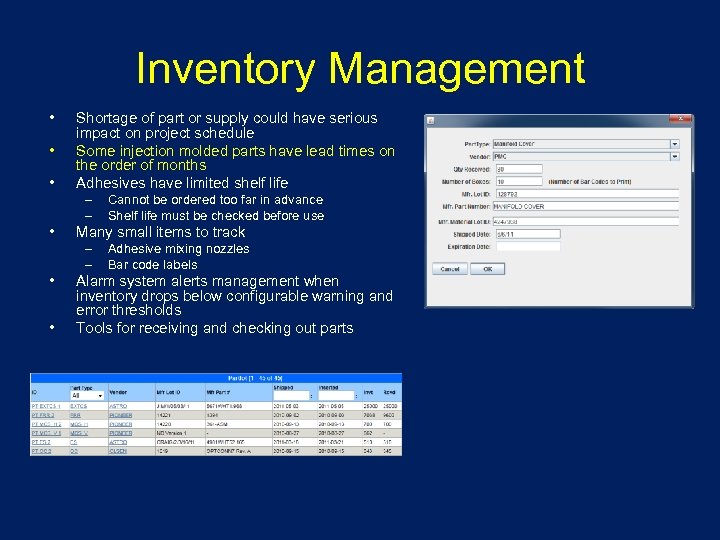 Inventory Management • • • Shortage of part or supply could have serious impact on project schedule Some injection molded parts have lead times on the order of months Adhesives have limited shelf life – – • Many small items to track – – • • Cannot be ordered too far in advance Shelf life must be checked before use Adhesive mixing nozzles Bar code labels Alarm system alerts management when inventory drops below configurable warning and error thresholds Tools for receiving and checking out parts
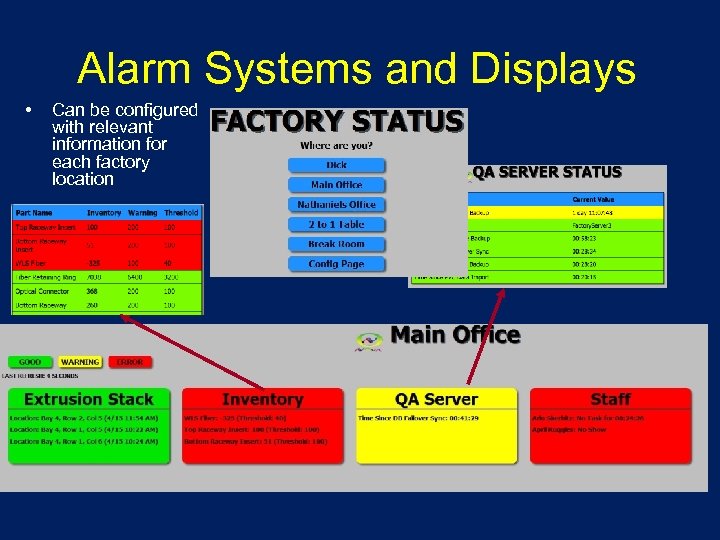 Alarm Systems and Displays • Can be configured with relevant information for each factory location
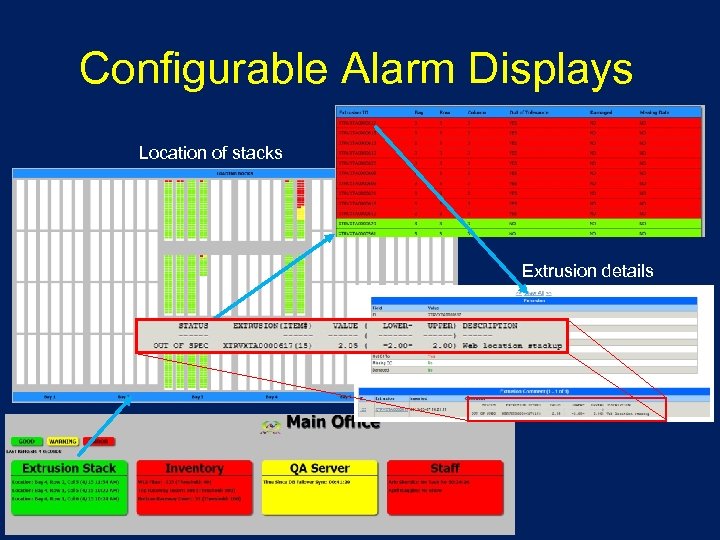 Configurable Alarm Displays Location of stacks Extrusion details
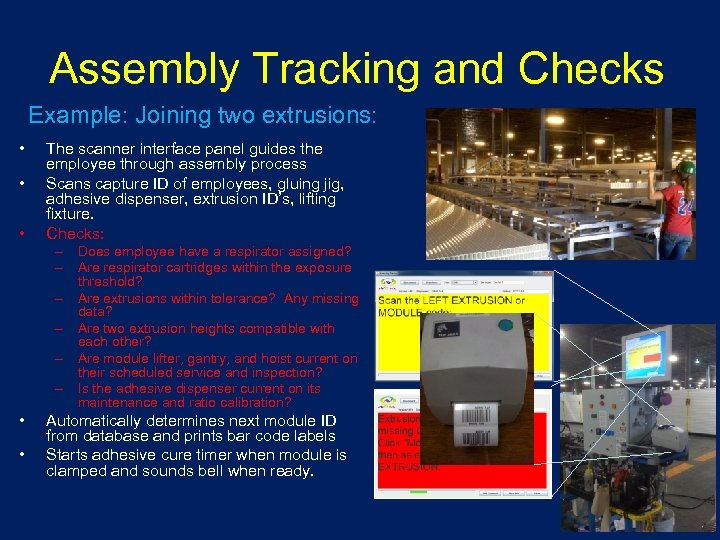 Assembly Tracking and Checks Example: Joining two extrusions: • • • The scanner interface panel guides the employee through assembly process Scans capture ID of employees, gluing jig, adhesive dispenser, extrusion ID’s, lifting fixture. Checks: – Does employee have a respirator assigned? – Are respirator cartridges within the exposure threshold? – Are extrusions within tolerance? Any missing data? – Are two extrusion heights compatible with each other? – Are module lifter, gantry, and hoist current on their scheduled service and inspection? – Is the adhesive dispenser current on its maintenance and ratio calibration? • • Automatically determines next module ID from database and prints bar code labels Starts adhesive cure timer when module is clamped and sounds bell when ready.
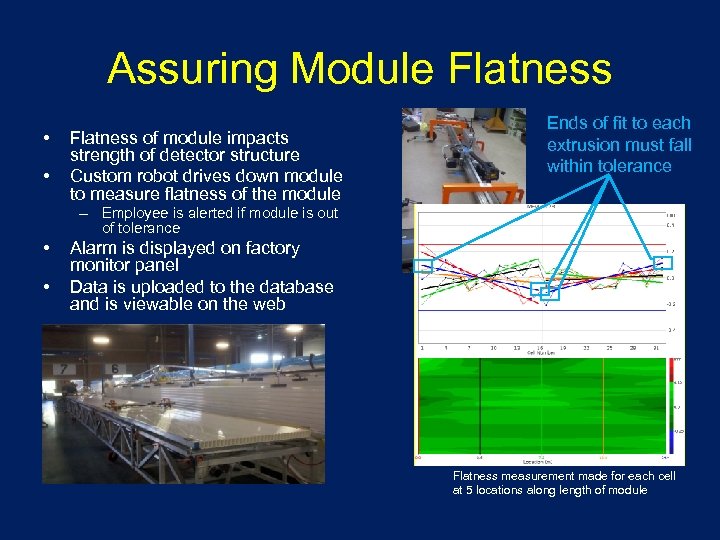 Assuring Module Flatness • • Flatness of module impacts strength of detector structure Custom robot drives down module to measure flatness of the module Ends of fit to each extrusion must fall within tolerance – Employee is alerted if module is out of tolerance • • Alarm is displayed on factory monitor panel Data is uploaded to the database and is viewable on the web Flatness measurement made for each cell at 5 locations along length of module
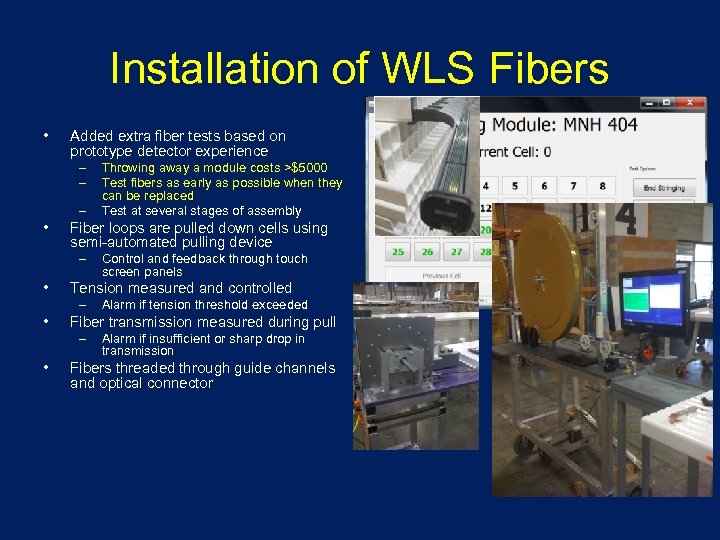 Installation of WLS Fibers • Added extra fiber tests based on prototype detector experience – – – • Fiber loops are pulled down cells using semi-automated pulling device – • Alarm if tension threshold exceeded Fiber transmission measured during pull – • Control and feedback through touch screen panels Tension measured and controlled – • Throwing away a module costs >$5000 Test fibers as early as possible when they can be replaced Test at several stages of assembly Alarm if insufficient or sharp drop in transmission Fibers threaded through guide channels and optical connector
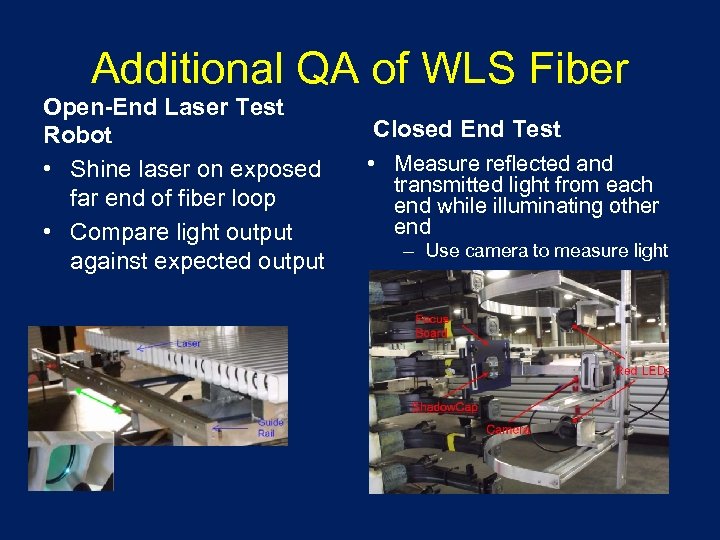 Additional QA of WLS Fiber Open-End Laser Test Robot • Shine laser on exposed far end of fiber loop • Compare light output against expected output Closed End Test • Measure reflected and transmitted light from each end while illuminating other end – Use camera to measure light
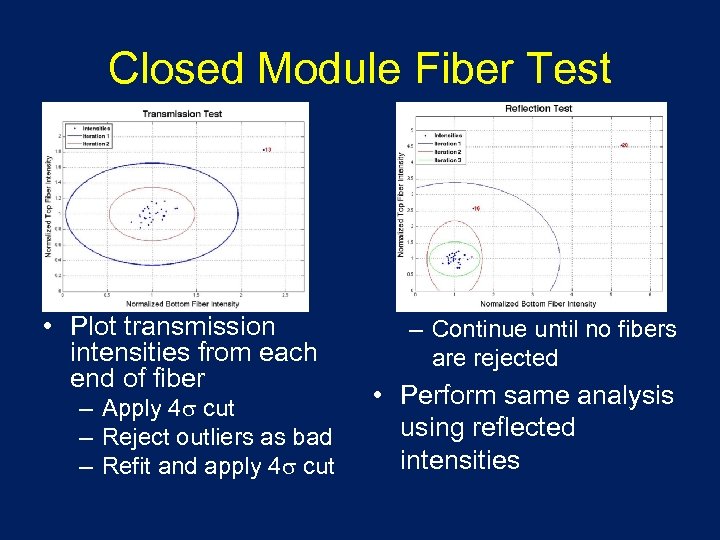 Closed Module Fiber Test • Plot transmission intensities from each end of fiber – Apply 4 s cut – Reject outliers as bad – Refit and apply 4 s cut – Continue until no fibers are rejected • Perform same analysis using reflected intensities
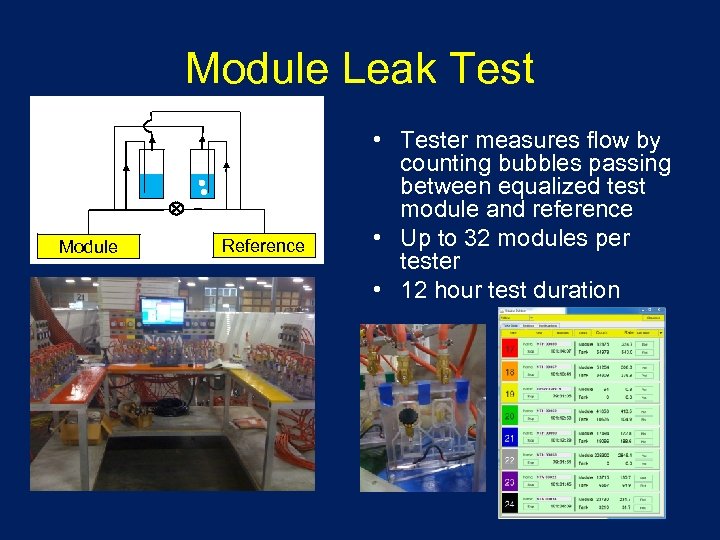 Module Leak Test Module Reference • Tester measures flow by counting bubbles passing between equalized test module and reference • Up to 32 modules per tester • 12 hour test duration
 Conclusions • System was used to build NOn. A prototype detector – Added additional QA steps based on experience • Currently being used for first steps of far detector assembly • This system is key to meeting the challenges ahead of us – Build ~12000 far detector modules – Meet stringent tolerances – Manage large part-time work force with small full-time crew • Ongoing development to address new needs and concerns as they arise