


 Скачать презентацию The noise spectra of mesoscopic structures Eitan Rothstein
5c459b4a25915ad92721083f2602f2a7.ppt
- Количество слайдов: 29
 The noise spectra of mesoscopic structures Eitan Rothstein With Amnon Aharony and Ora Entin 22. 09. 10 University of Latvia, Riga, Latvia
 The desert in Israel
 Outline • Introduction to mesoscopic physics • Introduction to noise • The scattering matrix formalism • Our results for the noise of a quantum dot • Summary
 Mesoscopic Physics Meso = Intermidiate, in the middle. Mesoscopic physics = A mesoscopic system is really like a large molecule, but it is always, at least weakly, coupled to a much larger, essentially infinite, system – via phonos, many body excitation, and so on. (Y. Imry, Introduction to mesoscopic physics) A naïve definition: Something very small coupled to something very large.
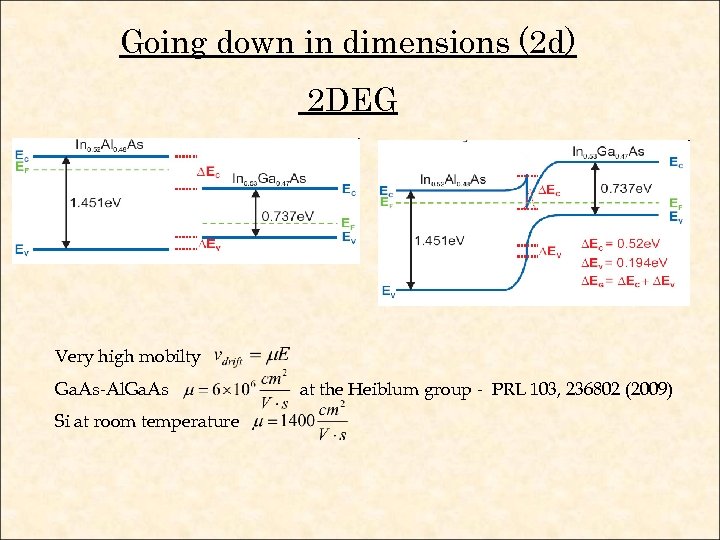 Going down in dimensions (2 d) 2 DEG Very high mobilty Ga. As-Al. Ga. As Si at room temperature at the Heiblum group - PRL 103, 236802 (2009)
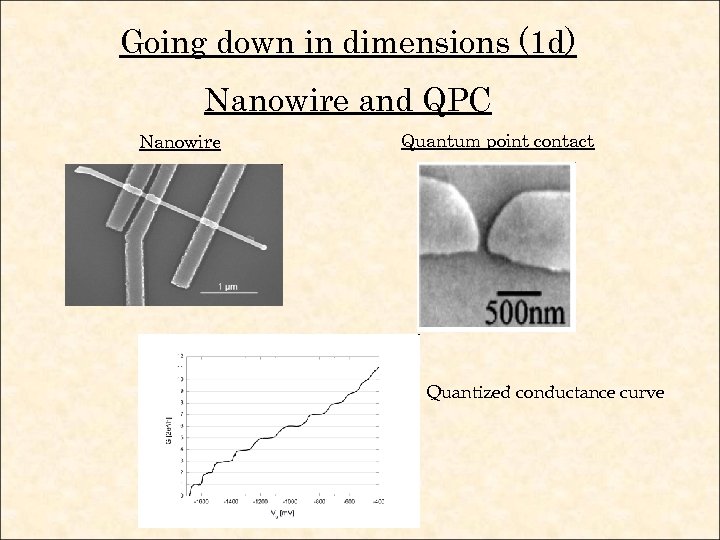 Going down in dimensions (1 d) Nanowire and QPC Nanowire Quantum point contact Quantized conductance curve
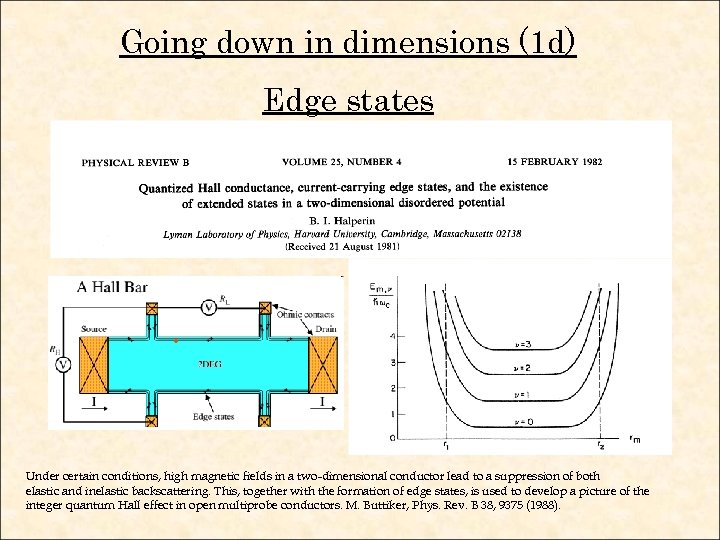 Going down in dimensions (1 d) Edge states Under certain conditions, high magnetic fields in a two-dimensional conductor lead to a suppression of both elastic and inelastic backscattering. This, together with the formation of edge states, is used to develop a picture of the integer quantum Hall effect in open multiprobe conductors. M. Buttiker, Phys. Rev. B 38, 9375 (1988).
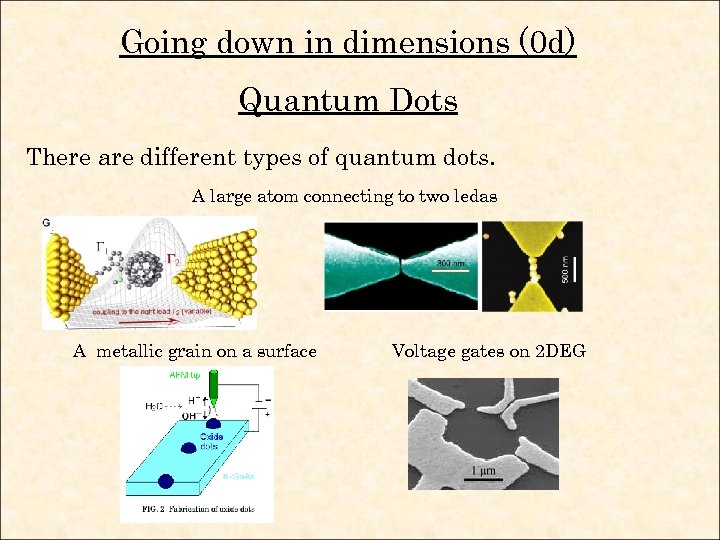 Going down in dimensions (0 d) Quantum Dots There are different types of quantum dots. A large atom connecting to two ledas A metallic grain on a surface Voltage gates on 2 DEG
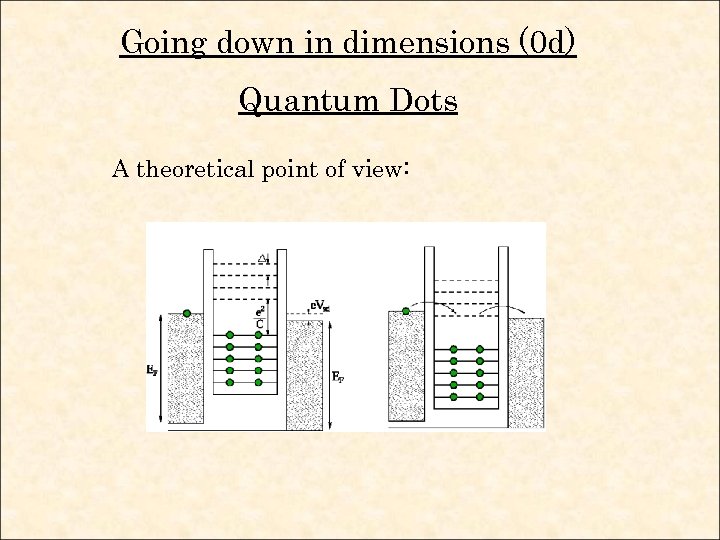 Going down in dimensions (0 d) Quantum Dots A theoretical point of view:
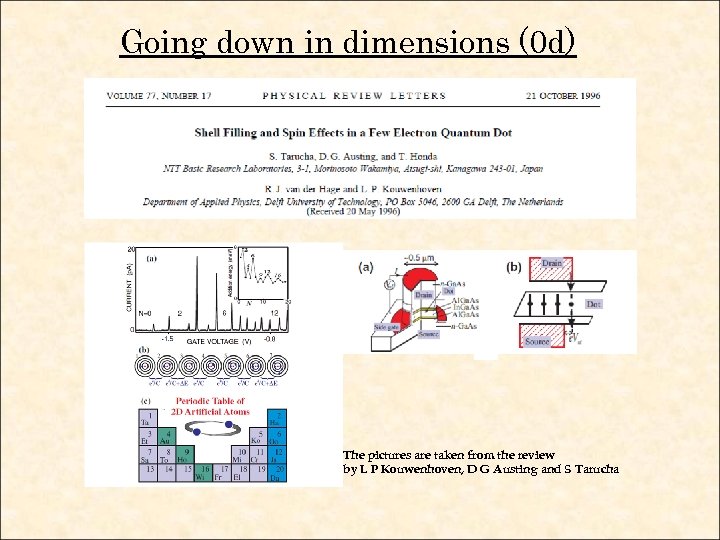 Going down in dimensions (0 d) The pictures are taken from the review by L P Kouwenhoven, D G Austing and S Tarucha
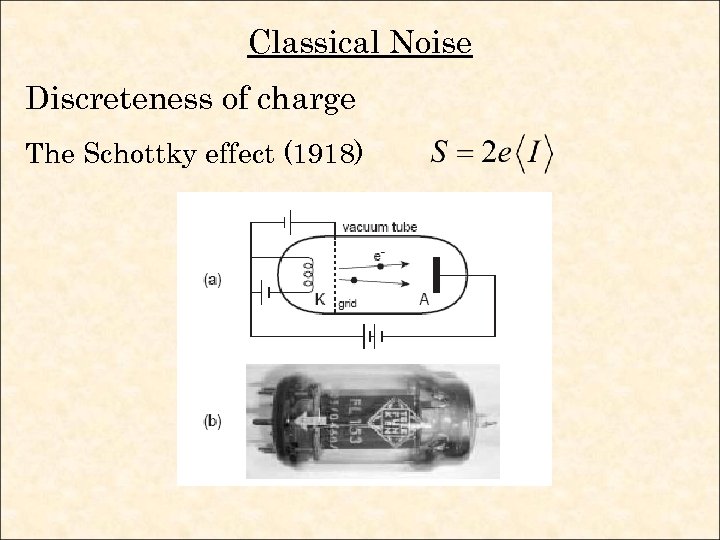 Classical Noise Discreteness of charge The Schottky effect (1918)
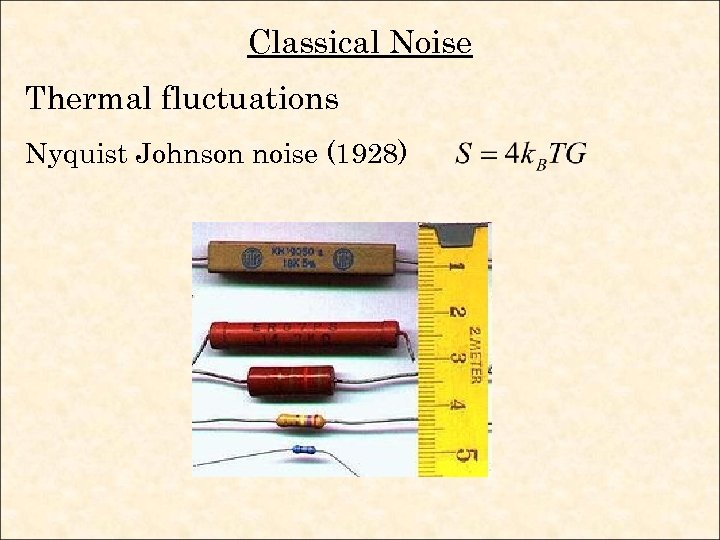 Classical Noise Thermal fluctuations Nyquist Johnson noise (1928)
 Quantum Noise
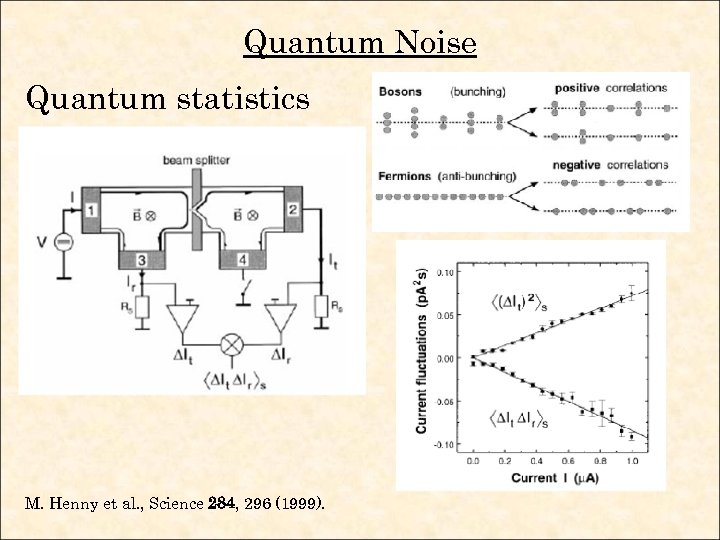 Quantum Noise Quantum statistics M. Henny et al. , Science 284, 296 (1999).
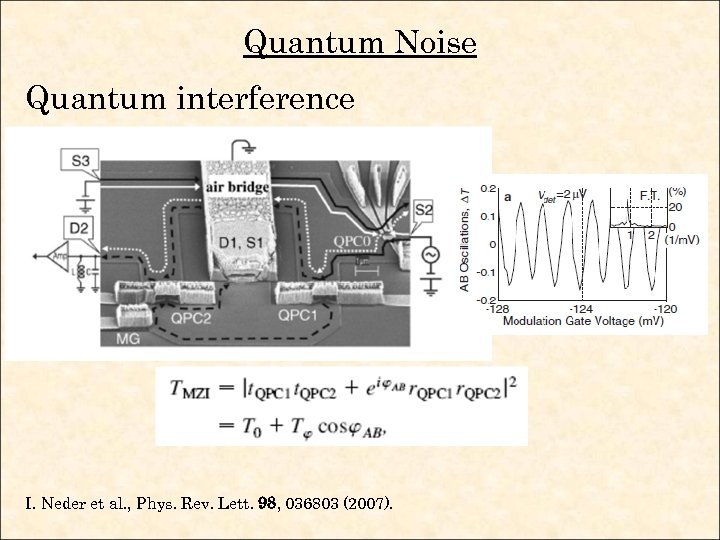 Quantum Noise Quantum interference I. Neder et al. , Phys. Rev. Lett. 98, 036803 (2007).
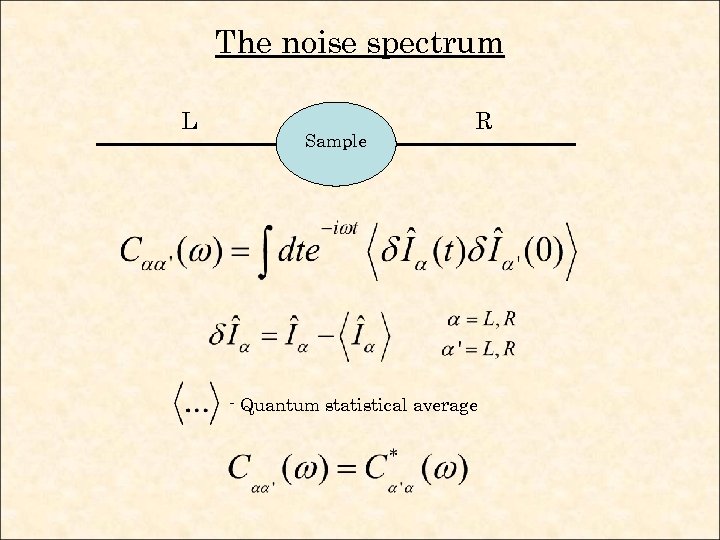 The noise spectrum L Sample R - Quantum statistical average
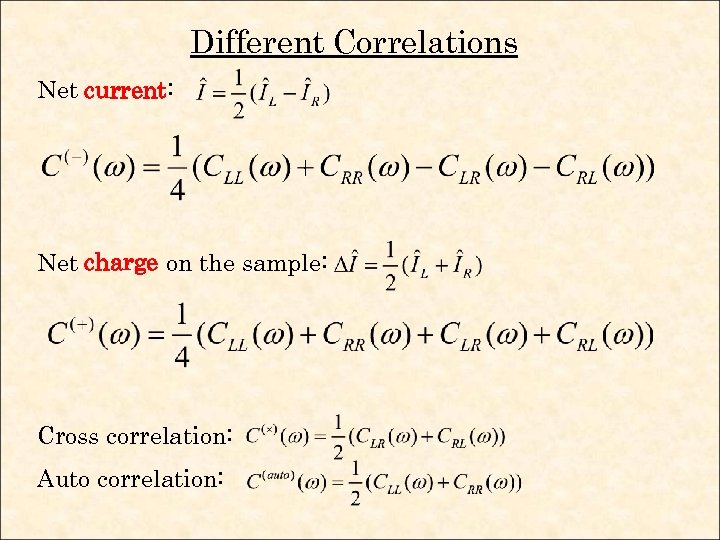 Different Correlations Net current: Net charge on the sample: Cross correlation: Auto correlation:
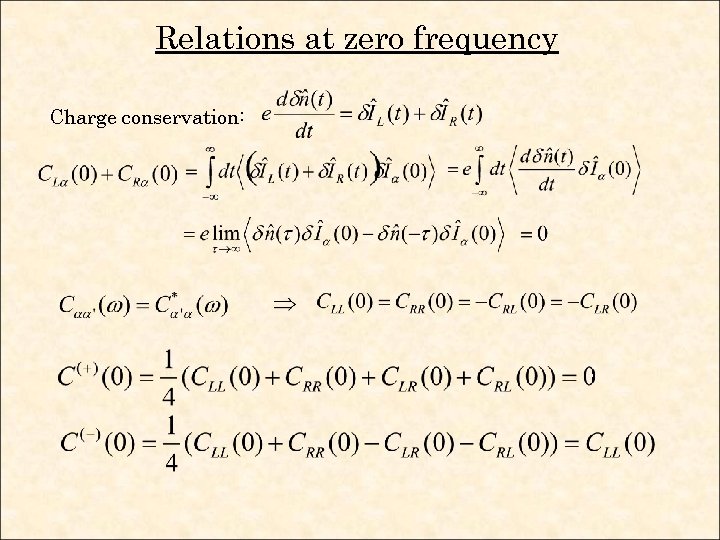 Relations at zero frequency Charge conservation:
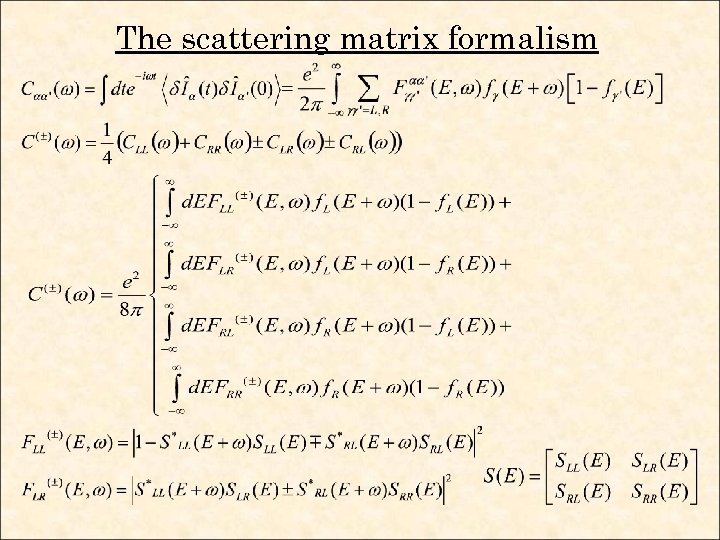
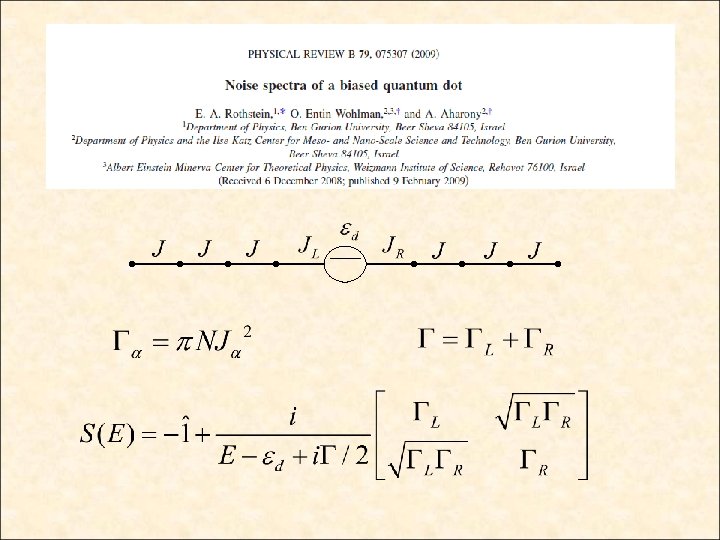
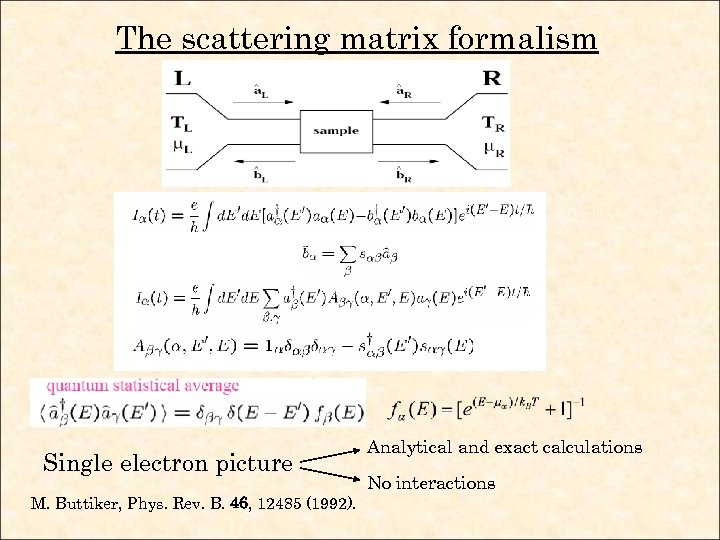 The scattering matrix formalism Single electron picture M. Buttiker, Phys. Rev. B. 46, 12485 (1992). Analytical and exact calculations No interactions
 The scattering matrix formalism
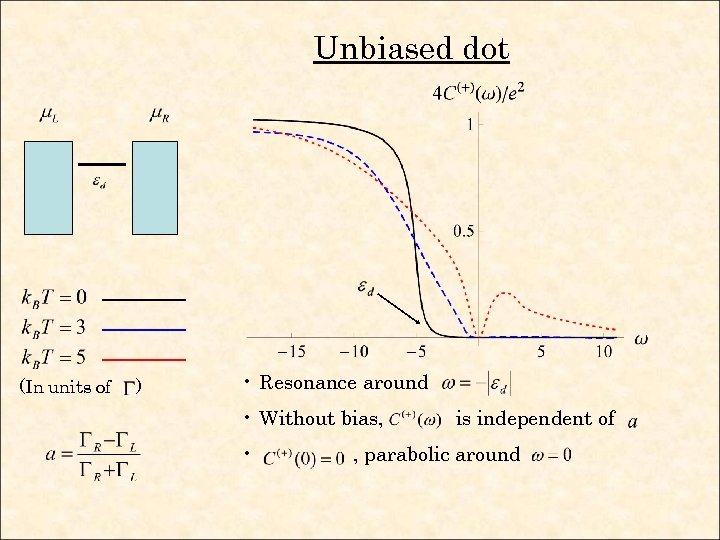 Unbiased dot (In units of ) • Resonance around • Without bias, • is independent of , parabolic around
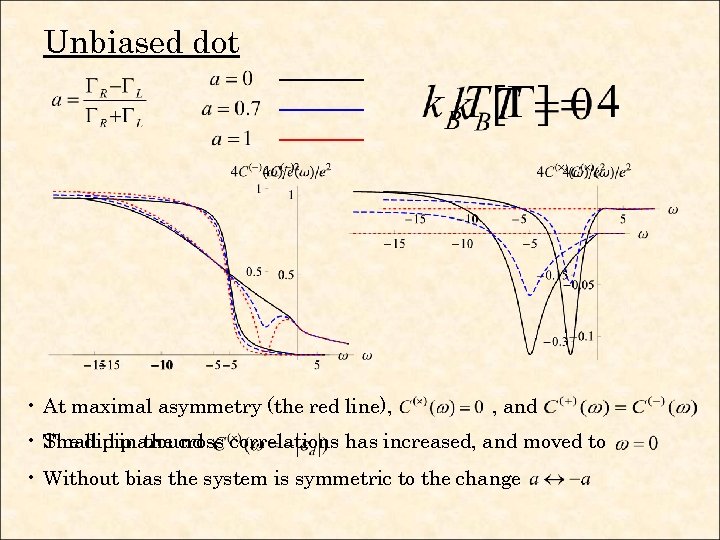 Unbiased dot • At maximal asymmetry (the red line), , and • The dip inaround correlations has increased, and moved to Small dip the cross • Without bias the system is symmetric to the change
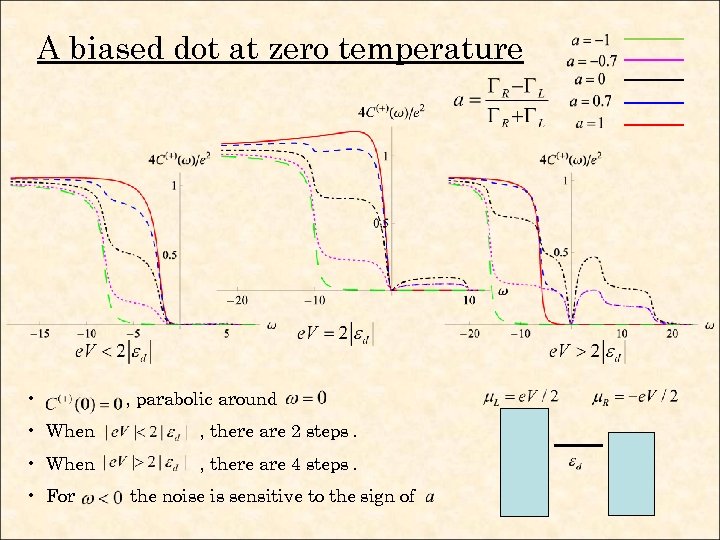 A biased dot at zero temperature • , parabolic around • When , there are 2 steps. • When , there are 4 steps. • For the noise is sensitive to the sign of
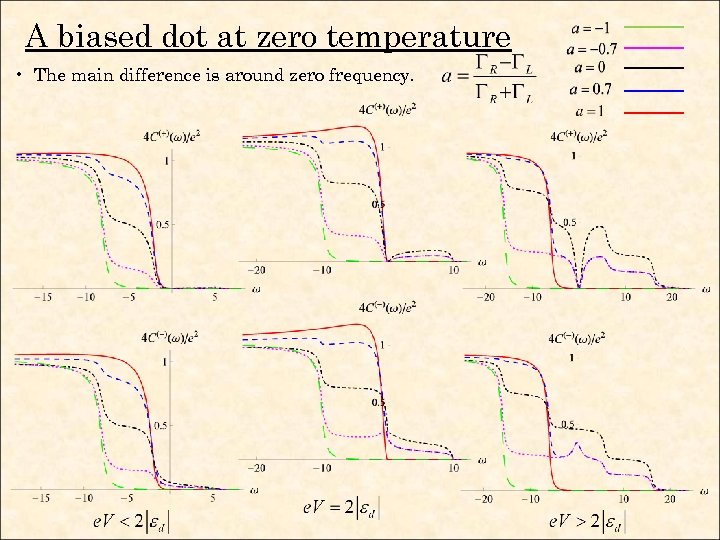 A biased dot at zero temperature • The main difference is around zero frequency.
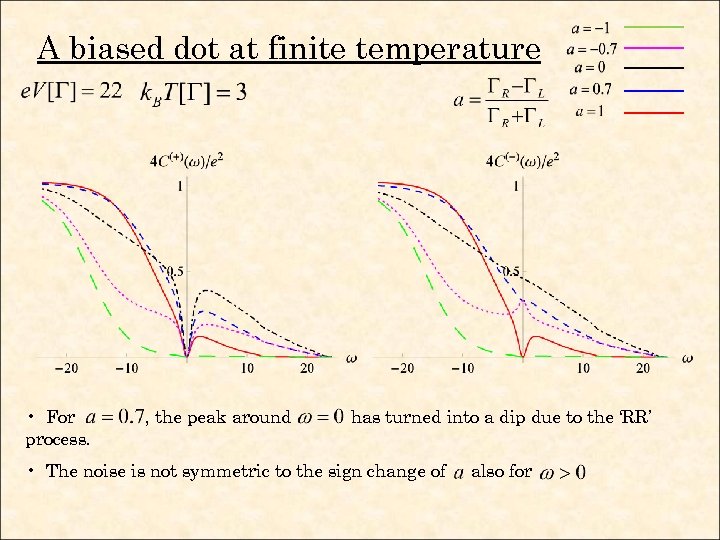 A biased dot at finite temperature • For process. , the peak around has turned into a dip due to the ‘RR’ • The noise is not symmetric to the sign change of also for
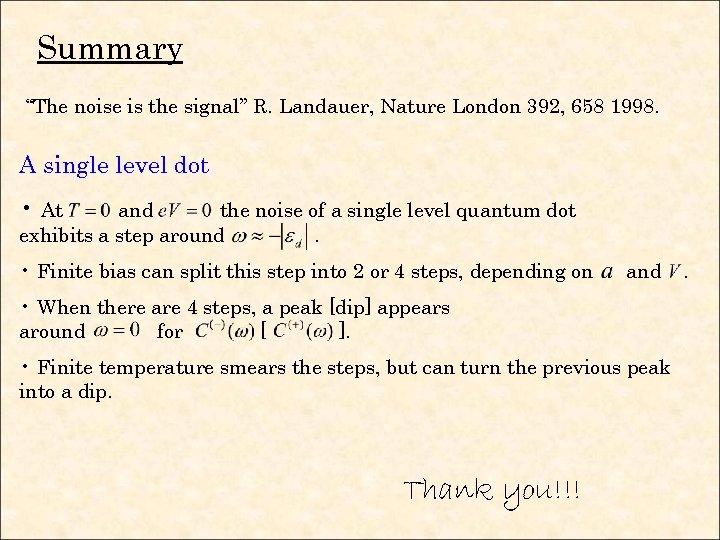 Summary “The noise is the signal” R. Landauer, Nature London 392, 658 1998. A single level dot • At and the noise of a single level quantum dot exhibits a step around. • Finite bias can split this step into 2 or 4 steps, depending on and • When there are 4 steps, a peak [dip] appears around for [ ]. • Finite temperature smears the steps, but can turn the previous peak into a dip. Thank you!!! .