 Скачать презентацию THE NEWS-BASED APPROACH TO EXCHANGE RATES AND THE
1bb036efc5efe2617827241fe664cfed.ppt
- Количество слайдов: 108



THE NEWS-BASED APPROACH TO EXCHANGE RATES AND THE ECONOMETRICS OF SHORT-TERM TRADING Massimo Tivegna University of Teramo, Italy University of Greenwich ECON 1083 Global Macroeconomics - Module 5 1
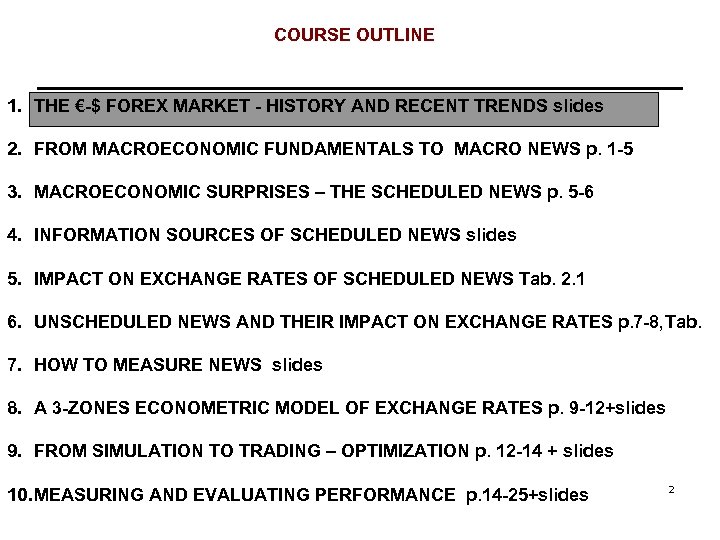
COURSE OUTLINE 1. THE €-$ FOREX MARKET - HISTORY AND RECENT TRENDS slides 2. FROM MACROECONOMIC FUNDAMENTALS TO MACRO NEWS p. 1 -5 3. MACROECONOMIC SURPRISES – THE SCHEDULED NEWS p. 5 -6 4. INFORMATION SOURCES OF SCHEDULED NEWS slides 5. IMPACT ON EXCHANGE RATES OF SCHEDULED NEWS Tab. 2. 1 6. UNSCHEDULED NEWS AND THEIR IMPACT ON EXCHANGE RATES p. 7 -8, Tab. 7. HOW TO MEASURE NEWS slides 8. A 3 -ZONES ECONOMETRIC MODEL OF EXCHANGE RATES p. 9 -12+slides 9. FROM SIMULATION TO TRADING – OPTIMIZATION p. 12 -14 + slides 10. MEASURING AND EVALUATING PERFORMANCE p. 14 -25+slides 2
THE €-$ FOREX MARKET – HISTORY AND RECENT TRENDS A CHECKLIST OF THE FOREX MARKET • • • General Features Instruments exchanged Trading Forecasting Techniques for trading Forex Market Microstructure The role of Central Banks and their operations
THE €-$ FOREX MARKET – HISTORY AND RECENT TRENDS GENERAL FEATURES • • • Open 24 hours a day Quoting currency pairs Number and ranking of currencies Who trades, where, when, why, how Postwar history at glance Instruments exchanged – Spot, Forward, Swaps, Futures, Options
THE €-$ FOREX MARKET – HISTORY AND RECENT TRENDS FROM MEDIUM TERM TO DAY-TRADING • Position Trading with a Multicurrency Portfolio (several days) • Hedging – On Real and Financial Assets – On Payables and Receivables – For Offsetting Payments Flows – For Asset Management • Day-trading as a separate asset class
THE €-$ FOREX MARKET – HISTORY AND RECENT TRENDS • • • Forecasting Techniques for Trading Technical Analysis Snooping “professional” Behaviours and Hints (herding and insider trading) Rumours and news trading Econometric Models from Various Theories and Frequencies The LONG – SHORT terminology
THE €-$ FOREX MARKET – HISTORY AND RECENT TRENDS Microstructure • Order flows • Payment and trading circuits (e. g. EBS, www. ebs. com) • Trading over the Internet(e. g. Oanda, IG Markets, Saxobank, etc. ) • High-frequency information (e. g. Bloomberg, Reuters, Dow Jones, etc. ) • Online consulting services, free and fee (e. g. Forexfactory, Forexpros, RANsquawk, etc. ) • Carry trades
THE €-$ FOREX MARKET – HISTORY AND RECENT TRENDS • • • Role and Operations of Central Banks European Central Bank The Federal Reserve System, Fed Bank of England, The Old Lady Bank of Japan Reserve Bank of Australia
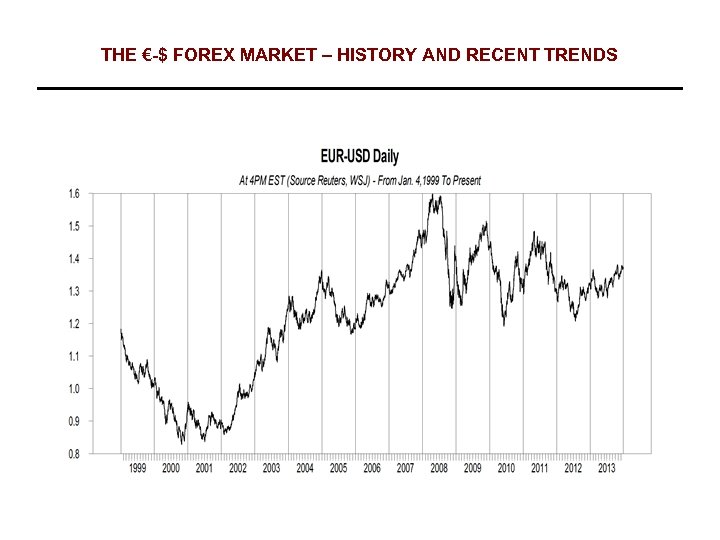
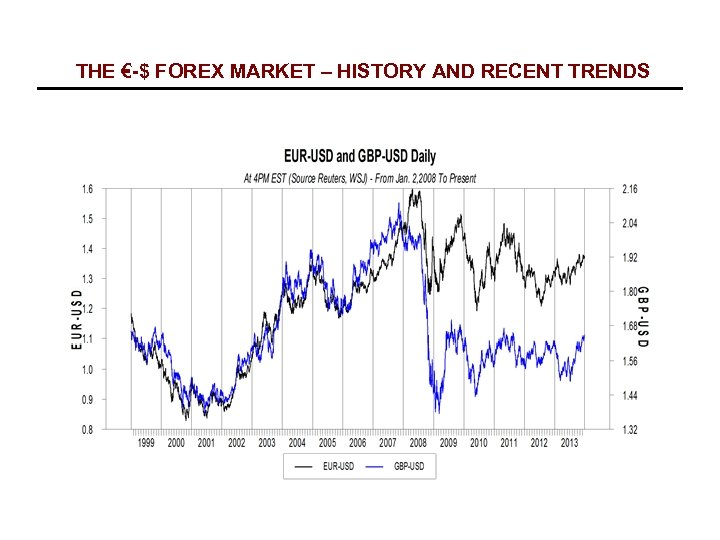
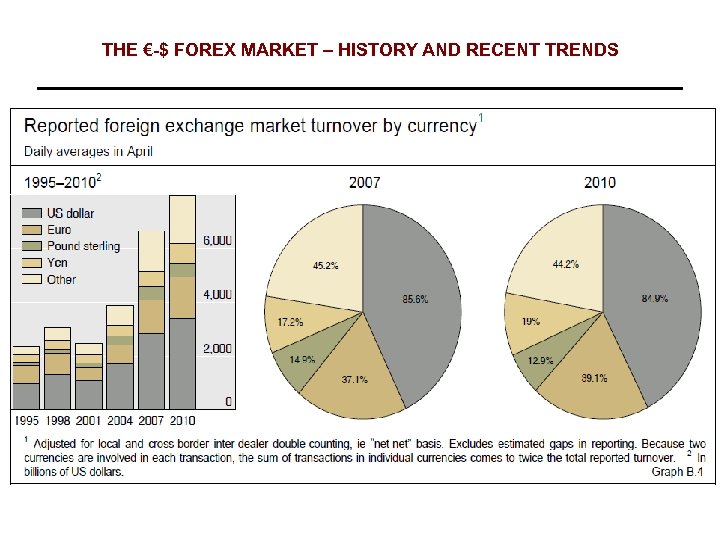
THE €-$ FOREX MARKET – HISTORY AND RECENT TRENDS • Notation: €-$ (EUR-USD) £-$ (STG-USD) • From the “Legacy Currencies” to the Euro: The Role of the DM and the Bundesbank • The Dimension of the Currency Market • The Euro and the British Pound • Cross exchange rates
THE €-$ FOREX MARKET – HISTORY AND RECENT TRENDS
THE €-$ FOREX MARKET – HISTORY AND RECENT TRENDS
THE €-$ FOREX MARKET – HISTORY AND RECENT TRENDS
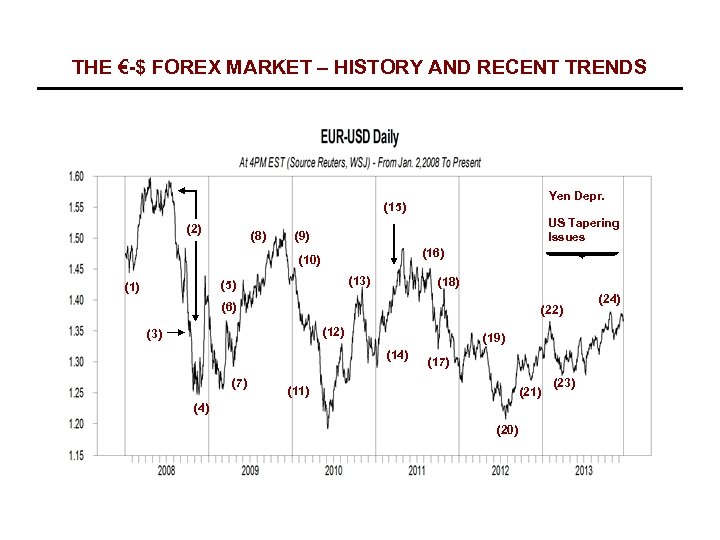
THE €-$ FOREX MARKET – HISTORY AND RECENT TRENDS Yen Depr. (15) (2) (8) US Tapering Issues (9) (16) (10) (13) (5) (18) (6) (22) (12) (3) (19) (14) (7) (11) (21) (4) (20) (23) (24)
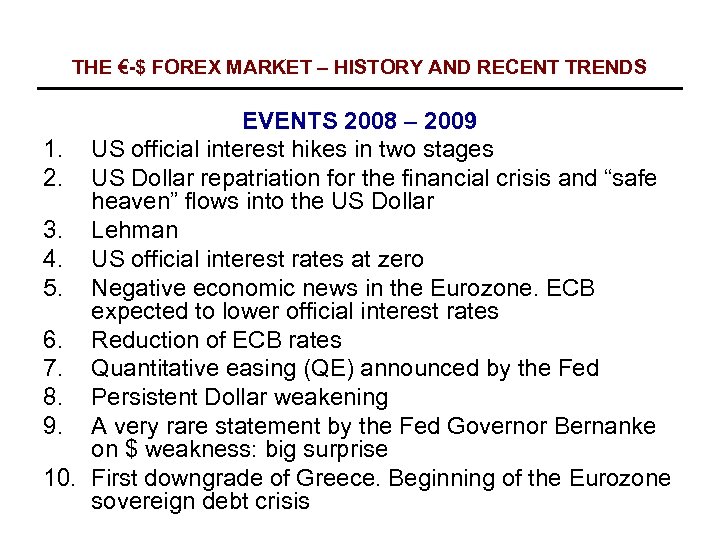
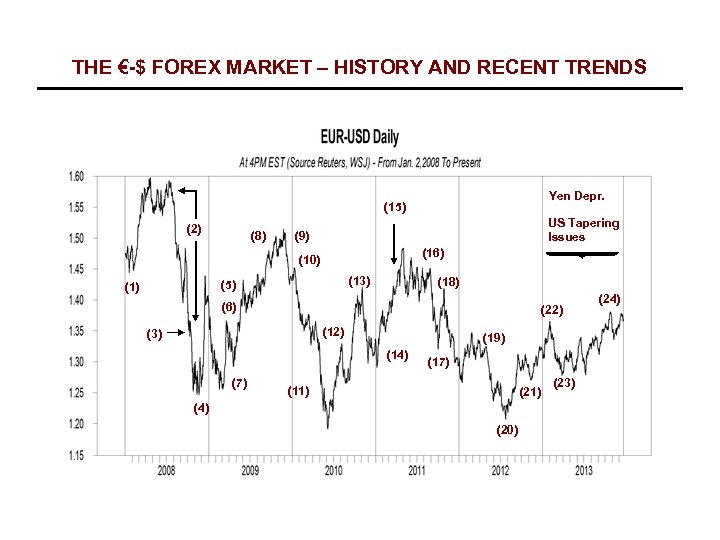
THE €-$ FOREX MARKET – HISTORY AND RECENT TRENDS EVENTS 2008 – 2009 1. US official interest hikes in two stages 2. US Dollar repatriation for the financial crisis and “safe heaven” flows into the US Dollar 3. Lehman 4. US official interest rates at zero 5. Negative economic news in the Eurozone. ECB expected to lower official interest rates 6. Reduction of ECB rates 7. Quantitative easing (QE) announced by the Fed 8. Persistent Dollar weakening 9. A very rare statement by the Fed Governor Bernanke on $ weakness: big surprise 10. First downgrade of Greece. Beginning of the Eurozone sovereign debt crisis
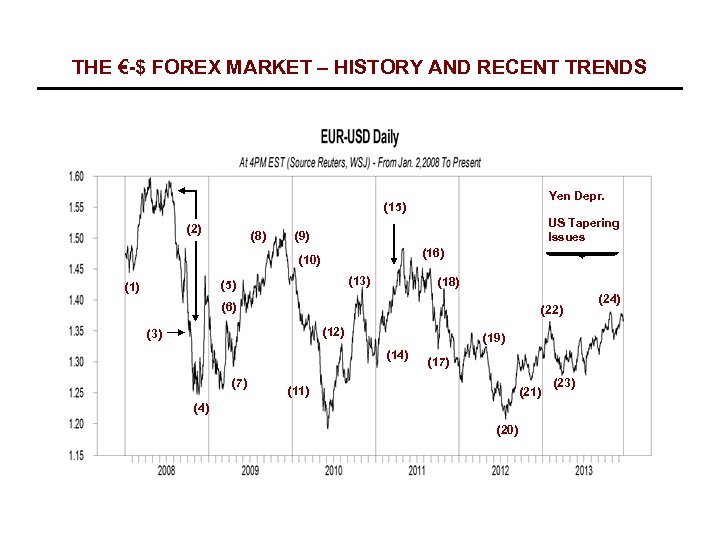
THE €-$ FOREX MARKET – HISTORY AND RECENT TRENDS Yen Depr. (15) (2) (8) US Tapering Issues (9) (16) (10) (13) (5) (18) (6) (22) (12) (3) (19) (14) (7) (11) (21) (4) (20) (23) (24)
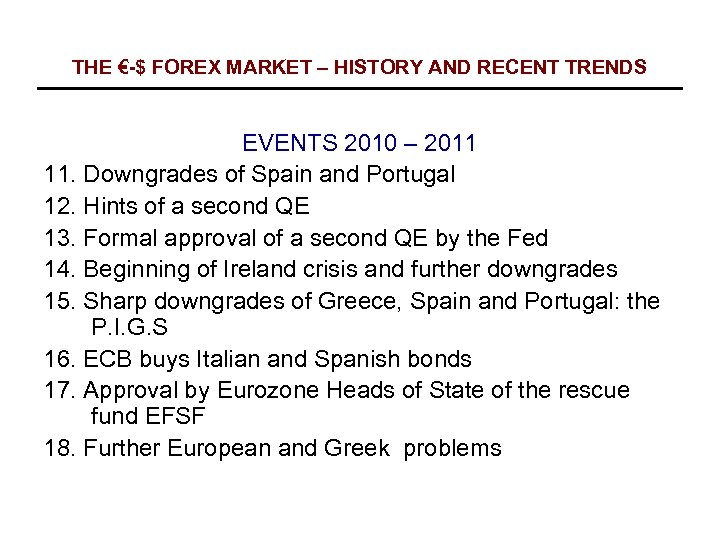
THE €-$ FOREX MARKET – HISTORY AND RECENT TRENDS EVENTS 2010 – 2011 11. Downgrades of Spain and Portugal 12. Hints of a second QE 13. Formal approval of a second QE by the Fed 14. Beginning of Ireland crisis and further downgrades 15. Sharp downgrades of Greece, Spain and Portugal: the P. I. G. S 16. ECB buys Italian and Spanish bonds 17. Approval by Eurozone Heads of State of the rescue fund EFSF 18. Further European and Greek problems
THE €-$ FOREX MARKET – HISTORY AND RECENT TRENDS Yen Depr. (15) (2) (8) US Tapering Issues (9) (16) (10) (13) (5) (18) (6) (22) (12) (3) (19) (14) (7) (11) (21) (4) (20) (23) (24)
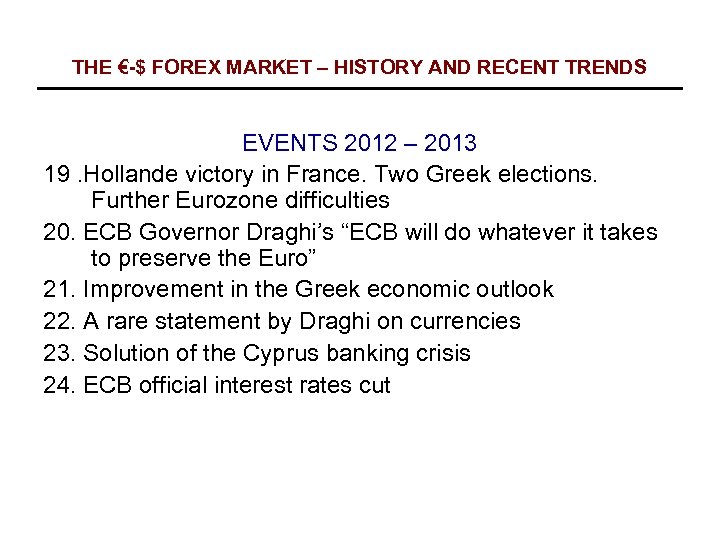
THE €-$ FOREX MARKET – HISTORY AND RECENT TRENDS EVENTS 2012 – 2013 19. Hollande victory in France. Two Greek elections. Further Eurozone difficulties 20. ECB Governor Draghi’s “ECB will do whatever it takes to preserve the Euro” 21. Improvement in the Greek economic outlook 22. A rare statement by Draghi on currencies 23. Solution of the Cyprus banking crisis 24. ECB official interest rates cut
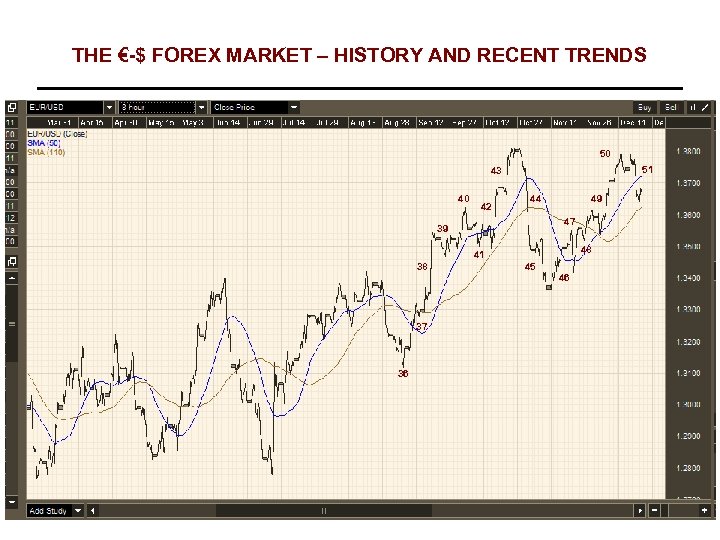
THE €-$ FOREX MARKET – HISTORY AND RECENT TRENDS 50 51 43 40 42 49 44 47 39 48 41 38 45 46 37 36
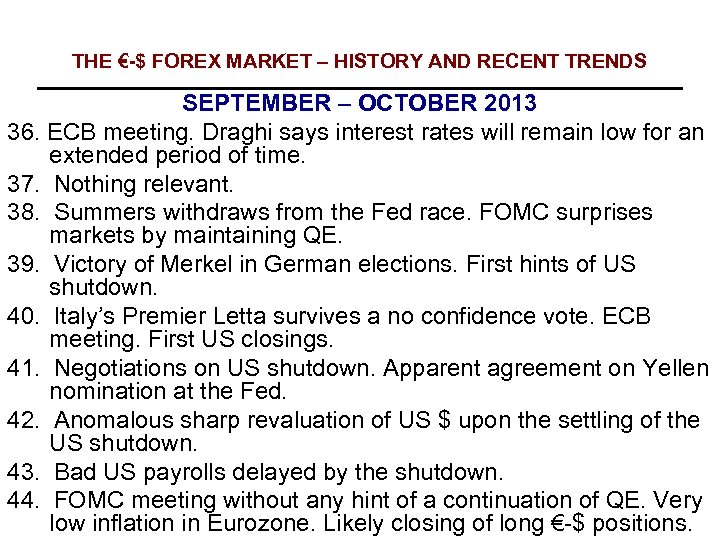
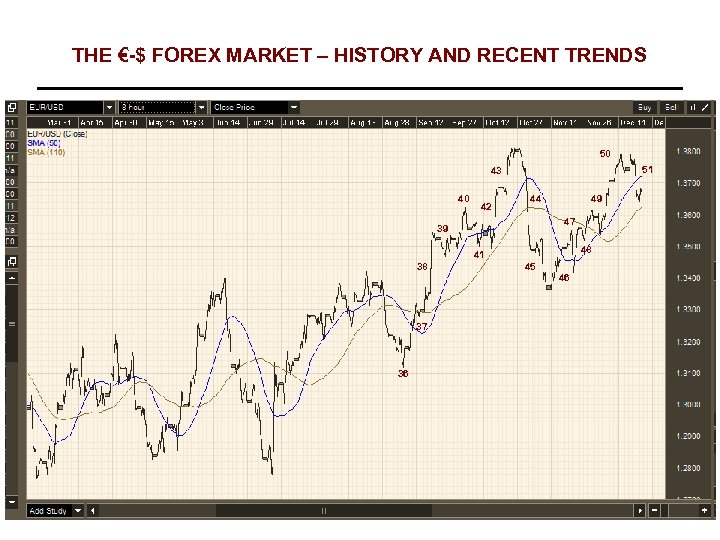
THE €-$ FOREX MARKET – HISTORY AND RECENT TRENDS SEPTEMBER – OCTOBER 2013 36. ECB meeting. Draghi says interest rates will remain low for an extended period of time. 37. Nothing relevant. 38. Summers withdraws from the Fed race. FOMC surprises markets by maintaining QE. 39. Victory of Merkel in German elections. First hints of US shutdown. 40. Italy’s Premier Letta survives a no confidence vote. ECB meeting. First US closings. 41. Negotiations on US shutdown. Apparent agreement on Yellen nomination at the Fed. 42. Anomalous sharp revaluation of US $ upon the settling of the US shutdown. 43. Bad US payrolls delayed by the shutdown. 44. FOMC meeting without any hint of a continuation of QE. Very low inflation in Eurozone. Likely closing of long €-$ positions.
THE €-$ FOREX MARKET – HISTORY AND RECENT TRENDS 50 51 43 40 42 49 44 47 39 48 41 38 45 46 37 36
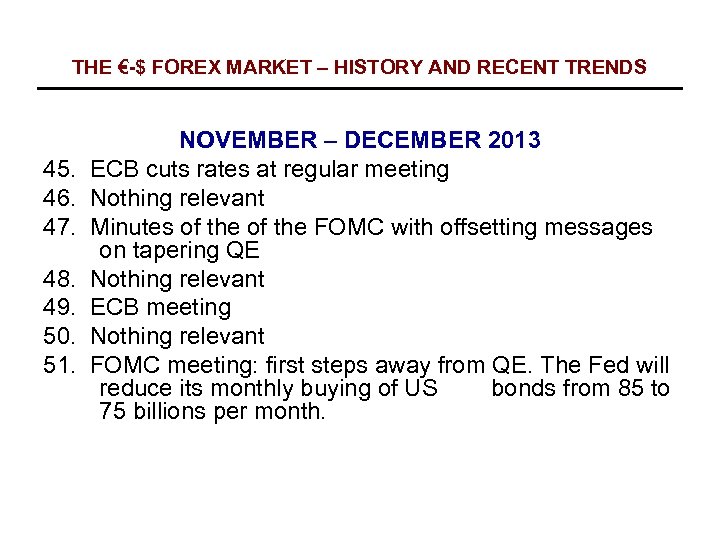
THE €-$ FOREX MARKET – HISTORY AND RECENT TRENDS 45. 46. 47. 48. 49. 50. 51. NOVEMBER – DECEMBER 2013 ECB cuts rates at regular meeting Nothing relevant Minutes of the FOMC with offsetting messages on tapering QE Nothing relevant ECB meeting Nothing relevant FOMC meeting: first steps away from QE. The Fed will reduce its monthly buying of US bonds from 85 to 75 billions per month.
COURSE OUTLINE 1. THE €-$ FOREX MARKET - HISTORY AND RECENT TRENDS 2. FROM MACROECONOMIC FUNDAMENTALS TO MACRO NEWS 3. MACROECONOMIC SURPRISES – THE SCHEDULED NEWS 4. INFORMATION SOURCES OF SCHEDULED NEWS 5. IMPACT ON EXCHANGE RATES OF SCHEDULED NEWS 6. UNSCHEDULED NEWS AND THEIR IMPACT ON EXCHANGE RATES 7. HOW TO MEASURE NEWS IMPACT ON EXCHANGE RATES 8. A 3 -ZONES ECONOMETRIC MODEL OF EXCHANGE RATES 9. FROM SIMULATION TO TRADING - OPTIMIZATION 10. MEASURING AND EVALUATING PERFORMANCE 23
FROM MACROECONOMIC FUNDAMENTALS TO MACROECON. NEWS
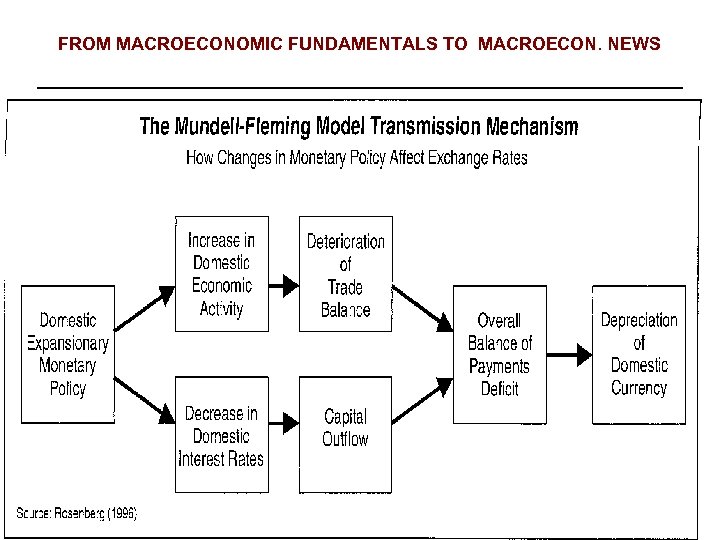
FROM MACROECONOMIC FUNDAMENTALS TO MACROECON. NEWS
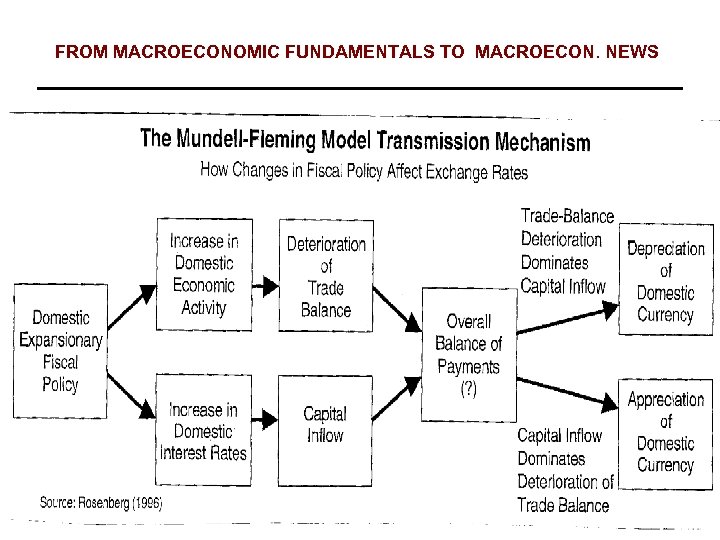
FROM MACROECONOMIC FUNDAMENTALS TO MACROECON. NEWS
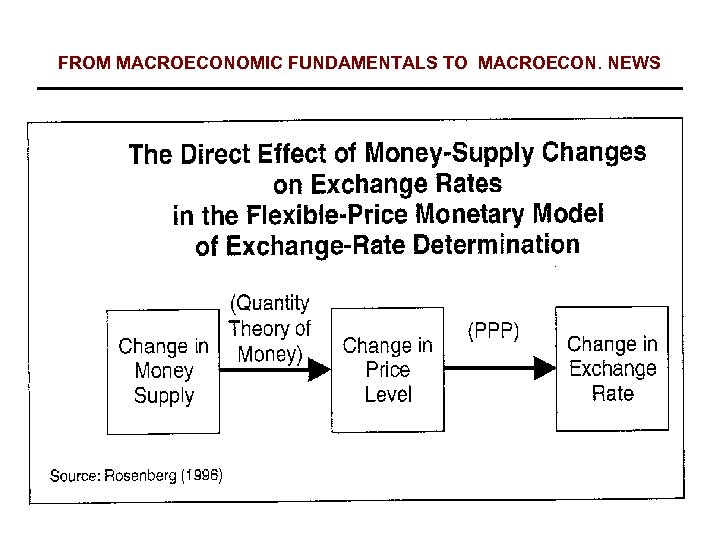
FROM MACROECONOMIC FUNDAMENTALS TO MACROECON. NEWS
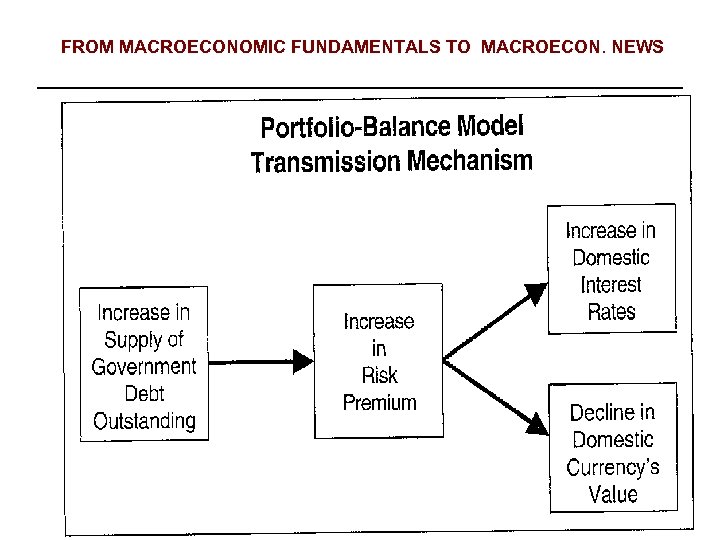
FROM MACROECONOMIC FUNDAMENTALS TO MACROECON. NEWS
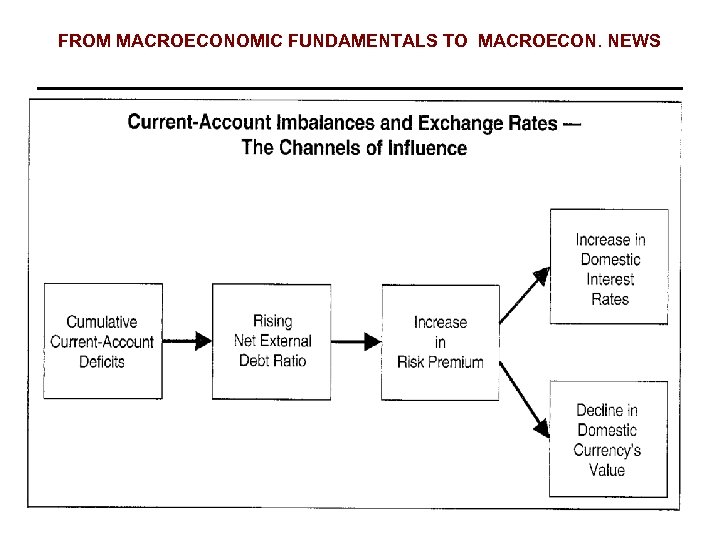
FROM MACROECONOMIC FUNDAMENTALS TO MACROECON. NEWS
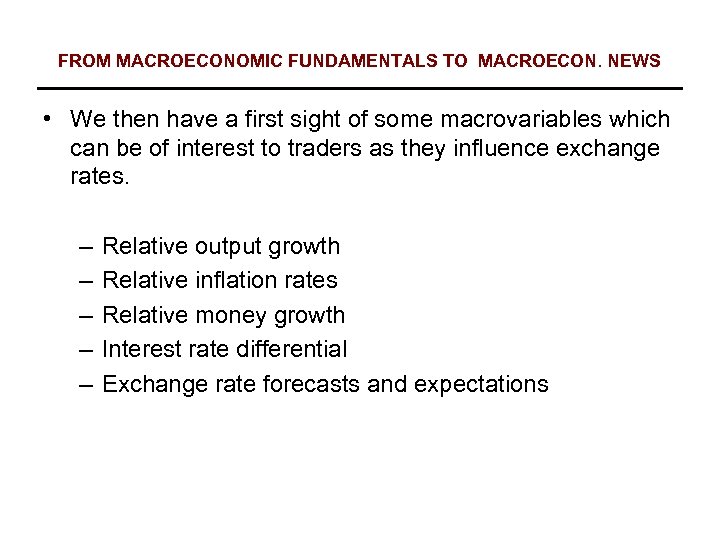
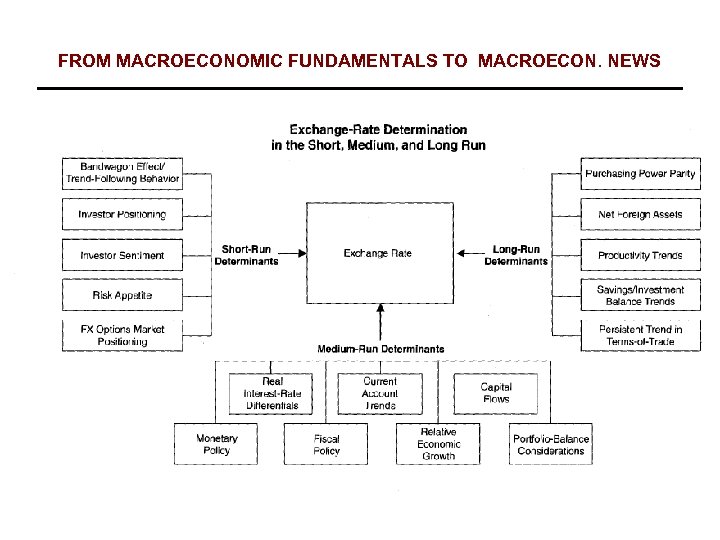
FROM MACROECONOMIC FUNDAMENTALS TO MACROECON. NEWS • We then have a first sight of some macrovariables which can be of interest to traders as they influence exchange rates. – – – Relative output growth Relative inflation rates Relative money growth Interest rate differential Exchange rate forecasts and expectations
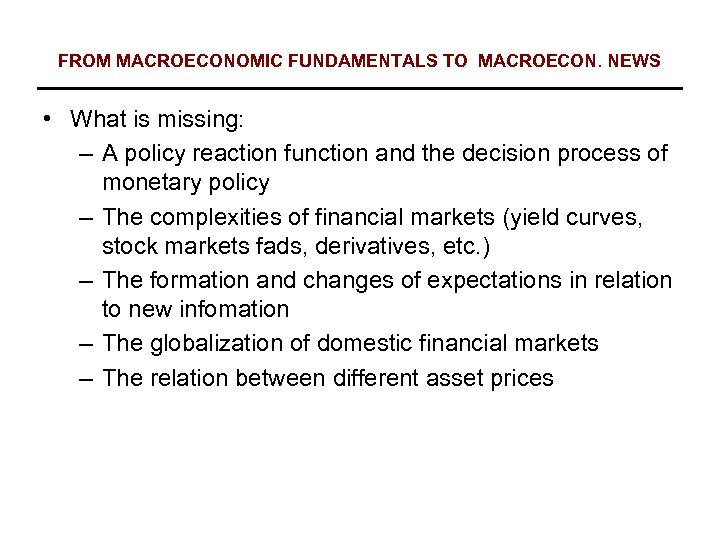
FROM MACROECONOMIC FUNDAMENTALS TO MACROECON. NEWS • What is missing: – A policy reaction function and the decision process of monetary policy – The complexities of financial markets (yield curves, stock markets fads, derivatives, etc. ) – The formation and changes of expectations in relation to new infomation – The globalization of domestic financial markets – The relation between different asset prices
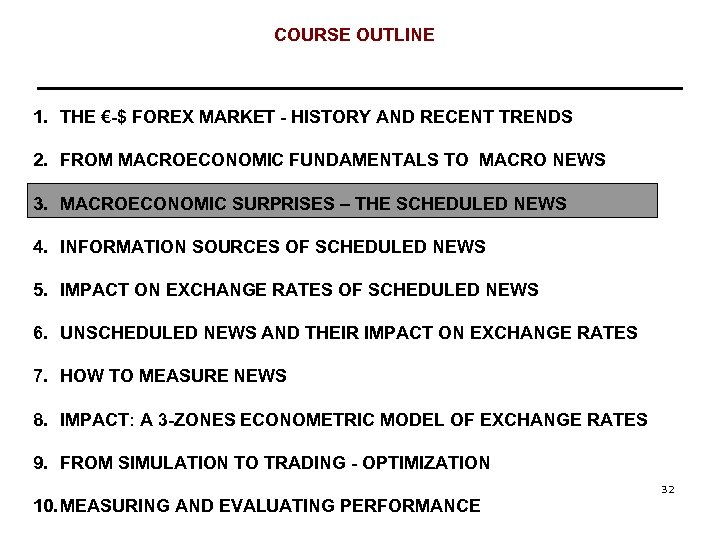
COURSE OUTLINE 1. THE €-$ FOREX MARKET - HISTORY AND RECENT TRENDS 2. FROM MACROECONOMIC FUNDAMENTALS TO MACRO NEWS 3. MACROECONOMIC SURPRISES – THE SCHEDULED NEWS 4. INFORMATION SOURCES OF SCHEDULED NEWS 5. IMPACT ON EXCHANGE RATES OF SCHEDULED NEWS 6. UNSCHEDULED NEWS AND THEIR IMPACT ON EXCHANGE RATES 7. HOW TO MEASURE NEWS 8. IMPACT: A 3 -ZONES ECONOMETRIC MODEL OF EXCHANGE RATES 9. FROM SIMULATION TO TRADING - OPTIMIZATION 10. MEASURING AND EVALUATING PERFORMANCE 32
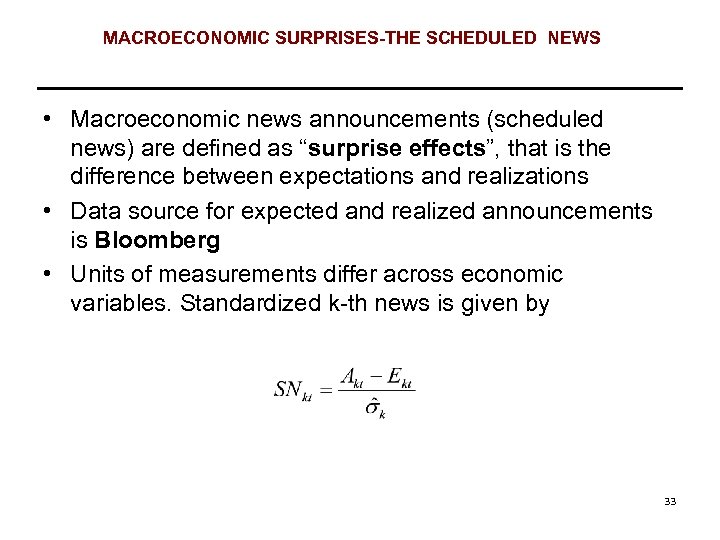
MACROECONOMIC SURPRISES-THE SCHEDULED NEWS • Macroeconomic news announcements (scheduled news) are defined as “surprise effects”, that is the difference between expectations and realizations • Data source for expected and realized announcements is Bloomberg • Units of measurements differ across economic variables. Standardized k-th news is given by 33
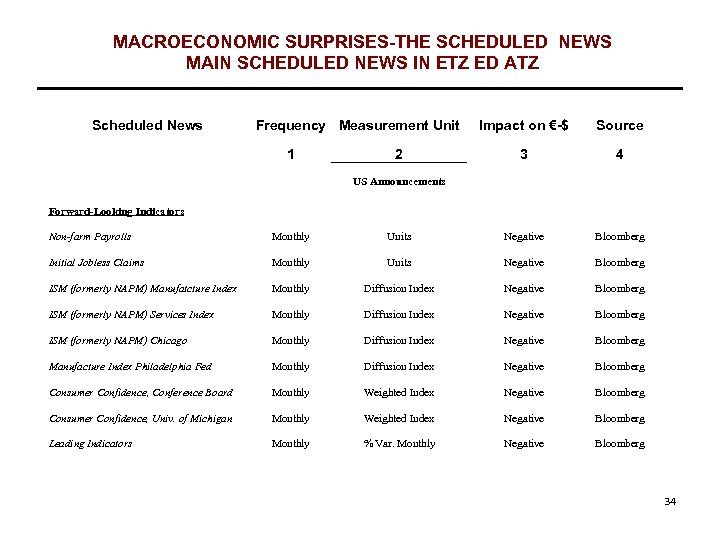
MACROECONOMIC SURPRISES-THE SCHEDULED NEWS MAIN SCHEDULED NEWS IN ETZ ED ATZ Scheduled News Frequency Measurement Unit 1 2 Impact on €-$ Source 3 4 US Announcements Forward-Looking Indicators Non-farm Payrolls Monthly Units Negative Bloomberg Initial Jobless Claims Monthly Units Negative Bloomberg ISM (formerly NAPM) Manufatcture Index Monthly Diffusion Index Negative Bloomberg ISM (formerly NAPM) Services Index Monthly Diffusion Index Negative Bloomberg ISM (formerly NAPM) Chicago Monthly Diffusion Index Negative Bloomberg Manufacture Index Philadelphia Fed Monthly Diffusion Index Negative Bloomberg Consumer Confidence, Conference Board Monthly Weighted Index Negative Bloomberg Consumer Confidence, Univ. of Michigan Monthly Weighted Index Negative Bloomberg Leading Indicators Monthly % Var. Monthly Negative Bloomberg 34
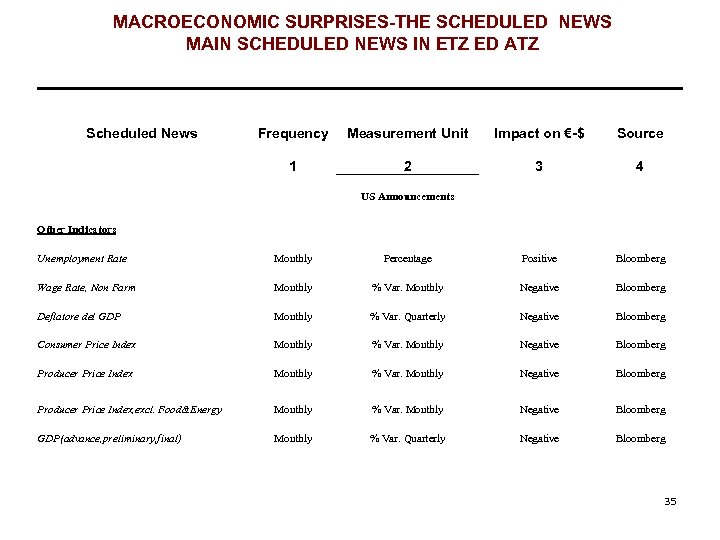
MACROECONOMIC SURPRISES-THE SCHEDULED NEWS MAIN SCHEDULED NEWS IN ETZ ED ATZ Scheduled News Frequency Measurement Unit Impact on €-$ Source 1 2 3 4 US Announcements Other Indicators Unemployment Rate Monthly Percentage Positive Bloomberg Wage Rate, Non Farm Monthly % Var. Monthly Negative Bloomberg Deflatore del GDP Monthly % Var. Quarterly Negative Bloomberg Consumer Price Index Monthly % Var. Monthly Negative Bloomberg Producer Price Index, excl. Food&Energy Monthly % Var. Monthly Negative Bloomberg GDP(advance, preliminary, final) Monthly % Var. Quarterly Negative Bloomberg 35
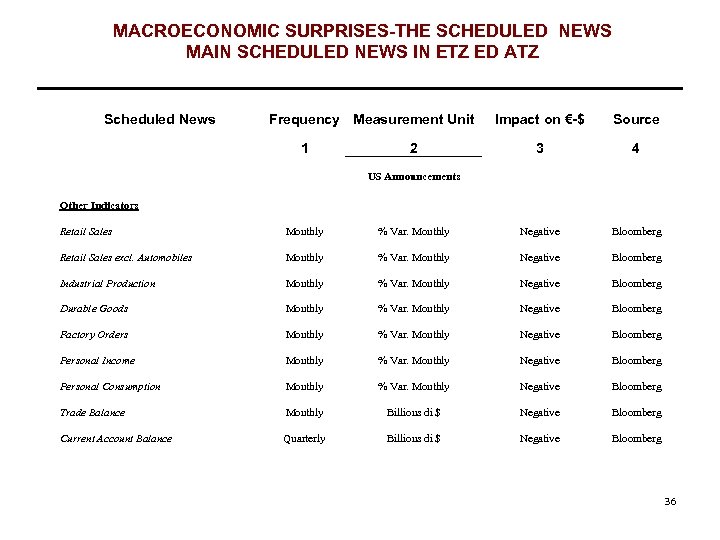
MACROECONOMIC SURPRISES-THE SCHEDULED NEWS MAIN SCHEDULED NEWS IN ETZ ED ATZ Scheduled News Frequency Measurement Unit 1 2 Impact on €-$ Source 3 4 US Announcements Other Indicators Retail Sales Monthly % Var. Monthly Negative Bloomberg Retail Sales excl. Automobiles Monthly % Var. Monthly Negative Bloomberg Industrial Production Monthly % Var. Monthly Negative Bloomberg Durable Goods Monthly % Var. Monthly Negative Bloomberg Factory Orders Monthly % Var. Monthly Negative Bloomberg Personal Income Monthly % Var. Monthly Negative Bloomberg Personal Consumption Monthly % Var. Monthly Negative Bloomberg Trade Balance Monthly Billions di $ Negative Bloomberg Current Account Balance Quarterly Billions di $ Negative Bloomberg 36
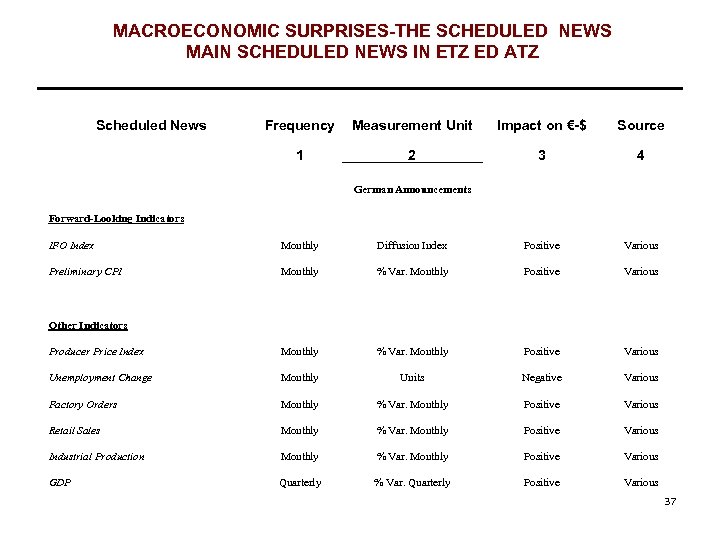
MACROECONOMIC SURPRISES-THE SCHEDULED NEWS MAIN SCHEDULED NEWS IN ETZ ED ATZ Scheduled News Frequency Measurement Unit Impact on €-$ Source 1 2 3 4 German Announcements Forward-Looking Indicators IFO Index Monthly Diffusion Index Positive Various Preliminary CPI Monthly % Var. Monthly Positive Various Producer Price Index Monthly % Var. Monthly Positive Various Unemployment Change Monthly Units Negative Various Factory Orders Monthly % Var. Monthly Positive Various Retail Sales Monthly % Var. Monthly Positive Various Industrial Production Monthly % Var. Monthly Positive Various GDP Quarterly % Var. Quarterly Positive Various Other Indicators 37
COURSE OUTLINE 1. THE €-$ FOREX MARKET - HISTORY AND RECENT TRENDS 2. FROM MACROECONOMIC FUNDAMENTALS TO MACRO NEWS 3. MACROECONOMIC SURPRISES – THE SCHEDULED NEWS 4. INFORMATION SOURCES OF SCHEDULED NEWS 5. IMPACT ON EXCHANGE RATES OF SCHEDULED NEWS 6. UNSCHEDULED NEWS AND THEIR IMPACT ON EXCHANGE RATES 7. HOW TO MEASURE NEWS 8. IMPACT: A 3 -ZONES ECONOMETRIC MODEL OF EXCHANGE RATES 9. FROM SIMULATION TO TRADING - OPTIMIZATION 10. MEASURING AND EVALUATING PERFORMANCE 38
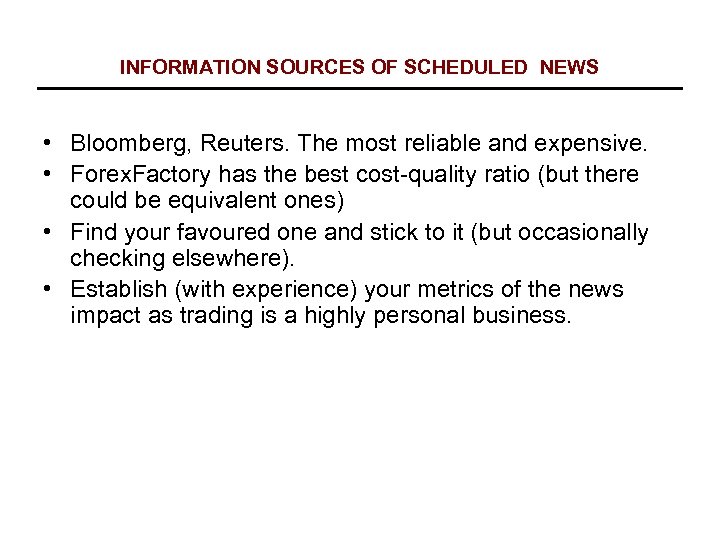
INFORMATION SOURCES OF SCHEDULED NEWS • Bloomberg, Reuters. The most reliable and expensive. • Forex. Factory has the best cost-quality ratio (but there could be equivalent ones) • Find your favoured one and stick to it (but occasionally checking elsewhere). • Establish (with experience) your metrics of the news impact as trading is a highly personal business.
COURSE OUTLINE 1. THE €-$ FOREX MARKET - HISTORY AND RECENT TRENDS 2. FROM MACROECONOMIC FUNDAMENTALS TO MACRO NEWS 3. MACROECONOMIC SURPRISES – THE SCHEDULED NEWS 4. INFORMATION SOURCES OF SCHEDULED NEWS 5. IMPACT ON EXCHANGE RATES OF SCHEDULED NEWS 6. UNSCHEDULED NEWS AND THEIR IMPACT ON EXCHANGE RATES 7. HOW TO MEASURE NEWS 8. IMPACT: A 3 -ZONES ECONOMETRIC MODEL OF EXCHANGE RATES 9. FROM SIMULATION TO TRADING - OPTIMIZATION 10. MEASURING AND EVALUATING PERFORMANCE 40
IMPACT ON EXCHANGE RATES OF SCHEDULED NEWS THE NON-FARM PAYROLLS AND THE UNEMPLOYMENT RATE IN THE US LABOUR MARKET • The US Non-farm Payrolls has by far the highest impact on world financial markets. • It is the number of jobs added to the US economy outside the agricultural sector, in a highly flexible labour market. • The impact is higher than that of Unemployment Rate and the two numbers come from different surveys.
IMPACT ON EXCHANGE RATES OF SCHEDULED NEWS REACTIONS TO THE US NON-FARM PAYROLLS • In the following two slides we have the €-$ reactions in the last two months: • The first chart indicates a reaction to a 160. 000 Expected and a 236. 000 Actual with unemployment rate going down. • The second chart indicates a reaction to a 165. 000 Expected and a 157. 000 actual, with unemployment rate going up.
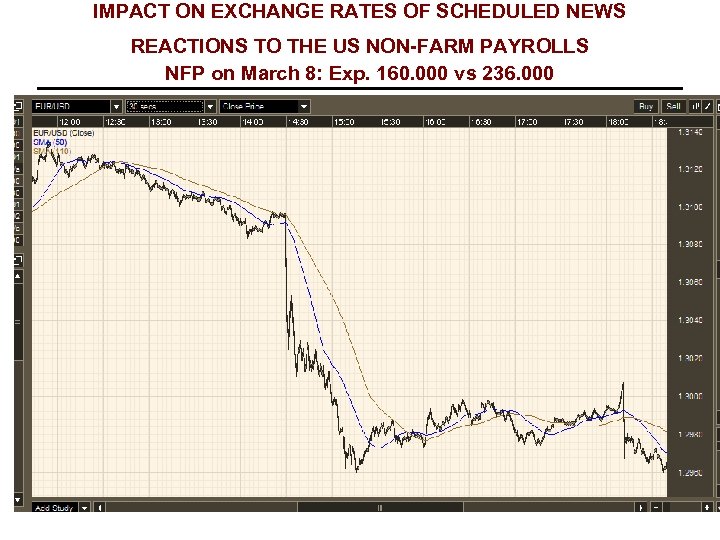
IMPACT ON EXCHANGE RATES OF SCHEDULED NEWS REACTIONS TO THE US NON-FARM PAYROLLS NFP on March 8: Exp. 160. 000 vs 236. 000
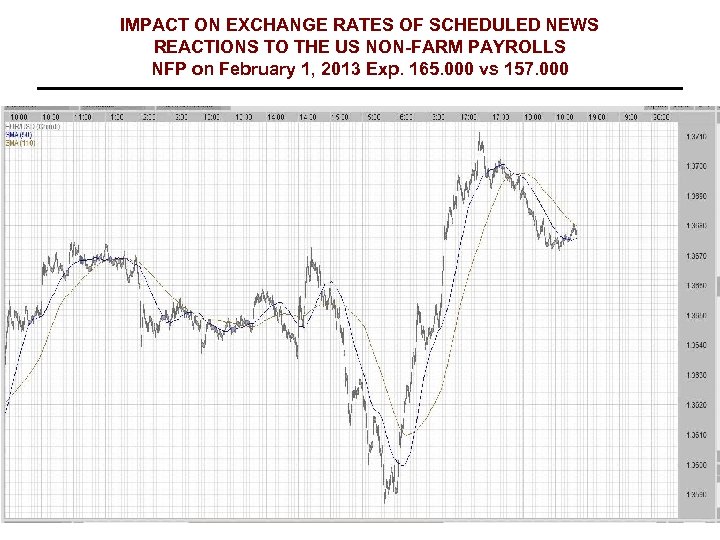
IMPACT ON EXCHANGE RATES OF SCHEDULED NEWS REACTIONS TO THE US NON-FARM PAYROLLS NFP on February 1, 2013 Exp. 165. 000 vs 157. 000
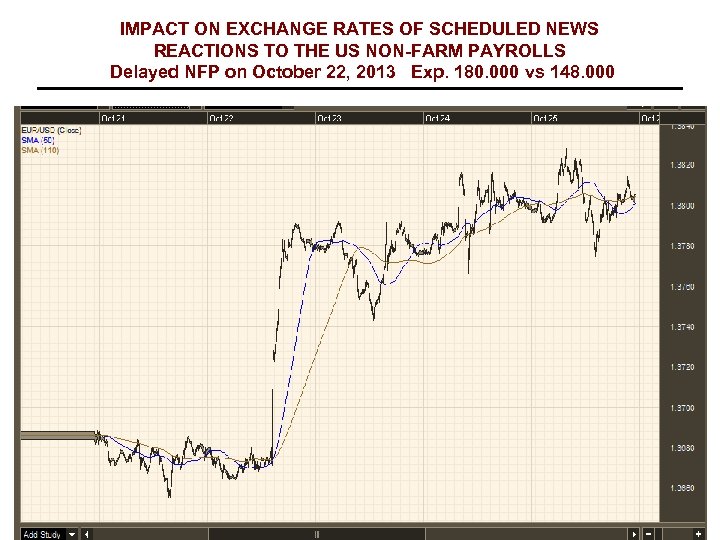
IMPACT ON EXCHANGE RATES OF SCHEDULED NEWS REACTIONS TO THE US NON-FARM PAYROLLS Delayed NFP on October 22, 2013 Exp. 180. 000 vs 148. 000
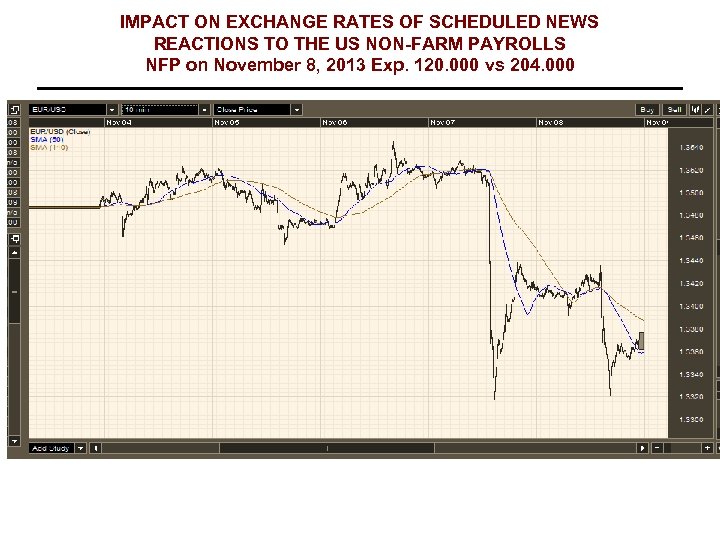
IMPACT ON EXCHANGE RATES OF SCHEDULED NEWS REACTIONS TO THE US NON-FARM PAYROLLS NFP on November 8, 2013 Exp. 120. 000 vs 204. 000
COURSE OUTLINE 1. THE €-$ FOREX MARKET - HISTORY AND RECENT TRENDS 2. FROM MACROECONOMIC FUNDAMENTALS TO MACRO NEWS 3. MACROECONOMIC SURPRISES – THE SCHEDULED NEWS 4. INFORMATION SOURCES OF SCHEDULED NEWS 5. IMPACT ON EXCHANGE RATES OF SCHEDULED NEWS 6. UNSCHEDULED NEWS AND THEIR IMPACT ON EXCHANGE RATES 7. HOW TO MEASURE NEWS 8. A 3 -ZONES ECONOMETRIC MODEL OF EXCHANGE RATES 9. FROM SIMULATION TO TRADING - OPTIMIZATION 10. MEASURING AND EVALUATING PERFORMANCE 47
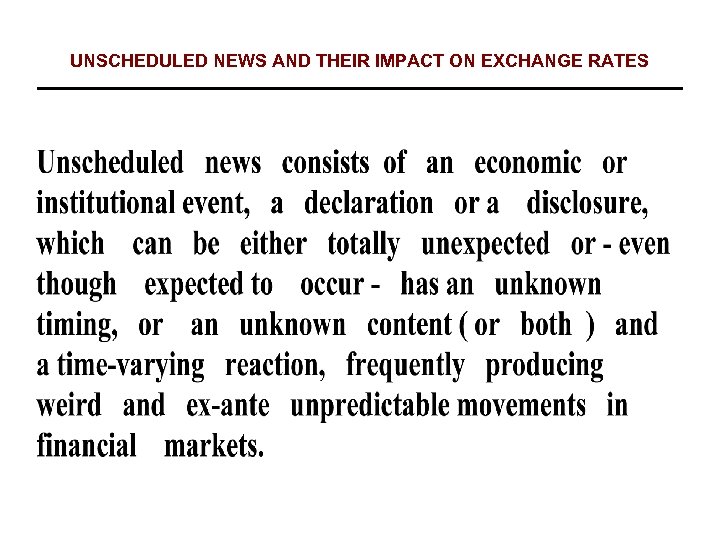
UNSCHEDULED NEWS AND THEIR IMPACT ON EXCHANGE RATES
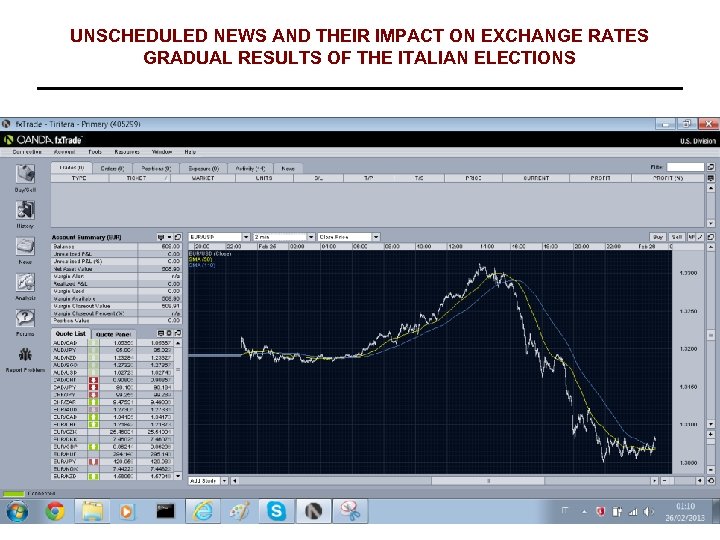
UNSCHEDULED NEWS AND THEIR IMPACT ON EXCHANGE RATES GRADUAL RESULTS OF THE ITALIAN ELECTIONS
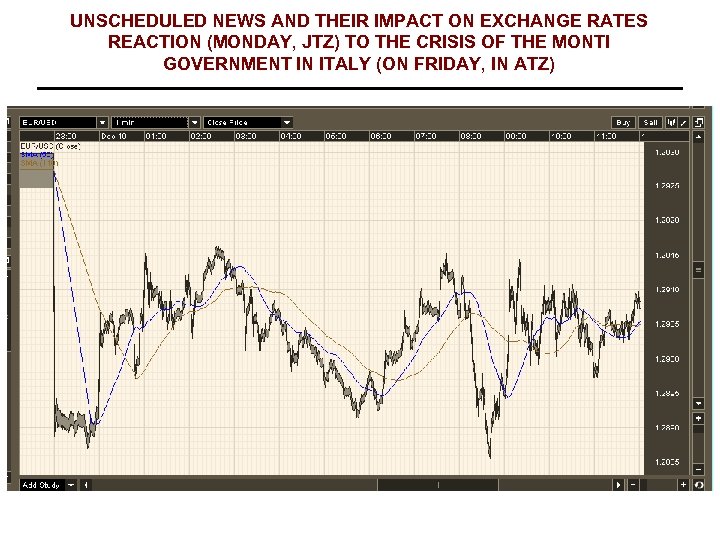
UNSCHEDULED NEWS AND THEIR IMPACT ON EXCHANGE RATES REACTION (MONDAY, JTZ) TO THE CRISIS OF THE MONTI GOVERNMENT IN ITALY (ON FRIDAY, IN ATZ)
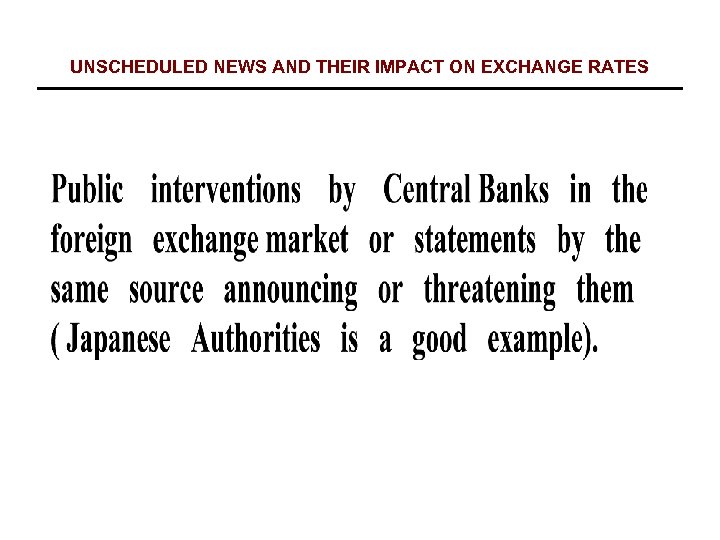
UNSCHEDULED NEWS AND THEIR IMPACT ON EXCHANGE RATES
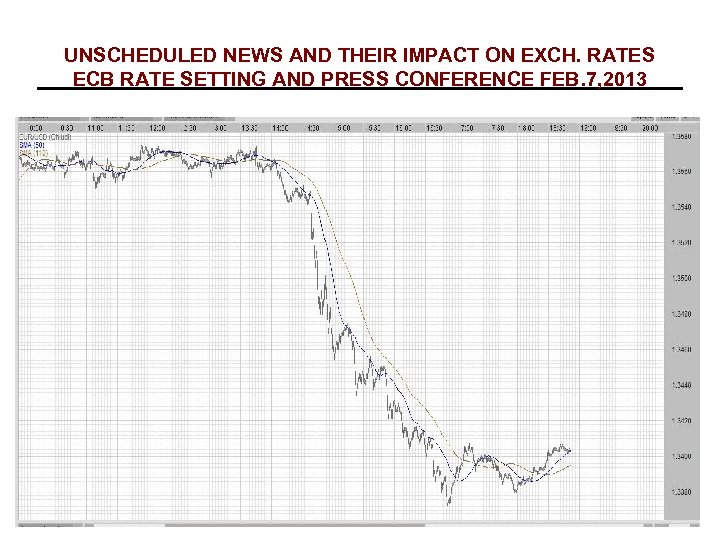
UNSCHEDULED NEWS AND THEIR IMPACT ON EXCH. RATES ECB RATE SETTING AND PRESS CONFERENCE FEB. 7, 2013
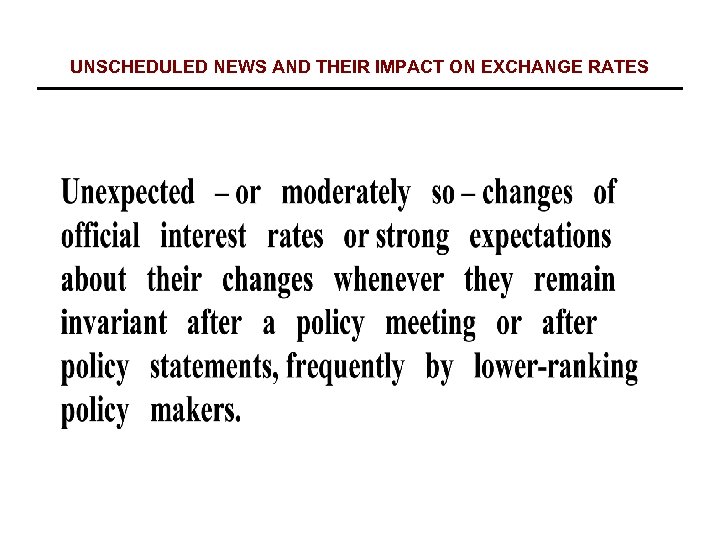
UNSCHEDULED NEWS AND THEIR IMPACT ON EXCHANGE RATES
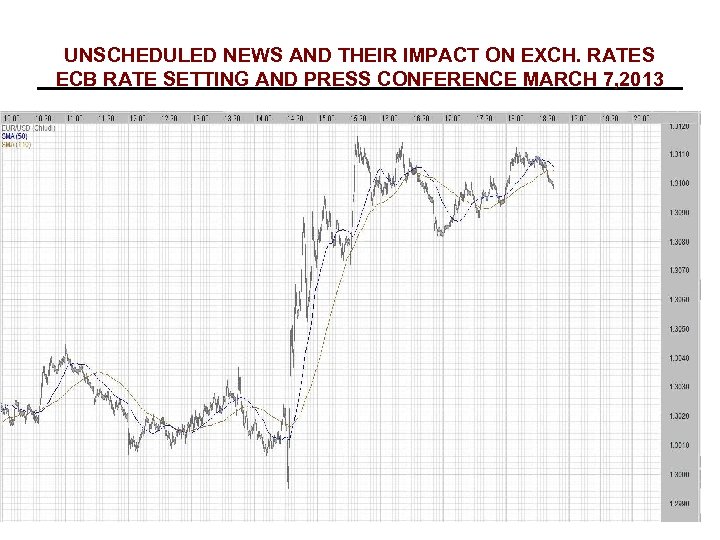
UNSCHEDULED NEWS AND THEIR IMPACT ON EXCH. RATES ECB RATE SETTING AND PRESS CONFERENCE MARCH 7, 2013
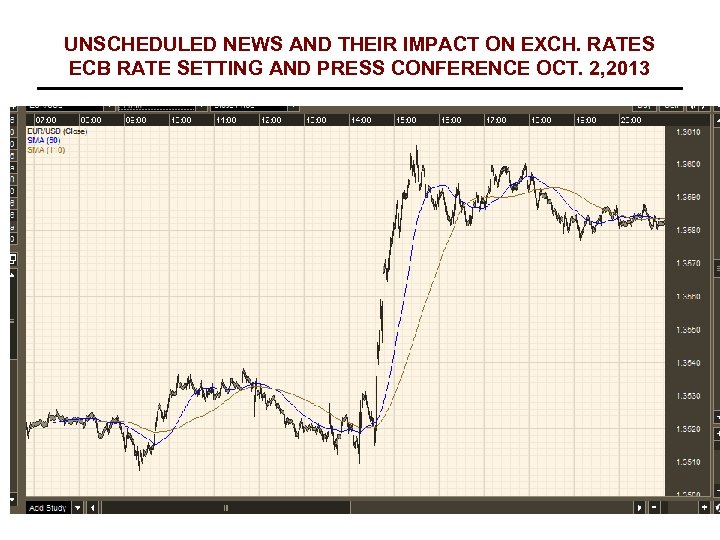
UNSCHEDULED NEWS AND THEIR IMPACT ON EXCH. RATES ECB RATE SETTING AND PRESS CONFERENCE OCT. 2, 2013
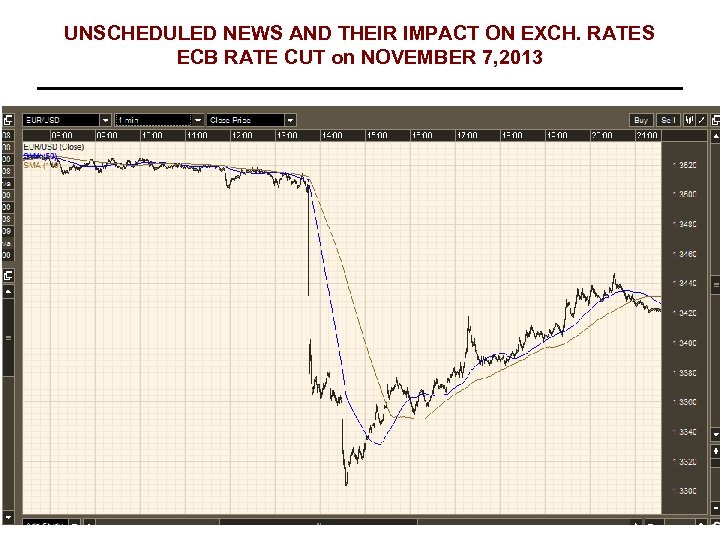
UNSCHEDULED NEWS AND THEIR IMPACT ON EXCH. RATES ECB RATE CUT on NOVEMBER 7, 2013
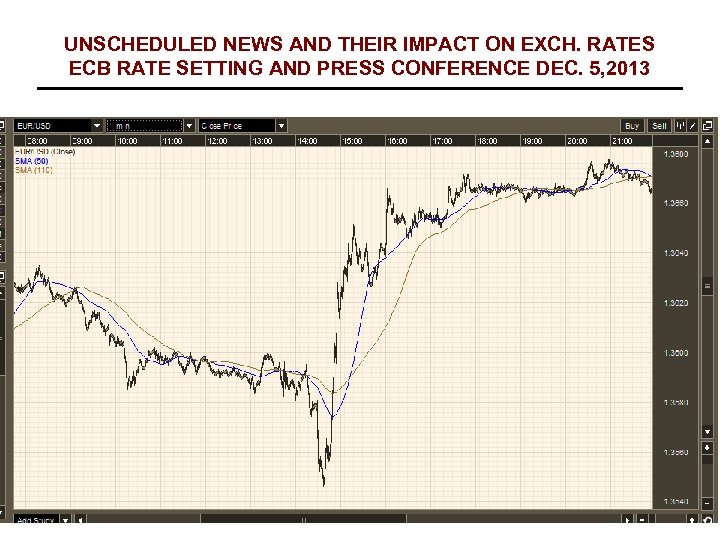
UNSCHEDULED NEWS AND THEIR IMPACT ON EXCH. RATES ECB RATE SETTING AND PRESS CONFERENCE DEC. 5, 2013
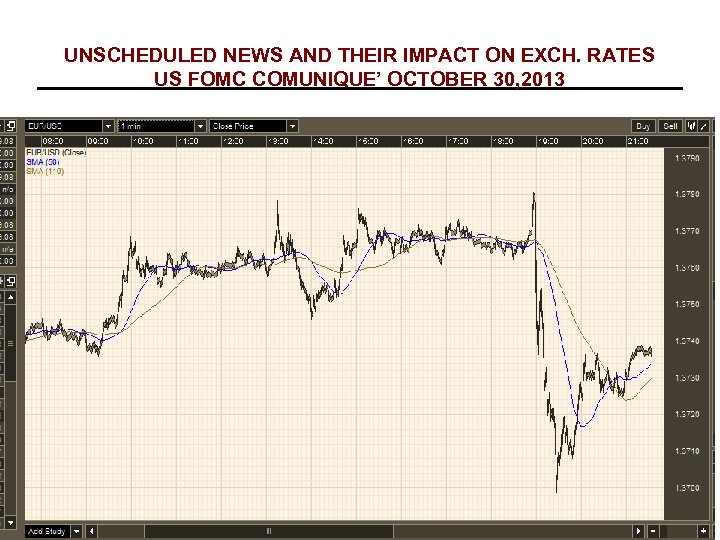
UNSCHEDULED NEWS AND THEIR IMPACT ON EXCH. RATES US FOMC COMUNIQUE’ OCTOBER 30, 2013
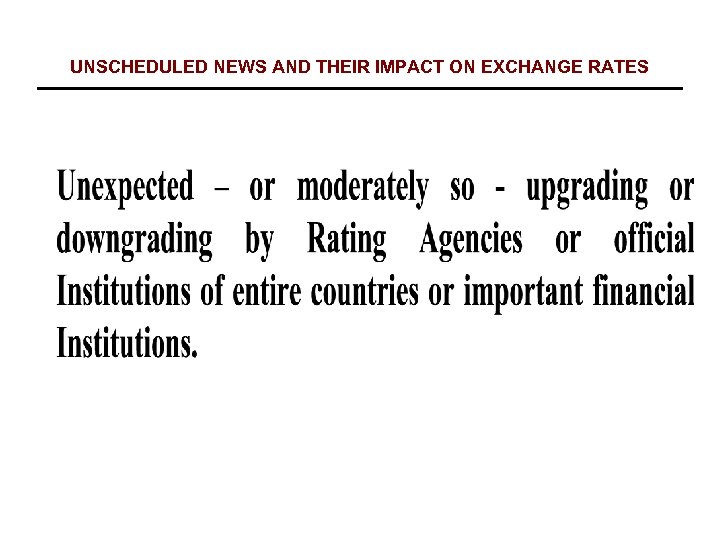
UNSCHEDULED NEWS AND THEIR IMPACT ON EXCHANGE RATES
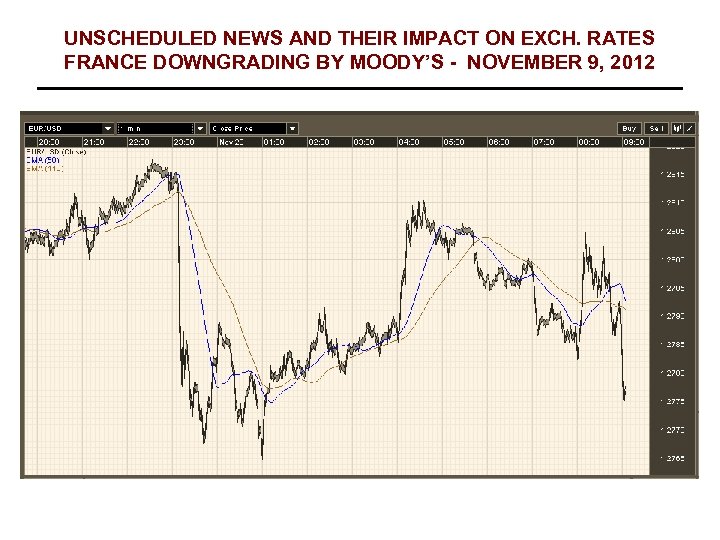
UNSCHEDULED NEWS AND THEIR IMPACT ON EXCH. RATES FRANCE DOWNGRADING BY MOODY’S - NOVEMBER 9, 2012
COURSE OUTLINE 1. THE €-$ FOREX MARKET - HISTORY AND RECENT TRENDS 2. FROM MACROECONOMIC FUNDAMENTALS TO MACRO NEWS 3. MACROECONOMIC SURPRISES – THE SCHEDULED NEWS 4. INFORMATION SOURCES OF SCHEDULED NEWS 5. IMPACT ON EXCHANGE RATES OF SCHEDULED NEWS 6. UNSCHEDULED NEWS AND THEIR IMPACT ON EXCHANGE RATES 7. HOW TO MEASURE NEWS 8. IMPACT: A 3 -ZONES ECONOMETRIC MODEL OF EXCHANGE RATES 9. FROM SIMULATION TO TRADING - OPTIMIZATION 10. MEASURING AND EVALUATING PERFORMANCE 61
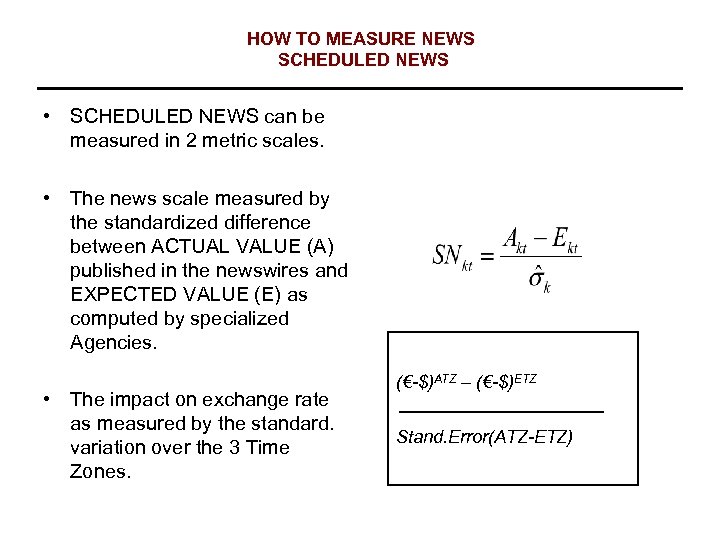
HOW TO MEASURE NEWS SCHEDULED NEWS • SCHEDULED NEWS can be measured in 2 metric scales. • The news scale measured by the standardized difference between ACTUAL VALUE (A) published in the newswires and EXPECTED VALUE (E) as computed by specialized Agencies. • The impact on exchange rate as measured by the standard. variation over the 3 Time Zones. (€-$)ATZ – (€-$)ETZ Stand. Error(ATZ-ETZ)
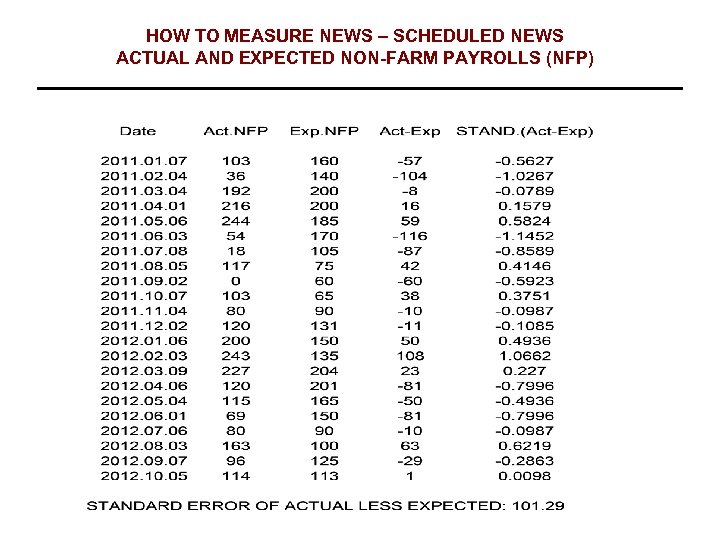
HOW TO MEASURE NEWS – SCHEDULED NEWS ACTUAL AND EXPECTED NON-FARM PAYROLLS (NFP)
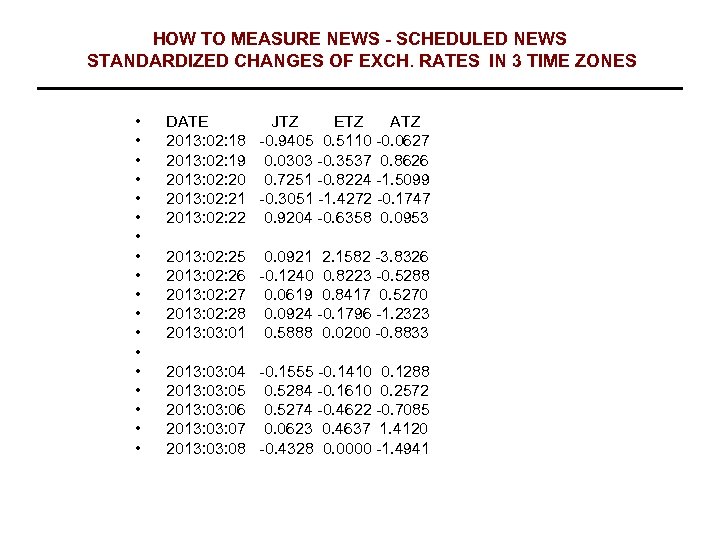
HOW TO MEASURE NEWS - SCHEDULED NEWS STANDARDIZED CHANGES OF EXCH. RATES IN 3 TIME ZONES • • • • • DATE JTZ ETZ ATZ 2013: 02: 18 -0. 9405 0. 5110 -0. 0627 2013: 02: 19 0. 0303 -0. 3537 0. 8626 2013: 02: 20 0. 7251 -0. 8224 -1. 5099 2013: 02: 21 -0. 3051 -1. 4272 -0. 1747 2013: 02: 22 0. 9204 -0. 6358 0. 0953 2013: 02: 25 0. 0921 2. 1582 -3. 8326 2013: 02: 26 -0. 1240 0. 8223 -0. 5288 2013: 02: 27 0. 0619 0. 8417 0. 5270 2013: 02: 28 0. 0924 -0. 1796 -1. 2323 2013: 01 0. 5888 0. 0200 -0. 8833 2013: 04 -0. 1555 -0. 1410 0. 1288 2013: 05 0. 5284 -0. 1610 0. 2572 2013: 06 0. 5274 -0. 4622 -0. 7085 2013: 07 0. 0623 0. 4637 1. 4120 2013: 08 -0. 4328 0. 0000 -1. 4941
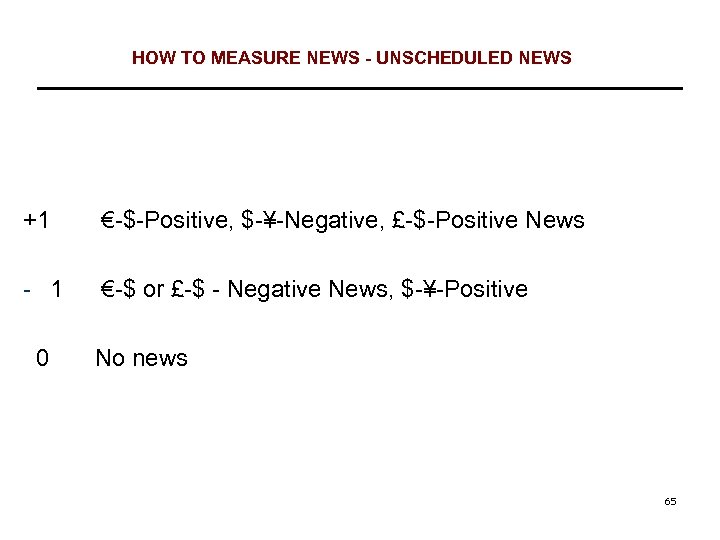
HOW TO MEASURE NEWS - UNSCHEDULED NEWS +1 €-$-Positive, $-¥-Negative, £-$-Positive News - 1 €-$ or £-$ - Negative News, $-¥-Positive 0 No news 65
COURSE OUTLINE 1. THE €-$ FOREX MARKET - HISTORY AND RECENT TRENDS 2. FROM MACROECONOMIC FUNDAMENTALS TO MACRO NEWS 3. MACROECONOMIC SURPRISES – THE SCHEDULED NEWS 4. INFORMATION SOURCES OF SCHEDULED NEWS 5. IMPACT ON EXCHANGE RATES OF SCHEDULED NEWS 6. UNSCHEDULED NEWS AND THEIR IMPACT ON EXCHANGE RATES 7. HOW TO MEASURE NEWS 8. IMPACT: A 3 -ZONES ECONOMETRIC MODEL OF EXCHANGE RATES 9. FROM SIMULATION TO TRADING - OPTIMIZATION 10. MEASURING AND EVALUATING PERFORMANCE 66
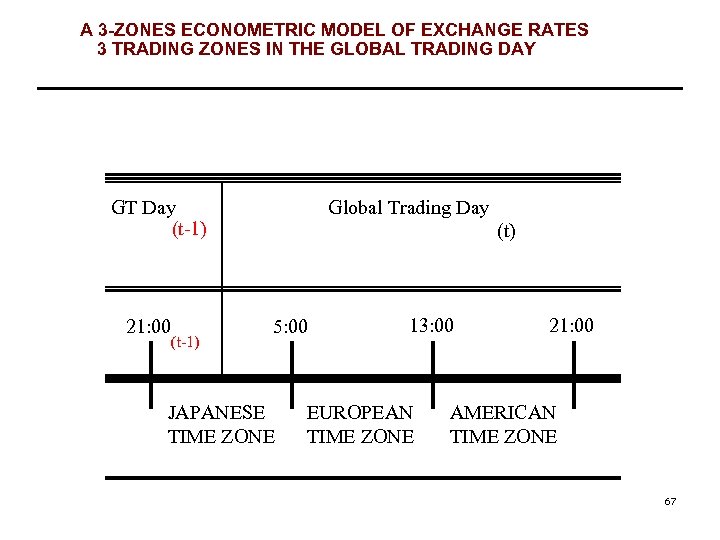
A 3 -ZONES ECONOMETRIC MODEL OF EXCHANGE RATES 3 TRADING ZONES IN THE GLOBAL TRADING DAY GT Day (t-1) 21: 00 (t-1) Global Trading Day (t) 5: 00 JAPANESE TIME ZONE 13: 00 EUROPEAN TIME ZONE 21: 00 AMERICAN TIME ZONE 67
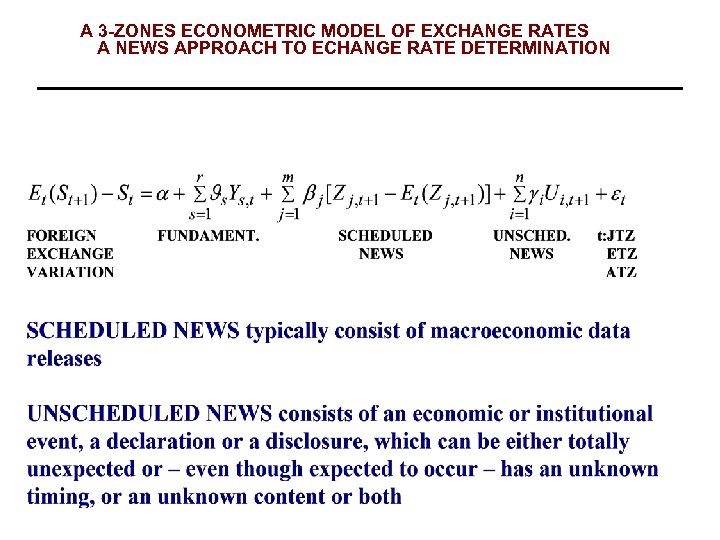
A 3 -ZONES ECONOMETRIC MODEL OF EXCHANGE RATES A NEWS APPROACH TO ECHANGE RATE DETERMINATION
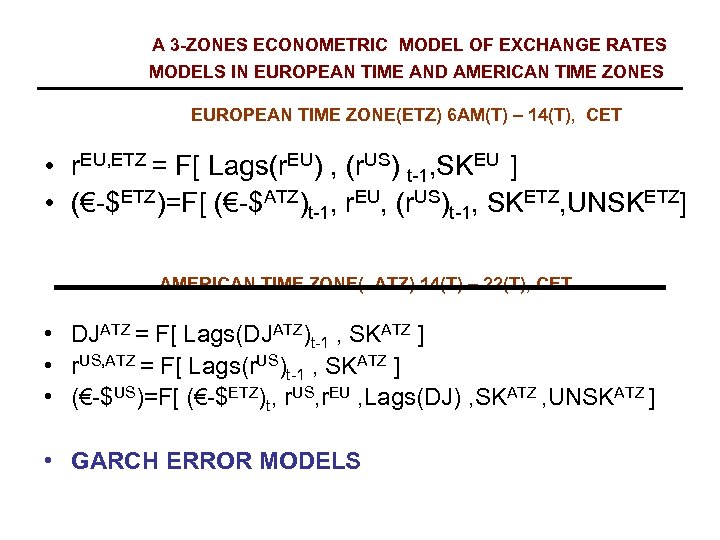
A 3 -ZONES ECONOMETRIC MODEL OF EXCHANGE RATES MODELS IN EUROPEAN TIME AND AMERICAN TIME ZONES EUROPEAN TIME ZONE(ETZ) 6 AM(T) – 14(T), CET • r. EU, ETZ = F[ Lags(r. EU) , (r. US) t-1, SKEU ] • (€-$ETZ)=F[ (€-$ATZ)t-1, r. EU, (r. US)t-1, SKETZ, UNSKETZ] AMERICAN TIME ZONE( ATZ) 14(T) – 22(T), CET • DJATZ = F[ Lags(DJATZ)t-1 , SKATZ ] • r. US, ATZ = F[ Lags(r. US)t-1 , SKATZ ] • (€-$US)=F[ (€-$ETZ)t, r. US, r. EU , Lags(DJ) , SKATZ , UNSKATZ ] • GARCH ERROR MODELS
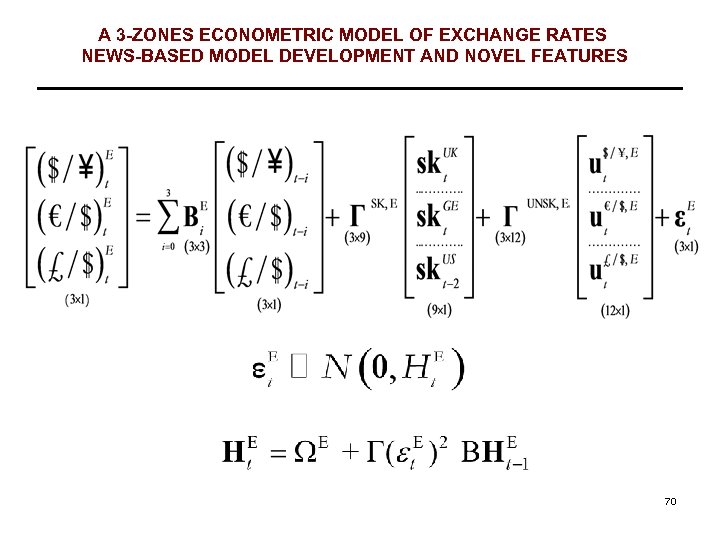
A 3 -ZONES ECONOMETRIC MODEL OF EXCHANGE RATES NEWS-BASED MODEL DEVELOPMENT AND NOVEL FEATURES 70
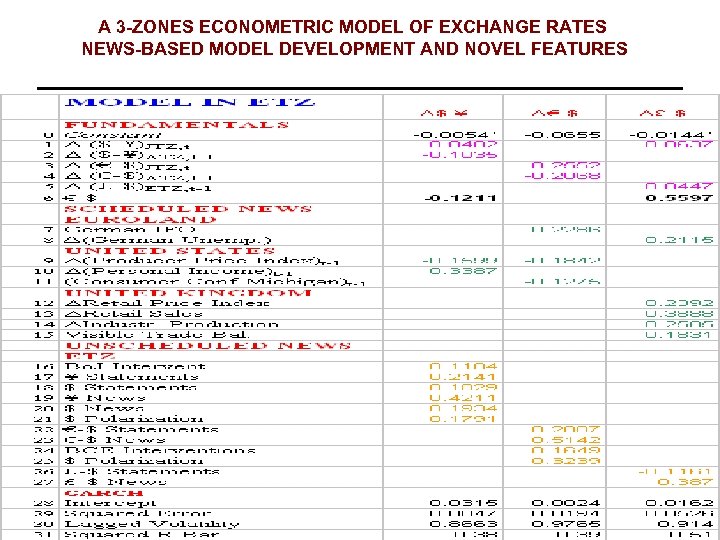
A 3 -ZONES ECONOMETRIC MODEL OF EXCHANGE RATES NEWS-BASED MODEL DEVELOPMENT AND NOVEL FEATURES 71
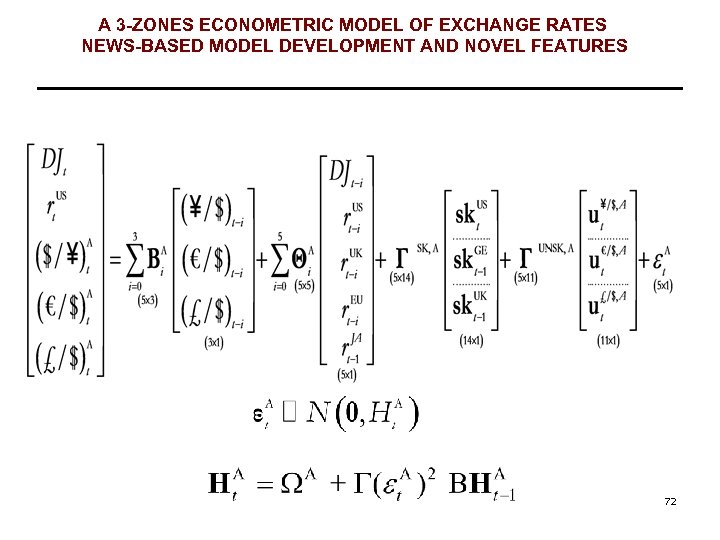
A 3 -ZONES ECONOMETRIC MODEL OF EXCHANGE RATES NEWS-BASED MODEL DEVELOPMENT AND NOVEL FEATURES 72
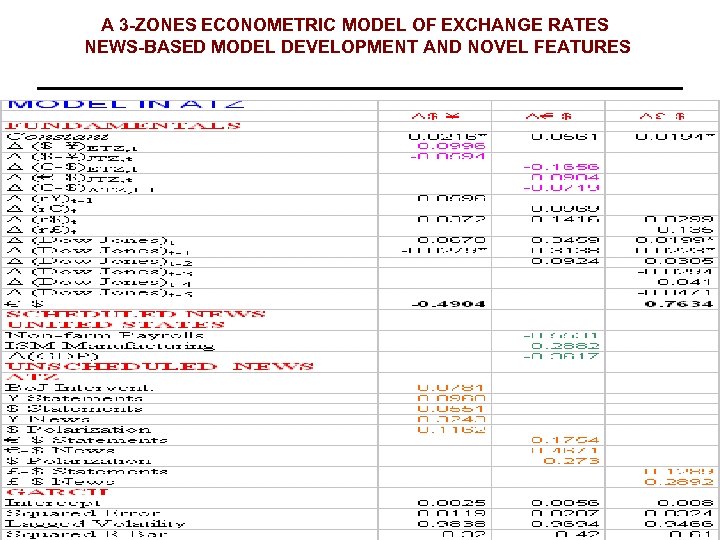
A 3 -ZONES ECONOMETRIC MODEL OF EXCHANGE RATES NEWS-BASED MODEL DEVELOPMENT AND NOVEL FEATURES 73
COURSE OUTLINE 1. THE €-$ FOREX MARKET - HISTORY AND RECENT TRENDS 2. FROM MACROECONOMIC FUNDAMENTALS TO MACRO NEWS 3. MACROECONOMIC SURPRISES – THE SCHEDULED NEWS 4. INFORMATION SOURCES OF SCHEDULED NEWS 5. IMPACT ON EXCHANGE RATES OF SCHEDULED NEWS 6. UNSCHEDULED NEWS AND THEIR IMPACT ON EXCHANGE RATES 7. HOW TO MEASURE NEWS 8. IMPACT: A 3 -ZONES ECONOMETRIC MODEL OF EXCHANGE RATES 9. FROM SIMULATION TO TRADING - OPTIMIZATION 10. MEASURING AND EVALUATING PERFORMANCE 74
FROM SIMULATION TO TRADING - OVERVIEW • In this course we will examine four protocols which can be used with a short-term econometric model: • Directional Trading • Contrarian Trading, news-assisted mode • Contrarian trading, automatic mode • Mixed Trading: Directional plus “Contrarian” at Stop Loss • Baseline (for a benchmark)
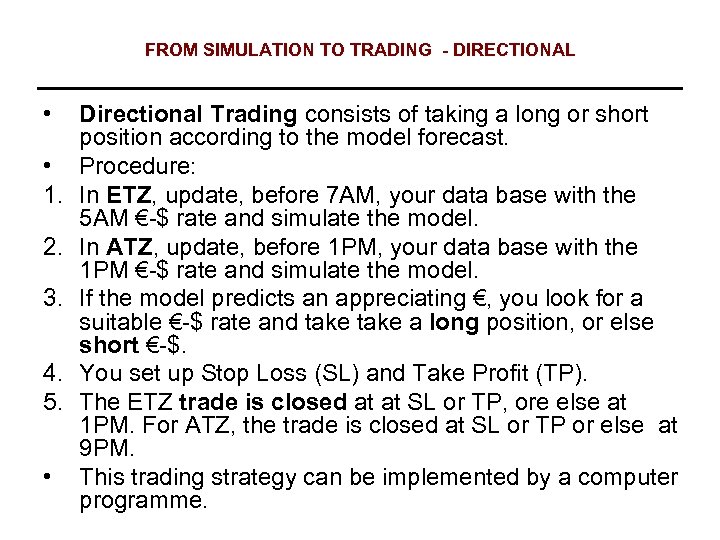
FROM SIMULATION TO TRADING - DIRECTIONAL • • 1. 2. 3. 4. 5. • Directional Trading consists of taking a long or short position according to the model forecast. Procedure: In ETZ, update, before 7 AM, your data base with the 5 AM €-$ rate and simulate the model. In ATZ, update, before 1 PM, your data base with the 1 PM €-$ rate and simulate the model. If the model predicts an appreciating €, you look for a suitable €-$ rate and take a long position, or else short €-$. You set up Stop Loss (SL) and Take Profit (TP). The ETZ trade is closed at at SL or TP, ore else at 1 PM. For ATZ, the trade is closed at SL or TP or else at 9 PM. This trading strategy can be implemented by a computer programme.
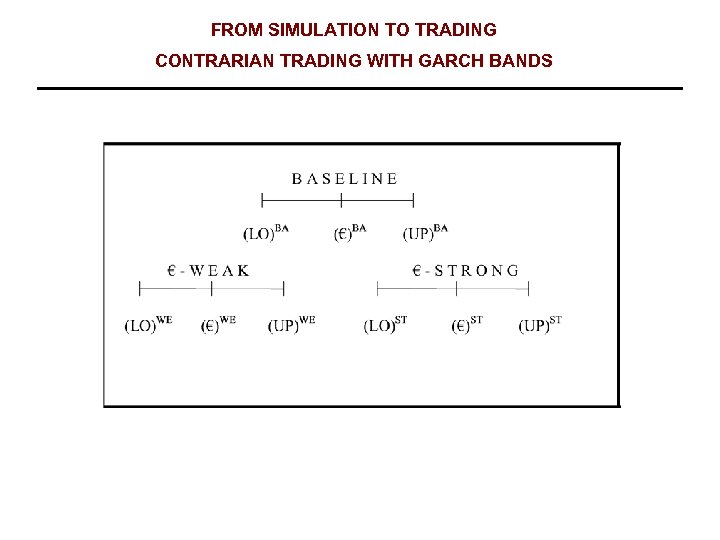
FROM SIMULATION TO TRADING - CONTRARIAN NEWS-ASSISTED • News-assisted contrarian trading consists of starting a Long or Short trade if the €-$ goes beyond GARCH-computed lower or upper thresholds (respectively), in the ETZ-ATZ time span after 7 AM. • All that must occur in a no-news situation (as there is no reason for the € to go beyond thresholds) or in conjunction with a Europositive or Euro-negative news (respectively). • The above two trading strategies (mutually exclusive, in principle) can be implemented by human intervention or in automated mode.
FROM SIMULATION TO TRADING - CONTRARIAN AUTOMATED • Automated contrarian trading consists of starting a Long or Short trade whenever the €-$ goes beyond GARCH-computed lower or upper thresholds (respectively), in the ETZ-ATZ time span after 7 AM. • Contrary to the news-assisted protocol, the trade begins mechanically if the € goes beyond GARCH thresholds. • This trading strategy can be implemented by a computer programme.
FROM SIMULATION TO TRADING - MIXED • • This kind of trade starts Directional in ETZ. If the trade is closed regularly at TP or at 1 PM, you start a trade in ATZ, with the normal Directional protocol. If a SL is touched, the procedure gets Mixed: Revert the trade (with respect to the movement of the €) in the same direction of the original Directional trading signal, setting SL and TP. In case of a Directional Long trade, SL is reached if the € goes in the other direction with respect to this signal. So you revert the trade and go Long again. In case of a Directional Short trade, SL is reached if the € goes in the other direction with respect to this signal. So you revert the trade and go Short again. In both Long or Short Mixed trading protocols, the trade is closed at SL or TP or at 9 PM. This trading strategy can be implemented by a computer programme.
FROM SIMULATION TO TRADING - BASELINE • • 1. 2. 3. 4. 5. • The Baseline follows a Directional Trading scheme. It consists of taking a long or short position according to the mode forecast. Procedure: In ETZ, update, before 7 AM, your data base with the 5 AM €-$ rate and simulate the model. In ATZ, update, before 1 PM, your data base with the 1 PM €-$ rate and simulate the model. If the model predicts an appreciating €, the suitable €-$ rate to start your Long trade is an average of the opening rate and the low rate between 7 -8. For a Short, you take the average of the opening rate between 7 -8 with the High €-$ rate, in the same time span. You set up Stop Loss (SL) and Take Profit (TP). The ETZ trade is closed at at SL or TP, ore else at 1 PM. For ATZ, the trade is closed at 9 PM. This trading strategy cannot be implemented by a computer
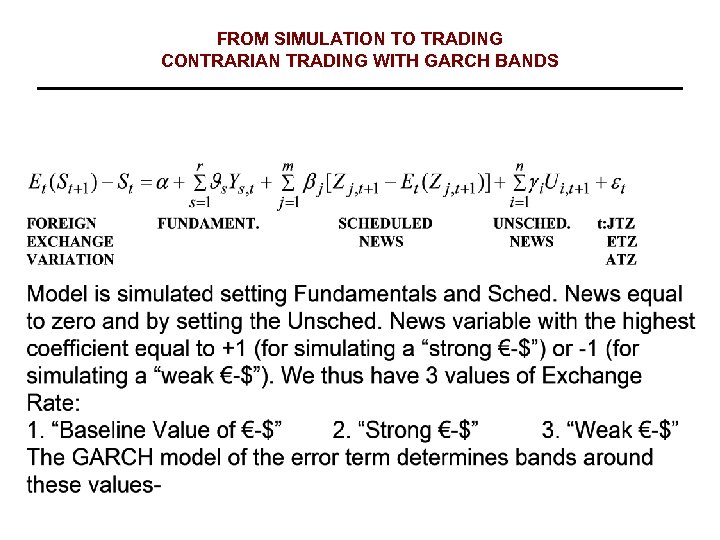
FROM SIMULATION TO TRADING CONTRARIAN TRADING WITH GARCH BANDS
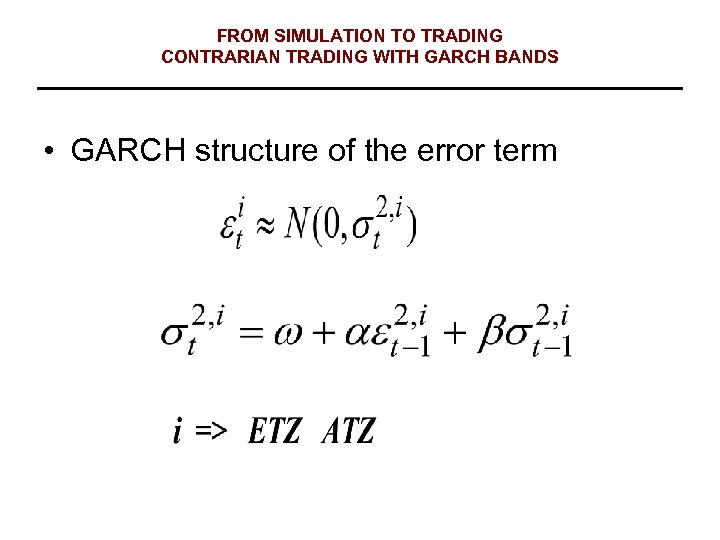
FROM SIMULATION TO TRADING CONTRARIAN TRADING WITH GARCH BANDS • GARCH structure of the error term
FROM SIMULATION TO TRADING CONTRARIAN TRADING WITH GARCH BANDS
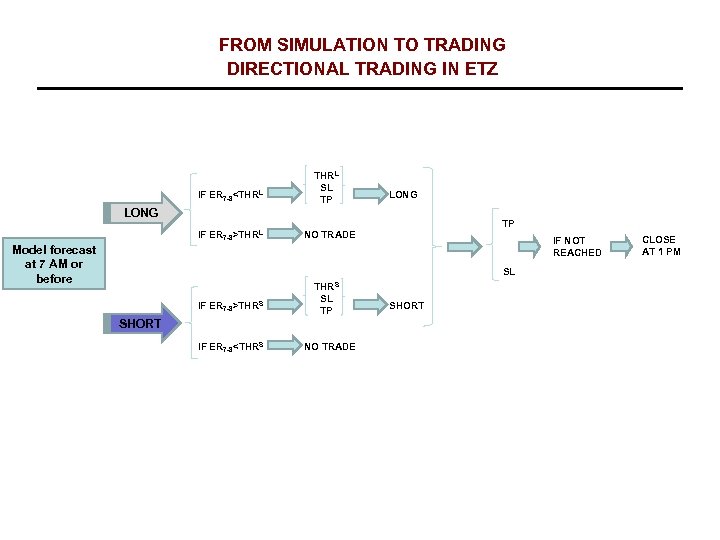
FROM SIMULATION TO TRADING DIRECTIONAL TRADING IN ETZ IF ER 7 -8<THRL SL TP LONG TP IF ER 7 -8>THRL Model forecast at 7 AM or before NO TRADE IF NOT REACHED SL THRS IF ER 7 -8>THRS SL TP SHORT IF ER 7 -8<THRS NO TRADE SHORT CLOSE AT 1 PM
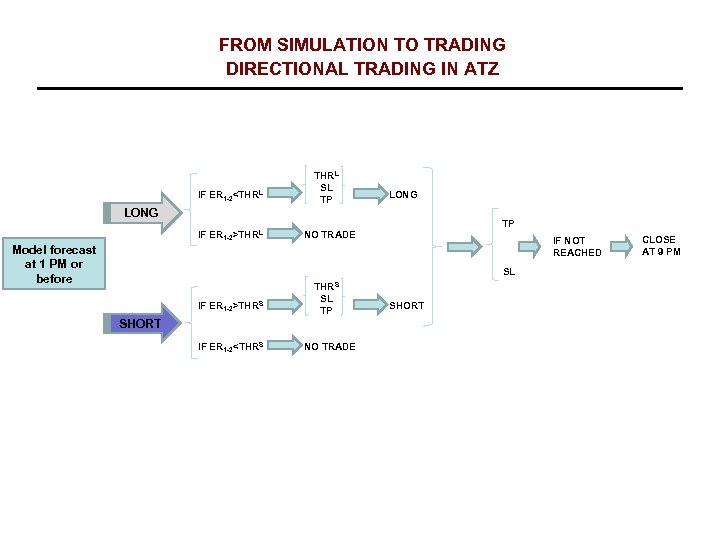
FROM SIMULATION TO TRADING DIRECTIONAL TRADING IN ATZ IF ER 1 -2<THRL SL TP LONG TP IF ER 1 -2>THRL Model forecast at 1 PM or before NO TRADE IF NOT REACHED SL THRS IF ER 1 -2>THRS SL TP SHORT IF ER 1 -2<THRS NO TRADE SHORT CLOSE AT 9 PM
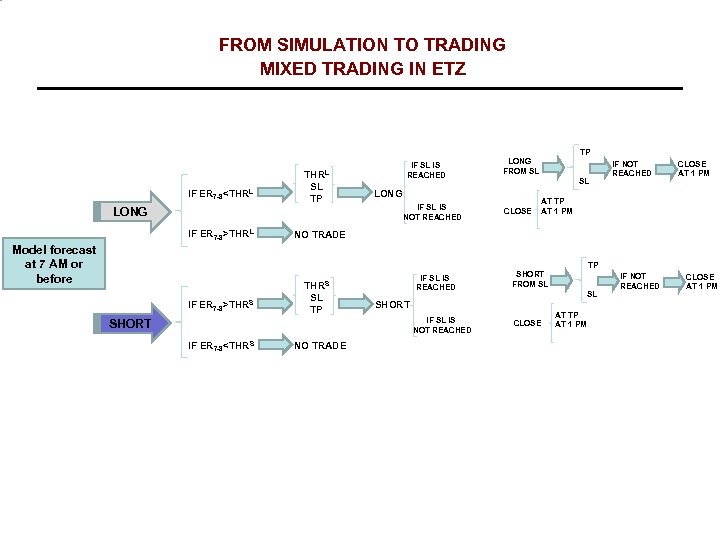
FROM SIMULATION TO TRADING MIXED TRADING IN ETZ TP IF ER 7 -8<THRL SL TP LONG IF ER 7 -8>THRL Model forecast at 7 AM or before IF SL IS REACHED LONG FROM SL SL LONG IF SL IS NOT REACHED CLOSE IF NOT REACHED CLOSE AT 1 PM AT TP AT 1 PM NO TRADE TP IF ER 7 -8>THRS SL TP IF SL IS REACHED IF ER 7 -8<THRS NO TRADE SL SHORT IF SL IS NOT REACHED SHORT FROM SL CLOSE AT TP AT 1 PM IF NOT REACHED CLOSE AT 1 PM
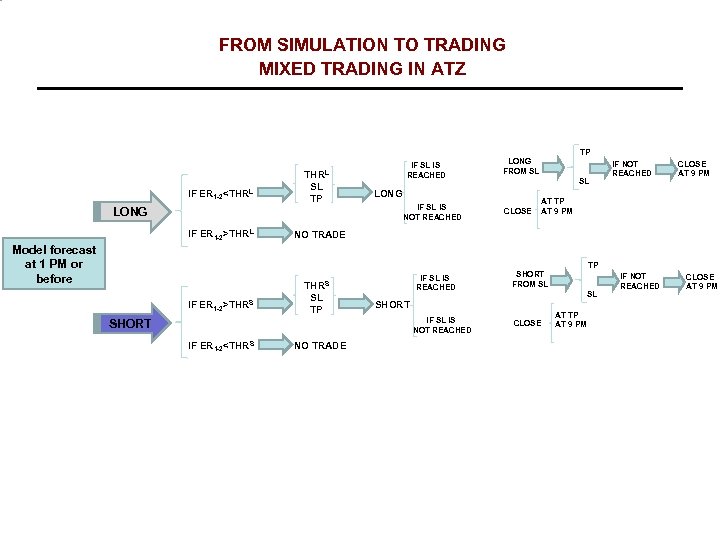
FROM SIMULATION TO TRADING MIXED TRADING IN ATZ TP IF ER 1 -2<THRL SL TP LONG IF ER 1 -2>THRL Model forecast at 1 PM or before IF SL IS REACHED LONG FROM SL SL LONG IF SL IS NOT REACHED CLOSE IF NOT REACHED CLOSE AT 9 PM AT TP AT 9 PM NO TRADE TP IF ER 1 -2>THRS SL TP IF SL IS REACHED IF ER 1 -2<THRS NO TRADE SL SHORT IF SL IS NOT REACHED SHORT FROM SL CLOSE AT TP AT 9 PM IF NOT REACHED CLOSE AT 9 PM
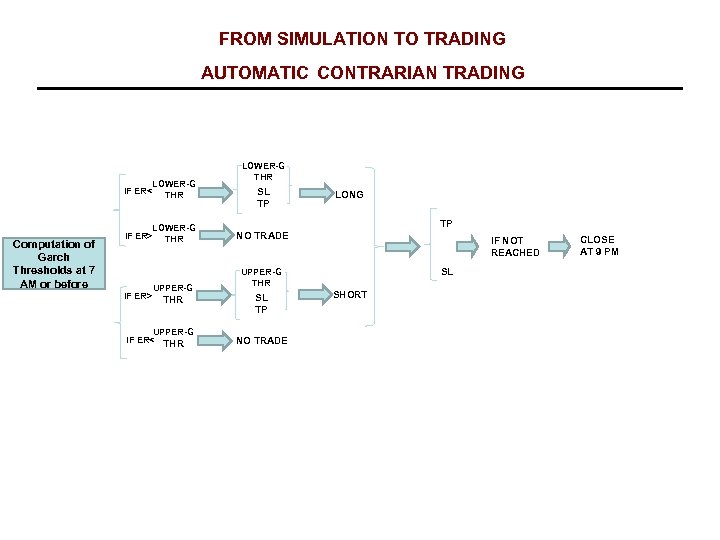
FROM SIMULATION TO TRADING AUTOMATIC CONTRARIAN TRADING IF ER< Computation of Garch Thresholds at 7 AM or before LOWER-G THR LOWER-G IF ER> THR IF ER> UPPER-G THR UPPER-G IF ER< THR LOWER-G THR SL TP LONG TP NO TRADE IF NOT REACHED SL UPPER-G THR SL TP NO TRADE SHORT CLOSE AT 9 PM
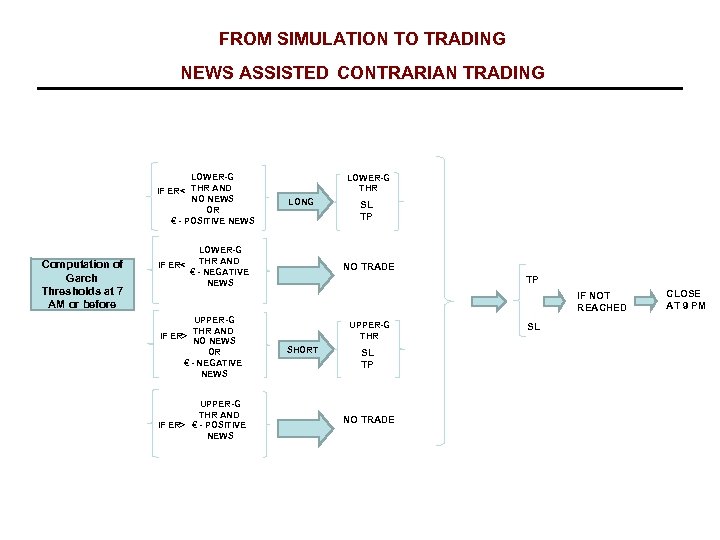
FROM SIMULATION TO TRADING NEWS ASSISTED CONTRARIAN TRADING LOWER-G IF ER< THR AND NO NEWS OR € - POSITIVE NEWS Computation of Garch Thresholds at 7 AM or before IF ER< LOWER-G THR LONG LOWER-G THR AND € - NEGATIVE NEWS SL TP NO TRADE TP IF NOT REACHED UPPER-G THR AND IF ER> NO NEWS OR € - NEGATIVE NEWS UPPER-G THR AND IF ER> € - POSITIVE NEWS UPPER-G THR SHORT SL TP NO TRADE SL CLOSE AT 9 PM
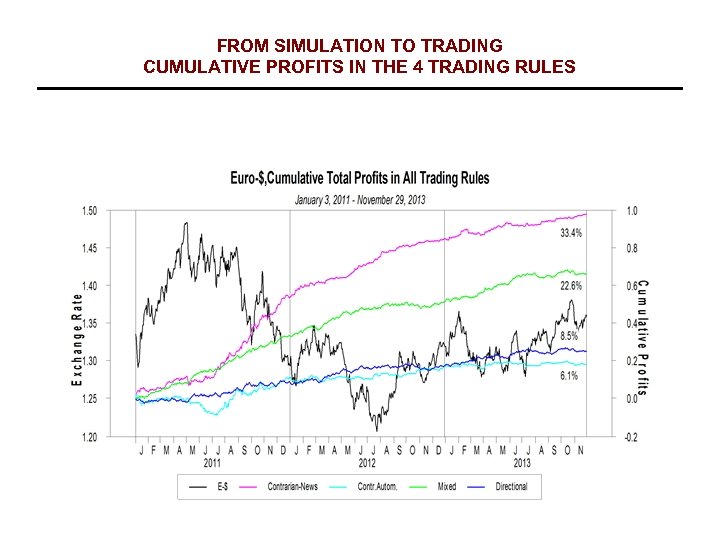
FROM SIMULATION TO TRADING CUMULATIVE PROFITS IN THE 4 TRADING RULES
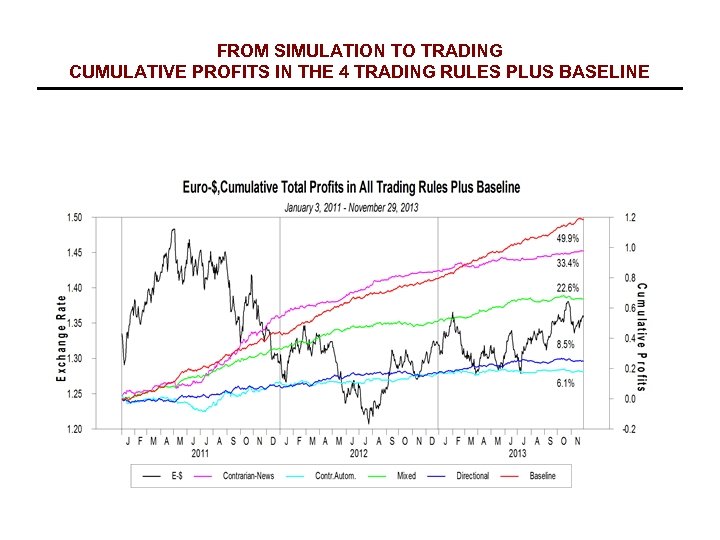
FROM SIMULATION TO TRADING CUMULATIVE PROFITS IN THE 4 TRADING RULES PLUS BASELINE
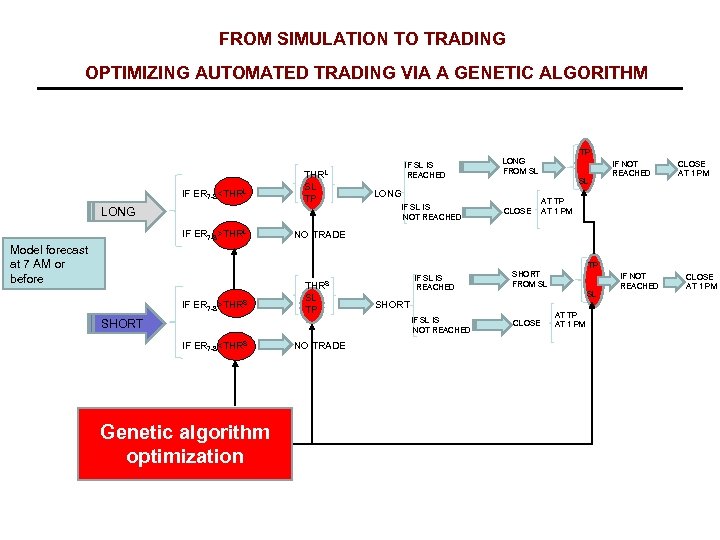
FROM SIMULATION TO TRADING OPTIMIZING AUTOMATED TRADING VIA A GENETIC ALGORITHM • Once you are able to devise a protocol which can be automated and you build a computer program able to execute your trading instructions sequentially, you may try to optimize the parameters of our rule which condition the profit performance. • A widely used optimization technique in finance is the Genetic Algorithm (GA), which is adapted from a “selection of the species” to a “selection of the profit-maximizing parameters”
FROM SIMULATION TO TRADING OPTIMIZING AUTOMATED TRADING VIA A GENETIC ALGORITHM • It is basically a data mining program which iteratively finds the best set of parameters from a group of numbers within boundary conditions. • In order to avoid “data snooping” (namely use the same set of numbers to optimize and compute trading results), you will need to split your data set into two parts.
FROM SIMULATION TO TRADING OPTIMIZING AUTOMATED TRADING VIA A GENETIC ALGORITHM • A Training Set (TNS), made up by the first part of your data set, where you find the optimal parameters. • A Trading Set (TRS), made up of the second part of your data set still within the sample, where you will compute the performance (generally in terms of cumulative profits, their volatility and their Drawdown)
FROM SIMULATION TO TRADING OPTIMIZING AUTOMATED TRADING VIA A GENETIC ALGORITHM • Ideally the time series of exchange rate (ER) in the two Sets should have comparable time series properties (e. g mean, volatility, cyclical properties, outliers) and they should be usable in the trading environment of the immediate future. • After some use of the optimized day-trading rule, the GA will have to be trained again, using the ER actually used for trading as a Training/Trading Set.
FROM SIMULATION TO TRADING OPTIMIZING AUTOMATED TRADING VIA A GENETIC ALGORITHM • The following slide shows what to optimize in the Automated Rule shown before (slide 66). The parameters are thresholds and SL and TP, besides a time length to decide to “Close and Reverse” the trade. • The subsequent two slides show a TNS and a TRS where charts of cumulative profits and of Drawdown features are depicted, together with the observed ER series
FROM SIMULATION TO TRADING OPTIMIZING AUTOMATED TRADING VIA A GENETIC ALGORITHM TP IF ER 7 -8<THRL SL TP LONG IF ER 7 -8>THRL Model forecast at 7 AM or before IF SL IS REACHED LONG FROM SL SL LONG IF SL IS NOT REACHED CLOSE IF NOT REACHED CLOSE AT 1 PM AT TP AT 1 PM NO TRADE TP IF ER 7 -8>THRS SL TP IF SL IS REACHED IF ER 7 -8<THRS Genetic algorithm optimization NO TRADE SL SHORT IF SL IS NOT REACHED SHORT FROM SL CLOSE AT TP AT 1 PM IF NOT REACHED CLOSE AT 1 PM
COURSE OUTLINE 1. THE €-$ FOREX MARKET - HISTORY AND RECENT TRENDS 2. FROM MACROECONOMIC FUNDAMENTALS TO MACRO NEWS 3. MACROECONOMIC SURPRISES – THE SCHEDULED NEWS 4. INFORMATION SOURCES OF SCHEDULED NEWS 5. IMPACT ON EXCHANGE RATES OF SCHEDULED NEWS 6. UNSCHEDULED NEWS AND THEIR IMPACT ON EXCHANGE RATES 7. HOW TO MEASURE NEWS 8. IMPACT: A 3 -ZONES ECONOMETRIC MODEL OF EXCHANGE RATES 9. FROM SIMULATION TO TRADING - OPTIMIZATION 10. MEASURING AND EVALUATING PERFORMANCE 98
MEASURING AND EVALUATING PERFORMANCE • The profitability of a day-trading rule is measured as any standard financial investment. • Profit Rate over a given time horizon and its standard deviation for evaluating statistical significance and drawing confidence bands. A Sharpe Ratio (i. e. standardized excess return over the risk-free return) is also widely used.
MEASURING AND EVALUATING PERFORMANCE • But a high-frequency trading rule (as a protocol replicating itself without any change) needs also monitoring indicators for checking the stability of profits and their volatility overtime and, in particular, in turbulent periods.
MEASURING AND EVALUATING PERFORMANCE The monitoring indicators can be: 1. Equity Line (a Cumulative Profit Line) 2. Moving Standard Deviation of Profit along the Equity Line (Volatility) 3. Drawdown Analysis 4. Policy and event analysis from the perspective of an historical evaluation of quiet and turbulent periods and related policy measures and market sentiment.
MEASURING AND EVALUATING PERFORMANCE Turbulent periods follow: 1. Unexpected Policy measures (e. g. US ultra expansionary monetary policy after Lehman and QE later) 2. Ongoing financial distress from contagion (e. g. Greece=>Ireland=>Portugal=>Italy and Spain, PIIGS) 3. Rumors, Fads, Myths, Excuses 4. Irrational Exuberance or Irrational Pessimism
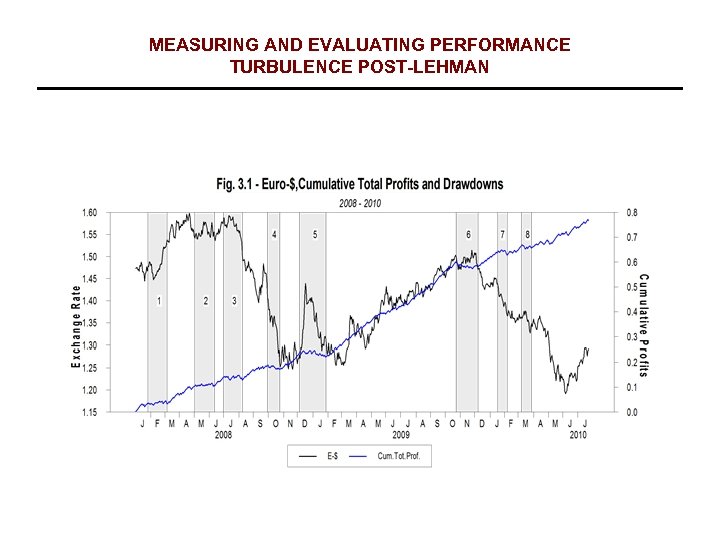
MEASURING AND EVALUATING PERFORMANCE TURBULENCE POST-LEHMAN
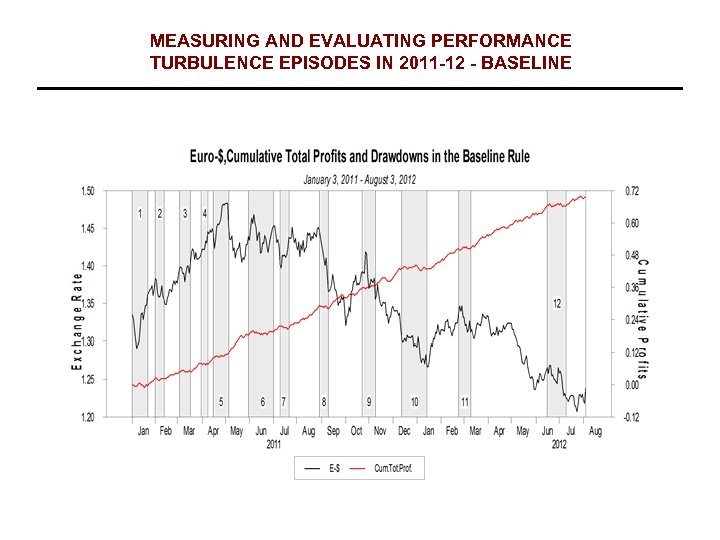
MEASURING AND EVALUATING PERFORMANCE TURBULENCE EPISODES IN 2011 -12 - BASELINE
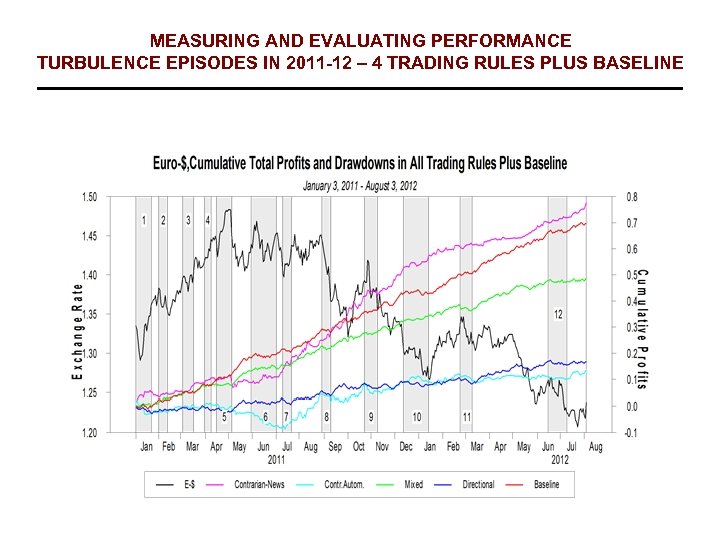
MEASURING AND EVALUATING PERFORMANCE TURBULENCE EPISODES IN 2011 -12 – 4 TRADING RULES PLUS BASELINE
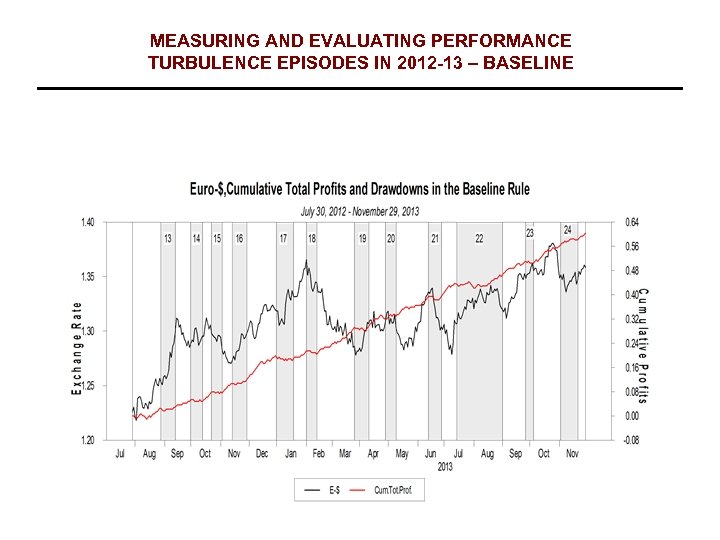
MEASURING AND EVALUATING PERFORMANCE TURBULENCE EPISODES IN 2012 -13 – BASELINE
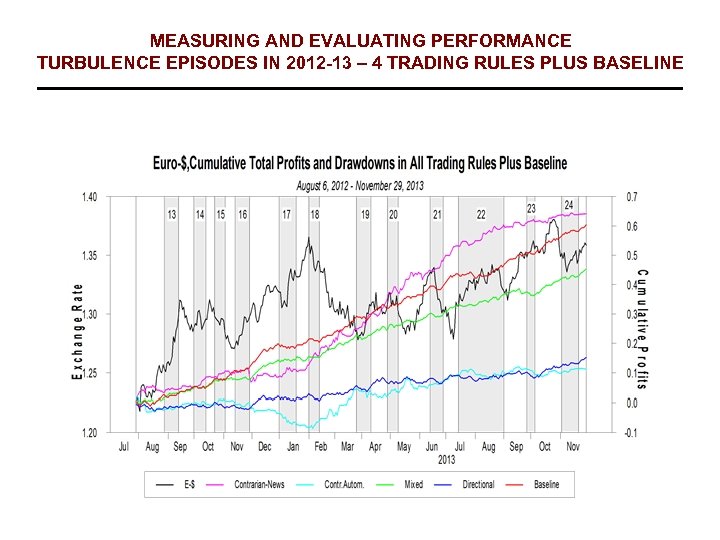
MEASURING AND EVALUATING PERFORMANCE TURBULENCE EPISODES IN 2012 -13 – 4 TRADING RULES PLUS BASELINE
THE END Goodnight And Good Luck ! Shakespeare “Julius Caesar” (Brutus)
Скачать презентацию THE NEWS-BASED APPROACH TO EXCHANGE RATES AND THE
1bb036efc5efe2617827241fe664cfed.ppt