 Скачать презентацию The New State Agenda Higher Education as Public
41b9ba3e7a681a88762ea5b131551dbd.ppt
- Количество слайдов: 25



The New State Agenda: Higher Education as Public Servant “Everybody can be great, because everybody can serve. . . you only need a heart full of grace, a soul generated by love, and you can be that servant. ” —Martin Luther King, Jr. The Futures Project: Policy for Higher Education in a Changing World January 2002
The Futures Project • A higher education think tank based at Brown University. • Investigating the growth of competition and market forces in higher education. Pew Charitable Trusts Ford Foundation Funders Atlantic Philanthropies Carnegie Corporation Rockefeller Foundation GE Fund
Market Forces in Higher Education: the Good, the Bad, the Reality “Competition is good between institutions. It leads to higher quality and higher efficiency if you do it right. How do you make them more competitive? Let them compete for resources and compete for clients. ” — Frans van Vught, Rector Magnificus, Universiteit Twente, The Netherlands
Market Forces in Higher Education: the Good, the Bad, the Reality “If we create market universities run purely on market principles they may be of their age, but they will not be able to transcend it. ” —Federico Mayor, UNESCO Director-General
The Bad: Undercuts Higher Education’s Public Role “All funds raised from The President’s Gala and Journal will be used to support student scholarships. As the competition for students continues to increase, scholarships enable Adelphi to remain competitive with other schools in attracting the brightest and most qualified students. ” —Invitation to the Second Annual President’s Gala, December 20, 2001
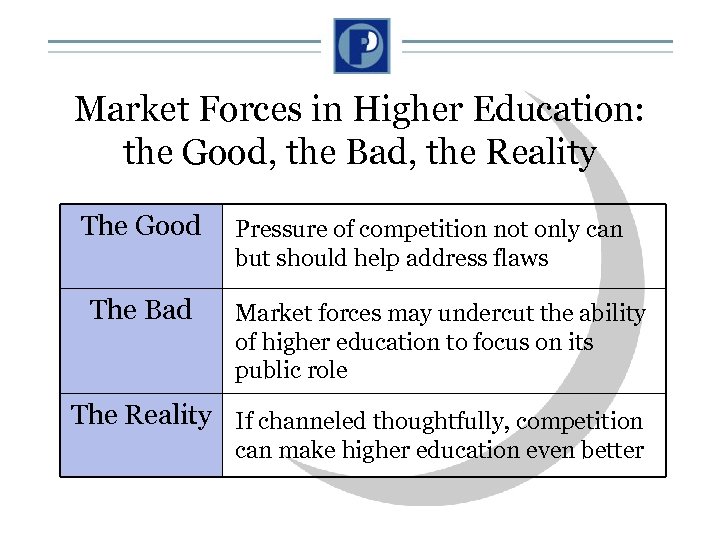
Market Forces in Higher Education: the Good, the Bad, the Reality The Good The Bad Pressure of competition not only can but should help address flaws Market forces may undercut the ability of higher education to focus on its public role The Reality If channeled thoughtfully, competition can make higher education even better
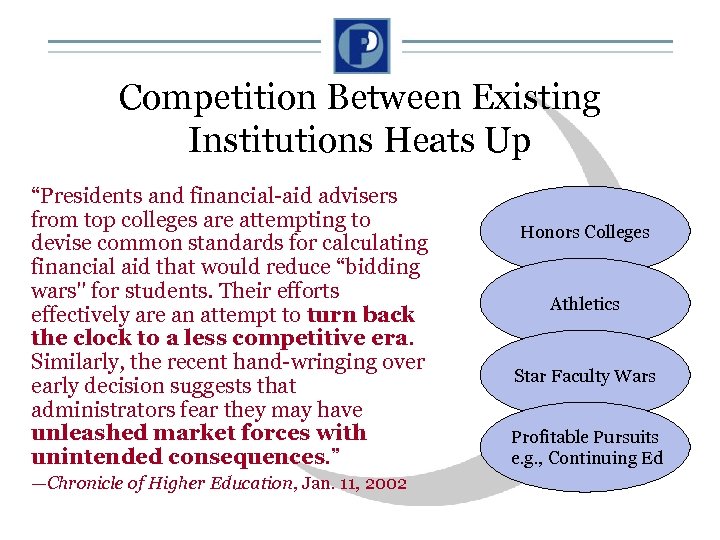
Competition Between Existing Institutions Heats Up “Presidents and financial-aid advisers from top colleges are attempting to devise common standards for calculating financial aid that would reduce “bidding wars" for students. Their efforts effectively are an attempt to turn back the clock to a less competitive era. Similarly, the recent hand-wringing over early decision suggests that administrators fear they may have unleashed market forces with unintended consequences. ” —Chronicle of Higher Education, Jan. 11, 2002 Honors Colleges Athletics Star Faculty Wars Profitable Pursuits e. g. , Continuing Ed
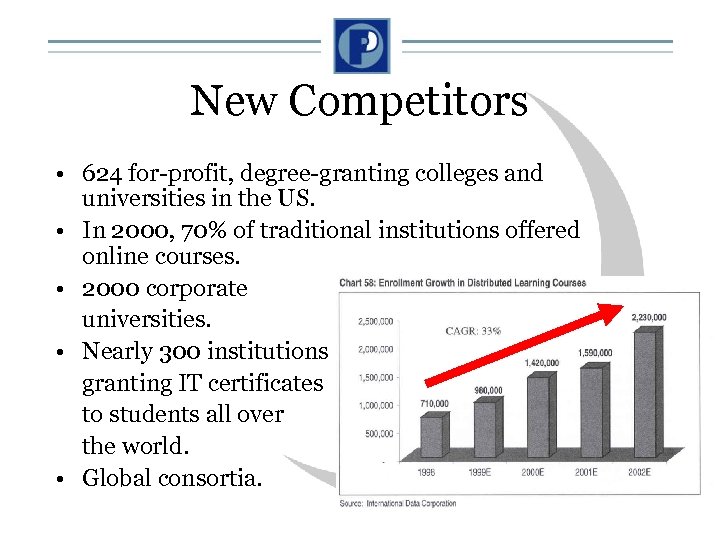
New Competitors • 624 for-profit, degree-granting colleges and universities in the US. • In 2000, 70% of traditional institutions offered online courses. • 2000 corporate universities. • Nearly 300 institutions granting IT certificates to students all over the world. • Global consortia.
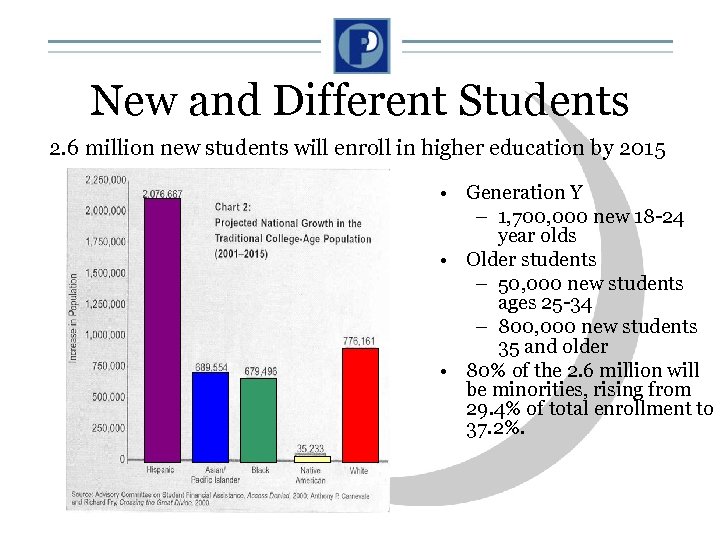
New and Different Students 2. 6 million new students will enroll in higher education by 2015 • Generation Y – 1, 700, 000 new 18 -24 year olds • Older students – 50, 000 new students ages 25 -34 – 800, 000 new students 35 and older • 80% of the 2. 6 million will be minorities, rising from 29. 4% of total enrollment to 37. 2%.
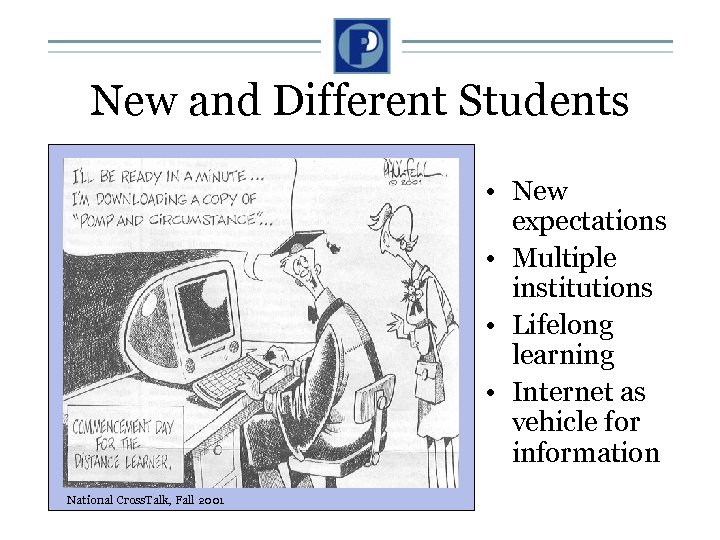
New and Different Students • New expectations • Multiple institutions • Lifelong learning • Internet as vehicle for information National Cross. Talk, Fall 2001
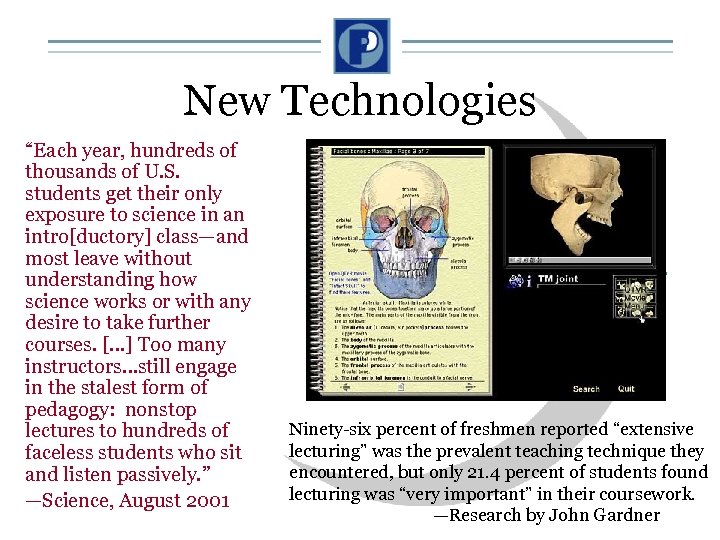
New Technologies “Each year, hundreds of thousands of U. S. students get their only exposure to science in an intro[ductory] class—and most leave without understanding how science works or with any desire to take further courses. […] Too many instructors…still engage in the stalest form of pedagogy: nonstop lectures to hundreds of faceless students who sit and listen passively. ” —Science, August 2001 • http: //www. lib. uiowa. edu /commons/skullvr/gallery/ tmj 2. htm Ninety-six percent of freshmen reported “extensive lecturing” was the prevalent teaching technique they encountered, but only 21. 4 percent of students found lecturing was “very important” in their coursework. —Research by John Gardner
Right Across the Globe… “The global ‘rightward shift’ to the values, institutions and modes of organization of a capitalist political economy has intensified competition between universities for students, staff and resources of all kinds. ” —Association of Commonwealth Universities “One remarkable development is the emergence of institutions of higher learning in the private sector. This ‘privatization’ of higher education is nearly a worldwide phenomenon. ” —Quddus and Rashid
Policymakers Find Market Forces Alluring Representative Keith King of Colorado said he believes it is time to: “force market realities on higher education. ” Not all policymakers feel this way now, but flaws in the system and tough economic times may engender more interest.
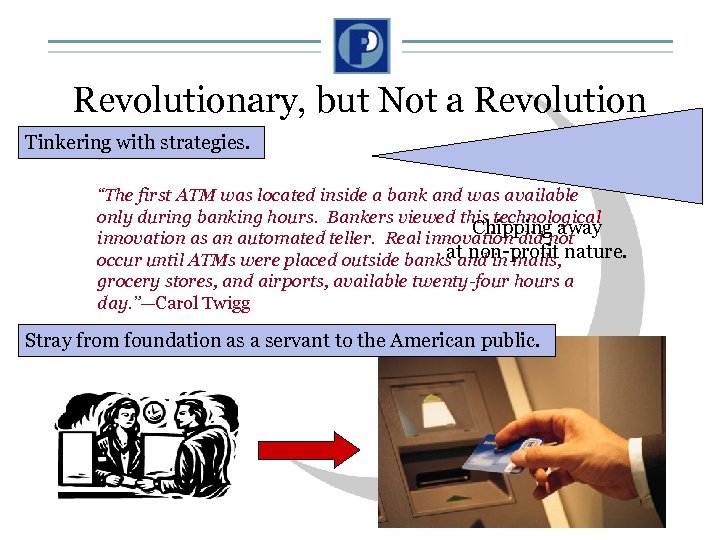
Revolutionary, but Not a Revolution Tinkering with strategies. “The first ATM was located inside a bank and was available only during banking hours. Bankers viewed this technological Chipping away innovation as an automated teller. Real innovation did not at non-profit occur until ATMs were placed outside banks and in malls, nature. grocery stores, and airports, available twenty-four hours a day. ”—Carol Twigg Stray from foundation as a servant to the American public.
Heeding the Warnings Competition has already caused trouble for: Athletics Research “Things that were true at Michigan in the '50 s were true at Princeton in the '70 s, were true at NESCAC in the '90 s and then true in women's colleges five or 10 years later. You see the spread through the system. ” —William Bowen, talking about the negative consequences of competition in athletics
Policy: The Public Use of Private Interest “Harnessing the ‘base’ motive of material self-interest to promote the common good is perhaps the most important social invention mankind has yet achieved. ” —Charles L. Schultze, 1977
The New State Agenda • Higher education is more important than ever to individual and societal well-being. • Its role in society is worth preserving: – Engaged citizenry – Educated workforce – Scholarship and open debate • Must renew compact with citizens. Higher education as public servant. “Universities have failed to market their expertise aggressively enough to government and industry in the past. ” —Association of Commonwealth Universities
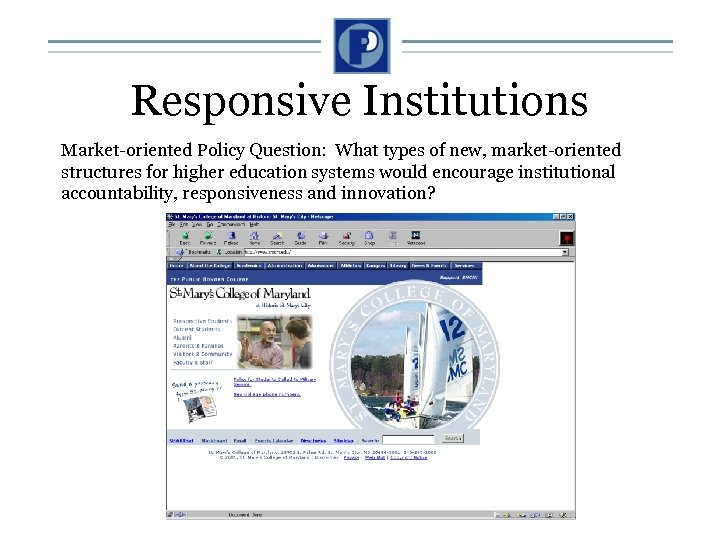
Responsive Institutions Market-oriented Policy Question: What types of new, market-oriented structures for higher education systems would encourage institutional accountability, responsiveness and innovation?
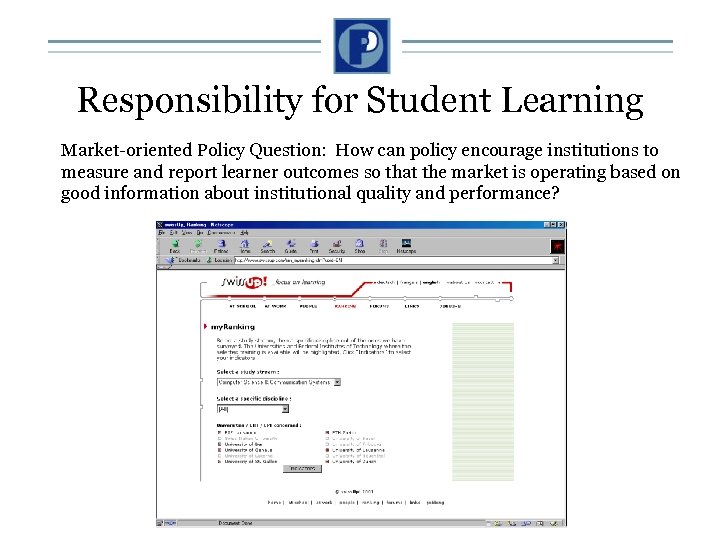
Responsibility for Student Learning Market-oriented Policy Question: How can policy encourage institutions to measure and report learner outcomes so that the market is operating based on good information about institutional quality and performance?
Higher Education for a Greater Share of the Population Market-oriented Policy Question: How can policy encourage colleges and universities to educate and graduate low-income and minority students, effectively turning those students into a target market?
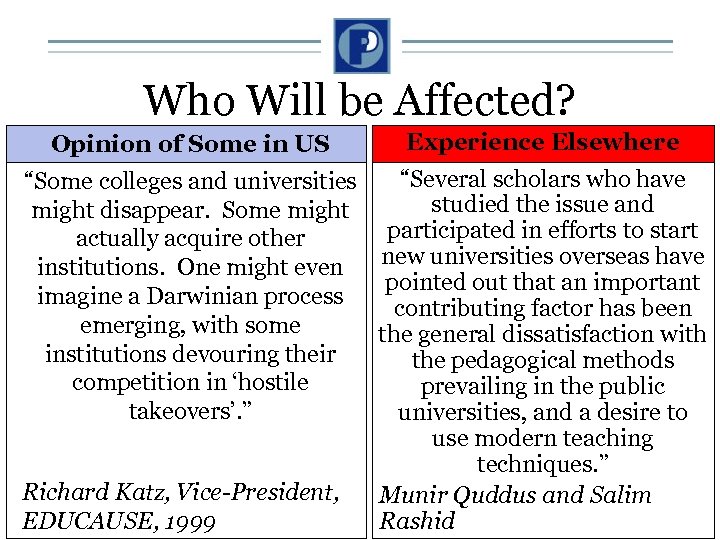
Who Will be Affected? Opinion of Some in US Experience Elsewhere “Several scholars who have “Some colleges and universities studied the issue and might disappear. Some might participated in efforts to start actually acquire other new universities overseas have institutions. One might even pointed out that an important imagine a Darwinian process contributing factor has been emerging, with some the general dissatisfaction with institutions devouring their the pedagogical methods competition in ‘hostile prevailing in the public takeovers’. ” universities, and a desire to use modern teaching techniques. ” Richard Katz, Vice-President, Munir Quddus and Salim EDUCAUSE, 1999 Rashid
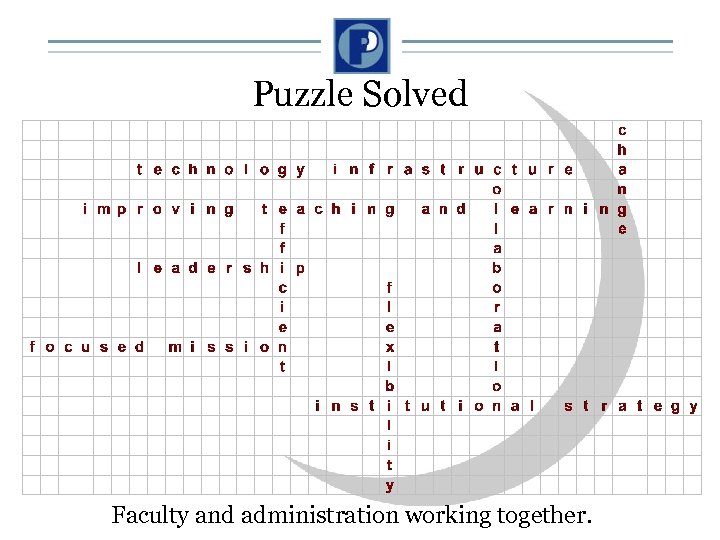
Puzzle Solved Faculty and administration working together.

Focus Groups with Public Agenda Completed: 3 • Legislators (2) • Community College Presidents Planned: 6 • • • Governors Faculty Four-year Presidents Governors’ Policy Aides Higher Ed Commissioners Business Leaders
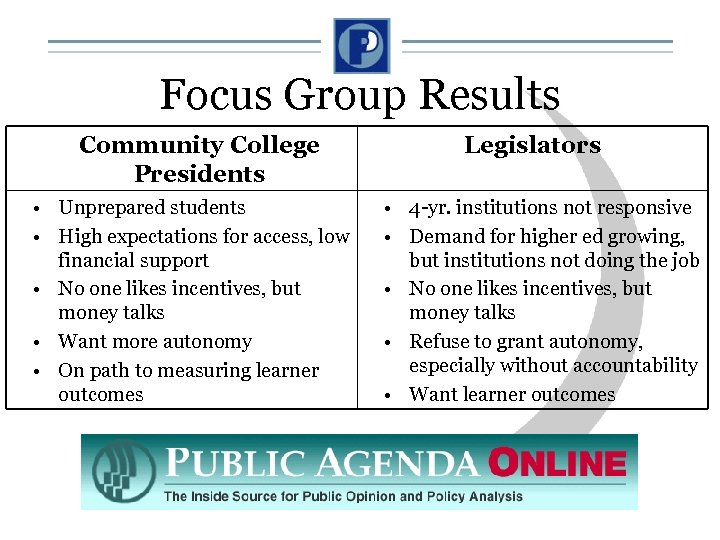
Focus Group Results Community College Presidents • Unprepared students • High expectations for access, low financial support • No one likes incentives, but money talks • Want more autonomy • On path to measuring learner outcomes Legislators • 4 -yr. institutions not responsive • Demand for higher ed growing, but institutions not doing the job • No one likes incentives, but money talks • Refuse to grant autonomy, especially without accountability • Want learner outcomes

We Want to Hear from You www. futuresproject. org 401 -863 -9582
Скачать презентацию The New State Agenda Higher Education as Public
41b9ba3e7a681a88762ea5b131551dbd.ppt