 Скачать презентацию The New SIB under SAFETEA-LU Northern Border Finance
400513e66f20ed94fa0eec853a1e02ea.ppt
- Количество слайдов: 29




The New SIB (under SAFETEA-LU) Northern Border Finance Conference Chicago, May 14 -16 2007 Mr. Prabhat Diksit FHWA Resource Center
State alternatives to grants n States traditionally support local highway projects through grants: n n Sometimes formula grants More often regional/competitive grants for projects. n But credit to local governments (or private sector projects) now provides a creative alternative to grants
State Infrastructure Bank (Sib) n Sibs are revolving funds created by a state using Federal transportation dollars n The revolving fund is used to provide credit assistance (loans, loan guarantees, lines of credit etc) for local transportation projects: n The funds are revolving in that repaid loans go back into the fund for further lending.
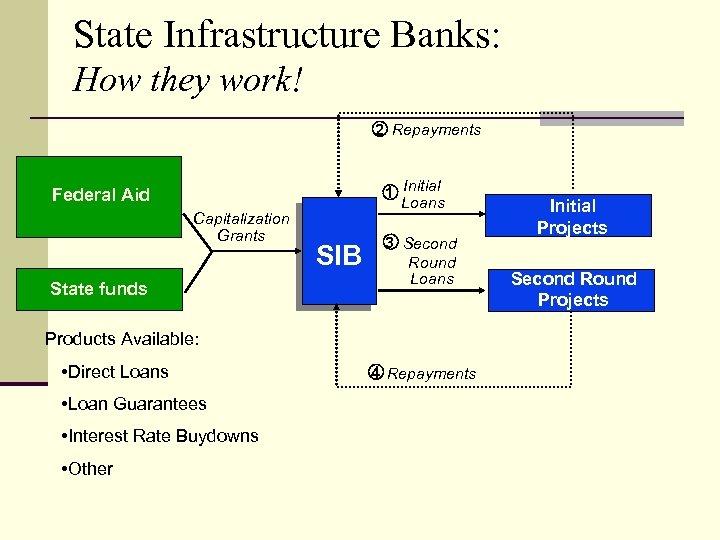
State Infrastructure Banks: How they work! 2 Repayments 1 Initial Loans Federal Aid Capitalization Grants State funds SIB 3 Second Round Loans Products Available: • Direct Loans • Loan Guarantees • Interest Rate Buydowns • Other 4 Repayments Initial Projects Second Round Projects
SIB Mechanics § A state would take Federal monies (say $40 m) from any of an allowed set of funding categories (NHS, STP, IM etc) § provide the local match ($10 m) and thus “capitalize” the SIB. § The funds can then be used for any Title 23 project--- even years down the line § The funds are not limited to the original funding categories drawn from.
Basics! n Obviously, a project owner requesting borrowing needs a means of repaying that borrowing, i. e. a revenue stream dedicated to repayments. n Typical project revenue streams Tolls on road and bridge projects n Pledges of taxes by local governments n n Sales taxes, property taxes, motel taxes, severance taxes etc.
Why should a state provide credit rather than grants for transportation? n Priorities differ: aid to projects of not high enough priority for grant assistance. (Second tier projects) n Allow local govts. to accelerate projects slated for grants in later years of a STIP. n Provide “gap” funding or initial “seed” funding for difficult to finance projects n & toll projects are always “difficult” n Assistance, short of grants, to private sector projects, n Truck stop electrification n Truck parking
State’s reasons to give credit n State encouragement to local govts. to accelerate project on strategic state agenda eg n Local connectors to state highways that enhance tourism or security n Strategic state effort to encourage private investment in transportation. n The option of a credit facility allows a state many alternative ways of supporting transportation besides straightforward grants.
Local govt. reasons for requesting credit n Advance a project not high on state agenda. n Boost economic development via transportation project even if it means borrowing costs. n Leverage borrowed funds to enable public private partnership For example, a state loan may be the only way of starting a toll project important to local mobility or to economic development. n An air quality non-attainment area might want to encourage private sector projects, such as truck stop idling projects that improve emissions. n
Federal Transportation Sibs since 1995 n Federal-Aid Highway (and Transit) dollars have been allowed for the capitalization of Sibs since the NHS Act of 1995. n A new Sib pilot with new rules was allowed with TEA 21 in 1998. n SAFETEA-LU has once again created a new Sib program– with its own governing legislation.
New SAFETEA-LU Sibs (Highway Account) n Program once again opened to all states and most territories. n 10% of major funding categories can be used to capitalize Sibs: n n NHS, STP, Bridge, IM, & Equity Bonus. (Highway account) Title 49, Sec 5307, 5309, 5311 (Transit account) n All rounds of lending have to be for either Title 23, & Title 49 eligible projects, or for surface transportation projects specifically approved by the Secretary.
Other Major Provisions n There is a state match requirement of 25% of Federal capitalization monies. n Separate transit and highway accounts have to be created. n Maximum terms & interest rates are set in legislation Maximum terms of 30 years. Payments to begin no later than 5 years after completion. n Interest rate no higher than market. n
Additional provisions n No grants allowed. n Investment income has to be credited to revolving fund. n Annual reports to Secretary required. n 2% limit on fraction of funds used for administration. n Guidelines on investment of Sib funds n Federal notes, bank deposits etc.
Important point! n Projects receiving Federal assistance, even indirectly via credit assistance, still have to undergo due reviews, and are subject to Federal requirements regarding NEPA, Davis -Bacon, Buy-America etc n With the “new” SAFETEA-LU sibs these reviews apply to all rounds of lending i. e. even to repaid loans lent out again.
Mechanics of Authorization n A cooperative agreement, or an amendment to an existing cooperative agreement , between a state wishing to create a Sib and the Secretary is necessary.
Sib Activity n Some 32 states have created Sibs. n Over 520 loan agreements n $6 b+ in project lending. n But it is fair to say only a few states have used Sibs actively. One state (So. Carolina) has disbursed half the dollar value of total loans n Six states account for 91% of dollar volume of loan disbursements. n
Approaches to Sib lending: Boost economic development! n Price Corridor, Chandler, AZ n Acceleration of 2. 7 miles of Maricopa Freeway important to Chandler economic development. n $26 m short term loan from Sib. Chandler & private developer together pay interest on loan. n Thus, a public private partnership enabled by Sib loan.
Fund HOT lanes/Express lanes n HOT/ Express lanes will become a popular answer to the urban congestion problem. They can be publicly or privately funded, n But may need the initial funding support that a “patient” Sib loan may supply. n n Lee Roy Selmon Reversible Express Lanes in Tampa: $290 m project seeded by $35 m Sib loan @ 3. 5% and subordinated to senior debt. Project would have been difficult to get off of ground without Sib loan.
Structure multimodal deal: n Sib money ideal for multimodal projects: n Once in Sib, Fed-aid funds loose “color” of origin and can be flexed to transit, or freight, or other intermodal projects. n Harrisburg Transportation Center n $2. 9 m rehab funded by $1. 4 m Sib loan & funds from Pen. DOT, Amtrak, Pa Economic Development, Pa Historical Commission.
Freight Finance n Intermodal freight projects, including private sector ones, have been financed with Sib loans: n Stark County intermodal Facility, OH n n n Transfer yard where truck trailers & containers are loaded onto railcars. $32 m project-- $7 m Sib loan; $25 m private sector. Wellsville intermodal facility, OH n A $5. 2 m local port authority project financed by a 3% $2. 1 m short term Sib construction loan.
Funding debt service reserve n Puerto Rico used $15 m from SIB to provide the debt service reserve on a $75 m revenue bond issuance. n Missouri’s Sib provided $1. 2 m loan to Springfield for debt service reserve on a $33 m revenue bond issuance. n The lifting of this requirement of a years payments as debt service reserve, allows for a smaller bond issuance; and permits a slightly lower rate on bonds. n The FTA recently began a pilot program to allow up to ten recipients the use of 5307 grant money for the funding of debt service reserves.
Use Sib to encourage investments in strategic assets. n Maine uses its Sib to encourage investments in state collector roads n Qualified loans are for ten year terms and are interest free. A local match of 25% is required. n Other states look to Sib loans to enhance local roadway access to state tourist spots. n Sibs can be used to lend to CMAQ projects, such as diesel engine retrofits & truck stop idle reduction– an approach encouraged by the EPA.
Boosting Sib Power: Revenues enhance! n A dedicated revenue base ( vs occasional additions to Sib capital ) enhances Sib power. n The stability afforded by dedicated funds, leads to a mature program that can be an important part of transportation funding in the state. n So. Carolina with truck registration fees and a ¼ c gas tax dedicated to the Sib has the largest volume of Sib lending in the country.
Bonding Multiplies! n Issuing a bond can greatly expand monies available for disbursement: Example: $50 m annual revenue stream supports a $700 -800 m bond at 4%, 20 yrs. n Four state SIBs have issued bonds: n n n So. Carolina($1. 2 b). MN, FL, OH 10 states have legislative authorization to do so. Kansas has created its own state revolving fund for transportation, without any Federal money-- thus avoiding Federal requirements.
Approaches to bonding n 1. South Carolina issued revenue bonds against annual gas taxes, registration fees. n 2. MN against block SIB capitalizations from state and Federal funds ($58 m cap. vs. $110 m revenue bond issuance) n 3. Next Level: Fl & OH have issued bonds against repayment streams from previously issued loans. OH uses repayment stream monies to issue bonds on demand by local borrowers. n This can be done with an established and mature program, but requires skilful management.
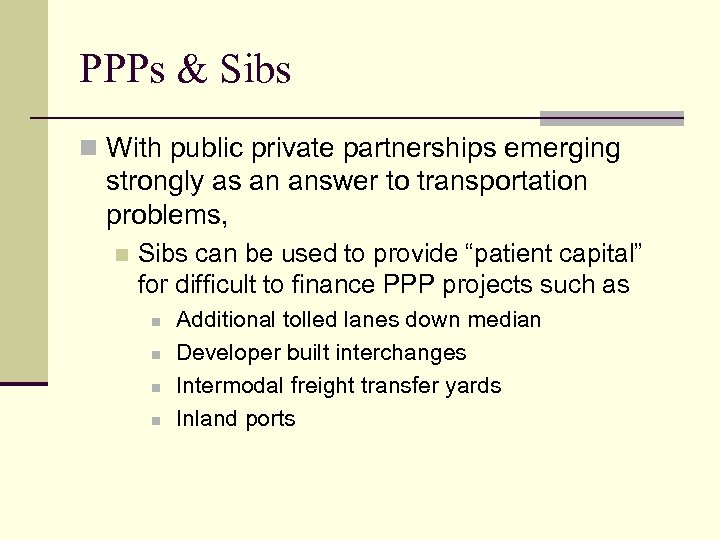
PPPs & Sibs n With public private partnerships emerging strongly as an answer to transportation problems, n Sibs can be used to provide “patient capital” for difficult to finance PPP projects such as n n Additional tolled lanes down median Developer built interchanges Intermodal freight transfer yards Inland ports
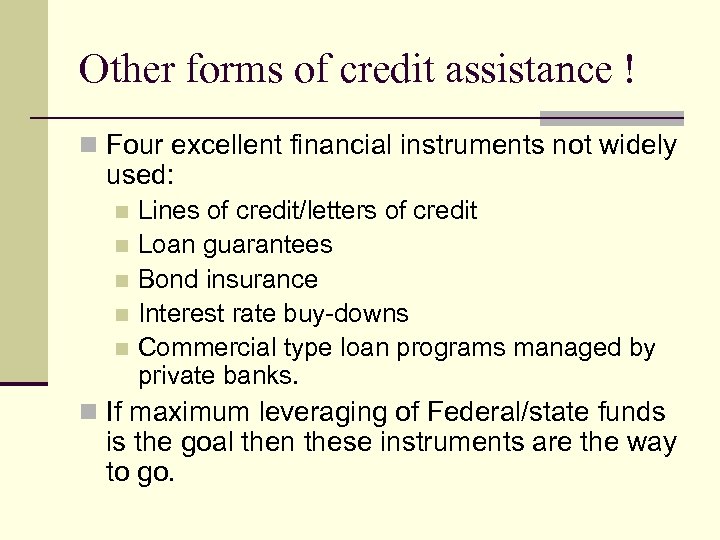
Other forms of credit assistance ! n Four excellent financial instruments not widely used: Lines of credit/letters of credit n Loan guarantees n Bond insurance n Interest rate buy-downs n Commercial type loan programs managed by private banks. n n If maximum leveraging of Federal/state funds is the goal then these instruments are the way to go.
In conclusion, n The new SAFETEA-LU bill provides a great opportunity for all states and territories to use Fed-Aid funds to establish Sibs. n Sibs provide a creative and underexploited alternative to grant assistance for local transportation projects.
For additional info: The FHWA Sib website http: //www. fhwa. dot. gov/innovativefinance/sib. htm The innnovativefinance. org web site http: //www. innovativefinance. org/ Or: Prabhat A Diksit Innovative Finance Specialist FHWA Resource Center Prabhat. diksit@fhwa. dot. gov 720 -963 -3202
Скачать презентацию The New SIB under SAFETEA-LU Northern Border Finance
400513e66f20ed94fa0eec853a1e02ea.ppt