


 Скачать презентацию THE NEW FRONTIER AND THE GREAT SOCIETY KENNEDY
692a6ff8708adfb820c4be9f26c09c38.ppt
- Количество слайдов: 42
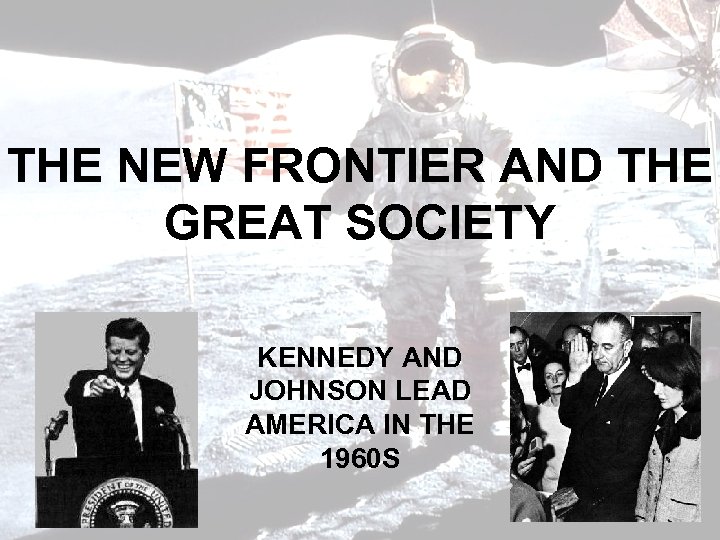 THE NEW FRONTIER AND THE GREAT SOCIETY KENNEDY AND JOHNSON LEAD AMERICA IN THE 1960 S
 Key Terms • • • John F. Kennedy BAY OF PIGS THE CUBAN MISSILE CRISIS Blockade Berlin Wall hot line The New Frontier Peace Corps RACE TO THE MOON • • Lyndon Baines Johnson The Great Society” CIVIL RIGHTS ACT OF 1964 VOTING RIGHTS ACT 1965 THE WAR ON POVERTY Economic Opportunity Act 1964 Secondary Education Act Medicare and Medicaid HUD Water Quality Act of 1965 The Immigration Act of 1965 CONSUMER PROTECTION Feminism NOW Title IX Equal Rights Amendment Roe v. Wade (1973) AIM Gray Panthers UFW Cesar Chavez Nixon EPA Watergate Impeachment
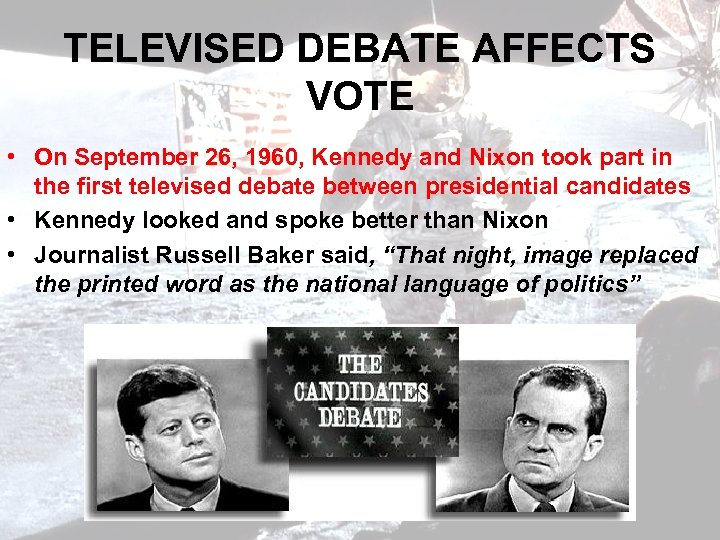 TELEVISED DEBATE AFFECTS VOTE • On September 26, 1960, Kennedy and Nixon took part in the first televised debate between presidential candidates • Kennedy looked and spoke better than Nixon • Journalist Russell Baker said, “That night, image replaced the printed word as the national language of politics”
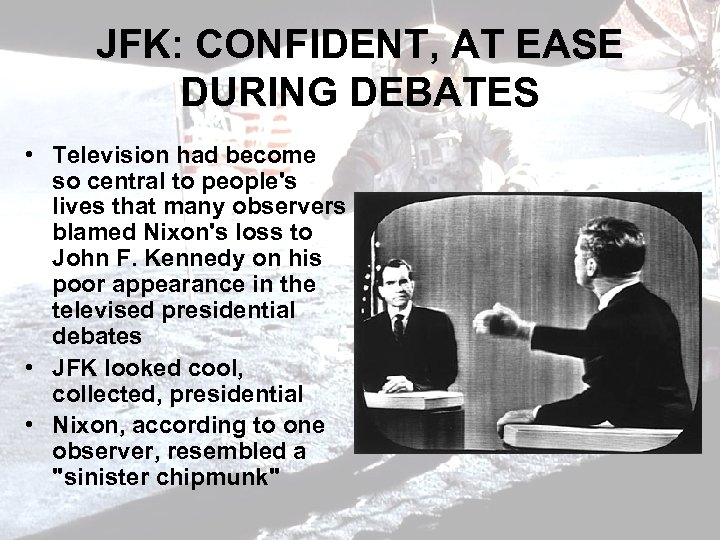 JFK: CONFIDENT, AT EASE DURING DEBATES • Television had become so central to people's lives that many observers blamed Nixon's loss to John F. Kennedy on his poor appearance in the televised presidential debates • JFK looked cool, collected, presidential • Nixon, according to one observer, resembled a "sinister chipmunk"
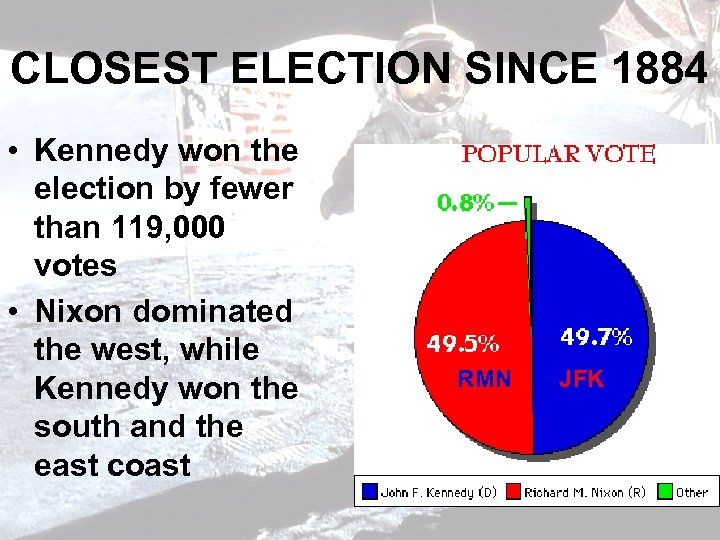 CLOSEST ELECTION SINCE 1884 • Kennedy won the election by fewer than 119, 000 votes • Nixon dominated the west, while Kennedy won the south and the east coast RMN JFK
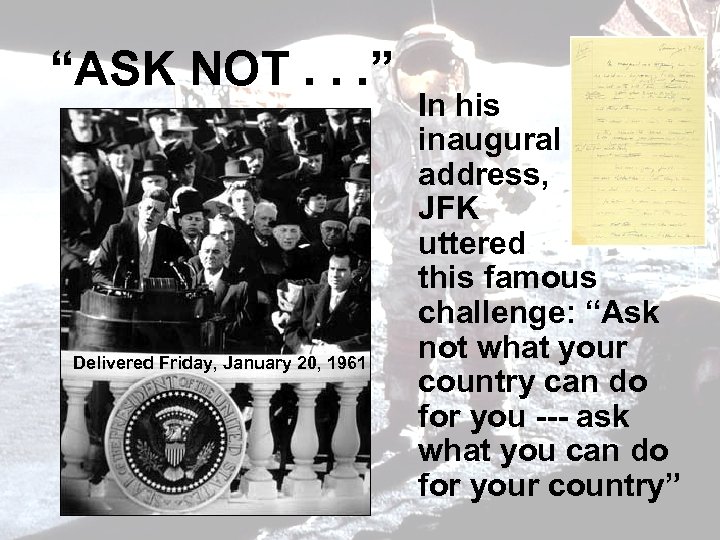 “ASK NOT. . . ” Delivered Friday, January 20, 1961 In his inaugural address, JFK uttered this famous challenge: “Ask not what your country can do for you --- ask what you can do for your country”
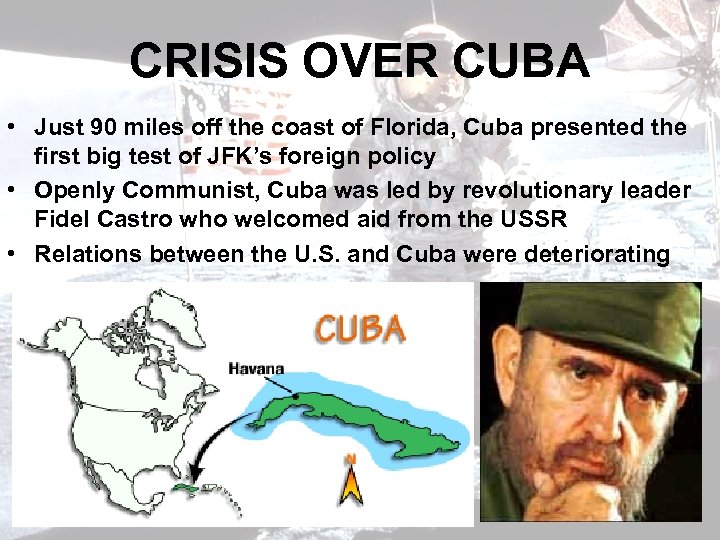 CRISIS OVER CUBA • Just 90 miles off the coast of Florida, Cuba presented the first big test of JFK’s foreign policy • Openly Communist, Cuba was led by revolutionary leader Fidel Castro who welcomed aid from the USSR • Relations between the U. S. and Cuba were deteriorating
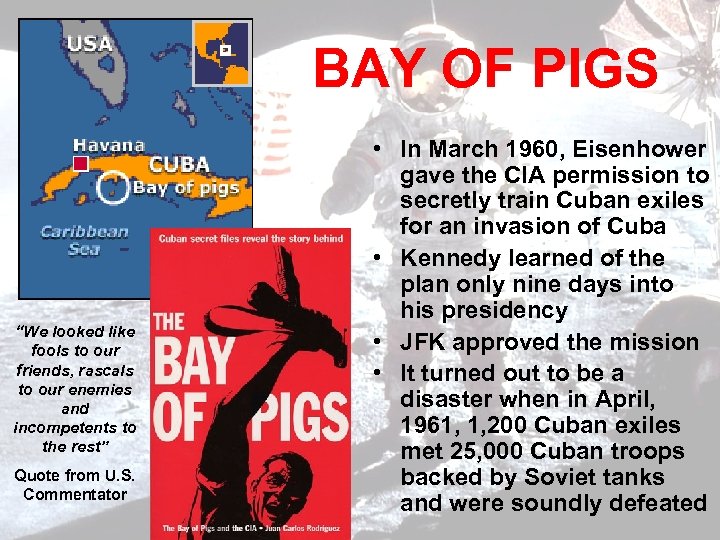 BAY OF PIGS “We looked like fools to our friends, rascals to our enemies and incompetents to the rest” Quote from U. S. Commentator • In March 1960, Eisenhower gave the CIA permission to secretly train Cuban exiles for an invasion of Cuba • Kennedy learned of the plan only nine days into his presidency • JFK approved the mission • It turned out to be a disaster when in April, 1961, 1, 200 Cuban exiles met 25, 000 Cuban troops backed by Soviet tanks and were soundly defeated
 Check for Understanding President John F. Kennedy supported the 1961 Bay of Pigs invasion of Cuba as an effort to a. remove a communist dictator from power b. stop the flow of illegal drugs to the United States c. support Fidel Castro’s efforts for reform d. rescue hostages held by Cuban freedom fighters
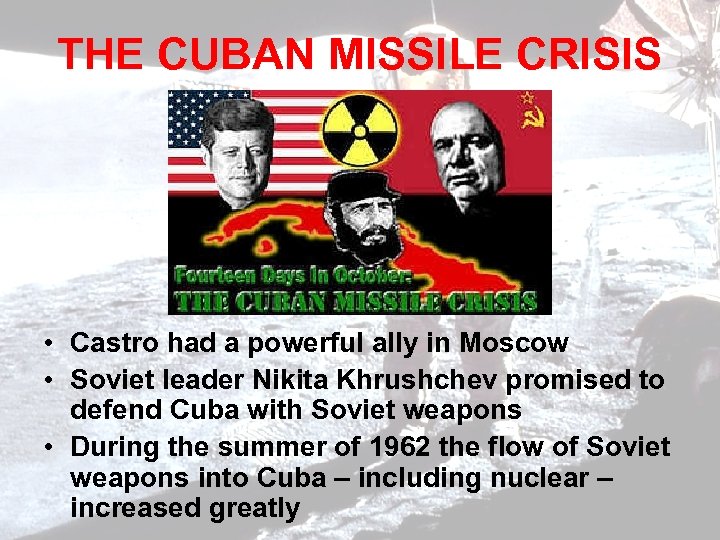 THE CUBAN MISSILE CRISIS • Castro had a powerful ally in Moscow • Soviet leader Nikita Khrushchev promised to defend Cuba with Soviet weapons • During the summer of 1962 the flow of Soviet weapons into Cuba – including nuclear – increased greatly
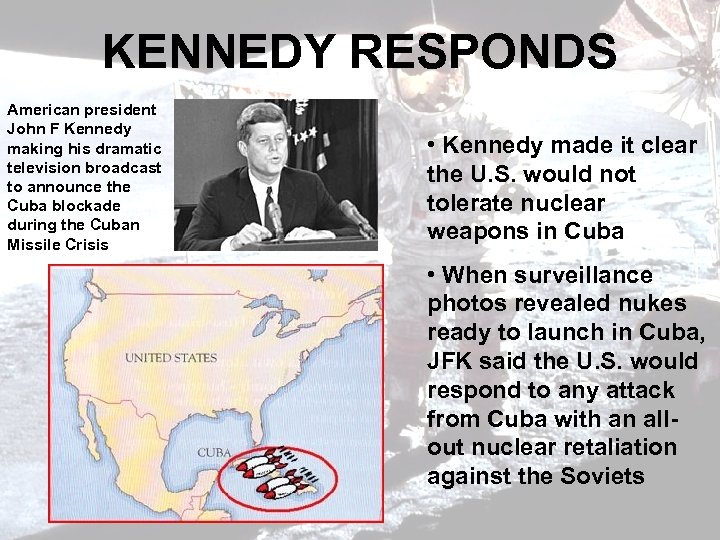 KENNEDY RESPONDS American president John F Kennedy making his dramatic television broadcast to announce the Cuba blockade during the Cuban Missile Crisis • Kennedy made it clear the U. S. would not tolerate nuclear weapons in Cuba • When surveillance photos revealed nukes ready to launch in Cuba, JFK said the U. S. would respond to any attack from Cuba with an allout nuclear retaliation against the Soviets
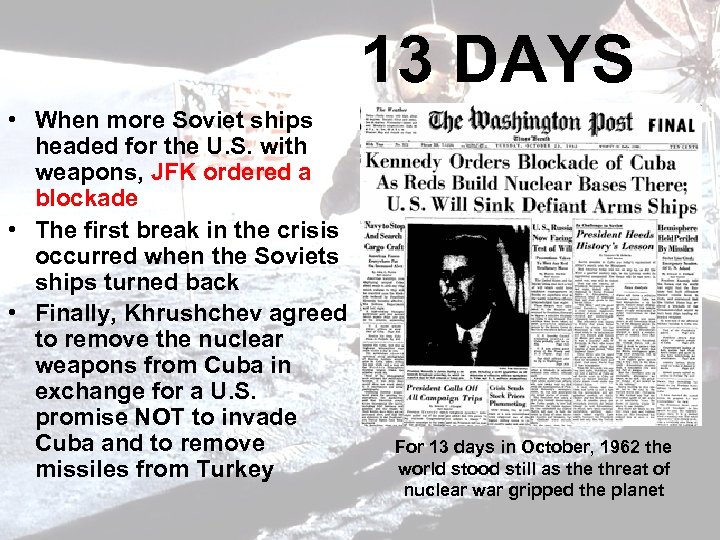 13 DAYS • When more Soviet ships headed for the U. S. with weapons, JFK ordered a blockade • The first break in the crisis occurred when the Soviets ships turned back • Finally, Khrushchev agreed to remove the nuclear weapons from Cuba in exchange for a U. S. promise NOT to invade Cuba and to remove missiles from Turkey For 13 days in October, 1962 the world stood still as the threat of nuclear war gripped the planet
 Check for understanding The Cuban missile crisis ended when A) the United States invaded Cuba and overthrew Batista. B) the Soviets agreed to withdraw their missiles in exchange for Kennedy's pledge not to invade Cuba and his agreement to withdraw U. S. missiles from Turkey. C) Khruschev agreed to end the blockade of Berlin. D) the United States threatened to impose a strict embargo on all Cuban exports. E) None of the answers are correct.
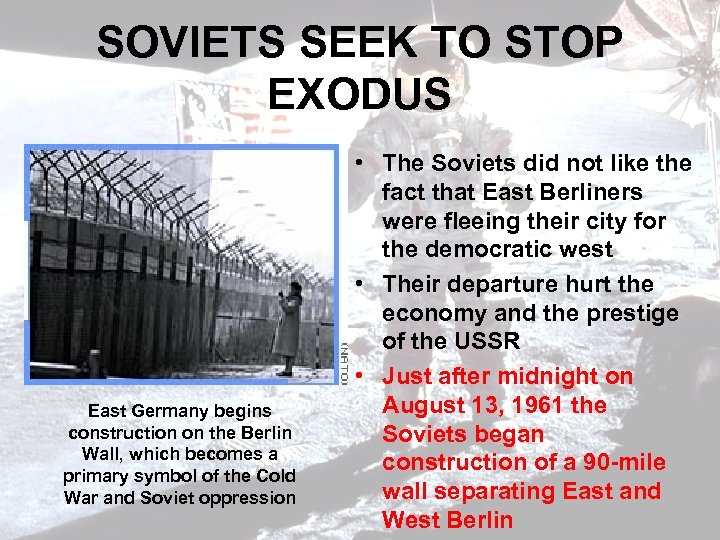 SOVIETS SEEK TO STOP EXODUS East Germany begins construction on the Berlin Wall, which becomes a primary symbol of the Cold War and Soviet oppression • The Soviets did not like the fact that East Berliners were fleeing their city for the democratic west • Their departure hurt the economy and the prestige of the USSR • Just after midnight on August 13, 1961 the Soviets began construction of a 90 -mile wall separating East and West Berlin
 EASING TENSIONS • Both Khrushchev and Kennedy began searching for ways to ease the enormous tension between the two superpowers • As a result of the Cuban Missile Crisis in 1963 they established a hot line between the White House and the Kremlin • Later that year, the superpowers signed a Limited Test Ban Treaty that served to ban nuclear testing in the atmosphere
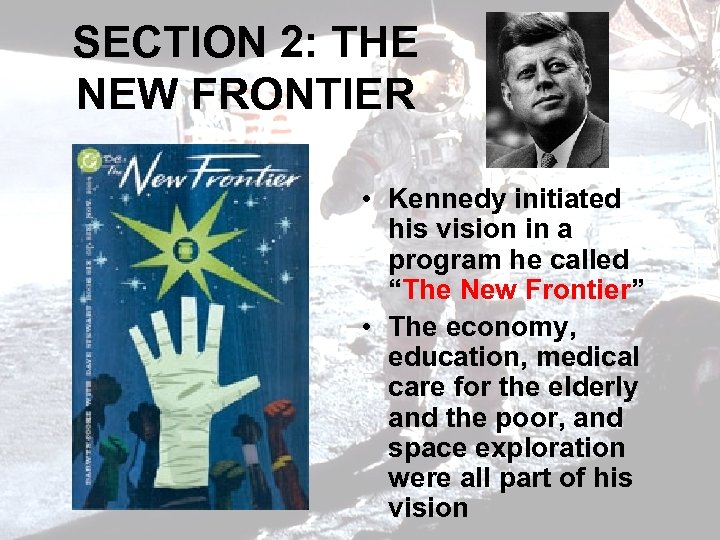 SECTION 2: THE NEW FRONTIER • Kennedy initiated his vision in a program he called “The New Frontier” • The economy, education, medical care for the elderly and the poor, and space exploration were all part of his vision
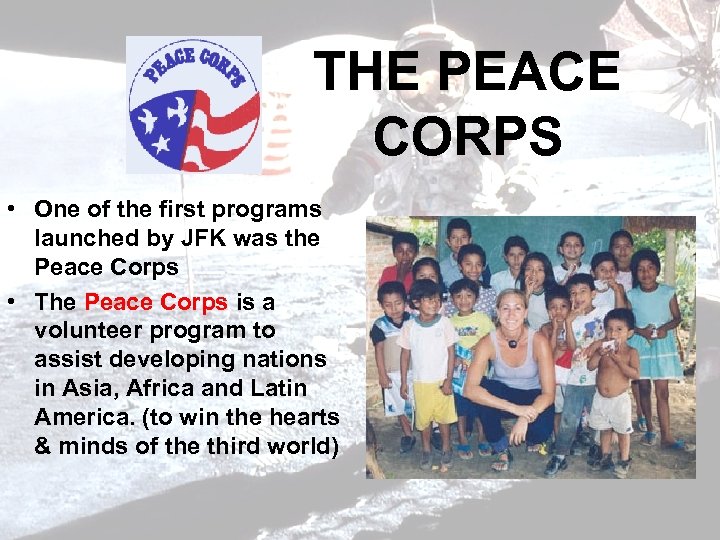 THE PEACE CORPS • One of the first programs launched by JFK was the Peace Corps • The Peace Corps is a volunteer program to assist developing nations in Asia, Africa and Latin America. (to win the hearts & minds of the third world)
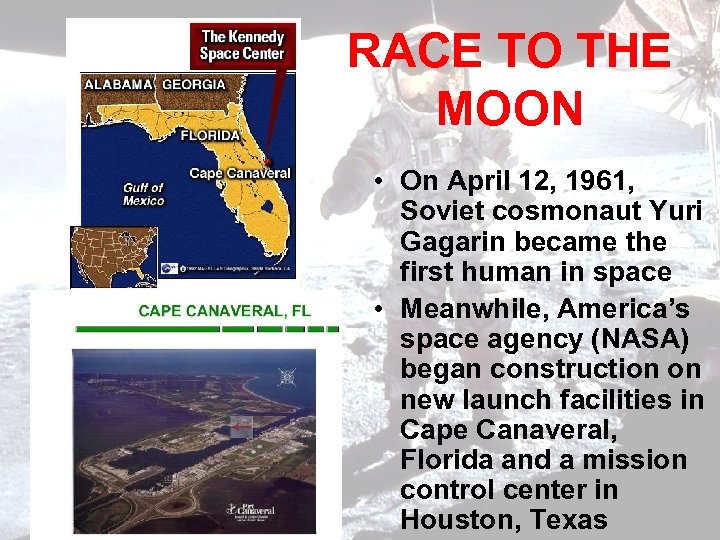 RACE TO THE MOON • On April 12, 1961, Soviet cosmonaut Yuri Gagarin became the first human in space • Meanwhile, America’s space agency (NASA) began construction on new launch facilities in Cape Canaveral, Florida and a mission control center in Houston, Texas
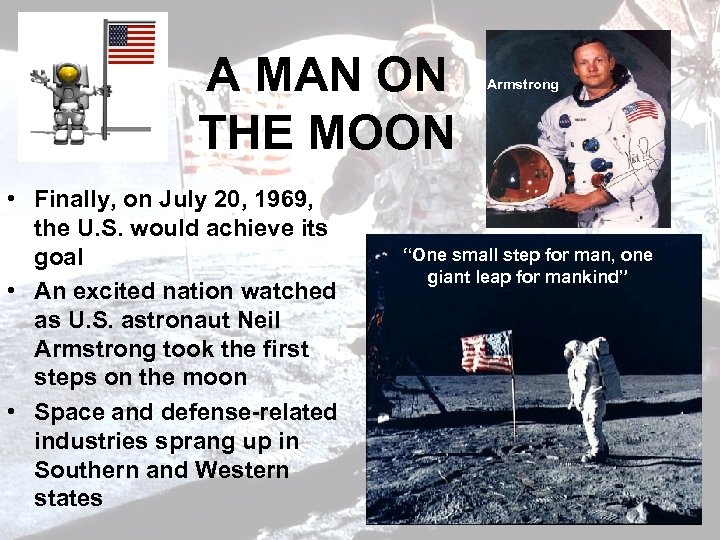 A MAN ON THE MOON • Finally, on July 20, 1969, the U. S. would achieve its goal • An excited nation watched as U. S. astronaut Neil Armstrong took the first steps on the moon • Space and defense-related industries sprang up in Southern and Western states Armstrong “One small step for man, one giant leap for mankind”
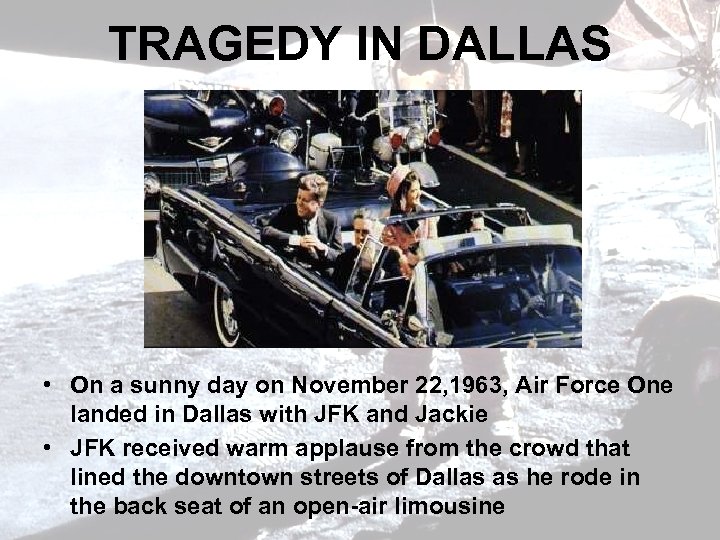 TRAGEDY IN DALLAS • On a sunny day on November 22, 1963, Air Force One landed in Dallas with JFK and Jackie • JFK received warm applause from the crowd that lined the downtown streets of Dallas as he rode in the back seat of an open-air limousine
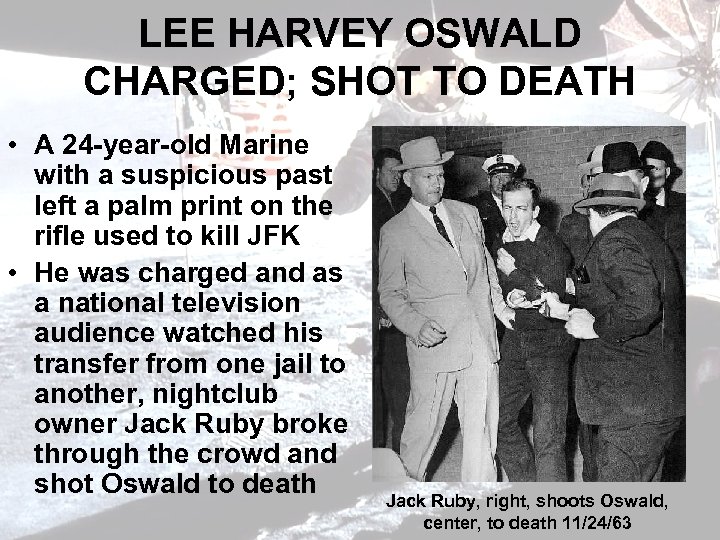 LEE HARVEY OSWALD CHARGED; SHOT TO DEATH • A 24 -year-old Marine with a suspicious past left a palm print on the rifle used to kill JFK • He was charged and as a national television audience watched his transfer from one jail to another, nightclub owner Jack Ruby broke through the crowd and shot Oswald to death Jack Ruby, right, shoots Oswald, center, to death 11/24/63
 Check for understanding • The Peace Corps was established by President John F. Kennedy in an effort to provide • a. support to developing nations of the world • b. job training for the unemployed • c. markets for consumer goods • d. teachers for inner-city areas
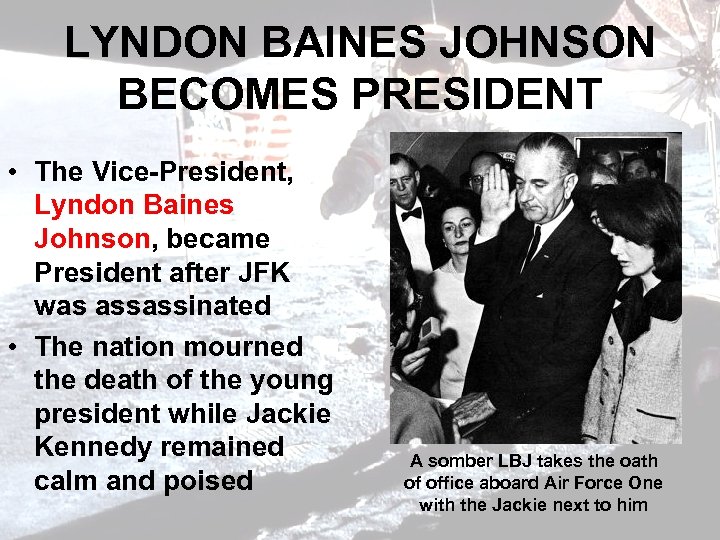 LYNDON BAINES JOHNSON BECOMES PRESIDENT • The Vice-President, Lyndon Baines Johnson, became President after JFK was assassinated • The nation mourned the death of the young president while Jackie Kennedy remained calm and poised A somber LBJ takes the oath of office aboard Air Force One with the Jackie next to him
 JOHNSON’S DOMESTIC AGENDA • As soon as Johnson took office, he urged Congress to pass the tax-cut bill that Kennedy had sent to Capital Hill • The tax cut passed and $10 billion in cuts took effect
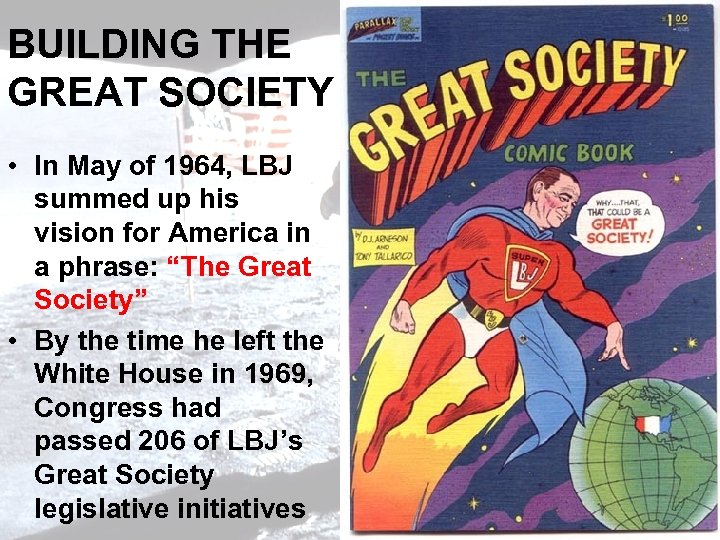 BUILDING THE GREAT SOCIETY • In May of 1964, LBJ summed up his vision for America in a phrase: “The Great Society” • By the time he left the White House in 1969, Congress had passed 206 of LBJ’s Great Society legislative initiatives
 CIVIL RIGHTS ACT OF 1964 • In July of 1964, LBJ pushed the Civil Rights Act through Congress • The Act prohibited discrimination based on race, color, religion or national origin, and granted the federal government new powers to enforce the law • VOTING RIGHTS ACT 1965 • Part of the Civil Rights Act was to insure voting rights for all Americans • The act prohibited literacy tests or other discriminatory practices for voting • The act insured consistent election practices
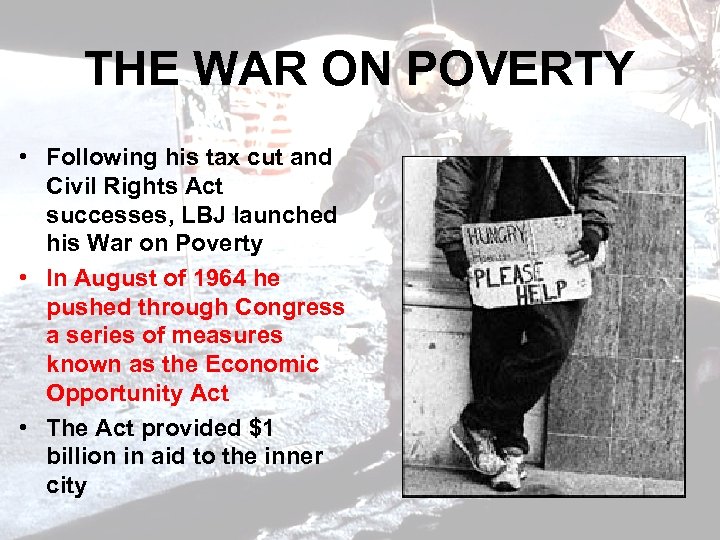 THE WAR ON POVERTY • Following his tax cut and Civil Rights Act successes, LBJ launched his War on Poverty • In August of 1964 he pushed through Congress a series of measures known as the Economic Opportunity Act • The Act provided $1 billion in aid to the inner city
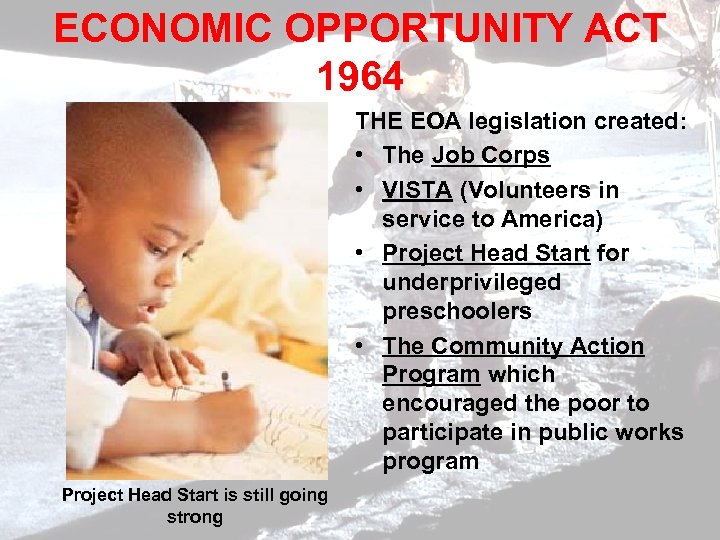 ECONOMIC OPPORTUNITY ACT 1964 THE EOA legislation created: • The Job Corps • VISTA (Volunteers in service to America) • Project Head Start for underprivileged preschoolers • The Community Action Program which encouraged the poor to participate in public works program Project Head Start is still going strong
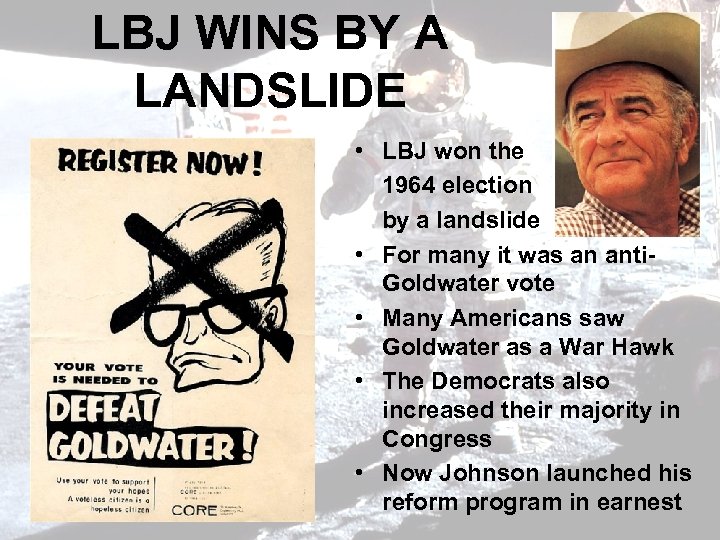 LBJ WINS BY A LANDSLIDE • LBJ won the 1964 election by a landslide • For many it was an anti. Goldwater vote • Many Americans saw Goldwater as a War Hawk • The Democrats also increased their majority in Congress • Now Johnson launched his reform program in earnest
 EDUCATION • Johnson considered education “the key which can unlock the door to the Great Society” • The Elementary and Secondary Education Act provided $1 billion to help public schools buy textbooks and library materials • This Act represented the first major federal aid package for education ever
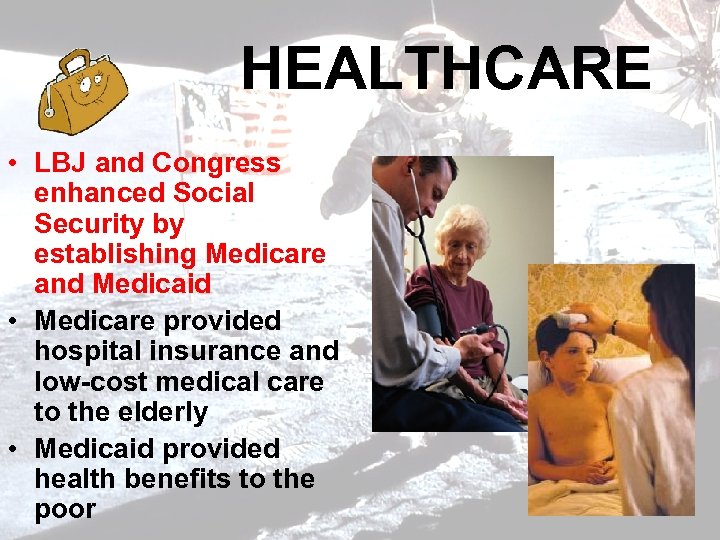 HEALTHCARE • LBJ and Congress enhanced Social Security by establishing Medicare and Medicaid • Medicare provided hospital insurance and low-cost medical care to the elderly • Medicaid provided health benefits to the poor
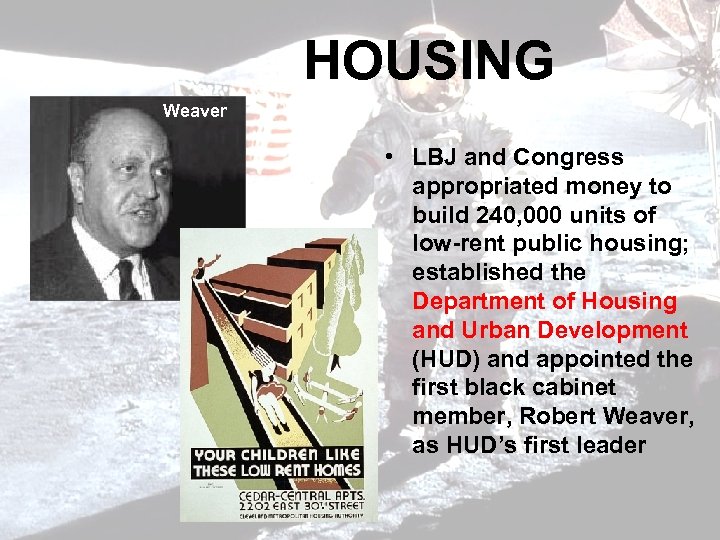 HOUSING Weaver • LBJ and Congress appropriated money to build 240, 000 units of low-rent public housing; established the Department of Housing and Urban Development (HUD) and appointed the first black cabinet member, Robert Weaver, as HUD’s first leader
 THE ENVIRONMENT • LBJ also actively sought to improve the environment • The Water Quality Act of 1965 required states to clean up their rivers and lakes IMMIGRATION REFORM • The Great Society also brought reform to immigration laws • The Natural Origins Acts of the 1920 s strongly discriminated against immigration by those outside of Western Europe • The Immigration Act of 1965 opened the door for many non-European immigrants to settle in the U. S.
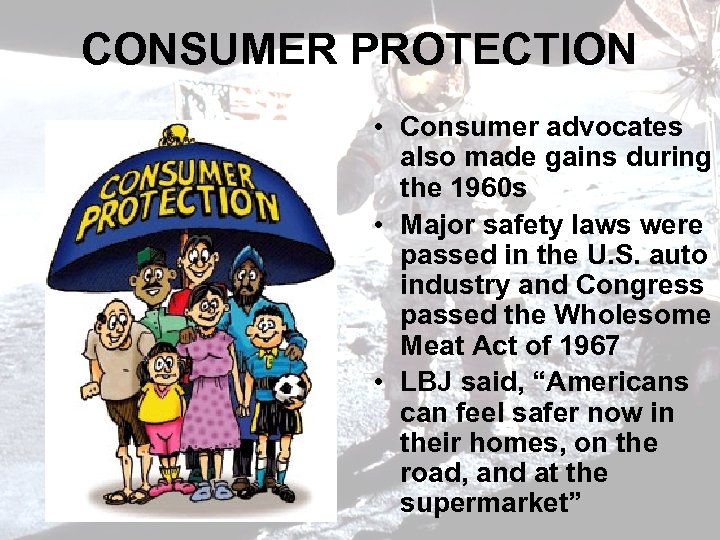 CONSUMER PROTECTION • Consumer advocates also made gains during the 1960 s • Major safety laws were passed in the U. S. auto industry and Congress passed the Wholesome Meat Act of 1967 • LBJ said, “Americans can feel safer now in their homes, on the road, and at the supermarket”
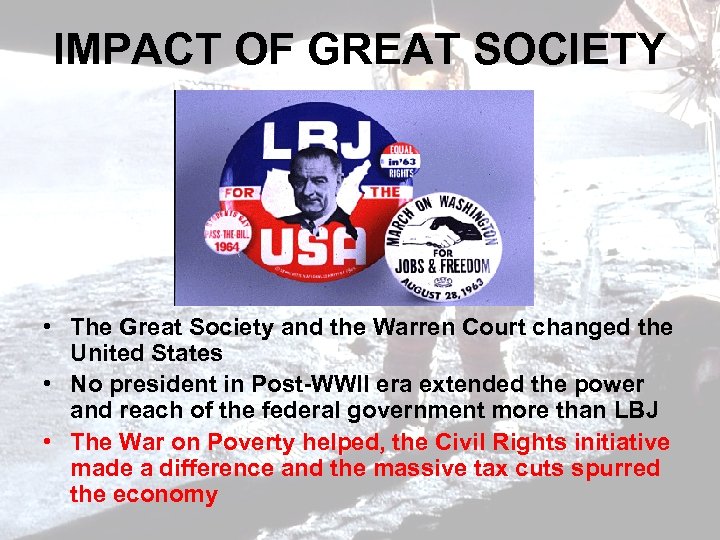 IMPACT OF GREAT SOCIETY • The Great Society and the Warren Court changed the United States • No president in Post-WWII era extended the power and reach of the federal government more than LBJ • The War on Poverty helped, the Civil Rights initiative made a difference and the massive tax cuts spurred the economy
 Check for understanding: The Great Society of Lyndon Johnson is most similar to which other Presidential program? a. Warren Harding’s Return to Normalcy b. Franklin D. Roosevelt’s New Deal c. Ronald Reagan’s New Federalism d. George Bush’s Thousand Points of Light
 Women’s Rights Movement Feminism of the 1960 s and early 1970 s To challenge the cult of domesticity. National Organization for Women (NOW-1966) Goals: to end job discrimination, legalize abortion, obtain federal and state support for child-care center. Title IX of the Educational Amendments Act of 1972 (gender equity) Support for the Equal Rights Amendment (ERA) (1972) Equal Rights Amendment was to provide for the legal equality of the sexes and prohibit discrimination on the basis of sex. (was never ratified) Roe v. Wade (1973) Legalized abortion
 AIM American Indian Movement (AIM) American Indian Movement, (AIM), militant American Indian civil rights organization, founded in Minneapolis, Minn. , in 1968. AIM was involved in many highly publicized protests. It was one of the Indian groups involved in the occupation (1969– 71) of Alcatraz Island, the march (1972) on Washington, D. C. , to protest violation of treaties (in which AIM members occupied the office of the Bureau of Indian Affairs), and the takeover (1973) of a site at Wounded Knee to protest the government’s Indian policy.
 Gray Panthers & UFW Gray Panthers: Founded in 1970 by Margaret E. "Maggie" Kuhn. The Gray Panthers is a national organization dedicated to social justice for old and young people alike. However, the Gray Panthers is best known for work on behalf of older persons. It has lobbied and litigated against Age Discrimination in the areas of retirement, housing, and health care. United Farm Workers (UFW): The United Farm Workers of America (UFW) began in 1962 as a coalition of poorly paid migrant farm workers and grew into a powerful Labor Union that has consistently fought to increase wages and improve working conditions for its members. Cesar Chavez was an American farm worker, labor leader and civil rights activist, who, with Dolores Huerta, co-founded the National Farm Workers Association (later the United Farm Workers union, UFW).
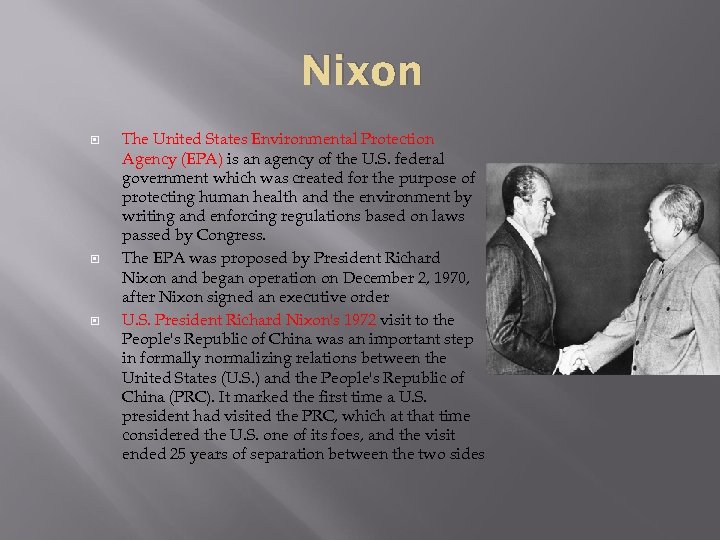 Nixon The United States Environmental Protection Agency (EPA) is an agency of the U. S. federal government which was created for the purpose of protecting human health and the environment by writing and enforcing regulations based on laws passed by Congress. The EPA was proposed by President Richard Nixon and began operation on December 2, 1970, after Nixon signed an executive order U. S. President Richard Nixon's 1972 visit to the People's Republic of China was an important step in formally normalizing relations between the United States (U. S. ) and the People's Republic of China (PRC). It marked the first time a U. S. president had visited the PRC, which at that time considered the U. S. one of its foes, and the visit ended 25 years of separation between the two sides
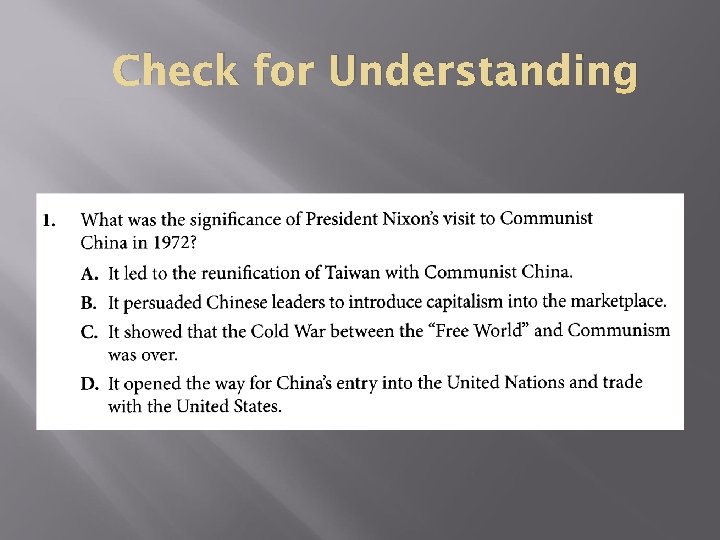 Check for Understanding
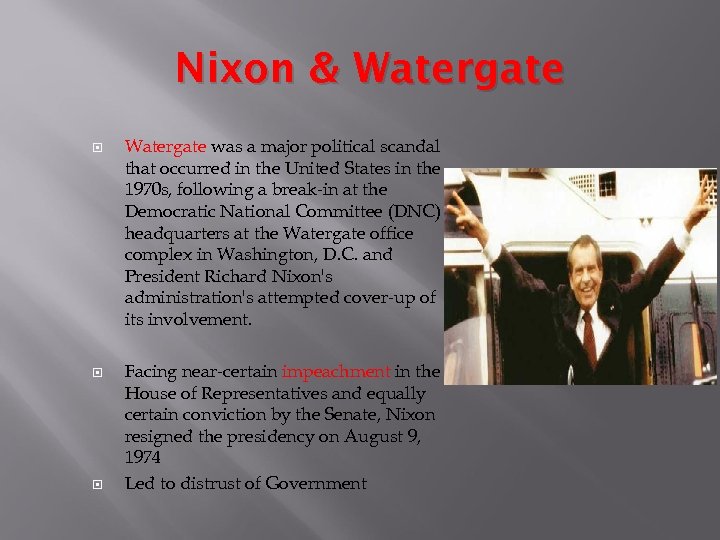 Nixon & Watergate was a major political scandal that occurred in the United States in the 1970 s, following a break-in at the Democratic National Committee (DNC) headquarters at the Watergate office complex in Washington, D. C. and President Richard Nixon's administration's attempted cover-up of its involvement. Facing near-certain impeachment in the House of Representatives and equally certain conviction by the Senate, Nixon resigned the presidency on August 9, 1974 Led to distrust of Government